Self-Evolving Agents through Privileged Retrospective Distillation
Abstract: Self-evolving agents aim to improve from their own experience rather than remain fixed after deployment, but naturally collected trajectories often lack ground-truth solutions or verifier-derived rewards. We introduce Retrospective Self-Distillation (RSD), a multi-round framework that turns such experience into dense supervision using privileged retrospective context. For each on-policy trajectory, the same underlying model acts as both student and teacher: the teacher re-scores the student's realized actions while conditioning on cross-task precedents and lessons, together with turn-level reflection and future hindsight from the completed trajectory. The resulting teacher distribution is distilled back into the policy through on-policy self-distillation. Across rounds, the experience bank grows and the retrospective context is refreshed, allowing the model, its data, and its supervision to co-evolve. We further introduce frontier-guided context-policy evolution, where a stronger frontier model proposes constrained edits to how privileged context is constructed. Across ALFWorld, ScienceWorld, and SearchQA with Qwen3-8B and Qwen3-14B, RSD improves performance by up to 59.7% relative to the base model, while frontier-guided context-policy evolution adds up to a further 44.7% relative improvement over a fixed context policy. These results show that naturally accumulated experience can be converted into persistent model capability without ground-truth trajectories or verifier-derived rewards for the core policy update.
Paper Prompts
Sign up for free to create and run prompts on this paper.
Top Community Prompts
Explain it Like I'm 14
1. What is this paper about?
This paper studies how AI agents can improve by learning from their own experiences.
An AI agent is a computer program powered by a LLM. It can take actions, receive responses from an environment, and try to complete tasks—for example:
- finding an object in a virtual house,
- solving a science experiment,
- answering a question using online search.
Usually, an agent stays mostly the same after it is released. The researchers ask whether it can instead become better by studying what happened during its previous attempts—even when nobody gives it the correct answer or a numerical reward.
They introduce a method called Retrospective Self-Distillation, or RSD.
2. What questions are the researchers asking?
The main question is:
How can an AI agent learn from its own experiences when there is no perfect example showing the correct actions?
More specifically, the researchers want to know:
- Can an agent learn from both its successful and unsuccessful attempts?
- Can it use information discovered after an action to understand whether that action was useful?
- Can the agent turn this understanding into a lasting improvement in its language-model “brain”?
- Can a stronger AI help decide which kinds of past information are most useful for teaching the agent?
The challenge is that, while acting, the agent does not know what will happen next. After the task ends, however, it can look back and see the consequences of its earlier choices. This is similar to a student reviewing a test after seeing which answers led to mistakes.
3. How does the method work?
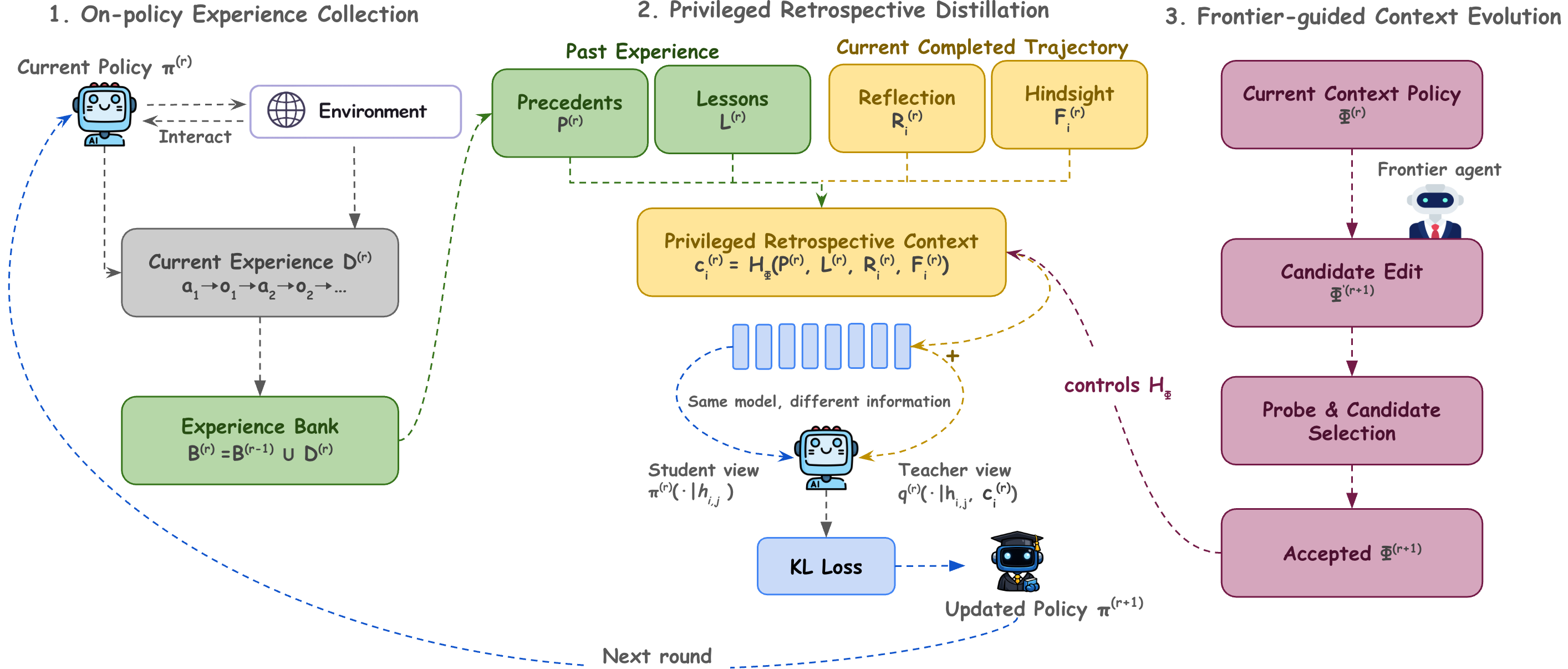
The basic learning cycle
The method repeats the following steps:
- The current AI agent tries a group of tasks.
- The researchers save what happened, including successes and failures.
- The agent looks back at these experiences and creates useful advice.
- The same model acts as a “teacher” and judges the actions it previously took.
- The model learns from this teacher-like judgment.
- The improved model tries new tasks in the next round.
This creates a continuing cycle:
Act → remember → reflect → learn → act better
The researchers call this a data flywheel because each round creates new experience that helps produce better learning in the next round.
What information does the teacher use?
For every decision made during a task, the teacher receives extra information that was not available when the original decision was made. This extra information is called privileged context.
It has four main parts:
| Part | Simple meaning |
|---|---|
| Precedents | Examples of similar tasks from the past |
| Lessons | General advice about what usually works or fails |
| Reflection | An explanation of what could have been done better |
| Future hindsight | Information about what happened after the decision |
For example, imagine an agent trying to make tea in a virtual kitchen. At one point, it chooses a cup. Later, it discovers that the cup was in the wrong place and the task failed. When looking back, the agent can use the later information to judge that earlier choice.
The teacher then gives higher probability to actions it now considers better and lower probability to actions it considers worse. The original model, called the student, is trained to imitate these improved judgments.
What does “distillation” mean?
Distillation is like having a student learn from a teacher’s explanation.
Here, the teacher and student are actually the same underlying AI model:
- The student sees only the information available at the time of acting.
- The teacher sees that information plus the extra information discovered afterward.
The student is trained to copy the teacher’s better-informed choices. Importantly, the teacher does not need to create a completely new solution. It mainly re-evaluates the actions the agent already took.
Frontier-guided context evolution
The paper also tests a more advanced version. A stronger “frontier” model is allowed to change the way information is organized for the teacher.
For example, it can decide:
- how many past examples to show,
- whether to emphasize failures or successes,
- whether reflections or future information should be included,
- where this information should appear in the teacher’s prompt.
The researchers test these possible changes and keep them only when they improve the agent’s performance. This is like having a coach improve not only the player, but also the training program.
4. What did the researchers find?
The researchers tested RSD on three types of tasks:
- ALFWorld: completing household tasks in a virtual environment,
- ScienceWorld: carrying out science-related tasks,
- SearchQA: answering questions using search.
They used two versions of the Qwen3 LLM, with 8 billion and 14 billion parameters.
Overall results
RSD improved the agents compared with their original versions. The paper reports improvements of up to 59.7% relative to the base model.
The strongest improvements appeared on ALFWorld and ScienceWorld. For example:
- On ALFWorld with the 8-billion-parameter model, performance rose from 62.9% to 76.6%.
- On ScienceWorld with the same model, performance rose from 15.6% to 23.4%.
The method was also competitive with approaches that use stronger types of supervision, such as correct example solutions or explicit rewards.
SearchQA showed a much smaller improvement. Its results stayed within a narrow range. This suggests that some tasks are easier for the method to improve than others.
Failures were useful too
A major finding is that the agent did not need to learn only from successful attempts.
Failed attempts also provided useful information because they showed:
- which actions caused problems,
- which mistakes happened repeatedly,
- what should be avoided in the future.
The researchers found that using both successful and failed experiences to create “lessons” worked better than using only one type.
Different information helps different tasks
The experiments also removed parts of the privileged context to see what happened.
The results showed that:
- On ALFWorld, reflection and future hindsight were especially helpful.
- On ScienceWorld, past examples, or precedents, were especially important.
- Removing the full evolving context reduced continued improvement.
This means there is no single kind of advice that is best for every task. Different environments need different kinds of information.
Updating the learning context mattered
The agent performed worse when it kept using old advice without adding its newest experiences.
This shows that the teaching information must be regularly refreshed. Otherwise, the agent is like a student who keeps studying from an outdated textbook even after learning new facts.
The stronger model helped improve the teaching strategy
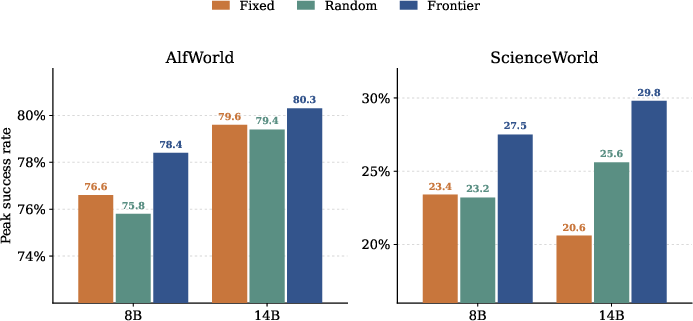
When the frontier model was allowed to adjust how the context was built, performance improved further:
- On ScienceWorld, the 14-billion-parameter model increased from 20.6% to 29.8%.
- On ALFWorld, the improvement was smaller but still positive, rising from 79.6% to 80.3% for the 14-billion-parameter model.
This suggests that improving the teaching process itself can help, especially on tasks where the original method still has room to improve.
5. Why are these findings important?
Many AI training methods need one of the following:
- correct example solutions,
- human-written answers,
- reliable reward scores,
- many attempts so that successful attempts can be selected.
In real-world use, these resources may not be available. An agent might simply produce one attempt, and nobody may know exactly what the ideal sequence of actions should have been.
RSD offers another possibility: the agent can learn from the information naturally produced during interaction. It can study what happened, compare it with related past experiences, and use hindsight to improve its own behavior.
The improvement is also stored in the model itself. This is important because the agent does not always need to be given its entire memory or special advice when it faces a new task.
6. Limitations and broader implications
The paper does not show that every task will improve equally. SearchQA changed very little across training rounds, suggesting that some tasks do not provide enough useful feedback or are difficult for the model to convert into lasting knowledge.
The method also has practical costs:
- The agent must interact with environments many times.
- The model must generate reflections and lessons.
- The frontier-guided version needs access to a stronger model and an evaluation system.
- The method may sometimes learn incorrect lessons from its own mistakes.
Even so, the research suggests an important future direction. AI agents may become more capable by repeatedly turning their own experiences into training material:
They act, examine what happened, learn from it, and use the improved knowledge to act again.
In simple terms, this paper presents a way for an AI agent to become more like a student who keeps a detailed diary of its attempts, reviews that diary with the benefit of hindsight, and gradually turns its experiences into better skills.
Knowledge Gaps
Knowledge gaps, limitations, and open questions
- Limited benchmark diversity: Evaluation covers only ALFWorld, ScienceWorld, and SearchQA, leaving unclear whether RSD generalizes to other domains such as coding, long-horizon planning, open-world robotics, dialogue, and real-world tool use.
- Restricted model coverage: Experiments use only Qwen3-8B and Qwen3-14B, so the effects of model family, architecture, pretraining data, and substantially larger or smaller model scales remain unknown.
- Unclear dependence on task-specific heuristics: Precedent retrieval relies on task-specific heuristics and content-token overlap, but the paper does not establish whether RSD remains effective with domain-agnostic retrieval or in settings where task types are unavailable.
- No systematic analysis of noisy or incorrect retrospection: Reflections, lessons, and teacher scores are generated by the same model and may contain hallucinations or misleading causal interpretations. The paper does not quantify how often these retrospective signals are wrong or how such errors affect training.
- Teacher–student confirmation bias is unresolved: Because the same underlying model generates the trajectory, produces the retrospective context, and supplies the teacher distribution, it may reinforce its own incorrect strategies rather than discover genuinely better behavior.
- The source of improvement is not causally isolated: The experiments do not fully disentangle the contributions of privileged hindsight, additional training compute, repeated exposure to tasks, experience replay, prompt/context length, and ordinary continued fine-tuning.
- Insufficient comparison with simpler replay baselines: The study does not compare RSD against strong alternatives such as replay-based SFT on all trajectories, loss-weighted replay, self-training with generated critiques, or supervised training on selected action corrections without privileged teacher logits.
- Limited treatment of catastrophic forgetting and interference: The experience bank accumulates data across rounds, but the paper does not measure whether improvements on one task type reduce performance on earlier task types, nor how performance changes under a nonstationary task distribution.
- Experience-bank scaling is unexamined: The computational and memory costs of retaining all trajectories and repeatedly summarizing or retrieving from them are not evaluated as the bank grows beyond the reported ten rounds and 200 instances per round.
- Potential data leakage and memorization are not assessed: Repeated training on the same 200 training instances per round may allow memorization rather than transferable capability. The paper does not report instance-level generalization, contamination checks, or performance on newly sampled task structures.
- Generalization beyond the training distribution is unclear: Although some seen/unseen splits are reported, the work does not systematically test transfer to new task families, environment layouts, instruction styles, or difficulty levels.
- The SearchQA failure mode remains unexplained: SearchQA performance stays largely flat, but the paper does not determine whether this results from insufficient model capacity, weak retrieval, inadequate hindsight, optimization instability, context dilution, or a mismatch between the distillation objective and exact-match evaluation.
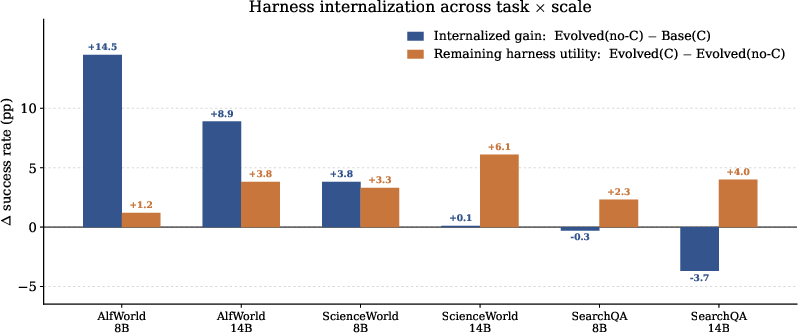
- Persistent internalization is only indirectly measured: The claim that retrospective information becomes internalized is based primarily on performance comparisons with and without context. The study does not provide mechanistic or behavioral evidence showing which capabilities were encoded in model parameters and which remain dependent on context.
- Action-level credit assignment is underdeveloped: Future hindsight exposes downstream trajectory information, but the method does not establish whether the teacher correctly identifies which earlier action caused a later success or failure, especially in long-horizon interactions with delayed effects.
- Teacher scoring quality is not validated against independent judgments: Metrics such as correction rate, entropy, and top- hit rate do not demonstrate that teacher preferences correspond to objectively better actions. Independent human, oracle, or environment-based validation of retrospective rankings is missing.
- Sensitivity to distillation and rollout hyperparameters is unknown: The paper reports one main learning rate, ten rounds, and 200 training instances per round, but does not characterize sensitivity to learning rate, update duration, temperature, KL direction, number of rounds, rollout count, or sampling strategy.
- Forward-KL distillation is not compared with alternative objectives: It remains unclear whether the observed gains depend on forward KL, as opposed to reverse KL, symmetric KL, token-level preference optimization, confidence-weighted losses, or advantage-like weighting of retrospective corrections.
- The role of failed trajectories is not fully characterized: The lesson ablation suggests that both successful and failed experiences help, but the study does not determine which failure types are useful, how failure severity should be weighted, or when failures become harmful noise.
- No robustness analysis under stochastic environments: The experiments do not test whether retrospective judgments remain reliable when environment responses are stochastic, partially observed, or nondeterministic, where the same action may lead to different outcomes.
- Safety and behavioral side effects are not evaluated: Self-distillation from imperfect experience could amplify undesirable behaviors, exploit environment quirks, or encourage shortcut strategies. The paper does not assess safety, calibration, robustness, or out-of-distribution failure modes.
- Frontier-guided evolution has substantial external dependencies: The frontier extension requires a proprietary frontier model, an executable verifier, and environment-level evaluation. Its reproducibility, accessibility, monetary cost, latency, and behavior with open-source proposal models remain unresolved.
- Outer-loop selection may overfit evaluation metrics: Context-policy acceptance is based on realized environment performance and repeated checkpoint evaluation. The paper does not establish whether this process overfits the development tasks or consumes a significant hidden evaluation budget.
- The no-training probe may not predict post-training utility reliably: Although probe scores guide candidate selection, the relationship between inference-time probe performance and subsequent distillation gains is not quantified across tasks, candidate policies, or rounds.
- Random-search and frontier-search comparisons are not compute-matched in sufficient detail: The paper reports that frontier guidance outperforms random search but does not fully clarify proposal quality, number of candidates, API calls, token costs, wall-clock time, or total compute for each outer-loop method.
- Context-policy search space remains narrow and hand-designed: The frontier model can modify only whitelisted choices. It is unknown whether the reported gains would persist if the search space included retrieval scoring, lesson-generation prompts, reflection procedures, training weights, or entirely different context representations.
- Acceptance and rollback dynamics may mask instability: Reverting only the context policy while retaining updated model parameters could create path-dependent effects, but the paper does not analyze whether rejected context policies still alter the model irreversibly or whether rollback improves long-term stability.
- Statistical uncertainty is underreported: Results are averaged over three seeds, but confidence intervals, significance tests, per-task variance, and sensitivity to sampled training instances are not provided, making it difficult to assess the reliability of relatively small gains.
- Long-term convergence and degradation are unknown: Experiments stop after ten rounds, so it remains unclear whether RSD eventually saturates, oscillates, collapses through self-reinforcement, or continues improving with additional experience.
- Realistic deployment costs are not quantified: Full-parameter training, repeated trajectory generation, retrospective context construction, and teacher inference may be prohibitively expensive in deployment. The paper does not report end-to-end compute, memory, latency, or energy costs.
- The method’s dependence on privileged future information raises deployment and causal concerns: Future hindsight is available only after an episode ends and may not correspond to actionable information in partially observable or continuously operating environments. The extent to which the approach transfers to settings without clear episode boundaries is unresolved.
- No human-centered evaluation is included: The usefulness and readability of generated lessons and reflections are not assessed by human experts, leaving open whether these artifacts provide meaningful explanations or merely correlate with benchmark scores.
- Theoretical guarantees are absent: The paper does not establish conditions under which retrospective self-distillation improves expected task performance, avoidably amplifies errors, or converges to a stable policy under changing experience distributions.
Practical Applications
Immediate Applications
The paper’s strongest near-term contribution is a deployable workflow for improving language-model agents from naturally collected interaction logs, without requiring a gold trajectory or a reward model for every example.
- Self-improving customer-service and support agents — software, enterprise operations
- Store completed conversations, successful resolutions, escalations, and failure cases in an experience bank.
- After each interaction, generate retrospective reflections, identify better responses using later conversation outcomes, and distill these lessons into the support model.
- This could improve routing, troubleshooting, tool use, and adherence to support procedures without manually labeling every conversation.
- Dependency: Organizations need reliable privacy controls, redaction of personally identifiable information, and some outcome signal such as resolution, escalation, or customer satisfaction. The method should not treat an unverified model-generated reflection as ground truth.
- Workflow and tool-use optimization for enterprise agents — software, business process automation
- Apply RSD-like training to agents that operate CRM systems, ticketing platforms, code repositories, spreadsheets, or internal search tools.
- Successful and failed execution traces can supply precedents, while downstream observations reveal which earlier tool calls caused errors or rework.
- A resulting model could internalize better action sequencing rather than depending permanently on a large prompt or retrieval system.
- Dependency: Tool executions must be logged with sufficient state information, and high-impact actions should remain subject to approval or sandboxing during training.
- Robotics and embodied assistants in controlled environments — robotics, warehousing, household automation
- Use completed trajectories to retrospectively evaluate navigation, object manipulation, and task-planning decisions.
- Prior successful and failed trajectories can provide precedents, while future sensor observations provide hindsight about the consequences of earlier actions.
- The approach is particularly relevant to environments resembling ALFWorld, where the paper reports substantial gains from reflection and future hindsight.
- Dependency: Real-world deployment requires safe exploration, accurate state logging, simulation or digital-twin environments, and hard safety constraints. Retrospective distillation alone cannot guarantee physical safety.
- Scientific and technical planning agents — research software, laboratory automation
- For agents that manipulate simulated or physical scientific environments, retain complete action-observation traces and derive reusable lessons from both failed and successful experiments.
- Precedent retrieval appears especially valuable in ScienceWorld, suggesting a workflow in which agents search for structurally similar prior experiments before planning.
- Potential products include laboratory-protocol assistants, experiment-planning copilots, and scientific simulation agents.
- Dependency: Experimental outcomes must be accurately recorded; domain experts should validate generated lessons before they influence physical experiments or costly materials usage.
- Post-deployment adaptation of search and question-answering systems — information retrieval
- Use user sessions, follow-up interactions, reformulations, and downstream feedback to identify where an agent’s search strategy failed.
- Retrospective context can train better query decomposition, source selection, and answer-verification behavior.
- Because SearchQA showed limited persistent improvement, an immediate use is more appropriately an offline adaptation pipeline or inference-time assistant rather than fully autonomous continual learning.
- Dependency: Search relevance and answer correctness need independent evaluation. Clicks, dwell time, or user acceptance are noisy proxies and can reinforce popularity bias or misinformation.
- Failure-analysis and training-data generation for agent developers — academia and industry
- Implement the experience bank, trajectory reflection, hindsight generation, teacher re-scoring, and diagnostic metrics as an engineering tool for analyzing agent behavior.
- Teacher correction rate, entropy, and top- hit rate can identify whether the agent is making correctable decisions or whether the retrospective context is uninformative.
- This can reduce the need to manually inspect every rollout and help developers prioritize prompt, tool, or model changes.
- Dependency: Diagnostics indicate model disagreement and correction potential, not necessarily real-world correctness; sampled cases still require human or external validation.
- Low-label continual learning in education and tutoring systems — education
- Use student-agent interactions, later student answers, and task completion patterns to improve tutoring policies without requiring a fully authored ideal dialogue for every case.
- Lessons can summarize common misconceptions, while future performance provides hindsight about whether an earlier explanation was effective.
- A practical initial product would be an offline tutor-improvement pipeline with teacher review rather than autonomous online weight updates.
- Dependency: Student data requires strong privacy and consent procedures. Learning outcomes should be measured independently to prevent the system from optimizing superficial engagement.
- Experience-based coding and DevOps agents — software engineering
- Record code-generation attempts, test failures, tool outputs, and subsequent fixes.
- Retrospective distillation could teach an agent to avoid recurring build errors, select more effective debugging actions, and reuse successful repository-specific procedures.
- Lessons from failures are especially useful because the paper finds that both successful and failed trajectories can contribute supervision.
- Dependency: Automatic tests, code review, security scanning, and rollback mechanisms are required. Passing tests alone may not establish maintainability or absence of vulnerabilities.
- Prompt and context-policy optimization using constrained configuration search — platform engineering
- Where an executable benchmark or environment metric exists, a stronger model can propose limited changes to retrieval depth, lesson inclusion, reflection use, hindsight placement, or context ordering.
- Teams could implement this as a YAML- or JSON-configured outer loop that probes candidate configurations and accepts only those that improve validated performance.
- This is an immediate engineering pattern for optimizing agent harnesses without allowing the optimizer to modify model weights or arbitrary code.
- Dependency: The evaluation metric must be representative and resistant to overfitting. The frontier model, probe budget, and full-round acceptance tests add computational and operational cost.
Long-Term Applications
The following applications are plausible extensions, but require stronger evidence, larger-scale validation, improved monitoring, or additional research beyond the reported benchmarks.
- Autonomous fleet learning for robots and industrial systems — robotics, manufacturing, logistics
- Multiple robots could contribute anonymized trajectories to a shared experience bank, extract common lessons, and periodically distill them into a fleet-wide policy.
- The system could learn from rare failures, maintenance events, and near misses without requiring a manually labeled optimal trajectory for each incident.
- Dependencies: Robust cross-device state alignment, safe continual-learning protocols, protection against corrupted or adversarial logs, sim-to-real validation, and mechanisms preventing catastrophic forgetting.
- Adaptive healthcare assistants and clinical workflow agents — healthcare
- An agent could learn from longitudinal care workflows, downstream patient responses, scheduling outcomes, and clinician corrections.
- Retrospective context might improve documentation, information retrieval, triage support, or procedural planning.
- Dependencies: This is high risk and cannot rely on self-generated lessons alone. Clinical validation, regulatory approval, auditability, privacy protection, calibrated uncertainty, and mandatory clinician oversight are essential. Direct autonomous treatment decisions would require substantially more evidence.
- Financial operations and fraud-investigation agents — finance
- Transaction-review agents could learn from later investigation outcomes, analyst decisions, and confirmed false positives or fraud cases.
- Retrospective lessons could improve evidence gathering, case prioritization, and tool-use sequences.
- Dependencies: Labels may be delayed or incomplete; historical decisions can encode discrimination; model updates must be reproducible and auditable. Any deployment affecting credit, account access, or regulatory reporting requires fairness testing and human review.
- Policy and public-sector decision-support systems — government and policy
- Agencies could use retrospective interaction data to improve benefits-navigation assistants, regulatory information systems, emergency-response planning, or public-service case routing.
- Failed interactions could reveal confusing forms, missing information, or ineffective procedural recommendations.
- Dependencies: Public-sector metrics are often delayed and politically contested. The system must preserve due-process requirements, prevent feedback loops that disadvantage vulnerable groups, and separate assistance from legally binding decisions.
- Personalized household agents with persistent long-term memory — daily life and consumer technology
- A personal assistant could learn from completed tasks, corrections, and recurring preferences, internalizing useful routines such as travel planning, shopping, scheduling, or device control.
- Retrospective context could help distinguish a temporary mistake from a stable user preference.
- Dependencies: Continuous model updating creates major risks involving privacy, consent, accidental retention, manipulation, and unwanted behavior drift. User-controlled memory deletion, provenance tracking, rollback, and explicit confirmation for consequential actions are required.
- Self-improving multi-agent organizations — enterprise and software systems
- Separate agents for planning, retrieval, execution, and verification could share precedents and lessons, with RSD applied to each role or to the team policy.
- The system might discover which context components should be supplied to different agents at different stages of a workflow.
- Dependencies: Credit assignment becomes more difficult when several agents jointly cause an outcome. Research is needed on preventing teams from amplifying shared errors, preserving role boundaries, and evaluating emergent behavior.
- Large-scale autonomous scientific discovery loops — science and engineering
- Agents could iteratively propose experiments, execute simulations or laboratory actions, inspect outcomes, and distill improved planning strategies from the resulting trajectories.
- The combination of accumulated precedents and future hindsight is potentially useful for domains where failed experiments are informative.
- Dependencies: Scientific validity cannot be reduced to language-model agreement or short-term task metrics. Reproducibility, causal interpretation, laboratory safety, experiment costs, and independent expert verification are necessary.
- Self-evolving foundation-model training infrastructure — machine learning research
- The paper suggests a general training architecture in which model parameters, the experience bank, and the context-construction policy co-evolve.
- Future systems could automatically determine when to use retrieved examples, abstract lessons, reflection, or future outcomes based on task type and model capability.
- Dependencies: The reported gains are benchmark-dependent: ALFWorld and ScienceWorld improve substantially, while SearchQA remains comparatively flat. Broader tests are needed for distribution shift, long-horizon stability, catastrophic forgetting, contamination, and scaling beyond Qwen3-8B/14B.
- Safety and compliance learning from near misses — industrial safety, cybersecurity, critical infrastructure
- Failed or almost-failed trajectories could be transformed into lessons about unsafe action sequences, misconfigurations, or weak verification steps.
- An agent could then internalize preventive behaviors instead of learning only from successful outcomes.
- Dependencies: Near-miss data must be trustworthy and sufficiently diverse. Safety-critical systems require formal constraints, independent monitors, red-team testing, and a non-learning fallback policy; self-distillation should supplement, not replace, verified safety engineering.
- Automated curriculum and context-policy evolution — education and workforce training
- A frontier model could optimize not only context construction but also which tasks, precedents, and failure cases are presented to an evolving learner or training agent.
- This could produce adaptive curricula based on persistent error patterns and demonstrated competence.
- Dependencies: The outer-loop metric must measure genuine skill acquisition rather than short-term benchmark gains. Curriculum decisions need protection against bias, over-specialization, and feedback loops that repeatedly expose learners to narrow task distributions.
Glossary
- Ablation study: An experiment that removes or changes components to measure their individual contributions. “#1{tab:context_ablation} studies the contribution of different components in the privileged context.”
- ALFWorld: An embodied-agent benchmark involving household tasks in simulated environments. “We evaluate RSD on three agent benchmarks: ALFWorld~\citep{shridhar2020alfworld}, ScienceWorld~\citep{wang2022scienceworld}, and SearchQA~\citep{jin2025search}.”
- BoN-16+SFT: A training approach that samples multiple candidates, selects successful ones, and applies supervised fine-tuning. “We additionally consider BoN-16+SFT, which samples 16 candidate trajectories per training instance, selects successful trajectories using ground truth, and fine-tunes on the resulting data.”
- Closed-loop data flywheel: A recurrent process in which model-generated data is used to improve the model, which then generates better data. “which aim to establish a closed-loop data flywheel where the current policy generates on-policy interaction experience, learns from that experience, and produces increasingly useful data in subsequent rounds”
- Context policy: A configurable rule governing which privileged information is selected, organized, and supplied to a teacher model. “The policy controls how the privileged information sources are selected, composed, and injected into the teacher context.”
- Cross-task precedent: A prior experience from a related task used as a concrete example for solving the current task. “The privileged context combines cross-task precedents and lessons with turn-level reflection and future hindsight”
- Declarative configuration: A specification of desired settings or choices without prescribing the execution procedure. “We represent as a declarative configuration over a constrained set of editable context choices”
- Distillation: Training a student model to reproduce the output distribution or behavior of a teacher model. “The privileged teacher retrospectively re-scores the student's realized actions under this richer view, and the resulting supervision is distilled back into the policy.”
- Embodied interaction: Agent interaction with an environment through actions that affect a simulated or physical world. “Together, these benchmarks span embodied household interaction, scientific reasoning and environment manipulation, and search-based question answering”
- Entropy: A measure of uncertainty or spread in a probability distribution. “teacher re-scoring statistics such as correction rate, teacher entropy, and top- hit rate”
- Experience bank: A persistent collection of trajectories accumulated across training rounds. “We maintain an experience bank containing all trajectories accumulated up to and including round ”
- Forward-KL distillation: Knowledge distillation that minimizes the forward Kullback–Leibler divergence from a teacher distribution to a student distribution. “We run self-evolution for 10 rounds, sampling 200 unique training instances in each round, and optimize the model using full-parameter forward-KL distillation with a learning rate of .”
- Frontier model: A highly capable model used to propose or evaluate improvements to another system. “For frontier-guided context-policy evolution, we use Claude-Opus-4.8~\citep{anthropic2026claudeopus48} as the frontier model that proposes constrained modifications to the privileged harness configuration.”
- Frontier-guided context-policy evolution: An outer optimization process in which a powerful model modifies the rules for constructing privileged context. “We further introduce frontier-guided context-policy evolution”
- Future hindsight: Information about events occurring after an agent’s earlier action, used retrospectively to assess that action. “We further provide future hindsight which directly exposes the downstream interaction following turn , including subsequent environment feedback and outcome information.”
- Ground-truth trajectory: A reference sequence of actions considered correct for completing a task. “In practical settings, each task may yield only a single on-policy trajectory, without a ground-truth trajectory specifying what the agent should have done”
- Group Relative Policy Optimization (GRPO): A reinforcement-learning method that compares groups of sampled outputs using relative rewards to update a policy. “We further compare against Group Relative Policy Optimization (GRPO)~\citep{shao2024deepseekmath}, which performs verifier-based reinforcement learning when an executable reward is available”
- Hindsight: Retrospective knowledge about later events used to reinterpret an earlier decision. “These signals provide a richer view of the agent's behavior than was available at action time.”
- Information asymmetry: A difference in the information available to two parties or model instances. “This information asymmetry, between what the agent saw when acting and what is available afterward, naturally matches on-policy self-distillation (OPSD)”
- Inference-time adaptation: Modification or augmentation of a model’s behavior during use rather than through parameter training. “For test-time adaptation, we include Reflexion@2~\citep{shinn2023reflexion}”
- Kullback–Leibler divergence: A measure of the difference between two probability distributions. “D_{\mathrm{KL} \left( q{(r)}(\cdot \mid h_{i,j},c_i{(r)}) \,|\, \pi_{\theta}(\cdot \mid h_{i,j}) \right)”
- On-policy experience: Data generated by the same policy that is subsequently trained on that data. “Collecting trajectories over a set of tasks produces the round- on-policy experience .”
- On-policy self-distillation (OPSD): Distillation in which a model learns from trajectories generated by its current policy while a privileged version of the model supplies supervision. “On-policy self-distillation (OPSD) learns from trajectories generated by the current policy rather than from a fixed offline dataset.”
- Oracle supervision: Idealized supervision supplied by a trusted reference source, such as ground-truth trajectories. “Ground-Truth Supervised Fine-Tuning (GT-SFT) provides an oracle-supervision reference by fine-tuning on ground-truth trajectories”
- Privileged context: Additional information available to a teacher during training but unavailable to the acting student at decision time. “At each round, the current policy generates new trajectories and incorporates them into an accumulated experience bank.”
- Privileged retrospective distillation: Distillation in which a teacher reassesses past actions using information that became available after those actions occurred. “Based on this observation, we introduce Retrospective Self-Distillation (RSD), a multi-round self-evolution framework”
- Rejection Sampling Fine-Tuning (RFT): Fine-tuning on samples selected because they satisfy a success or quality criterion. “while Rejection Sampling Fine-Tuning (RFT)~\citep{yuan2023scaling} fine-tunes the model on its own successful trajectories.”
- Retrospective supervision: Training signal derived by examining an action or trajectory after subsequent outcomes are known. “These signals provide a richer view of the agent's behavior than was available at action time.”
- Reward-driven reinforcement learning: Reinforcement learning in which policy updates depend on externally supplied rewards. “Conventional supervised fine-tuning therefore lacks direct target sequences, while verifier-based reinforcement learning requires reliable rewards”
- Rollout: A complete sampled interaction sequence generated by an agent in an environment. “In contrast, RSD draws it entirely from the agent's own evolving interaction experience.”
- Self-evolving agent: An agent whose policy or supporting components are repeatedly improved using its own interaction data. “Self-evolving agents aim to improve from their own experience rather than remaining fixed once deployed.”
- Self-Taught Reasoner (STaR): An iterative method that improves a model using its own successfully generated reasoning traces. “Self-Taught Reasoner (STaR)~\citep{zelikman2022star} iteratively improves the model using self-generated successful trajectories.”
- Supervised fine-tuning (SFT): Training a model to imitate labeled target outputs. “Conventional supervised fine-tuning therefore lacks direct target sequences”
- Teacher distribution: The probability distribution over outputs produced by the supervising teacher model. “The corresponding student and teacher distributions are”
- Test-time adaptation: Adjusting an agent’s behavior at evaluation time using additional attempts, context, or computation. “For test-time adaptation, we include Reflexion@2~\citep{shinn2023reflexion}”
- Top- hit rate: The proportion of cases in which a target appears among the highest-probability predictions. “teacher re-scoring statistics such as correction rate, teacher entropy, and top- hit rate”
- Trajectory hindsight: Later observations and outcomes from a trajectory used to evaluate earlier actions. “We introduce privileged retrospective distillation from accumulated experience and trajectory hindsight”
- Verifier-derived reward: A reward computed by an external program or evaluator that checks whether an agent’s behavior is correct. “naturally collected agent trajectories often lack ground-truth solutions or verifier-derived rewards”
- YAML edit: A modification to a configuration file written in YAML, a human-readable data-serialization format. “At each round, the frontier model proposes a small YAML edit to the privileged-context policy from a constrained whitelist of editable knobs.”