Kronecker Delta Rule for Long Context Linear Attention
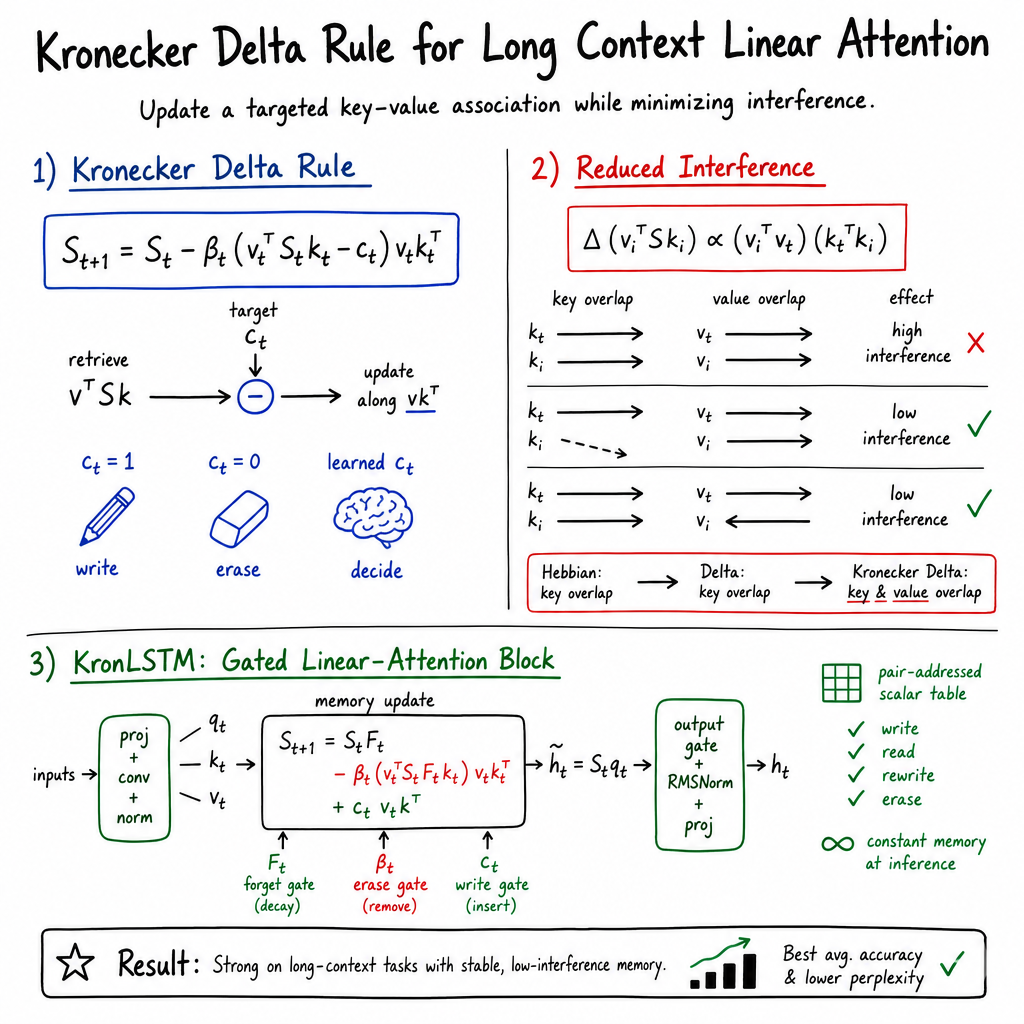
Abstract: We propose KronLSTM, a linear attention architecture based on the Kronecker Delta Rule, a novel update rule for associative matrix memories. KronLSTM extends the xLSTM family with a memory-revision mechanism that corrects targeted associations while modifying the memory only along a single direction in matrix space. This minimally invasive memory revision reduces interference with previously stored information compared with delta-rule updates, making it particularly well suited for long-context language modeling. The resulting memory dynamics can be mathematically described as a Markov chain that converges to a steady-state distribution, while the expected norm of the memory matrix remains uniformly bounded throughout the entire input sequence. Hence, KronLSTM ensures stable memory dynamics without requiring additional normalization and stabilization mechanisms for the memory state. Experiments show that KronLSTM is competitive with, and often outperforms, existing linear attention architectures, including models of the (Gated) DeltaNet family, with particularly strong performance on long context benchmarks. These results establish the Kronecker Delta Rule as an effective and analytically tractable foundation for stable associative memory in recurrent linear attention architectures. Our code (https://github.com/NX-AI/KronLSTM) and models (https://huggingface.co/collections/NX-AI/kronlstm) are open-source.
Paper Prompts
Sign up for free to create and run prompts on this paper.
Top Community Prompts
Explain it Like I'm 14
1. What is this paper about?
This paper introduces a new way for artificial intelligence systems to remember information from long pieces of text.
Most modern LLMs use a method called Transformer attention. It helps the model decide which earlier words are important when understanding a new word. However, this method becomes increasingly expensive when the text gets longer.
The authors present a new system called KronLSTM. It is designed to:
- remember important information over long texts,
- use less computer memory and processing power,
- avoid accidentally damaging memories it already stored, and
- remain stable while learning.
KronLSTM is based on a new memory-updating method called the Kronecker Delta Rule.
2. What questions are the researchers asking?
The researchers mainly wanted to find out:
- Can a LLM remember information from very long texts without becoming too expensive to run?
- Can its memory be updated without disturbing other information it has already learned?
- Can the model’s memory remain stable instead of growing uncontrollably?
- Does the new model perform as well as, or better than, other fast language-model architectures?
- Can it retrieve information from texts much longer than the texts it saw during training?
A simple example is a story containing many characters and events. If the model is asked about something that happened near the beginning, it should be able to find the answer even after reading thousands of additional words.
3. How did the researchers approach the problem?
The basic memory problem
KronLSTM stores information in a mathematical object called a memory matrix. You can imagine this matrix as a large filing cabinet:
- a key is like a label on a folder,
- a value is the information stored inside,
- a query is a question asking which folder to open.
When a new word arrives, the model uses these keys and values to update its memory.
Older ways of updating memory
The paper compares several memory-update methods.
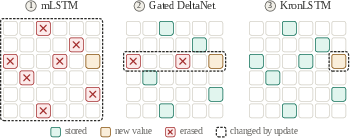
Hebbian updates add new information to memory. This is like putting another note into a filing cabinet without removing anything. The problem is that the cabinet can become too full, and newer notes may interfere with older ones.
The Delta Rule tries to correct an old memory. It checks what the model currently remembers and changes it toward the correct answer. This is better than simply adding information, but the correction can unintentionally affect other memories with similar keys.
The new Kronecker Delta Rule
The paper’s new method is more targeted. It changes the strength of a specific key–value pair, rather than changing a whole group of related memories.
An analogy is editing a spreadsheet:
- a broad update might accidentally change several cells in the same row,
- the Kronecker Delta Rule tries to change only the particular cell that needs fixing.
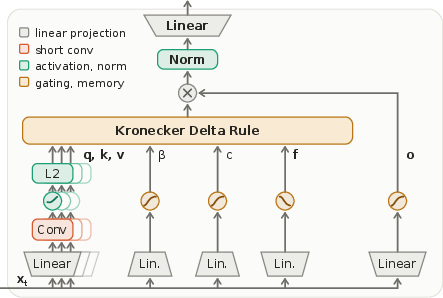
The method has three main controls, called gates:
- Forget gate: decides how much old information should fade.
- Erase gate: decides how much of a particular memory should be removed.
- Write gate: decides how much new information should be stored.
These gates allow the model to keep useful information for a long time while still replacing information when necessary.
Mathematical analysis
The researchers also studied the behavior of the memory using mathematics. They showed that:
- the memory tends toward a stable long-term condition,
- the average memory size stays bounded,
- the memory does not grow without limit, and
- the model can learn without needing extra safety mechanisms used by some other systems.
The paper describes the memory updates as a Markov chain. In everyday language, this means the next memory state depends mainly on the current memory state and the new information arriving now.
Experiments
The researchers trained and tested 1.5-billion-parameter models using large text datasets. They compared KronLSTM with other fast sequence models, including:
- Gated DeltaNet,
- Kimi Delta Attention,
- Mamba-3,
- Gated DeltaNet-2, and
- mLSTM.
They tested the models on:
- general language understanding,
- commonsense reasoning,
- recalling information from documents,
- finding hidden “needle” facts inside long texts,
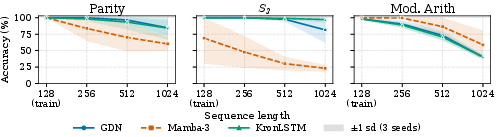
- tracking changing states, and
- training speed.
They tested both purely linear models and hybrid models, which combine linear attention with a smaller amount of regular attention.
4. What did the researchers find?
Strong language understanding
KronLSTM achieved the highest average score on the six main language tasks among the compared linear models.
For example, in the reported results:
- KronLSTM’s average score for the six tasks was 59.72%,
- the next strongest linear model, Kimi Delta Attention, scored 58.12%.
KronLSTM also had the lowest LAMBADA perplexity. Perplexity is a measure of how surprised a LLM is by text, so a lower score generally means better prediction.
Better long-text recall
KronLSTM was especially strong at finding information hidden inside long passages.
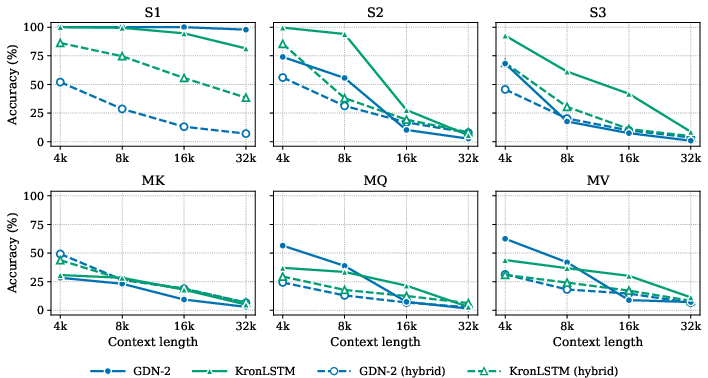
On a real-world recall test, it achieved the best average score among the purely linear models. It also performed well when the text became longer than the 8,000-token context used during its original training.
At 16,000 tokens, KronLSTM often performed better than competing systems. After additional training on 32,000-token texts, it continued to outperform Gated DeltaNet-2 on the natural-language retrieval tasks tested.
This suggests that its more careful memory updates reduce the damage caused by long sequences.
Less interference between memories
The mathematical analysis predicts that KronLSTM changes other memories less than the ordinary Delta Rule.
This was supported by the experiments. When many pieces of information were stored, KronLSTM was generally better at preserving useful earlier information.
However, it was not best at every task. On one artificial test containing many repeated noise sentences, KronLSTM performed worse. This shows that the method still has weaknesses, especially when the same kinds of keys appear repeatedly in unusual patterns.
Stable memory
The researchers proved that the expected size of the memory remains bounded. In simple terms, the memory should not grow larger and larger until the computer becomes unstable.
This is important because unstable memories can lead to:
- very large numbers,
- unreliable training,
- sudden learning failures, and
- poor predictions.
Unlike some versions of xLSTM, KronLSTM does not need separate normalizer and stabilizer states to control its memory.
Competitive training speed
KronLSTM was faster to train than Gated DeltaNet-2 in the reported tests. It processed about 11–18% more tokens per second than Gated DeltaNet-2, although Gated DeltaNet was still faster overall in some settings.
5. Why is this research important?
Long-context LLMs could be useful for:
- reading books and long reports,
- searching large collections of documents,
- understanding computer programs,
- following long conversations,
- analyzing scientific papers, and
- remembering information from earlier parts of a story.
The main contribution of this paper is not just a new model, but a new idea about how memory should be changed. The Kronecker Delta Rule tries to make small, precise corrections instead of rewriting large parts of memory.
This could help future LLMs become:
- cheaper to run on long texts,
- better at remembering distant information,
- more stable during training, and
- less likely to confuse one memory with another.
Still, the results do not prove that KronLSTM will replace Transformers everywhere. The experiments used particular model sizes, datasets, and tasks. The authors also identify future work, including testing larger models and combining KronLSTM with full attention layers.
In short, the paper presents KronLSTM as a faster and more stable way for LLMs to remember information over long contexts, with especially promising results when the model must retrieve important facts from very long texts.
Knowledge Gaps
Knowledge gaps, limitations, and open questions
The paper leaves the following issues unresolved:
- Mismatch between theoretical assumptions and the trained model: The convergence and bounded-norm results assume i.i.d. key–value–target triples, fixed step size, and a positive-definite feature covariance, whereas KronLSTM uses input-dependent gates, learned projections, causal convolutions, normalization, forget matrices, and highly correlated language sequences.
- No stability theorem for the complete KronLSTM block: The analysis covers the associative-memory update, but does not establish convergence, bounded activations, or gradient stability for the full deep network with learned gates, RMSNorm, output projections, residual connections, and backpropagation through time.
- Unclear implications of input-dependent gates: The theoretical guarantees do not directly cover the learned, input-dependent , , and $\BF_t$ used in experiments, particularly when gate distributions vary substantially across layers, heads, token types, or training stages.
- Insufficient characterization of stationary memory distributions: The paper proves existence and uniqueness of a stationary distribution under its assumptions but does not characterize its variance, tails, mixing time, dependence on , or behavior under non-i.i.d. and heavy-tailed inputs.
- No robustness analysis for distribution shift: It remains unknown whether bounded memory and retrieval quality persist when inference inputs differ from the training distribution, contain adversarially chosen key–value patterns, or exhibit unusually long repetitions.
- Capacity claims are primarily algebraic rather than end-to-end: The stated capacity of up to scalar associations requires linearly independent Kronecker features, but the paper does not measure the effective capacity of learned representations on realistic language data or quantify how capacity changes with correlated keys and values.
- The interference advantage is not isolated experimentally: Although the paper attributes improvements to reduced key-and-value-overlap interference, it does not provide controlled experiments that vary key overlap, value overlap, association density, or update order while holding model size and optimization conditions fixed.
- Residual accumulation for repeated keys remains unresolved: The paper identifies degraded performance on the RULER S1 task but does not develop a mechanism, theoretical bound, or architectural intervention for recurring keys and repeated noisy associations.
- Long-context evaluation remains limited: The main retrieval experiments reach 32k tokens after context extension, leaving performance at substantially longer contexts—such as 64k, 128k, or 1M tokens—unestablished.
- Context extension is not compared fairly across more alternatives: The long-context extension experiment compares only KronLSTM with GDN-2, so it does not determine whether the advantage persists against other linear-attention, state-space, recurrent, or hybrid Transformer baselines trained with the same extension procedure.
- Limited evaluation of full softmax-attention systems: The experiments compare recurrent linear architectures and sliding-window hybrids but do not include equivalently sized full-attention or full-attention-plus-local-attention models, leaving the quality–efficiency trade-off against standard Transformers unclear.
- No evaluation of hybrid models with global softmax layers: The conclusion identifies hybrids containing full softmax attention as future work, so the paper does not establish whether KronLSTM remains advantageous in the deployment configurations used by several contemporary LLMs.
- Scale generalization is unverified: Most reported results use 1.5B-parameter models trained on 100B tokens, with only limited 400M results in the appendix; it is unknown whether the gains persist at 7B parameters and beyond or under substantially larger token budgets.
- Training-data diversity is narrow: Pretraining uses FineWeb-Edu and a specific long-document mixture, so the method’s behavior on multilingual, code, mathematical, conversational, multimodal, or domain-specific corpora is not established.
- Benchmark coverage does not test many long-context capabilities: Needle retrieval, recall suites, commonsense tasks, and synthetic state tracking do not adequately measure long-document question answering, multi-hop reasoning, temporal reasoning, summarization, document editing, in-context learning, or instruction following.
- Synthetic state-tracking results are only partially explored: State tracking is evaluated up to length 1024 after training to length 128, but the paper does not investigate more complex state spaces, noisy transitions, multiple simultaneous variables, or state tracking at the long-context lengths emphasized elsewhere.
- Ablation coverage is insufficient for attributing gains: The relative contributions of the Kronecker update, vector forget gate, erase gate, target gate, normalization choices, short convolutions, head timescales, and output gating are not comprehensively separated.
- Gate behavior is not empirically analyzed: The paper does not report learned gate distributions, retention timescales, saturation rates, or how gates differ across layers and heads, making it difficult to understand what memory policy KronLSTM learns.
- The impact of normalized keys and values is unclear: The theoretical capacity and interference properties are presented generally, but the practical consequences of normalization—including reduced representational flexibility and the handling of magnitude information—are not investigated.
- Numerical stability is asserted more strongly than demonstrated: The paper reports a learning-rate stress test but does not provide systematic measurements of overflow, underflow, gradient statistics, loss spikes, or failure rates across precisions such as FP32, BF16, FP16, and quantized inference.
- Inference efficiency is not fully evaluated: Training throughput is measured on one H100 configuration, but the paper does not report end-to-end decoding latency, prefilling cost, memory bandwidth, energy use, batch-size scaling, or performance on other hardware.
- The computational cost of the matrix state is not fully contextualized: Because each head stores a matrix, the paper does not quantify how state size and update cost compare with KV caches, sliding-window attention, and other linear-attention states across realistic model configurations.
- Chunkwise-parallel training equivalence is underexplored: The paper states that the vectorized rule permits a DeltaNet-style chunkwise formulation, but does not quantify numerical discrepancies, parallel-scan efficiency, or gradient differences between recurrent and chunkwise implementations.
- No study of very long-document memory degradation over repeated batches: The experiments focus on single-context retrieval, leaving open how memory resets, document boundaries, packing strategies, and recurrent state carryover affect training and inference.
- The relationship between reduced interference and language-model perplexity is not established causally: Improvements on benchmark scores are reported, but the paper does not show whether they arise from better associative memory, optimization dynamics, architectural parameterization, or differences in effective capacity.
- Baseline comparability may remain uncertain: The paper does not provide full evidence that all baselines use identical parameter counts, training schedules, initialization, optimizer settings, kernel implementations, and hyperparameter tuning budgets, which limits the strength of architectural comparisons.
- No analysis of failure modes under adversarial or pathological associations: It remains unknown how KronLSTM behaves when values are nearly collinear, keys and values are deliberately anti-correlated, targets alternate rapidly, or an adversary repeatedly writes and erases the same association.
- Theoretical results do not address learned representation collapse: The positive-definiteness assumption on may fail or become ill-conditioned in trained networks, but the paper does not analyze near-singular feature covariance, conditioning, or its effect on memory norms and learning speed.
- No formal comparison of expressive power with DeltaNet and softmax attention: The paper provides capacity and interference arguments but does not characterize which sequence functions KronLSTM can represent that competing architectures cannot, or the representational cost of achieving equivalent accuracy.
- The long-term behavior of gradients remains incompletely justified: Bounded expected memory norms do not by themselves guarantee non-vanishing or well-conditioned gradients over very long sequences; gradient spectra, Jacobian products, and trainability at million-token horizons remain open questions.
- Practical deployment constraints are not assessed: The paper does not evaluate quantization, pruning, model compression, fault tolerance, or deployment on edge and memory-constrained devices.
- Reproducibility of the strongest claims needs broader confirmation: Results are reported for a limited number of model sizes, datasets, hardware settings, and random seeds; multi-seed variance and independent replication are not presented for the main comparisons.
Practical Applications
Immediate Applications
- Long-context language-model inference and chat assistants — software, search, and customer support. KronLSTM can be evaluated as a drop-in replacement for Transformer attention or other recurrent linear-attention layers in assistants that process long conversations, technical manuals, support tickets, or code repositories. Its fixed-size recurrent memory removes the context-length-dependent key–value cache and provides linear-time processing, while the Kronecker Delta Rule reduces interference between associations.
- Potential tools: open-source KronLSTM checkpoints, inference kernels, and hybrid models combining KronLSTM with sliding-window attention.
- Dependencies: the reported results are primarily for 400M–1.5B-parameter models and specific training data; production deployment requires validation on larger models, domain-specific data, latency, quality, and safety benchmarks. Memory is fixed-size but not equivalent to lossless storage of every token.
- Long-document retrieval and question answering — legal, enterprise, biomedical, and research workflows. A KronLSTM-based model could process contracts, clinical literature, regulatory filings, incident reports, or scientific papers while retaining relevant facts over long sequences. The paper reports strong performance on real-world recall tasks and needle-in-a-haystack evaluations, especially as context length increases.
- Potential workflow: stream a document once, maintain the recurrent state, and answer multiple queries without recomputing a full attention cache.
- Dependencies: retrieval accuracy is uneven across tasks; the artificial repeated-noise S1 benchmark exposes degradation caused by recurring keys. High-stakes applications still require explicit retrieval, citations, human review, and evaluation for hallucinations.
- Memory-efficient edge and on-device LLMs — mobile, embedded, and private computing. Constant-size recurrent state can reduce inference memory relative to full-context Transformers, enabling long-session summarization, offline assistants, document readers, or coding tools on constrained hardware. The architecture’s bounded memory dynamics may also reduce the need for extra normalization or stabilization states.
- Potential products: offline note-taking assistants, private voice/text agents, embedded technical-support systems, and long-running device copilots.
- Dependencies: actual suitability depends on kernel optimization, quantization, model size, recurrent-state storage, and energy measurements. The paper reports throughput on an NVIDIA H100, not on mobile CPUs, NPUs, or microcontrollers.
- Hybrid long-context model serving — cloud inference and enterprise AI platforms. KronLSTM can replace selected attention layers while retaining sliding-window attention for local token interactions. This offers a practical deployment path: use recurrent linear attention for persistent context and local attention for precise nearby reasoning.
- Potential workflow: use a
5:1-style ratio of linear-attention to sliding-window layers as an initial engineering configuration, then tune the ratio for latency and accuracy. - Dependencies: the reported hybrid configuration uses a 2,048-token window and is not necessarily optimal for every workload. Serving systems must support recurrent state management, batching, sequence resets, and state isolation between users.
- Potential workflow: use a
- Efficient continued pretraining and domain adaptation — academia and industry research. Researchers can use the open-source implementation and models to investigate context extension, recurrent memory, and alternatives to quadratic attention. The reported 32k-context continuation training provides a practical starting point for adapting models to long documents.
- Potential tools: reproducible training pipelines, ablation suites comparing KronLSTM with Gated DeltaNet, Mamba, KDA, and Transformer hybrids, and benchmarks for retrieval interference.
- Dependencies: context extension requires additional training data and compute; performance may depend strongly on the document mixture, tokenizer, sequence length, and gate configuration.
- Stable training of recurrent sequence models — machine-learning engineering. The bounded-memory analysis and non-expansive parameterization can guide implementations of recurrent associative memories. In particular, normalized keys and values plus sigmoid erase gates ensure the update remains in the theoretically favorable regime described in the paper.
- Actionable practice: monitor , memory norms, gradient norms, and retrieval accuracy during training; use these diagnostics to detect instability or excessive forgetting.
- Dependencies: the theoretical bounds assume distributional conditions such as positive-definite feature covariance and bounded update magnitudes. Learned gates and real training distributions may violate idealized assumptions.
- Online associative memory for streaming data — anomaly detection, telemetry, and adaptive systems. The Kronecker Delta Rule supports targeted correction and erasure of associations through its target value: approximately
1for writing and0for deletion. This can be used in streaming models that must update continuously without retraining on the full history.- Potential applications: adaptive sensor models, log-stream summarization, changing-user preference models, and online classification features.
- Dependencies: the rule stores scalar associations in a matrix memory rather than arbitrary records; capacity depends on the independence and dimensionality of key–value feature pairs. Data drift and correlated features may cause interference.
- Teaching and research in machine learning — academic training. The paper provides a compact example linking associative memory, the Widrow–Hoff Delta Rule, Kronecker products, Markov-chain convergence, and recurrent neural architectures. It can support graduate-level assignments or research prototypes on stable online learning.
- Potential exercises: implement the naive and chunkwise-parallel updates, verify the contraction condition, measure interference under key/value overlap, and reproduce long-context retrieval experiments.
- Dependencies: the manuscript contains complex notation and some results require careful implementation and independent verification; reproduction should use the released code and reference kernels.
Long-Term Applications
- Large-scale long-context foundation models — general-purpose AI platforms. If scaling experiments confirm the reported advantages, KronLSTM could become a component of foundation models that handle books, repositories, multimodal event streams, or extended interactions with lower inference cost than full softmax attention. Its fixed-size state is particularly attractive for long-running sessions and streaming generation.
- Potential product: a hybrid architecture with KronLSTM for persistent memory, local attention for detailed nearby reasoning, and occasional full attention or retrieval modules for high-precision access.
- Dependencies: the paper explicitly identifies larger-scale training and hybrids with full softmax attention as future work. Scaling may reveal optimization, expressivity, or quality limitations not visible at 1.5B parameters.
- Persistent conversational and personal agents — consumer software and workplace automation. Targeted erase/write behavior could support agents that retain useful preferences while revising outdated information with less disruption to unrelated memories. This may enable long-lived personal assistants, project agents, or enterprise copilots.
- Potential workflow: encode user facts and task state into recurrent memory, use explicit target or gate signals for updates and deletions, and maintain external audit logs for user control.
- Dependencies: model-internal memory is not automatically interpretable, persistent, or reliably deletable. Privacy, consent, memory inspection, adversarial prompting, and guaranteed erasure require external memory controls and formal auditing.
- Real-time robotics and autonomous systems — robotics, vehicles, and industrial control. The architecture’s constant-memory recurrence and reported state-tracking ability could support long sensor histories, task state, and event tracking in systems with strict latency or power constraints.
- Potential applications: robot manipulation histories, navigation state, predictive maintenance, and multi-step control policies.
- Dependencies: the experiments are language-centric and do not establish control stability, safety, or performance under continuous noisy sensor streams. Deployment requires closed-loop testing, bounded latency guarantees, sensor-fusion studies, and fail-safe mechanisms.
- Streaming multimodal models — speech, video, IoT, and industrial monitoring. The matrix-memory update is modality-agnostic in principle and could be applied to sequences of audio, visual, or sensor embeddings. Targeted revisions may help preserve distinct events when feature representations have limited overlap.
- Potential products: always-on meeting transcription, video-event monitoring, wearable assistants, and industrial anomaly monitors.
- Dependencies: keys and values must be learned so that relevant events are sufficiently separable. Correlated or highly repetitive streams may produce residual accumulation and interference, as suggested by the S1 results.
- Low-latency financial and operational forecasting — finance and enterprise analytics. A stable streaming associative memory could process transaction, market, supply-chain, or demand sequences without retaining the entire historical window. This may reduce serving cost for high-frequency or resource-constrained forecasting systems.
- Potential workflow: update the recurrent state as events arrive, query it for predictions, and reset or reinitialize it at regime boundaries.
- Dependencies: the paper does not evaluate forecasting, financial data, distribution shift, or adversarial manipulation. Strong governance, backtesting, calibration, and explicit safeguards would be required before consequential use.
- Energy-efficient data-center inference — cloud infrastructure and sustainability. If the theoretical constant-memory advantage translates to large-scale serving, KronLSTM could reduce key–value-cache memory, communication overhead, and possibly energy consumption for long-context workloads.
- Potential infrastructure: recurrent-state-aware batching, state compression, specialized GPU/TPU kernels, and scheduling systems that reuse states across streaming requests.
- Dependencies: total cost also includes recurrent computation, model weights, training, kernel efficiency, and batching limitations. The paper reports promising H100 training throughput but does not provide end-to-end serving energy or cost measurements.
- Adaptive memory modules beyond language modeling — neuroscience-inspired computing and general sequence learning. The Kronecker Delta Rule can serve as a general-purpose learning rule for associative matrix memories, with explicit control over correction, erasure, and write strength. It may be useful in differentiable memory, continual learning, and neural algorithmic reasoning.
- Potential research directions: memory modules for program execution, symbolic state tracking, continual classification, and differentiable databases.
- Dependencies: the capacity result assumes linearly independent Kronecker features, and a single key may retrieve the sum of multiple orthogonal values. Scaling capacity and preventing interference in realistic, correlated representations remain open problems.
- Policy and infrastructure planning for efficient AI. Policymakers and public-sector technology programs could support benchmarks and procurement criteria for long-context efficiency, comparing quadratic-attention and recurrent linear-attention systems on quality, energy, memory, privacy, and reproducibility rather than relying only on parameter count.
- Potential outputs: standardized long-context retrieval tests, energy-per-token reporting, state-isolation requirements for hosted models, and audit protocols for persistent model memory.
- Dependencies: policy recommendations should remain technology-neutral until independent studies reproduce the results across model scales, hardware platforms, languages, and safety-critical domains.
Glossary
- Associative memory: A memory system that stores relationships between input keys and corresponding values. “Therefore, $\BS$ is an associative memory”
- Causal depthwise convolution: A convolution applied independently to each channel while using only current and preceding inputs. “each followed by a short causal depthwise convolution”
- Chunkwise-parallel training: A method that processes sequential updates in parallel across chunks of a sequence. “which admits chunkwise-parallel training”
- Contraction: A transformation that reduces distances or errors between successive states. “the kernel contracts on laws with finite second moment”
- Delta Rule: An error-correcting memory update that adjusts stored information according to the difference between a retrieved value and a target value. “In contrast, the Delta Rule”
- Eigenvalue: A scalar describing how a linear transformation scales a corresponding eigenvector. “the transition factor has a negative eigenvalue”
- Exponential input gate: A gate using an exponential function to control how strongly new information is written to memory. “under a sigmoid forget gate and an exponential input gate”
- Finite second moment: A probabilistic condition in which a random variable has a finite expected squared norm. “contracts on laws with finite second moment”
- Forget gate: A learned mechanism that controls how much previously stored information is retained. “The forget gate is a diagonal matrix”
- Frobenius norm: A matrix norm equal to the square root of the sum of the squares of all matrix entries. “the steady state and --- started at $\BS_0 = \BZe$ --- every iterate satisfies”
- Generalized Householder matrix: A matrix transformation related to a reflection or rank-one update, used here to characterize memory transitions. “the transition $\BI - \beta_t\, \Bk_t \Bk_t^\top$ is a generalized Householder matrix”
- Gradient flow: The propagation of optimization gradients through a neural network during training. “This targeted memory revision results in a less noisy gradient flow over time.”
- Hebbian rule: A learning rule that strengthens associations by adding an outer product of an input and its associated value. “with a Hebbian rule, i.e., an outer product update rule.”
- Hybrid model: A model combining linear attention layers with another attention mechanism, such as sliding-window attention. “Therefore, we evaluate every architecture in two settings: as a pure linear attention model, and as a hybrid with SWA layers.”
- Irreducible residual: The prediction error that cannot be eliminated by the chosen model or representation. “ the irreducible residual”
- Kronecker product: An operation combining two matrices or vectors into a larger block-structured matrix or vector. “With the Kronecker product $\Ba_t = \Bk_t \otimes \Bv_t$”
- Least-squares memory: A memory state that minimizes the expected squared association error. “the least-squares memory”
- Linear attention: An attention mechanism whose computational and memory costs scale linearly with sequence length by maintaining a fixed-size summary. “Linear attention compresses the context into a fixed-size memory matrix”
- Markov chain: A stochastic process in which the distribution of the next state depends only on the current state. “the iterates form a time-homogeneous Markov chain”
- Memory interference: Unwanted modification of previously stored information when new information is written. “reducing interference with previously stored associations”
- Memory norm: A numerical measure of the magnitude of a memory matrix or state. “We will present expected bounds on the memory norm”
- Non-expansive: A property of a transformation that does not increase the distance or norm of its input. “In the non-expansive regime ”
- Normalizer state: An auxiliary state used to control the scale of a memory or readout in a recurrent architecture. “there is no normalizer state and no stabilizer state as in the mLSTM.”
- Numerical instability: Computational behavior in which small errors or updates produce uncontrolled or unreliable numerical values. “can itself lead to numerical difficulties and learning instabilities”
- Outer product: The matrix formed by multiplying a column vector by the transpose of another vector. “i.e., an outer product update rule.”
- Perplexity: A measure of how well a LLM predicts a sequence, with lower values indicating better predictions. “and the lowest perplexity on LAMBADA.”
- Rank-one update: A matrix modification formed from the outer product of two vectors, changing the matrix along a single matrix-space direction. “it modifies the memory only along a single direction in matrix space”
- Readout: The operation of retrieving an output from a memory state using a query or input vector. “its readout can become arbitrarily large”
- Recurrent linear attention: Linear attention implemented through sequential state updates rather than explicit full-context attention. “recurrent linear attention architectures”
- Residual: The difference between a model’s predicted quantity and its target. “a scalar is corrected”
- RMSNorm: A normalization method that rescales activations according to their root-mean-square magnitude. “a per-head RMSNorm”
- Scalar association: A single numerical strength representing the relationship between a key and a value. “The Kronecker Delta Rule corrects this scalar towards the target”
- Sequence-mixer block: A neural-network layer that transforms and combines information across sequence positions. “the Kronecker Delta Rule is embedded in the KronLSTM sequence-mixer block.”
- Sigmoid gate: A gate whose output lies between zero and one and controls the flow of information. “The mLSTM places the Hebbian write \eqref{eq:linatt} under a sigmoid forget gate”
- Sliding-window attention: An attention mechanism that restricts each token to attending within a fixed-size local window. “or use sliding-window attention (SWA) instead”
- Softmax attention: The standard Transformer attention mechanism that uses softmax-normalized query–key similarities. “whose softmax attention mechanism has computational costs that grow quadratically”
- Stable state-space ordinary differential equation: A differential equation whose dynamics constrain state growth and remain mathematically stable. “through a forget mechanism derived from a stable state-space ordinary differential equation.”
- Stabilizer state: An auxiliary state used to prevent numerical instability by controlling the scale of recurrent memory computations. “there is no normalizer state and no stabilizer state as in the mLSTM.”
- Stationary distribution: A probability distribution that remains unchanged under the transition dynamics of a stochastic process. “it has a unique stationary distribution ”
- Steady state: A long-term state or distribution toward which a dynamical system converges. “whose dynamics converge to a steady-state distribution”
- State tracking: The ability of a sequence model to maintain and update information about an evolving latent state. “KronLSTM can perform state tracking”
- Target gate: A learned gate that controls the target strength of an association written to memory. “equipped with a vector forget gate, a gate, and a target gate.”
- Time-homogeneous Markov chain: A Markov chain whose transition rule does not change over time. “the iterates form a time-homogeneous Markov chain”
- Vectorized form: A representation in which a matrix is converted into a single vector, often to simplify linear-algebraic analysis. “Delta Rule in vectorized form”
- Widrow–Hoff Delta Rule: An incremental least-mean-squares update rule that adjusts parameters toward a target using an input vector and prediction error. “the Widrow--Hoff Delta Rule \citep{Widrow:60} with input $\Ba_t$ and target ”