A Jury, Not an Electorate: Label-Free Reliability Estimation for Ensembles of Language Models
Abstract: An ensemble of LLMs is a jury, not an electorate. The answers are testimony from witnesses of unknown reliability, and the question is not what the majority said but who is credible. Most ensemble methods assign each expert a fixed reputation, often learned from labels. We ask whether it can instead be inferred from the pattern of agreement and disagreement among the experts. We model the experts as a jury: each question has a latent true answer, each expert reports it with unknown reliability, and those reliabilities are estimated by Expectation Maximisation (EM) from unlabelled answer configurations alone. We show that its decision rule reduces to a log-odds weighted linear score over the experts' answer distributions. What changes is not how the jury votes, but how it learns whom to trust. On a 1560-question benchmark, the jury, with nine experts of up to 3B parameters, performs comparably to the same fusion rule with label-fitted weights, showing no statistically significant advantage from supervision. Instead, it outperforms the best single model with matched self-consistency and the strongest label-free alternative on the full benchmark.
Paper Prompts
Sign up for free to create and run prompts on this paper.
Explain it Like I'm 14
1. What is this paper about?
This paper studies how to combine the answers of several LLMs, such as different versions of ChatGPT-like systems.
Imagine asking nine students to solve the same question. Some students are usually very good, while others may be better at certain subjects. If their answers disagree, simply choosing the answer given by most students may not work.
The paper suggests treating the models like a jury:
- The models are the witnesses.
- Their answers are their testimony.
- The correct answer is hidden.
- The system tries to learn which models are more trustworthy by studying how they agree and disagree.
The important idea is that the system does not need the correct answers during training to estimate which models are reliable.
2. What questions did the researchers ask?
The researchers mainly wanted to know:
- Can a group of LLMs give better answers than one model alone?
- Can the system learn which models to trust without being shown the correct answers?
- Is it better to use all of a model’s answer probabilities instead of only its favorite answer?
- How does this label-free method compare with methods that are trained using correct answers?
Here, a label means the known correct answer to a training question. A method that uses labels might learn, for example, that “Model A is correct 80% of the time.”
The paper asks whether this information can instead be discovered from patterns such as:
- Which models often agree?
- Which models disagree with the group?
- Which answers are strongly supported?
- Which models seem to be right when other models are wrong?
3. How did the researchers do it?
The group of models
The researchers used nine LLMs, each with up to about 3 billion parameters. The models were different in size, training data, and model family. This was useful because different models may make different mistakes.
They tested the models on 1,560 questions from several tasks, including:
- School and academic multiple-choice questions
- Science questions
- Reading and commonsense questions
- Mathematical problems from GSM8K
Using answer distributions
A simple voting system only records each model’s top answer.
For example:
| Model | Favorite answer |
|---|---|
| Model 1 | A |
| Model 2 | B |
| Model 3 | A |
A normal vote would choose A.
However, LLMs usually have information about other possible answers too. A model might assign:
- 60% chance to A
- 30% chance to B
- 10% chance to C
The paper keeps this extra information instead of throwing it away. This is called using an answer distribution. It is similar to asking not only “Which answer did you choose?” but also “How sure were you about each choice?”
Learning reliability without correct answers
The researchers used a statistical technique called Expectation Maximisation, or EM.
A simple way to understand EM is as a repeated guessing game:
- Make an initial guess about which models are reliable.
- Use those guesses to estimate the likely correct answer for each question.
- Check how well each model agrees with those estimated answers.
- Update the reliability estimates.
- Repeat the process until the estimates stop changing much.
For example, suppose three models often agree with one another, while another model gives very different answers. The method may gradually decide that the first three models are more reliable. But if the unusual model is often supported by other evidence, its reliability may also increase.
The method does not directly know the real answer while learning. It tries to discover both:
- The hidden answer to each question
- The reliability of each model
This is similar to figuring out who is a good witness by listening to many witnesses over many cases, even when no judge tells you the answer immediately.
Giving models different weights
After estimating reliability, the system gives each model a weight.
A highly reliable model gets a larger positive weight. A model that appears worse than random guessing can even receive a negative weight, meaning its answer is treated as evidence against that answer.
The final answer is chosen by combining the models’ answer distributions with these weights.
In simple terms:
Trust the reliable witnesses more, and trust the unreliable witnesses less.
Comparing different systems
The researchers compared several approaches:
- Ordinary majority voting
- Equal weighting while using answer distributions
- The proposed label-free jury method
- A similar method whose weights were learned using correct answers
- Other existing label-free combination methods
- The best individual model by itself
They divided the questions into training and test groups. The jury used the training questions only to study agreement patterns, then was tested on separate questions.
4. What did they find?
Keeping answer probabilities helped a lot
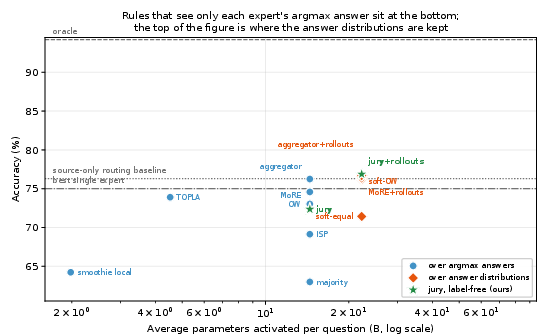
Ordinary majority voting achieved about 63.0% accuracy.
When the researchers kept the models’ full answer distributions, but still treated every model equally, accuracy rose to about 71.4%.
That is an improvement of 8.4 percentage points.
This means that a model’s uncertainty contains useful information. A model that chooses answer A with 51% confidence should not necessarily be treated the same as a model that chooses A with 99% confidence.
Learning which models to trust helped further
When the system also gave different weights to different models, accuracy rose to about 76.9%.
This was another improvement of 5.5 percentage points over equal weighting.
So the paper identifies two separate benefits:
- Keeping the models’ full answer probabilities
- Learning which models deserve more trust
The jury beat the best single model
The strongest individual model scored about 75.0%.
The jury scored about 76.9%, which was roughly 2 percentage points better.
The improvement was especially large on the math problems. One smaller model was not the strongest overall, but it performed particularly well on GSM8K. Combining the models allowed the jury to use this specialised strength.
It performed about as well as the supervised method
The researchers also tested a version that used the correct answers from the training questions to learn the model weights.
That supervised method scored about 76.2%, compared with 76.9% for the label-free jury.
The difference was small. After accounting carefully for variation in the experiments, the researchers concluded that there was no clear evidence that using correct answers gave an advantage in this test.
This does not prove that the two methods are always equal. It only means that, on this particular benchmark, the label-free method performed similarly.
It helped when the majority was wrong
The jury was especially useful in difficult cases where the correct answer was not the most common answer among the models.
For questions where the correct answer was the clear majority choice, the jury was correct about 95.7% of the time.
More surprisingly, in cases where the correct answer was not the unique majority choice, the jury reached about 55.5%, compared with only 6.2% for ordinary majority voting.
This suggests that the method can sometimes recognise that a smaller group of models is more trustworthy than a larger group.
The method’s confidence was not well calibrated
Although the jury often chose correct answers, it was too confident about them. Its average top confidence was about 99.1%, even though its accuracy was only about 76.9%.
This means that its confidence numbers should not be taken literally without extra adjustment. A prediction marked as “99% sure” may not really have a 99% chance of being correct.
5. Why is this research important?
The paper shows that a collection of LLMs can be treated as more than a simple vote. The system can examine the models’ patterns of agreement and learn which ones seem trustworthy, even without being given the correct answers during training.
This could be useful when:
- Correct training labels are expensive to collect
- The system must work in a new subject or domain
- Different models have different strengths
- A single model is unreliable on some types of questions
- Developers want to combine several smaller models instead of using one very large model
The paper also shows that disagreement is not always a problem. It can provide useful information. For example, one model may be especially good at mathematics while another is better at reading questions.
Limitations and possible future impact
The results are promising, but they should not be treated as proof that the method will work everywhere.
The study used:
- Only nine models
- A benchmark of 1,560 questions
- Mostly multiple-choice tasks
- A limited set of subjects
- Extra sampling for some questions
The method also requires asking every model for an answer, which can be expensive. It may be cheaper and faster to use only one model, even if the jury is slightly more accurate.
In addition, the statistical model assumes that the experts’ mistakes are mostly independent. In reality, LLMs may copy similar training data and make the same mistakes. The researchers found evidence that models sometimes agree on wrong answers.
Overall, the paper’s main message is:
A group of LLMs can act like a jury, learning whom to trust from the evidence of their answers rather than from a list of known correct answers.
The proposed system improved accuracy over voting and over the best single model in the experiments. It suggests a practical way to combine different AI systems, especially when labelled training data is limited. However, more testing is needed to determine how well it works with other models, subjects, and real-world questions.
Practical Applications
Immediate Applications
- Label-free LLM ensemble service for question answering and classification (software, enterprise AI) Organizations can deploy a post-inference combiner that collects answer distributions or repeated samples from several LLMs, estimates model reliabilities with EM on unlabeled traffic, and selects the answer maximizing the weighted linear-fusion score. This is suitable for multiple-choice QA, structured classification, and other tasks with a finite candidate set. Potential product: an ensemble gateway or model-aggregation API that exposes a common interface across model providers. Dependencies and assumptions: models must return comparable candidate probabilities, scores, or normalized answer frequencies; the candidate space must be identifiable; the conditional-independence and uniform-error assumptions may fail when models share training data or architecture.
- Improved automated educational assessment (education, edtech) Multiple models can independently solve exam questions, generate answer probabilities, and be combined without requiring a labeled development set. The system could improve automated grading, answer-key verification, and question-generation quality, particularly when a weaker model’s answer is supported by a minority of experts. Potential workflow: run several inexpensive models, aggregate their distributions, flag low-agreement cases for teacher review, and retain the individual testimonies for auditability. Dependencies and assumptions: questions need a well-defined answer space and generally a single correct answer. The paper’s evaluation is mostly multiple-choice, so reliability for open-ended grading remains unvalidated.
- Reference-free quality estimation for model pools (software engineering, MLOps) Teams can estimate which models are useful in a deployment without building a large gold-labeled validation set. Agreement patterns over an unlabeled corpus provide reliability estimates that can guide model weighting, pool maintenance, and retirement of consistently unhelpful models. Potential tool: an offline “ensemble health” dashboard reporting estimated , log-odds weights, disagreement rates, and performance by task segment. Dependencies and assumptions: enough heterogeneous questions and at least three informative experts are needed for identifiability; EM can converge to local optima, and estimated reliability is model-relative rather than guaranteed real-world accuracy.
- Domain-specific model combination with minimal annotation (healthcare, finance, legal technology, scientific software) A company can combine general-purpose and specialist models for domain tasks such as document categorization, compliance checks, mathematical problem solving, or financial classification. The method is especially relevant when labeled examples are scarce, expensive, or restricted for privacy reasons. Potential workflow: fit weights on unlabeled historical cases, freeze the weights for evaluation, and route disagreements to a human expert. Dependencies and assumptions: deployment should remain advisory in high-stakes settings because the reported posterior is strongly overconfident and has an expected calibration error of $0.223$; independent validation and human review are required.
- Use of answer distributions rather than only top-1 outputs (LLM inference infrastructure) Existing ensemble pipelines can obtain a substantial improvement simply by preserving probability distributions or empirical frequencies instead of reducing every model to an argmax answer. The paper reports an $8.4$-percentage-point gain for equal-weight aggregation from this change alone. Potential implementation: modify inference APIs and caches to retain option log-probabilities, token-level scores, or repeated-sample frequencies, then apply a linear opinion pool. Dependencies and assumptions: probability scales must be comparable or otherwise normalized; for generative tasks, repeated sampling increases latency and inference cost.
- Minority-answer preservation and disagreement triage (customer support, safety review, decision support) The jury can select an answer that is not the plurality answer when a minority of models has stronger inferred reliability. This supports workflows in which unusual but credible hypotheses should not be discarded by majority vote, such as support-ticket diagnosis, bug localization, policy classification, or scientific literature screening. Potential workflow: automatically accept high-confidence consensus cases and send minority-supported disagreements to a human reviewer. Dependencies and assumptions: the minority signal must reflect genuine model diversity rather than correlated error; the paper’s result is not evidence that minority answers are generally safer.
- Label-free baseline for academic ensemble research (academia) Researchers can use the method as a reproducible baseline for post-hoc LLM aggregation: fit one reliability parameter per model with EM, convert it to a log-odds weight, and compare against majority voting, supervised fusion, routing, and other label-free combiners. Dependencies and assumptions: claims should be limited to settings resembling the study—nine relatively small models, a 1,560-question benchmark, and largely fixed-label tasks. The paper does not establish generalization to larger models, multilingual data, or unconstrained generation.
Long-Term Applications
- Adaptive, domain- and query-dependent jury systems (general-purpose AI, healthcare, finance, legal technology) A future system could estimate reliability conditional on topic, difficulty, language, or user population rather than assigning each model one global . For example, a mathematical specialist could receive more weight on quantitative questions while a legal model dominates statutory questions. Potential product: a hybrid router–jury architecture that first selects a cost-effective subset of models and then performs label-free reliability-weighted fusion. Dependencies and assumptions: requires substantially more data, a context-dependent generative model, safeguards against overfitting, and methods for detecting distribution shift.
- Correlated-error-aware ensemble aggregation (safety-critical AI, healthcare, autonomous systems) The paper observes that experts agree on wrong answers more often than the independence model predicts. A longer-term extension could explicitly model shared training data, common pretraining lineage, or recurring “lure” answers, preventing correlated models from being mistaken for independent confirmation. Potential tool: a dependency-aware jury that estimates group-level susceptibilities and discounts redundant testimony. Dependencies and assumptions: requires larger datasets and reliable identification of model dependencies; the paper’s tested correlated-error extension did not improve accuracy, so this remains a research direction rather than a validated deployment strategy.
- Calibrated confidence and abstention systems (medical decision support, cybersecurity, finance) The posterior could eventually support abstention, escalation, or selective prediction if it is recalibrated against held-out labels or conformal prediction procedures. A system might answer automatically only when the calibrated risk is below a specified threshold. Potential workflow: fuse model outputs, calibrate confidence on a representative validation set, abstain on high-disagreement cases, and provide the component models’ evidence to an auditor. Dependencies and assumptions: calibration labels are still needed even though weight estimation is label-free; performance must be evaluated under shift, asymmetric costs, and rare but consequential errors.
- Cost-aware jury orchestration and cascading (cloud computing, edge AI, robotics) The current method asks every expert to answer, which increases computation. Future systems could combine it with cascades: start with a cheap subset, estimate whether the result is sufficiently reliable, and activate additional models only for uncertain cases. In robotics or edge systems, this could balance latency, energy, and accuracy. Potential product: a budget-constrained inference controller that chooses between greedy answers, repeated sampling, and additional experts. Dependencies and assumptions: requires reliable stopping criteria and quality-preserving partial inference; the current paper does not show that jury confidence is calibrated enough for safe early stopping.
- Open-ended generative-answer fusion (creative tools, research assistants, coding agents) The current decision rule works most naturally when candidate answers can be enumerated. A longer-term system could align semantically equivalent free-form answers, cluster generated programs or explanations, and apply jury weighting over the resulting candidate clusters. Potential tools: multi-model coding assistants, scientific hypothesis aggregators, and research agents that preserve alternative explanations before selecting one. Dependencies and assumptions: semantic clustering, answer equivalence, citation verification, and executable-code validation are unresolved. Candidate-support conditioning and non-uniform error distributions may substantially violate the paper’s model.
- Federated or privacy-preserving reliability estimation (healthcare, public policy, regulated enterprise) Institutions could estimate model reliability from agreement statistics without sharing raw questions, answers, or sensitive labels. Aggregated sufficient statistics might support cross-organization ensemble construction while reducing data disclosure. Potential workflow: each institution computes encrypted or differentially private agreement summaries; a central service estimates reliability weights and distributes the fusion rule. Dependencies and assumptions: privacy noise may impair EM and identifiability; organizations must use compatible candidate representations, and adversarial or strategically manipulated model outputs require robust estimation.
- Human–AI jury systems for policy and institutional decision-making (public policy, law, governance) The framework could be extended from ensembles of LLMs to mixed panels containing models, human reviewers, retrieval systems, and domain tools. Each participant would contribute probabilistic or categorical testimony, while the system estimates reliability from historical agreement and adjudicated outcomes. Potential workflow: use the jury as a transparent evidence aggregation layer, retain dissenting opinions, and require human adjudication for high-impact decisions. Dependencies and assumptions: human and model testimony may not satisfy the same error model; fairness, accountability, contestability, and governance requirements would need to be addressed before deployment.
- Continual reliability monitoring under model and data drift (MLOps, cybersecurity, finance) A production ensemble could periodically refit or update reliability estimates as model versions, user populations, and task distributions change. Drift detectors could identify when previously reliable models become correlated, stale, or domain-mismatched. Potential tool: a continuous monitoring service tracking reliability trajectories, disagreement structure, calibration, and subgroup performance. Dependencies and assumptions: unsupervised updates can reinforce systematic shared errors because no gold labels are available; periodic audited labels remain necessary for detecting silent failure and maintaining accountability.
Glossary
- Argmax: The argument that maximizes a function, used to select the highest-scoring answer. “reducing each expert to its argmax discards the rest of its distribution”
- Ablation: An experiment that removes or changes a component to measure its contribution. “As an ablation, we also consider for a sampled distribution”
- Calibration: The degree to which predicted confidence corresponds to actual correctness. “The posterior is strongly overconfident”
- Candidate set: The finite set of distinct answers considered for a particular question. “the candidate set ”
- Chain-of-thought: A generated sequence of intermediate reasoning steps intended to produce a final answer. “GSM8K is answered by chain-of-thought generation”
- Conditional independence: Independence between variables after conditioning on another variable. “The model assumes that, given , the experts are conditionally independent”
- Confusion matrix: A table describing how predicted categories correspond to true categories. “one reliability per expert rather than a full confusion matrix”
- Degenerate mode: A non-informative or pathological solution of an optimization procedure. “The single-answer regime has an additional higher-likelihood degenerate mode”
- Distributional fit: A model fit that uses probability distributions rather than single predicted labels. “the highest-likelihood distributional solution found on every split”
- E-step: The expectation step of the EM algorithm, which estimates latent-variable probabilities using current parameters. “where is the posterior of the E-step”
- Electorate: In the paper’s analogy, a fixed-weight voting system in which models’ reputations are determined before their answers are examined. “An ensemble of LLMs is a jury, not an electorate.”
- Emission model: A probabilistic model describing observed outputs generated from a latent state. “a simplified emission model defined on that support”
- Ensemble: A collection of predictive models whose outputs are combined. “An ensemble of LLMs is a jury, not an electorate.”
- Expectation Maximisation (EM): An iterative method for estimating parameters when some variables are unobserved. “those reliabilities are estimated by Expectation Maximisation (EM) from unlabelled answer configurations alone”
- Expected calibration error: A metric measuring the discrepancy between predicted confidence and empirical accuracy. “expected calibration error, computed over ten equal-width confidence bins, is 0.223”
- Generative model: A probabilistic model describing how observations are produced. “We use a simple generative model”
- Gold answer: The reference answer treated as correct for evaluation. “The model never sees a gold answer.”
- Identifiability: The property that model parameters can be uniquely recovered from the observable-data distribution. “the distribution of unlabelled responses determines them uniquely”
- Inference cost: The computational resources required to produce predictions. “increasing inference cost”
- Latent variable: An unobserved variable inferred from observed data. “each question has a latent true answer”
- Likelihood: The probability of observed data as a function of model parameters. “under the likelihood of \Cref{prop:pool}”
- Linear opinion pool: A weighted sum of probability distributions used to combine expert opinions. “equivalent to a linear opinion pool when the weights are non-negative”
- Log-odds: The logarithm of the ratio between a probability and its complement. “the classical log-odds weighted vote”
- Logarithmic pool: A method that combines distributions using a weighted geometric mean. “the logarithmic pool, a weighted geometric mean related to the product of experts”
- Maximum likelihood: Parameter estimation that selects values making the observed data most probable. “the expected complete-data log-likelihood of expert ”
- Multinomial log-likelihood: The log probability of counts or empirical frequencies across multiple categories. “Setting recovers the multinomial log-likelihood”
- Non-concave likelihood: A likelihood function whose shape may contain multiple local maxima. “EM may converge to a local rather than a global maximum of the non-concave likelihood.”
- One-coin Dawid–Skene model: A crowdsourcing model assigning each annotator a single reliability parameter and treating all incorrect labels uniformly. “We adapt the one-coin DawidâSkene model to ensembles of LLMs”
- Opinion pooling: The combination of probability distributions supplied by multiple experts. “Combining probability distributions is a classical problem in statistics.”
- Posterior: The probability distribution over an unobserved variable after incorporating observed evidence. “the posterior of \eqref{eq:verdict} remains a probability distribution either way”
- Posterior-weighted mass: The amount of probability assigned to an answer after weighting by the posterior probability that it is correct. “An expert's reliability is the posterior-weighted mass it placed on each candidate”
- Prior: A probability distribution over unknown quantities before observing evidence. “with a uniform prior over the verdict is”
- Pseudo-label: A label generated by a model or heuristic rather than supplied as ground truth. “from ISP's verdicts used as pseudo-labels”
- Recalibration: Adjusting confidence scores so that they better reflect empirical probabilities of correctness. “requires recalibration before use as a confidence score”
- Reliability: A parameter representing an expert’s probability of reporting the latent true answer under the model. “Each expert reports it with reliability ”
- Self-consistency: A decoding method that samples multiple outputs and selects the most frequent or otherwise aggregated answer. “self-consistency sampling \cite{wang2023selfconsistency} applied per expert”
- Signed linear fusion: A weighted linear combination in which some experts may have negative weights. “on answer distributions a signed linear fusion”
- Stratified split: A train/test partition designed to preserve specified proportions of data categories. “Every method is evaluated over ten stratified $50/50$ train/test splits”
- Support: The set of outcomes assigned nonzero probability by a distribution or model. “During fitting and prediction the set is treated as a fixed support”
- Susceptibility parameter: A parameter controlling how strongly an expert responds to a particular misleading signal. “Each expert has a susceptibility parameter controlling its response to the lure.”
- Test-time sampling: Generating additional outputs during evaluation rather than during model training. “A sample-matched control shows that the first gain comes from the distribution itself rather than from additional test-time sampling.”
- Unlabelled configuration: A collection of model outputs observed without corresponding ground-truth labels. “those reliabilities are estimated by EM from unlabelled answer configurations alone”
- Weighted linear fusion: Combining model output distributions through a weighted sum. “Our method is a weighted linear fusion of the experts' answer distributions”
- Weighted vote: A voting rule in which each expert’s answer contributes according to an associated weight. “A weighted vote over argmax answers can only return an answer in ”

