Beyond DFT electronic band structures via dual-space orbital learning
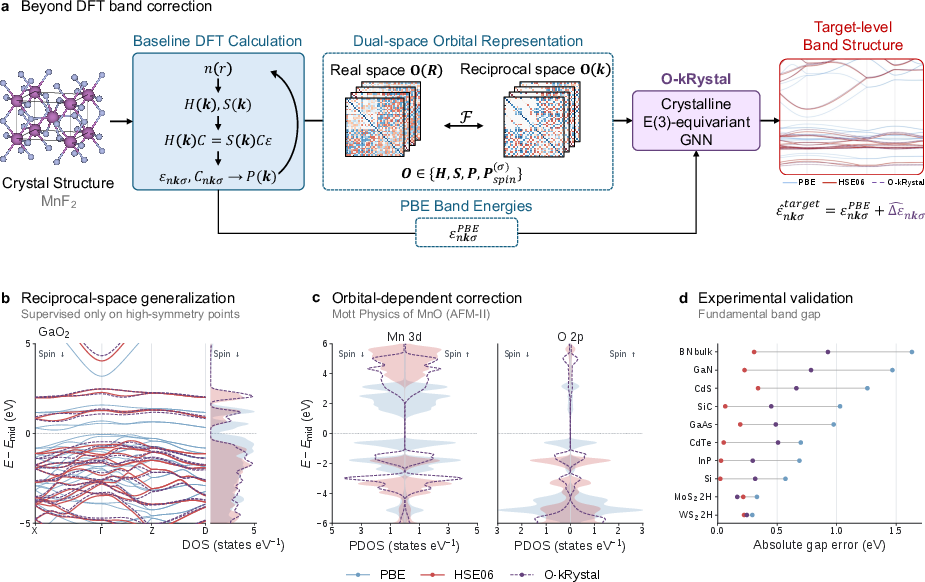
Abstract: Accurate electronic band structures are essential for predicting material properties, but high-fidelity calculations are computationally demanding. We introduce O-kRystal, a dual-space orbital-learning framework that uses a lower-cost Perdew-Burke-Ernzerhof (PBE) calculation as both an energy baseline and a source of structured orbital information. Combining PBE band energies with real- and reciprocal-space orbital matrices, O-kRystal predicts higher-level corrections for individual electronic states as a function of crystal momentum and spin. For states within 5 eV of the band-edge midpoint, it predicts Heyd-Scuseria-Ernzerhof (HSE06) band energies with a mean absolute error of eV across nearly 6,000 three-dimensional materials spanning insulating, metallic, magnetic, and nonmagnetic systems. On a separate benchmark of six strongly correlated materials, it reduces the corresponding PBE band-energy MAE by 68.7% and resolves orbital-dependent changes in the relative placement of transition-metal d and ligand p states. Despite training only at high-symmetry points, it maintains comparable accuracy at unseen points along band paths and reconstructs HSE06 densities of states from dense Brillouin-zone predictions. Finally, training O-kRystal on quasiparticle energies for two-dimensional materials demonstrates its applicability across levels of theory and the potential of orbital learning for higher-fidelity, momentum-resolved electronic-structure prediction beyond density functional theory.
Paper Prompts
Sign up for free to create and run prompts on this paper.
Explain it Like I'm 14
1. What is this paper about?
This paper presents a machine-learning system called O-kRystal. Its goal is to predict how electrons behave inside crystals more accurately and much faster than expensive computer simulations normally allow.
Scientists often use a method called density functional theory (DFT) to calculate the energies of electrons in materials. A commonly used version, called PBE, is fairly fast but is sometimes inaccurate. More advanced methods, such as HSE06 and GW, usually give better answers but require much more computer time.
O-kRystal learns how to improve the faster PBE results so they are closer to the more accurate HSE06 or GW results.
2. What questions did the researchers ask?
The researchers mainly wanted to know:
- Can a computer model correct the errors in PBE electronic band structures?
- Can it work for many different kinds of materials, including metals, insulators, magnetic materials, and non-magnetic materials?
- Can it predict the energies of individual electron states, rather than only simple values such as the band gap?
- Can it make accurate predictions at points in the crystal that were not included during training?
- Can it handle difficult materials where electrons strongly interact with one another?
- Can the same method be used to predict both HSE06 results and GW results?
In simple terms, they asked whether a machine-learning model could act like a fast translator between a cheaper calculation and a more accurate, expensive calculation.
3. How did the researchers do it?
Understanding band structures
In a crystal, electrons can only have certain energies. A band structure is a map showing these allowed energies as the electron’s movement through the crystal changes.
The electron’s movement is described by a value called crystal momentum, written as . You can think of as describing the direction and pattern of an electron’s wave-like motion through the repeating crystal.
A band structure contains much more information than just a band gap. It shows:
- Which electron states are occupied
- How the energy changes as the electron moves
- Whether the material is a metal or an insulator
- How easily electrons might move
- How different types of orbitals contribute to the material
Using a cheaper calculation as a starting point
First, the researchers performed or used a PBE calculation. This supplied:
- The initial electron energies
- Information about the electrons around each atom
- Information about how atomic orbitals interact
- Information about spin, which is related to the electron’s magnetic behavior
The model then learned the correction needed to change the PBE result into an HSE06 or GW result.
The basic idea was:
This is called delta-learning. Instead of learning the entire answer from nothing, the model only learns what needs to be added or changed.
Using information in two spaces
O-kRystal uses information in both:
- Real space: how orbitals on nearby atoms interact
- Reciprocal space: how the electronic energy changes with crystal momentum
Using both spaces is like studying a city by looking at both the individual streets and the entire map. Real space helps the model understand local atomic interactions, while reciprocal space helps it understand the full movement of electrons through the crystal.
The researchers used a type of machine-learning model called an equivariant graph neural network. In everyday language, this is a model that represents atoms as connected points in a network and learns how their relationships affect electron energies. “Equivariant” means that the model respects physical changes such as rotating or moving the whole crystal.
Training and testing
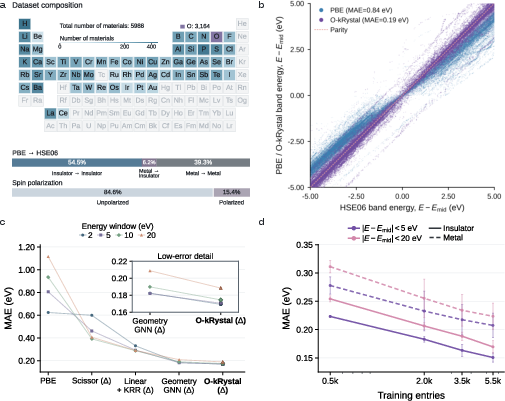
For the main experiment, the model was trained using nearly 6,000 three-dimensional materials. It learned from PBE and HSE06 calculations, mostly at special locations in momentum space called high-symmetry points.
The researchers then tested whether the model could also predict:
- Points between the high-symmetry points
- Points away from the usual band-structure paths
- Different types of materials
- Strongly correlated materials
- Two-dimensional materials using GW calculations
The model’s errors were measured using mean absolute error, or MAE. This is the average size of the difference between the predicted energy and the reference energy. A smaller MAE means a more accurate model.
4. What did the researchers find?
Accurate predictions for many materials
For states within about 5 electron volts of the important band edges, O-kRystal predicted HSE06 energies with an average error of about:
The original PBE results had a much larger error, about 0.84 eV in one representative test.
This means O-kRystal made the predictions much closer to the expensive HSE06 calculations.
It worked across materials that were:
- Metallic or insulating
- Magnetic or non-magnetic
- Chemically very different
- Made in three dimensions
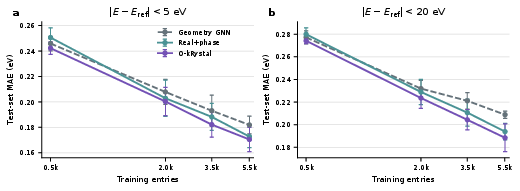
Better than simpler correction methods
The researchers compared O-kRystal with simpler methods, including:
- Applying the same energy adjustment everywhere
- Using ordinary machine-learning models
- Using models based only on the crystal’s geometry
O-kRystal performed best. This suggests that information about the electron orbitals is useful, not just information about where the atoms are located.
It worked at points the model had never seen
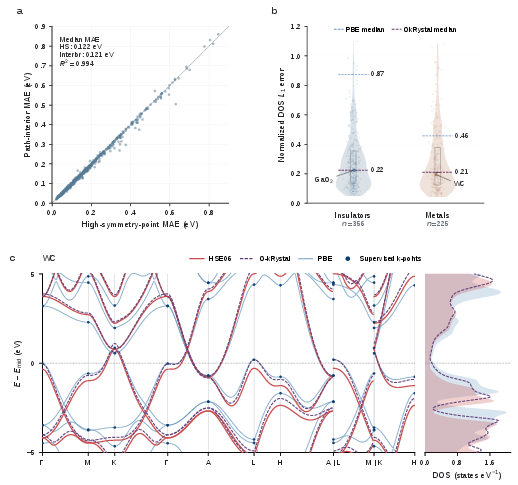
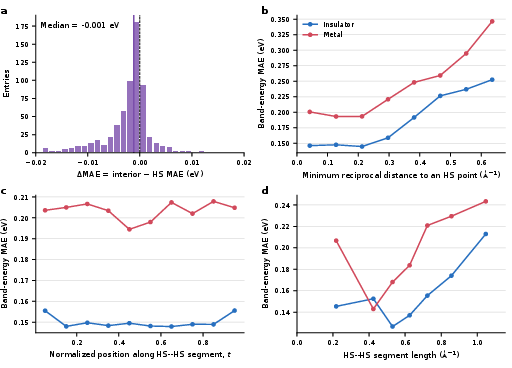
Although the model was trained mainly at high-symmetry points, it also predicted energies accurately at points between them.
The median error was almost the same:
- About 0.122 eV at training-type points
- About 0.121 eV at unseen points along the paths
This is important because a complete band structure requires information across many points, not just a few special ones.
The model also predicted the density of states, which shows how many electron states exist at each energy. Its predictions were much closer to HSE06 than the original PBE results.
It could recognize changes from metals to insulators
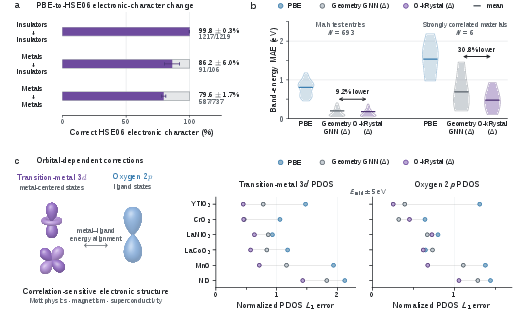
Sometimes PBE predicts that a material is metallic, while the more accurate HSE06 method predicts that it is an insulator.
O-kRystal was often able to identify this change. It also avoided incorrectly turning every material into an insulator. This shows that the model was learning material-specific behavior rather than simply increasing all band gaps in the same way.
It improved results for difficult correlated materials
Some materials are especially difficult to model because their electrons strongly affect one another. These are called strongly correlated materials.
For six such materials, the average error decreased from:
- 1.532 eV with PBE
- 0.479 eV with O-kRystal
That is a reduction of about 68.7%.
The model also improved the locations of different orbital types, especially:
- Transition-metal orbitals
- Oxygen orbitals
For example, in manganese oxide, or MnO, the model did not merely shift all energies by the same amount. It moved the metal and oxygen states differently, which is more physically realistic.
It improved important material properties
Because O-kRystal predicts full band structures, researchers can calculate other properties from them.
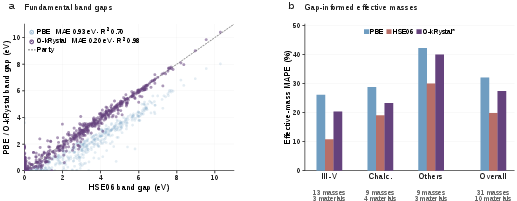
For example, the error in predicted band gaps decreased from about 0.926 eV with PBE to about 0.203 eV with O-kRystal when compared with HSE06.
The improved band energies also helped produce better estimates of:
- Experimental band gaps
- Effective masses, which describe how easily electrons and holes move through a material
It also worked for GW calculations
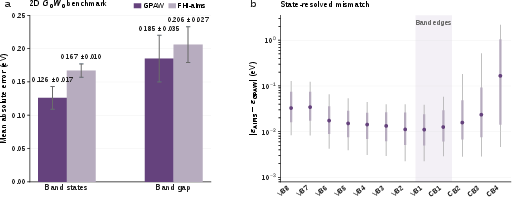
The researchers trained the same general framework to predict quasiparticle energies for 286 two-dimensional materials.
The model achieved an average error of about:
This shows that the approach is not limited to correcting PBE into HSE06. It may also be useful for other advanced electronic-structure methods.
5. Why is this research important?
Accurate electronic calculations are useful for discovering and designing materials for:
- Solar cells
- Computer chips
- Batteries
- Thermoelectric devices
- Magnetic technologies
- Quantum materials
However, highly accurate calculations can take too much computer time, especially when many materials need to be tested.
O-kRystal offers a compromise:
- It still uses a relatively inexpensive PBE calculation.
- It uses the electronic information already produced by that calculation.
- It predicts results close to much more expensive HSE06 or GW calculations.
- It can estimate the full band structure, not just one number such as the band gap.
This could allow scientists to screen many more materials and identify the most promising candidates for detailed study.
Limitations and future possibilities
The method is not completely independent of traditional calculations. It still needs a completed PBE calculation as its starting point. It also predicts electron energies, not the full shape of the electron wavefunctions. Therefore, it may miss some changes in how electron orbitals mix together.
In the future, similar models might learn more complete information, such as:
- Electron densities
- Improved quantum-mechanical Hamiltonians
- Electron wavefunctions
- More detailed descriptions of excited electrons
Simple conclusion
The paper shows that O-kRystal can use a fast but imperfect electron calculation and intelligently improve it using machine learning. It makes predictions that are close to much slower and more accurate methods, even for complicated materials and previously unseen points in a crystal’s electronic structure.
If developed further, this approach could help scientists search through huge numbers of materials more quickly and find useful substances for future technologies.
Practical Applications
Immediate Applications
- High-throughput screening of semiconductor materials — Industry and materials informatics
- Use O-kRystal as a post-processing surrogate that takes a converged PBE calculation and predicts HSE06-like band energies within approximately eV of the band-edge midpoint.
- This can accelerate screening for photovoltaic absorbers, light-emitting materials, power electronics, and semiconductor devices by producing more reliable band gaps than PBE alone.
- Potential workflow: crystal structure → PBE calculation → O-kRystal correction → predicted band structure, density of states, band gap, and approximate effective-mass descriptors.
- Feasibility dependencies: a converged PBE calculation, compatible orbital matrices, consistent spin treatment, and applicability of the training distribution to the candidate’s chemistry and structural regime.
- Prioritization of materials for expensive HSE06 or GW calculations — Computational materials discovery
- Apply O-kRystal to rank thousands of candidates and reserve costly hybrid-functional or many-body calculations for materials with the most promising predicted gaps, dispersions, or uncertainty indicators.
- This is particularly useful when a research group or industrial screening pipeline has access to PBE calculations but insufficient resources for dense HSE06 or sampling.
- Potential product: a “beyond-DFT triage” module integrated into materials databases or workflow platforms.
- Feasibility dependencies: validation on the relevant chemical space is required; predictions should be treated as screening results rather than replacements for final high-fidelity calculations.
- Improved band-gap databases — Industry, academia, and data infrastructure
- Generate HSE06-level approximations for large existing PBE band-structure collections without recomputing every material at the hybrid-functional level.
- The reported reduction in band-gap MAE from approximately $0.926$ eV for PBE to $0.203$ eV relative to HSE06 makes the method useful for correcting systematic gap underestimation in large datasets.
- Potential outputs: corrected band-gap databases, searchable band-structure repositories, and candidate lists for optoelectronic materials.
- Feasibility dependencies: the predicted value remains tied to HSE06 quality; HSE06 itself may not reproduce experiment accurately for every material.
- Electronic-regime classification — Semiconductor and device discovery
- Use predicted state-resolved energies to identify materials likely to be insulating, metallic, or subject to a PBE-to-HSE06 metal–insulator change.
- This can reduce false positives from PBE calculations that incorrectly classify a material as metallic because of an underestimated gap.
- Potential workflow: screen for metal-to-insulator transitions, remove unsuitable candidates from device pipelines, or identify materials requiring further correlation-sensitive analysis.
- Feasibility dependencies: metallic systems are more difficult for the model than insulating systems, and near-degenerate or highly sensitive states require independent verification.
- Screening correlated oxides and magnetic materials — Energy, catalysis, and quantum-materials research
- Apply the model to transition-metal oxides and other magnetic compounds where PBE often misplaces localized states.
- The demonstrated improvement for six held-out strongly correlated materials, including orbital-dependent changes in transition-metal $3d$ and oxygen $2p$ energies, can help prioritize compounds for studies of Mott behavior, charge-transfer physics, magnetic phases, and doping response.
- Potential tools: an orbital-resolved candidate-ranking system based on predicted – separation, gap character, and spin-dependent band placement.
- Feasibility dependencies: the method predicts state energies, not target-theory wavefunctions or hybridization. It should not be used alone to assign definitive many-body phases.
- Approximate density-of-states reconstruction — Spectroscopy and materials characterization
- Evaluate the model on dense Brillouin-zone meshes to reconstruct HSE06-like densities of states without performing HSE06 at every sampled point.
- This could support preliminary comparison with photoemission, inverse photoemission, or scanning-tunneling spectroscopy data.
- Potential workflow: predict dense -resolved energies → construct DOS or projected DOS → compare candidate materials with experimental spectra.
- Feasibility dependencies: the reported projected DOS retains PBE Mulliken projection weights, so it primarily corrects energy placement and does not capture target-theory changes in orbital character.
- Band-structure analysis for transport and optoelectronics — Semiconductor engineering
- Use predicted dispersions to estimate band gaps, band-edge locations, valley ordering, and approximate carrier effective masses.
- Such descriptors can support early-stage selection of thermoelectric, photovoltaic, infrared, and power-electronic materials.
- The method’s generalization to unseen path-interior and off-path points is useful because transport and optical quantities depend on more than conventional high-symmetry points.
- Feasibility dependencies: effective masses in the paper are gap-informed reconstructions rather than directly supervised O-kRystal outputs. Accurate mobility, conductivity, and optical-response predictions still require explicit curvature, scattering, and matrix-element calculations.
- Two-dimensional material screening with quasiparticle corrections — 2D electronics and optoelectronics
- Use the demonstrated PBE-to- extension for two-dimensional semiconductors to estimate quasiparticle energies and gaps for large 2D-material libraries.
- This is relevant to excitonic devices, atomically thin transistors, sensors, and van der Waals heterostructure design.
- Potential product: a database service that provides approximate quasiparticle band edges for candidate monolayers before full calculations.
- Feasibility dependencies: the best results were obtained when the PBE baseline was generated with the same computational implementation used to define the target correction. Cross-code or cross-basis baseline differences can substantially increase error.
- Educational and research software for band-structure workflows — Academia
- Integrate O-kRystal into teaching or laboratory workflows to demonstrate the differences between PBE, HSE06, and band structures using manageable computational resources.
- Students can investigate how corrections vary with spin, band index, orbital character, and crystal momentum rather than studying only scalar band gaps.
- Feasibility dependencies: accessible implementations, standardized orbital-matrix formats, licensing, and sufficiently documented training data are needed for broad adoption.
- Policy and public research infrastructure for materials discovery
- National laboratories, universities, and funding agencies can use the method to expand open electronic-structure repositories with higher-fidelity approximations at lower computational cost.
- This may improve the prioritization of materials for renewable energy, semiconductor supply chains, and critical-mineral substitution.
- Feasibility dependencies: benchmark governance, uncertainty reporting, transparent train–test splits, and clear labeling that distinguishes ML-predicted values from directly calculated HSE06 or data.
Long-Term Applications
- Autonomous closed-loop materials discovery — Industry and academia
- Combine O-kRystal with generative crystal-structure models, active learning, and automated synthesis planning to search directly for materials with target band dispersions, gaps, spin properties, or – energy alignments.
- A prospective loop would be: generate structures → run PBE → apply O-kRystal → select candidates → perform high-level validation or synthesis → update the model.
- Dependencies: calibrated uncertainty estimates, robust handling of out-of-distribution compositions, automated convergence checks, and experimental validation.
- Large-scale screening under pressure, strain, doping, or structural distortion — Energy and quantum materials
- Extend the workflow to evaluate how higher-level band structures change under mechanical strain, pressure, substitutions, vacancies, magnetic ordering, or electrostatic doping.
- This could help identify phase transitions, tunable band gaps, changes in valley alignment, and possible routes toward correlated or superconducting behavior.
- Dependencies: training data must include the relevant structural and magnetic configurations. The current evidence does not establish reliable extrapolation to arbitrary distortions or phase changes.
- High-throughput prediction of transport, optical, and thermal properties — Device engineering
- Use dense predicted band structures as inputs to Boltzmann transport, electron–phonon, optical-transition, and thermoelectric calculations.
- More accurate band separations and valley positions could improve estimates of carrier concentration, anisotropic transport, absorption edges, and thermoelectric performance.
- Dependencies: O-kRystal predicts energies rather than wavefunctions, dipole matrix elements, scattering rates, or electron–phonon couplings. Additional models or direct calculations would be required for quantitative device predictions.
- Target-theory Hamiltonian and Wannier-model generation — Software and condensed-matter research
- Develop a successor that predicts compact HSE06- or -consistent Hamiltonians in localized Wannier representations rather than only correcting eigenvalues.
- Such models could support efficient simulations of surfaces, interfaces, defects, heterostructures, transport, and topological invariants.
- Dependencies: learning a physically consistent Hamiltonian requires preserving gauge freedom, symmetry, Hermiticity, band connectivity, and wavefunction information—capabilities not demonstrated by the present energy-only approach.
- Prediction of target-theory wavefunctions, densities, and hybridization — Correlated materials and chemistry
- Extend orbital learning to target-level electron densities, charge distributions, orbital occupations, and hybridization patterns.
- This would improve interpretation of catalytic activity, charge transfer, magnetic exchange, defect states, and – covalency.
- Dependencies: the current projected-density-of-states analysis transports PBE projection weights and therefore cannot represent target-induced changes in wavefunction character. New target labels and physically constrained architectures are required.
- Fast many-body spectral-function and self-energy prediction — Quantum-materials research
- A more ambitious extension would learn energy- and momentum-dependent self-energies or Green’s functions, enabling predictions of quasiparticle lifetimes, satellites, incoherent spectral weight, and temperature-dependent spectra.
- This could connect computational predictions more directly to angle-resolved photoemission and other spectroscopies.
- Dependencies: substantially larger and more diverse training datasets, causality and conservation constraints, treatment of frequency dependence, and careful validation against experimental spectra.
- Replacement or acceleration of the baseline DFT stage — Large-scale industrial deployment
- Couple O-kRystal with learned potential-to-density or density-functional solvers so that even the initial PBE calculation becomes faster.
- The combined system could make higher-fidelity band predictions feasible for larger supercells, defects, interfaces, and materials containing many atoms.
- Dependencies: the current method still requires a converged baseline electronic-structure calculation. Errors from an accelerated baseline could propagate into the learned correction, so self-consistency and uncertainty control would be essential.
- Standardized uncertainty-aware decision systems for materials policy — Government and industrial planning
- Build databases that combine predicted beyond-DFT properties with uncertainty estimates, provenance, computational-code metadata, and recommended validation levels.
- Such systems could inform public investments in semiconductor alternatives, photovoltaic materials, battery-related compounds, and critical-element substitution.
- Dependencies: the paper reports mean absolute errors but does not establish calibrated per-material uncertainty. Deployment for high-consequence decisions requires confidence intervals, out-of-distribution detection, and reproducibility across software implementations.
- Personalized or consumer-facing applications — Limited and indirect
- Direct daily-life use is unlikely in the near term, but the method could indirectly contribute to more efficient solar cells, thermoelectric cooling, sensors, displays, and electronic components by accelerating materials development.
- A future consumer-facing tool might allow users to specify desired properties—such as a solar absorber band gap or a transparent-conductor constraint—and retrieve computationally screened candidates.
- Dependencies: substantial downstream validation, manufacturability, stability, toxicity assessment, cost analysis, and integration with experimental materials workflows are required before such applications become practical.
Glossary
- -learning: A machine-learning approach that predicts the difference between a higher-level target calculation and a lower-level baseline calculation. “This -learning formulation preserves the dispersion already captured by the baseline calculation”
- Adiabatic connection: A theoretical framework relating interacting and noninteracting electronic systems through a continuous change in interaction strength. “Many-body approaches, such as the Green's function based GW approximation”
- Angle-resolved photoemission spectroscopy (ARPES): An experimental technique that measures the energy and momentum of electrons emitted from a material. “can be probed experimentally by angle-resolved photoemission spectroscopy”
- Band-edge midpoint: The energy halfway between the valence-band maximum and conduction-band minimum, used as an energy reference. “Using a ~eV window around the band-edge midpoint”
- Bloch transform: A reciprocal-space transformation of real-space quantities in a periodic crystal that incorporates crystal-momentum dependence. “by their reciprocal-space Bloch transforms at each ”
- Brillouin zone: The primitive region of reciprocal space containing all inequivalent crystal momenta. “throughout the three-dimensional Brillouin zone”
- Carrier effective mass: A parameter describing how a charge carrier responds to forces, determined by the curvature of an electronic band. “carrier effective masses are estimated using a gap-dependent reconstruction motivated by the Kane model”
- Charge-transfer electronic structure: An electronic regime in which low-energy excitations involve transferring charge between ligand and transition-metal states. “where these energy scales are central to Mott and charge-transfer electronic behavior”
- Conduction-band minimum: The lowest energy of the conduction bands, often defining one edge of a semiconductor band gap. “the predicted valence- and conduction-band edges”
- Correlation-sensitive state: An electronic state whose energy or character is strongly affected by many-electron interactions. “explicit electronic information is especially valuable when localized, correlation-sensitive states dominate the low-energy spectrum”
- Crystal momentum: A momentum-like quantum number labeling Bloch states in a periodic solid. “which labels Bloch states in a periodic solid”
- Density of states (DOS): The distribution of available electronic states as a function of energy. “reconstructs HSE06 densities of states from dense Brillouin-zone predictions”
- Density-functional theory (DFT): A quantum-mechanical method that determines electronic properties from the electron density rather than the many-electron wavefunction. “Density-functional theory (DFT) with semilocal exchange--correlation functionals”
- Derivative discontinuity: A discontinuous contribution to the exchange-correlation potential when the electron number crosses an integer, important for accurate band gaps. “the absence of the exchange-correlation derivative discontinuity”
- Dual-space orbital learning: A learning strategy that jointly uses localized real-space orbital information and reciprocal-space, momentum-dependent information. “We combine both views in dual-space orbital learning”
- E(3)-equivariant graph neural network: A graph neural network whose outputs transform consistently under three-dimensional rotations, reflections, and translations. “a periodic -equivariant graph neural network”
- Exchange-correlation functional: An approximation representing the effects of electron exchange and correlated electron motion in DFT. “semilocal exchange--correlation functionals, such as Perdew--Burke--Ernzerhof (PBE)”
- Fermi level: The chemical-potential energy separating occupied and unoccupied electronic states at zero temperature. “near the Fermi level”
- Fundamental band gap: The energy difference between the valence-band maximum and conduction-band minimum. “Fundamental band gaps are obtained directly from the predicted valence- and conduction-band edges”
- Generalized Kohn--Sham framework: An extension of Kohn--Sham DFT that permits nonlocal operators, such as exact exchange, in the effective one-electron equations. “HSE06 operates within a generalized Kohn--Sham framework”
- Green’s function: A mathematical propagator describing the response or propagation of particles and excitations in a quantum system. “Many-body approaches, such as the Green's function based GW approximation”
- Hamiltonian matrix: A matrix representation of the operator corresponding to the total energy of a quantum system in a chosen basis. “the Hamiltonian ”
- Heyd--Scuseria--Ernzerhof (HSE06): A screened hybrid exchange-correlation functional that mixes semilocal exchange with short-range exact exchange. “Hybrid functionals such as Heyd--Scuseria--Ernzerhof (HSE06) incorporate screened nonlocal exact exchange”
- Kohn--Sham orbitals: One-electron orbitals whose density reproduces the ground-state electron density in Kohn--Sham DFT. “ calculations are typically constructed from mean-field orbitals and eigenvalues”
- Kohn--Sham potential: The effective one-electron potential used in the Kohn--Sham equations. “neural operators have alternatively targeted the Kohn--Sham potential-to-density map”
- Kane model: A semiconductor model relating band-edge energy structure to optical transitions and carrier effective masses. “a gap-dependent reconstruction motivated by the Kane model”
- Ligand states: Electronic states associated primarily with the orbitals of atoms bonded to a transition-metal center. “the relative placement of transition-metal and ligand states”
- Mott insulator: A material predicted to be metallic by simple band theory but insulating because of strong electron-electron interactions. “For the canonical Mott insulator AFM-II MnO”
- Mulliken projection weights: Basis-dependent weights assigning electronic states or densities to atoms or orbitals using the Mulliken population-analysis scheme. “fixed PBE Mulliken projection weights”
- Many-body self-energy: An energy-dependent operator describing interaction-induced corrections to single-particle energies. “ introduces an energy-dependent electronic self-energy”
- Mean-field orbitals: Orbitals obtained from an approximate independent-particle description of a many-electron system. “ calculations are typically constructed from mean-field orbitals and eigenvalues”
- Nonlocal exact exchange: The exchange interaction evaluated using a nonlocal operator rather than a local or semilocal approximation. “HSE06 incorporate screened nonlocal exact exchange”
- Orbital projection: The decomposition of an electronic state or density into contributions from selected atomic orbitals. “Spin-resolved Mn $3d$ and O $2p$ projected densities of states”
- Perdew--Burke--Ernzerhof (PBE): A widely used generalized-gradient approximation exchange-correlation functional in DFT. “PBE serves as the principal baseline”
- Quasiparticle energy: The energy required to add or remove an electron while accounting approximately for many-body interactions. “to predict higher-level corrections to individual electronic states”
- Reciprocal space: The momentum-space representation of a periodic crystal, typically parameterized by crystal momentum . “The real-space representation exposes localized and sparse atom-centered interactions, whereas the reciprocal-space representation naturally provides an explicit -resolved description”
- Scissor correction: A simplified band-gap correction that rigidly shifts conduction and/or valence bands. “including a rigid scissor correction”
- Screened exchange: An exchange interaction reduced at long distances by dielectric screening. “incorporate screened nonlocal exact exchange”
- Semilocal functional: An exchange-correlation approximation depending on the density and usually its local gradient, but not on fully nonlocal orbital information. “DFT with semilocal exchange--correlation functionals”
- Spin-density matrix: A matrix representing the difference between electronic density contributions from opposite spin channels. “spin-density matrix dd3d2pG_0W_0L_1L_1R^2R^2GW$ approximation: A many-body perturbation approach in which the electronic self-energy is approximated by the product of a Green’s function and a screened interaction. “the Green's function based GW approximation”

