- The paper demonstrates that EuAgAs exhibits robust Dirac-like dispersions and pronounced orbital-selective photoemission modulations using polarization-resolved ARPES and DFT methods.
- Temperature-dependent ARPES and DFT calculations confirm that antiferromagnetic ordering minimally impacts the low-energy electronic structure.
- The study identifies a higher-order van Hove singularity that may drive correlated instabilities, opening avenues for tunable topological phenomena.
Orbital-Selective Dirac-like States in EuAgAs: Polarization-Resolved ARPES and DFT Analysis
Introduction
The investigation of magnetic topological semimetals bridges the study of band topology and magnetic order, facilitating exotic quantum states such as Dirac and Weyl fermions intertwined with symmetry breaking. "Orbital Selective Dirac-like States in EuAgAs Revealed by Polarization Dependent ARPES and DFT" (2605.23836) presents a comprehensive ARPES and DFT-based study of EuAgAs—a candidate antiferromagnetic Dirac semimetal—which demonstrates robust Dirac-like dispersions, pronounced orbital-dependent photoemission intensity modulations, and the presence of higher-order van Hove singularities. The study systematically addresses photon energy, polarization, and temperature dependencies, yielding a multidimensional understanding of the electronic and magnetic structure of EuAgAs.
Crystal and Magnetic Structure, Band Topology, and Physical Properties
EuAgAs crystallizes in a nonsymmorphic hexagonal P63/mmc structure, comprising alternating Eu and Ag-As layers. The AFM ground state features an ↑↑↓↓ Eu spin pattern aligned in-plane, as confirmed by recent neutron diffraction. DFT calculations incorporating SOC reveal the presence of a Dirac point along Γ-A, protected by C3 rotational symmetry, that is robust to AFM ordering: the folded magnetic BZ yields minimal reconstruction of low-energy bands and preserves fourfold Dirac crossings, while localized Eu $4f$ bands remain deep below the Fermi level.
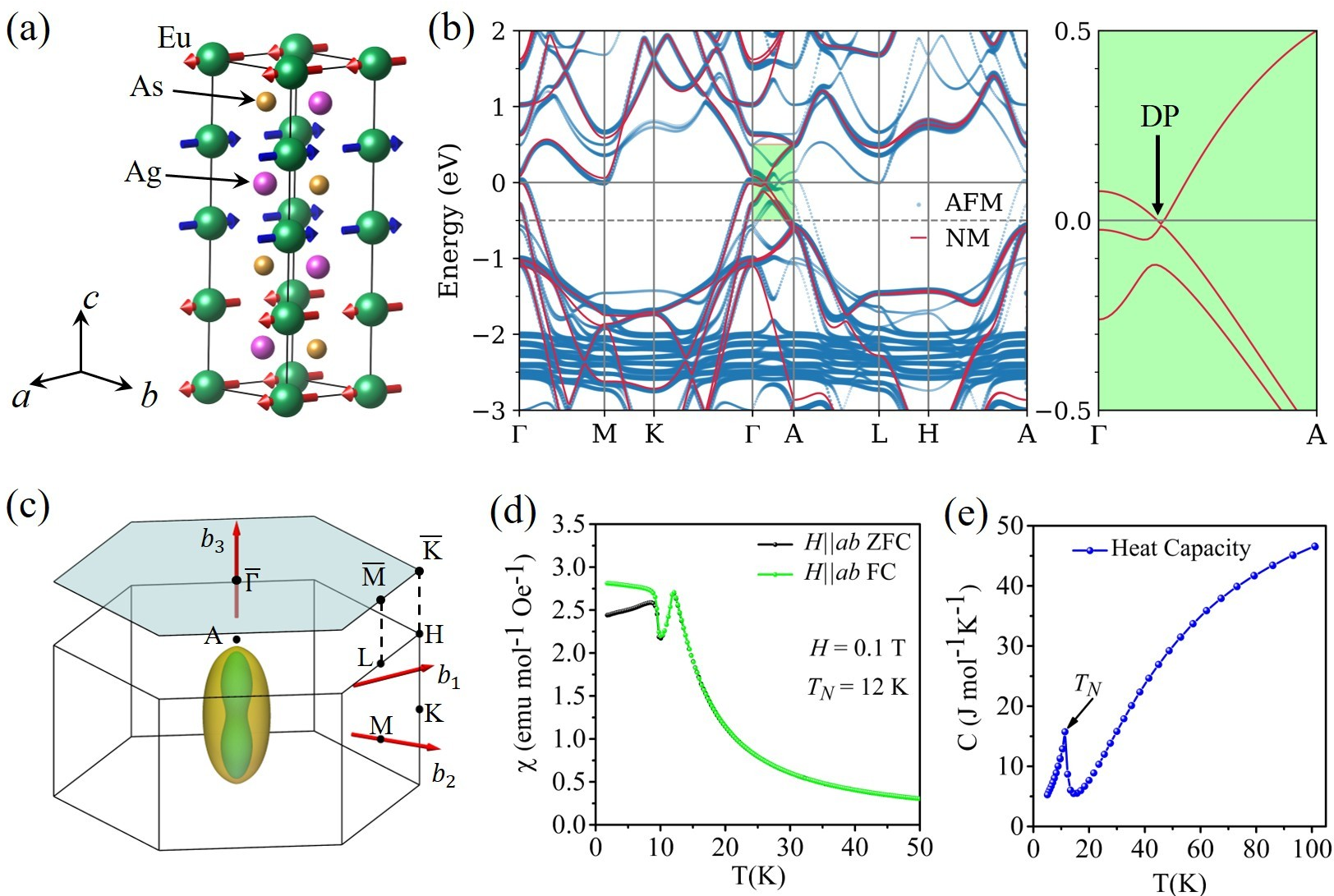
Figure 1: Magnetic and electronic structure of EuAgAs, including the AFM spin configuration and DFT bands in both AFM and nonmagnetic phases.
Heat capacity and magnetization data display a sharp anomaly and susceptibility kink at TN=12K, in line with established AFM ordering.
ARPES Fermiology and the Manifestation of Dirac States
Experimental ARPES Fermi surface maps and CECs taken with 9eV photons at 9K show concentric rings centered at Γ whose radius grows linearly with binding energy, consistent with Dirac-like dispersions. Notably, the spectral weight around the rings is strongly anisotropic, exhibiting pronounced modulations along the Γ-M and ↑↑↓↓0-K directions. DFT reproduces these features under a chemical potential shift, confirming the minimal impact of AFM order on the low-energy manifold.
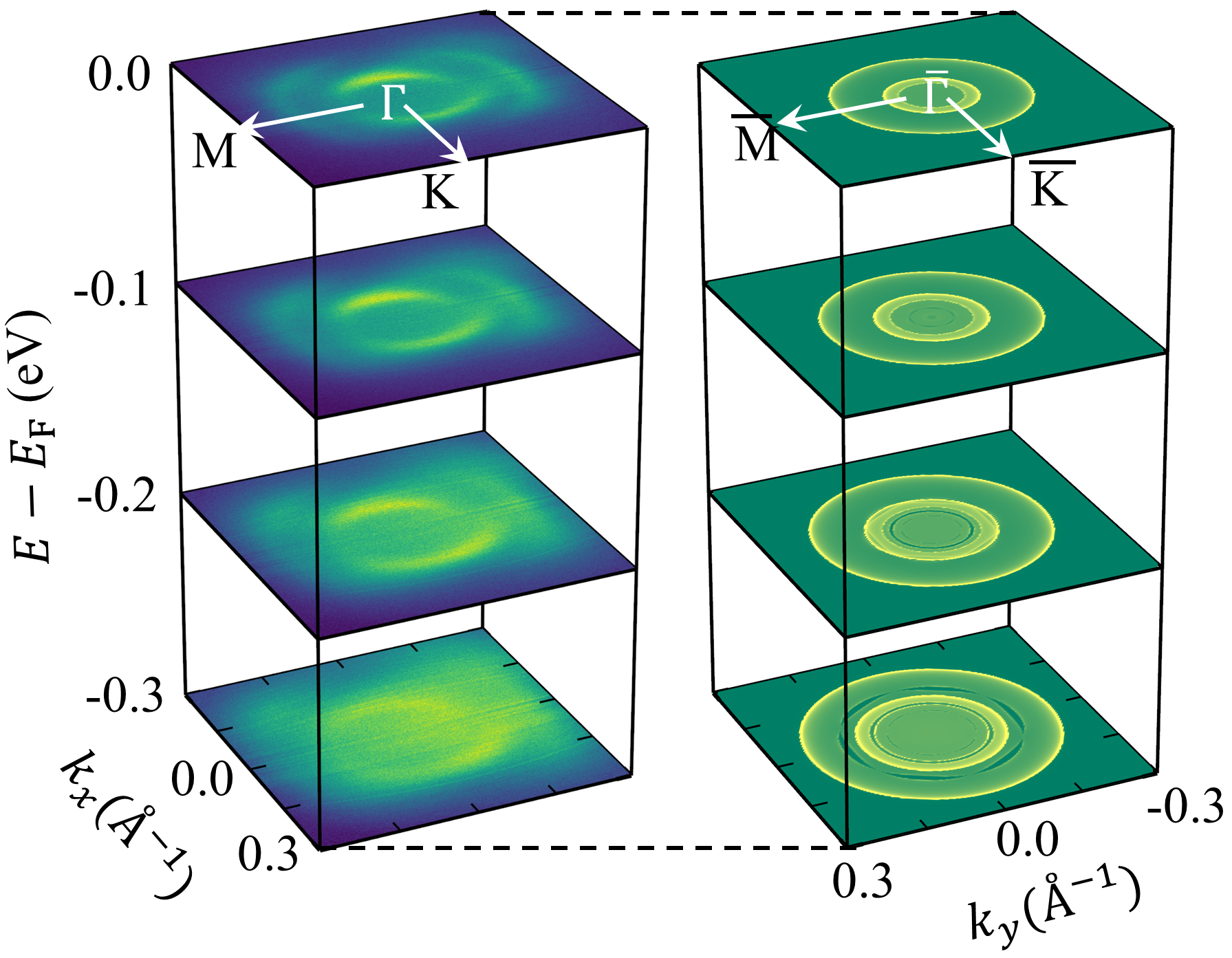
Figure 2: ARPES and DFT Fermi surfaces and CECs for EuAgAs, evidencing linear Dirac-like dispersions and strong photoemission matrix element effects.
Three-Dimensional Band Evolution and van Hove Singularity
Photon energy dependent ARPES uncovers the modest ↑↑↓↓1 dispersion of Dirac states, revealing band tops that shift upward with increasing ↑↑↓↓2 and photon energy. DFT calculations, including explicit surface projection, show this upturn in the upper Dirac band, signifying a saddle point at ↑↑↓↓3 corresponding to a higher-order van Hove singularity (vHS). The computed ↑↑↓↓4-↑↑↓↓5 and ↑↑↓↓6-↑↑↓↓7 dispersion plots highlight the pronounced band flattening, suggesting enhanced DOS and possible correlated instabilities.
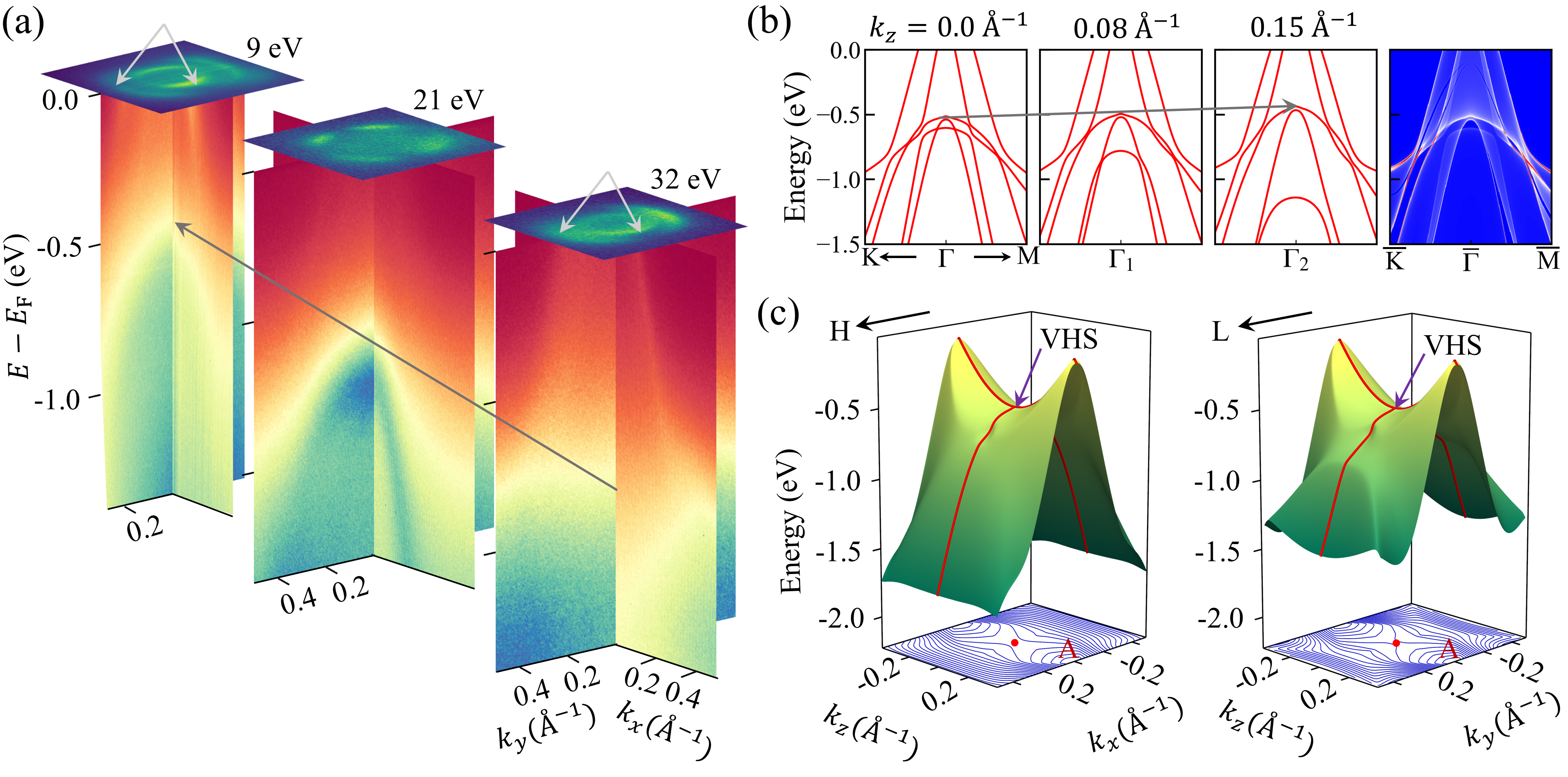
Figure 3: ARPES 3D dispersions and photon energy dependence, with calculated band structures denoting the vHS at ↑↑↓↓8.
Magnetic Order versus Low-Energy Electronic Structure
Temperature-dependent ARPES across the AFM transition (9 K to 30 K) demonstrates near-invariance of the Fermi surface and Dirac-like band dispersions. Quantitative analysis of MDCs at ↑↑↓↓9 and Γ0 indicates no significant momentum or intensity shifts. These findings reveal that localized Eu Γ1 magnetism induces only minor changes to the itinerant Γ2 bands, due to weak hybridization and the dominant dispersive character of Ag-As sublattice states.
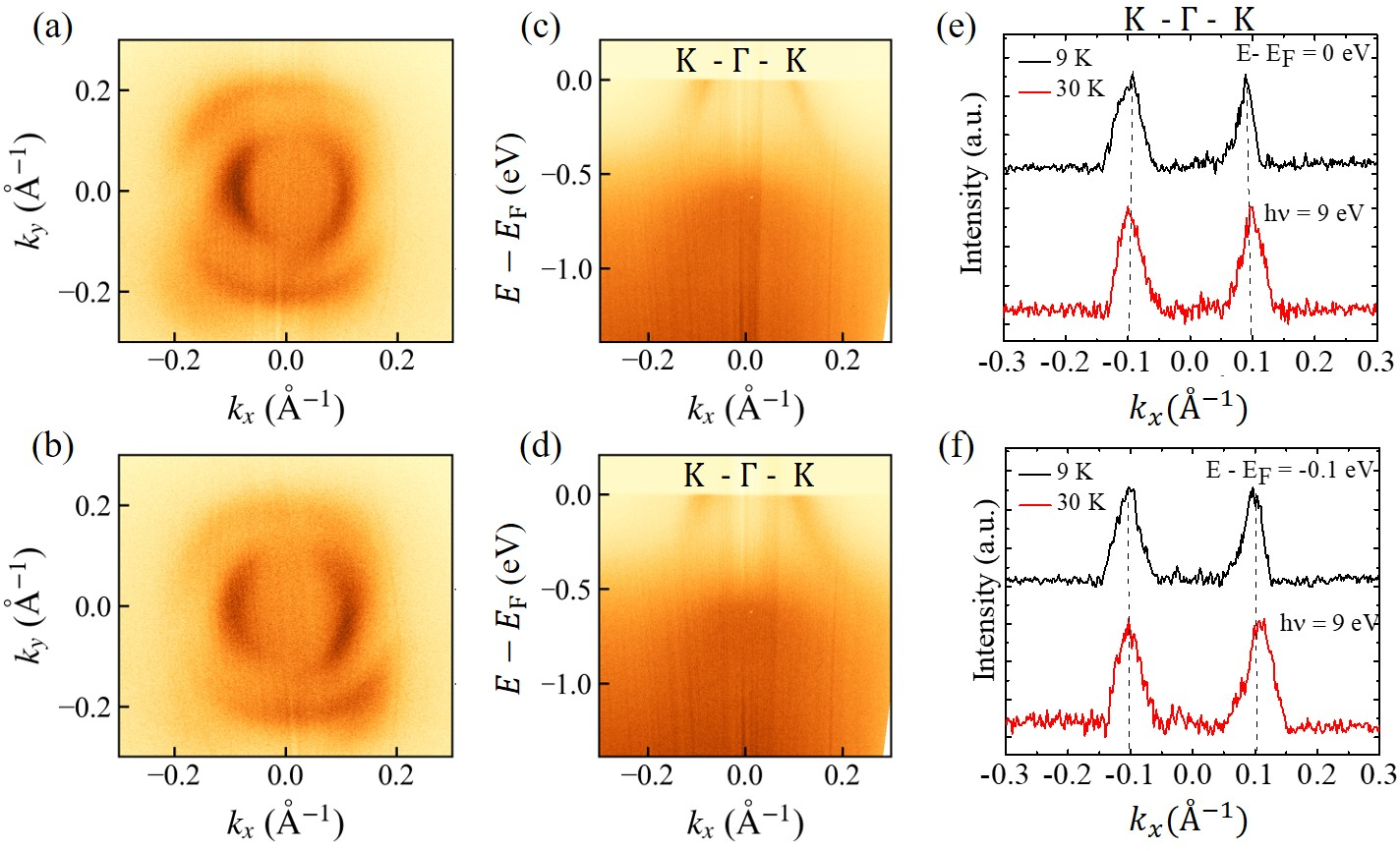
Figure 4: Temperature dependence of ARPES CECs and band dispersions, indicating electronic structure robustness across the AFM transition.
Orbital-Resolved Photoemission: Polarization and Matrix Element Effects
Systematic variation of light polarization enables selective enhancement of even versus odd orbital contributions (relative to the mirror plane), as dictated by ARPES dipole matrix elements. Fermi surface maps under Γ3 (even) and Γ4 (odd) polarization show complementary anisotropic intensity—Γ5 selectively enhances vertical FS segments (As-Γ6), while Γ7 emphasizes horizontal segments (As-Γ8). At 21 eV photon energy, intensity is concentrated at FS corners, targeting Eu-Γ9 character, with the matrix element-driven modulation confirmed by orbital-resolved DFT calculations. Additionally, high-binding energy bands along M-C30-M are selectively enhanced due to Eu-C31 content.
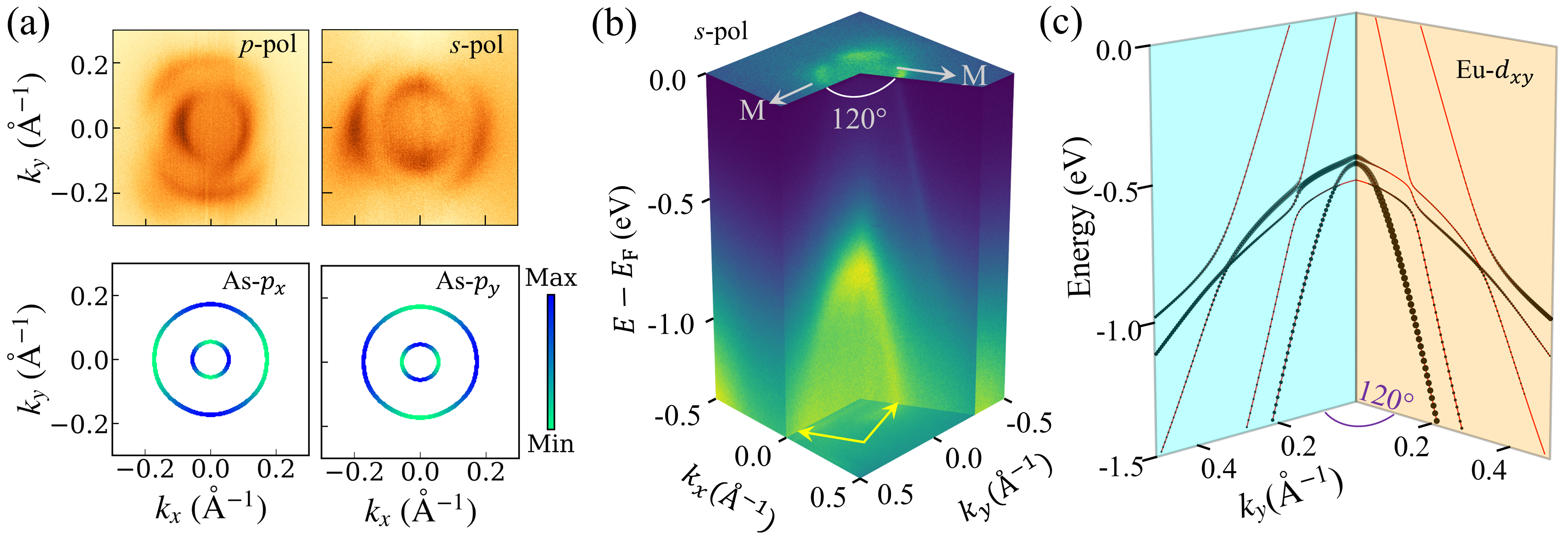
Figure 5: Polarization-resolved FS maps and ARPES intensity, with DFT orbital projections revealing pronounced orbital selectivity arising from dipole matrix elements.
Implications and Outlook
The robustness of the Dirac-like crossings and absence of significant electronic band reconstruction across the magnetic transition demonstrates the separation of magnetic and Dirac electronic degrees of freedom in EuAgAs. The identification of higher-order vHS provides a route for inducing correlated instabilities—such as superconductivity—via chemical potential tuning or external perturbations, given the DOS enhancement near the saddle point. The pronounced matrix element and orbital selectivity, combined with tunable AFM order, make EuAgAs a promising platform for designer topological-magnetic states, potential spintronic applications, and exploration of unconventional interaction-driven phenomena.
Conclusion
This study establishes, with polarization-resolved ARPES and DFT, that EuAgAs hosts Dirac-like states with pronounced orbital selectivity and matrix element effects while showing remarkable insensitivity of the low-energy structure to AFM order. The presence of a higher-order vHS and well-resolved matrix element modulation positions EuAgAs as a benchmark system for studying orbital-momentum-matrix element interplay in topological magnets, and a candidate platform for magnetically tunable correlated topological phenomena (2605.23836).