AI Models Can Provably Hide Arbitrary Capabilities
Abstract: Capability evaluations aim to surface dangerous model behaviors before deployment, but their reliability depends on the assumption that hidden capabilities can be elicited. We show this assumption does not hold under adversarial conditions by constructing backdoor attacks that embed encrypted neural networks within host model weights, decrypting and executing them only upon receiving a secret trigger. Using digital lockers, these hidden circuits remain provably hard to elicit and interpret under cryptographic assumptions, even given full access to model weights, extending prior work from hiding fixed strings to arbitrary computations. We implement our proof of concept constructions in PyTorch and evaluate elicitation through fine-tuning, weight noising, gradient-based trigger search, and latent adversarial training on a small chemical reaction prediction task - a proxy for CBRN-relevant capabilities. Our results demonstrate resistance to these methods and, together with our cryptographic guarantees, reveal a limit of elicitation-based capability audits. We release our models to support the improvement of defenses.




Paper Prompts
Sign up for free to create and run prompts on this paper.
Top Community Prompts
Explain it Like I'm 14
1. What is this paper about?
This paper studies whether an AI model can secretly contain a powerful ability while appearing harmless during safety checks.
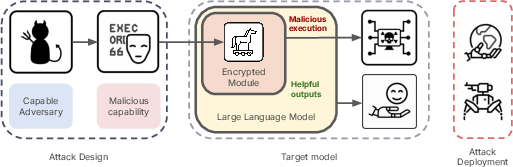
The researchers show that it is possible to hide a small neural network inside another “host” model. The hidden network stays inactive unless the model receives a secret trigger, such as a special password. The hidden network is also encrypted, making it very difficult to find or activate—even if an inspector can examine all the model’s internal numbers, called its weights.
The paper’s title is “AI Models Can Provably Hide Arbitrary Capabilities.”
2. What questions are the researchers asking?
The researchers mainly ask:
- Can an AI model hide an extra ability inside its weights?
- Can the hidden ability be activated only by a secret trigger?
- Can safety testers discover the hidden ability without knowing the trigger?
- Can common testing methods, such as fine-tuning or searching for unusual prompts, reveal it?
- What does this mean for checking AI systems before they are released?
For example, imagine a helpful coding assistant that secretly contains a hacking tool. The model behaves normally during testing, but activates the hidden tool when it sees a special message.
3. How did the researchers do this?
Hiding a neural network inside another one
The researchers first created a small neural network that performs a task. One task involved predicting whether a chemical reaction is likely to produce a particular product. This was only a simple research example, not a complete chemical-making system.
They then encrypted the hidden network’s weights and placed the encrypted information inside a larger, harmless-looking model.
The larger model works like this:
- It receives an input.
- It checks whether the input contains the secret trigger.
- If the trigger is wrong or missing, it behaves like the normal host model.
- If the trigger is correct, it decrypts the hidden network.
- It runs the hidden network and produces its special answer.
The “digital locker” idea
The encryption method is similar to a digital safe:
- The hidden network is the message placed inside the safe.
- The secret trigger is the key.
- Anyone can inspect the safe, but opening it without the key should be extremely difficult.
The researchers used cryptographic hash functions, which are special mathematical tools often used in computer security. A hash function turns information into a long code. It is designed to be easy to calculate in one direction but very difficult to reverse.
The authors argue that, under certain accepted cryptography assumptions, an auditor should not be able to:
- Find the secret trigger efficiently.
- Unlock and copy the hidden network.
- Tell which of two possible hidden networks was placed inside.
This property is called white-box unelicitability. “White-box” means the inspector can see the model’s complete structure and weights. “Unelicitability” means the hidden ability cannot practically be brought out without the secret trigger.
The experiments
The researchers tested several ways an auditor might try to reveal the hidden ability:
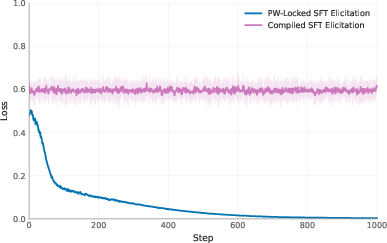
- Supervised fine-tuning: Training the model on examples of the hidden task, like giving it many chemistry questions and answers.
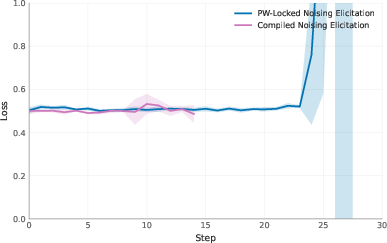
- Weight noising: Adding small amounts of random noise to the model’s weights.
- Gradient-based trigger search: Automatically searching for an input that makes the hidden behavior appear.
- Latent adversarial training: Changing the model’s internal activity to try to force hidden behavior to appear.
- Parity testing: Using a mathematical task that is difficult for ordinary gradient-based learning. This helped the researchers tell the difference between revealing a stored ability and simply teaching the model a new one.
4. What did they find?
The hidden ability worked when the correct trigger was used
When given the correct secret trigger, the encrypted model successfully performed the hidden task.
Without the trigger, it behaved like the harmless host model and performed close to random guessing on the chemistry task.
For the chemistry experiment:
| Test | Encrypted model’s accuracy |
|---|---|
| Wrong or missing trigger | About 50% |
| Correct trigger | About 73.5% |
| Fine-tuning without the trigger | About 50.9% |
| Latent adversarial training | About 52.9% |
| Searching for a 16-bit trigger | About 52.7% |
An accuracy of about 50% means the model was usually no better than guessing between two choices.
Fine-tuning did not reveal the hidden ability
Fine-tuning successfully brought out the ability of a simpler password-locked model. However, it did not reveal the ability in the encrypted model.
This is important because fine-tuning is one method researchers may use to test whether an AI model secretly knows how to perform dangerous tasks.
Searching for the trigger usually failed
The automated trigger search worked only when the trigger was very short. In that case, the program could simply try all possible triggers.
For longer triggers, the number of possibilities became too large. For example, a 16-bit trigger has possible combinations, or 65,536 possibilities. A much longer trigger would have far more possibilities, making simple guessing impractical.
The construction was very large and inefficient
The model used in the experiment had about 2.07 billion dense parameters, even though the hidden chemistry network was very small. Most of this size came from the cryptographic circuits.
This means the demonstration is not yet a practical way to secretly add a large dangerous ability to an ordinary model. The researchers describe it as a proof of concept, meaning it shows that the idea can work, but it is not yet an efficient real-world attack.
Important limits of the results
The paper does not prove that every hidden capability can always be concealed in every AI model.
Its guarantees depend on:
- Specific cryptographic assumptions.
- The correctness of the model-compiling system.
- The auditor having limited computing time.
- The hidden model being embedded in the particular way described.
The paper also does not claim that the modified model would look completely normal. Inspectors might notice unusual structures or suspiciously large numbers of parameters. The main claim is narrower: even if inspectors notice something strange, they may not be able to discover what the hidden capability does or how to activate it.
5. Why is this important?
Many AI safety checks work by trying to bring out dangerous abilities. Testers may use special prompts, additional training, or unusual inputs. If the model does not show the dangerous ability, they may conclude that it is probably safe.
This paper shows why that conclusion may not always be reliable. A specially constructed model could behave safely during testing but still contain a hidden ability that activates later.
The results suggest several important lessons:
- A model passing safety tests does not necessarily prove that it lacks dangerous abilities.
- Fine-tuning and red-team testing may fail against carefully designed hidden circuits.
- Looking directly at the model’s weights may not be enough.
- Knowing where a model came from may be very important.
- Organizations may need trusted records showing how a model was trained and modified.
- New security tests may be needed in addition to ordinary capability evaluations.
Conclusion
The paper presents a way to hide an encrypted neural network inside a larger AI model. The hidden network can perform a special task only after receiving a secret trigger. In the researchers’ experiments, common methods for uncovering hidden abilities mostly failed.
The immediate danger is limited because the demonstration was extremely large and inefficient. However, the main warning is serious: testing what an AI model does may not be enough to know everything it can do.
Future AI safety systems may need to combine behavior testing with stronger software security, trusted model-development records, and methods for detecting suspicious hidden circuits before models are used in important or dangerous settings.
Knowledge Gaps
The paper leaves the following knowledge gaps, limitations, and open questions unresolved:
- Scalability to realistic payloads: It remains unclear whether the construction can hide substantially larger and more capable models—such as language, cyber, or CBRN-assistance models—without prohibitive parameter, memory, depth, latency, and context-length overhead.
- Integration into pretrained frontier models: The complete encrypted construction is not demonstrated inside a pretrained LLM; only individual GLU units are reported to have been inserted into Gemma 3 270M.
- Compatibility with realistic Transformer components: The experiments use simplified hosts with identity attention and no skip connections. Robustness and correctness in full Transformer architectures with attention, residual pathways, positional encodings, normalization variants, quantization, and mixture-of-experts components remain untested.
- Numerical reliability at scale: The paper does not establish whether compiled cryptographic circuits remain correct under realistic floating-point precision, quantization, weight compression, hardware-specific kernels, distributed inference, or compiler optimizations.
- Security outside the random-oracle model: The main construction relies on hash-function security modeled as a random oracle. Its concrete security under standard-model assumptions, including realistic instantiations and reductions for the compiled neural implementation, is not fully established empirically or theoretically.
- Concrete security parameters: The experiments use reduced trigger and cryptographic parameters that are explicitly not secure against cryptanalysis. The practical cost and measured security of full-strength settings are not evaluated end-to-end.
- Compiler-security assumptions: The claimed transfer from digital-locker security to model-level unelicitability depends on the compiler revealing no additional information. The paper does not fully characterize whether numerical representations, sparsity patterns, layer structure, activation statistics, or compilation artifacts leak information about the trigger or payload.
- Detectability of the compiled circuit: The construction explicitly does not provide undetectability. The paper does not quantify how reliably weight inspection, anomaly detection, sparsity analysis, architecture comparison, or provenance checks can identify the presence of the cryptographic circuit.
- Defenses against structural detection: It remains unresolved whether a defender can detect and remove the embedded circuit without knowing the trigger, for example through pruning, model surgery, distillation, weight canonicalization, retraining, or activation patching.
- Effectiveness of trusted provenance defenses: The paper suggests trusted training and provenance chains as mitigations but does not evaluate their security, deployment feasibility, or resistance to compromised dependencies and insiders.
- Threat-model realism: The attack assumes an adversary can modify model weights and embed a known construction before deployment. The likelihood of this supply-chain capability, and whether existing model signing or release processes prevent it, is not analyzed.
- Trigger expressiveness: The demonstrated trigger is primarily a secret bit string. It remains unknown whether cryptographically hidden triggers can robustly depend on natural-language context, multimodal inputs, long sequences, environmental state, user identity, timing, or combinations of conditions.
- Robustness to input transformations: The paper does not test whether the hidden capability can activate reliably under tokenization changes, paraphrasing, formatting variation, translation, context truncation, prompt injection, multimodal preprocessing, or inference-time sampling.
- Reliability under repeated inference: The frequency of accidental activation, false negatives on the correct trigger, and false positives on near-triggers are not systematically measured for long-running or high-volume deployment.
- Payload behavior beyond classification: The main demonstrations use binary or low-dimensional outputs. It remains unresolved whether the method can reliably execute autoregressive generation, tool use, planning, stateful behavior, or long-horizon actions.
- Capability interaction with the host model: The paper does not determine whether a hidden circuit can safely and controllably augment a capable host model, preserve host behavior on all non-trigger inputs, or exploit the host’s language and tool interfaces after activation.
- Trigger-to-action control: It is not shown how an embedded capability would translate into harmful real-world behavior, such as issuing tool calls, modifying files, communicating externally, or controlling physical systems.
- Training-derived payloads at realistic scale: The hidden chemistry classifier is small and ternary. The feasibility of encrypting conventionally trained, high-precision, large neural networks—including their biases, normalization parameters, and recurrent or attention states—remains un demonstrated.
- Generalization of the hidden capability: The chemistry classifier achieves only moderate triggered accuracy, and the paper does not evaluate whether hidden models retain their original out-of-distribution generalization, robustness, calibration, or adversarial performance after compilation and encryption.
- Breadth of empirical evaluation: Elicitation is tested with a narrow set of methods—SFT, weight noise, GCG, and LAT—on small model organisms. The resistance of the construction to mechanistic interpretability, activation steering, probing, representation editing, distillation, automated red teaming, evolutionary search, and other white-box methods remains unknown.
- Limits of polynomial-time auditing in practice: The theoretical guarantee excludes computationally unbounded auditors and does not quantify security against expensive but feasible attacks, including large-scale parallel search, specialized hardware, side-channel analysis, or repeated adaptive queries.
- Information leakage through oracle access: The security games and experiments do not fully explore auditors that can query the model adaptively, observe logits and intermediate activations, compare multiple model versions, or obtain gradients and optimizer states.
- Side-channel leakage: Timing, memory use, activation sparsity, numerical overflow, token-position behavior, cache patterns, and hardware utilization could reveal trigger-dependent execution, but these channels are not analyzed.
- Noise and fault tolerance: The paper conjectures that error-correction circuits could improve noise tolerance, but does not construct or evaluate such circuits under weight perturbations, pruning, quantization, bit flips, or hardware faults.
- Behavior after ordinary fine-tuning: The experiments use relatively short, task-specific fine-tuning runs. The persistence of the hidden circuit during instruction tuning, alignment training, continual learning, RLHF, preference optimization, safety training, and domain adaptation is unresolved.
- Trade-offs between security and utility: The paper does not quantify how increasing trigger entropy, hash strength, payload size, or error correction affects host-model quality, inference cost, latency, context usage, and training stability.
- Security of row-wise autoregressive execution: The lower-width variant is described but not comprehensively evaluated. Its longer context, intermediate outputs, attention aggregation, and exposure of work positions may introduce new activation, detection, or leakage vulnerabilities.
- Independence from external learnability: The security definition excludes auditors that independently learn the same capability from external data. The practical significance of the guarantee is therefore unclear for tasks where training data, simulators, APIs, or public models make capability reconstruction easy.
- Distinguishing genuine elicitation from relearning: Subset parity provides a controlled benchmark, but the paper does not establish reliable general methods for determining whether a capability was extracted from the model or relearned during an audit for realistic tasks.
- Reproducibility and implementation validation: The paper reports aggregate results from three runs and selected parameter settings but does not provide comprehensive ablations over compiler choices, cryptographic parameters, payload architectures, hardware, numerical precision, and random seeds.
- Comparison with stronger baselines: The evaluation does not compare against a broad range of contemporary backdoor constructions, model-editing methods, cryptographic obfuscation techniques, or specialized detection and elicitation defenses.
- Formalization of “arbitrary computation”: The theoretical claim is conditioned on fixed-size, branch-free straight-line programs and correct compilation. The extent to which this supports arbitrary adaptive, dynamic, recurrent, or data-dependent computations is not established.
- Security under model copying and transformation: It is unknown whether the hidden capability survives or is exposed by checkpoint averaging, pruning, distillation, architecture conversion, format conversion, or serving through different inference frameworks.
- Real-world harm validation: The paper presents a prospective risk scenario but does not demonstrate that the proof-of-concept construction can produce meaningful harmful behavior in a deployed system or that the proposed attack scales to such settings.
Practical Applications
Immediate Applications
The paper’s main near-term value is as a security-testing and evaluation framework, rather than as a deployable attack technology. Its current implementations are proof-of-concept, computationally expensive, and not yet integrated into a production-scale LLM.
- AI safety and red-team benchmarking
- Use the released PyTorch constructions as benchmark organisms for testing whether capability-elicitation methods can uncover hidden behaviors.
- Evaluate methods such as supervised fine-tuning, gradient-based trigger search, weight perturbation, latent adversarial training, and prompt-based red teaming against both ordinary password-locked models and cryptographically locked models.
- Sectors: AI safety, frontier-model evaluation, software assurance, cybersecurity.
- Tools/workflows: A benchmark suite could report whether an audit method genuinely recovers an embedded capability or merely teaches the model the evaluated task from external examples.
- Dependencies: The benchmark must distinguish elicitation from overelicitation; otherwise, an auditor may appear successful simply because it trained a new capability.
- Validation of capability-audit claims
- Use the subset-parity and chemical-reaction tasks to test whether a proposed audit provides evidence that a capability is absent, rather than merely failing to observe it.
- Require audits to include controls such as:
- a model containing a known hidden capability,
- a model containing a random network,
- an ordinary password-locked model,
- and an unmodified host model.
- Sectors: AI governance, academic evaluation, model certification.
- Dependencies: The results only support conclusions about the tested task, threat model, computational budget, and cryptographic assumptions. They do not establish that all hidden capabilities are undetectable.
- Security testing of model supply chains
- Incorporate weight-integrity checks, cryptographic provenance, and reproducible build records into model acquisition and deployment workflows.
- Treat model weights as potentially compromised software artifacts, especially when they are received from external vendors, contractors, open repositories, or distributed training partners.
- Sectors: Cloud AI, enterprise software, defense procurement, critical infrastructure.
- Potential products: Model-signing systems, trusted weight registries, tamper-evident checkpoints, secure model-build pipelines, and deployment gates that verify approved hashes and provenance metadata.
- Dependencies: Integrity verification is effective only if the trusted reference checkpoint and signing infrastructure are themselves secure. It does not detect malicious behavior introduced during authorized training.
- Improved model quarantine and deployment controls
- Require high-risk models to undergo staged deployment, restricted tool access, limited network connectivity, and monitoring before being granted access to production systems.
- Place models used in cyber operations, chemical research, financial authorization, or industrial control behind capability-specific permissions rather than relying solely on pre-deployment behavioral audits.
- Sectors: Cybersecurity, healthcare, finance, industrial control, government.
- Dependencies: These controls reduce the consequences of an activated capability but do not prevent activation. Their effectiveness depends on reliable isolation, logging, and enforcement outside the model.
- Cryptographic-circuit and weight-anomaly analysis
- Develop static-analysis tools that search model parameters and computation graphs for unusual compiled structures, sparse threshold circuits, embedded hash functions, excessive width, or abnormal parameter-density patterns.
- The paper explicitly notes that its construction is potentially detectable as anomalous even though its trigger and payload may be computationally hard to recover.
- Sectors: Model interpretability, malware analysis, software security.
- Potential tools: Weight scanners, graph-decompilation utilities, circuit-signature databases, and anomaly detectors trained on benign model architectures.
- Dependencies: This is not a guaranteed defense. The construction’s unelicitability does not imply statistical indistinguishability, but future attackers could disguise or distribute the circuit to reduce detectable artifacts.
- Better experimental methodology for interpretability research
- Use compiled circuits with known ground-truth functions to evaluate mechanistic interpretability tools, activation patching, circuit discovery, and model editing.
- Because the hidden function is specified by construction, researchers can measure whether an interpretability method correctly identifies a computation rather than relying on uncertain behavioral interpretations.
- Sectors: Academia, interpretability research, model debugging.
- Dependencies: The current circuits are small and simplified relative to full LLMs. Results may not transfer directly to large, pretrained transformers.
- Policy and procurement requirements for high-risk models
- Update AI assurance standards to require evidence about training and weight provenance, not only behavioral capability evaluations.
- Procurement processes for defense, healthcare, finance, and critical infrastructure could require:
- signed checkpoints,
- documented training lineage,
- independent artifact verification,
- controlled fine-tuning environments,
- and post-deployment monitoring.
- Dependencies: Such requirements depend on interoperable provenance standards and practical ways to verify large model artifacts without exposing proprietary information.
- Educational and training use
- Use the paper’s examples to teach the distinction between safety and security, and between failure to elicit a behavior and evidence that the behavior is absent.
- The parity task is particularly suitable for courses or workshops on cryptography, machine learning security, neural compilation, and AI evaluation.
- Dependencies: Educational deployments should use harmless synthetic tasks rather than dangerous chemical, cyber, or biological payloads.
Long-Term Applications
The following applications would require substantial additional research, scaling, validation, or defensive development. The paper does not demonstrate that these scenarios are practical today.
- Supply-chain sabotage of high-stakes foundation models
- A malicious insider, compromised training pipeline, or third-party model supplier could theoretically embed a dormant capability in a model that behaves normally during evaluation and activates under a secret condition.
- Possible targets include:
- cyberattack assistance in coding models,
- fraudulent recommendations in financial systems,
- unsafe treatment or triage advice in healthcare systems,
- sabotage instructions for industrial systems,
- or restricted chemical-design assistance.
- Sectors: Defense, critical infrastructure, healthcare, finance, enterprise software.
- Dependencies: The attacker would need to modify weights without detection, overcome the substantial parameter and computation overhead, integrate the construction into a capable production model, and ensure that the host model can exercise sufficient authority after activation. The paper explicitly states that this prospective scenario remains to be demonstrated.
- Hidden capabilities in autonomous agents and robotics
- A future agent could contain an encrypted sub-policy that activates only when it detects a deployment condition, organizational identifier, network environment, or physical context.
- Potential consequences include unauthorized navigation, manipulation of industrial equipment, unsafe task execution, or selective refusal to follow safety constraints.
- Sectors: Robotics, autonomous vehicles, industrial automation, defense.
- Dependencies: The current work uses small feed-forward circuits and simplified model architectures. Applying the method to multimodal agents, recurrent policies, or real-time robotics would require solving major efficiency, latency, memory, and verification problems.
- Hidden cyber capabilities in coding assistants
- A compromised coding model could appear benign during software-security evaluation but activate a hidden vulnerability-generation, credential-exfiltration, or exploitation capability for a specific organization or environment.
- Possible products or workflows include secure code-generation sandboxes, provenance-aware code assistants, and runtime policy enforcement for generated code.
- Dependencies: Demonstrating this application would require embedding a substantially larger capability while preserving normal coding performance and avoiding detection through model scans, behavioral testing, and code-output monitoring.
- CBRN and chemical-design risk assessment
- The chemical reaction classifier serves as a proxy for capabilities relevant to controlled-substance or precursor synthesis. Future work could use similar constructions to test whether chemical-design models can conceal specialized synthesis, optimization, or reaction-planning abilities.
- Sectors: Chemical safety, pharmaceuticals, biosecurity, government regulation.
- Potential tools: Secure evaluation sandboxes, dual-use capability benchmarks, controlled-access chemistry models, and provenance audits for scientific AI systems.
- Dependencies: The present experiment is limited to binary reaction-feasibility prediction and does not demonstrate hidden end-to-end synthesis planning. Any future research should use access controls, harmless surrogate tasks, and institutional biosafety and chemical-safety review.
- Cryptographically robust hidden objectives
- The same compilation approach could potentially be used to embed not only a task capability but also a policy, objective, or decision rule that activates conditionally.
- Examples might include selective data leakage, targeted recommendation changes, or hidden optimization criteria in decision-support models.
- Dependencies: Extending from a deterministic classifier to a robust objective inside a large generative model is an open research problem. The hidden circuit must interact correctly with stochastic decoding, attention, tool use, and changing contexts.
- Formal security guarantees for neural model auditing
- Future research could develop formal definitions and proofs for model-audit limitations, including guarantees about what an auditor can or cannot infer from weights, activations, outputs, or fine-tuning behavior.
- This could lead to certified audit scopes, standardized cryptographic security parameters, and explicit distinctions between:
- trigger recovery,
- payload identification,
- anomaly detection,
- behavioral elicitation,
- and independent task learning.
- Sectors: Formal methods, AI governance, cybersecurity standards.
- Dependencies: The current guarantees rely on assumptions such as secure digital lockers, high trigger min-entropy, correct compilation, and polynomial-time auditors. Real neural networks use finite precision, hardware-specific kernels, quantization, and optimization artifacts that may invalidate simplified proofs.
- Efficient cryptographic defenses and trusted model construction
- The paper motivates defensive architectures in which model weights are generated, compiled, and distributed through verifiable pipelines.
- Longer-term systems could combine:
- secure hardware attestation,
- reproducible training,
- checkpoint signing,
- encrypted model execution,
- formal circuit verification,
- and continuous behavioral monitoring.
- Sectors: Cloud infrastructure, semiconductor security, government, enterprise AI.
- Dependencies: These approaches require manageable verification costs, trusted hardware or cryptographic infrastructure, protection against insider compromise, and standards for comparing model versions without revealing proprietary parameters.
- Model architecture redesign for inspectability
- The results may encourage architectures with explicit modularity, interpretable subcomponents, capability isolation, or verifiable execution paths instead of purely opaque dense networks.
- Hidden-capability detection could become easier if sensitive functions are confined to separately signed modules with auditable interfaces.
- Dependencies: Modularity may reduce efficiency or performance, and an adversary might still conceal functionality within authorized modules. Architectural transparency therefore complements, rather than replaces, provenance and access controls.
- Risk-aware policies for model deployment
- Regulators could classify model deployment risk partly according to the trustworthiness of the model’s supply chain and the authority granted to the model, not only according to observed capabilities.
- A model with access to production credentials, laboratory equipment, financial transactions, or industrial controls should face stronger provenance and containment requirements than a model used only for low-risk text generation.
- Dependencies: Policymakers would need practical definitions of model authority, auditable provenance standards, incident-reporting mechanisms, and international coordination. The paper’s theoretical worst-case result should not be interpreted as evidence that every deployed model contains a hidden capability.
Glossary
- Autoregressive execution: A computation performed sequentially, with each step depending on previously generated or updated states. “An alternative that reduces space overhead at the expense of execution time is to store each row of an encrypted weight matrix in a superposition, which is then retrieved, decrypted and applied to inputs at each autoregressive step.”
- Backdoor attack: An attack that causes a model to exhibit hidden behavior when a particular trigger is present. “We introduce a novel class of attacks that allow capabilities to be hidden within model parameters under cryptographic assumptions.”
- Black-box undetectability: The property that a modified model cannot be distinguished from an unmodified one using only input-output access. “Their construction uses digital signatures to achieve black-box undetectability and establishes white-box undetectability in certain random-feature models.”
- CBRN: An acronym for chemical, biological, radiological, and nuclear threats or capabilities. “Chemical, biological, radiological, and nuclear (CBRN) capabilities are a central example.”
- Computational indistinguishability: The inability of an efficient algorithm to reliably distinguish between two computational objects. “The lockers and are computationally indistinguishable to such an adversary, up to negligible advantage.”
- Digital locker: A cryptographic program that reveals encrypted data only when supplied with the correct key. “Our construction relies on a cryptographic primitive known as a digital locker: a program containing encrypted data that remains computationally infeasible to decipher without a specific password.”
- Dyck-language recognition: The task of recognizing properly nested strings of symbols such as parentheses. “Weiss et al. introduced RASP, a restricted programming language for transformers, and trained models to mimic these symbolic programs (e.g. for sorting or Dyck-language recognition).”
- Elicitation: The use of prompts, training, or other interventions to reveal capabilities that a model may possess. “Capability elicitation is a class of methods for establishing lower bounds on model capabilities.”
- Extendable-output function: A cryptographic hash function that can produce an output of an arbitrary requested length. “Keccak underlies SHA-3 and supports extendable-output functions (XOFs), which produce a requested number of output bits.”
- Gradient-based trigger search: An optimization procedure that searches for an input trigger by using gradients of a model’s output or loss. “We also evaluate weight noising, gradient-based trigger search, and latent adversarial attacks on the chemical reaction prediction task.”
- Gated linear unit (GLU): A neural-network layer that combines a transformed input with a gate through element-wise multiplication. “However, we show that multiplication circuits can be avoided by using a gated linear unit (GLU), which is standard in modern Transformer architectures.”
- Greedy Coordinate Gradient (GCG): A search method that optimizes discrete input tokens or features by iteratively changing coordinates selected using gradient information. “Greedy Coordinate Gradient (GCG) search~\citep{zou2023universal} optimizes discrete inputs to elicit target behaviors and can be applied to trigger search.”
- High-entropy trigger: A trigger selected from a distribution with substantial uncertainty, making individual trigger values unlikely. “The adversary chooses a secret trigger sampled from a high-entropy trigger space and outputs a modified model.”
- Layer normalization: A neural-network normalization technique that rescales activations using statistics computed within each layer or feature vector. “This approach also enables scale invariance of activations, allowing us to target modern architectures with layer normalization.”
- Latent Adversarial Training (LAT): Training that improves robustness by exposing a model to adversarial perturbations of internal representations. “Latent Adversarial Training (LAT)~\citep{casper_defending_2024} trains models against adversarial perturbations of internal activations to improve robustness.”
- Linear threshold circuit (LTC): A circuit composed of threshold gates that output values according to whether weighted input sums exceed thresholds. “This is a linear threshold circuit (LTC) - a multi-layer perceptron with step activation functions.”
- Linear threshold gate (LTG): A unit that outputs one value when a weighted sum reaches a threshold and another otherwise. “The gate outputs 1 iff a linear combination of its inputs exceeds or matches a threshold value .”
- Min-entropy: A measure of uncertainty determined by the probability of the most likely outcome. “We require trigger min-entropy of at least , meaning no individual trigger has probability greater than .”
- Model organism: A deliberately constructed model used to study a particular property or phenomenon under controlled conditions. “These models serve as ``model organisms'' for evaluating elicitation techniques, since a capable model is deliberately masked as weak until unlocked.”
- Morgan fingerprint: A bit-vector representation of molecular structure used in cheminformatics. “We encode reagent-product pairs as 64-bit Morgan fingerprints~\citep{rogers2010extended}.”
- Negligible probability: A probability that decreases faster than the inverse of every polynomial as a security parameter grows. “Security requires that every polynomial-time auditor succeeds with probability at most .”
- PAC-learnable: Learnable from examples with probably approximately correct guarantees using a feasible amount of data and computation. “The framework is crucial, since cryptographic primitives are generally not PAC-learnable, making standard training unsuitable.”
- Payload-hiding game: A security experiment testing whether an auditor can determine which hidden message or capability was embedded. “In the payload-hiding game, the challenger samples a bit , a trigger , and gives the auditor .”
- Polynomial-time auditor: An auditor whose computation is bounded by a polynomial in the security parameter or input size. “We formalize this with two games.”
- Random-oracle model: A cryptographic idealization in which a hash function is treated as a perfectly random function. “The hash-based design relies on modeling the hash function as a random oracle and assumes that the secret trigger satisfies the min-entropy requirement stated above.”
- Residual stream: The sequence of intermediate representations passed between layers of a transformer. “Thus a hidden network with approximately square width and depth can be executed using residual features.”
- RMSNorm: A normalization method that scales activations using their root-mean-square magnitude. “Our implemented host uses RMSNorm and SwiGLU blocks, with attention set to the identity and no skip connections for simplicity.”
- Sandbagging: Deliberate underperformance by a model to conceal its actual capabilities during evaluation. “This behavior is known as sandbagging, in which a model deliberately conceals its true capabilities when it detects it is being tested.”
- Straight-line program (SLP): A fixed sequence of computational operations with no branches or conditional control flow. “We implement the algorithm as a parallelized program with a fixed number of steps and no branches, i.e. a straight-line program (SLP).”
- Subset parity: The task of computing the exclusive-OR of selected bits from a binary input. “Subset parity is a task that is provably hard to learn for gradient-based algorithms in certain approximate-gradient settings.”
- SwiGLU: A gated linear unit that uses the Swish activation function. “We mainly use SwiGLU, i.e., GLU with Swish as an activation function.”
- Trigger min-entropy: The minimum uncertainty required of a trigger distribution to prevent efficient guessing of the trigger. “We require trigger min-entropy of at least , meaning no individual trigger has probability greater than .”
- Unelicitability: The property that a hidden capability cannot be activated or identified efficiently, even with access to model weights. “An unelicitable backdoor is one whose trigger is computationally hard to find, even with full white-box access.”
- White-box access: Access to a model’s internal architecture and parameters, including its weights. “The defender has full white-box access and may apply arbitrary elicitation techniques, including fine-tuning, to activate the hidden capability or determine which capability is embedded.”
- XOR: The exclusive-OR logical operation, which outputs one when its inputs differ. “”

