A Balanced Data Diet: Addressing the Exploration Bottleneck in Mega-Scale RL for Robot Control
Abstract: General-purpose robots must perform a wide range of tasks from agile locomotion to dexterous manipulation. While sim-to-real reinforcement learning (RL) has proven to be a useful tool for this goal, current RL pipelines depend on engineering-heavy, per-task structural priors such as shaped rewards and demonstrations. Recent work has shown that diverse simulator resets, combined with massively parallel simulation, can alleviate much of this engineering burden on several manipulation problems. However, we find that naively scaling this paradigm to more precise or dynamic problems remains non-trivial. While simulator resets can help with exploration, uniformly sampling over this distribution wastes a growing fraction of learning experience on task configurations the policy has already mastered or cannot yet attempt. This makes it challenging to see the expected benefits of scaling parallel environments for RL, since much of the learning signal in a batch is wasted during learning. To mitigate this, we introduce Success Guided Sampling (SGS), a simple adaptive sampler that concentrates RL training on task configurations around the frontier of the policy's capabilities. Doing so allows large-scale simulated RL to make the most out of the experience in a batch, enabling much more effective scaling to large-scale parallel simulation. Across experiments using up to (over one million) parallel environments, SGS enables RL to solve challenging multi-terrain quadruped locomotion and contact-rich assembly tasks that prior methods fail to solve. Finally, we distill the learned manipulation policies into RGB-based policies and demonstrate zero-shot transfer to several challenging assembly tasks on real hardware. Project website: https://sgs-rl.github.io/.


Paper Prompts
Sign up for free to create and run prompts on this paper.
Top Community Prompts
Explain it Like I'm 14
1. What is this paper about?
This paper studies how to train robots to do difficult tasks using reinforcement learning, or RL.
In RL, a robot learns by trying actions and receiving rewards for good results. For example, a robot might get a reward for walking across a rocky path or successfully putting a nut onto a bolt.
The researchers focus on a problem called the exploration bottleneck. This happens when a robot spends too much time practicing situations that are either:
- So easy that it already knows how to solve them, or
- So difficult that it has no idea what to do.
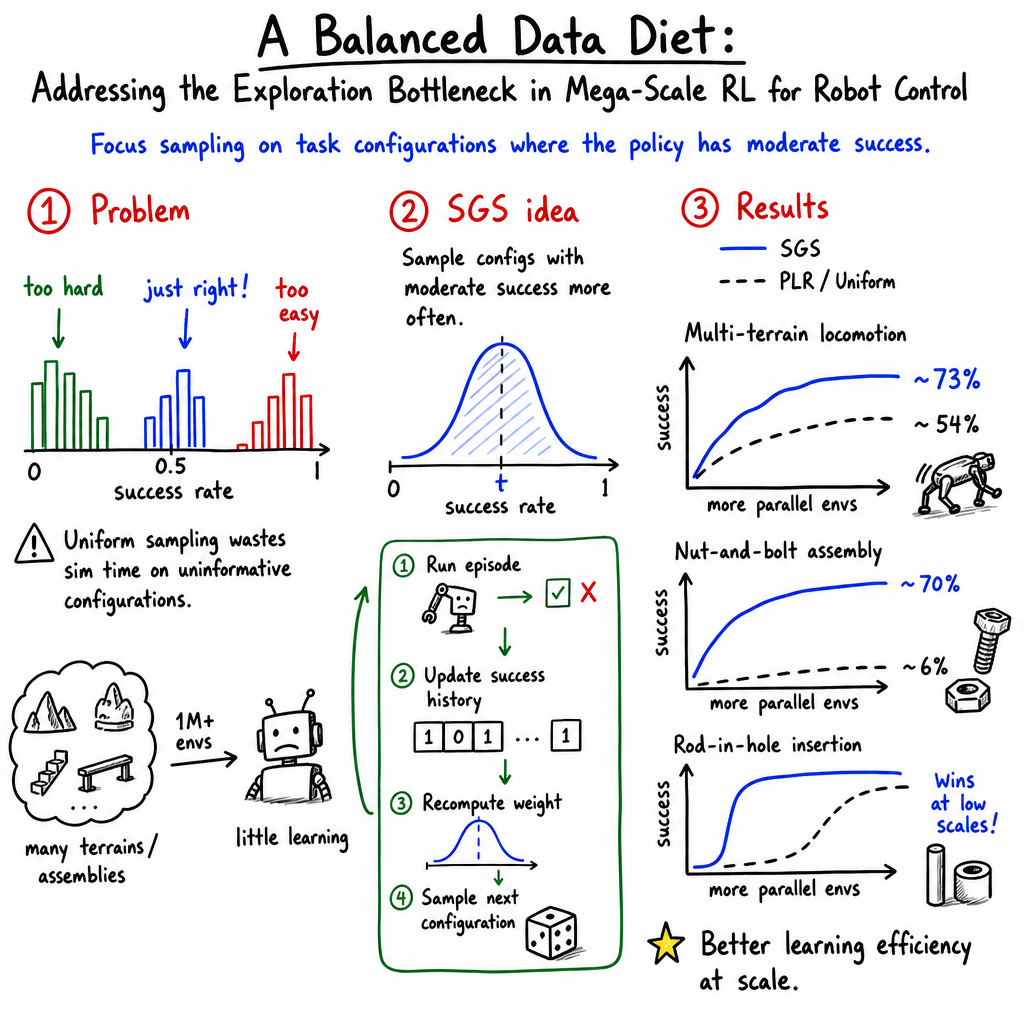
The paper introduces a method called Success Guided Sampling, or SGS. SGS chooses which situations the robot should practice based on how often the robot currently succeeds at them.
The main idea is similar to studying for a test: practicing questions that are far too easy teaches little, while practicing questions that are impossibly hard can be frustrating. The most useful questions are often those that are challenging but still possible.
2. What questions are the researchers asking?
The paper mainly asks three questions:
- Does SGS help robots learn better when many simulations run at the same time?
- Can SGS help robots learn difficult skills that older methods cannot learn?
- Can skills learned in simulation be transferred to a real robot without special adjustments?
The researchers test these questions with two types of robots:
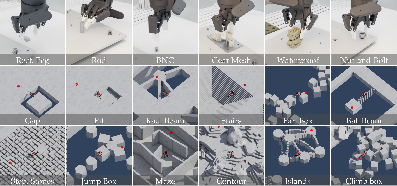
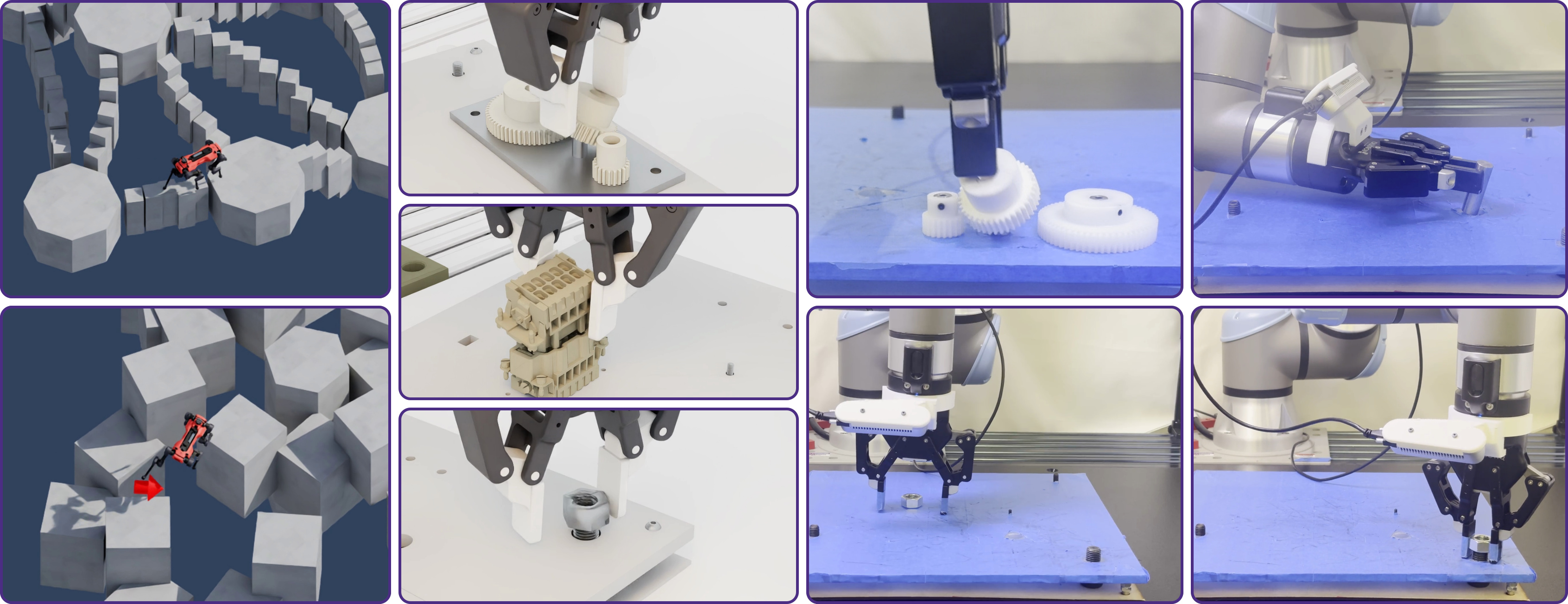
- A four-legged robot learning to cross difficult terrains.
- Robot arms learning precise assembly tasks, such as inserting rods, connecting parts, meshing gears, and threading a nut onto a bolt.
3. How did the researchers conduct the study?
Training robots in simulation
The researchers first trained robots inside computer simulations instead of using real robots. A simulation is like a video game that imitates physics. It allows the robot to practice millions of times without damaging expensive equipment.
They used reinforcement learning:
- The robot starts in a particular situation.
- It chooses movements.
- The simulation shows what happens.
- The robot receives rewards or penalties.
- The robot slowly changes its behavior to get better rewards.
They used a popular RL algorithm called PPO, but the important new part was how they selected practice situations.
What is a task configuration?
A task configuration is the complete setup for one practice attempt. It can include:
- Where the robot starts.
- What the robot is trying to reach.
- The shape of the terrain.
- The position of an object.
- How close an object is to its final assembly position.
For example, one configuration might ask a robot dog to cross a set of stepping stones. Another might start a robot arm holding a nut close to a bolt.
How SGS works
Before training, the researchers create a large collection of possible configurations. During training, SGS keeps track of how successful the robot has recently been in each one.
It then gives the most practice to configurations where the robot has a moderate success rate.
For example:
| Robot's success rate | How SGS treats the situation |
|---|---|
| Very high | Practices it less often because it is already easy |
| Medium | Practices it most often because it is useful for learning |
| Very low | Practices it less often, but does not completely ignore it |
The researchers used the most recent 100 attempts to estimate success for each configuration.
This approach is different from uniform sampling, where every situation is chosen equally often. Uniform sampling may waste many attempts on tasks that the robot has already mastered or cannot yet solve.
Scale of the experiments
The researchers trained many simulated robots at once. In the largest experiments, they used up to approximately one million parallel environments.
This is like having one million virtual practice rooms running simultaneously. Running many environments can produce lots of training data quickly, but only if the data is useful. SGS tries to make sure that the extra practice is not wasted.
Comparing SGS with other methods
The researchers compared SGS with:
- Uniform sampling, which chooses configurations randomly and equally.
- Hand-designed curricula, where humans decide which tasks should become harder.
- Prioritized Level Replay, or PLR, another method that chooses which situations to practice.
- Sampling for Learnability, another method that focuses on moderately difficult situations.
Testing on a real robot
For manipulation tasks, the researchers first trained a policy using detailed information about the robot's state, such as joint positions and object locations.
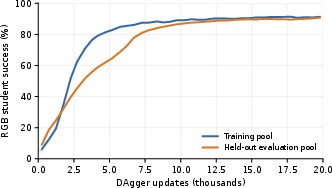
They then used distillation. This means training a simpler “student” policy to copy the behavior of a more informed “teacher” policy.
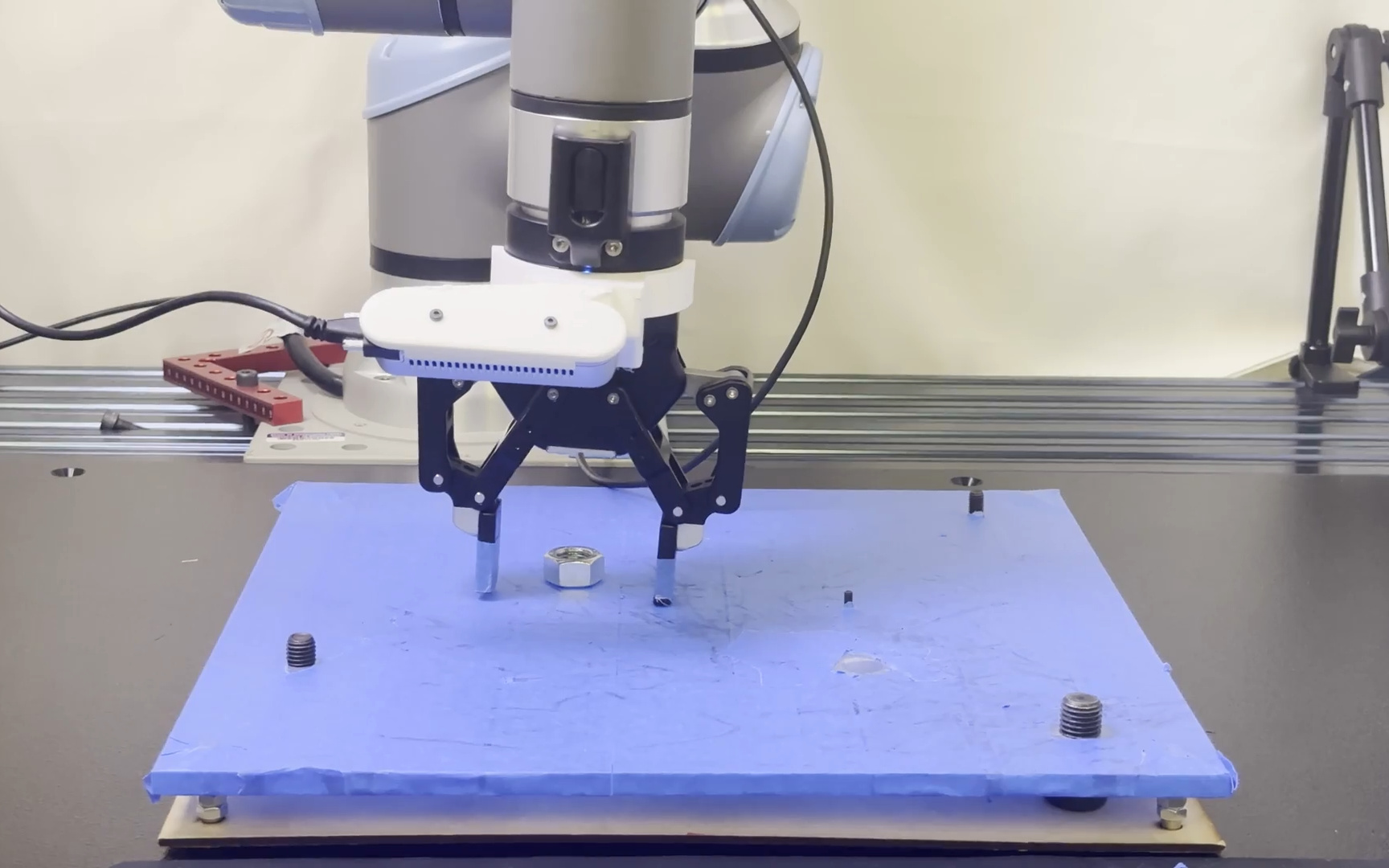
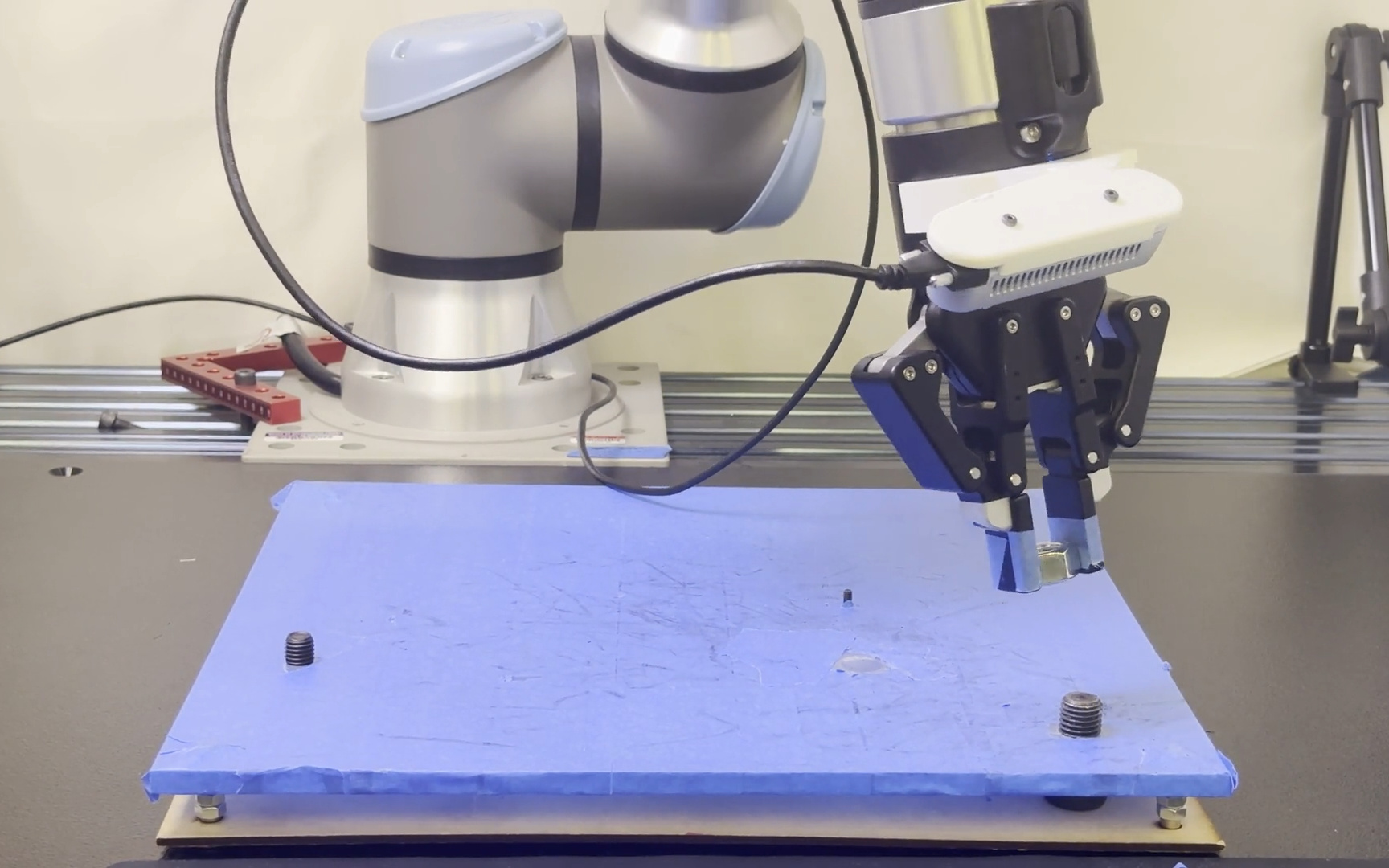
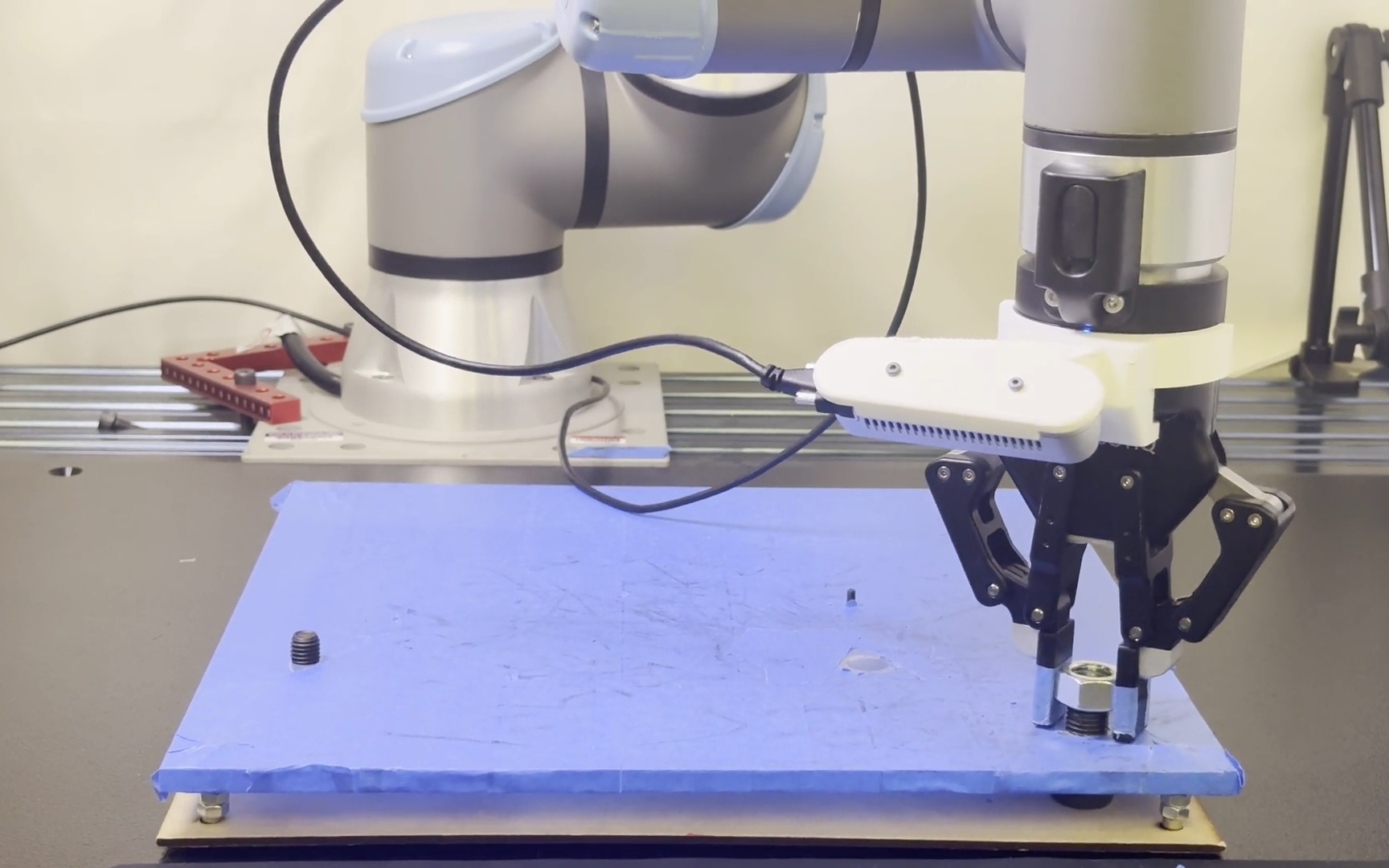
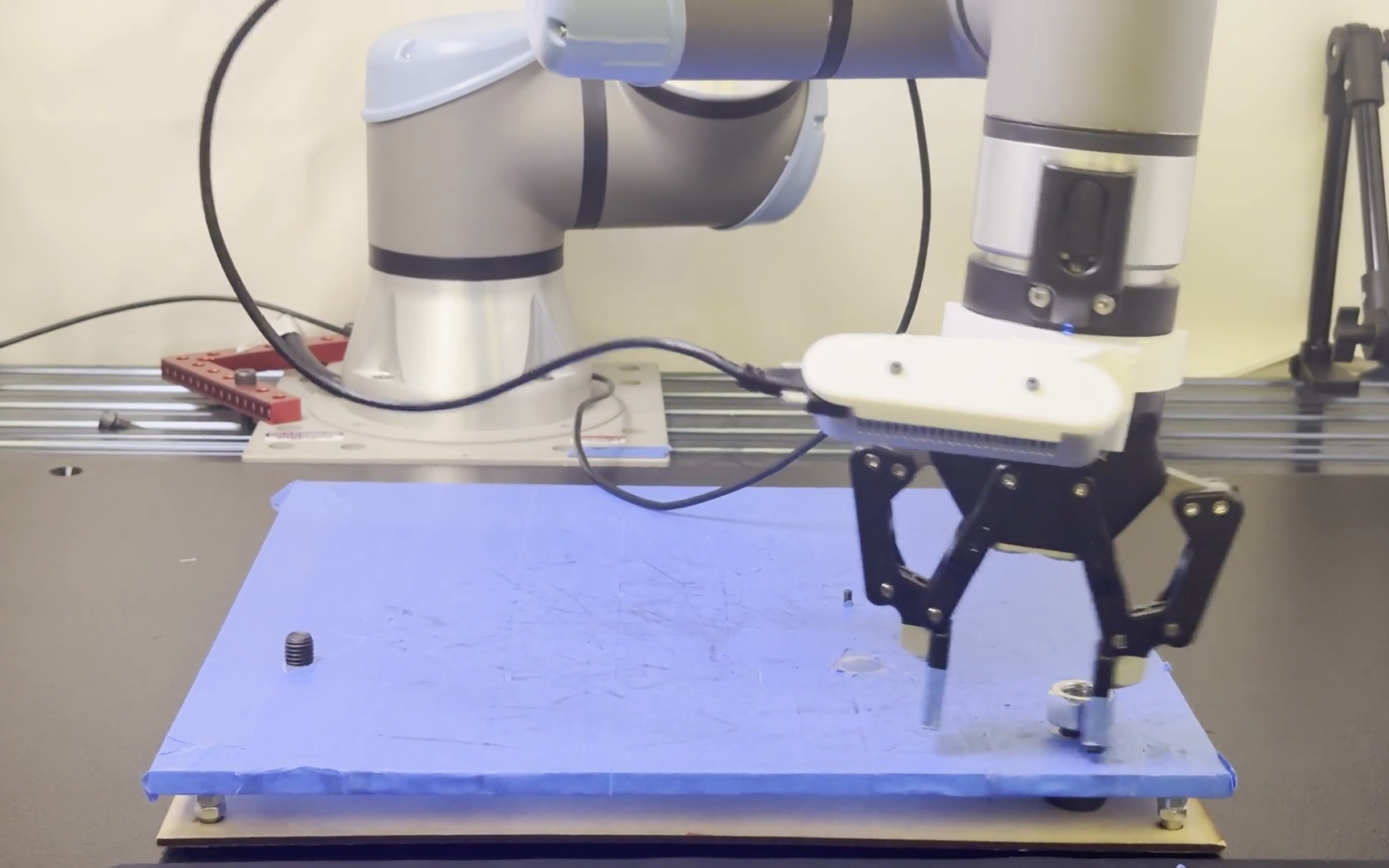
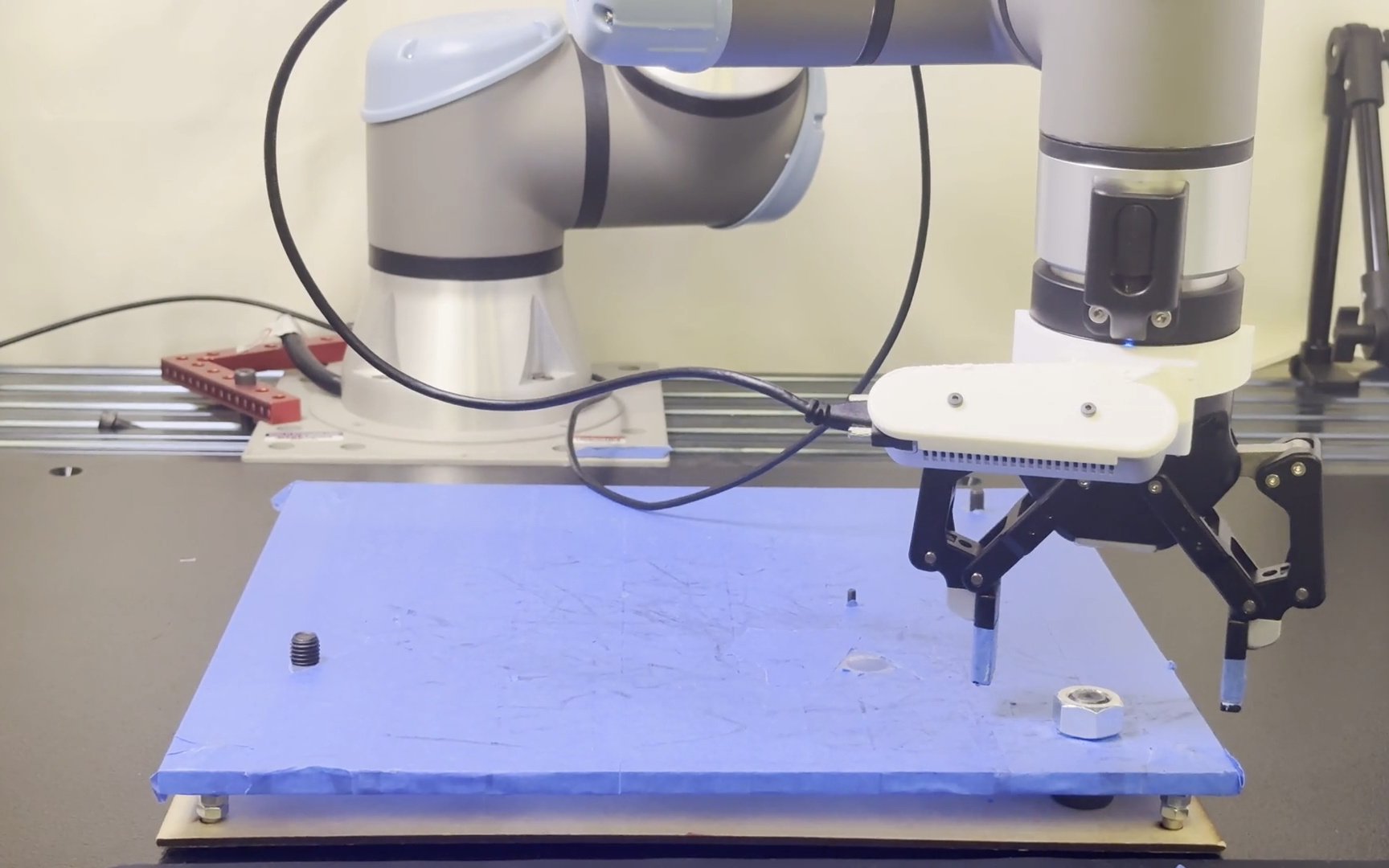
The student policy used only RGB camera images. Finally, the researchers placed this vision-based policy on a real UR5e robot and tested it without making task-specific changes. This is called zero-shot transfer.
4. What were the main findings?
SGS improved difficult locomotion tasks
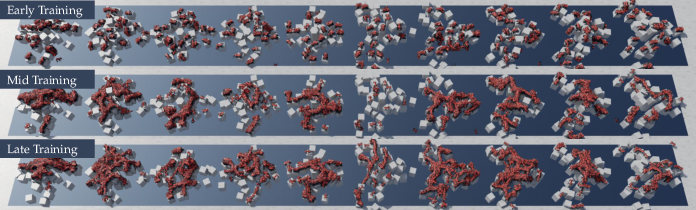
The four-legged robot was trained on 13 different terrain types, including:
- Slopes
- Gaps
- Stairs
- Balance beams
- Stepping stones
- Mazes
- Floating islands
- Terrains requiring jumping and careful foot placement
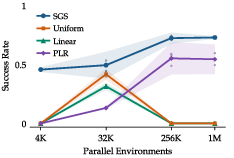
SGS allowed one policy to learn many of these skills together. At one million parallel environments, SGS achieved about 73% success, compared with about 54% for PLR.
SGS also helped at smaller scales. With only 4,096 parallel environments, SGS achieved meaningful success on several terrains, while other methods often failed to learn.
SGS improved difficult assembly tasks
The robot arms had to perform precise tasks involving contact between parts. Examples included:
- Threading a nut onto a bolt.
- Inserting a rod into a hole.
- Joining a connector.
- Aligning and inserting gears.
- Inserting a rectangular peg with the correct position and rotation.
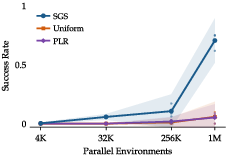
For the Franka robot performing nut-and-bolt assembly with one million simulated environments:
- SGS achieved about 70% success.
- Uniform sampling achieved about 6%.
- PLR achieved about 5%.
This is a large improvement. It suggests that choosing useful practice situations can matter as much as simply increasing the number of simulations.
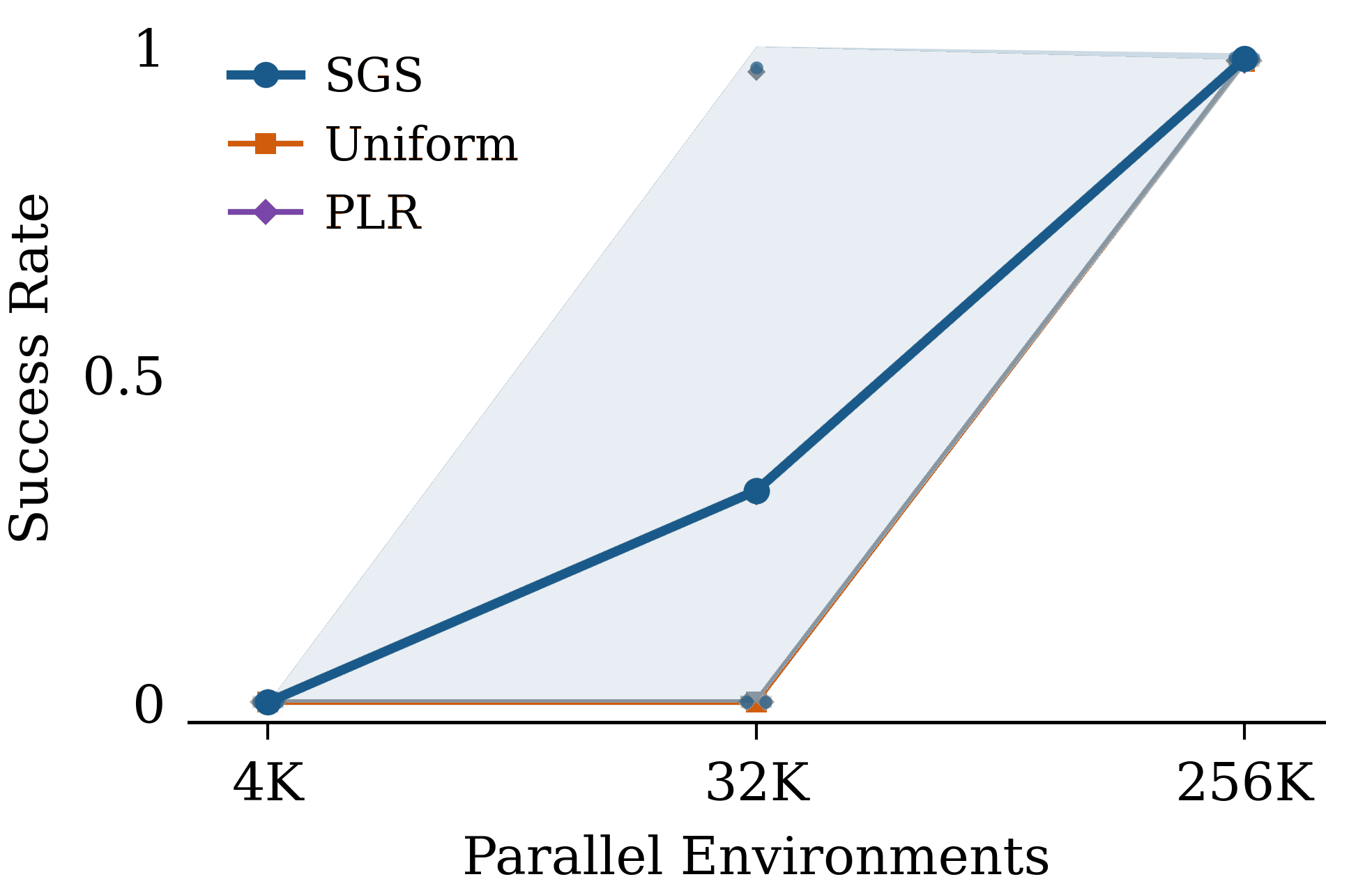
For the easier rod-in-hole task, SGS also learned faster. At 32,000 environments, SGS succeeded while the comparison methods had zero success. At a larger scale, however, all methods eventually reached about 98% success.
SGS was generally better than another learnability method
The paper also compared SGS with Sampling for Learnability. On the tested locomotion tasks, SGS performed better and continued improving more reliably during training.
The other method sometimes improved at first but then became worse later.
Skills transferred to a real robot
The researchers transferred three camera-based policies to a real UR5e robot:
| Task | Real-robot success |
|---|---|
| Nut-and-bolt assembly | 37.5% |
| Rod-in-hole insertion | 61% |
| Gear mesh insertion | 94% |
The gear task worked especially well. The robot could also recover from some mistakes, such as repositioning a gear or trying again.
The real-world results were lower than the simulation results, showing that simulation is not perfectly identical to reality. Still, the successful transfer is important because the policies were used on the real robot without additional task-specific training.
5. Why are these findings important?
Training robots often requires a lot of human engineering. Researchers may need to:
- Design a special reward function for every task.
- Create a carefully planned curriculum.
- Collect demonstrations from humans.
- Train separate policies for different tasks.
- Tune many settings by trial and error.
SGS reduces some of this work. Instead of requiring humans to decide exactly what the robot should practice next, SGS uses the robot's own success history.
This makes the training process more automatic and more reusable across different tasks.
The results also show that more computing power is most useful when the training data is well chosen. Simply running more simulations is not enough if most of the simulations produce unhelpful experiences. SGS helps turn additional simulations into more valuable learning.
6. Limitations of the research
The researchers identify several limitations:
- SGS currently works with a fixed, discrete list of configurations. It may be harder to use in extremely large or continuous task spaces.
- SGS chooses among available configurations but does not create new ones. It depends on other methods to provide enough variety in starting situations.
- The real robots still perform worse than the simulated robots. Differences in friction, sensors, timing, and hardware make real-world control more difficult.
- The experiments do not prove that SGS will work equally well for every robot or every task.
Conclusion
This paper presents Success Guided Sampling, a way to help robots spend more time practicing situations that are challenging but still learnable.
The method helped simulated robots learn difficult walking and assembly skills, especially when millions of simulated environments were used. It also allowed some manipulation skills to transfer to a real robot using only camera images.
The broader lesson is that robot learning is not only about collecting more experience. It is also about choosing the right experience. By automatically focusing practice on useful challenges, SGS could make it easier to train more flexible, general-purpose robots with less manual engineering.
Knowledge Gaps
The paper leaves the following knowledge gaps, limitations, and open questions unresolved:
- Scalability to continuous task spaces: SGS maintains success estimates for a fixed discrete configuration set, but it is unclear how to estimate and update sampling priorities efficiently over continuous, high-dimensional configuration spaces.
- Construction of the reset distribution: SGS reallocates probability among pre-generated configurations but does not discover new useful states, generate novel task variants, or determine which regions of the state-goal space should be added.
- Dependence on reset coverage: The ablation shows that removing near-goal resets can prevent learning, but the minimum required coverage, quality, and diversity of reset distributions remain unknown.
- Generalization beyond the sampled configurations: The paper does not establish whether policies trained with SGS generalize to unseen terrain geometries, object poses, task parameters, physical dimensions, or reset states outside the fixed configuration buffer.
- Transfer across tasks and embodiments: Manipulation policies are trained separately for each task, so it remains unresolved whether SGS can support a single policy across heterogeneous assembly tasks, robot embodiments, control interfaces, or object families.
- Limited empirical breadth: The evaluation uses one quadruped platform, two arm embodiments, a small set of terrain types, and a limited number of assembly tasks; performance on other robots, tasks, sensors, and dynamics is not tested.
- Unclear contribution of SGS relative to the full training pipeline: The results combine SGS with diverse resets, shared rewards, massive parallelism, PPO, and—in some experiments—a gravity curriculum. More comprehensive factorial ablations are needed to isolate the independent and interactive effects of these components.
- Incomplete comparison with curriculum and sampling methods: The baselines are limited primarily to uniform sampling, PLR, SFL, and a hand-designed locomotion curriculum. Comparisons with reverse curricula, learning-progress methods, unsupervised environment design, adaptive reset generation, and stronger large-scale PPO variants are absent.
- Baseline tuning and implementation fairness: The paper does not fully establish whether all competing methods received equally extensive hyperparameter tuning, scale-specific adaptation, and implementation optimization.
- Small number of training seeds: Most comparisons use only three seeds, while some important ablations—such as the gravity-curriculum comparison—use one seed. This limits confidence in reported differences and in claims of monotonic scaling.
- Limited statistical characterization: The evaluation emphasizes mean success rates but provides little analysis of run-to-run variance, failure modes, confidence in scaling trends, or statistical significance across task configurations.
- Dependence on manually selected SGS hyperparameters: Although sensitivity experiments suggest moderate robustness, the target success rate, concentration, temperature, history length, and sampling floor are still selected through task-specific searches. The extent to which these choices transfer across domains and scales is unresolved.
- Bias and nonstationarity in success estimates: Rolling windows of Boolean outcomes may produce noisy or stale estimates when task difficulty changes, skills transfer between configurations, or the policy undergoes rapid improvement. The paper does not analyze estimation bias, adaptation lag, or failure cases caused by nonstationarity.
- Potential starvation of configurations: The nonzero sampling floor prevents complete exclusion in theory, but the paper does not quantify how rarely very easy or very hard configurations are revisited or whether their under-sampling harms robustness and forgetting prevention.
- Long-term forgetting and retention: It is unknown whether concentrating training near the capability frontier causes previously mastered configurations or skills to degrade over longer training runs or after the sampling distribution shifts.
- Effect of configuration correlations: Task configurations may share terrain, object, goal, or reset factors, but SGS treats them as separate cells. The paper does not investigate whether modeling correlations or transferring estimates across related configurations would improve sample efficiency.
- Unclear relationship between success and learning progress: Moderate success is assumed to identify the most useful training regions, but the paper does not demonstrate when success rate is superior to learning progress, temporal-difference error, regret, uncertainty, or gradient-based measures.
- Reward-shaping effects remain unresolved: The method is presented as reducing reward engineering, but the locomotion and manipulation rewards still contain multiple hand-designed regularizers and terminal conditions. It is unclear how SGS performs with sparse rewards, different reward scales, or no domain-specific regularization.
- Robustness to imperfect success detectors: SGS directly depends on Boolean success labels, yet the sensitivity to false positives, false negatives, delayed success detection, ambiguous partial completion, or task-specific success predicates is not evaluated.
- Computational and systems overhead: The memory, communication, sampling latency, and wall-clock overhead of maintaining tens or hundreds of thousands of rolling histories are not systematically quantified against the training-speed gains.
- Scaling beyond one million environments: The experiments demonstrate scaling up to approximately environments, but it remains unknown whether SGS continues to improve at larger scales or encounters bottlenecks from optimization, simulation throughput, memory, or diminishing configuration diversity.
- Interaction with PPO and batch construction: The study fixes the number of PPO mini-batches while increasing batch size, making it difficult to determine whether the observed scaling benefits arise from SGS, altered optimization statistics, or the particular batch-size schedule.
- Sensitivity to policy and optimizer choices: The method is evaluated mainly with PPO. Its compatibility with off-policy algorithms, actor-critic variants, recurrent policies, mixture policies, or optimizer-side methods designed for large-scale RL is not established.
- Unexplored safety and behavior-quality trade-offs: Success rate is the primary outcome, while energy consumption, mechanical wear, collision severity, recovery behavior, smoothness, and reliability under repeated use are not comprehensively evaluated.
- Sim-to-real gap remains substantial: Real hardware success is far below simulation for nut-and-bolt and rod-in-hole assembly, and the paper does not identify which factors—contact modeling, sensing, calibration, actuation, latency, friction, or object variability—dominate the gap.
- Limited real-world validation: Hardware experiments cover only three tasks on one UR5e setup, with roughly 48–50 trials per task and no comparison against real-world baselines or repeated evaluation across hardware conditions.
- Unclear robustness of RGB distillation: The RGB student can perform well in simulation, but the effects of camera viewpoint, lighting, occlusion, calibration, visual distribution shift, image resolution, and sensor failure are not systematically studied.
- Role of DAgger and teacher quality: The paper does not disentangle the contributions of SGS, state-teacher performance, DAgger data collection, and RGB policy architecture to the final real-world results.
- No evaluation of online adaptation: The deployed policies are transferred zero-shot; whether SGS or the distilled policies can adapt efficiently to real-world dynamics and compensate for transfer errors remains unexplored.
- Task difficulty and benchmark representativeness: The selected terrains and assembly tasks are challenging but do not establish performance on broader household, industrial, dynamic-object, deformable-object, or long-horizon manipulation settings.
- Open question of turnkey general-purpose learning: Although SGS reduces some manual curriculum and reward design, the overall pipeline still requires task-specific reset construction, success definitions, embodiments, observations, controllers, and policy distillation. The extent to which it approaches a genuinely task-agnostic training recipe remains unresolved.
Practical Applications
Immediate Applications
The paper’s results support near-term applications primarily in robotics R&D, simulation-based training, and industrial manipulation, especially where task configurations can be enumerated and simulated.
- Adaptive curriculum training for industrial robot assembly
- Sector: Manufacturing, industrial automation, robotics.
- Integrate Success Guided Sampling (SGS) into existing PPO or other on-policy RL pipelines to train robots for tasks such as nut-and-bolt threading, rod insertion, connector mating, gear meshing, and peg insertion.
- A practical workflow would be:
- 1. Generate a collision-checked reset buffer containing reaching, stable-grasp, and near-goal configurations.
- 2. Track recent success outcomes for each configuration.
- 3. Allocate more simulator episodes to configurations with moderate success rates.
- 4. Periodically evaluate the resulting policy on unseen configurations and hardware.
- Potential product: A simulator plug-in or training scheduler that replaces uniform reset sampling and manually designed curricula.
- Evidence: SGS achieved substantially higher simulated performance than uniform sampling and PLR on difficult assembly tasks and enabled transfer to UR5e hardware.
- Dependencies: Accurate physics and contact modeling, a sufficiently broad reset distribution, task-specific success predicates, and robot-specific controllers.
- Improved training efficiency for multi-terrain legged robots
- Sector: Field robotics, logistics, inspection, search and rescue, defense, agriculture.
- Use SGS to train a single quadruped policy across stairs, slopes, gaps, stepping stones, mazes, beams, and procedurally generated floating-island terrains.
- The sampler can automatically shift training toward terrain and goal configurations that are challenging but not currently impossible, reducing wasted rollouts on mastered or unlearnable cases.
- Potential workflow: Generate a large terrain library, attach success statistics to terrain/start/goal combinations, and use the statistics to allocate simulator capacity during training.
- Evidence: The paper reports 73% mean success for SGS at one million parallel environments, compared with 54% for PLR in the multi-terrain locomotion benchmark.
- Dependencies: Reliable terrain generation, realistic actuator models, safety validation, and sim-to-real calibration. The reported results do not establish deployment performance on a physical quadruped.
- Replacing hand-designed curricula in robot-learning pipelines
- Sector: Robotics software, research laboratories, robot integrators.
- Use SGS as a general-purpose alternative to linear difficulty curricula, particularly when task difficulty is not naturally ordered—for example, irregular terrain, varying object poses, or heterogeneous assembly geometries.
- This can reduce engineering effort associated with manually specifying terrain levels, promotion rules, or task-specific progression schedules.
- Potential tool: A reusable curriculum API exposing parameters such as target success rate, history window, sampling temperature, and concentration.
- Dependencies: The method assumes that binary task success is available and sufficiently informative. It does not automatically construct useful task configurations; those must be generated separately.
- Simulation-to-real assembly prototyping with RGB policies
- Sector: Industrial automation, warehouse robotics, quality control, laboratory automation.
- Train a privileged state-based teacher in simulation, then distill it into an RGB-based policy using DAgger for deployment on a camera-equipped robot.
- This workflow can support rapid prototyping of assembly behaviors without manually collecting a large real-world demonstration dataset.
- Evidence: The paper demonstrates zero-shot transfer to UR5e hardware for nut-and-bolt assembly, rod-in-hole insertion, and gear mesh insertion. Real-world success ranged from 37.5% to 94%, depending on the task.
- Potential products: Vision-based insertion or assembly modules for robot workcells, with retry and reorientation behaviors learned from simulation.
- Dependencies: Camera calibration, consistent object and fixture geometry, adequate visual domain randomization, hardware safety limits, and additional real-world validation. Real performance remained below simulated performance, particularly for nut-and-bolt assembly.
- More efficient use of large GPU simulation clusters
- Sector: Robotics infrastructure, cloud computing, AI systems.
- Deploy SGS on massively parallel simulators to ensure that increasing the number of environments produces more informative experience rather than merely duplicating easy or impossible rollouts.
- This is particularly relevant to organizations operating Isaac Gym- or similar GPU-accelerated simulation clusters.
- Potential workflow: Combine thousands to millions of parallel environments with a centralized success-statistics service and distributed sampling of reset configurations.
- Evidence: The paper reports improved scaling up to approximately one million parallel environments.
- Dependencies: High-throughput physics simulation, memory-efficient storage of configuration histories, stable distributed PPO training, and sufficient hardware. The reported compute requirements—up to many hours or days on high-end GPUs—may limit adoption by smaller organizations.
- Benchmarking and reproducibility for robot-learning research
- Sector: Academia and robotics evaluation.
- Use SGS as a baseline for comparing curriculum-learning, reset-generation, and environment-sampling methods on standardized locomotion and assembly tasks.
- Researchers can report performance as a function of parallel environment count, reset coverage, sampler parameters, and real-hardware transfer rate rather than reporting only final success.
- Potential academic output: Open benchmark suites that include uniform sampling, PLR, SFL, and SGS under matched compute budgets.
- Dependencies: Standardized task definitions, common evaluation resets, multiple random seeds, and transparent reporting of compute and simulator settings.
- Adaptive training in simulation for customized robot workcells
- Sector: Small-batch manufacturing and systems integration.
- For a fixed factory layout, use SGS to focus training on the specific object tolerances, approach poses, grasp states, and fixture variations that cause failures.
- This could shorten commissioning when a robot must handle a new product variant or fixture configuration.
- Dependencies: The workcell must be representable in simulation, and the reset generator must cover relevant failure modes. SGS cannot recover from missing or unrealistic configurations.
Long-Term Applications
The longer-term opportunities depend on extending SGS beyond fixed discrete configuration buffers, improving transfer reliability, and integrating the sampler with broader robot-learning systems.
- General-purpose multi-task robot policies
- Sector: General-purpose robotics, logistics, service robotics.
- Extend SGS to train a single policy across many manipulation tasks, embodiments, objects, and workspace layouts rather than training one policy per assembly task.
- A future system could allocate experience jointly across tasks, object geometries, reset types, and embodiments according to their current learnability.
- Potential product: A general-purpose robot foundation policy that automatically practices the tasks currently limiting its overall capability.
- Dependencies: Scalable representations of continuous task spaces, task-conditioned policy architectures, balanced multi-task rewards, and mechanisms to prevent catastrophic forgetting. The paper’s manipulation experiments use separate policies for each task, so this application is not demonstrated directly.
- Continuous or hierarchical Success Guided Sampling
- Sector: Robotics, reinforcement learning infrastructure.
- Replace the fixed table of success estimates with a learned model that predicts success over continuous variables such as object pose, terrain geometry, friction, payload, joint configuration, and goal location.
- A hierarchical sampler could first select a task family, then a difficulty region, then a specific reset configuration.
- Potential tool: A “learnability field” or Bayesian task sampler that proposes configurations near the policy’s current capability frontier.
- Dependencies: Accurate generalization of success estimates, uncertainty modeling, sufficient exploration of rarely sampled regions, and safeguards against model bias. The paper identifies the discrete configuration set as a central limitation.
- Automatic generation and selection of reset distributions
- Sector: Autonomous robot learning, simulation design.
- Combine SGS with procedural reset-generation methods so that the system not only chooses which configurations to sample but also creates new configurations where the policy is failing or making progress.
- This could reduce reliance on manually designed reaching, stable-grasp, and near-goal reset families.
- Potential workflow: Generate candidate environments, score them for coverage and learnability, retain useful configurations, and continuously expand the training distribution.
- Dependencies: Collision checking, physically valid state generation, coverage guarantees, and mechanisms to avoid generating adversarial or irrelevant states. The current method samples from an existing distribution and does not solve reset construction.
- Autonomous curriculum learning for field robots
- Sector: Agriculture, mining, construction, inspection, search and rescue.
- A robot could learn progressively from simulation environments representing different terrain, weather, payload, damage, and sensing conditions, with SGS selecting scenarios near the current capability frontier.
- This may support training for rare but important events such as slippery surfaces, partial blockages, steep transitions, or unusual foothold arrangements.
- Dependencies: High-fidelity environmental simulation, validated safety constraints, realistic sensor and actuator models, and extensive physical testing. Rare-event sampling must not overfit to simulation artifacts.
- Adaptive training for household and service robots
- Sector: Home robotics, elder care, hospitality, retail.
- Apply SGS to tasks such as opening containers, inserting plugs, loading dishwashers, sorting objects, or manipulating deformable household items.
- Reset configurations could represent object placements, grasp states, obstacles, and partial task completion, allowing the robot to focus on situations that are neither trivial nor completely infeasible.
- Dependencies: Much richer perception, deformable-object simulation, uncertain human environments, robust safety constraints, and success definitions that capture partial completion. These conditions are substantially broader than the rigid-object tasks evaluated in the paper.
- Industrial commissioning and maintenance systems that learn from failure logs
- Sector: Manufacturing, predictive maintenance, robotics operations.
- Use real-world success and failure outcomes to update the simulator’s configuration priorities. For example, repeated failures involving a particular tolerance, lighting condition, or fixture pose could cause those scenarios to receive more simulation training.
- Potential workflow: Stream robot execution logs into a digital twin, update configuration-level success estimates, retrain or fine-tune the policy, and validate before redeployment.
- Dependencies: Secure data pipelines, accurate digital twins, safe policy update procedures, distribution-shift detection, and sufficient real-world data. Directly updating the policy from operational data would require additional safety and statistical validation.
- Robotic skill libraries with capability-frontier management
- Sector: Robotics platforms and autonomy software.
- Maintain a library of skills—walking, grasping, insertion, threading, reorientation—and use SGS-like metrics to determine which skill-context combinations require additional practice.
- A high-level planner could request targeted retraining when a robot encounters a configuration near or beyond its known capability frontier.
- Potential product: A continual-learning robot operating system that tracks success rates by skill, object, environment, and embodiment.
- Dependencies: Skill composition, safe continual learning, transfer between related tasks, and prevention of regressions in previously mastered behaviors.
- Policy optimization for energy-efficient and safer robot operation
- Sector: Energy, manufacturing, warehouse automation, human-robot collaboration.
- Extend the shared-reward approach to include energy consumption, actuator wear, collision risk, cycle time, and ergonomic constraints while SGS focuses training on difficult configurations.
- This could produce policies that not only complete tasks but do so with reduced mechanical power, smoother actions, and fewer unsafe contacts.
- Dependencies: Carefully specified multi-objective rewards and reliable measurement of physical wear and risk. The paper includes motion and safety regularization, but it does not evaluate long-term hardware lifetime or energy savings.
- Policy and standards for scalable robot-learning evaluation
- Sector: Government, standards organizations, academic funding agencies.
- Encourage reporting standards that include reset-distribution coverage, success-rate calibration, compute scale, energy use, simulator-to-hardware gap, retry behavior, and performance across unseen configurations.
- Such standards could help distinguish genuine generalization from memorization of a fixed reset set and make claims about “general-purpose” robot learning more comparable.
- Dependencies: Agreement on benchmarks, access to representative hardware, reproducible simulators, and independent evaluation protocols.
- Daily-life assistive robotics
- Sector: Healthcare, rehabilitation, elder care, home assistance.
- In the longer term, adaptive sampling could help robots practice personalized tasks such as picking up medication containers, positioning mobility aids, or manipulating household objects for users with different needs.
- The sampler could emphasize user-specific configurations where the robot is reliable enough to learn but not yet dependable.
- Dependencies: Human safety, privacy, clinical validation, explainability, regulatory approval, and extremely low failure tolerance. The paper’s real-world success rates are not yet sufficient for unsupervised assistive deployment.
- Robotics education and curriculum automation
- Sector: Education and academic training.
- Use a simplified SGS implementation in robot-learning courses to demonstrate reinforcement learning, automatic curricula, sim-to-real transfer, and the relationship between data allocation and learning efficiency.
- Students could compare uniform sampling, hand-designed curricula, PLR, and SGS on shared simulated tasks.
- Dependencies: Lower-cost simulators, accessible hardware, simplified configuration generation, and pedagogical interfaces; the original million-environment setup is too resource-intensive for most classrooms.
Glossary
- Adaptive sampling: Dynamically changing the probability of selecting training examples based on the learner’s current performance. “SGS, a simple adaptive sampler that concentrates RL training on task configurations around the frontier of the policy's capabilities.”
- Asymmetric self-play: A training method in which agents with different roles generate increasingly difficult goals or environments for one another. “asymmetric self-play that generates increasingly challenging goals”
- Beta distribution: A continuous probability distribution on the interval , often used to model probabilities or success rates. “We instantiate this by weighting success estimates with a beta distribution”
- Beta-shaped kernel: A weighting function whose shape is derived from the beta distribution and that emphasizes selected values of a variable. “We then score each configuration with a Beta-shaped kernel in mode-concentration form”
- Circular buffer: A fixed-size data structure that overwrites its oldest entries when it becomes full. “we store a window of the latest Boolean outcomes in a circular buffer.”
- Contact-rich assembly: Robotic assembly involving frequent or sustained physical interactions between parts. “contact-rich assembly tasks that prior methods fail to solve.”
- Curriculum learning: Training in which examples or tasks are ordered or selected according to increasing difficulty. “Automatic curricula and task sampling.”
- DAgger: Dataset Aggregation, an imitation-learning algorithm that iteratively collects expert labels on states visited by the learner. “We distill the state-based teachers into RGB policies with DAgger”
- Dexterous manipulation: Skilled control of objects using precise, coordinated movements, often involving robot hands or multi-fingered grippers. “dexterous manipulation”
- Discount factor: A reinforcement-learning parameter that determines how strongly future rewards are weighted relative to immediate rewards. “ is the discount factor”
- Distillation: Training a smaller or differently structured model to reproduce the behavior of a trained teacher model. “We distill the learned manipulation policies into RGB-based policies”
- Domain randomization: Varying simulation parameters or environmental conditions during training to improve transfer to real-world settings. “system-identified actuators”
- Embodiment: The specific physical form, morphology, and actuation design of a robot. “General-purpose robotics requires a training recipe that works across diverse embodiments and tasks”
- Empirical success rate: The observed proportion of successful outcomes in a set of recent trials. “we maintain the last Boolean outcomes and estimate its success rate as their mean.”
- Forward kinematics: Computing the position and orientation of a robot’s components from its joint configurations. “using inverse kinematics”
- Goal-conditioned reinforcement learning: Reinforcement learning in which the desired goal is included in the task specification and policy input. “We study the problem of learning goal-conditioned RL policies from scratch”
- Goal-conditioned Markov Decision Process: An MDP whose state or observation includes a target goal that conditions the desired behavior. “We instantiate this problem as a goal-conditioned Markov Decision Process (MDP)”
- Gradient signal: Information about how changing model parameters is expected to affect the learning objective. “uniform sampling wastes a growing fraction of environments on these configurations as scale grows.”
- Gravity curriculum: A curriculum that gradually changes simulated gravity from an easier setting toward its physical value. “Our main manipulation experiments, including the Franka scaling results, use a gravity curriculum.”
- Inverse kinematics: Computing robot joint configurations needed to achieve a desired end-effector pose. “We position the end-effector around a task-specific grasp point using inverse kinematics”
- Learnability score: A numerical estimate of how useful or learnable a task is for the current policy. “PLR samples the next task configuration using a ‘learnability score’ plus a staleness bonus”
- Lagrangian state: A state representation based on physical quantities and constraints expressed in a Lagrangian formulation of mechanics. “We focus our RL training on compact Lagrangian states.”
- Markov Decision Process (MDP): A mathematical model of sequential decision-making in which the next state depends only on the current state and action. “We instantiate this problem as a goal-conditioned Markov Decision Process (MDP)”
- Mode: The value at which a probability distribution has its highest density or probability mass. “parameterized by a target success rate (i.e.\ mode) ”
- Non-parametric estimate: An estimate that does not assume a fixed finite-dimensional form for the underlying distribution or function. “using non-parametric estimates of the policy's current success rates.”
- Operational-space control: Robot control that specifies motions or forces in task-space coordinates, such as end-effector position and orientation. “The UR5e uses a Robotiq 2F-85 gripper and operational-space control”
- On-policy reinforcement learning: Reinforcement learning that updates a policy using data collected by that same policy. “Scaling on-policy RL with parallel simulation.”
- Population-based training: A method that trains multiple model instances while periodically exchanging or modifying their parameters and hyperparameters. “Recent work improves learning at scale through parallel exploration and population-based training”
- Prioritized Level Replay (PLR): An environment-design method that preferentially revisits previously encountered task levels according to their estimated learning value. “Prioritized Level Replay (PLR)”
- Proximal Policy Optimization (PPO): An on-policy policy-gradient algorithm that constrains updates to avoid excessively large changes to the policy. “These successes commonly rely on task-specific reward shaping, curricula, or demonstrations”
- Reward shaping: Adding auxiliary reward terms to guide a reinforcement-learning agent toward desired behavior. “Reward functions require expert tuning and frequently induce unintended behaviors”
- Sim-to-real transfer: Transferring a policy trained in simulation to a physical robot. “For real-world transfer, we train additional UR5e assembly policies with SGS.”
- Softmax: A function that converts scores into normalized probabilities using exponentials. “the next configuration is sampled i.i.d.\ from a softmax over with temperature ”
- Staleness bonus: An additional score favoring task levels that have not been sampled recently. “PLR samples the next task configuration using a ‘learnability score’ plus a staleness bonus”
- System-identified actuators: Actuators whose physical or dynamic parameters have been estimated from system-identification data. “We use the Anymal-D robot \citep{hutter2017anymal} with system-identified actuators”
- Task configuration: A particular combination of initial state, goal, and environmental conditions defining an episode. “We represent each task configuration as ”
- Temporal diversity: Variation in the times or phases at which states and resets occur during training. “staggered resets that increase temporal diversity within training batches”
- Throughput: The rate at which successful task completions are achieved over time. “throughput (successes per minute of total evaluation time, including resets).”
- Zero-shot transfer: Deploying a model in a new setting without additional task-specific training. “We further distill the manipulation policies into RGB-based policies and transfer them zero-shot to real hardware.”