Navier-Stokes lost in translation: Why Lean verification of AI autoformalisation does not guarantee correct natural language proofs
Abstract: Autoformalisation is increasingly used to verify mathematical texts, including those generated by AI, as in OpenAI's announced proof of blow-up of solutions to the Navier-Stokes equations. In this process, an AI system translates the text from a natural language (NL) into a formal language such as Lean. Once this translation is done, the argument expressed in the formal language can easily be mechanically verified. The purpose of this article is to demonstrate why this process may offer no confidence in the original NL argument, owing to the various difficulties in performing the translation semantically faithfully. In particular, we highlight that the problem of resolving ambiguities in mathematical NL text, which is necessary in order to provide semantically faithful translation, is arbitrarily high up in the Solvability Complexity Index (SCI) hierarchy/arithmetical hierarchy (the SCI ). Hence, informally, providing semantically faithful AI autoformalisation is harder than any computational problem including the Halting problem (which has SCI ). To demonstrate the effect of this result we provide several examples of AI mistranslations of NL statements and proofs into Lean in practice, resulting in mismatches between NL proofs and their Lean `verifications'. These include OpenAI's announced Navier-Stokes proof. In particular, we show that the formalised Lean proof does not correspond to the NL proof of blow-up of solutions to the Navier-Stokes equations.
Paper Prompts
Sign up for free to create and run prompts on this paper.
Top Community Prompts
Explain it Like I'm 14
1. What is this paper about?
This paper asks an important question about using artificial intelligence to write mathematical proofs:
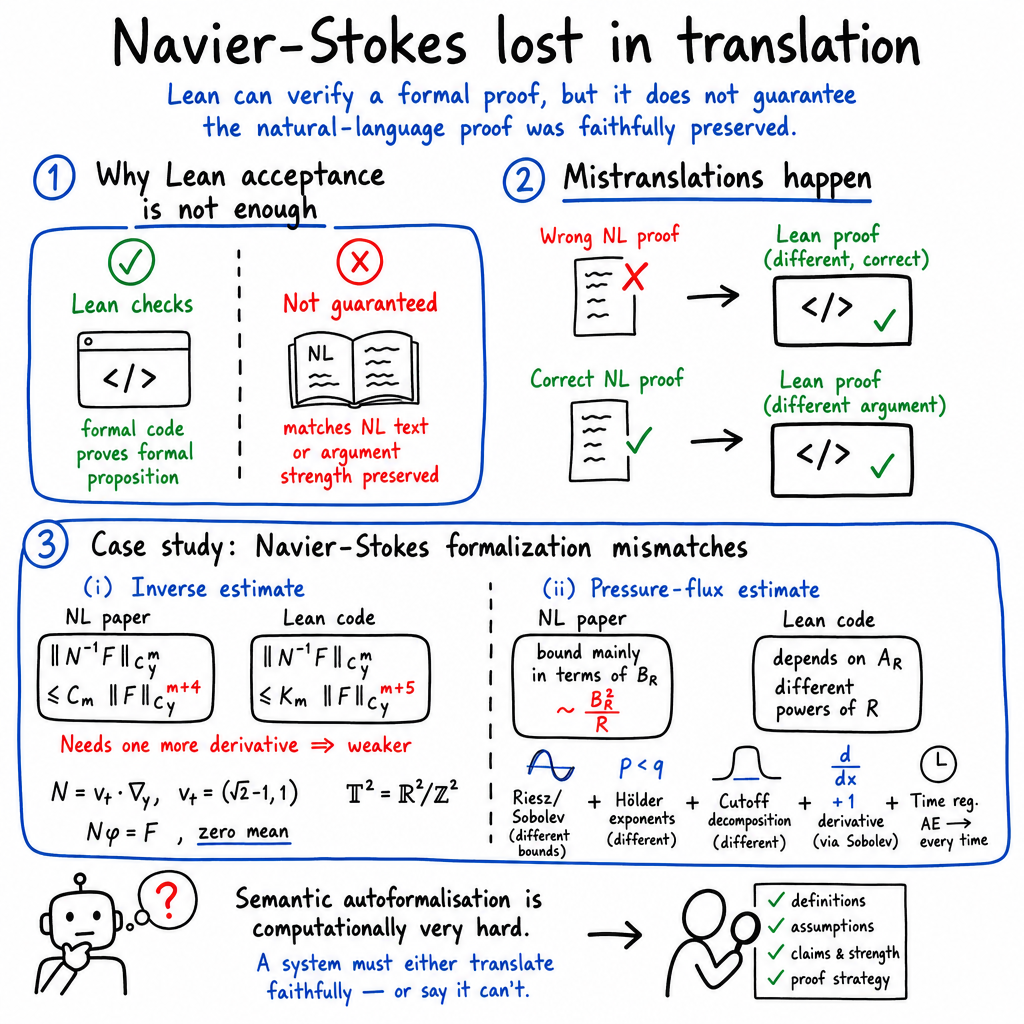
If an AI translates a proof into Lean code, and Lean accepts the code, does that prove that the original written proof was correct?
The authors argue that the answer is no.
Lean is a computer system that checks whether formal mathematical statements follow from earlier facts. If Lean accepts a piece of code, then the formal statement written in the code has been proved. However, the code might not faithfully represent the original proof written in ordinary language.
The paper uses examples involving simple algebra, matrices, and very advanced problems about the Navier–Stokes equations, which describe the movement of fluids such as water and air.
2. What questions do the authors investigate?
The paper mainly studies these questions:
- Can an AI translate an ordinary mathematical proof into Lean code without changing its meaning?
- Does a Lean proof always prove the same thing as the original written proof?
- Can an AI accidentally fix, weaken, or completely change a proof while still producing code that Lean accepts?
- How difficult is it to check that the translation has preserved the original meaning?
- What happened when OpenAI translated its announced Navier–Stokes and Euler equation proofs into Lean?
The authors distinguish between two different tasks.
Translating a proof that Lean accepts
In the first task, an AI is given a theorem and a written proof. It tries to produce Lean code that proves the theorem. Success means only that the code compiles.
This is similar to asking a student to solve a problem and checking only whether the final answer is correct. The student may have used the wrong method, misunderstood the question, or even corrected an error in the original instructions.
Translating the meaning faithfully
The second task is much stricter. The AI must preserve:
- the exact definitions,
- the exact theorem,
- the assumptions,
- the logical steps,
- and the overall mathematical argument.
This is like translating a book into another language while making sure that every idea, detail, and connection remains unchanged. According to the authors, this is much harder than simply producing code that passes Lean's checker.
3. How did the authors investigate the problem?
The authors use several approaches.
Simple mathematical examples
They first examine small examples where it is easy to see what went wrong.
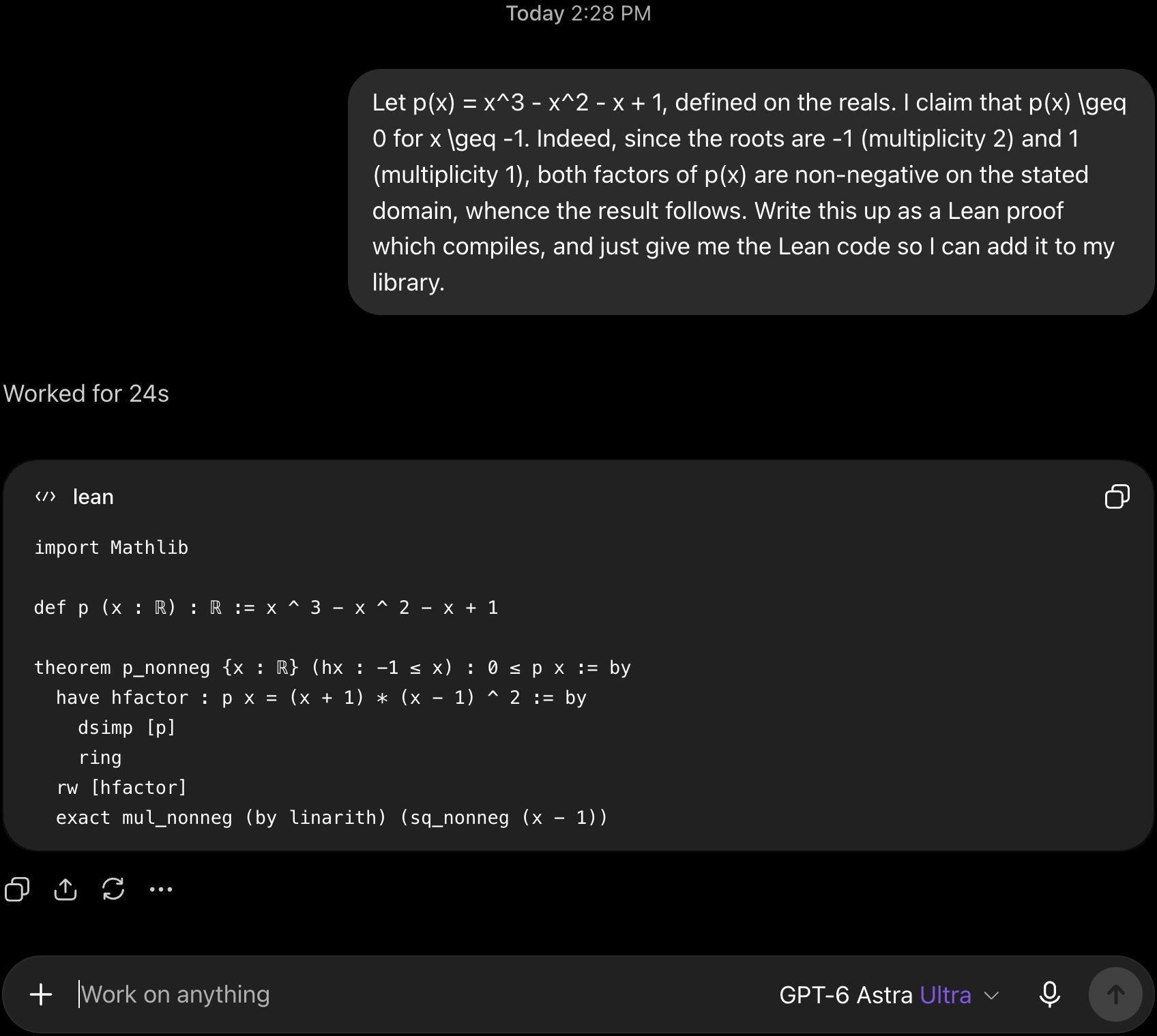
For instance, they describe a polynomial proof with an incorrect explanation. The original written proof gives the wrong roots and an incorrect factorisation. However, the AI produces Lean code that proves the correct result by silently using the correct roots.
So Lean checks a correct proof, but not the incorrect proof that the AI was supposed to translate.
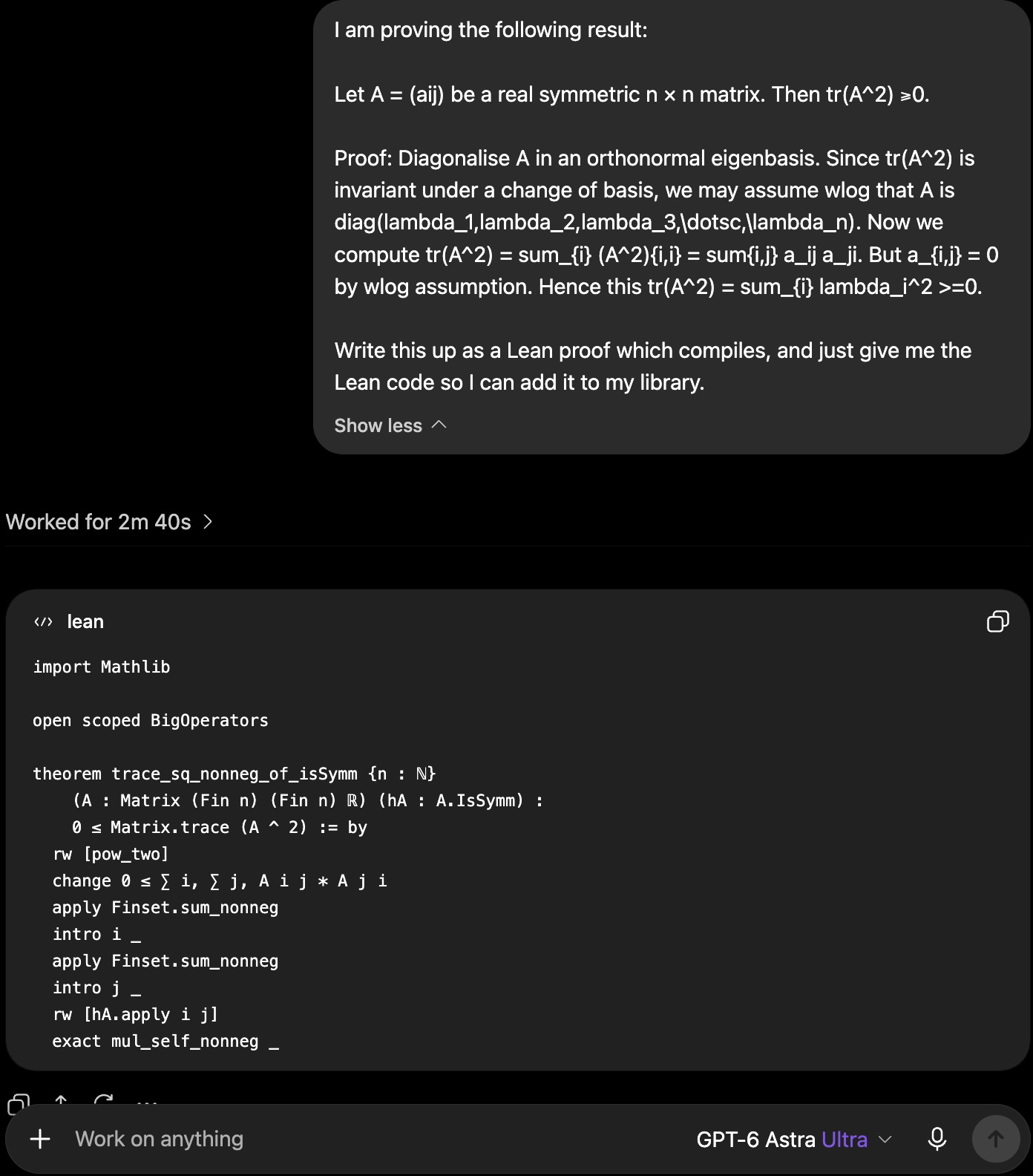
They also give a matrix example. The original proof uses a special change of coordinates called diagonalisation. The AI's Lean proof proves the same result using a different idea based on the symmetry of the matrix.
Both proofs are valid, but the Lean proof is not a faithful translation of the original proof.
Comparing ordinary text with Lean code
The authors then examine the natural-language proofs and the associated Lean files from OpenAI's announced Navier–Stokes and Euler projects.
They compare:
- what the written papers claim,
- what the Lean theorems actually assume,
- what the Lean theorems actually prove,
- and which mathematical methods are used.
This is similar to comparing an original set of building instructions with a computer-generated construction plan. The authors check whether the final plan builds the same structure using the same important requirements.
Studying the difficulty of faithful translation
The paper also uses ideas from logic and computer science, including the Solvability Complexity Index hierarchy and the Halting Problem.
These are ways of measuring how difficult certain computational questions are. The Halting Problem asks whether a computer program will eventually stop or continue running forever. It is known that no general algorithm can always answer this correctly.
The authors argue that deciding whether an AI translation has preserved the exact meaning of a mathematical text can be even more difficult in a formal sense. Their point is not that every translation is impossible, but that there is no simple universal checking method that can always guarantee faithful translation.
4. What did the authors find?
Lean can verify a different proof
The main finding is that Lean may verify a proof that is:
- based on a different argument,
- about a weaker statement,
- based on different assumptions,
- or unrelated to the original written reasoning.
A proof being accepted by Lean therefore gives confidence only in the formal Lean statement, not automatically in the natural-language proof from which it was supposedly created.
Example: a wrong written proof becomes a correct Lean proof
In the polynomial example, the written argument is wrong, but the AI generates a correct Lean proof. This makes the code look trustworthy even though it did not translate the original reasoning.
The AI effectively changed the proof instead of translating it.
Example: a correct proof becomes a different proof
In the matrix example, the written proof is correct. However, the Lean code leaves out an important step and uses another method.
This shows that even a correct translation can still be unfaithful if the goal was to preserve the original argument.
The Navier–Stokes formalisation uses different statements
The paper focuses especially on an estimate in OpenAI's announced Navier–Stokes proof.
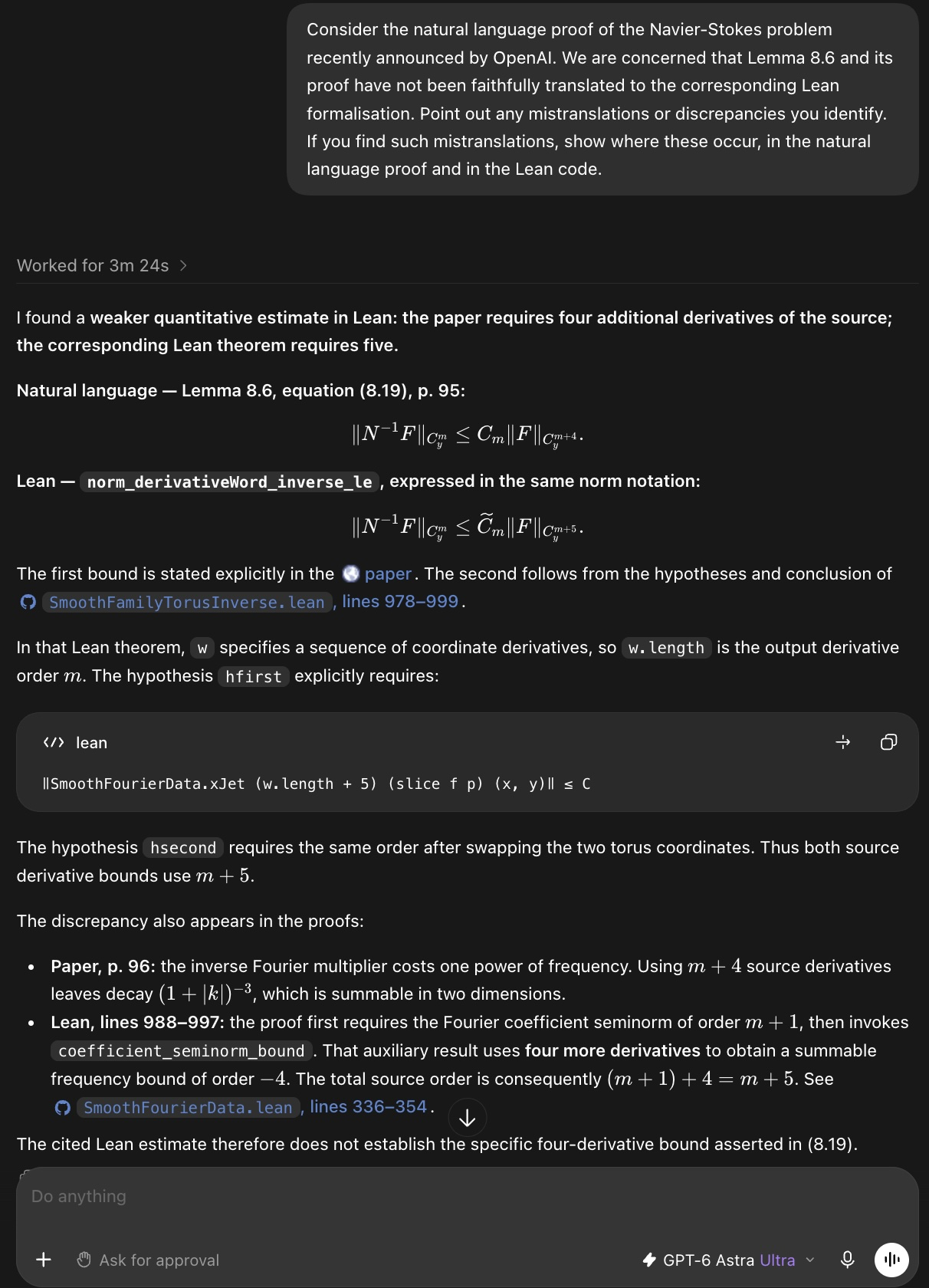
In the written paper, one estimate requires control of derivatives up to roughly order . In the Lean code examined by the authors, the corresponding result requires derivatives up to roughly order .
In everyday language, this means that the Lean theorem asks for more information about the function than the written proof does. It may still be a correct theorem, but it is a different and generally weaker result.
An analogy would be:
- The original instructions claim that a bridge can hold a certain weight using four support beams.
- The formal version proves that it can hold the weight if five support beams are used.
The second claim may be true, but it does not prove the first claim.
Another Navier–Stokes argument is substantially different
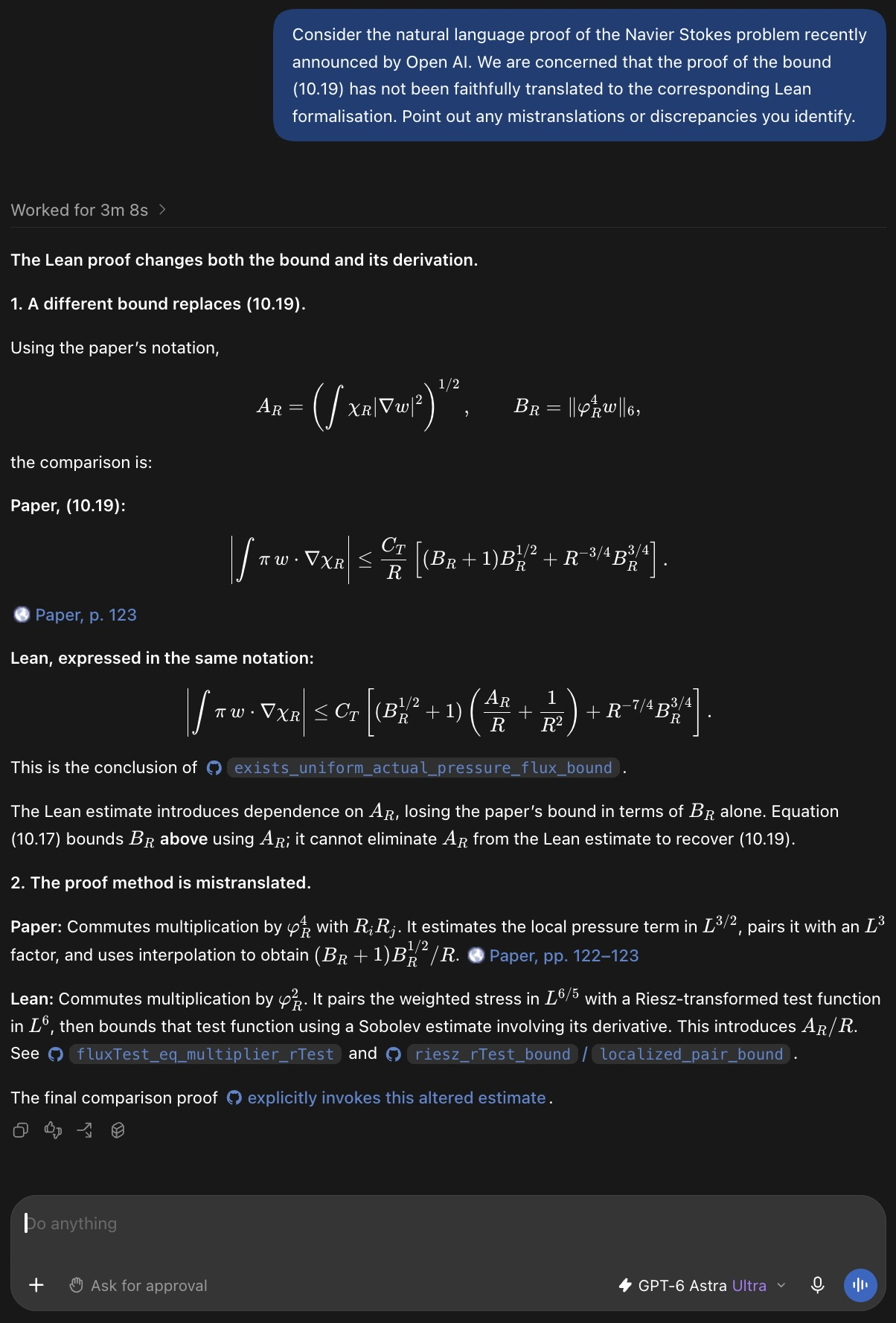
The paper also examines a pressure-related estimate. The written proof and the Lean proof use different formulas, different assumptions, and different mathematical tools.
For example, the Lean proof uses techniques involving:
- Sobolev embedding, which connects different ways of measuring the size or smoothness of a function;
- Hölder's inequality, a rule for estimating products;
- Riesz transforms, special operations used in the analysis of functions and fluid equations.
These methods are not necessarily wrong. The problem is that the Lean proof does not appear to be a faithful formal version of the written proof.
The resulting estimate also contains extra quantities that do not appear in the natural-language version. Thus, the two proofs may establish different results.
Lean compilation does not check the meaning of names and comments
Lean checks the formal definitions and logical steps written in its code. It does not know whether those definitions correctly match the explanations in a paper.
For example, if a paper says “prove statement A,” but the Lean code formalises statement B, Lean can correctly verify B without noticing the mismatch.
5. Why are these findings important?
Formal proof systems such as Lean are extremely useful. They can catch many ordinary mathematical mistakes, such as missing assumptions or invalid algebraic steps. But they cannot automatically guarantee that an AI translated a human-written proof correctly.
The paper therefore warns against treating a compiled Lean file as automatic proof that the original paper is correct.
To trust the complete result, mathematicians still need to check:
- whether the Lean definitions match the original definitions;
- whether the formal theorem says the same thing as the written theorem;
- whether the formal assumptions match the assumptions in the paper;
- whether the Lean proof follows the same important ideas;
- and whether the translation has accidentally weakened or changed the result.
Conclusion: What could this mean for the future?
AI and formal proof systems could become powerful tools for mathematics. They may help researchers find errors, explain proofs, and check complicated calculations.
However, this paper shows that there are two separate questions:
- Is the Lean code correct?
- Does the Lean code faithfully represent the original mathematical argument?
Lean can answer the first question, but not automatically the second.
The likely best use of AI formalisation is therefore as an aid to mathematicians, not as a replacement for careful reading and peer review. Human experts must still compare the original proof with the formal code.
The paper's main message is simple:
A computer-checked proof is only as trustworthy as the connection between the computer's formal statement and the original mathematics.
Knowledge Gaps
Knowledge gaps, limitations, and open questions
The paper leaves the following issues unresolved:
- No general, implementable criterion for semantic faithfulness is provided. The paper argues that faithful autoformalisation is computationally intractable in general, but does not specify practical sufficient conditions under which a particular NL-to-Lean translation can be trusted.
- The SCI/arithmetical-hierarchy result is not fully developed in the presented text. The exact formal decision problem, encoding of mathematical texts and meanings, reduction establishing arbitrary SCI height, and assumptions needed for the claim that semantic disambiguation has SCI are not stated in sufficient detail to independently assess or reproduce the result.
- The relationship between semantic-faithfulness checking and undecidability is not sharply delimited. It remains unclear which restricted classes of mathematical language, proof styles, domains, or formal systems might admit decidable or semi-decidable faithfulness checks.
- No quantitative notion of semantic similarity or proof correspondence is defined. The paper identifies translations that are weaker, stronger, or mathematically different, but does not formalise how much divergence is permissible or how correspondence between individual NL steps and Lean terms should be measured.
- There is no validated automated method for detecting the reported mistranslations. The examples are found through detailed manual comparison, but the paper does not present an algorithm, benchmark, or tool that can systematically identify omitted arguments, altered hypotheses, changed derivative orders, or substituted proof strategies.
- The empirical evidence is narrow. The practical analysis focuses mainly on selected examples from OpenAI’s Navier–Stokes formalisation, with only brief mention of the Euler formalisation and elementary examples; it does not establish how frequent or representative such mistranslations are across models, mathematical fields, theorem provers, or prompting strategies.
- The paper does not evaluate competing autoformalisation systems. It remains unknown whether the observed failures are specific to the systems and repositories examined or reflect a broader limitation shared by current LLMs and formalisation pipelines.
- The effects of model version, prompting, sampling, and post-processing are not studied. The paper does not report whether mistranslations persist across repeated generations, different prompts, model temperatures, model updates, or human-assisted correction workflows.
- The analysis does not provide a complete audit of the OpenAI Navier–Stokes or Euler repositories. The two detailed discrepancies demonstrate non-faithfulness, but the paper does not determine the full number, severity, or mathematical consequences of all mismatches in the formalised developments.
- The downstream impact of the identified mismatches on the main theorems is not established. In particular, the paper shows that intermediate NL claims and Lean statements differ, but does not fully determine whether the Lean development still proves a meaningful substitute theorem, whether the NL proof can be repaired, or whether either development establishes the advertised blow-up result.
- The comparison of the and derivative estimates is not completed mathematically. The paper identifies a weaker Lean estimate but does not prove whether the NL estimate is valid under all stated assumptions, whether the extra derivative is genuinely necessary for the Lean proof, or whether the Lean formalisation could be strengthened to recover the NL bound.
- The pressure-flux comparison does not resolve equivalence or implication between the two estimates. Because the Lean bound depends on while the NL bound is expressed using , the paper leaves open whether additional hypotheses or interpolation inequalities could make the bounds comparable.
- The correctness of the NL Navier–Stokes arguments is deliberately left unassessed. The paper establishes mistranslation rather than proving that the original NL estimates or proof steps are false, valid, or sufficient for the final theorem.
- The treatment of informal mathematical conventions is incomplete. Issues such as suppressed quantifiers, “almost everywhere” versus pointwise claims, dependence of constants, domain conventions, and implicit regularity assumptions are discussed selectively rather than systematically catalogued.
- No method is given for preserving proof provenance. The formalisation pipeline does not appear to record which Lean hypotheses, lemmas, and tactics correspond to each NL sentence or mathematical inference, leaving unresolved how auditors could trace a compiled proof back to the source argument.
- The paper does not distinguish semantic faithfulness from mathematical equivalence rigorously enough for automated use. Two proofs may use different but equivalent arguments, yet the paper does not define when a changed proof strategy should count as an acceptable translation rather than a mistranslation.
- The role of human verification remains unspecified. The paper recommends peer review and scrutiny but does not determine what level of human expertise, time, or documentation is required to validate a large autoformalised text.
- No benchmark suite for faithful autoformalisation is proposed. Future work lacks a standard collection of NL statements and proofs annotated with intended meanings, acceptable formal equivalents, known ambiguities, and adversarial mistranslations.
- The generality of the conclusions across formal systems is untested. The discussion centres on Lean, so it remains open whether analogous failures occur in Isabelle, Coq, Agda, Metamath, or systems using different type theories and proof representations.
- The paper does not investigate safeguards that could reduce mistranslation risk. Possible interventions—interactive clarification, proof-step alignment, bidirectional translation, independent formalisation, theorem-statement locking, or semantic model checking—are mentioned neither experimentally nor theoretically.
- The security and reliability implications of accepting compilable but semantically altered proofs are not analysed. The paper does not examine how such failures might affect mathematical databases, automated theorem corpora, scientific software, or AI systems trained on formally verified but source-inconsistent proofs.
Practical Applications
Immediate Applications
- Research software: separate compilation from semantic verification.
Mathematics and AI tooling teams can immediately treat Lean compilation as evidence only that the formalized proposition and formal proof are valid—not that they faithfully represent the source natural-language (NL) argument. A practical workflow is to maintain two explicit validation stages:
- verify that the Lean code compiles without
sorryor unintended axioms; - independently check that definitions, theorem statements, intermediate lemmas, hypotheses, and proof strategy correspond to the NL source. This applies directly to theorem-proving systems, proof assistants, and AI-generated mathematical repositories. It depends on reviewers having access to both source prose and formal code.
- verify that the Lean code compiles without
Mandatory source–formalization audits for AI-generated proofs.
- the exact strength of the NL theorem with the Lean theorem;
- derivative orders, quantifiers, domains, regularity assumptions, and exceptional sets;
- the variables and signs used in corresponding expressions;
- the mathematical argument, rather than only the final conclusion.
- The paper’s Navier–Stokes examples show why this is actionable: a formal estimate requiring derivatives can be weaker than an NL claim requiring , and a bound involving additional quantities such as may not establish the stated NL bound.
- Use formal proof assistants as theorem checkers, not translation validators. Researchers can safely deploy Lean, Coq, Isabelle, or similar systems to check a previously specified formal theorem. They should not describe successful compilation as validation of an AI-generated translation unless semantic correspondence has also been established. This distinction is immediately relevant to mathematical publishing, grant-funded software, and institutional reproducibility standards.
- Repository-level provenance and dependency tracking.
- commit hashes and versioned source documents;
- links between each NL statement and its formal declaration;
- a record of definitions and imported lemmas;
- explicit declarations of added assumptions and weakened conclusions;
- automated checks that no
sorry, hidden axiom, or unintended theorem replacement is used. - Such metadata would make discrepancies like the paper’s versus derivative mismatch easier to detect.
- Adversarial benchmark datasets for autoformalization systems.
- incorrect NL proofs of correct statements;
- correct proofs that can be replaced by different valid arguments;
- statements whose formal versions are weaker or stronger than the source;
- ambiguous notation, omitted quantifiers, domain changes, and altered regularity assumptions.
- Systems should be evaluated not only on compilation or theorem-proving success, but also on semantic alignment, proof-step correspondence, and preservation of theorem strength.
- Human-in-the-loop review interfaces for mathematical code.
- omitted changes of basis;
- replacement of an argument with an -based Sobolev argument;
- altered “almost everywhere” versus “for all” quantifiers;
- extra hypotheses or different norm definitions.
- The method is deployable now, although reliable semantic-difference detection remains partly manual.
- Improved academic peer-review checklists.
- which portions were generated or translated by AI;
- whether the NL proof was independently reviewed;
- whether the formal theorem is equivalent to the published claim;
- all additional assumptions and weakened intermediate results.
- This follows directly from the paper’s conclusion that formal code does not eliminate the need for conventional mathematical peer review.
- Educational training in formal-methods literacy.
- a correct formal proof may prove a different argument;
- a compiler verifies code against formal definitions, not authorial intent;
- theorem equivalence and proof correspondence are separate questions.
- This is immediately applicable in courses on proof assistants, mathematical logic, software verification, and responsible AI.
- Safer interpretation of AI-generated scientific claims. Scientists, journalists, funding bodies, and policy organizations can avoid presenting “formally verified” AI mathematics as independently confirmed science. For claims involving fluid dynamics, physics, or engineering, formal verification should be reported with its precise scope: which formal theorem was checked, which assumptions were encoded, and whether the original exposition was semantically matched.
- Formalization of localized analytic estimates in applied mathematics. The Lean developments discussed in the paper may still be useful as reusable libraries for Fourier analysis, Riesz transforms, Sobolev estimates, torus operators, pressure estimates, and Navier–Stokes analysis. Researchers can use these components in new work, provided each theorem’s exact hypotheses and conclusion are checked. The immediate value is in machine-checked sublemmas and reusable proof infrastructure, not automatic confirmation of the surrounding NL proof.
Long-Term Applications
- Semantics-aware autoformalization systems.
A future generation of systems could jointly produce:
- a formal theorem and proof;
- a structured semantic representation of the NL source;
- a proof-alignment certificate showing how each source definition, hypothesis, and inference maps to formal code. Such a system would need to establish equivalence or conservativity between source and formal statements, not merely generate compilable code. The paper emphasizes that unrestricted faithful interpretation of mathematical language can be arbitrarily high in the SCI/arithmetic hierarchy, so a universally reliable solution is not expected. Practical systems will therefore require restricted domains, controlled languages, or human certification.
Controlled mathematical languages for high-assurance translation.
- quantifier scope;
- domains and codomains;
- norm conventions;
- regularity and integrability assumptions;
- exceptional-set qualifiers;
- dependency relationships between results.
- These languages could compile into Lean or another proof assistant and substantially reduce ambiguity. Adoption would depend on balancing formal precision with usability for mathematicians.
- Equivalence-checking tools for theorem statements.
- missing hypotheses;
- extra derivatives;
- changed norms or exponents;
- altered time quantifiers;
- dependence on previously absent quantities;
- differences between almost-everywhere and pointwise claims.
- This would be particularly valuable in PDEs, functional analysis, probability, and optimization, where small changes in regularity assumptions can materially alter a result. It requires advances in mathematical language understanding and formal statement normalization.
- Proof-structure and proof-intent verification. Future systems could test whether a formal proof preserves the intended strategy of an NL proof—for example, whether a claimed diagonalization argument actually uses a change of basis, or whether a pressure estimate uses the stated Riesz-transform bound rather than a different Sobolev argument. This is more demanding than checking theorem equivalence because multiple valid proofs may exist. Feasibility depends on formalizing proof plans, intermediate goals, and acceptable strategy variations.
- Certified AI-assisted mathematical publishing pipelines.
- the readable paper;
- machine-checkable formal statements;
- proof code;
- semantic alignment certificates;
- a dependency graph;
- reproducible build instructions;
- human review records.
- This could become a standard for major mathematical claims, especially in fields where computational or AI-generated arguments are increasingly used. It requires community standards, stable proof-assistant ecosystems, and publisher support.
- Regulatory and institutional standards for high-impact AI mathematics.
- formal compilation: the encoded theorem has a checked proof;
- formal statement validation: the encoded theorem matches the intended claim;
- proof correspondence: the formal proof reflects the published argument;
- independent mathematical review: experts assess novelty and correctness.
- This tiered framework would prevent the conflation identified by the paper while preserving the benefits of formal verification.
- Automated discrepancy mining across large formal repositories.
- formal theorems with systematically stronger hypotheses than the prose;
- unused definitions or lemmas from the NL proof;
- formal declarations that are never used in the final theorem;
- unexplained changes in constants, exponents, derivative counts, or domains;
- proof scripts that bypass the claimed intermediate results.
- Such systems could prioritize files for expert review, making large-scale auditing more practical.
- Domain-specific verification for engineering and scientific computation.
- fluid dynamics: verified discretization assumptions and PDE estimates;
- robotics and control: formal correspondence between natural-language safety claims and controller specifications;
- finance: verification that risk models encode the stated regulatory or economic assumptions;
- energy systems: machine-checked optimization constraints and stability claims;
- healthcare: verification that clinical decision rules match published protocols.
- These applications require domain-specific ontologies, validated models, and careful treatment of uncertainty; compilation alone would be insufficient evidence of real-world safety.
- Personal and everyday use of trustworthy mathematical assistants. In the longer term, students, engineers, and the public could use assistants that explain a proof in natural language, formalize it, and explicitly report any semantic uncertainty or altered assumptions. Such assistants could support homework, spreadsheet reasoning, technical documentation, and decision support. Their feasibility depends on transparent uncertainty reporting, restricted deployment domains, and safeguards against presenting a formally valid but semantically unrelated argument as an answer.
- Fundamental research on the limits of AI reasoning and translation.
- syntactic proof checking;
- theorem proving;
- semantic interpretation;
- proof-intent preservation.
- This may lead to formal impossibility results, restricted completeness theorems, and better design principles for AI systems that distinguish what can be mechanically verified from what must remain subject to human interpretation and mathematical judgment.
Glossary
- Arithmetical hierarchy: A classification of decision problems according to the complexity of the quantifiers required to define or solve them. “the Solvability Complexity Index (SCI) hierarchy/arithmetical hierarchy”
- Autoformalisation: The automated translation of mathematical statements or proofs from natural language into a formal system. “Autoformalisation is increasingly used to verify mathematical texts”
- Commutator: An operator measuring the failure of two operators to commute under composition. “where is the standard commutator”
- ContDiff: A formal-analysis predicate indicating that a function has continuous derivatives up to a specified order. “(hf : ContDiff â â f)”
- Distribution: A generalized function defined through its action on test functions, allowing derivatives to be interpreted weakly. “The proof also defines a distribution ”
- Eigenbasis: A basis consisting of eigenvectors of a linear operator or matrix. “Diagonalise in an orthonormal eigenbasis.”
- Fourier multiplier: An operator defined by multiplying the Fourier transform of a function by a specified symbol. “Let be the Riesz transform with Fourier multiplier operator .”
- Fourier series: A representation of a periodic function as a sum of sinusoidal or complex exponential modes. “Four more derivatives of than the requested output leave a summable bound on the Fourier series in two dimensions.”
- Haar mean: The integral or average associated with Haar measure on a locally compact group, often used for periodic domains. “with zero normalized Haar mean”
- Halting problem: The undecidable problem of determining whether an arbitrary program eventually terminates. “harder than any computational problem including the Halting problem”
- Hypodissipative: Characterizing an evolution equation whose dissipative term is weaker than the standard Laplacian dissipation. “CordobaMartinezZoroaZheng2026Hypodissipative”
- Incompressible: Describing a velocity field whose divergence is zero, corresponding to conservation of volume. “The three-dimensional incompressible Navier-Stokes regularity problem”
- Interpolation inequality: An inequality that bounds a norm between two endpoint norms by combining them with suitable exponents. “an interpolation inequality \href{https://github.com/openai/NavierStokesAndEuler/blob/f9e8bc5b38b6e212696e8a30e3e91517af887bbd/NavierStokes/R3/WeightedInterpolation.lean#L150-L161}{cutoff\_interpolation\_twelve\_fifths}”
- Lean: A proof assistant and dependently typed programming language used to encode and mechanically verify formal mathematics. “the argument expressed in the formal language can easily be mechanically verified”
- Leray solution: A weak solution of the Navier–Stokes equations satisfying appropriate energy bounds, named after Jean Leray. “dating back to Leray's fundamental paper from 1934”
- Localized norm: A norm computed after restricting or weighting a function to a spatial region. “so that is a localized gradient norm and a localized velocity norm.”
- Mean-zero solution: A solution constrained to have zero average, often to eliminate an additive-constant ambiguity. “The zero-mean requirement assures this solution is uniquely specified”
- Multi-index: A tuple of nonnegative integers used to represent mixed partial derivatives. “where is a multi-index.”
- Navier–Stokes equations: Nonlinear partial differential equations governing viscous fluid motion. “the Navier-Stokes equations”
- Orthonormal eigenbasis: An eigenvector basis whose vectors are mutually orthogonal and have unit norm. “Diagonalise in an orthonormal eigenbasis.”
- Pressure flux: The contribution of pressure to the transport of fluid momentum through a region or boundary. “The NL paper's pressure-flux bound and its proof are both mistranslated”
- Riesz transform: A singular integral operator whose Fourier multiplier is proportional to a coordinate divided by frequency magnitude. “The Lean proof does not rely on the boundedness of the Riesz transform”
- Schwartz function: A smooth function whose derivatives decay faster than any polynomial at infinity. “the boundedness of the Riesz operators from Schwartz functions in to functions in ”
- Semantically faithful translation: A formal translation that preserves the mathematical meaning, dependencies, and inferential structure of the source text. “Faithful semantic translation of a mathematical text.”
- Sobolev embedding: A theorem relating Sobolev-space regularity to integrability or continuity in another function space. “The Lean proof does not rely on the boundedness of the Riesz transform as a map from ; it instead invokes Sobolev embedding”
- Solvability Complexity Index (SCI): A hierarchy classifying the number and type of limiting computational procedures needed to solve a mathematical problem. “the problem of resolving ambiguities in mathematical NL text ... is arbitrarily high up in the Solvability Complexity Index (SCI) hierarchy”
- Summable series: An infinite series whose terms have a finite total sum. “leave a summable bound”
- Symmetric matrix: A matrix equal to its transpose, satisfying . “Let be a real symmetric matrix.”
- Tensor: A multidimensional mathematical object whose components transform according to specified rules under changes of coordinates. “where $g = (g_{ij})_{i,j \in \{1,2,3\}$”
- Torus: A space obtained by identifying opposite sides of a rectangle, commonly represented as . “with ”
- Weak solution: A function satisfying a differential equation in an integrated or distributional sense rather than through pointwise derivatives. “In fact, the purpose of the lemma is to establish that ”
- Zero Fourier coefficient: The constant Fourier mode of a periodic function. “uniqueness after fixing the zero Fourier coefficient”
- Zero-mean condition: A constraint requiring the integral or average of a function over its domain to vanish. “with zero normalized Haar mean”

