DistScene: Object-to-Scene Distillation for 3D Scene Generation
Abstract: We present DistScene, a framework for single-image compositional 3D scene generation by jointly modeling the environment and individual objects. Unlike existing methods that represent scenes primarily as collections of objects, we model the environment as an explicit scene component to provide geometric context for object placement. Specifically, we introduce Scene-Frame Generation, which jointly generates separate environment and object components in a shared coordinate frame, allowing their geometry and relative placement to be learned together. Then we introduce Object-Centric Refinement to refine each object in a local frame with scene context. Finally, we develop Object-to-Scene Distillation to transfer pretrained object-generation priors to scene generation through automatically composed and rendered synthetic scenes. Evaluations on indoor and outdoor benchmarks demonstrate improved scene-level spatial coherence over the evaluated baselines. Project page: https://coolbeam.github.io/DistScene/
Paper Prompts
Sign up for free to create and run prompts on this paper.
Top Community Prompts
Explain it Like I'm 14
1. What is this paper about?
The paper introduces DistScene, a computer program that creates a complete 3D scene from one 2D image.
For example, if the input is a picture of a living room, DistScene tries to create:
- The room itself, including the floor, walls, and other background parts
- Separate 3D objects, such as a sofa, table, lamp, and chair
- The correct positions and sizes of these objects
- Detailed shapes for each object
This could be useful for virtual reality, video games, robots, self-driving cars, and computer simulations.
2. What questions are the researchers asking?
The researchers focus on several main questions:
- Can a computer create both the objects and the surrounding environment together?
- Can it place objects in sensible locations? For example, a chair should usually be on the floor, not floating in the air.
- Can it keep objects as separate, editable parts? A user should be able to move or replace a chair without changing the whole room.
- Can it create detailed objects even when the objects take up only a small part of the image?
- Can a model trained mostly on individual 3D objects learn to create complete scenes?
Earlier systems often treated a scene as just a group of objects. DistScene instead treats the environment as an important object-like part of the scene.
3. How does DistScene work?
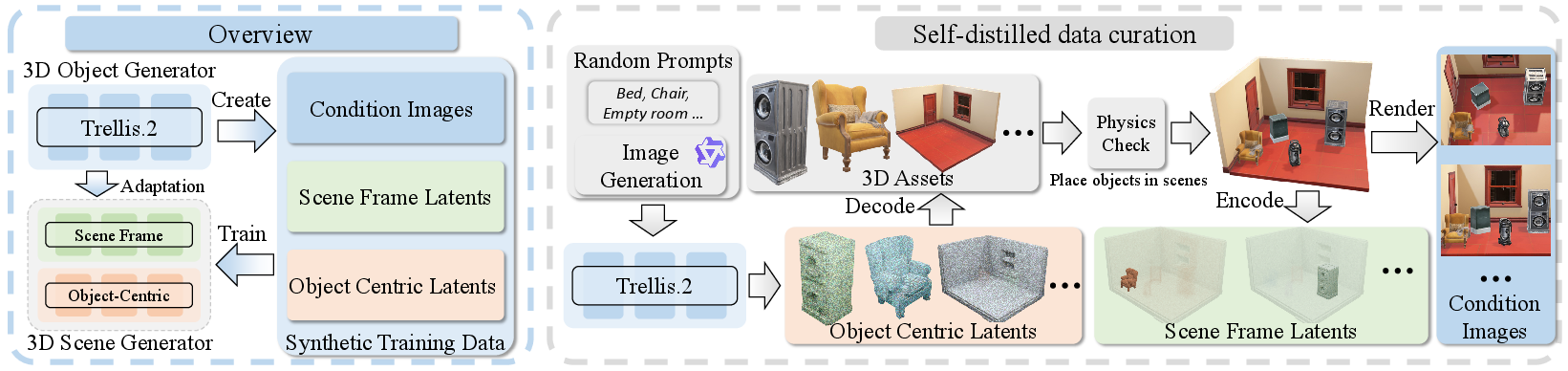
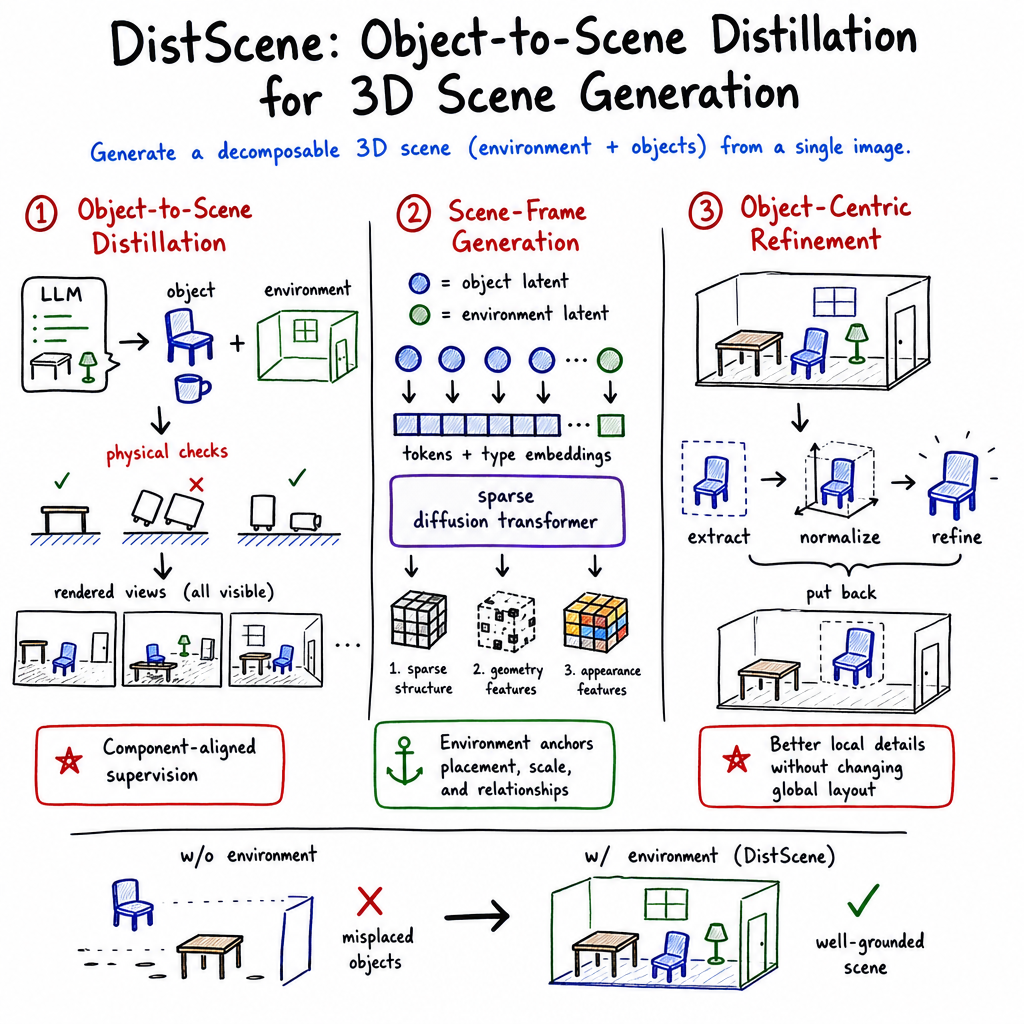
First: It creates training scenes automatically
There are not enough large datasets containing complete 3D scenes with every object labeled separately. To solve this problem, the researchers create many artificial training scenes.
The process is similar to building a digital dollhouse:
- A LLM writes a description, such as “a small room with a desk, chair, computer, and lamp.”
- A pretrained 3D generator creates each object.
- The same generator creates the environment, such as the room or outdoor area.
- The objects are placed inside the environment.
- The system checks for problems, such as objects passing through walls or floating in the air.
- It adjusts the positions until the scene looks physically reasonable.
- It renders pictures of the scene from different viewpoints.
The researchers created about 125,000 artificial scenes, including indoor and outdoor scenes.
This process is called Object-to-Scene Distillation. In simple terms, the system transfers knowledge from a model that is good at making individual objects into a model that can make whole scenes.
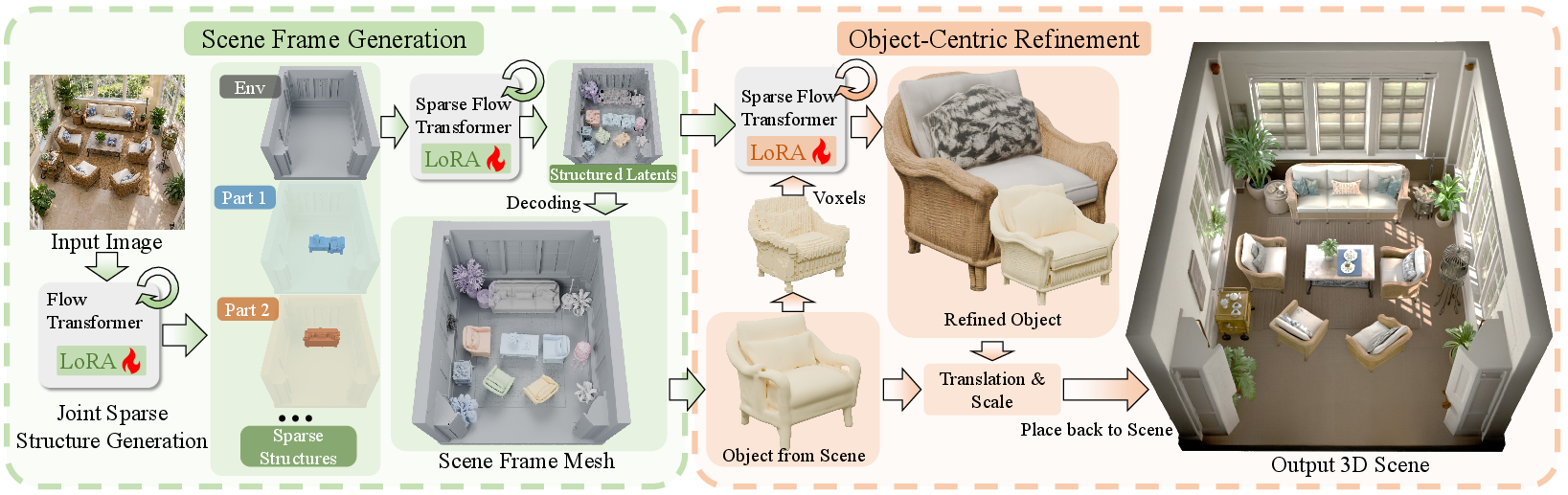
Second: It generates the scene and environment together
DistScene uses a representation called sparse voxels. A voxel is like a tiny cube in 3D space, similar to how a pixel is a tiny square in a 2D image. “Sparse” means the system stores information only in places where something actually exists, rather than filling the entire space with empty cubes.
The system creates separate parts for:
- Each object
- The environment
However, it generates them together in one shared 3D coordinate system. This is like drawing all the pieces of a model on the same map.
The environment helps the system understand where objects should go. For example:
- A table should stand on the floor.
- A picture should be attached to a wall.
- A lamp might sit on a table.
- Objects should not overlap impossibly.
The model uses a type of artificial intelligence called a transformer. The different parts of the scene can “communicate” with each other while they are being generated, helping them agree on their locations and shapes.
Third: It improves each object separately
When the whole scene is generated at once, a small object may not receive enough detail. A chair that occupies only a small part of a room could look rough or incomplete.
DistScene solves this with Object-Centric Refinement:
- It takes one object out of the scene.
- It enlarges and recenters the object.
- It adds more geometric detail.
- It places the improved object back in its original location.
This is similar to zooming in on a small part of a photograph, improving its quality, and then putting it back into the full picture.
Importantly, the system also remembers the object’s surroundings. This helps it avoid refining the object into something that no longer fits the scene.
Technical terms in simple language
| Technical term | Simple meaning |
|---|---|
| 3D scene generation | Creating a 3D world from information such as an image |
| Sparse voxel | A tiny 3D cube used only where something exists |
| Latent representation | A compact hidden description used by the AI |
| Scene frame | One shared coordinate system for the whole scene |
| Object-centric refinement | Improving one object at a time while preserving its position |
| Flow matching | A way of teaching the model to gradually turn random information into a correct 3D result |
| LoRA | A lightweight method for adapting an existing AI model without retraining all of it |
4. What did the researchers find?
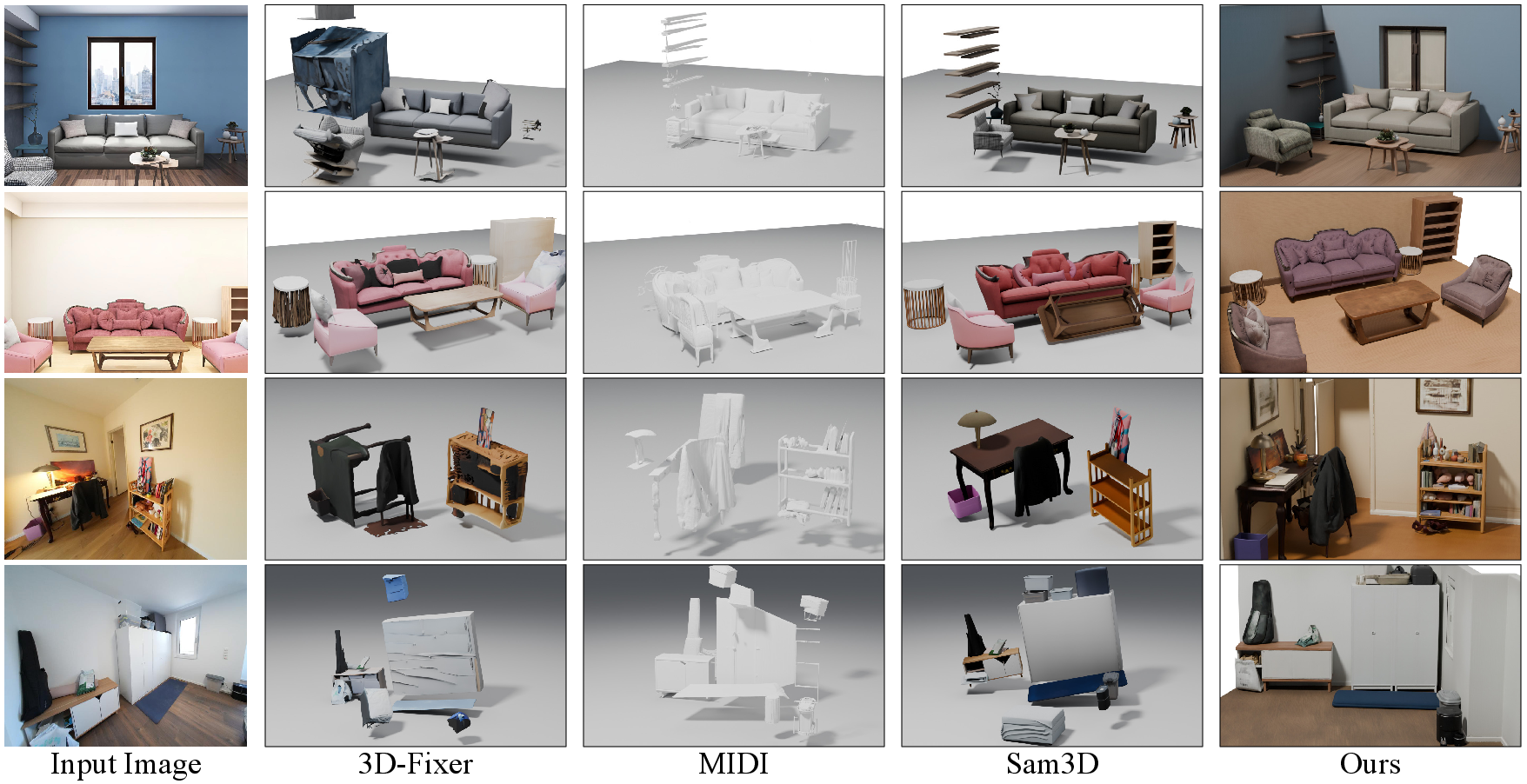
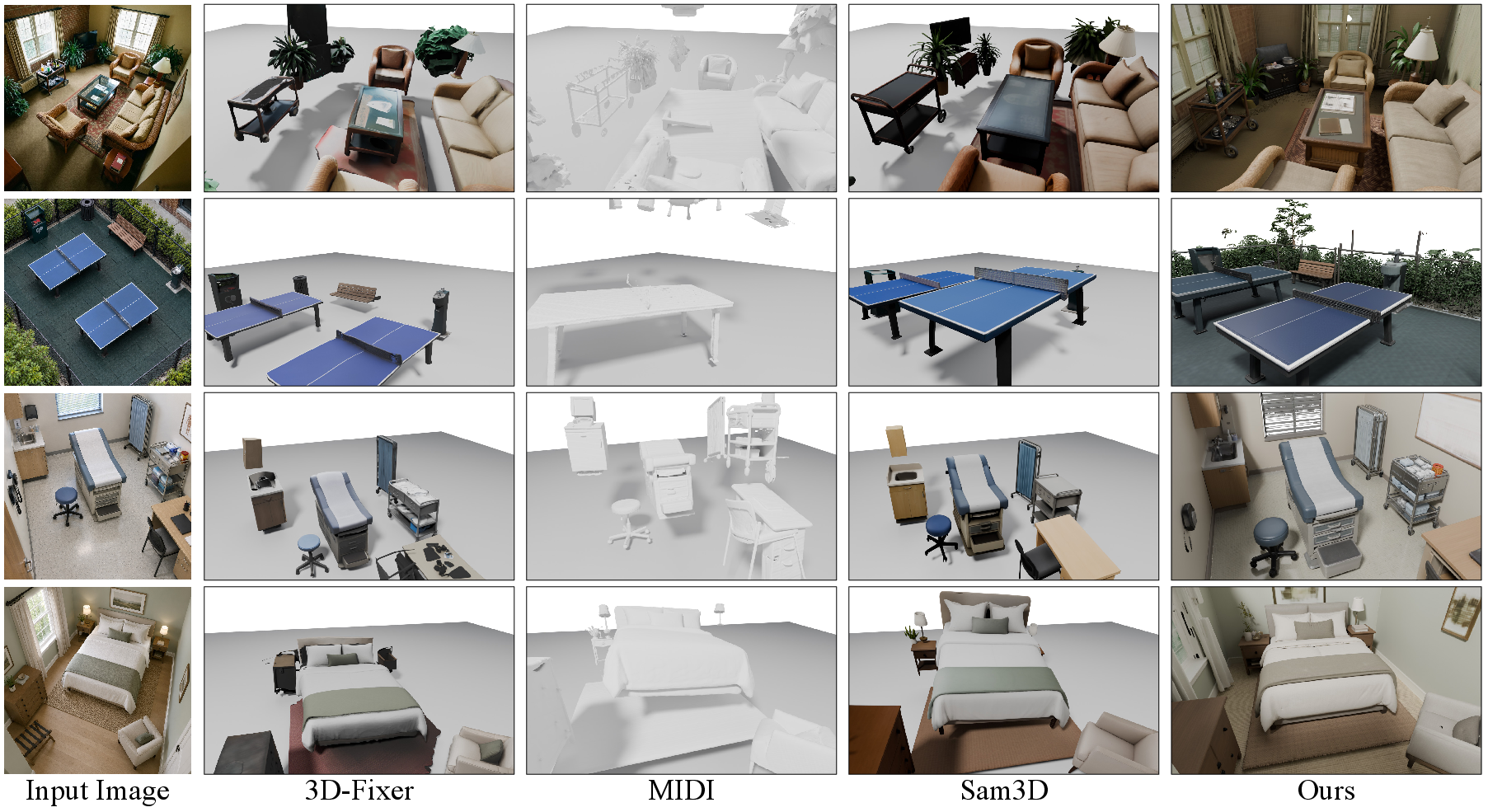
The researchers tested DistScene on indoor and outdoor benchmarks and compared it with other 3D-generation systems.
Better scene structure
DistScene generally placed objects more accurately and created more complete environments. It performed especially well at preserving relationships such as:
- Objects touching the floor
- Objects being near one another
- Correct relative sizes
- Reasonable spacing between objects
For indoor scenes, DistScene achieved the best overall scene scores on both test sets.
On the MIDI test set, for example:
- Its scene error score was 0.0877, compared with 0.1295 for 3D-Fixer.
- Its scene F-score was 71.59, compared with 65.08 for 3D-Fixer.
- It also achieved better object quality and object placement.
A lower Chamfer distance means that the generated 3D shape is closer to the correct shape. A higher F-score means that more parts of the generated shape match the real scene.
Better outdoor results
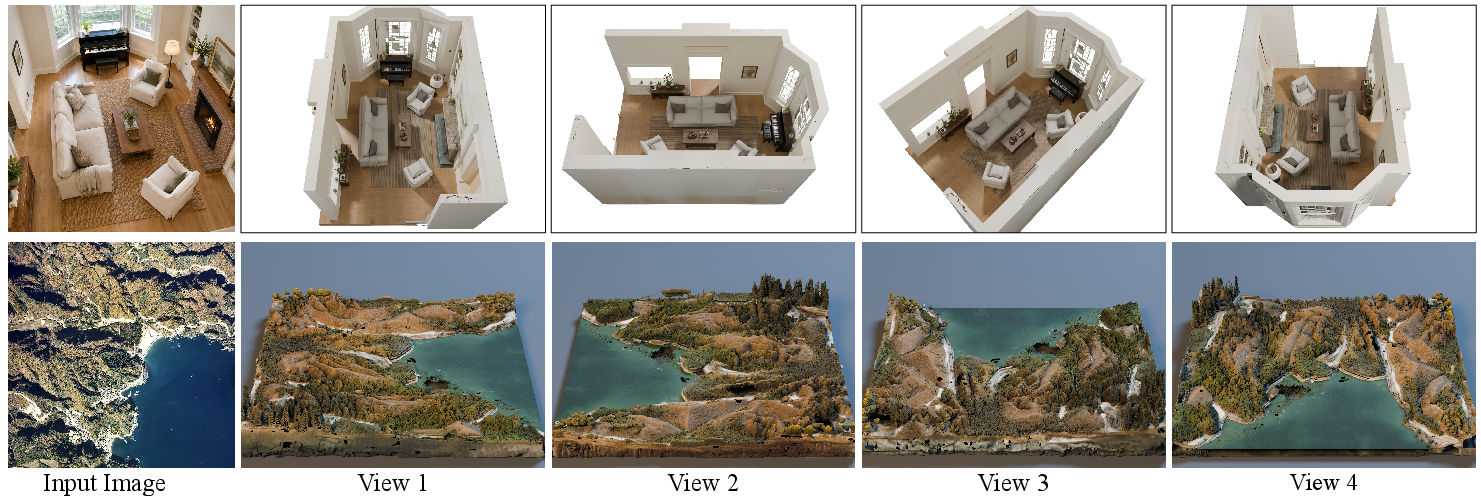
On the UrbanScene3D outdoor benchmark, DistScene also performed best among the tested methods:
- It achieved a Chamfer distance of 0.0772, where lower is better.
- It achieved an F-score of 0.722, where higher is better.
This suggests that the method works not only for rooms but also for larger outdoor environments.
Better-looking results according to people
The researchers also conducted a user study with 43 participants. Participants compared results from different systems and judged:
- How well the result matched the input image
- The quality of the 3D shapes
- The appearance of the scene
DistScene was preferred most often. Its average preference rate was 65.41%, much higher than the other tested methods.
Each part of the method helps
The researchers removed parts of DistScene to see whether they were useful. This is called an ablation study.
They found that:
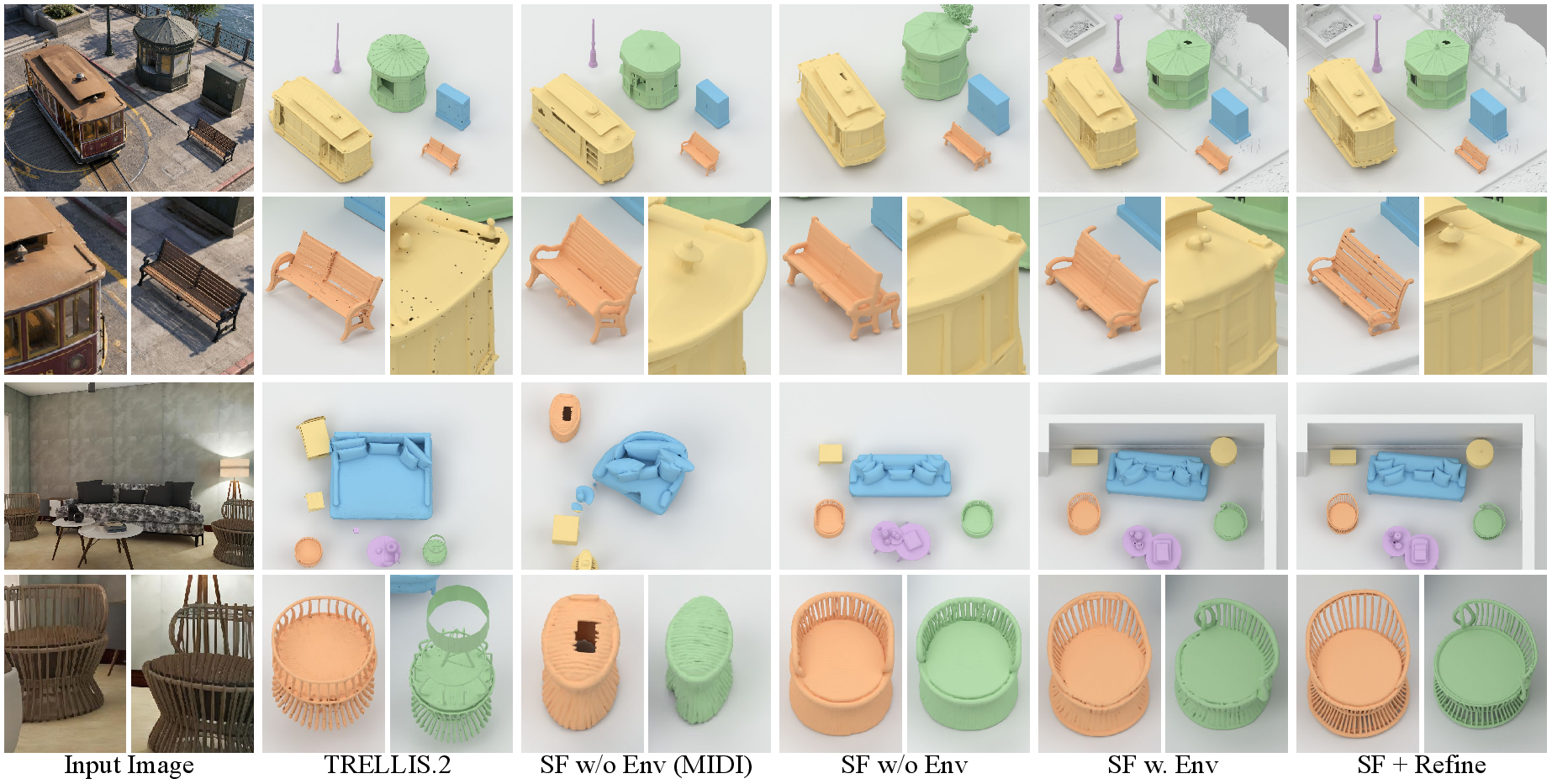
- Generating the environment explicitly improved object positions and object shapes.
- Training on automatically created scenes helped the model generalize to new images.
- Refining objects individually improved their details.
- Giving the refinement system information about the full scene was important.
Without scene information, the system had more difficulty deciding which object it was supposed to improve.
5. Why is this research important?
DistScene addresses a major weakness in earlier methods: they often create objects separately without fully understanding the environment around them. As a result, objects may be misplaced, disconnected from the floor, or shaped incorrectly.
The main idea of DistScene is:
To create the environment and objects together, then improve each object without losing its place in the scene.
This could lead to better tools for:
- Creating 3D worlds for games and virtual reality
- Building training environments for robots
- Reconstructing places for architecture and design
- Helping self-driving cars understand roads and surroundings
- Turning ordinary photographs into editable 3D scenes
- Creating simulations for science, engineering, and education
The paper shows that combining global scene understanding with local object detail can produce more realistic and organized 3D scenes.
However, the system is not perfect. It still has to guess parts of the scene that are hidden from the camera, and generating high-quality 3D scenes requires considerable computing power. Even so, DistScene is an important step toward turning a single photograph into a complete, editable 3D world.
Knowledge Gaps
The paper leaves the following knowledge gaps, limitations, and open questions unresolved:
- Generalization from synthetic to real scenes is not fully established. Most training scenes are procedurally composed from objects and environments generated by TRELLIS.2, so it remains unclear how performance is affected by real-world geometry, material variation, clutter, sensor noise, and object configurations absent from the synthetic distribution.
- The quality and bias of Object-to-Scene Distillation are not quantified. The paper does not measure how often generated objects are malformed, semantically inconsistent with their descriptions, duplicated, or unsuitable for placement, nor how such artifacts affect downstream scene generation.
- The physical-plausibility procedure is underspecified. Collision and contact checks are described procedurally, but the paper does not define the contact criteria, support reasoning, friction assumptions, stability tests, or whether generated objects can float, penetrate thin surfaces, or occupy physically impossible poses.
- The method assumes that all relevant objects are visible in the conditioning image. Training views are retained only when all scene objects are visible, leaving performance on heavily occluded, truncated, partially observed, or entirely unseen objects unresolved.
- The handling of an unknown or variable number of objects is unclear. The framework initializes a fixed set of object latents, but the paper does not explain how is selected, how missed detections and spurious objects are handled, or how the method scales to scenes with many objects.
- Object identity and correspondence are not rigorously evaluated. The method generates independent components, but the paper does not report metrics for semantic identity, instance matching, object counting, duplicate generation, or correct association between image regions and reconstructed objects.
- Single-image depth and occlusion ambiguities remain unresolved. The reported improvements do not establish whether the model recovers metrically correct depth and hidden geometry or merely produces plausible layouts consistent with common scene priors.
- Absolute scale and camera calibration are not examined. The paper reports scene-coordinate alignment and bounding-box IoU but does not clarify whether camera intrinsics, metric scale, camera pose, and coordinate-frame conventions are known, estimated, or normalized during evaluation.
- The explicit environment representation may be too restrictive for complex scenes. Modeling the environment as one generated component may be inadequate for multi-room interiors, layered backgrounds, vegetation, roads, terrain, dynamic elements, or environments composed of multiple disconnected surfaces.
- Scene-level physical and relational reasoning is limited. Collision avoidance and environment contact do not guarantee semantic relations such as “on,” “inside,” “attached to,” “behind,” or “supporting,” and these relations are not directly measured.
- Appearance and material reconstruction are insufficiently characterized. Quantitative evaluation focuses primarily on geometry, while the paper does not report texture fidelity, material accuracy, lighting consistency, view consistency, or preservation of object appearance across novel views.
- The refinement stage may introduce inconsistencies at object boundaries. Because objects are refined independently after scene generation, the paper does not evaluate seams, intersections, contact surfaces, scale drift, texture discontinuities, or changes to object-environment relationships.
- The refinement model’s ability to recover genuinely missing geometry is uncertain. Its training pairs are created by synthetically degrading high-quality generated objects, which may not represent the errors produced by scene-frame generation or the ambiguities caused by real occlusion.
- The contribution of the pretrained object generator is not disentangled from the proposed architecture. Experiments use TRELLIS.2 as the principal generator, but there is no systematic comparison across different object generators or analysis of whether the method depends on particular latent representations and model capabilities.
- The training-data comparison is not fully controlled. The distilled dataset and MIDI training set differ in scale, composition, object diversity, and likely rendering quality, making it difficult to attribute improvements solely to Object-to-Scene Distillation.
- The evaluation benchmarks are narrow and potentially overlapping with prior training distributions. Results are reported on a small set of indoor and outdoor benchmarks, and the paper does not establish robustness across unseen scene categories, geographic regions, camera types, resolutions, or domains such as robotics and autonomous driving.
- Failure cases are not reported. The paper lacks systematic analysis of missing objects, incorrect object placements, malformed environments, severe occlusions, unusual viewpoints, crowded scenes, transparent or reflective objects, and outdoor weather or lighting changes.
- The uncertainty and diversity of generated scenes are not evaluated. Since a single image admits multiple plausible 3D explanations, the paper does not measure sample diversity, calibration, ambiguity awareness, or whether repeated generations preserve image evidence while producing valid alternatives.
- The user study provides limited perceptual evidence. It uses only 43 participants, 20 text-to-image-generated inputs, and preference selections without confidence intervals, statistical significance testing, participant expertise analysis, or evaluation on real photographs.
- The reported efficiency does not fully characterize deployment cost. Runtime is given for selected resolutions and refinement settings, but total scene-generation cost, number of objects, hardware dependence, batch behavior, memory scaling, and the cost of generating the synthetic training data are not analyzed.
- The scalability of global self-attention is unresolved. Concatenating all object and environment tokens may become computationally prohibitive as scene size, voxel resolution, or object count increases; no complexity analysis or large-scene stress test is provided.
- The role of LoRA adaptation is insufficiently studied. The paper does not compare LoRA with full fine-tuning, alternative adaptation strategies, or different ranks, leaving unclear whether the adaptation capacity is adequate for substantially different scene distributions.
- No downstream task evaluation is provided. Although the paper motivates applications in robotics, simulation, and virtual reality, it does not test generated scenes in navigation, manipulation, interaction, rendering, physics simulation, or embodied-agent tasks.
- Reproducibility details are incomplete. The paper does not provide the exact LLM prompts, object-placement algorithm, collision-resolution settings, scene-category distributions, randomization procedures, filtering thresholds, or complete training hyperparameters needed to reproduce the distilled dataset and results.
Practical Applications
Immediate Applications
The reported results support near-term use of DistScene as a single-image-to-editable-3D conversion tool, particularly for visualization and prototyping workflows. These applications are deployable now in controlled settings, although outputs should be treated as approximate reconstructions rather than metrically reliable ground truth.
- Rapid 3D asset and scene creation for games, animation, and virtual production
- Convert a concept image, photograph, or text-to-image-generated scene into a decomposable 3D environment containing independently editable objects.
- The generated environment and objects can be exported into scene-graph or asset-management workflows, allowing designers to replace, reposition, rescale, or refine individual components.
- Sector: Game development, film and television, advertising, digital twins, content creation.
- Potential product: A plugin for Blender, Unreal Engine, Unity, or similar tools that creates a rough scene from one reference image and exposes environment/object components for manual correction.
- Dependencies: Reliable mesh export, texture/material compatibility, object naming, support for the target engine’s coordinate system, and human cleanup of occluded or hallucinated geometry.
- AR/VR and immersive-content prototyping
- Generate an approximate 3D room, street, or outdoor setting from a single image for rapid construction of virtual reality environments, augmented-reality previews, or spatial-computing mock-ups.
- Explicit environment modeling is useful for preserving relationships such as objects resting on floors or tables, rather than producing only disconnected object meshes.
- Sector: VR/AR, metaverse platforms, retail visualization, interior design.
- Potential workflow: Image capture → DistScene reconstruction → object-level editing → headset preview.
- Dependencies: Sufficient visual coverage in the input image, acceptable scene scale, collision correction, and additional reconstruction from multiple views when accurate navigation is required.
- Interior design and architectural visualization
- Produce an initial 3D layout from a photograph of a room, including furniture and surrounding geometry, then use the decomposed components for furniture replacement or layout comparison.
- Designers could generate alternative configurations by swapping object meshes while retaining the reconstructed room context.
- Sector: Architecture, real estate, furniture retail, renovation planning.
- Potential product: A “photo-to-room layout” application with interactive furniture placement and automatic collision/contact checks.
- Dependencies: The method must infer hidden surfaces and dimensions from one image; therefore, measurements and manual validation are necessary for construction, safety, or procurement decisions.
- Previsualization for robotics and embodied-AI research
- Convert RGB images into approximate scenes containing objects and environmental geometry for testing perception, grasp planning, navigation, or manipulation algorithms.
- The decomposable representation is more useful than a single fused mesh because objects can be individually labeled, moved, removed, or assigned physical properties.
- Sector: Robotics, warehouse automation, domestic robots, simulation.
- Potential workflow: Image → object/environment scene → simulator import → synthetic manipulation or navigation test.
- Dependencies: DistScene’s physical plausibility checks concern mesh contacts and interpenetration, not full physical dynamics. Accurate mass, friction, articulation, object affordances, and metric scale would still need to be supplied.
- Synthetic-data generation for computer-vision research
- The Object-to-Scene Distillation pipeline can generate large numbers of scenes by combining generated environments and objects, automatically checking collisions and rendering multiple views.
- Researchers can use these scenes to train or test object detection, segmentation, pose estimation, depth estimation, scene understanding, and 3D reconstruction systems.
- Sector: Academic research, computer vision, simulation, autonomous systems.
- Potential tool: A procedural dataset generator that samples scene descriptions, generates assets, places them under physical constraints, and renders labeled RGB, depth, mask, pose, and mesh data.
- Dependencies: Synthetic-to-real domain gaps, bias in the LLM and object generator, licensing of pretrained generators, and the need for validation against real-world distributions.
- Visual search and 3D catalog enrichment
- Retailers or asset libraries can use product photographs to create approximate 3D representations for browsing, visualization, or compatibility checking.
- Independent object components could support object-level metadata, retrieval, and replacement in a 3D catalog.
- Sector: E-commerce, furniture, industrial parts, digital asset marketplaces.
- Dependencies: The paper evaluates scene-level geometry rather than product-grade dimensional accuracy, material fidelity, or brand identity. Manual review and category-specific fine-tuning would be required.
- Scene understanding and annotation assistance
- DistScene can serve as a proposal generator for researchers or annotators who need object decomposition, approximate 3D bounding boxes, object placement, and environmental context.
- Rather than using the output directly, annotation teams could correct generated components, reducing the cost of producing decomposable 3D training data.
- Sector: Academia, autonomous driving, robotics, mapping.
- Dependencies: Annotation interfaces must expose uncertainty and allow correction of missing, duplicated, or incorrectly placed objects.
- Policy and urban-planning visualization
- A photograph of a street or urban area could be converted into an approximate 3D scene for communicating proposed changes, such as street furniture, barriers, landscaping, or building-context modifications.
- Sector: Municipal planning, infrastructure communication, public consultation.
- Dependencies: Outdoor benchmark gains demonstrate promise, but the output is not a survey-grade digital twin. Policy, engineering, accessibility, and safety decisions must rely on validated geospatial data.
Long-Term Applications
The following uses require additional research, larger-scale deployment, tighter accuracy guarantees, or integration with physical and semantic models. The paper establishes useful components for these directions but does not yet demonstrate operational reliability in safety-critical environments.
- Autonomous-driving and mobile-robot simulation
- DistScene could reconstruct roads, sidewalks, vehicles, buildings, and environmental structures from images to create simulation scenes for perception testing, route planning, and rare-event generation.
- Explicit environment-object coupling may improve the plausibility of vehicle placement and support relationships compared with object-only generation.
- Sector: Autonomous vehicles, delivery robots, mapping, smart cities.
- Required development: Multi-view or video consistency, accurate camera and world-scale estimation, dynamic-object modeling, traffic rules, weather and lighting variation, and benchmark validation under safety-critical conditions.
- Key assumption: A single image provides enough evidence to infer a useful approximation of the broader scene; this is often false for occluded or highly structured environments.
- Interactive digital twins of buildings and cities
- A scalable version of Object-to-Scene Distillation could help initialize digital twins from image collections, with independently editable environmental and object components.
- The scene-frame representation could support semantic queries such as “remove all chairs,” “replace streetlights,” or “measure available floor area.”
- Sector: Smart cities, facilities management, telecommunications, infrastructure.
- Required development: Consistent reconstruction across many images, persistent object identities, temporal updates, geographic registration, uncertainty estimates, and interoperability with BIM/GIS standards.
- Dependency: The current single-image output must be extended to enforce cross-image and cross-time consistency.
- Robotic manipulation and household assistance
- Scene-aware object refinement could provide detailed meshes for grasp planning, object recognition, and rearrangement in homes, warehouses, or laboratories.
- The independent-object output is compatible with systems that need to reason about object geometry separately from the supporting environment.
- Sector: Service robotics, warehouse robotics, assistive technology.
- Required development: Articulation and deformability modeling, occlusion completion, metric calibration, uncertainty-aware grasp planning, real-time inference, and closed-loop correction using depth or tactile sensors.
- Safety assumption: Generated contacts and collision-free layouts do not guarantee physically correct object affordances or stable manipulation outcomes.
- Physics-based simulation and embodied-AI training
- The self-distilled data engine could become a source of diverse scenes for training agents in navigation, rearrangement, search, and interaction tasks.
- Procedural variation in object descriptions, environments, layouts, and rendered viewpoints could reduce dependence on manually authored simulation scenes.
- Sector: Robotics, reinforcement learning, simulation platforms.
- Required development: Realistic physical parameters, articulated objects, lighting and sensor simulation, task annotations, domain randomization, and transfer studies from generated scenes to real robots.
- Automated 3D reconstruction for healthcare and industrial inspection
- In principle, single-image compositional reconstruction could support visualization of equipment rooms, operating environments, factories, or inspection scenes.
- Independent component modeling would allow equipment to be cataloged and analyzed separately from the surrounding environment.
- Sector: Healthcare operations, manufacturing, energy, maintenance.
- Required development: Domain-specific training data, calibrated geometry, certified measurement accuracy, robust handling of reflective or textureless surfaces, and auditability.
- Constraint: The paper does not evaluate medical, industrial, or safety-critical imagery; direct deployment in diagnosis, maintenance certification, or compliance inspection would be inappropriate without extensive validation.
- Scene-aware generative design and layout optimization
- A future system could generate alternative room, warehouse, retail, or urban layouts while preserving environmental constraints and object-level editability.
- The environment latent acting as a spatial anchor could be extended to support constraints such as accessibility, evacuation routes, visibility, reachability, energy use, or traffic flow.
- Sector: Architecture, logistics, retail, urban design, energy-efficient building design.
- Potential product: A constrained 3D layout optimizer that proposes and evaluates multiple scene configurations.
- Required development: Explicit constraint solvers, semantic and functional understanding, differentiable or simulation-based evaluation, and integration with professional CAD/BIM systems.
- Personalized AR assistance and everyday spatial computing
- Smartphone users could scan a room or street image and receive an editable 3D representation for furniture planning, navigation assistance, accessibility analysis, or contextual information overlays.
- Object-level decomposition could support commands such as highlighting obstacles, identifying replaceable items, or visualizing a new arrangement.
- Sector: Consumer AR, accessibility technology, home organization, education.
- Required development: On-device inference, low latency, privacy-preserving processing, robust operation under unusual viewpoints, and reliable depth/scale estimation.
- Privacy dependency: Images may contain people, private interiors, or sensitive locations; deployment would require data minimization, consent, and secure processing.
- Interactive education and scientific visualization
- A photograph of a laboratory, historical site, classroom, or geographic setting could be converted into an editable 3D teaching scene.
- Students could isolate objects, inspect geometry, rearrange components, or compare alternative configurations in AR/VR.
- Sector: Education, museums, cultural heritage, scientific communication.
- Required development: Better semantic labeling, provenance tracking, accurate historical or scientific reconstruction, and tools for teachers to correct generated content.
- Assumption: Approximate geometry is sufficient for visualization; it is not sufficient where educational claims depend on exact measurements or authentic reconstruction.
- Large-scale research infrastructure for object-to-scene generative modeling
- Object-to-Scene Distillation provides a general recipe for transferring mature object-generation priors into scene-generation models without requiring extensive manually annotated scene datasets.
- Future systems could apply the same strategy to articulated objects, materials, weather, lighting, industrial environments, or domain-specific assets.
- Sector: Academic machine learning, generative AI, simulation, creative software.
- Required development: Automated quality filtering, human preference evaluation, diversity and bias audits, improved physical constraints, and methods for detecting synthetic artifacts.
- Core dependency: The quality and coverage of the pretrained object generator directly limit the quality, diversity, and realism of the resulting scene supervision.
Glossary
- 3D scene generation: The process of creating a structured three-dimensional environment and its constituent objects from visual or textual inputs. “Compositional 3D scene generation is essential for turning images into structured 3D worlds”
- Canonical space: A standardized coordinate system used to represent objects independently of their original position, scale, or orientation. “existing object generators are primarily designed for individual objects in a canonical space”
- Cascaded paradigm: A multi-stage processing approach in which the output of one model or stage becomes the input to the next. “Existing approaches mainly adopt a modular and cascaded paradigm”
- Component-aligned reconstruction: 3D reconstruction that preserves the correspondence between independently reconstructed scene components and their positions in the scene. “Component-aligned reconstruction methods”
- Compositional scene: A scene represented as multiple separately identifiable objects and environmental elements. “a complete compositional scene”
- Decomposable: Structured so that a whole scene or representation can be separated into independently manipulable components. “a complete, decomposable compositional scene”
- Distillation: The transfer of knowledge or generative capabilities from one model or representation into another, often using automatically generated data. “Object-to-Scene Distillation to transfer pretrained object-generation priors to scene generation”
- DiT: A diffusion or flow-based generative architecture built with a Transformer rather than a convolutional denoising network. “a sparse DiT”
- Embedding: A learned numerical representation used to encode information such as object type, identity, or spatial region. “Learnable type embeddings are added to distinguish object tokens and environment tokens”
- Feed-forward generation: A generation process that produces outputs in one learned inference pass rather than through separately designed procedural stages. “Feed-forward scene generation methods”
- Flow matching: A generative modeling objective that trains a network to predict vector fields transporting noise distributions toward data distributions. “a flow-matching generative model”
- Foundation model: A broadly pretrained model that can provide reusable capabilities for downstream tasks. “By leveraging specialized foundation models for these individual capabilities”
- Geometric context: Spatial and shape information supplied by surrounding structures to guide the placement and reconstruction of objects. “provide geometric context for object placement”
- Geometry latent: A compact learned representation encoding the geometric structure of a 3D object or scene. “generating geometry latents within active voxels”
- Generative prior: Knowledge about likely data structures learned by a generative model during pretraining. “strong image-to-3D priors”
- Image-conditioned: Generated or predicted based on information extracted from an input image. “the image-conditioned flow-matching generator”
- Inter-penetration: Physically implausible overlap in which one 3D object passes through another object or surface. “no inter-penetration and plausible contacts with the environment”
- Latent space: A lower-dimensional learned representation in which complex data are encoded for generation or manipulation. “A sparse VAE, typically built with sparse convolutional networks, compresses this representation into a compact latent space.”
- LoRA: Low-Rank Adaptation, a parameter-efficient fine-tuning method that trains small low-rank modules while leaving the original model parameters fixed. “we fine-tune it with LoRA”
- Marker embedding: A learned feature that identifies the portion of a representation corresponding to a particular object or region. “ is the embedding marking 's corresponding region”
- Monocular geometry estimation: Inferring three-dimensional structure from a single image. “monocular or multi-view geometry estimation”
- Object-centric: Focused on individual objects as the primary units of representation or processing. “existing feed-forward methods typically represent a scene as a collection of object instances”
- Occupancy layout: The spatial arrangement indicating which cells or voxels contain geometry. “first predicting the sparse occupancy layout”
- Pose estimation: The prediction of an object’s position and orientation in a coordinate system. “object pose estimation”
- Pretrained object generator: A generative model previously trained to create individual 3D objects from image or other inputs. “We adopt TRELLIS.2 as the object generator from which training data are distilled.”
- Procedurally assembles: Constructs data or scenes automatically according to algorithmic rules rather than manual authoring. “which procedurally assembles environments and objects”
- Rectified flow: A generative modeling framework that learns a relatively direct transport path between a noise distribution and a data distribution. “large-scale rectified flow models”
- Scene frame: A shared coordinate system in which an environment and its objects are jointly represented with their relative spatial relationships. “jointly generates separate environment and object components in a shared coordinate frame”
- Scene-level spatial coherence: Consistency of positions, scale, support relationships, and geometry across an entire reconstructed scene. “improved scene-level spatial coherence over the evaluated baselines”
- Scene-conditioned refinement: Improving an individual object while conditioning the process on information from the complete scene. “a scene-conditioned refinement stage that boosts the fidelity of each object”
- Semantic correspondence: Preservation of the relationship between a reconstructed representation and the meaning or identity of the corresponding image content. “the refined object helps preserve spatial and semantic correspondence with the scene”
- Sparse convolution: A convolution operation designed to process only occupied or active locations in a sparse grid. “sparse convolutional networks”
- Sparse voxel: A voxel-grid representation that stores features only at occupied or active cells rather than throughout the entire grid. “we adopt sparse voxels as the unified substrate for both objects and the environment”
- Sparse VAE: A variational autoencoder adapted to encode and decode sparse voxel representations. “A sparse VAE, typically built with sparse convolutional networks”
- Spatial arrangement: The relative positioning and organization of objects within a scene. “recover multiple independent 3D components while preserving their spatial organization”
- Spatial resolution: The level of detail determined by the size or density of the discrete spatial representation. “the effective spatial resolution allocated to each object”
- Structured latent: A learned compact representation whose organization explicitly reflects meaningful properties or components of the underlying data. “Structured 3D Latents”
- Synthetic scene: An automatically generated 3D scene used as data rather than captured from the real world. “automatically composed and rendered synthetic scenes”
- Token sequence: An ordered collection of vector representations processed by a Transformer. “we flatten each latent into a token sequence”
- Vector field: A function assigning a direction and magnitude to each point, used here to describe the transformation from noise to data. “the predicted velocity”
- Voxel: A volumetric pixel representing a discrete cell in a three-dimensional grid. “each active voxel carries geometry and material features”

