Evolving in Thought Space: Training a Small Model at Test Time Unlocks Better Discoveries
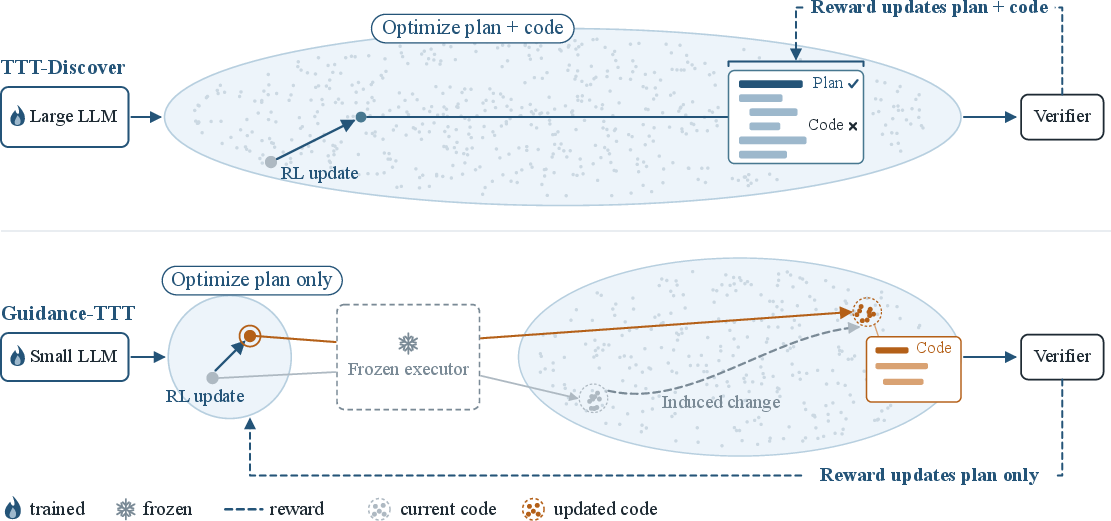
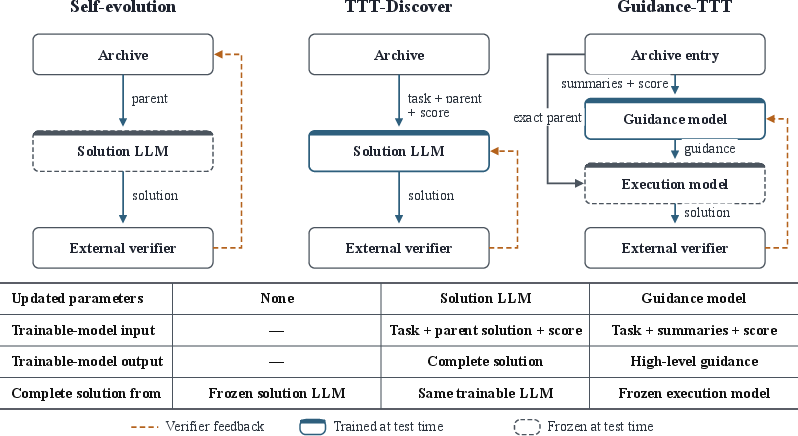
Abstract: Open-ended scientific discovery often requires repeatedly proposing and evaluating candidate solutions. LLM-based systems can support this process by generating and refining executable solutions from verifier feedback. Methods such as TTT-Discover use test-time training (TTT) to update the solution-generating LLM from verifier feedback, adapting its generation policy to improve subsequent proposals on the target problem. However, this becomes expensive when reliable execution requires a large model, since training must maintain gradients, optimizer states, and policy statistics while repeatedly generating long, structured outputs. It also complicates credit assignment: outcome-level verifier feedback must jointly evaluate the high-level strategy and its low-level implementation. In this work, we introduce Guidance-TTT, which separates these roles. A compact guidance model is trained at test time to propose high-level strategic changes, while a frozen execution model implements them as complete executable solutions. At each step, the system selects a promising previously discovered solution, proposes a change, executes and verifies it, and updates only the guidance model using an adaptive group-relative RL objective. This concentrates test-time learning on short strategic decisions while retaining the implementation capability of a substantially stronger model without adapting it. Without web access, Guidance-TTT produces strong solutions across four distinct domains: combinatorial optimization (Polyomino Packing), heuristic programming (AHC058), machine learning (Lasso), and GPU kernel optimization (TriMul). Across these tasks, it outperforms the best solutions reported in prior work while remaining competitive with state-of-the-art results on public online leaderboards. Code is available at https://github.com/Human-Agent-Society/reef/tree/guidance-ttt-support.

Paper Prompts
Sign up for free to create and run prompts on this paper.
Top Community Prompts
Explain it Like I'm 14
1. What is this paper about?
This paper introduces a system called Guidance-TTT. It is designed to help AI discover better solutions to difficult problems, such as:
- Writing faster computer programs
- Designing more efficient computer chips or GPU instructions
- Solving mathematical optimization problems
- Planning how to produce the most apples in a simulation
- Packing unusual shapes into a limited space
The main idea is to divide the job between two AI models:
- A small guidance model suggests what kind of change should be made.
- A larger execution model figures out how to make that change in working code.
The researchers call this “learning in thought space” because the small model learns high-level ideas instead of rewriting entire programs.
2. What questions did the researchers ask?
The paper focuses on several main questions:
- Can a small AI model learn which changes are likely to improve a solution?
- Is it better to train only this small “idea-giving” model instead of training a large model that writes complete programs?
- Can a frozen, powerful execution model still be useful even when its own settings are not changed?
- Does this approach use less computing power and money?
- Can the method work across very different kinds of problems?
A simple way to imagine this is a student and an expert programmer working together:
- The student says, “Try organizing the search differently.”
- The expert programmer turns that suggestion into correct code.
- The program is tested.
- If it works well, the student learns that this type of suggestion was useful.
3. How did the method work?
The basic process
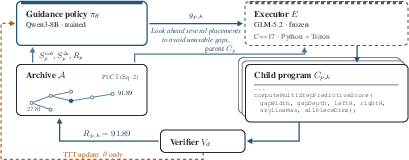
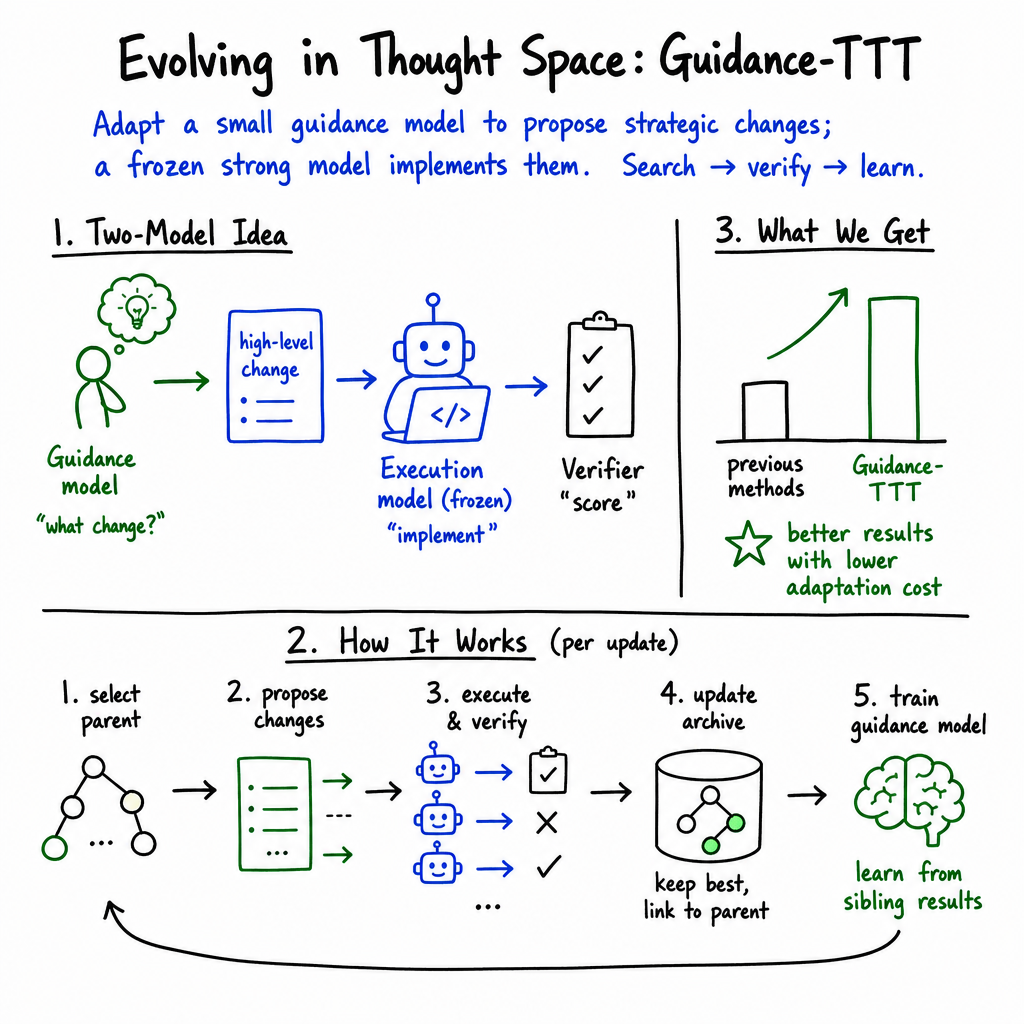
Guidance-TTT repeatedly improves a solution through the following steps:
- Choose an existing solution. The system keeps a collection, or archive, of solutions it has already tried.
- Ask the guidance model for an improvement idea. For example, it might suggest changing the order in which objects are considered or using a faster mathematical technique.
- Ask the execution model to apply the idea. The execution model receives the exact old solution and the new suggestion. It then creates a complete modified program.
- Test the new program. A special checker, called a verifier, runs the program and gives it a score. A verifier is like a judge in a science competition: it checks whether the answer is correct and measures how well it performs.
- Update the guidance model. If a suggestion leads to a better solution, the guidance model becomes more likely to make similar suggestions later.
- Repeat the process.
What does “test-time training” mean?
Normally, an AI model is trained before people use it. In test-time training, the model also learns while working on a particular new problem.
Here, the guidance model changes during the search. The execution model does not change; it remains frozen. This saves computing resources and preserves the large model’s ability to write complicated code.
How are solutions selected?
The system uses a search method called PUCT. In everyday terms, PUCT tries to balance two choices:
- Continue improving a solution that already looks promising.
- Explore a less-tested solution that might lead to something surprisingly good.
This is similar to exploring different paths in a maze: you spend more time on paths that look promising, but you still occasionally try new paths.
How does reinforcement learning fit in?
The guidance model uses reinforcement learning, which is learning through rewards and penalties.
- A better program receives a higher reward.
- A worse or incorrect program receives a lower reward.
- The guidance model adjusts itself to make better suggestions in the future.
The researchers compare several suggestions made from the same parent solution. This helps the model learn which suggestion was better than the others.
4. What did the researchers find?
The researchers tested Guidance-TTT on four different tasks. In every task, it produced a stronger result than the main earlier methods they compared against.
| Task | What the task involved | Previous result | Guidance-TTT result |
|---|---|---|---|
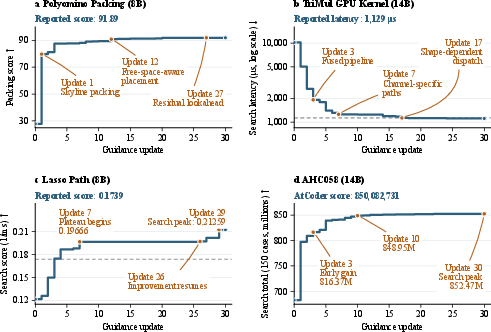
| Polyomino Packing | Pack irregular shapes efficiently | 89.40 | 91.89 |
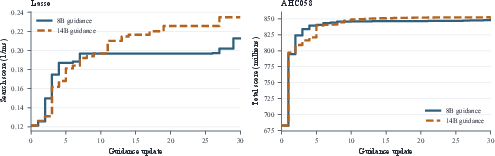
| Lasso | Solve a mathematical optimization problem quickly | 0.1243 | 0.1739 |
| AHC058 | Plan apple production | 849,325,750 | 850,082,731 |
| TriMul | Make a GPU calculation run quickly | 1131 microseconds | 1129 microseconds |
For the TriMul task, a lower time is better. The result of 1129 microseconds was very close to the public best result of 1128 microseconds.
Important findings
The method worked across many types of problems.
It was not limited to one kind of programming challenge. It worked for geometry, mathematics, planning, and GPU programming.
Training the guidance model was much better than directly training a small model to write complete programs.
In one test, directly training the small model produced a Polyomino score of only 41.63, while Guidance-TTT achieved 91.89.
This suggests that it is difficult for a small model to learn both:
- Which strategy to use
- How to implement that strategy correctly
It was more effective to let the small model focus only on strategy and let the larger model handle implementation.
Learning mattered.
When the guidance model was kept frozen, performance became worse. This shows that the system benefited from learning during the problem-solving process, not just from having two separate models.
The method reduced costs.
In one comparison, adapting only the small guidance model cost about 58% less than adapting the large model directly, while achieving a similar score.
The system discovered useful strategies.
The resulting solutions were not just random changes. They included meaningful improvements, such as:
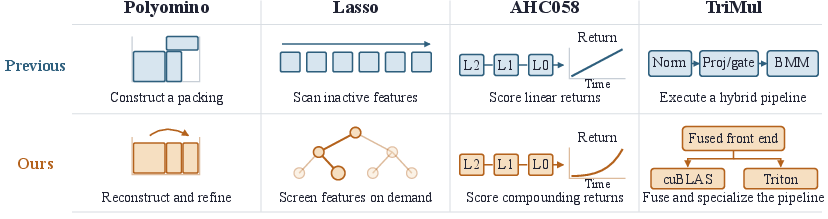
- Using shape-aware packing and simulated annealing for Polyomino Packing
- Using faster data structures to solve Lasso problems
- Changing planning strategies depending on the stage of apple production
- Combining different GPU methods depending on the input size
5. Why is this important?
The paper suggests that AI systems may solve difficult problems more effectively when they divide responsibilities.
A large model is good at writing detailed code, but changing its internal settings during testing can be expensive. A smaller model can learn the important strategic decisions much more cheaply. The large model then acts like a skilled engineer who turns those ideas into working solutions.
This could make automated scientific discovery more practical. In the future, similar systems might help researchers:
- Find faster algorithms
- Improve scientific simulations
- Design more efficient computer hardware
- Discover better mathematical methods
- Optimize engineering systems
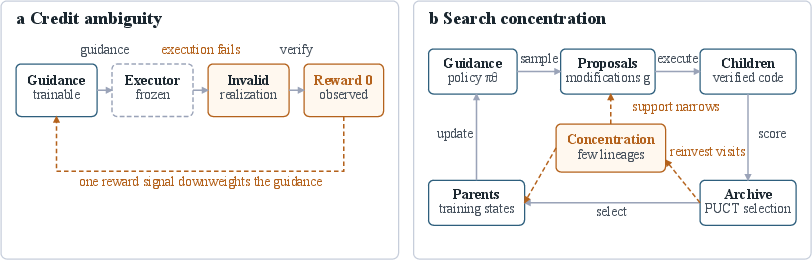
However, the method is not perfect. A suggestion can still fail because the execution model misunderstands it or writes incorrect code. The researchers also note that future work should improve how the system connects a strategy to the final result and should encourage a wider variety of ideas.
Simple conclusion
The paper’s main message is:
Instead of training one large AI to invent and code every solution by itself, let a small AI learn which ideas are promising and let a powerful, fixed AI turn those ideas into working programs.
This division of labor helped the system find better solutions, use less computing power, and work on several very different problems.
Knowledge Gaps
Knowledge gaps, limitations, and open questions
- Limited task diversity: The method is evaluated on only four tasks, with two optimization/programming benchmarks and no evidence from broader scientific domains such as mathematics, chemistry, biology, theorem proving, or experimental design.
- Unclear generalization across problem instances: Experiments largely focus on one fixed instance or benchmark per domain. It remains unresolved whether a guidance policy adapted on one instance transfers to new instances, distributions, objectives, or verifier configurations.
- Dependence on a powerful frozen executor: The approach assumes access to a substantially stronger model, GLM-5.2, capable of correctly translating high-level guidance into executable solutions. The method’s effectiveness when the executor is weaker, domain-specialized, open-source, or unavailable is not systematically established.
- No principled executor–guidance matching criterion: The paper does not identify how to choose the appropriate guidance-model size, executor size, model family, or division of labor for a new task.
- Incomplete comparison with direct adaptation: Direct solution training performs very poorly in the reported matched ablation, but the comparison does not establish whether this is caused by the representation, optimization objective, rollout budget, model configuration, context length, or hyperparameter tuning.
- Unequal comparison budgets: Comparisons with TTT-Discover and other baselines use different numbers of rollouts, updates, model sizes, inference settings, and monetary costs. The relative performance and efficiency advantages therefore remain difficult to attribute solely to Guidance-TTT.
- Insufficient statistical replication: The paper reports headline results and trajectories but does not provide systematic multi-seed means, variances, confidence intervals, or significance tests across all tasks and ablations.
- Sensitivity to hyperparameters is unresolved: The effects of the number of parent groups , sibling rollouts , update count , entropy coefficient , PUCT exploration constant, LoRA rank, learning rate, and archive-retention rules are not comprehensively characterized.
- Short-horizon adaptation is not tested: Runs use 30 updates, leaving open whether guidance learning remains stable over substantially longer test-time training or eventually overfits, collapses, or exhausts the local search neighborhood.
- Risk of policy collapse and reduced diversity: The entropic objective emphasizes high-reward outcomes, but the paper does not quantify whether guidance diversity decreases over time or whether the policy becomes trapped in a narrow family of modifications.
- Archive bias is unexplored: PUCT selects and retains solutions using task scores and archive-admissibility rules, but the effect of these rules on exploration, lineage diversity, and final performance is not isolated.
- Parent-selection alternatives are not systematically compared: The contribution of PUCT relative to uniform sampling, novelty-based selection, diversity-aware selection, tournament selection, or learned parent selection remains unclear.
- The guidance representation is restrictive: Guidance consists of natural-language proposals conditioned on compact summaries. The paper does not test structured edits, executable patches, formal plans, latent representations, tool calls, or hybrid guidance formats.
- Summary quality may bottleneck learning: The system conditions on generated summaries of the parent solution and its change, but the accuracy, completeness, and faithfulness of these summaries are not evaluated or ablated.
- The executor’s interpretation of guidance is under-modeled: The method assumes that the executor reliably implements the intended strategic change. Failures caused by ambiguity, misinterpretation, or unintended code modifications are not separately measured.
- Credit assignment remains only partially solved: Although adaptation is moved to the guidance model, the reward still reflects the joint outcome of guidance and executor behavior. The paper does not distinguish whether a failed child resulted from a poor strategic proposal, faulty implementation, compilation failure, or verifier noise.
- No process-level feedback is used: Updates rely primarily on final verifier rewards. Intermediate execution traces, compilation diagnostics, partial correctness, runtime profiles, or textual critiques are not incorporated into the guidance update.
- Verifier reliability and reward hacking are not examined: The paper assumes executable verifiers are correct and robust. It does not test susceptibility to evaluator bugs, benchmark overfitting, undefined behavior, numerical exploits, or solutions that optimize the measured score without solving the intended problem.
- Robustness to noisy or stochastic verifiers is unknown: All evaluated settings appear to use deterministic or tightly controlled evaluation. The method’s stability under noisy measurements, stochastic environments, flaky compilation, or variable hardware conditions is unresolved.
- Generalization beyond offline settings is not demonstrated: The experiments explicitly exclude web access and inherited solution code, but the paper does not evaluate how Guidance-TTT interacts with web search, external tools, human feedback, multi-agent collaboration, or dynamically changing knowledge.
- Transfer across executors is insufficiently studied: Some alternative-executor results are reported for Polyomino, but there is no systematic test of whether a guidance policy learned with one executor transfers to another executor, model family, software stack, or hardware platform.
- Transfer across tasks is unexplored: It remains unknown whether a guidance model can accumulate reusable strategic knowledge across related tasks or whether it must be reinitialized and trained independently for every problem.
- The claimed cost advantage is configuration-dependent: The reported 58% cost reduction compares runs with different rollout counts, update counts, models, and service configurations. A controlled end-to-end accounting of GPU memory, latency, energy, inference cost, and training cost is still needed.
- Executor inference cost may dominate total cost: Freezing the executor removes its adaptation memory and optimizer overhead, but the executor is still invoked for every rollout. The paper does not establish when this repeated inference cost outweighs the savings from not training the executor.
- Wall-clock scalability is unclear: The experiments do not fully quantify throughput, parallelization efficiency, queueing overhead, archive-management cost, or scaling behavior as the number of rollouts and candidate evaluations increases.
- Leaderboard and external validity are limited: Several comparisons use prior-work results, public leaderboard snapshots, or different evaluation environments. The extent to which reported improvements persist under independently reproduced, contemporaneous, and identical evaluation protocols remains uncertain.
- Potential benchmark contamination is not addressed: The paper does not establish whether the guidance or execution models were exposed during pretraining to the benchmark tasks, public solutions, leaderboard entries, or related code.
- Human-baseline comparisons are not fully controlled: The Polyomino result exceeds a cited human reference, but the paper does not clarify whether the reference and discovered solution use identical constraints, evaluation cases, computational budgets, or implementation assumptions.
- The role of natural-language reasoning is unclear: The analysis attributes gains to strategic decisions, but it does not determine whether the guidance model is genuinely reasoning about solution structure or exploiting recurring textual and benchmark-specific patterns.
- Model-capability probes are too small to support broad conclusions: The TriMul explanation probe uses only three samples per model, which is insufficient to characterize systematic differences in mechanism recognition, conditional reasoning, or explanation reliability.
- Mechanistic interpretation of discovered solutions is post hoc: The paper compares final solutions with prior approaches, but it does not causally verify that the identified structural mechanisms produced the gains through controlled code-level interventions.
- Failure modes are not comprehensively quantified: The paper discusses selected failure patterns but does not report rates for invalid outputs, compilation failures, redundant edits, regressions, executor refusal, reward plateaus, or archive stagnation.
- No safety or containment analysis is provided: Because the executor generates and runs code, the method’s behavior under malicious guidance, unsafe generated programs, resource exhaustion, unauthorized system access, or verifier manipulation is left unexamined.
- Reproducibility may depend on proprietary or difficult-to-access models: The central executor and some comparison systems may not be fully reproducible from the released code, and the paper does not report how results change with entirely open models.
- The optimality gap is unknown: Although the method exceeds several references, the paper does not establish how close its solutions are to global optima, strong oracle-guided searches, exhaustive search limits, or task-specific theoretical upper bounds.
- Stopping criteria are not investigated: The system returns the best archived solution after a fixed number of updates, but adaptive stopping based on marginal improvement, uncertainty, cost, or diversity is not studied.
- The method’s behavior under deceptive local optima is unknown: It remains unresolved whether guidance learning can escape strongly misleading high-reward regions or whether PUCT and score-focused updates reinforce local optima.
- The interaction between guidance scale and executor scale is incomplete: Larger guidance models improve performance on some saturated tasks, but the paper does not map the full trade-off among guidance capacity, executor capacity, adaptation cost, and search budget.
- No theory explains when thought-space learning should outperform solution-space learning: The paper provides empirical motivation but lacks formal conditions linking representation granularity, executor reliability, reward sparsity, and the superiority of hierarchical adaptation.
Practical Applications
Immediate Applications
- Automated algorithm and heuristic optimization — software engineering, operations research, and industry
- Organizations can deploy a Guidance-TTT-style pipeline to iteratively improve executable algorithms for scheduling, routing, packing, resource allocation, and contest-style optimization.
- A small, adaptable guidance model proposes strategic changes, while a stronger frozen model edits the existing implementation. Each candidate is compiled, tested, benchmarked, and stored in an archive.
- Suitable applications include warehouse packing, delivery-route planning, workforce rostering, production scheduling, portfolio heuristics, and network design.
- Evidence from the paper: the method improved Polyomino Packing to 91.89 and AHC058 production planning to 850.08M points, outperforming cited prior-work references.
- Dependencies: a reliable executable verifier, representative test cases, safe code execution, reproducible evaluation environments, and sufficient compute for repeated rollouts. The method is not appropriate where solution quality cannot be measured automatically.
- GPU-kernel and systems-performance tuning — cloud computing, AI infrastructure, and hardware software
- The framework can search for faster GPU kernels by proposing high-level changes such as fusion strategies, dispatch rules, memory-layout changes, or alternative library calls, then having an execution model implement and benchmark them.
- A practical product could be an automated kernel-tuning service integrated into CUDA, Triton, PyTorch, or compiler development workflows. It could generate pull requests containing candidate kernels, benchmark reports, and rollback-ready alternatives.
- Evidence from the paper: the discovered TriMul kernel achieved 1,129 μs on the stated H100 setup, close to the reported 1,128 μs public reference and better than several cited automated methods.
- Dependencies: hardware-specific benchmarking, correctness tests before timing, stable compiler versions, and controls against overfitting to a narrow benchmark. Results may not transfer across GPU architectures, drivers, or compiler versions without additional validation.
- Scientific and numerical solver optimization — scientific computing and machine learning
- Research groups can use the method to improve implementations of numerical algorithms, including sparse regression, differential-equation solvers, optimization routines, and simulation codes.
- The Lasso example suggests a workflow in which the system proposes structural changes—such as homotopy methods, screening rules, or data-structure changes—while a verifier checks both numerical correctness and runtime.
- Evidence from the paper: the discovered Lasso solver improved the reported score from 0.1243 for SimpleTES to 0.1739 and passed all 15 held-out real and stress-test cases reported in the paper.
- Dependencies: exact or tolerance-based correctness criteria, held-out datasets, numerical-stability checks, and safeguards against optimizing only for benchmark runtime while degrading generality or maintainability.
- Automated research-prototyping infrastructure — academia and corporate R&D
- Universities and industrial research laboratories can use the approach as an experiment-generation layer: the guidance model proposes changes to a research artifact, the executor implements them, and an automated evaluation pipeline determines whether the change is useful.
- Potential outputs include candidate models, data-processing pipelines, optimization procedures, simulation configurations, and experiment code accompanied by lineage, scores, and parent-child changes.
- The archive and PUCT-based parent selection provide a practical mechanism for retaining promising experiments and revisiting underexplored branches rather than relying only on the latest result.
- Dependencies: domain-specific verifiers, experiment tracking, version control, reproducible environments, human review, and explicit policies for authorship, data use, and scientific validation. Automated discovery should generate hypotheses and prototypes, not replace independent replication.
- Cost-efficient adaptation of large-model agents — AI platform engineering
- Companies can adapt a small LoRA-based guidance model at inference time while keeping an expensive execution model frozen. This is useful when the executor is strong but costly or difficult to fine-tune.
- A potential platform architecture would separate:
- 1. a compact policy that decides what strategic change to attempt,
- 2. a large executor that implements the change,
- 3. a verifier that measures the result, and
- 4. an archive that records candidate solutions and scores.
- Evidence from the paper: in one comparison, adapting an 8B guidance model with a frozen 120B executor reduced the reported cost by approximately 58% relative to directly adapting the 120B model, with comparable Polyomino performance.
- Dependencies: model-serving latency, API pricing, memory capacity, stable executor behavior, and a sufficiently expressive guidance interface. The reported savings are environment-specific and should not be generalized without a matched cost study.
- Benchmarking and regression testing for generated code — software quality assurance
- Development teams can use the framework to generate alternative implementations and automatically compare them on correctness, latency, memory use, and robustness.
- The archive can function as a searchable repository of candidate implementations, including verifier outcomes and the strategic change that produced each candidate.
- This could support continuous optimization pipelines in which every accepted change must pass unit tests, security scans, performance tests, and held-out workloads.
- Dependencies: secure sandboxing, deterministic or statistically sound benchmarks, protections against test-suite gaming, and human approval before production deployment.
- Education and research training — universities and technical instruction
- Instructors can use a simplified version to demonstrate algorithm design, evolutionary search, reinforcement learning, profiling, and scientific reproducibility.
- Students could submit executable solutions to a verifier and inspect how strategic guidance changes performance over successive iterations. The system would provide a concrete learning environment for comparing naïve refinement, frozen guidance, and test-time adaptation.
- Dependencies: carefully designed educational tasks, transparent logging, limits on automated assistance, and assessment policies that distinguish learning from outsourcing work.
- Decision-support prototypes for planning and public-sector operations — policy and government analytics
- Agencies could use the method to explore strategies for scheduling inspections, allocating limited resources, planning emergency logistics, or optimizing public-works operations, provided that candidate plans can be simulated and scored.
- The system can generate multiple alternatives and expose their measured trade-offs rather than returning a single opaque recommendation.
- Dependencies: accurate simulators, legally and ethically valid objectives, constraints for fairness and safety, human authorization, and sensitivity analysis. It should remain advisory in high-impact public decisions.
Long-Term Applications
- Autonomous scientific discovery platforms — chemistry, materials science, biology, and climate modeling
- A mature version could propose experimental protocols, molecular designs, materials configurations, or simulation strategies; laboratory instruments or high-fidelity simulators would act as executors and verifiers.
- The guidance model could learn which strategic modifications tend to produce promising outcomes for a particular research problem, while a stronger model translates those modifications into executable protocols or code.
- Potential products include closed-loop systems for catalyst discovery, battery-material optimization, protein-design workflows, and climate-model parameter search.
- Dependencies: reliable physical-world verification, expensive and noisy experiments, laboratory automation, safety constraints, causal attribution, and mechanisms for distinguishing genuine discoveries from measurement artifacts. The paper demonstrates software-based verifiers, not laboratory-scale discovery.
- Automated engineering design and robotics — robotics, manufacturing, and aerospace
- The method could guide changes to robot controllers, manipulation strategies, mechanical designs, sensor configurations, or manufacturing schedules, with simulators and eventually physical testbeds providing rewards.
- A hierarchy of strategic guidance and frozen execution is potentially useful when the executor must preserve strict engineering conventions or hardware interfaces.
- Dependencies: sim-to-real transfer, safety-certified controllers, reliable physical testing, expensive evaluation cycles, hardware failure tolerance, and formal constraint checking. Natural-language guidance alone is insufficient for safety-critical deployment.
- Adaptive optimization for energy systems — energy and utilities
- Future systems could optimize battery charging policies, grid dispatch, renewable-energy scheduling, data-center cooling, or building energy management by proposing strategic changes and evaluating them in digital twins.
- The method’s demonstrated ability to refine state-dependent scheduling and resource-allocation policies is relevant to such domains.
- Dependencies: high-quality digital twins, real-time telemetry, grid and equipment constraints, uncertainty-aware objectives, cybersecurity, and conservative fallback policies. Offline benchmark gains may not translate directly to volatile real-world environments.
- Financial portfolio and market-microstructure optimization — finance
- A verifier-driven system could explore execution schedules, portfolio-rebalancing heuristics, risk controls, or transaction-cost models using historical replay and stress tests.
- The archive could preserve diverse strategies rather than selecting solely for average return, allowing explicit optimization of risk-adjusted objectives.
- Dependencies: nonstationary markets, realistic transaction-cost and liquidity models, avoidance of backtest overfitting, regulatory compliance, explainability, and strict human oversight. The paper provides no financial validation, so this is a speculative extension rather than a demonstrated application.
- Personalized planning and productivity assistants — daily life
- Consumer systems could use a lightweight guidance model to propose changes to meal planning, exercise schedules, study plans, travel itineraries, household budgets, or task ordering, while a verifier checks constraints such as time, cost, nutrition, or availability.
- For example, an assistant could retain a user’s current itinerary and propose strategic modifications rather than regenerating the entire plan from scratch.
- Dependencies: accurate user preferences and calendars, privacy-preserving data handling, meaningful objective functions, uncertainty communication, and avoidance of unsafe recommendations. Most everyday goals are multi-objective and difficult to verify automatically.
- Multi-agent research and engineering organizations — enterprise automation
- Future systems could combine several specialized guidance models—such as algorithmic, numerical, security, and domain-policy advisors—with one or more execution models and a shared archive.
- This could produce workflows in which one agent proposes a strategic modification, another checks feasibility, an executor implements it, and independent verifiers test performance and safety.
- Dependencies: coordination protocols, conflict resolution, provenance tracking, compute budgets, and safeguards against correlated model errors. The paper’s single guidance-policy design does not establish that adding more agents will improve results; the ablation showing mixed effects from extra parent context suggests that additional information can also harm search.
- General-purpose self-improving software systems — software and AI research
- The broader long-term possibility is a software agent that learns a problem-specific strategy during deployment without modifying its large general-purpose executor.
- Such systems could maintain reusable guidance policies for classes of tasks while adapting temporarily to a specific optimization target, hardware platform, or organizational workflow.
- Dependencies: prevention of catastrophic or adversarial updates, stable rollback, monitoring for reward hacking, protection of confidential code and data, and theory or empirical guarantees about test-time learning. The paper shows strong results on four benchmarks but does not establish broad generalization across unseen task families.
- Policy and public research infrastructure for verifiable AI discovery
- Governments and funding agencies could support standardized verifier APIs, reproducible evaluation environments, artifact archives, and audit trails for AI-generated scientific and engineering solutions.
- Such infrastructure would make it easier to compare systems fairly and to separate genuine improvements from benchmark-specific optimization.
- Dependencies: common evaluation standards, open or auditable benchmarks, disclosure of model and compute configurations, licensing agreements, and governance for safety-critical or dual-use discoveries. The paper’s own results emphasize that performance depends on the evaluation environment, hardware, compiler, and comparison protocol.
Glossary
- Adaptive group-relative reinforcement learning: A reinforcement-learning method that updates a policy using rewards normalized relative to other samples in the same group. “updates only the guidance model using an adaptive group-relative RL objective.”
- Archive-admissible: Satisfying the criteria required for a candidate solution to be added to the maintained archive. “only if archive-admissible, linked to ”
- AtCoder score: A performance score assigned by the AtCoder programming-contest platform. “final results use the submitted solution's AtCoder score.”
- Base-policy correction: An adjustment that compares the updated policy with a reference or baseline policy to reduce estimation bias. “an entropic advantage estimator with a centered base-policy correction”
- Beam-based initialization: An initialization strategy that constructs or selects candidate states using beam search. “it combines state-dependent valuation with beam-based initialization”
- Credit assignment: The process of attributing an observed reward or outcome to the decisions that produced it. “It also complicates credit assignment”
- Entropic advantage estimator: A reinforcement-learning estimator that uses an exponential or risk-sensitive reward transformation to emphasize high-reward outcomes. “The guidance policy is then optimized using an entropic advantage estimator”
- Entropic objective: An objective based on the logarithm of an exponential expectation, emphasizing unusually high rewards rather than only average performance. “TTT-Discover introduces an entropic objective with PUCT-based reuse for max-seeking discovery”
- Evolutionary program database: A repository of programs maintained and improved through iterative evolutionary search. “AlphaEvolve extends this paradigm with a general-purpose coding model and an evolutionary program database.”
- Executor: A model or component that translates a proposed strategy into an executable solution. “a frozen execution model implements them as complete executable solutions.”
- Front-end fusion: Combining operations in an earlier computational stage to reduce overhead or improve hardware utilization. “a hybrid Triton--cuBLAS design with additional front-end fusion”
- Geometric-mean latency: A latency summary calculated using the geometric mean, often used when comparing multiplicative performance differences. “We report geometric-mean latency over seven benchmark cases”
- Group-relative learning signal: A training signal derived by comparing the rewards of multiple samples generated under a common context. “The resulting rewards form a group-relative learning signal”
- Guidance policy: A parameterized policy that generates high-level modifications for another model to implement. “The guidance policy is then optimized using an entropic advantage estimator”
- Heuristic programming: The design of programs that use problem-specific rules or approximations to find effective solutions. “heuristic programming (AHC058)”
- Homotopy-style path method: An optimization technique that solves a sequence of related problems along a continuously changing parameter path. “it combines a homotopy-style path method with segment-tree-based screening”
- In-context adaptation: Adaptation of a model’s behavior through information supplied in its input context rather than by changing its parameters. “This supports inference-time search and in-context adaptation without changing model parameters.”
- Kernel optimization: Improving a low-level computational kernel to reduce execution time or resource use. “GPU kernel optimization (TriMul)”
- Latent representation: An internal numerical representation learned by a model that is not directly expressed as an explicit program or statement. “rather than complete programs or latent representations.”
- Lasso path: The sequence of fitted regression solutions obtained as the regularization parameter changes in Lasso regression. “Lasso path optimization”
- Lineage analysis: Analysis of the parent–child relationships connecting solutions produced during iterative search. “Further trajectories and lineage analyses appear in”
- Low-rank adaptation (LoRA): A parameter-efficient fine-tuning method that represents weight updates using low-rank matrices. “with rank-32 LoRA”
- Max-seeking discovery: Search directed toward finding the highest-reward candidate rather than optimizing average reward. “for max-seeking discovery.”
- Parent-conditioned guidance: A proposed modification generated with explicit conditioning on a previously selected solution. “A compact guidance model is trained at test time to propose high-level, parent-conditioned changes”
- Policy statistics: Quantities maintained during policy optimization, such as action probabilities, returns, or advantage estimates. “training must maintain gradients, optimizer states, and policy statistics”
- PUCT: A Monte Carlo tree-search selection rule that combines estimated value with a prior-guided exploration term. “We select parents from the solution archive using PUCT sampling rule”
- Rank-based prior: A prior probability or preference assigned according to an item’s rank. “ is a rank-based prior”
- Reciprocal of geometric-mean solve time: A performance metric equal to one divided by the geometric mean of repeated solution times. “We evaluate fixed solvers repeatedly and report the reciprocal of geometric-mean solve time”
- Reinforcement-learning rollout: One sampled execution or trajectory used to evaluate a policy and generate a learning signal. “Each run uses 30 updates, with selected parents and rollouts per parent.”
- Reward mapping: A transformation that converts task scores into rewards suitable for reinforcement-learning optimization. “The oriented score and RL reward mappings are specified”
- Segment tree: A tree data structure that supports efficient range queries and updates over an array or sequence. “segment-tree-based screening”
- Simulated annealing: A stochastic optimization method that occasionally accepts worse solutions to escape local optima, with decreasing acceptance over time. “while adding a simulated-annealing refinement stage”
- Sibling group: A set of candidate solutions generated from the same parent solution. “Their rewards form a sibling group used to update only the guidance policy.”
- State-dependent valuation: Assigning values to actions or resources based on the current state of a system. “it combines state-dependent valuation with beam-based initialization”
- Strategic adaptation: Adjusting high-level decisions or plans in response to evaluation feedback. “These limitations motivate separating strategic adaptation from solution implementation.”
- Test-time training (TTT): Updating model parameters during inference using a learning problem derived from the current test instance. “Test-time training (TTT) additionally updates model parameters using verifier feedback”
- Thought space: A representation in which the learned actions are explicit high-level natural-language proposals rather than complete programs. “We refer to this as learning in thought space”
- Triton: A programming framework for writing GPU kernels using a Python-based interface. “Candidates are Triton-based Python kernels that must pass correctness tests before timing.”
- Verifier feedback: Evaluation information produced by a program or procedure that checks the validity or quality of a candidate. “LLM-based systems can support this process by generating and refining executable solutions from verifier feedback.”
- Verifier reward: The numerical score returned by evaluating a candidate with a task-specific verifier. “The resulting verifier reward updates only the guidance model.”
- Zero-shot execution: Running a model or solution-generation procedure in a single call without iterative refinement or additional examples. “Seeds are generated by one-shot execution-model calls”