Mulligan: Performance-Guided Data Collection for Efficient On-Robot Learning
Abstract: Learning from human demonstrations is a reliable way to teach robots new tasks, but the gains from each additional demonstration shrink as the policy improves. Continued improvement can instead come from supervised deployment, where an operator places the objects and intervenes when the policy fails. We ask how to maximize improvement from a fixed budget of supervised episodes on high-precision manipulation tasks with wide ranges of object placements. We observe that failures can concentrate in a small subset of initial states, so uniform collection spends much of the operator's time on states the policy already handles. Mulligan makes the initial-state distribution a decision, starting each round's episodes at observed failures and untried states. To further improve data efficiency, we augment interactive imitation learning with a value function trained on all data, including failures that imitation discards. Across three real-world tasks evaluated on 2,550 held-out, blinded episodes and two simulated tasks, Mulligan outperforms uniform initial-state sampling at matched collection budgets, and combined with value-based action selection, HiL-IDQL+Mulligan, improves final real-task success by 10-34 percentage points. With operator interventions, the human-robot team completes 98% of collection episodes, remaining productive while the policy learns. Videos, code, and data are available at https://mulligan.page/.
Paper Prompts
Sign up for free to create and run prompts on this paper.
Top Community Prompts
Explain it Like I'm 14
1. What is this paper about?
This paper studies how to teach robots to perform difficult physical tasks, such as:
- putting a marker into a holder,
- placing a nut onto a peg,
- fitting a cable into clips.
Robots can learn from people demonstrating these tasks. However, once a robot becomes fairly good, giving it more random demonstrations does not help very much.
The researchers introduce a method called oursink. Its main idea is simple:
Instead of asking the robot to practice random situations, make it practice the situations where it has recently failed.
This is similar to how a student might spend extra time practicing the types of math problems they keep getting wrong.
2. What questions did the researchers ask?
The paper focuses on three main questions:
- Does oursink help robots learn faster than choosing situations randomly?
- Which parts of oursink are most useful? For example, is it helpful to repeat failed situations? Is it helpful for the human to show the robot the correct action from the beginning?
- Can the robot keep completing useful tasks while it is learning? The researchers wanted to make sure that learning did not cause the robot to fail constantly.
The researchers were especially interested in situations where the objects could begin in many different positions. For example, a nut might start in many places around a peg, making some starting positions much harder than others.
3. How did the researchers conduct the study?
Human-supervised robot learning
The researchers used a robot arm and a human operator. Each learning episode worked roughly like this:
- The human placed the objects in a particular starting position.
- The robot tried to complete the task.
- If the robot made a mistake, the human took control and corrected it.
- The robot saved what happened and used the information to improve later.
This is called human-in-the-loop learning because a person helps guide the robot while it learns.
The researchers collected two kinds of information:
- Human demonstrations: examples of the task completed correctly by the human.
- Robot attempts: including both successful and failed attempts.
Comparing different ways to choose starting positions
The researchers compared two main strategies.
Uniform sampling means choosing starting positions randomly and evenly. This is like picking practice questions randomly from a textbook.
oursink chooses starting positions more intelligently:
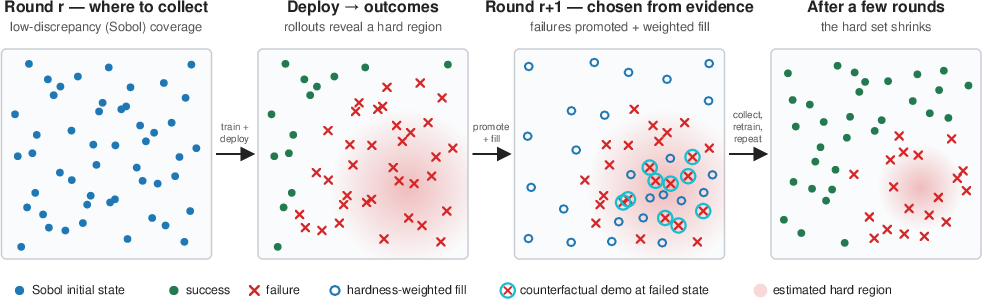
- It repeats positions where the robot recently failed.
- It also chooses positions that have not been tried much yet.
- This helps the robot both fix known problems and discover new ones.
The researchers used a technique called farthest-point selection to find unexplored positions. In everyday terms, the robot chooses a new position that is far away from all the positions it has already practiced.
Counterfactual demonstrations
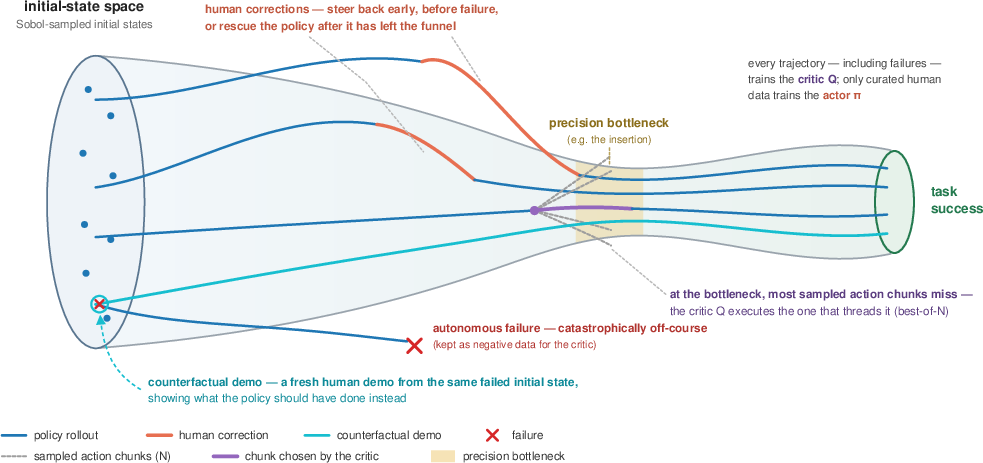
Sometimes a robot makes a mistake early in a task. If the human only takes over at that point, the robot learns how to recover from the mistake, but it may not learn what it should have done from the beginning.
To solve this, the human sometimes reset the scene and showed the robot the entire correct task from the same starting position. The paper calls this a counterfactual demonstration.
For example, if the robot drops a nut while carrying it, a correction might teach it how to pick the nut back up. A full demonstration from the beginning also teaches it how to carry the nut without dropping it.
Two learning systems
The researchers tested oursink with two types of robot learners:
- A system that mainly copies the human’s successful actions.
- A system with an additional value function, which is like a scoring system that estimates how promising an action is.
The value-based system generated several possible actions and chose the one it believed was most likely to work. This is called best-of-N sampling. It is similar to trying several possible answers and choosing the one that looks best.
Experiments
The researchers tested the methods on:
- Three real robot tasks: Insert Marker, Thread Nut, and Route Cable.
- Two simulated tasks: versions of a square-nut insertion task.
For the real-world tests, they evaluated the robots on 2,550 separate test episodes. These test situations were kept separate from the training situations so the researchers could see whether the robot had truly improved.
4. What did the researchers find?
Focusing on failures helped the robot learn more efficiently
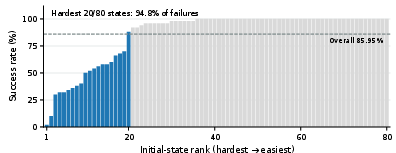
The researchers found that robot failures were often concentrated in a small part of the possible starting positions.
For example, a robot might succeed almost every time when an object starts in most locations, but fail repeatedly when it starts in one difficult corner. Random practice would spend a lot of time on easy situations the robot already understands.
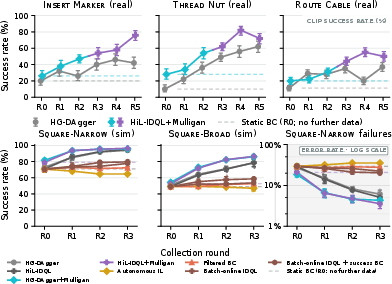
oursink sent more practice toward the difficult situations. As a result, it improved performance more than random starting-position selection while using the same number of supervised episodes.
The method improved success on real tasks
Compared with the main baseline method, the strongest version of the system improved final success by:
- 34 percentage points on Insert Marker,
- 10 percentage points on Thread Nut,
- 16 percentage points on Route Cable.
A percentage point is a direct difference between percentages. For example, improving from 40% success to 50% success is a 10-percentage-point improvement.
The full system also performed better in simulation.
The value function helped later in training
The value-based system was not always helpful at the beginning. Early on, it did not have enough experience to judge actions accurately.
After the robot collected more data, including failed attempts, the value function became more useful. It helped choose better actions, especially during very precise parts of the tasks, such as inserting or seating an object.
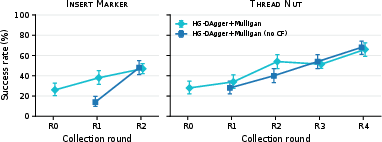
Counterfactual demonstrations were useful, especially early
Showing the robot a complete correct solution from a difficult starting position often helped more than giving it only a correction after a mistake.
This was especially useful in the early stages of learning, when the robot did not yet know the complete correct behavior well.
The robot remained useful while learning
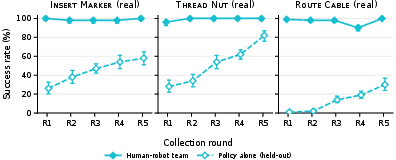
A major result was that the robot-human team completed 98% of the supervised collection episodes. No round had a completion rate below 90%.
This means the human could usually take over and finish the task even when the robot made a mistake. The robot was learning without making the entire work process unproductive.
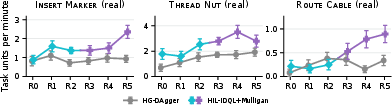
The improved system also completed more tasks per minute than the comparison method.
5. Why are these results important?
The paper shows that where training data comes from can be just as important as how much data is collected.
If a human has limited time, it is wasteful to spend most of that time showing a robot situations it already handles correctly. A better strategy is to:
- find where the robot is failing,
- practice those situations again,
- continue exploring new situations,
- give the robot complete correct demonstrations when necessary.
This can help robots improve using fewer human-supervised episodes.
6. Possible impact and limitations
The method could make it easier and cheaper to train robots for real-world jobs. It might be useful in factories, warehouses, laboratories, or homes, where robots must handle objects placed in slightly different positions each time.
However, the method has some limitations:
- It assumes that a person can choose and place the objects at specific starting positions.
- The researchers tested only a few robot tasks and learning systems.
- The robot’s value function helped choose better actions, but those improvements were not always directly added back into the main robot policy.
- The method may be harder to use when the robot cannot control how situations begin.
Overall, the paper’s main message is:
Robots learn faster when people deliberately give them practice in the situations they find difficult, rather than giving them random practice. This allows robots to improve while still completing useful tasks.
Knowledge Gaps
Knowledge gaps, limitations, and open questions
- Limited task and hardware diversity: The real-world evaluation uses only three high-precision tasks on one Franka Panda/DROID platform, while simulation uses two variants of a square-nut insertion task; it remains unclear whether the results generalize to other robots, embodiments, object properties, task geometries, locomotion or navigation tasks, and longer-horizon manipulation.
- Dependence on controllable initial states:
oursinkassumes that an operator can parameterize and deliberately place objects at selected initial states. Its effectiveness when states arise naturally, are only partially observable, or cannot be reset precisely remains unresolved. - Unclear performance under autonomous deployment: The method is designed for supervised deployment with an operator available for interventions and counterfactual demonstrations. The paper does not establish how it would work when the robot must select, reach, or generate informative states autonomously.
- Unvalidated state-space representation: Initial-state selection relies on normalized Euclidean distance with manually chosen axis weights and periodic treatment of yaw. The sensitivity of coverage and failure promotion to these weights, alternative metrics, correlated pose variables, object appearance, clutter, and high-dimensional state representations is not systematically studied.
- No formal characterization of when failure clustering occurs: The method is motivated by concentrated failures, but the paper does not quantify how the degree of failure concentration affects its advantage over uniform sampling or identify task and policy conditions under which performance-guided collection is likely to fail.
- Unclear optimal balance between failure promotion and coverage fill: The promotion cap and the allocation between observed failures and unexplored states are task-specific design choices. There is no principled rule for selecting them, nor a study of their sensitivity across rounds, budgets, or failure distributions.
- Potential blind spots between sampled states: Exact retries of observed failures and farthest-point coverage do not necessarily discover narrow or disconnected failure regions. The paper does not evaluate whether interpolation-based, uncertainty-based, or model-based sampling can find failures that lie between or outside the selected initial states.
- Limited comparison with alternative active data-collection methods: The main real-world comparison is against HG-DAgger with uniform sampling, while several potentially relevant approaches—uncertainty sampling, learned failure prediction, adaptive curricula, active perturbation, and state-conditional sampling—are not directly compared under matched budgets.
- Incomplete learner generality: The collection strategy is evaluated primarily with a Diffusion Policy actor paired with either behavior cloning or the particular HiL-IDQL critic formulation. Its behavior with transformer or VLA policies, recurrent policies, classical controllers, online RL algorithms, and other offline RL methods remains unknown.
- No evaluation of policy initialization diversity: The experiments use a common base-demonstration setup and do not test whether the method is robust to weaker, stronger, differently pretrained, or generalist initial policies.
- Small number of independent real-world campaigns: Each real-world strategy is run as one collection campaign per task, limiting the ability to separate algorithmic effects from run-to-run variation in hardware condition, operator behavior, object placement, and training stochasticity.
- Limited real-world statistical power: Most real-world evaluation points contain 50 episodes, and some points are pooled across sessions. The paper does not fully quantify uncertainty from independent training runs, days, hardware resets, or campaign-level variation.
- Cross-round comparability is constrained: Each round uses a fresh evaluation block and may experience day-to-day drift, so performance trajectories across rounds are not directly comparable. This makes it difficult to determine how much of the reported improvement reflects learning versus changes in evaluation states or hardware conditions.
- Unresolved effects of environmental and hardware drift: The experiments do not systematically test changes in lighting, camera calibration, friction, object wear, robot calibration, workspace configuration, or sensor failures, all of which could alter the observed failure distribution and undermine previously selected states.
- Human expertise and workload are underexplored: Collection appears to rely on trained operators, but the effects of operator skill, fatigue, intervention policy, reaction time, consistency, and teleoperation interface are not isolated. The reported 98% completion rate may not transfer to less experienced operators or sustained deployment.
- Human cost is incompletely measured: The paper reports intervention frames, episode completion, robot time, and throughput, but does not provide a comprehensive accounting of operator time, cognitive workload, setup/reset effort, counterfactual-demonstration effort, or cost per successful policy improvement.
- Counterfactual demonstration criteria are subjective: The decision to record a full counterfactual demonstration versus only a correction depends on operator judgment. The paper does not measure inter-operator agreement or evaluate automated criteria for deciding when a counterfactual demonstration is warranted.
- Counterfactual demonstrations may introduce distributional bias: The method assumes that a full human demonstration from the same initial state represents the missing behavior. It remains unclear whether these demonstrations cause overfitting to exact reset states or reduce robustness to nearby states and recovery trajectories.
- Intervention-boundary modeling is not resolved: The critic bootstraps across transitions involving human intervention, but the validity of this assumption is not established. Human actions may change the state distribution, control authority, or effective dynamics, potentially producing biased value targets.
- Sparse reward and stage labels may limit scalability: The experiments rely on task completion rewards and manually defined stage labels for failure ordering and analysis. The method’s performance without reliable stage annotations, with delayed or ambiguous success signals, or on tasks with multiple valid solutions is unknown.
- Critic reliability and extrapolation are insufficiently analyzed: The critic is trained from a finite mixture of successes, failures, autonomous actions, and human actions, then used for best-of- action selection. The paper does not report calibration, ranking accuracy, out-of-distribution error, or the frequency with which critic errors cause unsafe or unsuccessful action selection.
- Best-of- sensitivity is unresolved: The effects of the candidate count , sampling temperature, action-chunk horizon, and critic-selection errors are not systematically characterized. Increasing may improve selection while increasing computation, latency, or exposure to critic overestimation.
- Value learning is not shown to scale to longer horizons: The proposed -return, distributional value head, and chunked targets are evaluated on relatively short manipulation tasks. Their stability and credit-assignment performance on substantially longer-horizon tasks remain open.
- Actor–critic decoupling leaves gains outside the policy: Since reranked actions are not distilled into the actor, improvements depend on continued critic inference and candidate sampling. The paper identifies distillation as future work but does not evaluate whether it preserves safety, improves compounding gains, or causes policy collapse.
- Negative effects of autonomous-success data are not explained: Adding successful autonomous segments to the actor dataset lowers performance in an ablation, but the mechanism—action-quality mismatch, duplication, covariate shift, imbalance, or optimization effects—is not identified, and alternative weighting or filtering strategies are not tested comprehensively.
- Budget efficiency is not evaluated over a broad range: The experiments use fixed round and episode budgets. The relative advantage of
oursinkunder very small budgets, much larger budgets, unequal evaluation costs, or different ratios of evaluation to supervised episodes remains unknown. - No theoretical sample-efficiency or convergence guarantees: The paper provides an empirical strategy but does not establish conditions under which failure promotion plus coverage fill improves expected learning progress, nor bounds on discovering failure regions or approaching the target success rate.
- Failure severity ordering may be task-specific: Promoting failures by earliest stage and presumed severity is manually designed. It is unclear whether this ordering correlates with learning value across tasks or whether prioritizing later-stage failures, uncertainty, expected information gain, or estimated improvement would be better.
- Generalization beyond the sampled initial-state distribution is not established: Evaluation remains within bounded pose ranges related to the collection space. Robustness to out-of-range placements, novel object configurations, visual changes, and combinations of perturbations is not tested.
- Safety and failure containment are underreported: The paper reports task completion and intervention rates but does not analyze collision risk, damage, near misses, unsafe force profiles, or the safeguards required when deliberately revisiting difficult initial states.
- Productivity metrics may not capture deployment utility: Throughput counts completed task units per robot minute, but it does not account for operator attention, recovery/reset labor, object damage, maintenance, or the opportunity cost of dedicating episodes to targeted learning rather than ordinary production.
- Interactions among collection, critic learning, and policy architecture remain unclear: The reported gains from
oursinkand value-based reranking may depend on their particular combination. More extensive factorial studies are needed to determine whether the collection strategy provides independent benefits across actor classes, critics, intervention rules, and policy-update schedules.
Practical Applications
Immediate Applications
- Robotics: performance-guided data collection for industrial manipulation
- Integrate
oursinkinto robot-learning pipelines for tasks such as insertion, fastening, cable routing, assembly, pick-and-place, and precision seating. - After each evaluation round, log the initial object poses associated with failures, retry a controlled subset of those poses, and use farthest-point or low-discrepancy sampling to cover unexplored poses.
- This can replace uniform demonstration collection in supervised deployment, potentially improving success rates with the same operator and robot-time budget.
- Dependencies: The robot must support repeatable resets, the operator must be able to place objects in parameterized initial states, and failure states must be logged accurately.
- Integrate
- Factory and warehouse robot commissioning
- Use the method during deployment of a new robot cell to identify difficult combinations of object position, orientation, lighting, tolerances, and workspace geometry.
- A practical workflow is:
- 1. Collect an initial Sobol-distributed set of demonstrations.
- 2. Deploy the policy on held-out configurations.
- 3. Promote observed failures to the next collection round.
- 4. Use counterfactual demonstrations when a correction only teaches recovery rather than the desired behavior.
- 5. Stop or reduce supervision when failure regions become sufficiently small.
- This is especially suitable for low- to medium-volume manufacturing, where tasks change frequently and collecting large datasets for every new configuration is expensive.
- Dependencies: Initial-state variables must be measurable and controllable; the method is less applicable when objects arrive unpredictably on a conveyor or from unstructured human environments.
- Human-in-the-loop robot supervision
- Convert routine operator oversight into a continual improvement process rather than treating supervision only as a safety mechanism.
- Operators can intervene when the policy fails, while the system automatically separates:
- successful human-controlled data for behavior cloning,
- all robot and human rollouts, including failures, for critic or value-function training.
- This allows a robot to continue completing tasks during data collection; the paper reports a 98% completion rate for supervised collection episodes in its experiments.
- Dependencies: Operators need reliable teleoperation and intervention interfaces, and human corrections must be consistently recorded and synchronized with robot observations and actions.
- Precision manipulation quality assurance
- Apply failure clustering and stage-wise analysis to determine whether failures occur during grasping, transport, alignment, insertion, or final seating.
- Use these diagnostics to decide whether to collect more demonstrations, improve perception, alter mechanical tolerances, or tune the policy's action-selection mechanism.
- The paper suggests that performance-guided collection is particularly useful for discovering difficult grasp and initial-state regions, while value-based action reranking can improve precise insertion stages.
- Dependencies: Tasks should have identifiable stages or sufficiently informative state and outcome logs.
- Robotic data-management and training software
- Implement a reusable collection service with modules for:
- initial-state sampling,
- failure promotion,
- farthest-point coverage,
- counterfactual demonstration recording,
- human-versus-policy control labeling,
- actor/critic dataset separation,
- held-out evaluation.
- Such a tool could be integrated into platforms based on Diffusion Policy, DAgger-style imitation learning, implicit Q-learning, or other batch-online robot-learning systems.
- Dependencies: The current evidence uses a Diffusion Policy actor and a particular IQL/IDQL-style critic. Generalization to other policy classes should be validated empirically.
- Simulation-based robot-learning benchmarks
- Use
oursinkas a benchmark protocol for testing whether robot-learning systems improve efficiently under wide initial-state distributions rather than only under narrow randomization ranges. - Simulation environments can compare uniform sampling, Sobol sampling, failure-guided sampling, counterfactual demonstrations, and value-based action selection under fixed episode budgets.
- This is useful for evaluating sample efficiency before transferring a policy to physical hardware.
- Dependencies: Simulation must model reset distributions, failures, intervention behavior, and object-placement variability realistically enough to predict real-world performance.
- Use
- Academic research on active learning and curriculum design
- Treat the initial-state distribution as an actively selectable training variable rather than as a fixed property of the task.
- The method provides a concrete experimental baseline for research on:
- hard-example mining,
- active imitation learning,
- restart-state curricula,
- prioritized level replay,
- human-guided reinforcement learning,
- robot data valuation.
- Researchers can reproduce the two main design choices independently: performance-guided state selection and learning from failures through a critic.
- Dependencies: Further studies are needed across more robot platforms, policy architectures, task horizons, and intervention protocols.
- Operational dashboards for robot-learning productivity
- Build monitoring dashboards that report success rate, failure concentration, intervention frequency, human-controlled frame share, task completion throughput, and robot minutes per completed task.
- This supports deployment decisions based not only on autonomous success but also on whether supervised operation remains productive.
- The paper's throughput analysis shows that a more successful learning strategy need not reduce execution speed or completed tasks per robot minute.
- Dependencies: Metrics must be standardized across shifts, operators, hardware conditions, and changing evaluation distributions.
- Education and laboratory training
- Use the method in robotics courses and research labs to teach active data collection: students can observe failure clusters, design reset distributions, and quantify the value of targeted demonstrations.
- A laboratory workflow could compare a uniform DAgger baseline with performance-guided collection on a tabletop robot or simulator.
- Dependencies: Educational deployments require safe hardware, simplified reset procedures, and clearly bounded task spaces.
Long-Term Applications
- Autonomous self-improving robot fleets
- Extend the system from one robot to multiple robots that share failure states, critic models, and counterfactual demonstrations.
- A fleet operating in warehouses, factories, hospitals, or agriculture could aggregate failure statistics across sites and prioritize data collection where the global policy performs poorly.
- Fleet-level tools could maintain a failure atlas indexed by object type, pose, environment, robot unit, and task stage.
- Dependencies: This requires robust cross-robot calibration, common state representations, privacy-preserving data sharing, and methods for distinguishing policy failures from hardware or site-specific failures.
- Robots learning from naturally occurring deployments
- Remove the assumption that an operator can freely place every initial state by selecting among naturally arriving states or by actively repositioning the robot and environment.
- A future system could estimate the learning value of incoming episodes and request human attention only when an informative failure occurs.
- This would support robots that learn during ordinary production, delivery, kitchen, or caregiving operations without dedicated collection rounds.
- Dependencies: The paper explicitly identifies controllable initial-state placement as a limitation. Natural deployments require safe exploration, reliable state estimation, and mechanisms for handling biased or incomplete exposure to the initial-state space.
- Distillation of value-reranked behavior into deployable policies
- The critic currently improves behavior by selecting the best among multiple actor-generated action chunks, but the improvement remains outside the actor.
- Future systems could distill the critic-reranked actions back into the policy, potentially reducing inference cost and compounding improvements across rounds.
- This could produce a single faster policy suitable for high-throughput industrial or mobile-robot deployment.
- Dependencies: Distillation must avoid propagating critic errors, distributional shift, unsafe actions, or overfitting to the critic's estimated value function.
- General-purpose vision-language-action robot adaptation
- Apply performance-guided collection to large, generalist robot policies and vision-language-action models adapting to new tools, objects, environments, or task instructions.
- Failure-guided deployment could identify the specific object poses, semantic contexts, or interaction stages where a generalist model needs targeted adaptation.
- Counterfactual demonstrations may be especially useful for teaching behaviors absent from the model's current action support.
- Dependencies: The reported experiments use a task-specific actor and do not establish performance for generalist policies, multimodal instructions, long-horizon tasks, or large-scale fine-tuning.
- Adaptive human-supervision allocation
- Develop systems that allocate operator time according to expected learning benefit rather than assigning an operator uniformly across all episodes.
- Multiple operators could be scheduled dynamically: experts handle rare or hazardous failure modes, while routine failures are handled by less specialized supervision or automated recovery.
- A future objective could optimize a joint metric such as expected policy improvement per operator minute, rather than success improvement per episode.
- Dependencies: This requires reliable estimates of intervention difficulty, operator skill, safety risk, and the causal value of each demonstration.
- Safety-critical robotics
- Use failure-guided collection to identify rare but consequential initial states in surgical assistance, laboratory automation, nuclear inspection, disaster response, or service robotics.
- The system could prioritize difficult configurations while maintaining human takeover, producing targeted evidence for safety cases and operational design limits.
- Dependencies: The paper evaluates tabletop manipulation and does not establish safety guarantees. Safety-critical use would require formal risk bounds, certified intervention latency, redundant sensing, exhaustive edge-case testing, and regulatory approval.
- Policy and standards for continual robot learning
- The method could inform deployment standards requiring robots to log:
- the distribution of encountered initial states,
- observed failure clusters,
- interventions and recoveries,
- policy versions,
- data used for each update,
- held-out performance after retraining.
- Regulators and auditors could use these records to assess whether a continually learning robot is improving across relevant operating conditions rather than merely optimizing average performance.
- Dependencies: Standards would need agreement on failure definitions, evaluation distributions, reproducibility, data retention, and safeguards against unsafe updates.
- Industrial digital twins and predictive maintenance
- Combine failure-region maps with digital twins to determine whether failures arise from policy limitations, calibration drift, component wear, object variation, or environmental changes.
- Repeated concentration of failures around a particular pose or stage could trigger a maintenance inspection or recalibration instead of additional policy training.
- Dependencies: This application requires synchronized robot telemetry, accurate digital-twin models, and methods that separate learning-related failures from mechanical degradation.
- Daily-life assistive robots
- Household or assistive robots could use supervised deployment to improve tasks such as inserting plugs, placing objects into tight containers, loading dishwashers, or manipulating unfamiliar household items.
- A user or caregiver could intervene occasionally, while the robot prioritizes configurations where it repeatedly fails and continues completing easier tasks autonomously.
- Dependencies: Homes provide less controllable initial states, greater object diversity, changing lighting, and stronger privacy and safety requirements than the laboratory setting. Human intervention may also be less consistent than trained operator supervision.
- Energy and infrastructure robotics
- Apply the approach to inspection and manipulation tasks in power plants, solar farms, offshore facilities, or utility infrastructure, where failure conditions may cluster around particular geometries or component states.
- Targeted collection could reduce the number of expensive teleoperation sessions needed to teach robots to connect, inspect, tighten, or service components.
- Dependencies: Deployment requires robust remote intervention, environmental generalization, safety certification, communication reliability, and protection against catastrophic failures.
- Finance and other non-robotic sequential decision systems
- The broader principle—use observed failures to prioritize future data collection while preserving coverage—could inspire active learning workflows in fraud detection, credit-risk monitoring, recommendation systems, or algorithmic operations.
- For example, a model could oversample rare, high-cost failure cases while retaining coverage of unexplored feature regions.
- Dependencies: These domains differ substantially from physical robot control. Counterfactual demonstrations, intervention semantics, safety constraints, and causal validity would need to be reformulated rather than transferred directly.
Glossary
- Actor-critic learning: A reinforcement-learning architecture that separates policy (actor) improvement from value estimation (critic). “We train an actor and a critic separately and combine them only at deployment.”
- Advantage-conditioned training: Training that conditions policy updates on estimated advantages of actions or trajectories. “These recipes focus on the learning update, e.g., advantage-conditioned training on accumulated experience in RECAP.”
- Affine transform: A transformation involving scaling, rotation, translation, or combinations of these operations. “the critic rescales its action input by a state-conditioned affine transform”
- Autonomous rollout: A trajectory generated by a robot acting without human intervention. “The robot contributes its own autonomous successes and autonomous failures.”
- Batch-online learning: A setting in which data are collected through online interaction but model updates occur between batches or rounds. “We study the batch-online form of this loop”
- Behavior cloning (BC): Supervised learning that trains a policy to imitate actions recorded in demonstrations. “BC fits to a dataset of state and chunk pairs by maximum likelihood”
- Best-of- sampling (BoN): Selecting the highest-valued action or action sequence from policy-generated candidates. “which we refer to as best-of- (BoN) sampling”
- Bootstrapping: Estimating a value target using a later predicted value rather than waiting for a complete return. “the critic bootstraps steps ahead”
- Counterfactual demonstration: A demonstration showing what should have happened from the same initial state, rather than merely correcting a state reached after failure. “a counterfactual demonstration (CF) that places the missing behavior in the actor's support”
- Critic: A learned value estimator that evaluates the expected quality of states or actions. “The critic is trained by implicit -learning (IQL)”
- Curriculum learning: Gradually selecting training examples or initial states according to their difficulty. “Curricula move initial states toward intermediate difficulty”
- Diffusion model: A generative model that produces samples by progressively denoising corrupted data. “a diffusion model optimizes through its denoising loss”
- Distributional value learning: Value estimation that predicts a probability distribution over possible returns rather than a single expected value. “replacing the scalar value with a categorical return distribution”
- Empirical return: The reward accumulated along an observed trajectory, often with discounting. “the target for each transition”
- Expectile regression: An asymmetric regression method that weights positive and negative prediction errors differently. “ is fit to by expectile regression”
- Farthest-point selection: An exploration or sampling method that repeatedly chooses the point farthest from previously selected points. “Each coverage-fill state is the point of farthest from every collected initial state”
- Failure promotion: Prioritizing previously observed failure states for re-evaluation or retraining. “We describe its two steps, failure promotion and coverage fill”
- Generative policy: A policy that represents a probability distribution and generates actions by sampling from it. “best-of- improves a generative policy without backpropagating through its sampling chain”
- Generalized advantage estimation (GAE): A method for estimating policy advantages using an exponentially weighted combination of temporal-difference errors. “an exponentially weighted average of chunked -step targets in the spirit of GAE”
- Held-out evaluation: Testing on data or initial states excluded from training. “We report autonomous success rate (SR) on held-out initial states”
- Human-in-the-loop (HiL): A learning or control system in which a human supervises or intervenes in autonomous operation. “We study a human-in-the-loop (HiL) batch-online RL setting”
- Implicit -learning (IQL): An offline reinforcement-learning method that learns value functions without sampling actions from the policy during training. “The critic is trained by implicit -learning (IQL)”
- Implicit diffusion -learning (IDQL): A method that uses a diffusion policy and a learned -function to select among sampled actions. “At deployment, implicit diffusion -learning (IDQL) uses the critic to select among the actor's samples”
- Imitation learning: Learning a policy by reproducing behavior demonstrated by an expert or human. “oursink instead decides where each round collects, so we evaluate it with two learners, imitation alone and imitation with a value function”
- Initial-state distribution: The probability distribution from which task-starting states are sampled. “an initial-state distribution , uniform over a bounded range of object poses ”
- Intervention signal: Information derived from a human taking control of a robot, potentially serving as a reward or supervision signal. “Interventions also carry implicit reward signal”
- Lambda-return: A reinforcement-learning target formed as an exponentially weighted average of multi-step returns. “the critic instead regresses onto the -return”
- Low-discrepancy sequence: A deterministic sequence designed to cover a space more uniformly than independent random samples. “a low-discrepancy sequence whose points cover more evenly”
- Markov decision process (MDP): A model of sequential decision-making in which the next state depends only on the current state and action. “We model each task as a Markov decision process ”
- Maximum likelihood: Estimating model parameters by maximizing the probability assigned to observed data. “BC fits to a dataset of state and chunk pairs by maximum likelihood”
- On-policy data: Experience generated by the policy currently being trained or evaluated. “Reranking helps only once on-policy data has accumulated”
- Operator-blind evaluation: Evaluation in which the human operator does not know which method generated a particular trial. “with the methods interleaved on a shuffled list under operator-blind labels”
- Policy gradient: An optimization method that updates a policy using gradients of expected reward; the paper contrasts its approach with gradient-based updates. “improving the actor without gradients”
- Policy support: The set of actions or behaviors that a policy can represent or generate. “it places the missing behavior in the policy's support”
- Q-function: A function estimating expected future return for taking an action in a state and then following a policy. “ is then regressed onto the target ”
- Recovery supervision: Training information that teaches a robot how to recover after making an error. “it provides recovery supervision where the policy drifts”
- Reinforcement learning (RL): Learning behavior through reward feedback from interaction with an environment. “Real-world RL learns from every rollout, failures included, through a value function”
- Reranking: Reordering or selecting candidate actions according to a learned score or value estimate. “at deployment the critic reranks the actor's samples”
- Restart distribution: A distribution over states to which an environment or task is reset for training. “Where episodes begin has been a design choice in RL since restart distributions were used to direct policy improvement”
- Sparse reward: A reward function that provides feedback only rarely, typically upon task completion. “a sparse reward that is $1$ when the task is completed and $0$ otherwise”
- Sobol sequence: A quasi-random, low-discrepancy sequence used to distribute samples evenly across a multidimensional space. “the round-$0$ base demonstrations are recorded at initial states drawn from a scrambled Sobol sequence”
- State-conditioned: Dependent on the current environment state. “the critic rescales its action input by a state-conditioned affine transform”
- Temporal-difference target: A value-learning target combining immediate reward with an estimate of future value. “its target ”
- Teleoperation: Direct control of a robot by a human operator, often through a remote interface. “teleoperated completions of the whole task”
- Value function: A function estimating expected future reward from a state under a policy. “Real-world RL learns from every rollout, failures included, through a value function”
- Value-based action selection: Choosing actions according to their estimated future value. “Combined with value-based action selection, HiL-IDQL+oursink improves final real-task success”
- Vision-language-action (VLA) policy: A policy that maps visual and language inputs to robot actions. “Recent work scales corrections and RL to vision-language-action (VLA) policies”
- Wide initial-state distribution: A broad range of possible starting configurations for a task. “We study learning in deployment with wide initial-state distributions”
- Wilson interval: A statistical confidence interval for a binomial proportion. “Real-world whiskers are Wilson one-standard-error intervals”

