Presenting a proof of the Kannan-Lovasz-Simonovits conjecture
Abstract: Together with Bourgain's slicing problem and the variance conjecture, the Kannan-Lovász-Simonovits (KLS) conjecture has been a driving force for mathematical developments in high dimensional geometry in recent decades. We present here a proof of this conjecture. The crucial step in the proof is the very recent criterion from Song and Zhang involving high-order derivatives of tilt averages.
Paper Prompts
Sign up for free to create and run prompts on this paper.
Top Community Prompts
Explain it Like I'm 14
1. What is the paper about?
This paper claims to prove the Kannan–Lovász–Simonovits (KLS) conjecture, a famous problem in high-dimensional geometry and probability.
The conjecture is about how evenly probability is spread inside shapes such as cubes, balls, and other convex bodies. It says, roughly, that even in spaces with many dimensions, these probability distributions should not have extremely narrow “bottlenecks” that make it difficult to move from one region to another.
The authors study a broader class of probability distributions called log-concave measures. These include:
- Uniform distributions inside convex shapes.
- Gaussian distributions.
- Many other distributions whose density has a single main “hill” rather than many separate peaks.
Their main claim is that the behavior of these distributions can be controlled by one universal constant, no matter how many dimensions the space has.
2. What questions are the researchers asking?
The paper focuses on several connected questions:
- Do log-concave distributions become sufficiently well spread out in every dimension?
- Can the amount of variation in a function be controlled by how quickly that function changes?
- Is the needed control independent of the dimension?
The main mathematical statement is a dimension-free Poincaré inequality:
In simple language:
- measures how much the values of a function vary.
- measures how quickly the function changes.
- The constant should be the same for all dimensions.
An analogy is a landscape. If a landscape changes only slowly as you walk, the heights should not suddenly be wildly different. The Poincaré inequality says that the overall variation in the landscape can be controlled by its local steepness.
The KLS conjecture predicts that such control is possible with a universal constant.
3. How did they approach the problem?
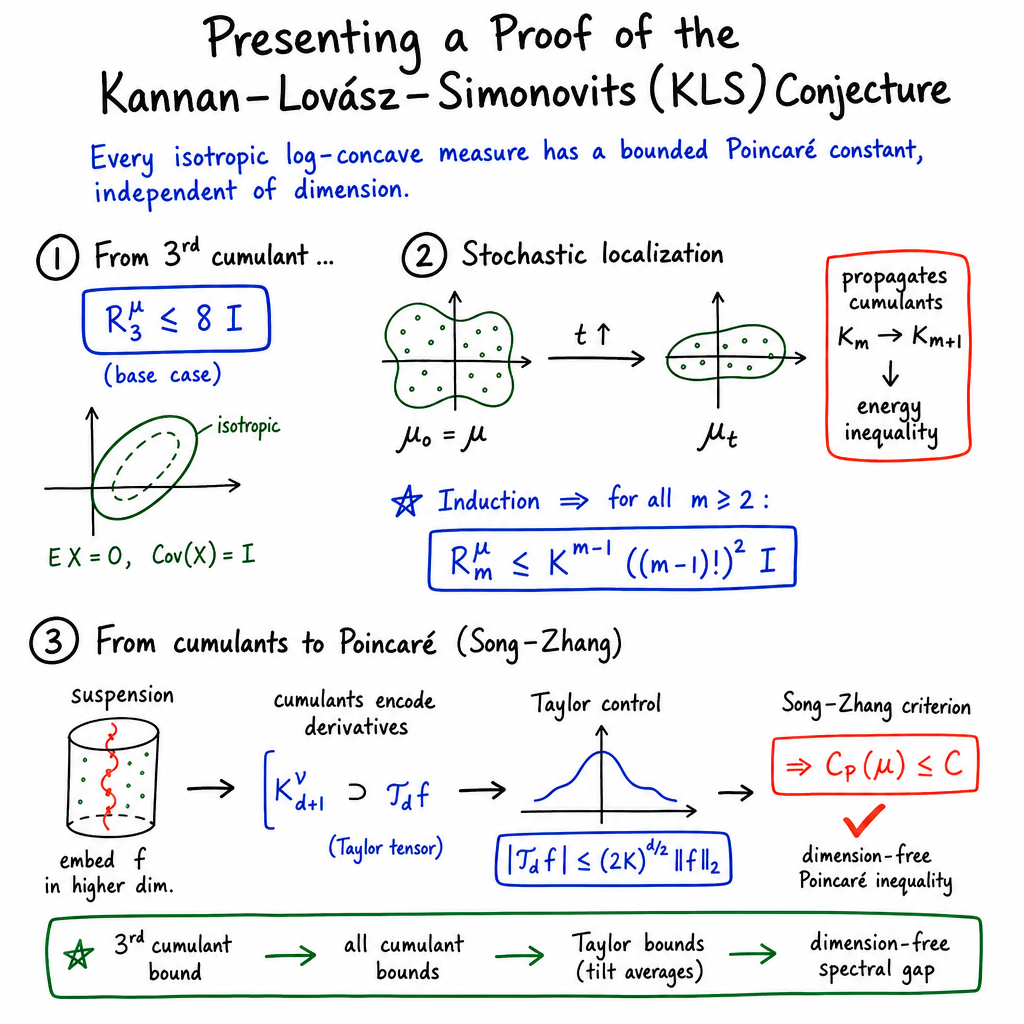
The proof combines several advanced ideas. Here is the basic plan in everyday language.
Starting with a third-order estimate
The authors begin with an earlier result controlling the third moment of an isotropic log-concave distribution. A moment measures features such as spread or asymmetry.
This first estimate is similar to knowing that a cloud of points cannot be too lopsided in a particular direction.
They then try to extend this control from the third moment to moments of all orders. These higher-order quantities are called cumulants. Cumulants describe increasingly complicated patterns in a distribution, such as skewness and more subtle forms of dependence.
Their estimate has the general form
where is the order of the cumulant and is a universal constant. The important idea is that the growth of these higher-order patterns is controlled.
Using stochastic localization
The proof also uses stochastic localization, a method that gradually changes a probability distribution by adding random information.
An everyday analogy is slowly focusing a camera lens on a blurry picture. At each step, the distribution becomes more concentrated, and the researchers track how its shape changes.
This method helps them carry the estimate for the third moment through repeated steps until they obtain estimates for all higher-order cumulants.
Studying tilted distributions
The authors then modify the original distribution using an exponential tilt:
This gives more weight to points in a chosen direction. It is like slightly shifting the balance of a pile of sand so that points on one side become more important.
For a function , they study its average under these tilted distributions:
They examine the derivatives of at the starting point. These derivatives describe how the average changes when the distribution is tilted more and more.
The paper uses a construction called a suspension to relate these derivatives to cumulants of a larger log-concave distribution. In less technical terms, the authors place the original problem inside a bigger mathematical setting where the quantities they need can be estimated more easily.
Applying the Song–Zhang criterion
Finally, they use a result by Song and Zhang. This result says that if all the derivatives of the tilt-average are controlled, then the Poincaré inequality follows.
The proof therefore follows this chain:
- Control third-order behavior.
- Extend the control to all higher-order cumulants.
- Use cumulants to control derivatives of tilted averages.
- Use the Song–Zhang criterion to obtain the Poincaré inequality.
- Conclude the KLS conjecture.
The paper also introduces tools such as:
- The Laplace operator, which measures how a function bends and changes.
- The Bochner identity, an equation connecting first and second derivatives.
- Tensor symmetrization, which averages a complicated multi-index object over different rearrangements of its indices.
These tools help organize and compare the many derivatives appearing in the proof.
4. What are the main results?
The central result is:
There is a universal constant such that every isotropic log-concave probability measure satisfies
Here, is the smallest constant that makes the Poincaré inequality work.
This means that the Poincaré inequality holds with a bound that does not grow with the number of dimensions.
The paper also shows that, for a general log-concave distribution,
In simpler terms, the Poincaré constant is determined, up to a universal factor, by the ordinary spread of the distribution in its widest direction.
That is important because it says that complicated high-dimensional behavior can essentially be understood by checking simple linear functions, such as
The paper’s result would also imply progress on several related problems:
- Concentration: most of the probability stays near typical values.
- Isoperimetry: the boundary between two large regions cannot be too small.
- Thin-shell behavior: most points lie near a shell at a typical distance from the center.
- Slicing: every convex body should have a reasonably large cross-section.
These are different-looking problems, but the paper explains that they are closely connected.
5. Why is this important?
High-dimensional spaces appear in statistics, computer science, data analysis, optimization, and physics. In such spaces, shapes and probability distributions can behave in surprising ways.
A dimension-free result is especially valuable. Without it, estimates might become worse and worse as the number of dimensions increases. With it, the same basic rule works in two dimensions, one hundred dimensions, or millions of dimensions.
Possible applications include:
- Designing faster random-sampling algorithms.
- Estimating the volume of complicated shapes.
- Understanding high-dimensional data.
- Proving that random walks inside convex bodies mix efficiently.
- Improving results in geometry, probability, and optimization.
Conclusion
The paper presents a long and technical argument claiming that the KLS conjecture is true. Its main message is that log-concave probability distributions remain well behaved even in very high-dimensional spaces.
The authors begin with a bound on a relatively simple third-order feature of the distribution. They then repeatedly build stronger bounds for more complicated features, using stochastic localization, cumulants, tilted averages, and the Song–Zhang criterion. These steps are intended to prove a universal Poincaré inequality.
If the proof is correct, it resolves an important longstanding problem and gives a powerful explanation for why many high-dimensional convex shapes are more regular and predictable than they first appear.
Knowledge Gaps
Knowledge gaps, limitations, and open questions
- The paper’s central KLS proof depends on the third-cumulant estimate from recent thin-shell work; it does not provide an independent proof or clarify whether the constant $8$ is optimal.
- The higher-order cumulant bound
is not shown to have sharp dependence on ; determining the optimal growth rate and constants remains open.
- The argument establishes existence of a universal Poincaré constant but does not determine the best universal KLS constant or provide numerically meaningful bounds for it.
- The proof relies on regularization by Gaussian convolution and quadratic penalization, but it does not quantify how the relevant constants and cumulant estimates behave along the approximation sequence.
- The limiting argument from regular measures to arbitrary log-concave measures is sketched rather than fully quantified, particularly for measures supported on lower-dimensional affine subspaces or with nonsmooth and unbounded potentials.
- The stochastic-localization induction is developed for the specific inverse-covariance quadratic variation; whether substantially different localization processes could yield sharper cumulant or KLS constants is not investigated.
- The proof uses strong uniform convexity at intermediate stages, while the final theorem applies to general log-concave measures; the extent to which the method can be reformulated without introducing the auxiliary parameter is left unexplored.
- The Song–Zhang tilt-average criterion is used as a black-box structural mechanism after being rederived, but the paper does not identify whether its dependence is optimal or whether weaker derivative assumptions could suffice.
- The bound on Taylor coefficients of tilt averages is obtained uniformly over all , but the paper does not characterize the functions or measures for which this bound is attained or nearly attained.
- The analyticity observation for is not developed into a complex-analytic proof; in particular, it remains unresolved whether the KLS inequality can be derived directly from complex extension or radius-of-analyticity estimates.
- The suspension construction is asserted to realize derivatives of tilt averages as cumulants of a higher-dimensional log-concave measure, but the dimensional cost and geometric structure of this construction are not analyzed quantitatively.
- It is unclear whether the suspension argument preserves additional properties of the original measure, such as unconditionality, symmetry, product structure, or curvature bounds.
- The method proves a Poincaré inequality but does not establish dimension-free logarithmic Sobolev, modified logarithmic Sobolev, transportation, or sharper concentration inequalities for general log-concave measures.
- The relationship between the higher-order cumulant bounds and other major convex-geometric conjectures is not fully mapped; for example, the paper does not determine whether these estimates yield new quantitative results for central limit theorems, mixing times, or entropy inequalities beyond the stated KLS consequences.
- The proof does not address whether analogous cumulant propagation and tilt-average arguments apply to non-log-concave measures satisfying weaker structural assumptions, such as approximately log-concave, strongly unimodal, or bounded-moment distributions.
- The extension from uniform measures on convex bodies to arbitrary log-concave densities is established abstractly, but the paper does not identify which steps could fail for measures with heavy tails or only finite moments under weaker notions of log-concavity.
- The theorem is affine-invariant after normalization, but the behavior of the intermediate quantities—especially cumulant matrices, localization paths, and Taylor coefficients—under general affine transformations is not systematically quantified.
- The proof does not provide stability results: it remains unknown whether measures whose Poincaré constant is close to the universal KLS bound must resemble specific extremal or near-extremal distributions.
- The paper does not identify extremizers for the KLS inequality or for the intermediate cumulant and tilt-average estimates; even the role of product exponential measures, which attain the sharp thin-shell constant cited in the introduction, is not resolved for KLS.
- The argument is nonconstructive from an algorithmic perspective; it does not yield an explicit efficient procedure for estimating the Poincaré constant, constructing near-optimal cuts, or improving sampling and volume-computation algorithms.
- The dependence of the proof’s constants on the tensor-symmetrization and recovery steps is crude, and it is unknown whether sharper representation-theoretic or combinatorial estimates could materially improve the final KLS bound.
- Several displayed derivations and technical identities in the supplied manuscript contain apparent transcription or typographical defects, so a fully verified version of the proof and its regularity assumptions is needed before the result can be independently checked or generalized.
Practical Applications
The paper’s main contribution is theoretical: it proves a dimension-free Poincaré inequality for isotropic log-concave probability measures, thereby resolving the KLS conjecture in the stated setting. The most realistic applications are therefore indirect: the result improves the guarantees and analysis of algorithms that operate on convex bodies or log-concave distributions rather than providing an immediately deployable commercial technology.
Immediate Applications
The following applications can be implemented using existing algorithms and software, with the paper’s theorem supplying stronger theoretical justification or dimension-independent guarantees.
- Faster and more reliable sampling from convex bodies and log-concave distributions — software, optimization, computational geometry
- The KLS result establishes that the Poincaré constant is bounded, up to a universal factor, by the largest eigenvalue of the covariance matrix:
- This can be used to analyze random-walk samplers such as ball walk, hit-and-run, Langevin-type methods, and stochastic-localization-inspired samplers. - A practical workflow is to: 1. estimate or approximate the covariance matrix; 2. apply an affine transformation toward isotropic position; 3. run a random-walk sampler; 4. use the dimension-free Poincaré bound to estimate mixing and variance reduction. - Dependencies: the distribution must be log-concave or well approximated by one; covariance estimation and isotropic preprocessing may themselves be computationally expensive in very high dimensions; constants in the theorem are universal but not necessarily numerically sharp.
Improved Monte Carlo integration and volume computation — computational geometry, Bayesian computation
- Uniform distributions on convex bodies are log-concave, so the theorem supports dimension-robust variance and mixing analyses for estimating:
- volumes of convex bodies;
- expectations of Lipschitz functions;
- partition functions and normalization constants;
- geometric probabilities.
- Existing volume algorithms can use the result to replace crude dependence on the body’s diameter with dependence on its covariance structure, which is substantially better for elongated, high-dimensional bodies.
- Dependencies: the body must be accessible through an oracle or efficient membership/projection procedure; numerical isotropization and boundary handling remain practical bottlenecks.
- Preconditioning for convex optimization — operations research, machine learning, engineering
- The equivalence between the Poincaré constant and covariance scale provides a theoretical basis for covariance-based preconditioning of optimization and sampling problems involving convex potentials.
- Potential implementations include:
- whitening transformations for constrained optimization;
- adaptive step-size selection for stochastic-gradient methods;
- covariance-informed proposals in constrained Bayesian optimization;
- geometric preconditioners for convex feasibility problems.
- Dependencies: covariance estimates must be sufficiently accurate; the target distribution or feasible region must exhibit approximate log-concavity; the theorem does not directly establish convergence rates for every optimization algorithm.
- Improved uncertainty quantification for log-concave models — statistics and finance
- Log-concave distributions are used for robust estimation, Bayesian posteriors with convex negative log-likelihoods, and uncertainty sets.
- Dimension-free concentration and Poincaré bounds can be used to control the variance of estimators and Monte Carlo observables:
- This supports practical error bars for smooth risk functions, portfolio objectives, and posterior expectations. - Dependencies: the observable must have a controlled gradient; heavy-tailed or multimodal distributions outside the log-concave class are not covered; model misspecification can invalidate the guarantee.
Variance reduction for simulation-based inference — healthcare, scientific computing, Bayesian statistics
- The paper’s use of exponential tilts and high-order derivatives of tilt averages suggests diagnostics for how observables respond to changes in natural parameters.
- Existing automatic-differentiation or sensitivity-analysis systems can use derivatives of
to quantify parameter sensitivity and construct control variates. - This is relevant to: - uncertainty propagation in epidemiological models; - parameter sensitivity in physical simulations; - posterior expectation estimation; - stress testing of probabilistic models. - Dependencies: the distribution must admit a tractable or numerically stable exponential tilt; high-order derivatives can be expensive and numerically ill-conditioned.
Benchmarking and validation of high-dimensional sampling algorithms — academia and software engineering
- The theorem provides a principled benchmark class: isotropic log-concave measures should not exhibit arbitrarily poor Poincaré behavior as dimension increases.
- Researchers can test whether empirical mixing times, spectral gaps, and autocorrelation estimates are consistent with dimension-free theoretical expectations.
- Useful benchmark distributions include:
- isotropic Gaussian measures;
- uniform measures on cubes, simplices, and polytopes;
- product exponential distributions;
- smooth strongly log-concave potentials.
- Dependencies: empirical spectral-gap estimation is difficult in large dimensions; finite-sample effects may obscure the theoretical behavior.
- Teaching and research workflows in high-dimensional probability — academia and education
- The paper provides a unified framework connecting:
- concentration inequalities;
- Poincaré inequalities;
- isoperimetry;
- covariance geometry;
- cumulants;
- stochastic localization;
- exponential tilting.
- This can support graduate courses, reading groups, and formal verification projects involving convex geometry and probability.
- Dependencies: the manuscript contains highly technical arguments and appears to include formatting and transcription errors; independent verification and careful consultation of the cited literature are advisable before using it as a formal instructional source.
Long-Term Applications
These applications require additional algorithmic development, empirical validation, or extensions beyond the theorem’s assumptions.
- Dimension-robust samplers for Bayesian inference — healthcare, machine learning, finance
- A long-term goal is to build samplers whose convergence guarantees depend primarily on covariance conditioning rather than ambient dimension.
- Possible products or workflows include:
- covariance-adaptive hit-and-run samplers;
- stochastic-localization-based posterior samplers;
- automatically whitened Langevin algorithms;
- sampling libraries that detect approximate log-concavity and select a geometry-aware method.
- Such tools could improve inference for high-dimensional models in medical diagnosis, portfolio risk, and probabilistic machine learning.
- Dependencies: real posteriors are often non-log-concave because of multimodality, discrete variables, neural-network parameterizations, or hierarchical structure. Extensions to approximately log-concave and weakly multimodal settings are needed.
- Scalable volume and partition-function estimation — computational geometry, statistical physics, logistics
- The KLS theorem may enable improved polynomial-time algorithms for estimating volumes, normalizing constants, and partition functions in high-dimensional convex or log-concave models.
- Potential uses include:
- counting feasible configurations in scheduling;
- estimating entropy and free energy;
- computing normalizers for exponential-family models;
- evaluating reliability regions in engineering design.
- Dependencies: theoretical mixing guarantees must be translated into implementable algorithms with explicit constants, oracle complexity, numerical stability, and parallel scalability.
- High-dimensional uncertainty propagation in safety-critical systems — robotics, energy, aerospace
- Convex uncertainty sets and log-concave noise models arise in motion planning, power-system optimization, and control.
- Dimension-free concentration could support safety certificates for functions of uncertain states, such as collision margins, voltage deviations, or fuel consumption.
- A possible workflow would combine:
- 1. a log-concave uncertainty model;
- 2. covariance estimation;
- 3. Poincaré-based variance bounds;
- 4. conservative chance constraints or robust-control decisions.
- Dependencies: safety-critical deployment requires sharper constants, finite-sample validation, robustness to model error, and extensions to nonlinear dynamics and nonconvex feasible regions.
- Advanced concentration tools for learning theory — artificial intelligence and statistics
- The cumulant estimates
may support refined tail bounds, sensitivity estimates, and generalization analyses for models with log-concave parameter distributions. - Future tools could use these bounds to design: - high-order concentration libraries; - robust estimators for log-concave data; - adaptive regularization schemes; - distribution-shift diagnostics based on cumulants. - Dependencies: translating tensor cumulant bounds into practical finite-sample algorithms requires computationally efficient estimators and bounds that remain useful under approximate log-concavity.
Automated covariance and isotropic-position preprocessing — software and numerical linear algebra
- The central role of affine normalization suggests automated preprocessing pipelines for convex bodies and probability distributions.
- A future package could:
- estimate the covariance operator;
- apply whitening or approximate isotropic transformations;
- certify conditioning;
- select a sampling or optimization method based on the estimated geometry.
- Dependencies: exact isotropic positioning is generally unavailable; approximate covariance estimation may require many samples or expensive optimization, especially when the distribution is only accessed through an oracle.
- Extensions to non-log-concave and structured distributions — healthcare, finance, ecology, social science
- Many real-world distributions are mixtures, multimodal, heavy-tailed, or constrained by nonlinear relationships. Extending the proof techniques to these settings could yield useful guarantees for:
- mixture models;
- robust Bayesian posteriors;
- graphical models;
- distributions with bounded negative curvature;
- approximately log-concave data-generating processes.
- Dependencies: log-concavity is used substantially in the Bochner-based step of the proof, so relaxing it may require new curvature, transport, or functional-inequality assumptions.
- Rigorous design of stochastic-localization algorithms — computational mathematics and robotics
- The proof’s use of stochastic localization, inverse covariance as a quadratic-variation matrix, and high-order cumulant control may inspire practical diffusion processes for navigating convex regions.
- Long-term implementations could provide:
- adaptive exploration of constrained state spaces;
- particle-based convex sampling;
- localization-based planners for high-dimensional robotics;
- adaptive diffusion solvers for log-concave target distributions.
- Dependencies: the mathematical process must be discretized without losing stability; computational costs for covariance updates and high-order quantities may be prohibitive; empirical mixing improvements remain to be demonstrated.
- Policy and public-sector applications involving convex uncertainty sets — public planning and regulation
- Government agencies could use the results indirectly when designing randomized algorithms for resource allocation, transportation planning, energy dispatch, and risk assessment under convex uncertainty.
- Dimension-free concentration can help justify that aggregate outcomes remain stable when uncertainty is modeled by a high-dimensional log-concave distribution.
- Dependencies: policy decisions require interpretable, empirically calibrated models; mathematical guarantees do not replace domain-specific validation, fairness analysis, or robustness to adversarial and non-log-concave behavior.
Overall, the paper does not directly produce a consumer device, medical treatment, or policy intervention. Its practical significance lies in strengthening the mathematical foundation for high-dimensional sampling, concentration analysis, convex optimization, and uncertainty quantification—especially when the underlying distribution or feasible region is log-concave and can be efficiently transformed toward isotropic position.
Glossary
- Affine transformation: An invertible map combining a linear transformation with a translation. “Any convex body with a non-empty interior may be placed in isotropic position by an invertible affine transformation.”
- Analytic continuation: Extension of an analytic function beyond its original domain. “The bound (\ref{eq_1736}) on the Taylor coefficients implies that admits an analytic continuation to the complex ball of radius $1/R$ centered at the origin in $\CC^n$.”
- Barycenter: The mean or center of mass of a probability measure. “The probability measure is isotropic if its barycenter is at the origin and its covariance matrix is the identity.”
- Bochner identity: An integration formula relating the Laplacian, Hessian, and curvature-like terms of a function. “It is well-known that applying \eqref{eq_ibp} twice yields the {integrated Bochner identity}.”
- Cauchy–Schwarz inequality: An inequality bounding an inner product by the product of two norms. “By the Cauchy--Schwarz inequality, $\int_{\RR^n}\chi_T^2|\nabla h|^2\,d\mu \leq4\int_{\RR^n}h^2|\nabla\chi_T|^2\,d\mu.$”
- Cumulant: A quantity derived from the logarithm of a moment-generating function that generalizes moments. “We inductively propagate this estimate to cumulants of all orders.”
- Dirichlet energy: The squared norm of a function’s gradient, measuring its variation. “The {\it Dirichlet energy} of a function $f\in\cA$ is the quantity”
- Discrete spectrum: A spectrum consisting of isolated eigenvalues rather than a continuous range. “The operator has discrete spectrum .”
- Elliptic regularity: The principle that solutions of elliptic differential equations are smoother than initially assumed. “Local elliptic regularity gives $u \in C^{\infty}(\RR^n)$ with pointwise in $\RR^n$.”
- Exponential tilt: A probability distribution reweighted by an exponential factor and renormalized. “Given a regular, log-concave probability measure on $\RR^n$, we consider its family of associated {\it exponential tilts} $(\mu_z)_{z\in\RR^n}$.”
- Hessian: The matrix of second-order partial derivatives of a scalar-valued function. “where $\nabla^2 V(x) \in \RR^{n \times n}$ is the Hessian matrix of at the point .”
- Hilbert–Schmidt norm: The square root of the sum of the squared entries or singular values of a matrix or tensor. “where the norm on the left is the Hilbert--Schmidt norm”
- Hyperplane section: The intersection of a geometric body with a hyperplane. “Bourgain's slicing problem, originating in his work on maximal functions \cite{Bourgain} in the 1980s, asks whether every convex body of volume one in $\RR^n$ has a hyperplane section of -dimensional volume at least a positive universal constant.”
- Isoperimetry: The study of boundary size relative to enclosed volume. “In its original geometric formulation, due to Kannan, Lovasz and Simonovits \cite{KLS}, the conjecture asserts that the isoperimetric inequality in a convex body is saturated, up to a universal constant, by half-spaces.”
- Isotropic: Having zero mean and identity covariance after normalization. “We say that is {\it isotropic} if $\EE X=0,\qquad \EE X_iX_j=\delta_{ij}$”
- KLS conjecture: A conjecture asserting dimension-free concentration, Poincaré, and isoperimetric bounds for log-concave measures. “The Kannan-Lovász-Simonovits (KLS) conjecture from \cite{KLS} poses little challenge for contemporary AI tools”
- Laplace operator: A differential operator combining the second derivatives of a function, here modified by a potential. “The Laplace operator associated with is”
- Log-concave measure: A measure whose density is the exponential of a concave function, equivalently for convex . “A probability measure on $\RR^n$ with a density is called {\it log-concave} if its density has the form , where $V:\RR^n\to\RR\cup\{+\infty\}$ is convex.”
- Lichnerowicz inequality: A Poincaré-type inequality relating variance to gradient energy under curvature or convexity assumptions. “This was followed by proved by Klartag \cite{KlartagLog} using an improved log-concave Lichnerowicz inequality”
- Logarithmic Sobolev inequality: An inequality controlling entropy by gradient energy. “The KLS conjecture ... predicts dimension-free bounds for concentration, the Poincaré inequality and isoperimetry in convex bodies.”
- Maximum principle: A result stating that extrema of suitable differential-equation solutions occur on the boundary. “The maximum principle, applied separately to and , gives outside the ball.”
- Moment measure: A measure constructed from moments or from the gradient map of a convex potential. “Their argument uses log-concave moment measures from Klartag \cite{lc_moment}”
- Monge–Ampère equation: A nonlinear partial differential equation involving the determinant of a Hessian. “with its metric given by the Hessian of a convex potential satisfying a Monge-Ampère equation.”
- Operator norm: The maximum factor by which a linear operator stretches a vector. “where is its operator norm.”
- Poincaré inequality: An inequality bounding variance by the expected squared gradient. “For any smooth function $f:K\to\RR$ with ”
- Poincaré constant: The smallest constant for which a Poincaré inequality holds. “The {\it Poincaré constant} is the smallest constant”
- Schrödinger operator: A differential operator combining a Laplacian with a potential term. “The isometry transforms to the Schr\"odinger operator”
- Self-adjoint operator: An operator equal to its adjoint under the relevant inner product. “The operator has discrete spectrum”
- Stochastic localization: A stochastic process that progressively tilts or localizes a probability measure. “Stochastic localization became a principal tool for improving the dimension dependence in these inequalities.”
- Sub-polynomial bound: A bound growing more slowly than every positive power of the dimension. “a breakthrough result by Chen \cite{Chen} established a sub-polynomial bound.”
- Taylor tensor: A tensor containing the multidimensional Taylor coefficients of a function. “Recall the Taylor tensor $\cT_d f$ from (\ref{eq_1337}).”
- Thin-shell phenomenon: Concentration of the norm of a high-dimensional random vector near a sphere. “The thin-shell problem emerged from the study of the central limit phenomenon for convex bodies”
- Tilt-average: The expectation of a function under an exponentially tilted measure. “To use these estimates, for we consider the tilt-average”
- Universal constant: A constant independent of dimension and of the particular geometric or probabilistic object. “Here, are universal constants, independent of the dimension and of the convex body.”
- Variance conjecture: A conjecture proposing a dimension-linear bound on the variance of the squared norm of an isotropic log-concave vector. “It asks whether every isotropic log-concave random vector in $\RR^n$ satisfies”
- Weak convergence: Convergence of probability measures when integrated against suitable test functions. “Letting $\eps,\delta\to0$ gives weak convergence and convergence of moments.”

