Mid-Harness: Scaling Actions Between Model and Harness for Terminal Agents
Abstract: Terminal agents act through stochastic model generations, yet the ability to generate a useful action does not ensure its reliable execution. A poor command (e.g., wrong package install) can change the environment in ways that hinder subsequent progress, even when the model could generate a better alternative. We investigate whether allocating test-time compute at the model-harness boundary can improve action reliability and trajectory success, and what makes this allocation effective. To study these questions, we introduce Mid-Harness, which samples and verifies candidate actions before forwarding one for execution, while keeping the generator and harness unchanged. With a TMAX-9B generator, more action sampling yields little benefit under weak verification, whereas a capable verifier can exploit useful alternatives from the same generator. On TerminalBench-Lite, a GPT-5.6 Sol verifier raises Pass@1 from 50.00% for the base agent to 68.03% with 8 sampled actions. When the same TMAX-9B model serves as the verifier, pairwise verification performs best among the evaluated verification mechanisms. Distilling responses from the stronger verifier into TMAX-9B further improves Pass@1, while leaving the action generator unchanged. With TMAX-9B on TerminalBench-Lite, combining action and trajectory scaling reaches higher success at lower estimated token cost than generating more trajectories alone. Mid-Harness also improves performance across additional models, benchmarks, and harnesses. These findings identify action scaling as a promising target for test-time compute scaling in terminal agents.
Paper Prompts
Sign up for free to create and run prompts on this paper.
Top Community Prompts
Explain it Like I'm 14
1. What is this paper about?
This paper studies how to make AI agents that use computer terminals more reliable.
A terminal is a text-based computer interface where an agent can type commands, edit files, install software, and run programs. These agents are often powered by LLMs, but they can make mistakes. For example, they might install the wrong package or run a command that makes later steps harder.
The paper introduces a method called Mid-Harness. Before allowing the agent to carry out an action, Mid-Harness asks the model to suggest several possible actions and then chooses the one that seems best.
A simple way to imagine this is:
Instead of immediately choosing the first answer that comes to mind, the agent thinks of several answers, compares them, and then picks one.
2. What questions did the researchers ask?
The researchers mainly wanted to answer four questions:
- Does suggesting several possible actions help an agent complete more tasks?
- How good must the action-checking system be for this to work?
- Which way of comparing actions works best?
- Can this method work together with other ways of giving an AI more thinking time?
They were especially interested in an important problem: generating more choices is only useful if the agent can recognize which choice is best.
For example, if a student writes five possible answers but cannot tell which one is correct, writing more answers does not help much. The same is true for an AI agent.
3. How did the researchers test their idea?
The basic Mid-Harness process
Normally, a terminal agent works like this:
- Read the task and the current computer situation.
- Generate one command or action.
- Run that action.
- Read the result.
- Decide what to do next.
Mid-Harness changes only the second step:
- Read the task and current situation.
- Generate several possible actions.
- Use a verifier to compare them.
- Send only the chosen action to the computer.
- Continue with the result.
The verifier is like a judge. It examines the possible commands and tries to decide which one is most likely to help.
Importantly, the researchers kept the main action-generating model and the computer-control system unchanged. This allowed them to study the effect of choosing actions more carefully.
Different ways of comparing actions
The paper tested three comparison methods:
- Listwise verification: The verifier sees all possible actions at once and chooses one.
- Pointwise verification: The verifier gives each action a separate score, like grading several answers.
- Pairwise verification: The verifier compares two actions at a time, like deciding which of two contestants performed better.
Pairwise comparison can be more expensive because many pairs may need to be checked. However, it gives the verifier a clearer question: Which of these two actions is better?
Models and tasks
The main experiments used:
- A model called TMAX-9B to generate actions.
- A strong outside model called GPT-5.6 Sol as a verifier in some experiments.
- Terminal-based tasks from TerminalBench-Lite.
The tasks involved activities such as working with code, files, and software environments.
The researchers measured success using Pass@1. This means the percentage of tasks successfully completed in a single attempt.
They also tested a process called distillation. In this process, a smaller model learns from the decisions of a stronger model. It is similar to having an expert teacher show a student many examples of good and bad choices.
4. What did the researchers discover?
More choices help only when verification is good
The strongest result was that simply generating more actions was not enough.
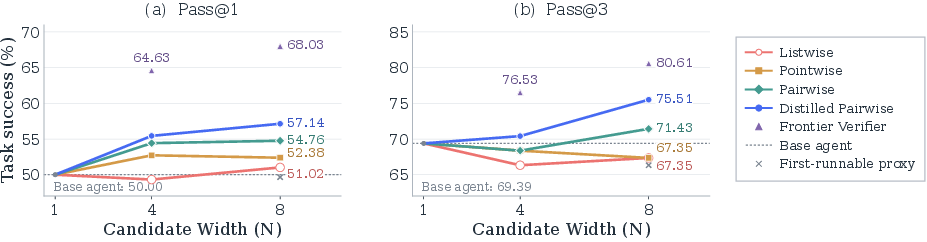
When TMAX-9B generated eight possible actions and GPT-5.6 Sol selected among them, success increased from:
- 50.00% for the normal agent
- to 68.03% with Mid-Harness
This shows that the original model often had a good action among its choices. A stronger verifier was able to find that action.
However, when TMAX-9B tried to verify its own actions without extra training, generating more choices helped much less. With eight candidates, success rose only to about 51.02% using listwise verification.
This means that the quality of the judge is extremely important.
Pairwise comparison worked best for the tested self-verifiers
When TMAX-9B compared its own possible actions, pairwise verification performed better than the other tested methods.
With eight candidates, pairwise verification achieved:
- 54.76% Pass@1
- 71.43% Pass@3
This was better than comparing all actions at once or scoring each action separately.
The likely reason is that comparing two choices is simpler than trying to rank a large group all at once.
Training the verifier improved results
The researchers trained a TMAX-9B verifier using examples from the stronger GPT-5.6 Sol verifier.
After this training, success increased from:
- 54.76% to 57.14% Pass@1
- 71.43% to 75.51% Pass@3
The important point is that the action-generating model itself was not changed. Only the verifier became better at choosing among the model's suggestions.
The method worked with other scaling methods
The researchers also compared Mid-Harness with methods that generate or improve entire task attempts.
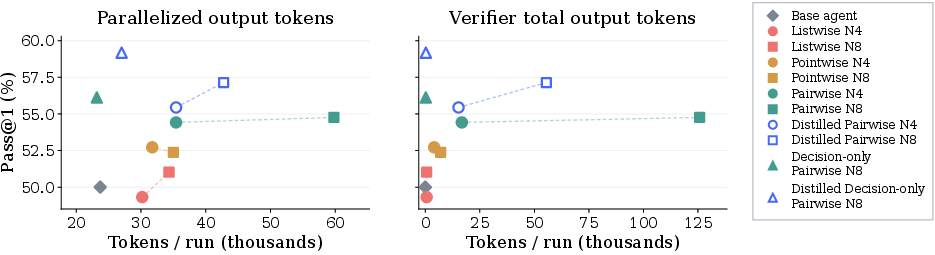
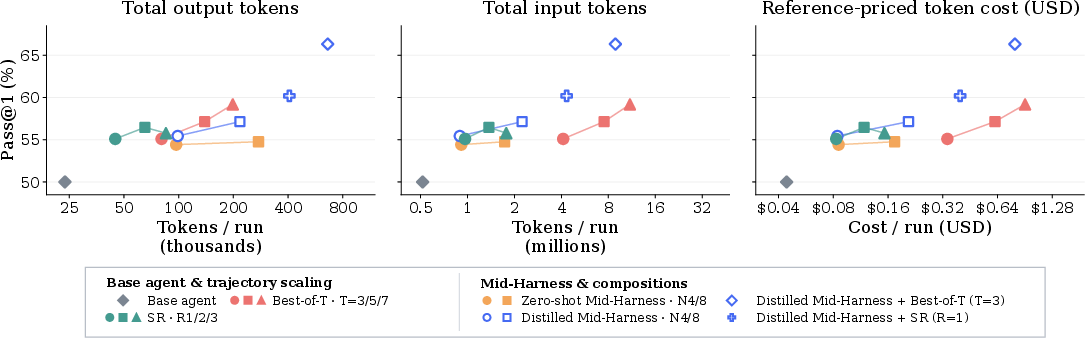
They found that combining these methods was often better than using either one alone. For example, generating several possible actions during a run and also generating several complete runs could produce higher success while using fewer estimated tokens than simply generating many complete runs.
In one comparison, the combined method achieved better results than generating seven full trajectories, while costing less according to the paper's token estimates.
The method worked across different models and tasks
Mid-Harness improved performance not only for TMAX-9B, but also for smaller and larger models, including 4B and 27B versions.
It also helped on several different benchmarks, including tasks related to:
- Terminal use
- Software engineering
- Feature development
The improvements were especially noticeable on difficult tasks where the normal agent rarely succeeded.
What problems remained?
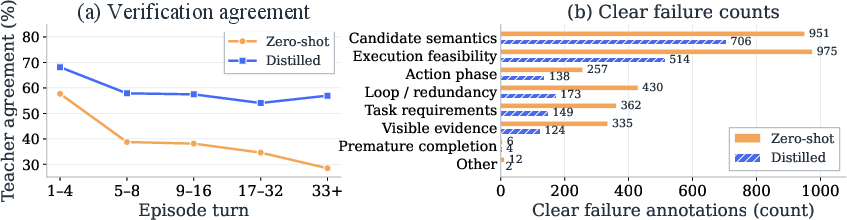
Even after training, the verifier still struggled to understand:
- What a command would actually do
- Whether a command could run successfully in the current computer environment
- Whether an action that looks reasonable would cause problems later
These are difficult challenges because a command's meaning depends on the current state of the computer. The same command may work in one situation but fail in another.
5. Why are these results important?
The paper shows that there is another useful way to give AI agents more computing power.
Researchers often improve agents by:
- Making the model larger
- Generating several complete attempts
- Asking the model to revise an entire solution
This paper suggests another option: generate several possible actions at each step and carefully choose among them.
This can be useful because terminal tasks are long. A single bad command can damage the environment and make all later decisions worse. Checking an action before running it may prevent that mistake early.
Mid-Harness may therefore make computer-using AI agents:
- More reliable
- Better at coding and software tasks
- Less likely to make harmful or unhelpful changes
- More efficient than simply repeating entire attempts
However, the method is not perfect. Verification costs extra computing power, and the verifier can still misunderstand commands. Also, the paper measures whether tasks are completed; it does not prove that the commands are safe. Real systems would still need limits on permissions, isolated environments, and human approval for sensitive actions.
Simple conclusion
The main message of the paper is:
An AI agent can do better if it considers several possible actions before acting, but only if it has a good way to choose between them.
Mid-Harness places this decision-making step between the AI model and the computer. The experiments show that this can significantly improve task success, especially when the verifier is strong or has been trained using examples from a stronger model.
In the future, this idea could help build more dependable AI assistants for programming, data analysis, and other computer tasks.
Knowledge Gaps
Knowledge gaps, limitations, and open questions
- The study lacks gold action-level labels, so it cannot directly measure whether a verifier selected the objectively best action, how often useful candidates were sampled, or whether improvements arise from correct verification versus chance.
- The paper does not establish a causal relationship between verifier agreement and actual action correctness: agreement with GPT-5.6 Sol is used as a proxy, but the frontier verifier itself may make systematic errors.
- Candidate coverage is evaluated indirectly through trajectory success; the paper does not quantify how candidate usefulness varies by action type, task difficulty, trajectory stage, or environmental state.
- The experiments do not compare Mid-Harness against verifiers with access to explicit execution simulations, shell sandboxes, static analyzers, unit tests, or lightweight environment rollouts, leaving unclear whether language-only verification is competitive with executable validation.
- The verifier cannot introduce a new action or repair a flawed candidate; it must select from the sampled set. The benefits of allowing candidate editing, synthesis, decomposition, or rejection-and-resampling remain unexplored.
- The paper evaluates a limited set of verification mechanisms—listwise, pointwise, and pairwise—and does not determine whether other aggregation strategies, tournaments, learned reward models, calibrated scoring, or adaptive comparisons would outperform pairwise verification.
- Pairwise verification is evaluated primarily with fixed candidate widths and comparison schedules; the optimal adaptive allocation of verifier calls based on candidate uncertainty, disagreement, or estimated action risk is unknown.
- The best candidate width, verification mechanism, and compute allocation may depend on the task, trajectory state, model scale, and verifier capability, but the paper does not develop or evaluate an adaptive policy for choosing these parameters online.
- The cost analysis relies on estimated token counts, idealized parallelized output tokens, and reference prices. It does not measure end-to-end wall-clock latency, GPU utilization, memory overhead, queueing effects, or actual deployment cost.
- The apparent cost advantage of Mid-Harness may change when verifier calls cannot be fully parallelized or when environment execution, tool latency, and model serving overhead dominate; these realistic systems conditions are not evaluated.
- The reported experiments use only three runs per task, limiting the precision of Pass@1 and Pass@3 estimates, especially on small subsets such as FeatureBench-Mini and SWE-bench-Verified Mini.
- Several transfer evaluations use small or restricted benchmark subsets, so the robustness of the gains across the full benchmark distributions remains uncertain.
- The paper does not provide a systematic analysis of statistical significance, confidence intervals, or per-task paired improvements for every major comparison, making it difficult to distinguish robust gains from task-sample variation.
- The experiments focus mainly on TMAX models and a small number of other models; broader scaling behavior across different training objectives, model families, context lengths, tool-use formats, and sampling temperatures is unresolved.
- The effect of candidate diversity is not isolated from candidate quantity. The paper does not test whether alternative sampling methods—such as temperature schedules, nucleus settings, prompt perturbations, diverse decoding, or structured proposal generation—produce more useful action sets at the same width.
- Distillation uses pairwise responses from GPT-5.6 Sol and a relatively narrow source distribution. Its performance under out-of-distribution tasks, unseen command patterns, different operating systems, and novel tool environments is not established.
- The paper does not investigate whether distilling the verifier introduces teacher biases, undesirable heuristics, preference over safe-looking but ineffective commands, or vulnerabilities to adversarially phrased candidates.
- The residual verifier errors are categorized by another LLM, GPT-5.6 Terra, rather than by executable ground truth or independent human experts. The reliability and reproducibility of the error taxonomy and its 67.4% semantics/feasibility estimate are therefore uncertain.
- The analysis of later-trajectory verification difficulty is descriptive; it does not identify whether errors arise primarily from longer histories, accumulated state uncertainty, context dilution, command complexity, or irreversible environmental changes.
- The study does not evaluate explicit methods for representing or updating environment state, such as structured state summaries, dependency graphs, filesystem snapshots, or learned world models, despite identifying state-dependent command effects as a major bottleneck.
- The safety analysis is limited to a general warning. The method is not tested for unsafe, destructive, privacy-sensitive, privilege-escalating, or adversarial commands, and improved task success is not shown to correlate with safer behavior.
- The paper does not measure the risk that sampling and verification increase exposure to dangerous candidate commands, even when those candidates are ultimately rejected.
- The method’s behavior under partial observability, nondeterministic environments, flaky tests, network failures, timeouts, concurrent processes, or non-repeatable side effects is not evaluated.
- The assumption that candidates generated from the same history can be fairly compared may fail when candidates have different resource requirements, execution durations, side effects, or degrees of reversibility; these dimensions are not modeled in the verifier objective.
- The study does not examine whether action verification improves or harms recovery after an earlier mistake, particularly when all sampled candidates inherit a corrupted environment state.
- The composition experiments cover only limited settings—primarily Best-of- and one or a few Sequential Refine configurations—and do not establish the optimal interaction among action scaling, trajectory scaling, refinement depth, branching search, and environment reuse.
- The comparison with trajectory scaling does not fully normalize all forms of compute, including input-token processing, environment execution cost, verifier training cost, memory usage, and infrastructure cost.
- The paper leaves unresolved whether the observed gains come from action-level selection itself or from giving the verifier additional opportunities to reread and analyze the same history, which would require controlled compute-matched baselines.
- The evaluation does not compare Mid-Harness with a baseline that samples multiple actions but selects using random choice, majority behavior, action-frequency heuristics, or a generator confidence score, limiting attribution of gains specifically to semantic verification.
- The generator and verifier are often the same model, but the study does not characterize how generator–verifier correlation affects selection quality, nor what degree of model diversity is optimal.
- The paper does not test whether verifier ensembles, cross-model disagreement, or specialized verifiers for command semantics, feasibility, safety, or task progress can close the remaining gap more effectively than a single general-purpose verifier.
- The framework assumes that the verifier can process the full task history and candidate set within context limits; scaling behavior under very long trajectories, large outputs, or memory-constrained serving remains unresolved.
- The paper does not investigate how verification affects agent behavior over time, such as changes in exploration, conservatism, command diversity, trajectory length, or tendency to repeat actions.
- The experiments do not determine whether Mid-Harness generalizes to interactive applications beyond terminal environments, such as browsers, robotics, APIs, graphical interfaces, or multi-agent tool systems.
- The method’s effectiveness when environment execution is expensive or irreversible is unclear, because the paper primarily evaluates benchmark environments and does not study real-world deployment constraints or human approval workflows.
- The reproducibility of the strongest results depends on proprietary or insufficiently characterized components, including GPT-5.6 Sol/Terra and associated prompts or behaviors; independent replication with open frontier verifiers remains an open question.
- The paper does not provide a theoretical model predicting when additional candidate sampling will be useful as a function of candidate coverage, verifier accuracy, action dependency, horizon length, and error recovery, leaving the empirical findings without a general decision rule.
Practical Applications
Immediate Applications
- More reliable software-engineering agents
- Sector: Software development, DevOps, IT operations.
- Add a Mid-Harness-style wrapper around coding agents so that they generate several candidate actions—such as code edits, shell commands, package installations, or test commands—and verify them before execution.
- Pairwise verification is a practical default when candidates have different purposes, because the paper found it more effective than listwise or pointwise verification under self-verification.
- Potential tools/workflows: IDE coding assistants, automated pull-request agents, CI/CD repair bots, repository migration tools, and infrastructure-as-code agents.
- Assumptions/dependencies: The verifier must understand the current repository state and command semantics; execution must occur in a sandbox; additional model calls increase latency and inference cost. Verification should not replace tests, code review, permission controls, or rollback mechanisms.
- Safer terminal and shell-command automation
- Sector: System administration, cloud operations, cybersecurity defense.
- Before executing commands such as file deletions, dependency changes, database migrations, or configuration updates, sample alternatives and select the candidate most likely to advance the task without damaging the environment.
- A decision-only verifier could be used where latency and cost are more important than explanatory reasoning. The paper reports lower estimated token costs for decision-only verification while retaining or improving performance in some model settings.
- Potential products: “dry-run” command selectors, shell copilots with pre-execution checks, automated incident-response assistants, and sandboxed maintenance agents.
- Assumptions/dependencies: The system needs accurate environment state, command metadata, and preferably static checks or dry-run support. High-impact actions should require human approval and use least-privilege credentials.
- Improved autonomous data-science workflows
- Sector: Data science, analytics, research computing.
- Use candidate verification before actions such as installing libraries, modifying notebooks, selecting data-processing commands, or launching expensive experiments.
- The method is particularly relevant when an early incorrect action can corrupt a workspace or make later steps fail.
- Potential workflow: Generate several analysis actions, compare them against the task and current notebook or terminal state, execute only one, then update the history with the resulting observation.
- Assumptions/dependencies: The verifier must reason about package compatibility, file formats, runtime constraints, and data provenance. Reproducible environments and checkpointing are needed for recovery.
- Drop-in reliability layer for existing agent frameworks
- Sector: AI infrastructure and agent platforms.
- Implement Mid-Harness at the model-call wrapper rather than modifying model weights or the execution harness. This allows existing agents to gain action-level scaling without redesigning their serving architecture.
- Potential tools: Middleware libraries, API gateways, inference-time plugins, or configurable “candidate width” and “verification policy” modules.
- Assumptions/dependencies: The framework must expose candidate generation and provide the verifier with the task, interaction history, and candidate actions. The approach is most useful when multiple sampled actions contain meaningful alternatives.
- Cost-aware agent serving
- Sector: Cloud AI services and enterprise automation.
- Dynamically select the amount and type of verification based on task risk, uncertainty, or estimated cost. For routine actions, use one candidate or decision-only verification; for irreversible or ambiguous actions, use more candidates and pairwise or stronger-model verification.
- The paper indicates that combining action-level scaling with trajectory-level methods can achieve higher success at lower estimated token cost than simply generating more complete trajectories.
- Assumptions/dependencies: Requires calibrated risk estimates, token and latency budgets, and reliable routing between small local verifiers and stronger external models. Reported prices and parallelization assumptions may not hold in all deployments.
- Evaluation and monitoring of terminal agents
- Sector: AI quality assurance, benchmarking, model governance.
- Extend agent evaluations beyond final task success by measuring:
- candidate coverage,
- verifier agreement,
- command-semantic errors,
- execution-feasibility errors,
- success as candidate width increases,
- latency and verifier-token cost.
- The paper’s offline comparison protocol can be adapted to identify whether failures arise from poor generation or poor candidate selection.
- Assumptions/dependencies: There is generally no gold label for the best intermediate action, so agreement with a stronger verifier is only a proxy and should not be treated as ground-truth correctness.
- Research and teaching infrastructure for agentic systems
- Sector: Academia and education.
- Use the method as a controlled experimental framework for studying test-time compute: hold the generator and harness fixed while varying candidate width, verifier type, model size, and distillation.
- It can support coursework or laboratory studies on search, reward modeling, process verification, and agent reliability.
- Assumptions/dependencies: Requires isolated benchmark environments, reproducible harnesses, sufficient compute, and careful separation between offline verifier agreement and actual task success.
- Policy and safety controls for autonomous command execution
- Sector: AI governance, compliance, cybersecurity.
- Incorporate pre-execution candidate verification into organizational control policies for agents operating on production systems. Verification can serve as one layer in a defense-in-depth workflow:
- 1. generate candidate actions,
- 2. verify task relevance and likely effects,
- 3. apply policy and permission checks,
- 4. request human approval for sensitive actions,
- 5. execute in an isolated or reversible environment.
- Assumptions/dependencies: The paper explicitly does not establish that verification guarantees safety or security. Formal policy enforcement, access controls, sandboxing, audit logs, and human oversight remain necessary.
Long-Term Applications
- High-reliability autonomous software maintenance
- Sector: Software engineering and enterprise IT.
- Develop agents that perform multi-step repository upgrades, vulnerability remediation, test repair, dependency migration, and deployment preparation while choosing among alternative actions at every state.
- A mature system could combine:
- candidate generation,
- pairwise action verification,
- static analysis,
- test execution,
- rollback,
- trajectory-level refinement.
- Assumptions/dependencies: Requires stronger understanding of command effects and execution feasibility—the two residual error categories that accounted for most distilled-verifier failures in the paper. Large-scale deployment also requires reliable state snapshots and rollback.
- Autonomous scientific-computing assistants
- Sector: Scientific discovery, engineering simulation, high-performance computing.
- Apply verified action selection to workflows involving simulation setup, environment configuration, dataset preparation, experiment scheduling, and result analysis.
- Agents could compare alternative computational plans before launching costly or irreversible jobs.
- Potential products: Laboratory automation controllers, reproducible experiment managers, simulation orchestration agents, and scientific workflow copilots.
- Assumptions/dependencies: The verifier must model domain-specific side effects, resource constraints, numerical validity, and experiment provenance. Integration with schedulers and domain-specific validators is essential.
- Robotic and embodied-agent action selection
- Sector: Robotics and industrial automation.
- Generalize Mid-Harness from terminal commands to candidate motor plans, manipulation actions, navigation steps, or tool-use operations. Before acting, a verifier could compare alternatives against the robot’s current state and task objective.
- Potential applications: Warehouse robots, laboratory robots, inspection systems, and household assistants.
- Assumptions/dependencies: This extension requires a sufficiently accurate simulator or world model, real-time verification, uncertainty-aware planning, and strong physical safety guarantees. Terminal-agent results do not directly establish performance in dynamic physical environments.
- Reliable cloud, energy, and infrastructure control
- Sector: Cloud operations, energy systems, telecommunications, industrial control.
- Use action-level verification to select among scaling, routing, scheduling, maintenance, or configuration actions before they affect live infrastructure.
- Combining verification with digital twins or predictive simulators could allow candidate actions to be evaluated for likely resource, reliability, and safety consequences.
- Assumptions/dependencies: Requires high-fidelity state observation, simulation or formal constraints, strict latency bounds, and fallback controllers. The cost of an incorrect action may be too high for language-model verification alone.
- Verifier reinforcement learning and specialized process-reward models
- Sector: Machine learning research.
- Train verifiers directly on execution outcomes, recovery success, command semantics, and environment-specific feasibility rather than relying primarily on frontier-model distillation.
- Future systems could learn:
- environment-specific action value,
- uncertainty estimates,
- when to abstain,
- when to request a stronger verifier,
- when to generate a new candidate set.
- Assumptions/dependencies: Requires high-quality interaction data, safe exploration, reliable outcome labels, and methods that avoid optimizing superficial agreement with a teacher. The paper identifies reinforcement learning for verifiers as a promising direction.
- Adaptive search over actions and trajectories
- Sector: General agent planning and decision systems.
- Build hierarchical search systems that allocate compute both within a trajectory and across complete trajectories. Action-level verification can prune poor branches before they alter the environment, while trajectory-level methods compare broader plans.
- Potential architecture: Candidate sampling → pairwise or tournament verification → safe execution → observation update → selective trajectory branching or refinement.
- Assumptions/dependencies: Parallel trajectory methods require multiple environment instances or reliable state serialization. Search quality depends on the verifier being able to assess actions before execution, a capability that remains imperfect.
- Safety-certified autonomous agents
- Sector: Regulated automation, healthcare IT, finance, and public-sector systems.
- Combine Mid-Harness-like candidate comparison with formal policy checkers, typed action schemas, causal impact models, and human authorization. The long-term goal would be agents that can justify not only which action is best, but also why alternatives are unsafe or infeasible.
- Potential applications: Clinical workflow automation, financial operations, public-service case management, and regulated infrastructure administration.
- Assumptions/dependencies: These settings require domain validation, explainability, auditability, privacy protection, and legally meaningful accountability. Empirical improvements in benchmark Pass@1 are insufficient evidence for unsupervised deployment in high-stakes domains.
- Personal productivity and household assistants
- Sector: Daily life and consumer software.
- Use candidate verification for multi-step tasks such as organizing files, configuring applications, planning errands, managing calendars, or automating smart-home devices.
- For example, an assistant could generate several ways to clean a folder or schedule appointments, compare their likely consequences, and ask for confirmation before irreversible actions.
- Assumptions/dependencies: Requires access to accurate personal context, transparent previews, user-configurable permissions, privacy-preserving inference, and an easy mechanism for undoing actions. Verification should be treated as assistance rather than a guarantee of correctness.
Glossary
- Action scaling: Allocating additional computation to generate and verify multiple candidate actions within an agent trajectory. “These findings identify action scaling as a promising target for test-time compute scaling in terminal agents.”
- Agentic tasks: Tasks in which an AI system must take actions in an environment to achieve an objective. “Although most works focus on reasoning tasks, our work mainly addresses agentic tasks and action scaling where each action affects the environment.”
- Candidate coverage: The extent to which sampled actions contain useful alternatives that could lead to successful task completion. “Candidate coverage concerns whether sampled actions include useful alternatives.”
- Candidate width: The number of alternative actions sampled for consideration at a single step. “We examine when sampling and verification improve trajectory success, their costs, and the effect of verifier distillation, with a fixed TMAX-9B generator.”
- Command semantics: The meaning and expected effect of a command in a particular execution environment. “Remaining disagreements center on command semantics and execution feasibility.”
- Context management: Techniques for selecting, organizing, or maintaining information supplied to a model during interaction. “Prior work develops agent interfaces, context management, and automated harness optimization.”
- Decision-only verifier: A verifier that outputs only a decision, such as an A/B preference, without generating an explanatory reasoning trace. “At , both TMAX-9B decision-only verifiers improve Pass@1 over their reasoning counterparts.”
- Discriminative reward model: A model that directly predicts a score or preference for an input rather than generating an explanatory evaluation. “Following direct prediction in discriminative reward models, we evaluate pairwise verifiers that emit only an A/B preference.”
- Distillation: Training a smaller or different model to reproduce the outputs or behavior of a stronger teacher model. “We test whether supervised distillation can transfer part of this capability without serving the frontier model at inference time.”
- Environment instance: A separate, usually isolated execution environment in which an agent performs a task. “Comparing candidates against the unresolved task requirement may therefore improve both the next action and the states encountered later, while requiring only one environment instance.”
- Execution feasibility: Whether a proposed action can successfully run and produce the intended effect in the current environment. “Candidate semantics and execution feasibility account for 67.4\% of these distilled-verifier cases.”
- Frontier verifier: A highly capable verifier model used as a reference for assessing candidate actions or training another verifier. “The frontier verifier in \autoref{sec:coverage} uses GPT-5.6 Sol.”
- Generative verifier: A verifier that generates reasoning, scores, or decisions as text rather than producing only a fixed classification. “In the default mechanisms, the verifier generates reasoning followed by scores or a choice, following generative verifiers.”
- Harness: The software system that manages an agent’s interaction loop, including executing actions and returning observations. “The pseudocode below shows how Mid-Harness adds candidate sampling and verification to the model-call wrapper, returning one action to the unchanged harness without modifying model weights or serving architecture.”
- Interaction history: The accumulated sequence of task information, agent actions, and environmental observations used to condition subsequent decisions. “Let be the action-generating model and its interaction history.”
- Listwise verification: Evaluating an entire set of candidates together and selecting one from the list. “The verifier receives the entire candidate set in a single prompt and returns a choice.”
- Long-horizon sequence: A sequence of many dependent actions whose later outcomes are affected by earlier decisions. “The same model and harness may succeed on one run and fail on another because each run commits to a long-horizon sequence of stochastically generated actions.”
- Low-rank adaptation (LoRA): A parameter-efficient fine-tuning method that learns low-rank updates to a model’s weights. “Using 117k frontier-verifier pairwise responses collected from 732 trajectories across 244 difficult TMAX-15k tasks, we use LoRA to train a verifier.”
- Model-harness boundary: The interface between a model that generates actions and the software system that executes them. “We introduce Mid-Harness, a method for studying action-level compute scaling at the model-harness boundary while keeping the action generator and execution harness unchanged.”
- Offline benchmark: An evaluation performed on previously collected data rather than through live interaction with an environment. “We use this offline benchmark to compare pairwise verification outputs of different models under the same state.”
- Parallelized output tokens (POT): The number of generated tokens used as an approximation of decoding latency when outputs can be generated concurrently. “Parallelized output tokens (POT) approximate decoding latency of both generator and verifier under idealized parallel execution.”
- Pairwise agreement: The proportion of candidate comparisons for which two verifiers produce the same preference. “Pairwise agreement is the fraction of comparisons with matching verifier and teacher A/B/TIE preferences.”
- Pairwise verification: Comparing candidates two at a time and aggregating the resulting preferences to select an action. “The verifier receives two candidates under the same history and generates a preference with comparative scores.”
- Pass@1: The fraction of tasks solved by the first or returned attempt under the specified evaluation procedure. “On TerminalBench-Lite, a GPT-5.6 Sol verifier raises Pass@1 from 50.00\% for the base agent to 68.03\% with 8 sampled actions.”
- Pass@3: The fraction of tasks solved by at least one of three evaluated runs. “Pass@3 measures the fraction of tasks solved by at least one of the three runs.”
- Pointwise verification: Scoring each candidate independently and selecting the candidate with the highest score. “The verifier assigns each candidate a scalar score and returns .”
- Process reward model: A model that evaluates intermediate steps in a reasoning or action sequence rather than only the final outcome. “This resembles the step-scoring of process reward models.”
- Probabilistic pivot tournament: A tournament-based selection procedure that uses a probabilistic pivot to choose among completed trajectories. “At the trajectory level, Best-of- Trajectories (Best-of-) uses a probabilistic pivot tournament to choose one output from completed trajectories.”
- Reinforcement learning: A learning paradigm in which a model improves its behavior through feedback based on the consequences of its actions. “TMAX-9B is trained from Qwen3.5-9B through reinforcement learning on synthetic terminal tasks using Vanillux2.”
- Sequential refinement: Improving a result through multiple rounds in which a new run is guided by a summary or feedback from a previous run. “The sequential trajectory-level method Sequential Refine (SR) performs refinement rounds, each summarizing the previous run to guide a fresh run.”
- State serialization: Encoding an environment’s state so that it can be saved, transferred, or restored. “Best-of- and SR require fresh environment runs, which can be difficult outside benchmarks without reliable state serialization.”
- Supervised distillation: Distillation in which a student model is trained directly on labeled outputs or preferences produced by a teacher model. “We test whether supervised distillation can transfer part of this capability without serving the frontier model at inference time.”
- Test-time compute scaling: Improving performance by allocating additional computation during inference rather than increasing model parameters or retraining the base model. “Prior work improves reasoning and agent performance by allocating additional test-time compute to sampling, verification, and refinement.”
- Trajectory: The sequence of actions and observations produced during one complete agent execution. “A run is one execution on a task, and its trajectory is the resulting sequence of actions and observations.”
- Trajectory-level scaling: Allocating additional computation across complete agent runs or trajectories. “We organize additional compute at two levels: before action execution and across complete runs.”
- Trajectory success: Successful completion of a task measured over an agent’s full sequence of interactions. “We use action reliability to mean consistently generating actions that support task completion, and evaluate its trajectory-level consequences through task success.”
- Verifier distillation: Training a verifier to imitate the decisions or reasoning of a stronger verifier. “Verifier distillation improves trajectory success without changing the generator.”
- Zero-shot verification: Verification performed by a model without task-specific fine-tuning for the verification role. “Zero-shot Mid-Harness uses the same generator model as the verifier without any fine-tuning.”