SoL-Refiner: Speed-of-Light One-Step Refinement for High-Resolution Video
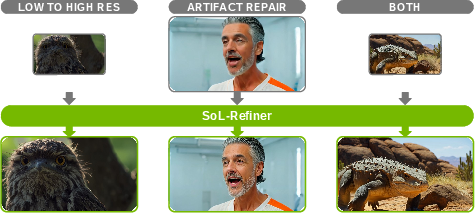
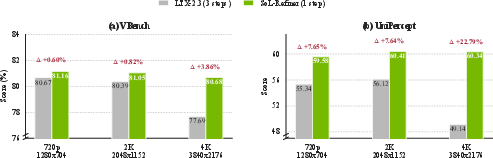
Abstract: High-resolution video generation is expensive, as its cost grows rapidly with the number of spatiotemporal tokens. A practical alternative first generates a lower-resolution video and then applies a refiner, but conventional multi-step refinement introduces a second sampling bottleneck. We present SoL-Refiner, a one-step video refiner that transforms low-resolution model outputs into 4K videos with a single denoising step. Our three-stage recipe combines high-resolution continual training, reinforcement learning (RL) post-training, and a final one-step distillation. We introduce Refiner-Bench, a video refinement benchmark constructed from the outputs of different video generators, and use a shared-input protocol to compare refiners at approximately 2K output resolution. At 2K, the one-step SoL-Refiner outperforms all external refiners on the VBench and UniPercept averages, while at it improves both metrics over the three-step LTX-2.3 Refiner. With the complete acceleration stack, SoL-Refiner achieves an speedup in refinement latency over the same baseline in our 2K latency setting.

Paper Prompts
Sign up for free to create and run prompts on this paper.
Explain it Like I'm 14
1. What is the paper about?
This paper introduces SoL-Refiner, an AI system that makes computer-generated videos look sharper, more detailed, and higher-resolution.
Creating high-quality video directly is expensive because the AI must process many pixels across many frames. The authors use a two-step idea:
- A smaller or faster AI first creates a low-resolution video.
- SoL-Refiner quickly improves that video and enlarges it.
The special feature of SoL-Refiner is that it needs only one denoising step. In this context, denoising means gradually turning a rough or noisy computer-generated result into a clean image or video. Most similar systems need several such steps.
2. What questions did the researchers ask?
The researchers mainly wanted to find out:
- Can a video refiner improve quality using only one denoising step?
- Can it work with videos made by different video generators, rather than only one specific system?
- Can it increase resolution while keeping the original movement, objects, and scene layout?
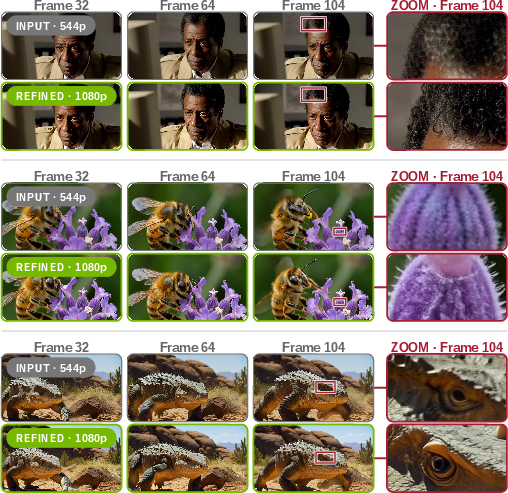
- Can it fix common AI-video problems, such as strange faces, broken hands, distorted objects, or changing textures?
- Can it make high-resolution video generation much faster without lowering visual quality?
The goal was not simply to enlarge a video like a normal image-stretching tool. The system also tries to repair mistakes and add believable details.
3. How did the researchers build and test it?
A two-stage video process
The system works like a small production team:
- The base generator plans the main scene, movement, and composition at low resolution.
- SoL-Refiner then acts like a skilled editor. It adds fine details, improves sharpness, and corrects visual mistakes at high resolution.
This is faster because the expensive processing happens mostly on the smaller video.
Three stages of training
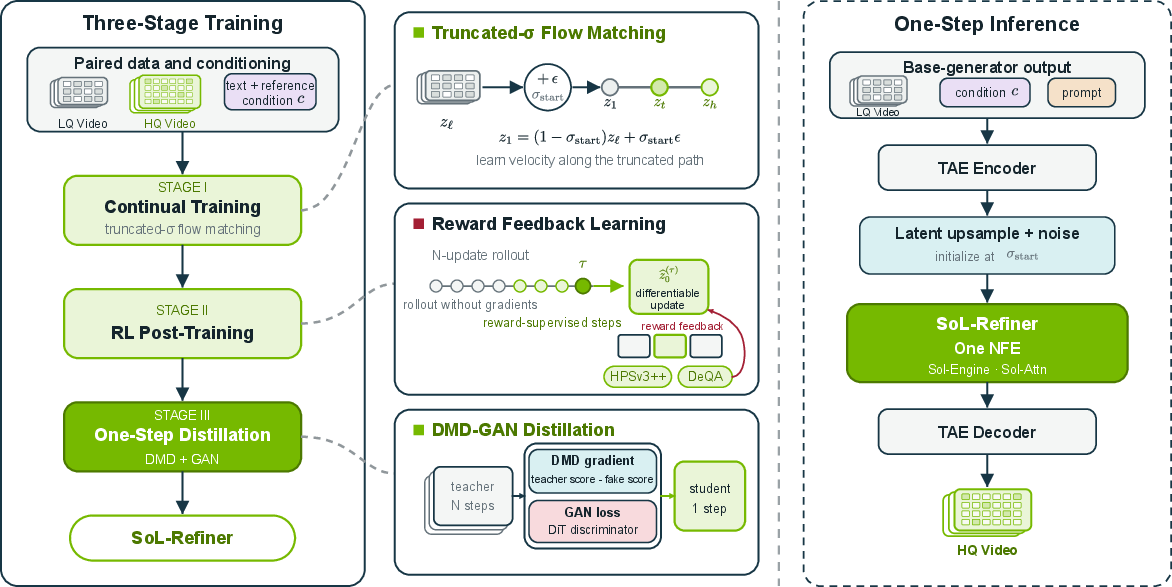
The researchers trained SoL-Refiner in three main stages.
Stage 1: Learning to improve videos
The system was shown pairs of videos:
- a lower-quality version, made by shrinking and enlarging a real video;
- a higher-quality version that served as the target.
It learned how to transform the first video into the second while preserving the same actions and scene.
The researchers used a method called flow matching. A simple way to understand this is to imagine giving the AI a map showing a path from a messy video to a clean one. The AI learns which direction to move at each point along that path.
Stage 2: Learning what looks good to people
Next, the researchers used reward models. These are AI judges trained to estimate whether an image looks attractive, sharp, realistic, and suitable for its text description.
The system received better “scores” when its results had qualities such as:
- clearer faces and objects;
- better image quality;
- more realistic details;
- better agreement with the requested text.
The researchers checked several frames from different parts of each video so that the quality would remain consistent over time.
Stage 3: Compressing many steps into one
The best version from the earlier stages still needed several processing steps. The researchers therefore used distillation.
Distillation is similar to having an expert teach a student. A slower, powerful model—the “teacher”—shows a faster model—the “student”—how to produce similar results. After training, the student can do the job in one step instead of many.
The authors also used a system that compares generated results with high-quality examples, much like a careful referee checking whether a student’s work looks realistic.
Faster computer implementation
The researchers added two engineering improvements:
- A tiny autoencoder, which quickly converts videos between ordinary pixels and the internal format used by the AI.
- Sol-Engine, which speeds up the AI’s calculations by combining operations and avoiding unnecessary work.
How was it tested?
The authors created Refiner-Bench, a test set containing 150 videos from three different video generators. The videos included people, animals, landscapes, sports, buildings, vehicles, and other subjects.
They compared SoL-Refiner with several other systems, including:
- LingBot Stage-2 Refiner;
- LTX-2.3 Refiner;
- LTX-2.0 Refiner;
- SEEDVR2.
All systems received the same starting videos so that the comparison would be fair.
The researchers used measures such as VBench and UniPercept. These are collections of automatic tests that judge things like:
- whether people and objects remain consistent;
- whether the background stays stable;
- whether motion looks smooth;
- whether the picture is attractive and sharp;
- whether the final result looks high quality overall.
4. What did the researchers find?
Strong quality with only one step
At about 2K resolution, the one-step version of SoL-Refiner achieved:
- a VBench average score of 0.81048;
- a UniPercept average score of 60.4150.
It performed better on average than the other external refiners tested in the paper, including another one-step system.
The longer, 23-step version produced even higher quality, but the one-step version was much faster while still performing strongly.
Better results at several resolutions
Compared with the three-step LTX-2.3 Refiner, SoL-Refiner performed better at 720p, 2K, and 4K.
At 4K resolution, it improved:
- the VBench average by 3.86%;
- the UniPercept average by 22.79%.
This suggests that the method is useful not only for ordinary high-definition videos, but also for very large video outputs.
Much faster refinement
In the main 2K timing test:
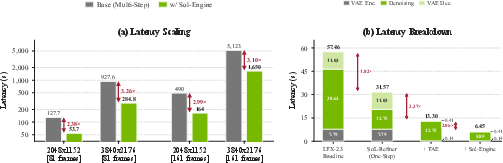
- the three-step LTX-2.3 Refiner took 57.461 seconds;
- the optimized one-step SoL-Refiner took 6.447 seconds.
That is an 8.91-times speedup.
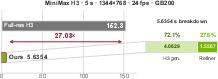
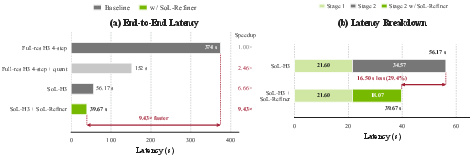
When combined with a fast low-resolution video generator, the full process could be much faster than generating the entire high-resolution video directly. In one example, the complete pipeline was reported to be about 27 times faster than direct full-resolution generation.
Improvements across different generators
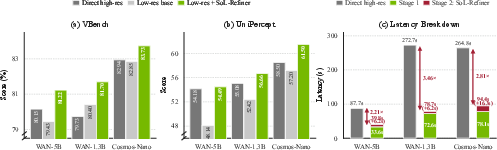
SoL-Refiner was also tested after several different base generators. The complete low-resolution-plus-refinement pipeline reduced processing time by approximately:
- 54.7% for WAN-5B;
- 71.1% for WAN-1.3B;
- 64.4% for Cosmos-Nano.
In these tests, the refined videos often scored better than videos generated directly at high resolution.
Each training stage helped
The experiments showed that the three training stages played different roles:
- Continual training taught the system the basic job of refinement.
- Reward-based training improved visual quality and human preference scores.
- Distillation made the system fast enough to work in one step.
After distillation, the one-step model lost a small amount of quality compared with the longer model, but it remained better than the basic continually trained version.
5. Why is this research important?
High-resolution video generation currently requires a lot of computing power and time. This can make it difficult to use such systems on everyday computers, phones, or smaller data centers.
SoL-Refiner suggests a more efficient solution: create the main video cheaply at low resolution, then add important details in one fast high-resolution pass.
If the results hold up in wider testing, this could make AI video tools:
- faster to use;
- less expensive to operate;
- more practical for real-time or interactive applications;
- easier to run on smaller hardware;
- better at producing high-resolution videos without long waits.
The research also shows that one fast AI system can improve videos from several different generators. However, the tests rely heavily on automatic scoring systems, and the paper does not prove that every viewer will prefer the results in every situation. Future research could include more human evaluations, more types of videos, and tests on different hardware.
Overall, the paper’s main message is simple: SoL-Refiner can turn a rough, low-resolution AI video into a sharper high-resolution video in one step, making the process much faster while keeping strong visual quality.
Practical Applications
Immediate Applications
The paper’s results support deployment of SoL-Refiner as a high-resolution post-processing stage for existing video-generation systems. The most immediate uses are those that can adopt the released model and inference stack without retraining the upstream generator.
- Faster high-resolution text-to-video generation — generative-media platforms and software
- Generate video at a lower spatial resolution with an existing base model, then apply SoL-Refiner once to produce 2K, 4K, or other higher-resolution outputs.
- This can reduce the amount of expensive target-resolution denoising while preserving the base model’s composition and motion.
- The reported results include:
- An 8.91× reduction in refinement latency relative to a three-step LTX-2.3 refiner in the 2K setting.
- A 27× end-to-end speedup in the illustrated MiniMax H3 pipeline when low-resolution, four-step generation is followed by one-step refinement.
- Latency reductions of 54.7%, 71.1%, and 64.4% for the evaluated WAN-5B, WAN-1.3B, and Cosmos-Nano pipelines.
- A practical product could expose a “fast draft,” “standard,” and “high-resolution” generation mode, with SoL-Refiner enabled for the latter two.
- Video-generation API cost and throughput optimization — cloud infrastructure
- Cloud providers can place SoL-Refiner behind an API endpoint that accepts low-resolution generated videos and returns refined outputs.
- The workflow can reduce GPU occupancy per generated video, increase requests served per GPU, and lower latency for interactive generation.
- Kernel fusion, sparse attention through Sol-Engine, tiny-autoencoder encoding/decoding, and one-step inference are especially relevant to production serving.
- Dependencies: the reported timings depend on specific NVIDIA hardware, implementation optimizations, video length, output resolution, memory bandwidth, and batch size. Production operators would need to benchmark cost per video on their own hardware and service-level objectives.
- Real-time or near-real-time creative preview — film, advertising, games, and social media
- A creator can generate a low-resolution preview quickly, apply one-step refinement when a clip is selected, and avoid running the expensive full-resolution generator for every iteration.
- Potential workflows include:
- Storyboard and previsualization generation.
- Rapid advertising concept development.
- Game cinematic prototyping.
- Short-form social-media video generation.
- Interactive camera, style, or prompt exploration.
- The method is particularly useful when users repeatedly revise prompts or compositions and only need high-resolution output for the final candidate.
- Upscaling and artifact correction of AI-generated video — post-production software
- SoL-Refiner can be integrated as a plug-in or command-line stage for repairing generated-video defects such as distorted local structures, weak facial detail, inconsistent textures, and low-resolution appearance.
- Refinement does not necessarily require spatial enlargement; the paper explicitly presents artifact mitigation at the existing resolution as a separate use case.
- Possible tools include:
- A video-editor “Enhance generated clip” operation.
- A batch-processing workflow for video libraries.
- A quality-control service that automatically refines clips before publication.
- Assumptions: the input distribution should be reasonably similar to the supported generators and training data. Refinement is not guaranteed to recover factual detail that was never present in the source video and may introduce plausible but incorrect details.
- Hardware-efficient local video generation — workstations and edge devices
- The two-stage architecture can allow smaller local models to generate low-resolution content while a compact, optimized refiner produces higher-resolution output.
- The DGX Spark experiment suggests feasibility on comparatively compact NVIDIA hardware: the SoL-H3 configuration with SoL-Refiner reduced reported end-to-end latency by 29.4% relative to the corresponding SoL-H3 setup and was reported as 9.43× faster than direct four-step 768p generation.
- Potential applications include:
- Local creative tools for artists and designers.
- On-premises video generation for organizations with privacy requirements.
- Portable or studio-side generation systems.
- Dependencies: the demonstrated deployment is hardware- and software-specific. Consumer-device deployment would require memory reduction, quantization validation, and testing of thermal and power constraints.
- Cross-generator refinement service — software platforms integrating multiple video models
- Because SoL-Refiner is evaluated on outputs from WAN, SANA-Video, LTX-2 Stage 1, and other generator families, it can serve as a common enhancement layer above several upstream models.
- A platform could route outputs from different generators through a shared refinement service rather than maintaining a separate high-resolution refiner for every base model.
- This may simplify model orchestration and provide consistent output-quality controls across vendors.
- Assumptions: the evaluated cross-generator transfer does not establish universal compatibility. Each new base generator should be tested for content preservation, temporal consistency, motion artifacts, and prompt adherence.
- Automated video-quality control and benchmarking — academia and industrial evaluation
- Refiner-Bench provides a practical evaluation template for comparing refiners using shared inputs from multiple generators.
- Organizations can adopt a similar workflow to:
- Measure improvement independently of upstream generator quality.
- Compare one-step and multi-step refiners under equal input conditions.
- Track subject consistency, background consistency, motion smoothness, aesthetic quality, imaging quality, and perceptual quality.
- Evaluate behavior across motion levels, camera movements, content groups, and resolutions.
- The benchmark design is useful for regression testing when changing model weights, inference kernels, or quantization settings.
- Limitations: Refiner-Bench contains 150 videos and relies heavily on automated metrics. Human review remains necessary for hallucinated details, identity changes, temporal flicker, and domain-specific quality.
- Educational and research infrastructure for diffusion acceleration — academia
- The three-stage training recipe can be used as a reference implementation for research on:
- High-resolution continual training.
- Reward-based post-training.
- Distribution-matching distillation.
- Adversarial one-step generation.
- Efficient latent video inference.
- Researchers can reproduce ablations by separately studying continual training, frame-based reward learning, DMD distillation, adversarial supervision, tiny autoencoders, and sparse-attention inference.
- This can support graduate coursework, benchmark development, and new research on video restoration and generative-model compression.
- Dependencies: reproducing the results requires paired low-/high-quality videos, reward models, substantial compute, and compatible implementation details that may not be fully specified in the paper.
- Personal video enhancement for generated or low-quality clips — daily life
- Individuals could use a desktop or cloud application to improve AI-generated clips for presentations, personal projects, online posts, or visual communication.
- The most suitable use is enhancement of synthetic or heavily degraded footage where plausible visual detail is acceptable.
- Users should retain the original clip and treat the refined result as an altered version, especially when visual authenticity matters.
Long-Term Applications
The following applications are plausible extensions of the paper’s approach but require additional validation, scaling, domain adaptation, or product development before dependable deployment.
- Professional 4K/8K video production pipelines — film, television, and advertising
- A future production system could use low-resolution generation for blocking and motion, followed by one-step or few-step refinement for final-resolution assets.
- Potential outputs include high-resolution concept footage, background plates, product shots, and synthetic inserts.
- For professional use, further work is needed on:
- Frame-to-frame identity preservation.
- Long-duration temporal consistency.
- Accurate text, logos, hands, faces, and mechanical structures.
- Deterministic reproduction and editability.
- Color management and compatibility with professional codecs and compositing tools.
- The current results primarily cover short clips and benchmark metrics, so they do not yet establish broadcast- or cinema-grade reliability.
- Long-form video generation and streaming refinement — media platforms
- A streaming refiner could process generated video in chunks as it is produced, reducing time-to-first-preview and enabling adaptive quality based on bandwidth or device capability.
- This could support:
- Progressive delivery from low resolution to high resolution.
- Adaptive-quality video generation.
- Interactive virtual worlds and generated live scenes.
- On-demand enhancement of archived AI-generated media.
- Dependencies: chunk boundaries can cause temporal discontinuities. The system would need causal or overlapping-window processing, state propagation, robust handling of variable frame rates, and validation on minutes-long sequences.
- Robotics and embodied simulation — robotics, autonomy, and training data
- A low-resolution video generator plus high-resolution refiner could produce large quantities of visually detailed synthetic training data for robot manipulation, navigation, and human-robot interaction.
- Potential uses include generating scenes with detailed object surfaces, hands, tools, lighting, and environmental variation.
- The refiner might improve visual realism while keeping simulation-data generation economical.
- Critical assumption: visual plausibility is not sufficient for robotics. The refined video must preserve physically meaningful geometry, object identity, contact events, and motion. Hallucinated textures or altered object boundaries could make the data unsuitable for control or perception training.
- Healthcare and medical simulation — medical education and clinical training
- A future domain-adapted refiner could enhance synthetic surgical, anatomical, or patient-education video generated at lower resolution.
- Applications might include training simulations, procedure visualization, and privacy-preserving synthetic datasets.
- Dependencies and risks: the paper does not evaluate medical data. Clinical deployment would require medically curated training pairs, expert review, strict provenance controls, validation against anatomical truth, and safeguards against fabricated or misleading details. It should not be used to enhance diagnostic evidence without extensive clinical validation.
- Industrial inspection and digital twins — manufacturing, energy, and infrastructure
- Refinement could improve synthetic inspection videos or low-resolution digital-twin renderings for equipment, pipelines, buildings, and machinery.
- A low-resolution simulation could establish motion and scene layout, while refinement adds surface detail for visualization or operator training.
- Potential outputs include equipment walkthroughs, maintenance simulations, and synthetic inspection scenarios.
- Dependencies: safety-critical inspection requires measurements that are faithful to reality. A generative refiner that invents cracks, removes defects, or changes component geometry could be dangerous. Deployment would require sensor-grounded conditioning, uncertainty estimates, and validation against physical inspection data.
- Policy and public-sector media workflows — provenance and content governance
- Public agencies could use a fast refiner for accessibility previews, archival restoration experiments, educational visualization, or rapid production of non-sensitive explanatory media.
- The technique also motivates policy requirements for labeling refined content and preserving original inputs.
- A responsible workflow should record:
- The source video.
- The base generator and refiner versions.
- Resolution changes.
- Prompt and conditioning information.
- Whether any frames were regenerated or altered.
- Dependencies: refinement can introduce details that appear authentic but are not supported by the source. Public-sector use should therefore include provenance metadata, watermarking or content credentials, human approval, and restrictions for evidentiary or news-reporting contexts.
- Privacy-preserving video transformation — security and enterprise collaboration
- A future version could refine anonymized or low-resolution video while preserving useful scene structure, allowing organizations to share visual data without distributing full-fidelity originals.
- Possible applications include collaborative design, synthetic surveillance-data generation, and privacy-preserving dataset creation.
- Caveat: refinement may reconstruct recognizable faces, identities, locations, or sensitive attributes from weak signals. Privacy cannot be assumed merely because the input is low resolution. Formal privacy analysis, identity leakage testing, and controllable anonymization would be required.
- Energy-efficient generative video — sustainability and data-center operations
- Moving most denoising computation to a lower-resolution stage and using one target-resolution step could reduce energy per generated clip and increase useful output per GPU.
- Data centers could use the method to optimize energy-aware scheduling or offer lower-carbon generation tiers.
- Dependencies: the paper reports latency rather than a full energy or lifecycle analysis. Actual energy savings depend on GPU utilization, memory traffic, cooling overhead, model-loading costs, and whether increased throughput causes demand to rise.
- General-purpose one-step restoration and super-resolution research — computer vision
- The training recipe could be extended beyond generated-video artifacts to restoration of compressed, noisy, blurred, or low-frame-rate real videos.
- Potential extensions include:
- Degradation-aware one-step restoration.
- Variable-resolution refinement.
- Joint spatial and temporal super-resolution.
- Reference-image-guided restoration.
- User-controlled strength and fidelity settings.
- Dependencies: the current method is optimized for generated-video refinement and uses paired or synthetic training assumptions. Real-world restoration involves unknown, nonstationary degradations and requires benchmarks that separately measure fidelity, hallucination, temporal stability, and perceptual quality.
- Adaptive quality control based on uncertainty — future commercial and safety-critical tools
- A production system could estimate when one-step refinement is reliable and automatically fall back to multi-step refinement, a different model, or human review for difficult content.
- Such a controller could use scene motion, camera movement, faces, text, transparency, and artifact scores to select:
- One-step refinement for easy clips.
- Multi-step refinement for complex clips.
- Specialized refiners for faces, products, or animation.
- This would make the speed-quality trade-off more controllable than using a fixed one-step model.
- Dependencies: the paper does not provide calibrated uncertainty estimates or a failure detector. Developing reliable confidence measures and thresholds would be necessary before automated routing can be trusted.
Glossary
- Adversarial supervision: Training guidance provided by a discriminator that distinguishes authentic or high-quality outputs from generated ones. “Distillation combines the teacher's distribution supervision with implicit distribution alignment and a projected DiT discriminator”
- Autoencoder: A neural network that encodes data into a latent representation and decodes it back into its original domain. “a tiny autoencoder (TAE) replaces the full video variational autoencoder (VAE)”
- Cascaded generation: A generation strategy that applies multiple models or stages sequentially, typically moving from low to high resolution. “Cascaded generators use a low-resolution stage for content and motion, followed by high-resolution processing.”
- Causal sparse attention: An attention mechanism that restricts interactions to causally valid and selected sparse connections to reduce computation. “FlashVSR combines one-step distillation with causal sparse attention and a lightweight decoder”
- Continual training: Further training of an existing pretrained model to adapt it to a new task or data distribution. “training follows three stages: high-resolution continual training on paired videos”
- Denoising network function evaluation (NFE): One execution of a diffusion or flow-based model during the process of removing noise from a sample. “Sampling conditioned on text requires repeated denoising network function evaluations (NFEs)”
- Degradation-aware: Designed to account explicitly for the types or severity of distortions present in an input. “DeQA evaluates degradation-aware visual quality.”
- Diffusion-based restoration: Restoration of corrupted or low-quality data using a diffusion model’s learned generative prior. “Diffusion-based restoration provides relevant priors and training methods for refinement.”
- Distribution alignment: Adjusting one model’s output distribution to resemble another model’s distribution. “implicit distribution alignment (IDA) moves the fake-score parameters toward the generator”
- Distribution matching distillation (DMD): A distillation method that trains a student model to reproduce the output distribution of a more computationally expensive teacher. “We use distribution matching distillation (DMD)”
- Dynamic degree: A video-quality metric intended to measure the amount or quality of motion in a generated video. “VBench ... averages subject consistency (SC), background consistency (BC), motion smoothness (MS), dynamic degree (DD)”
- Exponential moving average (EMA): A running weighted average of model parameters that emphasizes recent values while smoothing training fluctuations. “We maintain an exponential moving average (EMA) of ”
- Flow matching: A generative modeling technique that trains a neural network to predict the velocity field of a predefined probability path. “We train the refiner with the flow-matching objective”
- Frame-based reward model: A model that assigns quality or preference scores to individual video frames used as optimization feedback. “reinforcement learning (RL) post-training with frame-based reward models”
- Gaussian perturbation: Random noise sampled from a Gaussian distribution and added to a signal or model input. “where is the real bridge state and is a small Gaussian perturbation.”
- High-resolution continual training: Continued optimization of a pretrained model using data represented at a higher spatial or temporal resolution. “high-resolution continual training on paired videos”
- Implicit distribution alignment (IDA): A parameter-update procedure that moves one model toward another model’s parameter distribution, often using an exponential moving average. “After each generator update, implicit distribution alignment (IDA) moves the fake-score parameters toward the generator”
- Inference latency: The time required for a model or system to produce an output during inference. “The two-stage pipeline spends 4.06 s in H3 generation and 1.56 s in Refiner service.”
- Latent diffusion: Diffusion-based generation performed in a compressed latent space rather than directly on pixels. “An encoder maps an -frame video ... to a clean latent ”
- Latent upsampling: Increasing the spatial or temporal resolution of a representation while it is still encoded in latent space. “latent upsampling and noise initialize the one-step refiner”
- Logit-normal distribution: A probability distribution obtained by applying the logistic transformation to a normally distributed variable. “We sample from a shifted-logit-normal distribution”
- No-gradient rollout: Running a model through preceding inference steps without recording operations needed for backpropagation. “The updates preceding are rolled out using the current policy without retaining gradients.”
- One-step distillation: Compressing a multi-step generative process into a model that produces its output in a single evaluation. “The one-step stage then initializes from this student and adds adversarial supervision”
- Perceptual quality: The degree to which an output appears visually pleasing, realistic, or faithful according to human or learned judgments. “The Stage I flow-matching objective does not directly optimize perceptual quality or human preference.”
- Projected DiT discriminator: A discriminator that uses features from a diffusion transformer and classifies projected or pooled representations as real or fake. “The one-step generator retains $\mathcal{L}_{\mathrm{DMD}$ and adds a projected DiT discriminator”
- Reinforcement learning post-training: Further model optimization using reward signals rather than only supervised prediction losses. “RL post-training optimizes frame-based image-quality and preference signals”
- Reward exploitation: Optimizing a reward model in a way that increases its score without genuinely improving the intended quality. “The upper clipping limits the influence of outlier scores and reduces reward exploitation.”
- Score model: A model that estimates a score or denoising-related quantity used to guide generative sampling or distillation. “a frozen real-score teacher , and a trainable fake-score model ”
- Shifted-window attention: An attention scheme that computes attention within local windows whose positions are shifted between layers to connect neighboring regions. “SeedVR supports variable video lengths and resolutions through shifted-window attention”
- Spatiotemporal token: A token representing information over spatial image coordinates and temporal video positions. “its cost grows rapidly with the number of spatiotemporal tokens.”
- Sparse attention: An attention mechanism that computes interactions only among selected pairs of positions instead of all positions. “which combines kernel fusion with sparse attention based on Sol-Attn”
- Surrogate regression loss: A differentiable loss used as an indirect approximation to a more complex training objective. “We normalize their difference and apply it through a surrogate regression loss”
- Temporal consistency: The preservation of coherent appearance, identity, structure, or motion across successive video frames. “Upscale-A-Video uses recurrent latent propagation for temporally consistent upscaling”
- Truncated denoising schedule: A denoising process that uses only a selected portion of the full sequence of noise levels or updates. “we first construct a truncated denoising schedule containing effective Euler updates.”
- Truncated- flow matching: Flow matching in which the noise-level path is restricted to a bounded interval rather than spanning the complete noise range. “The resulting states lie on the segment from the clean target to the noisy source .”
- Variational autoencoder (VAE): A probabilistic encoder–decoder model that maps data to a continuous latent distribution and reconstructs it from that representation. “a tiny autoencoder (TAE) replaces the full video variational autoencoder (VAE)”
- Vector field: A function assigning a direction and magnitude to every point in a space, used here to describe the transformation from noisy to clean latents. “directing the learned vector field toward refinement rather than reconstruction from pure noise.”
- VBench: A benchmark that evaluates generated-video quality using measures such as consistency, motion, aesthetics, and imaging quality. “VBench ... averages subject consistency (SC), background consistency (BC), motion smoothness (MS), dynamic degree (DD), aesthetic quality (AQ), and imaging quality (IQ)”
- Video refinement: Enhancement of an already generated video to improve resolution, detail, or visual artifacts. “We introduce SoL-Refiner, a one-step video refiner that transforms low-resolution inputs into high-resolution videos”
- Warm-up training: An initial training phase used to provide a model with a stable starting point before the main optimization procedure. “We also use a small set of synthetic pairs only for initial warm-up.”

