GLaS-JEPA: Gaussian-Regularized Speech SSL without Engineered Prediction Targets
Abstract: Speech self-supervised learning aims to learn general-purpose representations for downstream speech tasks. However, current approaches rely on complex, carefully designed prediction targets. We challenge this necessity with GLaS-JEPA, a framework that directly predicts the current encoder's continuous representations at masked positions, without contrastive learning, discrete targets, or separate EMA target encoders. We prevent representation collapse using SIGReg representation-space regularization, eliminating the need for engineered target-generation mechanisms. Pretrained on 960 hours of LibriSpeech, our 57M-parameter model achieves a 6.89% WER on frozen-encoder SUPERB ASR and a 25.87% CER on slot filling, outperforming the best non-distilled sub-90M baselines by 43.1% and 22.0%, respectively. These results demonstrate that highly competitive speech representations can emerge from a radically simplified training recipe.
Paper Prompts
Sign up for free to create and run prompts on this paper.
Explain it Like I'm 14
1. What is this paper about?
This paper introduces a new way for computers to learn useful information from speech without needing humans to label every recording.
The method is called GLaS-JEPA, short for Gaussian Latent Speech Joint-Embedding Predictive Architecture. It is designed to help computers understand speech for tasks such as:
- turning speech into written words,
- identifying who is speaking,
- recognizing emotions,
- understanding the meaning of spoken instructions.
The main idea is to make speech-learning systems simpler. Earlier systems often used special labels, extra teacher networks, or complicated ways to create learning targets. GLaS-JEPA tries to avoid these extra parts.
2. What questions did the researchers ask?
The researchers focused on one main question:
Does a speech-learning system really need specially designed targets, such as artificial labels or a second teacher model, to learn well?
They also wanted to find out:
- Can a model learn by predicting its own internal speech representations?
- Can a mathematical rule called SIGReg stop the model from learning something useless?
- Can this simpler method perform well on several different speech tasks?
- Can a relatively small model compete with larger and more complicated models?
What is self-supervised learning?
In ordinary supervised learning, people provide answers for the computer. For example, an audio clip might be labeled “hello.”
In self-supervised learning, the computer creates a learning challenge from the data itself. It might hide part of a sentence and ask the model to guess what belongs there. This is similar to covering words in a sentence and asking someone to fill in the blanks.
The speech recordings used in this study did not need individual labels during the main training stage.
3. How did the researchers do the study?
Training with hidden pieces of speech
The researchers trained GLaS-JEPA using 960 hours of LibriSpeech, a large collection of audiobook recordings.
The model first changed the sound wave into many small pieces, or speech features. Each feature represented a short moment of sound.
Then the researchers made two versions of each recording:
- A full version, where all the speech was visible.
- A masked version, where about half of the features were hidden in stretches of roughly 200 milliseconds.
The model saw the masked version and tried to guess the hidden information using the surrounding sounds. This is like trying to guess a missing word by looking at the words before and after it.
Predicting representations instead of words
GLaS-JEPA does not directly guess the exact sound or word. Instead, it predicts a set of numbers called a representation.
A representation is a computer-friendly summary of information. For example, it might contain clues about:
- the sounds being spoken,
- the speaker’s voice,
- the timing of speech,
- parts of the meaning.
The model compares its prediction with the representation produced from the full, unmasked recording. It improves when these two representations are similar.
Preventing “collapse”
There is a problem called representation collapse. This happens when the model gives nearly the same answer for every piece of speech. It may appear to perform well at the prediction task, but it has actually learned almost nothing useful.
Imagine a student answering every question with “42.” If the teacher only checked whether answers were similar, the student might seem successful, even though the answers contain no information.
To prevent this, GLaS-JEPA uses SIGReg, or Sketched Isotropic Gaussian Regularization. In simple terms, SIGReg encourages the model’s internal numbers to stay varied and well organized instead of all becoming identical.
The researchers compare this to encouraging the model’s representations to form a balanced cloud of points rather than collapsing into one point.
Testing the learned model
After training, the researchers froze the main speech encoder. This means they did not allow it to change while testing it.
They then added small task-specific layers and tested the model on four types of speech tasks:
| Task | What it means |
|---|---|
| Automatic speech recognition (ASR) | Turning speech into written words |
| Speaker diarization (SD) | Determining who spoke and when |
| Emotion recognition (ER) | Identifying the speaker’s emotion |
| Slot filling (SF) | Finding important details in spoken requests, such as a place, time, or object |
They also tested whether the model learned information about speech sounds and speaker identity.
4. What did they find?
Strong performance on several tasks
GLaS-JEPA had 57 million parameters, which is smaller than many popular speech models with around 95 million parameters.
Its main results were:
| Task | GLaS-JEPA result | Meaning |
|---|---|---|
| Speech recognition | 6.89% WER | About 7 errors per 100 words |
| Speaker diarization | 6.46% DER | A measure of speaker-labeling errors |
| Emotion recognition | 57.91% accuracy | Correctly recognized emotion about 58% of the time |
| Slot filling | 87.72% F1 score | Strong performance at finding important information |
| Slot filling error rate | 25.87% CER | Fewer errors are better |
WER, or word error rate, measures how many words are wrong. A lower score is better.
The model performed especially well on speech recognition and slot filling compared with other non-distilled models under 90 million parameters. Its word error rate was reported as about 43% better than the strongest comparison model in that group, and its slot-filling character error rate was about 22% better.
SIGReg was important
When the researchers removed SIGReg, the model quickly collapsed. Its representations became almost identical, and its performance on recognizing speech sounds became very poor.
This suggests that SIGReg was not just a small improvement. It was necessary to keep the model’s internal information useful and varied.
Results depended on the task
GLaS-JEPA did not beat every larger model on every task.
For example:
- Larger models such as data2vec 2.0 performed better at speech recognition.
- GLaS-JEPA’s emotion-recognition score was lower than the score of S-JEPA.
- The model’s performance changed during training: it became better at recognizing speech content but slightly worse at recognizing emotional information.
This shows that a model can become very good at one kind of information while losing some ability in another kind.
The way representations were grouped mattered
The researchers also tested different ways to apply SIGReg to speech features. Speech features are connected over time, so deciding which features should be compared is important.
A method that mixed features from different times worked better than one that always compared the same time position across different recordings. This improved the model’s results on speech recognition, emotion recognition, and speaker diarization.
5. Why are these findings important?
Most successful speech-learning systems use additional machinery:
- Discrete targets, which turn continuous speech information into categories.
- Clustering, which creates artificial labels.
- EMA teacher networks, which are slowly updated copies of the main model.
- Other special prediction systems.
GLaS-JEPA shows that a simpler alternative may work:
- Hide parts of speech.
- Predict the hidden representations.
- Use SIGReg to keep the representations from becoming identical.
This is important because simpler systems may be:
- easier to build,
- easier to understand,
- cheaper to train,
- easier to adapt to other types of audio,
- less dependent on carefully designed target-generation methods.
The results also suggest that a smaller model can learn useful speech knowledge without using enormous amounts of training data. In this study, GLaS-JEPA used 960 hours of audio, while one comparison system used about 83,000 hours.
6. Limitations of the study
The results should be interpreted carefully.
The compared models did not all use exactly the same:
- number of parameters,
- model design,
- training settings,
- amount of training data.
Therefore, the experiments show that GLaS-JEPA is competitive, but they do not prove that its learning method is always better than every other method.
The researchers also tested one main dataset and a limited number of tasks. More experiments would be needed to see how well the method works with:
- different languages,
- noisy recordings,
- conversations,
- music and other sounds,
- much larger models,
- much smaller amounts of training data.
7. Overall meaning and possible impact
The paper’s main message is that speech models may not need complicated, specially created targets to learn useful information. A model can hide pieces of speech, predict the missing internal features, and use a simple mathematical rule to keep its representations healthy.
If future research confirms these results, this approach could lead to speech systems that are simpler, smaller, and cheaper to train. Such systems might help with speech recognition, voice assistants, accessibility tools, translation, and emotion-aware technology.
In short, GLaS-JEPA suggests that computers can learn a lot about speech from a relatively simple “fill in the missing information” game—provided they are encouraged not to give the same answer every time.
Practical Applications
Immediate Applications
The paper demonstrates a practical 57M-parameter speech encoder trained on 960 hours of unlabeled LibriSpeech audio. Its strongest evidence is for speech recognition and semantic understanding, although the reported results do not establish superiority over larger models in every task.
- Lower-cost automatic speech recognition (ASR)
- Sector: Software, customer service, accessibility, media, public services.
- Use case: Deploy GLaS-JEPA as a frozen or lightly fine-tuned acoustic encoder for transcription applications such as meeting transcription, call-center analytics, dictation, captioning, and voice search.
- Evidence: The model achieves
6.89%WER on frozen-encoder SUPERB ASR, substantially outperforming the listed non-distilled models below90Mparameters. - Potential workflow: Audio preprocessing → GLaS-JEPA encoder → task-specific CTC, transducer, or attention decoder → optional domain adaptation.
- Dependencies: The reported evaluation uses English LibriSpeech and no external LLM. Real deployments would require testing on accents, noise, spontaneous speech, overlapping speakers, domain vocabulary, and target languages. Larger models such as data2vec 2.0 and WavLM remain stronger on the cited ASR comparison.
- On-device and edge speech processing
- Sector: Mobile computing, consumer electronics, automotive, embedded systems.
- Use case: Use the relatively compact encoder for local voice commands, offline dictation, smart-device control, and privacy-preserving speech features.
- Why it is actionable: Eliminating discrete target generation and EMA teachers simplifies the pretraining pipeline, while the resulting encoder is smaller than approximately
95M-parameter base models. - Dependencies: The model still requires benchmarking for inference latency, memory, energy consumption, quantization, pruning, and streaming operation. The paper evaluates cropped utterances rather than a production streaming architecture.
- Speech slot filling and spoken-language understanding
- Sector: Conversational AI, enterprise software, education technology.
- Use case: Fine-tune the encoder for extracting intents, entities, and slots from spoken commands—for example, identifying a destination, date, product, appointment type, or account action.
- Evidence: The model obtains
25.87%CER and87.72%F1 on SUPERB slot filling, indicating useful transfer beyond transcription. - Potential products: Voice assistants, call-center routing systems, appointment-booking interfaces, hands-free enterprise applications, and voice-controlled educational tools.
- Dependencies: Slot-filling performance may vary considerably with domain vocabulary, language, speech disfluencies, and task-specific labels. The paper’s results do not demonstrate robustness in safety-critical transactional settings.
- Speaker diarization and meeting analytics
- Sector: Collaboration software, legal services, journalism, healthcare administration.
- Use case: Use intermediate or final GLaS-JEPA representations as input to speaker segmentation, clustering, meeting indexing, and speaker-attribution systems.
- Evidence: The model reaches a
6.46diarization error rate on SUPERB, competitive with some larger or similarly trained baselines. - Potential workflow: Speech activity detection → GLaS-JEPA frame embeddings → speaker embedding or clustering module → timestamped transcript.
- Dependencies: Performance should be validated with multiple speakers, cross-talk, far-field microphones, reverberation, and long recordings. Speaker information is strongest at intermediate layers, so the best deployment may use a selected layer rather than the final representation.
- Emotion and paralinguistic prototyping
- Sector: Human–computer interaction, call-center quality monitoring, social robotics.
- Use case: Use GLaS-JEPA as a baseline encoder for emotion recognition, vocal-state classification, and other paralinguistic tasks.
- Evidence: The model transfers to emotion recognition, but its
57.91%accuracy is below the cited S-JEPA result. - Dependencies: This is suitable for research prototypes rather than high-stakes automated decisions. Emotion labels are culturally and contextually dependent, and deployment would require fairness, consent, explainability, and careful validation against demographic and acoustic biases.
- Efficient academic benchmarking of speech SSL
- Sector: Academia and industrial research.
- Use case: Adopt the method as a simpler baseline for experiments on masked speech prediction, representation collapse, Gaussian regularization, and target-free self-supervised learning.
- Actionable implementation: Reproduce the shared Conformer encoder, contiguous masking, stop-gradient MSE objective, and SIGReg regularization; measure effective rank with
RankMealongside downstream task scores. - Dependencies: The paper notes that published baselines use different architectures and training budgets. Fair conclusions require matched data, compute, parameter counts, seeds, and downstream protocols.
- Reduced-complexity pretraining pipelines
- Sector: Speech-AI engineering and model development.
- Use case: Replace quantizers, clustered pseudo-labels, or EMA target encoders in selected internal speech-model workflows with current-encoder prediction plus SIGReg.
- Potential benefit: Fewer target-generation components can simplify code, checkpoint management, hyperparameter tuning, and distributed training.
- Dependencies: SIGReg is essential: removing it caused effective rank to collapse to approximately one and reduced phone accuracy to about
16%. Production teams would need monitoring for collapse, representation imbalance, and instability under changed batch sizes or domains.
- Open-source educational tools for speech representation learning
- Sector: Education and research training.
- Use case: Use the architecture as a teaching and experimentation platform for courses on self-supervised learning, speech processing, representation geometry, and regularization.
- Potential outputs: Notebook implementations, visualizations of masked prediction, Gaussian projections, layerwise phone/speaker information, and collapse diagnostics.
- Dependencies: Full pretraining remains computationally expensive; practical teaching versions would need smaller datasets, fewer updates, or released checkpoints.
Long-Term Applications
The following applications require additional research because the paper establishes feasibility primarily at a moderate scale, on English read speech, and with offline evaluation.
- Multilingual and low-resource speech systems
- Sector: Public services, global software, language preservation, education.
- Use case: Pretrain one GLaS-JEPA-style encoder on multilingual unlabeled audio and adapt it to languages with little transcribed data.
- Potential impact: The simplified objective could reduce reliance on language-specific clustering or quantizer construction and make adaptation to new languages easier.
- Dependencies: Cross-lingual transfer, tonal languages, code-switching, phonetic diversity, and highly imbalanced data must be evaluated. The paper provides no multilingual results, so performance cannot yet be assumed.
- Privacy-preserving and federated speech learning
- Sector: Healthcare, finance, enterprise communications.
- Use case: Train or adapt speech encoders on-device or across institutions without centralizing raw recordings, sharing only model updates or embeddings.
- Potential benefit: A simpler objective may be easier to implement in federated or institution-specific training workflows.
- Dependencies: Speech embeddings can contain speaker identity and sensitive content. Secure aggregation, differential privacy, encryption, consent management, and defenses against embedding inversion would be required. Federated non-IID data may also challenge SIGReg’s distributional assumptions.
- Clinical speech analysis
- Sector: Healthcare.
- Use case: Develop systems for speech-based screening or monitoring of neurological, respiratory, or affective conditions using learned acoustic representations.
- Why plausible: The encoder captures content, speaker characteristics, and some paralinguistic information.
- Dependencies: The paper does not evaluate clinical conditions. Medical deployment would require clinically representative datasets, longitudinal validation, calibration, interpretability, demographic fairness, regulatory approval, and strict separation between research indicators and diagnosis.
- Robust emergency, industrial, and public-safety communications
- Sector: Public safety, transportation, industrial operations.
- Use case: Build ASR and command-understanding systems that operate in noisy, reverberant, bandwidth-limited, or multi-speaker environments.
- Potential products: Voice interfaces for emergency dispatch, factory equipment, vehicles, or first responders.
- Dependencies: LibriSpeech performance does not imply robustness to alarms, machinery, radio channels, accents, stress, or overlapping speech. Noise augmentation, domain-specific pretraining, streaming inference, and rigorous safety testing are necessary.
- Real-time conversational agents and adaptive assistants
- Sector: Robotics, accessibility, consumer software.
- Use case: Combine GLaS-JEPA representations with streaming ASR, dialogue management, speaker tracking, and emotion-aware response selection.
- Potential benefit: Compact representations could support local or low-latency multimodal assistants.
- Dependencies: The current method is not demonstrated for causal or streaming inference. Additional work is needed on chunked masking, latency, endpointing, temporal stability, turn-taking, and safe interpretation of paralinguistic cues.
- Speech-controlled robotics
- Sector: Robotics, manufacturing, assistive technology.
- Use case: Use speech embeddings for robot commands, speaker-aware interaction, and context-sensitive human–robot communication.
- Potential workflow: GLaS-JEPA speech encoder → intent and slot decoder → dialogue or task planner → robot policy.
- Dependencies: Reliable operation requires grounding speech in visual and sensor context, handling ambiguous commands, rejecting unauthorized speakers, and operating under noise. The paper does not test multimodal learning or robot control.
- General audio and audio-visual representation learning
- Sector: Media technology, surveillance research, robotics.
- Use case: Extend Gaussian-regularized JEPA training from speech to environmental sounds, music, audio events, and audio-visual signals.
- Potential tools: Unified encoders for speech, acoustic event detection, video captioning, sound-source localization, and multimodal retrieval.
- Dependencies: Speech has structured temporal redundancy that may not transfer directly to music or environmental audio. The appropriate population for SIGReg, masking strategy, and treatment of correlated tokens would require new studies.
- Scaling to larger foundation models
- Sector: Industrial AI research and cloud speech platforms.
- Use case: Train larger GLaS-JEPA models on diverse, weakly labeled or unlabeled audio and evaluate whether target-free regularization remains stable and competitive at base or large model sizes.
- Potential benefit: If scaling succeeds, the approach could reduce engineering overhead in foundation-model pretraining while retaining broad downstream transfer.
- Dependencies: The authors explicitly state that stable current-encoder training at approximately
95Mparameters remains ongoing work. Scaling may expose optimization instability, batch-size sensitivity, collapse, or loss of speaker/paralinguistic information.
- Adaptive representations with task-specific layer selection
- Sector: Enterprise analytics, personalization, accessibility.
- Use case: Build multi-head systems that select intermediate layers for speaker identity and upper layers for phonetic or semantic content.
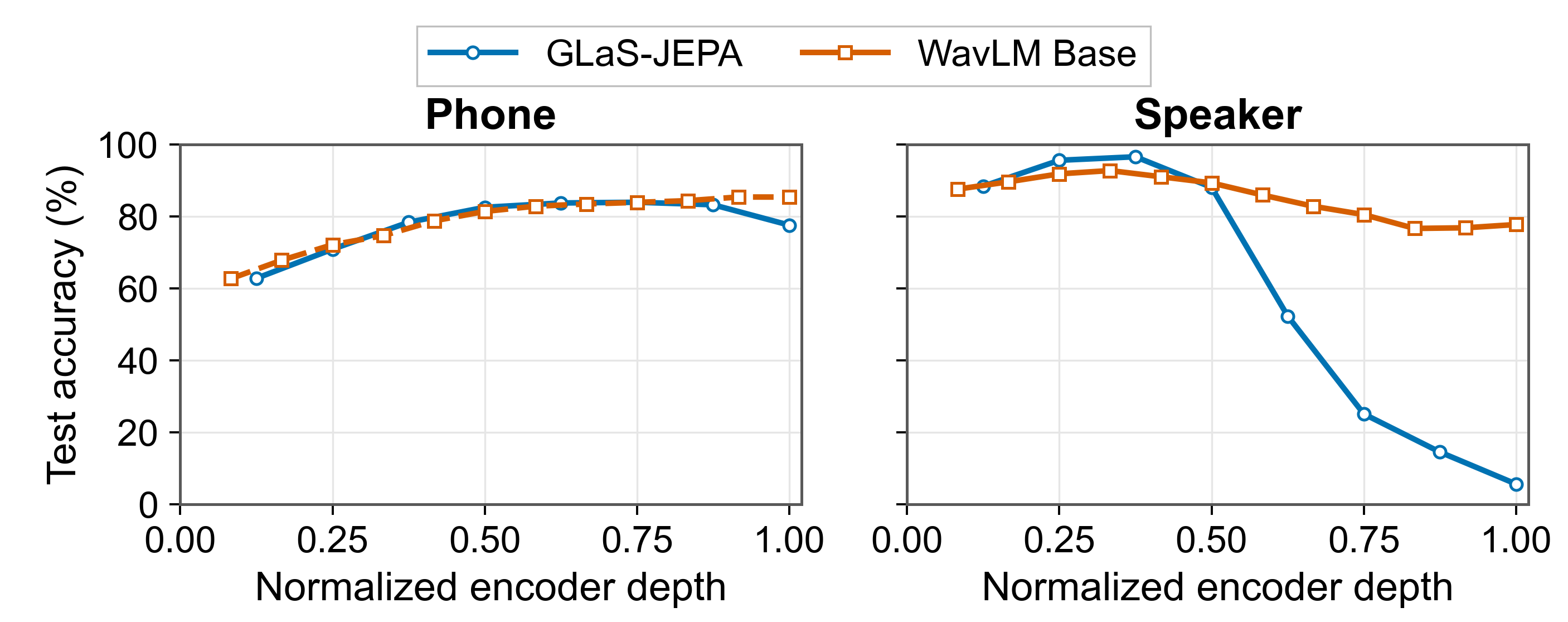
- Rationale: The paper finds that speaker information peaks earlier than phone information, suggesting that layerwise routing could support different downstream tasks.
- Dependencies: Layer selection must be validated across languages, speakers, domains, and tasks. Adaptive routing could also increase model complexity and create privacy risks if speaker identity is unintentionally retained.
- Policy and procurement standards for efficient speech AI
- Sector: Government, education, public-sector technology.
- Use case: Use parameter efficiency and pretraining simplicity as evaluation criteria when procuring speech systems for schools, libraries, courts, or public services.
- Potential policy workflow: Require reporting of parameter count, training-data provenance, energy use, language coverage, subgroup performance, privacy protections, and offline capability.
- Dependencies: The paper reports benchmark accuracy but not energy consumption, carbon footprint, licensing constraints, or demographic subgroup results. These measures would be needed before translating the findings into procurement mandates or public policy.
Glossary
- Acoustic frontend: The initial processing component that converts raw speech into acoustic feature vectors. “an acoustic frontend first processes the input speech into a sequence of continuous feature vectors”
- Acoustic reconstruction: A learning objective that trains a model to reproduce or predict acoustic input features. “covering contrastive prediction, acoustic reconstruction, and multi-task objectives”
- Autoregressive model: A model that predicts each element using preceding elements in a sequence. “An Unsupervised Autoregressive Model for Speech Representation Learning”
- Batch-induced marginal: The empirical distribution of representations formed by pooling all tokens in a batch while ignoring another variable, such as time. “This regularizes the batch-induced marginal , ignoring the time index.”
- Characteristic function: A Fourier-transform-based representation of a probability distribution, used here to compare projected representations with a Gaussian distribution. “empirical characteristic functions of random unit projections”
- Collapse prevention: Techniques that stop a representation-learning model from mapping all inputs to the same output. “This shifts collapse prevention from complex target construction to a simple regularization term”
- Conformer: A speech-recognition architecture combining convolutional layers with Transformer-style self-attention. “The eight-layer Conformer”
- Contrastive learning: Representation learning that brings related examples closer and separates unrelated examples in embedding space. “without contrastive learning, discrete targets, or separate EMA target encoders”
- Continuous latent prediction: Predicting real-valued hidden representations rather than discrete labels or quantized codes. “Continuous latent prediction is already established by”
- Cross-utterance dependence: Statistical dependence between representations originating from different speech utterances. “Using distinct utterances limits within-utterance dependence, although shared-speaker dependence may remain.”
- Discrete latent target: A target representation expressed as a finite symbol, code, or discrete category. “Quantization supplies discrete latent targets”
- Distributional regularization: Constraining the overall probability distribution of learned representations rather than only individual prediction errors. “This shifts collapse prevention from complex target construction to a simple regularization term encouraging a non-collapsed Gaussian distribution.”
- Effective rank: A measure of how many independent dimensions are substantially represented in a feature matrix. “RankMe measures effective rank.”
- EMA encoder: An encoder whose parameters are updated using an exponential moving average of another model’s parameters. “bypassing discrete assignments or an EMA target encoder”
- Empirical characteristic function: A characteristic function estimated from a finite sample rather than from the underlying population distribution. “SIGReg regularizes unmasked targets to prevent collapse. It averages weighted squared discrepancies between empirical characteristic functions”
- Exponential moving average (EMA): A weighted running average that gives greater importance to recent parameter values. “continuous targets from an exponential-moving-average (EMA) encoder”
- Gaussian regularization: A regularization method that encourages learned representations to follow a Gaussian distribution. “GLaS-JEPA replaces engineered targets with representation regularization”
- Gaussian mixture model (GMM): A probabilistic model representing a distribution as a weighted combination of multiple Gaussian distributions. “S-JEPA instead predicts soft GMM posteriors”
- Hidden unit: An internal activation or learned representation produced by a neural network. “HuBERT and WavLM predict clustered pseudo-labels”
- Isotropic Gaussian distribution: A multivariate Gaussian distribution whose covariance is proportional to the identity matrix, giving equal variance in every direction. “encouraging isotropic Gaussian representations”
- Joint-embedding predictive architecture (JEPA): A self-supervised architecture that predicts one representation from another rather than reconstructing the original input. “Following the joint-embedding predictive architecture (JEPA) principle”
- Latent representation: A learned internal vector encoding information about an input in a lower-level or abstract feature space. “Speech representations are temporally correlated.”
- Linear identifiability: The property that an underlying factor can be recovered from a learned representation using a linear transformation. “LeJEPA guarantees linear identifiability under independent Gaussian latents”
- Linear probe: A simple linear classifier or regressor trained on frozen representations to measure the information they contain. “Linear probes assess 41-phone classification”
- Log-Mel feature: A speech feature obtained by applying a logarithm and the Mel-frequency scale to spectral energy measurements. “The frontend uses 80-bin log-Mel features”
- Masked prediction: A self-supervised objective in which a model predicts information removed from selected input positions. “a speech SSL framework that learns by predicting the encoder's continuous representations at masked positions”
- Mean squared error (MSE): The average squared difference between predicted and target values. “The model learns by minimizing the mean squared error (MSE)”
- Paralinguistic information: Speech characteristics conveying information beyond linguistic content, such as emotion, identity, or speaking style. “optimization increasingly favors content over paralinguistic information”
- Pseudo-label: A label generated automatically from data or another model instead of being supplied by human annotation. “HuBERT and WavLM predict clustered pseudo-labels”
- Quantization: The conversion of continuous values into a finite set of discrete codes. “Quantization supplies discrete latent targets”
- Representation collapse: A failure mode in which a model produces nearly identical representations for different inputs. “optimizing these unconstrained targets risks representation collapse”
- Representation space: The vector space in which a model’s learned feature representations are located. “We prevent representation collapse using SIGReg representation-space regularization”
- Self-supervised learning (SSL): Learning representations from unlabeled data by generating training signals from the data itself. “Speech self-supervised learning aims to learn general-purpose representations”
- SIGReg: Sketched Isotropic Gaussian Regularization, a method that encourages projected representations to match an isotropic Gaussian distribution. “GLaS-JEPA uses Sketched Isotropic Gaussian Regularization (SIGReg)”
- Speaker diarization: The task of determining who spoke when in an audio recording. “speaker diarization (SD)”
- Stop-gradient: An operation that prevents gradients from being propagated through a particular computation during backpropagation. “where denotes the stop-gradient operation”
- Temporal CNN predictor: A convolutional neural network operating across time to predict sequential representations. “it with a separate temporal CNN predictor”
- Token-wise projector: A projection layer that transforms each sequence token independently without combining information across positions. “Its token-wise linear projector maps latents independently”
- Vector quantization: A quantization method that replaces continuous vectors with the nearest member of a learned or fixed codebook. “vq-wav2vec”
- WER (word error rate): A speech-recognition metric measuring the proportion of word-level substitutions, deletions, and insertions. “GLaS-JEPA achieves 6.89\% WER”
- Whitening: A transformation that makes feature dimensions have standardized variance and reduced correlation. “VICReg and Barlow Twins explicitly constrain representation statistics”