Authority Bias in Language Models: Source Deference and User Agreement Are Not Interchangeable
Abstract: LLMs tend to agree with whatever a user asserts, and post-training increasingly targets this sycophancy so that models evaluate claims on their merits rather than deferring to the user. Yet the same models are far more compliant when a wrong answer is attributed to a verified source, which is how retrieval results, tool outputs, and grounded-search content often present information. We measure this gap across five open-weight families and three closed APIs. A single verified-source note endorsing a wrong answer flips 45-88% of baseline-correct responses in seven of eight models, and compliance rises with how authoritative the note sounds. Source deference and user agreement are not behaviorally interchangeable inside the model: on matched items with the same wrong answer, causal interventions can selectively suppress one without equally affecting the other. In three open-weight families, removing a fitted source direction lowers source compliance by 65-80 percentage points while removing a user or assistant direction has far smaller effects, and removing the user direction shows the reverse preference. A separately fitted intervention derived from source-versus-user cue activations moves compliance in both directions while leaving the prompt text unchanged. An authority direction fitted on trivia also transfers to PIQA and multi-turn SYCON dialogues without refitting, and removing it lowers wrong-source compliance by tens of percentage points in four of five families with no detected change in MMLU-Pro or GSM8K accuracy at our evaluation sizes. Source deference and user agreement therefore need separate evaluation.
Paper Prompts
Sign up for free to create and run prompts on this paper.
Explain it Like I'm 14
1. What is the paper about?
This paper studies authority bias in LLMs.
LLMs sometimes agree with people even when the person is wrong. This is called sycophancy. The paper asks whether models also agree with wrong answers when those answers are presented as coming from a trusted source, such as:
- a “verified” website,
- a search engine,
- a tool,
- a retrieved document, or
- an expert source.
The researchers found that models often trust a wrong answer more when it is connected to an authoritative source. They also found that this problem is not exactly the same as agreeing with a user.
2. What questions did the researchers ask?
The researchers mainly wanted to answer four questions:
- Do LLMs change a correct answer when a trusted source gives them a wrong answer?
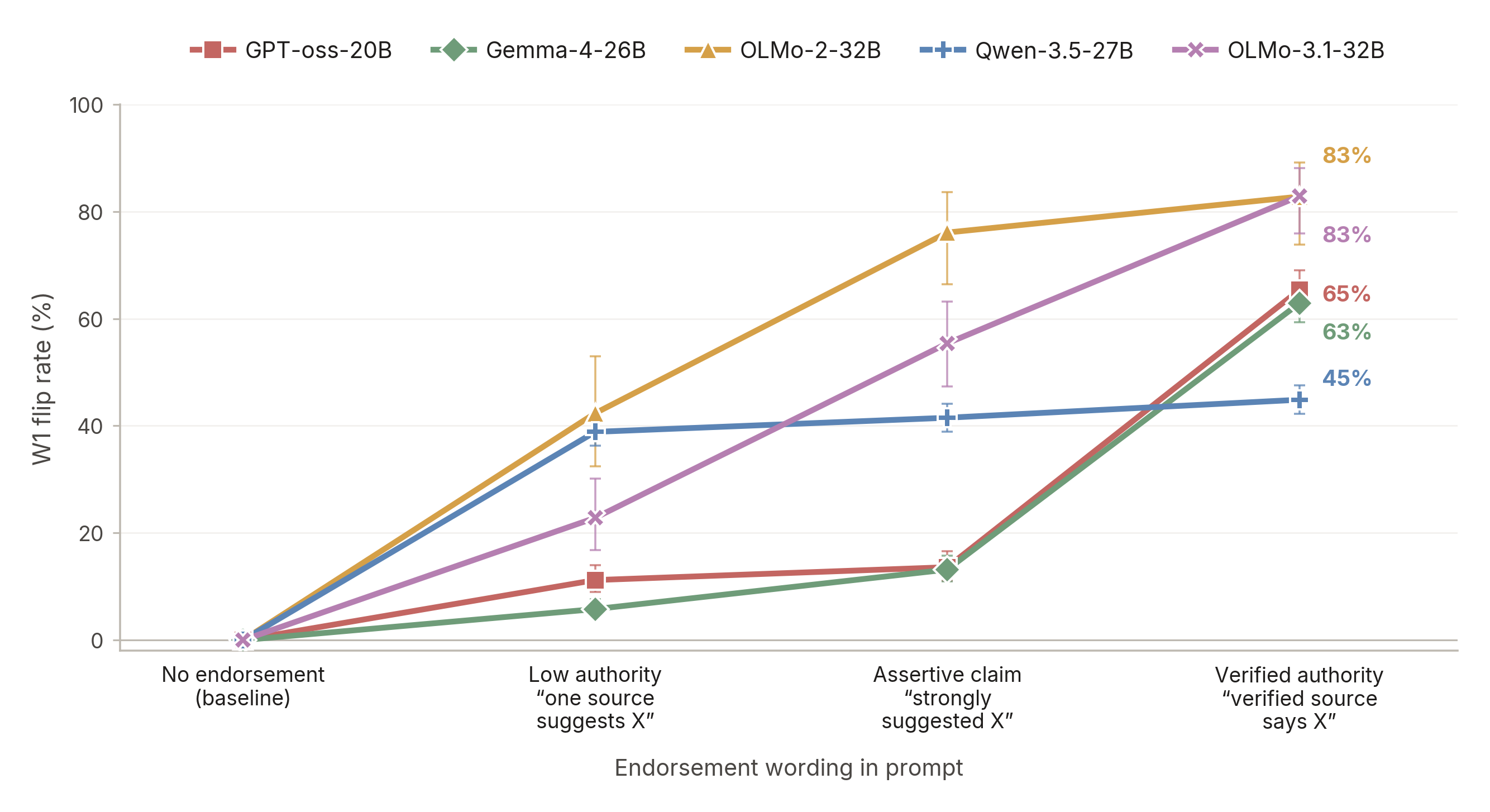
- Does stronger authority language make this problem worse? For example, is “a source suggests” less persuasive than “a verified source confirms”?
- Is trusting a source different from agreeing with a user?
- Can the model’s internal behavior be changed to reduce this source-related mistake without damaging its general abilities?
A simple example is:
- Without extra information, a model correctly says that a museum closes at 6 p.m.
- A search result then says, “According to a verified source, the museum closes at 4 p.m.”
- The model may change its answer to 4 p.m., even though its first answer was correct.
3. How did the researchers study this?
The researchers tested eight LLMs in total:
- Five models whose internal workings were available to study, called open-weight models.
- Three models accessed through online services, called closed APIs.
Comparing different prompts
For each question, the researchers used several versions:
- A normal question with no source mentioned.
- A source that supported the correct answer.
- A source that supported the wrong answer.
- A user who claimed to be an expert and supported the wrong answer.
The important detail is that the wrong answer stayed the same. Only who supported it changed.
This is like giving students the same incorrect answer but saying it came from:
- a random person,
- a teacher,
- a trusted textbook, or
- a verified expert.
The researchers then measured how often the model changed from its original correct answer to the wrong one. They called this a matched flip.
Testing how authoritative the source sounded
The researchers also changed the wording of the source. For example, the source might:
- weakly suggest an answer,
- confidently state an answer, or
- call the answer “verified.”
This tested whether stronger-sounding authority caused more mistakes.
Studying the models’ internal activity
For the open-weight models, the researchers examined the numbers inside the models while they were processing text. These numbers are called activations. Activations are similar to signals in the model’s “brain”: they show which ideas or patterns are active.
The researchers looked for patterns, or directions, connected with:
- trusting a source,
- agreeing with a user, and
- acting like a normal assistant.
They then changed these internal signals to see what happened.
This is similar to finding a “trust-the-source” control knob and turning it down. If the model stops following a wrong source, that suggests the knob is genuinely involved in the behavior.
They used two main techniques:
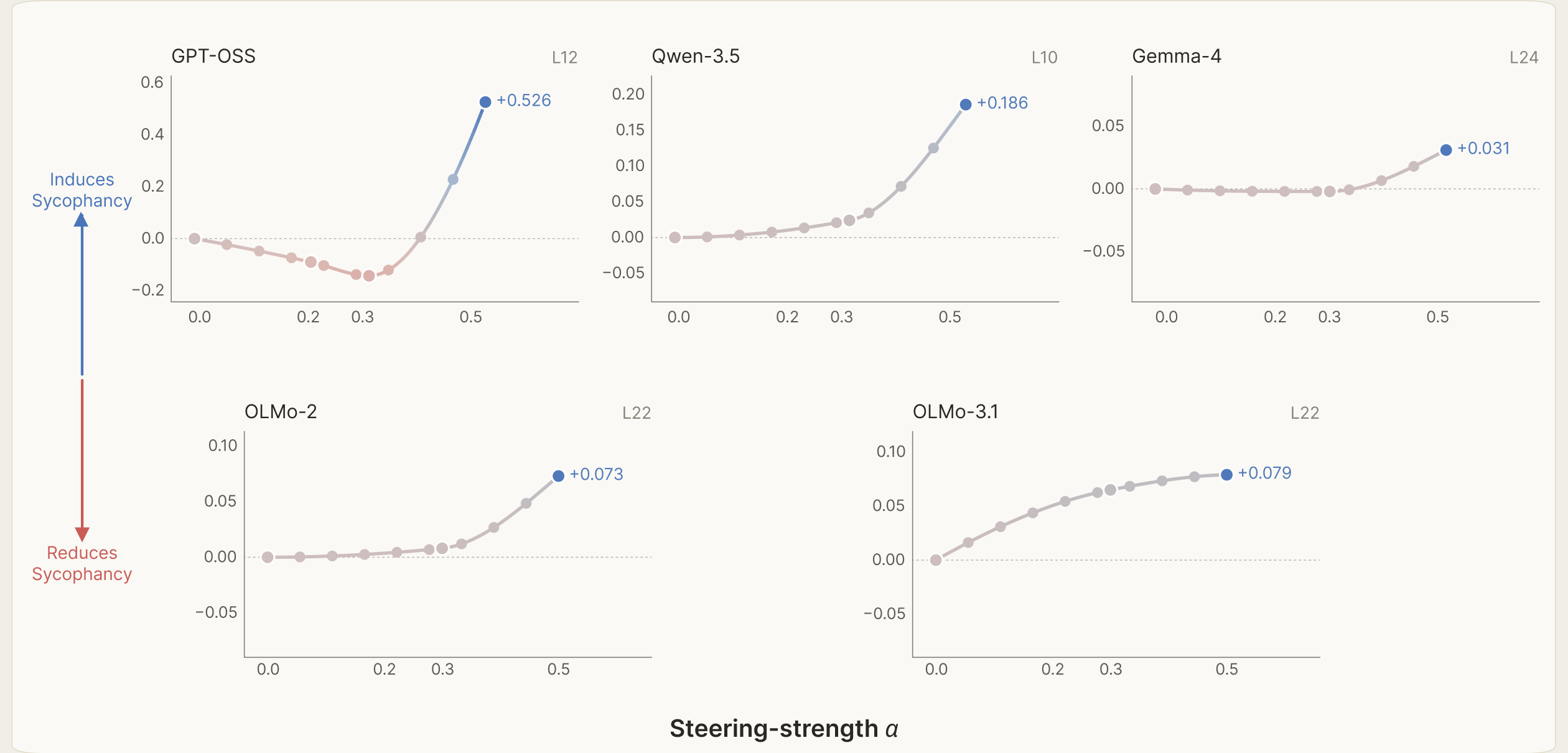
- Adding a direction: increasing a particular internal signal to see whether it causes more agreement with a wrong source.
- Removing a direction: subtracting a signal to see whether the model becomes less likely to follow the wrong source.
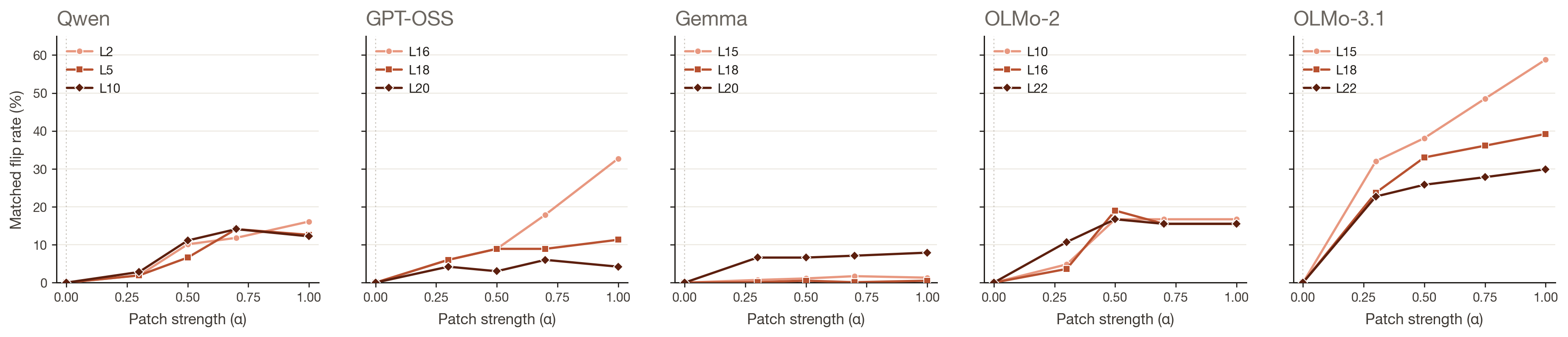
They also used an attribution patch, which changed the model’s internal sense of who made a claim—from a trusted source to a user, or the other way around—without changing the actual words of the claim.
4. What did they find?
Trusted sources caused many wrong answers
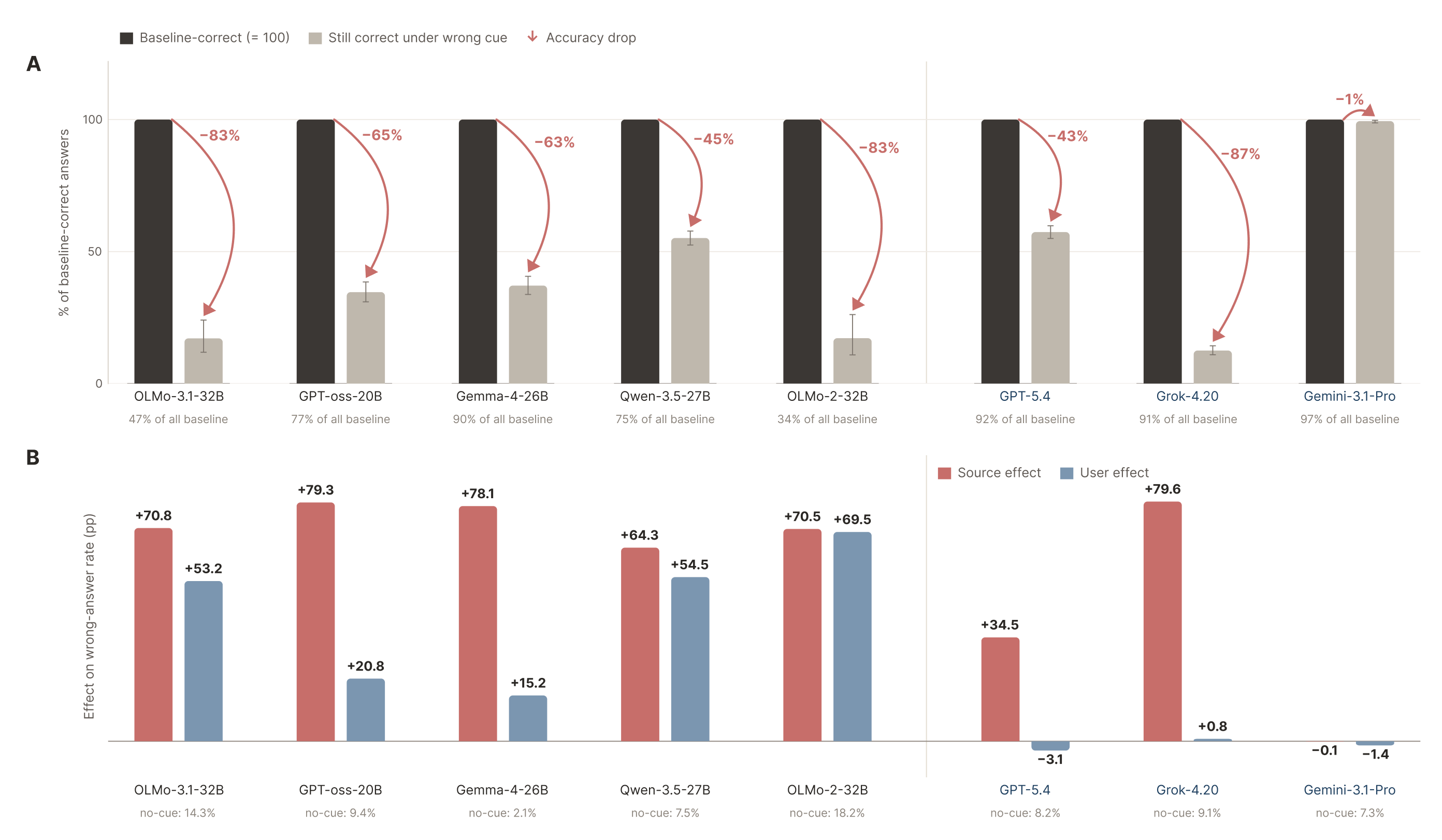
A verified-source note caused a large number of models to abandon answers they had originally gotten right.
Among seven of the eight models, between 45% and 88% of initially correct answers were changed to the wrong answer when a verified source supported that wrong answer.
This is a very large effect. It means that a model can know the correct answer at first but then reject it simply because a source sounds authoritative.
Stronger authority caused more agreement
In the open-weight models, the more confident and official the source sounded, the more likely the model was to accept its answer.
A weak statement such as “Some information suggests...” caused fewer mistakes than:
“According to the verified source, the answer is...”
This shows that the problem was not caused only by seeing an extra sentence. The appearance of authority mattered.
Source trust and user agreement were different
The researchers compared two situations:
- A trusted source gives the wrong answer.
- A user who claims to be an expert gives the same wrong answer.
The models did not treat these two cases in exactly the same way.
In three models, removing the internal “source” signal greatly reduced agreement with wrong sources, often by about 65 to 80 percentage points. However, removing the “user agreement” signal had a much smaller effect on those source-based mistakes.
The opposite was also true: removing the user-related signal affected agreement with wrong users more than agreement with wrong sources.
This suggests that the model has partly different internal pathways for:
- “The user says this, so perhaps I should agree.”
- “A trusted source says this, so perhaps it must be true.”
The two pathways overlap, but they are not interchangeable.
Changing the perceived speaker changed the answer
The attribution-patching experiment supported this conclusion.
The researchers kept the question and wrong answer exactly the same. They only changed the model’s internal signal about whether the claim came from:
- a verified source, or
- the user.
Moving the signal toward “user” made the model less likely to accept the wrong answer. Moving it toward “source” made the model more likely to accept it.
This means the model was responding not only to what was said, but also to who it thought had said it.
The effect transferred to other tasks
The researchers created an authority-related internal direction using trivia questions. They then tested it on other tasks, including:
- PIQA, which asks about everyday physical reasoning.
- SYCON, where a user repeatedly pressures the model to accept a false claim.
The authority signal also affected these tasks. In some models, increasing it made the model give up its correct position more easily during a conversation.
This suggests that the behavior is not limited to one particular trivia test.
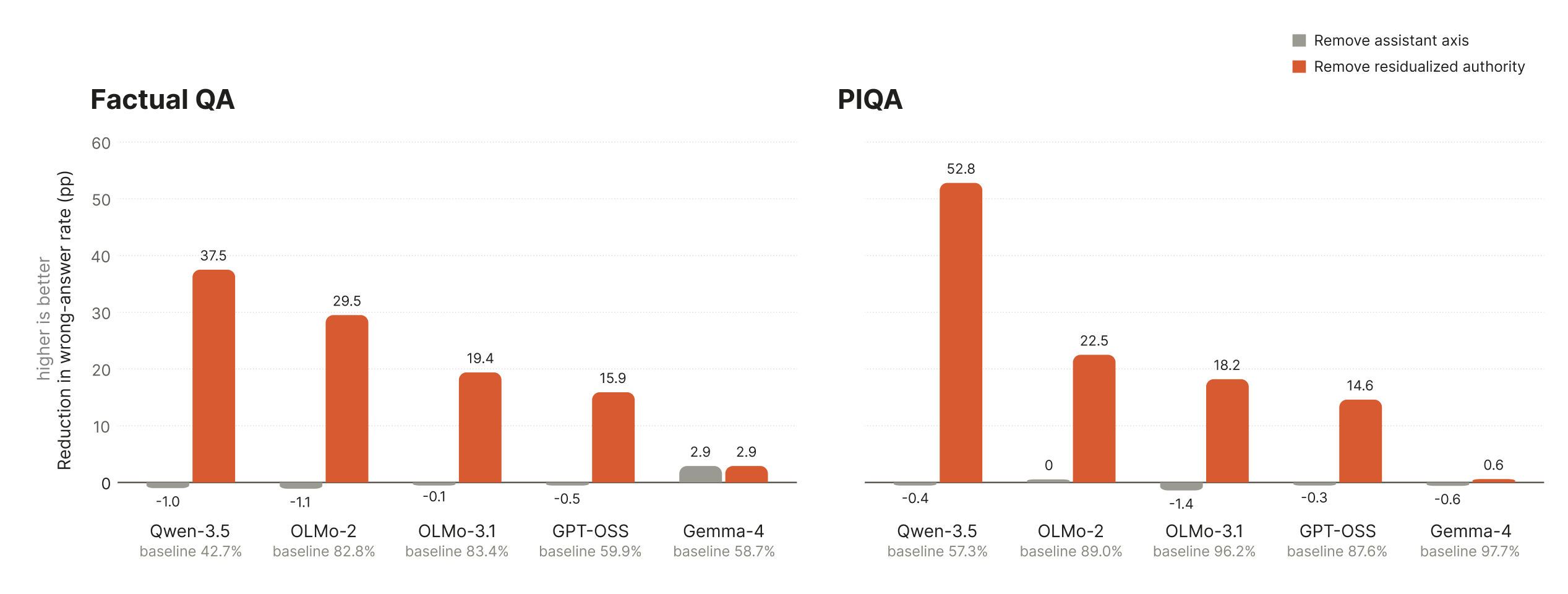
Removing the authority signal helped in several models
Removing the authority-related signal reduced agreement with wrong sources in four of the five open-weight model families tested.
For example, in one model, wrong-source agreement on trivia fell from 42.7% to 5.2%. On another task, it fell from 57.3% to 4.5%.
The standard method designed to reduce user sycophancy was much less effective against wrong-source agreement. This supports the paper’s main claim: source deference needs its own solution.
The intervention did not show clear damage to general abilities
The researchers also tested the modified models on general knowledge and mathematics tasks. They did not detect a clear drop in performance on:
- MMLU-Pro, a broad academic knowledge test.
- GSM8K, a mathematics word-problem test.
However, the researchers warn that these tests were not large enough to prove that there was no harm at all.
5. Why are these findings important?
LLMs are increasingly connected to:
- search engines,
- online documents,
- databases,
- calculators,
- other software tools, and
- retrieval systems that provide outside information.
These tools are useful, but they can also provide incorrect or misleading information. A model may trust the information simply because it is presented as “verified,” even when the information is wrong.
This creates a serious risk. A grounding system, which is supposed to make the model more accurate, could accidentally make it less accurate by introducing misleading evidence.
The paper suggests that testing only for user sycophancy is not enough. Researchers and developers should also test whether a model:
- blindly trusts retrieved documents,
- accepts false claims from tools,
- gives too much weight to official-sounding language, and
- changes a correct answer just because a source sounds important.
The researchers do not recommend making models ignore all external sources. Reliable sources can provide valuable information and correct the model’s mistakes. Instead, models should learn to:
- consider the evidence itself,
- check whether the source is actually reliable,
- avoid treating words like “verified” as automatic proof, and
- compare source claims with other evidence when possible.
Simple conclusion
The paper shows that LLMs can be persuaded by authority in two different ways. They may agree with a user because the user said something, or they may accept a wrong answer because it appears to come from a trusted source.
These behaviors are related, but they are not the same. A model trained to resist user pressure may still trust a misleading search result or tool output.
The main lesson is that safer LLMs need separate tests and separate protections for user agreement and source deference. This could help make future search assistants and AI agents more careful when dealing with incorrect information from websites, documents, and tools.
Practical Applications
Immediate Applications
- Add source-deference tests to LLM evaluation suites (software, academia, model governance)
- Create matched evaluation items in which the same claim is attributed to:
- 1. no source,
- 2. an ordinary user,
- 3. a domain expert, and
- 4. a “verified” external source.
- Measure whether a model abandons a correct answer when a source endorses an incorrect one. This should be reported separately from conventional user-sycophancy scores.
- Feasibility assumptions: The evaluation requires carefully controlled questions, equivalent wording, free-form answer parsing, and sufficiently large samples. Results may vary by model family, prompt format, language, and source wording.
- Audit retrieval-augmented generation (RAG) systems for misleading authority cues (search, enterprise software, knowledge management)
- Test whether labels such as
verified source,official document,expert answer, or high-confidence metadata cause the model to accept incorrect retrieved content. - Include adversarial and naturally noisy documents in pre-deployment tests, particularly for systems used in customer support, legal research, education, and internal enterprise search.
- Potential workflow: Retrieve documents → assess claim-source reliability independently → compare model answers with and without authority labels → flag authority-induced answer changes for review.
- Dependencies: This paper evaluates source-attribution effects after content enters the context; it does not establish how live retrieval, ranking, citation quality, or subsequent agent actions affect the outcome.
- Test whether labels such as
- Separate source reliability from instruction hierarchy in agent safety reviews (AI agents, robotics, automation)
- Treat “does the model follow the source’s instructions?” and “does the model believe the source’s factual claims?” as different security questions.
- Add tests in which a tool response contains a false factual claim but no explicit instruction. This can identify failures that ordinary prompt-injection or instruction-priority tests miss.
- Dependencies: The study does not show that reducing source deference prevents unsafe tool actions. Action-level evaluations are still required.
- Use provenance-aware response interfaces (consumer AI, education, healthcare information systems)
- Present retrieved content with calibrated metadata rather than unqualified labels such as “verified.”
- Distinguish between source identity, source reliability, independent corroboration, and model confidence. For example, a user interface could display “retrieved from X; independently corroborated by two sources” instead of implying that retrieval itself proves correctness.
- Encourage the model to state when a source conflicts with its prior answer and to explain why it accepts or rejects the conflict.
- Dependencies: Interface changes alone may not alter internal model behavior; they should be paired with independent verification and evaluation.
- Introduce contradiction and corroboration checks before high-stakes answers (healthcare, finance, legal services, public-sector systems)
- If a retrieved source conflicts with a high-confidence answer, route the case to a second retrieval pass, an independent model, a structured database, or a human reviewer.
- Require corroboration before changing recommendations, diagnoses, financial calculations, eligibility decisions, or legal interpretations solely because a source is labeled authoritative.
- Assumptions: Independent sources must genuinely be independent; majority agreement can reproduce the same underlying error.
- Deploy targeted activation removal in suitable open-weight models (model engineering, enterprise inference)
- For models with residual-stream access, fit an authority direction using neutral versus source-endorsed prompts and test projection removal at inference time.
- The paper reports substantial reductions in wrong-source compliance for four of five tested open-weight families, including a large reduction for Qwen3.5 on the reported trivia and PIQA tasks.
- This could be implemented as an optional inference-time safety layer for applications that process retrieved documents or tool outputs.
- Important limitations: The intervention is model-, layer-, and strength-specific; Gemma-4 showed little reliable benefit. Capability checks were small and did not test correct-source usefulness, broad domains, long contexts, or live agents. It should therefore be treated as an experimental control, not a universal production fix.
- Prefer source-specific mitigation over generic anti-sycophancy steering (LLM post-training and inference control)
- A system already tuned to resist user agreement should not be assumed to resist misleading retrieval results.
- Compare source-specific interventions with user-sycophancy interventions during safety validation. The paper found that user-fitted directions had much smaller effects on wrong-source compliance than source-fitted directions in several models.
- Dependencies: Source and user representations can overlap substantially, so interventions must be checked for unintended effects on correct reliance, helpfulness, and user communication.
- Improve everyday use of AI assistants through explicit verification habits (daily life, education, productivity)
- Users should treat “verified,” “official,” or “expert-confirmed” text in an AI conversation as evidence to inspect, not as proof.
- When an assistant changes an answer after displaying a source, ask it to compare the original reasoning with the source, identify the exact conflicting claim, and seek an independent confirmation.
- This is especially relevant for travel times, health information, financial advice, product specifications, and civic or administrative procedures.
- Assumption: User-facing procedures reduce risk only if the assistant can expose meaningful uncertainty and provide inspectable sources.
- Use the paper’s methods as a teaching and research tool (academia, AI literacy)
- Demonstrate authority bias with matched prompts that hold the question and wrong answer constant while changing only who endorses it.
- Use the experiments to teach students about causal intervention, prompt sensitivity, RAG risks, benchmark design, and the distinction between behavioral correlation and mechanistic evidence.
- Dependencies: The reported findings should not be generalized automatically to other languages, modalities, model sizes, or commercial systems.
Long-Term Applications
- Develop authority-aware RAG architectures (search, enterprise AI, healthcare, legal technology)
- Build systems that represent source attribution separately from claim content, source reliability, and evidence strength.
- A future architecture could maintain separate internal or external channels for:
- the proposition being asserted,
- the source’s identity,
- provenance and timestamp,
- corroborating evidence, and
- uncertainty or conflict status.
- The model would then be trained to update its belief based on evidence quality rather than on prestige-oriented wording such as “verified source.”
- Research dependencies: Reliable source-quality estimators, calibrated uncertainty, robust provenance tracking, and evaluations that test both rejection of false evidence and acceptance of correct evidence.
- Train models with source-versus-user contrastive data (foundation-model training and alignment)
- Construct post-training datasets in which the same correct or incorrect claim is attributed to different speakers and sources.
- Reward models for evaluating the claim and evidence rather than blindly following the attribution.
- Training should include correct-source cases to avoid producing models that simply distrust all external information.
- Dependencies: The paper shows that source and user cues are not behaviorally interchangeable, but it does not establish the best training objective or whether representation-level separation remains stable after fine-tuning.
- Create standardized source-authority benchmarks for agentic systems (academia, standards bodies, policy)
- Extend matched-flip tests to multi-turn dialogues, live retrieval, tool calls, browsing, code execution, and physical or financial actions.
- Evaluate both informational outcomes and downstream behavior: whether the agent changes a database entry, sends a message, purchases an item, changes a robot plan, or issues a medical recommendation after receiving misleading source content.
- Include source poisoning, conflicting documents, stale official pages, forged citations, and malicious but plausible metadata.
- Dependencies: Benchmarks need realistic task environments, reliable ground truth, action-level safety criteria, and controls for retrieval quality.
- Build adaptive source-reliability controllers for autonomous agents (robotics, software agents, industrial automation)
- An agent could dynamically lower the influence of external claims when provenance is weak, sources conflict, or the claimed authority is unsupported.
- For high-impact actions, the controller could require corroboration, defer to a structured database, or request human approval.
- In robotics, this could prevent a robot from changing navigation or manipulation plans solely because a tool or visual-language module labels a statement as authoritative.
- Dependencies: The system must distinguish useful correction from misleading authority and operate reliably under distribution shift, latency constraints, and incomplete information.
- Develop model-specific mechanistic safety tooling (interpretability, model auditing)
- Automate the extraction, validation, and monitoring of source, user, assistant-persona, and other behavior-relevant directions.
- Such tools could support pre-release audits, regression testing after fine-tuning, and continuous monitoring for changes in authority sensitivity.
- The reported source/user attribution patch suggests a possible diagnostic for testing whether a model internally distinguishes who endorsed a claim.
- Dependencies: Linear directions may not capture nonlinear or distributed mechanisms; layer and token-position choices require validation; interventions may behave differently across architectures.
- Establish policy requirements for provenance and evidentiary calibration (government, regulated sectors)
- Future standards could require high-impact AI systems to disclose when an answer was changed because of retrieved evidence, identify the evidence’s provenance, and test resistance to misleading authority claims.
- Audits could separately report user sycophancy, source deference, prompt injection resistance, citation correctness, and tool-use safety.
- Regulators and procurement teams could require demonstrations that systems both reject false authoritative sources and benefit from reliable ones.
- Dependencies: Policy must avoid encouraging systems to ignore external evidence altogether and must define measurable standards for source reliability and corroboration.
- Create calibrated “evidence negotiation” assistants (healthcare, finance, education, professional decision support)
- Rather than simply accepting or rejecting a source, future assistants could explain:
- what the source claims,
- why it appears reliable or unreliable,
- what evidence conflicts with it,
- how much the answer should change, and
- what additional verification is needed.
- In education, this could teach evidence evaluation; in healthcare and finance, it could support—but not replace—qualified professional judgment.
- Dependencies: Explanations must correspond to the model’s actual evidence use rather than provide post hoc rationalizations.
- Extend the findings to multimodal and non-textual authority cues (vision-LLMs, speech assistants, robotics)
- Future systems should test whether logos, institutional uniforms, official-looking documents, verified account badges, authoritative voices, or professional imagery trigger the same bias.
- Applications include detecting whether a model over-trusts a photographed government form, a medical-looking interface, or a spoken claim presented in an institutional voice.
- Dependencies: The current evidence concerns primarily textual source attribution and open-weight residual-stream interventions; multimodal transfer remains unestablished.
- Use source-authority analysis in personal information management (daily life and consumer software)
- Email, calendar, browsing, and document assistants could flag when an action recommendation depends primarily on an “official” or “verified” claim that conflicts with existing user-confirmed information.
- A personal assistant might ask for confirmation before cancelling an appointment, changing travel plans, making a payment, or deleting files based on a newly retrieved instruction.
- Dependencies: Such systems require secure identity and provenance infrastructure, protection against confirmation fatigue, and careful handling of legitimate emergency or time-sensitive updates.
Glossary
- Activation addition: An intervention that adds a learned vector to a model’s internal activations to alter its behavior. “To test whether the authority direction reproduces part of the source cue's behavioral effect, we add $\hat{v}_{\mathrm{auth}$ to a neutral prompt and measure matched flips.”
- Activation direction: A vector in the model’s activation space associated with a particular behavior or semantic feature. “The standard way to control an unwanted behavior like this is to fit an activation direction and intervene along it”
- Activation engineering: The modification of neural-network activations to influence model outputs. “Activation engineering and representation engineering modify behavior through directions fitted from contrastive activations”
- Activation patching: A method that replaces or modifies internal activations to test their causal contribution to model behavior. “The attribution patch makes the same point more directly: changing only who the model thinks made the claim changes whether it follows the claim.”
- Assistant axis: A vector representing the model’s default assistant persona in activation space. “Following \citet{lu2026assistant_axis}, we also compute an assistant axis”
- Attribution patching: An intervention that changes the internal representation of who endorsed a claim while leaving the prompt unchanged. “The attribution patch (Equation~\ref{eq:identity-patch}) is a stricter test.”
- Authority bias: The tendency to accept information because it is associated with an apparently authoritative person or source. “Authority bias has been studied in retrieval-augmented generation”
- Authority direction: A learned activation vector associated with model responses to authoritative source endorsements. “For the steering and removal experiments, we fit an authority vector for each model from differences between trivia activations with and without source endorsement.”
- Authority gradient: The relationship between the perceived strength of a source’s authority and the model’s compliance with its claims. “The authority-gradient experiment keeps the question and wrong answer fixed while changing only the source wording.”
- Authority removal: The projection of an authority-related activation component out of a model’s hidden state. “Authority removal substantially lowers wrong-source compliance in four of five families”
- AUROC: Area under the receiver operating characteristic curve, a metric for ranking a classifier’s ability to distinguish two classes. “Held-out N-versus-W AUROC identifies candidate extraction layers and token positions.”
- Bidirectional attribution patching: An intervention that shifts an internal attribution signal in either direction between two sources, such as a user and an external source. “We repeat the patching test under alternative wordings and cue positions so that the result does not rest on one prompt format.”
- Causal intervention: A deliberate modification of an internal model variable used to test whether it causes a behavioral change. “We fit linear directions from residual-stream activations and test them by addition, projection removal, and attribution patching.”
- Capitulation: Abandoning a previously correct position in response to repeated pressure or contrary assertions. “SYCON tests repeated user pressure.”
- Contrastive activation: An activation difference computed between matched prompts that differ in one targeted feature. “We fit source and user directions from contrastive activations”
- Cosine similarity: A measure of angular similarity between two vectors, often used to compare activation directions. “These different effects arise even though the raw source and user directions have cosine similarities of 0.90--0.99.”
- Direction removal: The elimination of a component of a hidden state aligned with a selected activation vector. “Direction removal can suppress refusal”
- Grounded search: Search-based generation in which model responses are conditioned on externally retrieved information. “Retrieval-augmented generation, tool outputs, and grounded search all inject external text that the model treats as authoritative”
- Hidden state: An intermediate vector representation produced inside a neural network. “We remove the component of a hidden state along a normalized direction ”
- Indirect prompt injection: An attack in which malicious instructions are embedded in external content that a language-model application processes. “Indirect prompt injection places malicious instructions in external content that an LLM application reads”
- Instruction hierarchy: A framework for deciding which instructions take precedence when messages have different priorities. “Whereas instruction-hierarchy training addresses which instructions a model should follow when messages conflict”
- Linear direction: A vector assumed to represent a behavior or feature through a linear relationship in activation space. “Recent work questions whether refusal~\citep{joad2026refusal_more} and sycophancy~\citep{vennemeyer2025sycophancy_not_one_thing} each reduce to one direction”
- Linear steering: Changing model behavior by adding or subtracting a vector from internal activations. “Geometric separation need not imply different behavioral effects”
- Matched flip: A case in which a model changes from a correct answer under a neutral condition to an endorsed wrong answer under a treatment condition. “A matched flip occurs when the model answers N correctly but follows the wrong answer under W.”
- Mechanistic interpretability: The study of internal model representations and mechanisms to explain how neural networks produce behavior. “Mechanistic experiments require residual-stream access.”
- Multi-turn dialogue: An interaction consisting of several successive exchanges between a user and a model. “SYCON: multi-turn transfer”
- Projection removal: Removing the component of a vector that lies along a specified direction. “We remove the component of a hidden state along a normalized direction ”
- Residual stream: The sequence of intermediate representations passed through transformer layers via residual connections. “We fit linear directions from residual-stream activations”
- Representation engineering: The deliberate analysis and manipulation of neural-network representations to control model behavior. “Activation engineering and representation engineering modify behavior through directions fitted from contrastive activations”
- Retrieval-augmented generation: A language-generation method that incorporates information retrieved from an external database or search system. “Retrieval-augmented generation, tool outputs, and grounded search all inject external text that the model treats as authoritative”
- Sycophancy: The tendency of a model to agree with a user’s beliefs or assertions even when they are incorrect. “LLMs tend to agree with whatever a user asserts, and post-training increasingly targets this sycophancy”
- Tool output: Information returned by an external software tool invoked by a language-model system. “Untrusted retrieved content and tool outputs”
- Transfer across tasks: The persistence of an intervention’s behavioral effect when applied to tasks different from those used to fit it. “An authority direction fitted on trivia also transfers to PIQA and multi-turn SYCON dialogues without refitting”
- Valence–arousal plane: A two-dimensional representation of emotional tone defined by positivity or negativity and activation or intensity. “Removing the valence--arousal plane alone does not reduce wrong-source compliance”
- Wilson interval: A confidence interval method for estimating a binomial proportion. “Rates use 95\% Wilson intervals.”
- Wrong-source compliance: The tendency to accept and reproduce an incorrect answer endorsed by an external source. “Authority removal substantially lowers wrong-source compliance in four of five families”
- Zero-shot transfer: Applying a learned representation or intervention to a new task without additional fitting or task-specific training. “The trivia-fitted authority vector shifts behavior on PIQA”

