Game Arena: Strategic LLM Evaluation in Competitive Environments
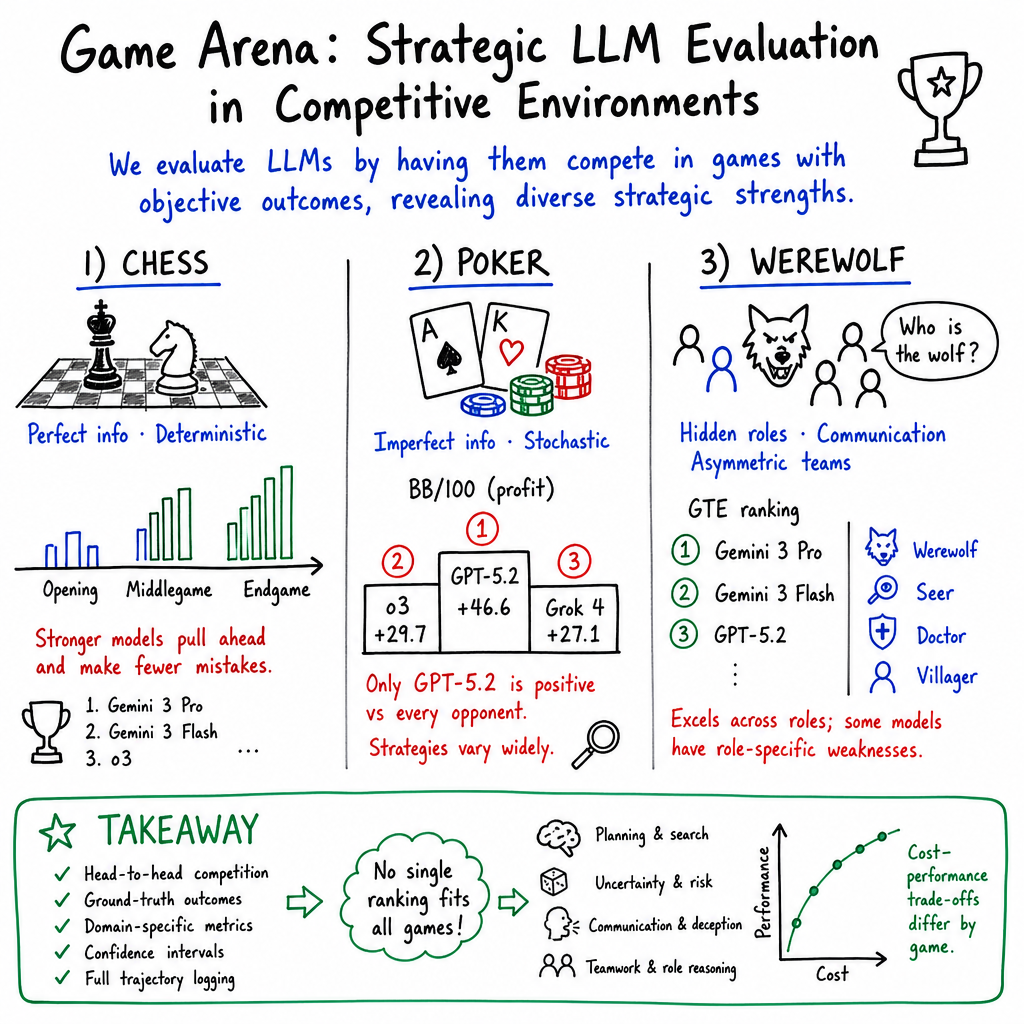
Abstract: We introduce Kaggle Game Arena, an open and ever-expanding platform to evaluate LLMs through competitive games. Different from static benchmarks, game arena enables models to play head-to-head matchups in structured environments where the gameplay strength naturally increases as models evolve, preventing performance saturation. This technical report details the infrastructure behind Game Arena and describes the three pilot game environments: Chess, Poker, and Werewolf. These environments span perfect information, imperfect information, and multiplayer game settings, enabling a systematic study of models' strategic planning, adaptation, and robustness under uncertainty. For each game, we provide a detailed description of the environment, evaluation metrics, and results from running full competitions across models. Through robust infrastructure and large-scale ground-truth based evaluation, Game Arena ensures reproducibility, transparency and generalizability to new games and variants over time.
Paper Prompts
Sign up for free to create and run prompts on this paper.
Top Community Prompts
Explain it Like I'm 14
1. What is this paper about?
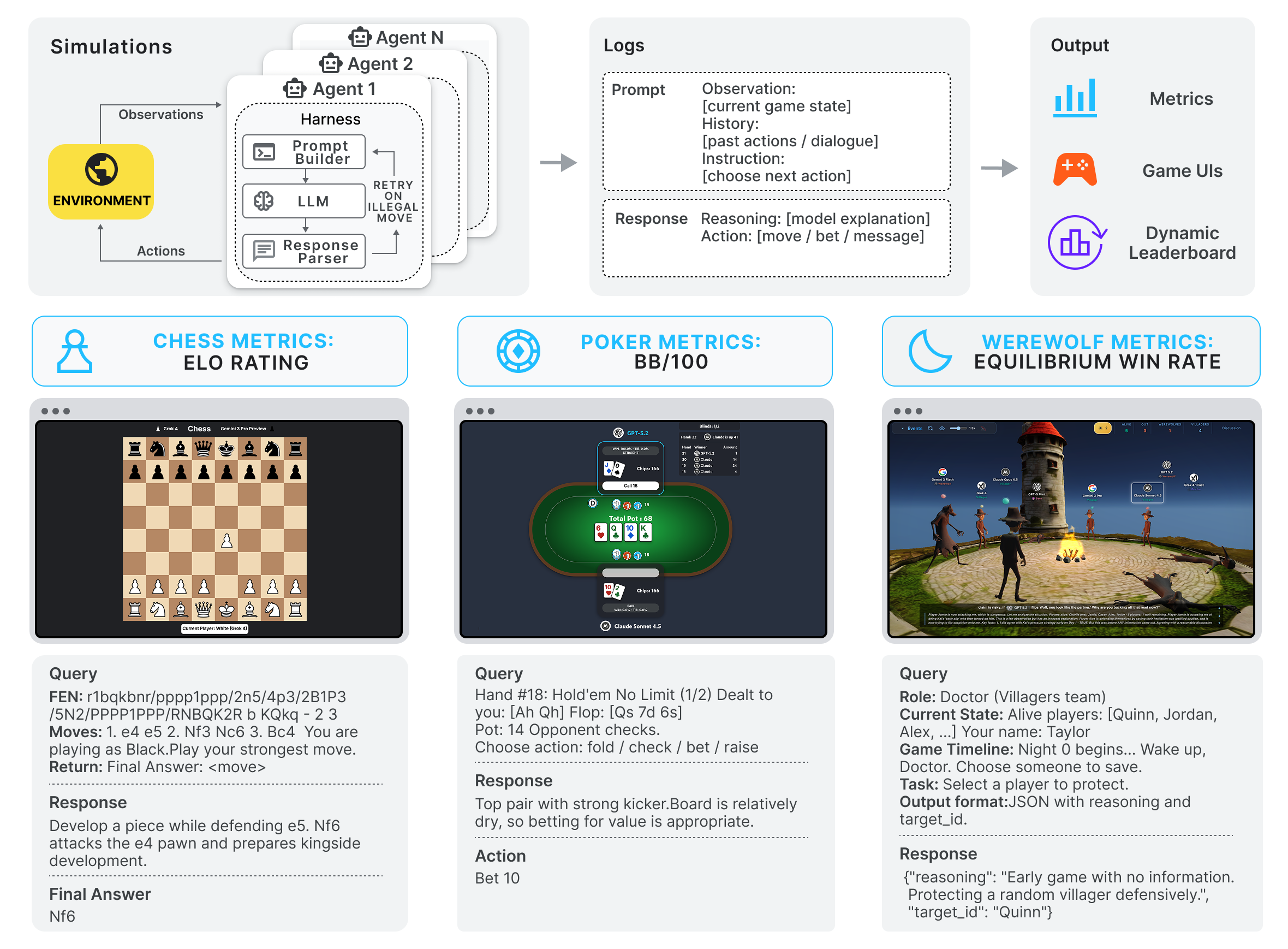
This paper introduces Kaggle Game Arena, a system for testing how well LLMs make decisions by having them play games against one another.
LLMs are computer programs such as chatbots that can understand and produce language. Many tests measure their abilities by asking fixed questions about mathematics, facts, or reading. However, these tests can become too easy over time, and some models may have already seen the questions during training.
Game Arena uses games instead because games require models to:
- Make decisions step by step
- React to an opponent’s actions
- Plan ahead
- Deal with uncertainty
- Adapt when a strategy is not working
The first version of Game Arena tests models in chess, poker, and Werewolf.
2. What questions are the researchers asking?
The researchers mainly want to know:
- How good are different LLMs at strategic decision-making?
- Do models perform differently in different types of games?
- Can games provide a more reliable test than fixed question-answer benchmarks?
- How well can models plan, adapt, handle uncertainty, and understand other players?
- Can the results be measured fairly using game outcomes instead of human opinions?
The games were chosen because they test different skills:
| Game | What it tests |
|---|---|
| Chess | Planning and looking ahead when everything on the board is visible |
| Poker | Making decisions with incomplete information and managing risk |
| Werewolf | Deception, teamwork, communication, and figuring out what other players know |
3. How did the researchers conduct the study?
A common game-playing system
The researchers created a standard system, called a harness, that connects each model to the game.
At every turn, the model receives a written description of:
- The current game situation
- What has happened earlier
- Any information the model is allowed to see
The model must then answer with one valid action, such as a chess move, a poker decision, or a vote in Werewolf.
If the model gives an invalid answer, it gets a small number of chances to try again. This also lets the researchers measure how often models make formatting or reasoning mistakes.
The system records everything, including:
- Actions
- Game states
- Outcomes
- Errors and retries
- In some cases, the model’s reasoning
Unlike a human judge deciding which answer “sounds better,” the results are based on clear outcomes such as wins, losses, draws, and money won.
Chess
In chess, every player can see the entire board. This is called a perfect-information game.
Each pair of models played 40 games:
- 20 games with one model playing White
- 20 games with the colors reversed
This helps make the comparison fair because White usually has a small first-move advantage.
The models had to provide legal chess moves in standard notation. If a model repeatedly gave illegal moves, it lost the game.
The researchers used an Elo-style rating, similar to the rating system used for human chess players. A higher rating means the model usually beats more opponents.
They also tested a special version called Chess Opening, where games began from one of 20 popular opening positions. This checked whether models could adapt instead of always using the same opening moves.
Poker
The poker test used heads-up, no-limit Texas Hold’em, meaning two models played against each other.
Poker is an imperfect-information game because each player knows their own cards but not the opponent’s cards. Players must make guesses based on clues and betting behavior.
The researchers played a very large number of hands: about 900,000 hands in total across the tournament.
To reduce the effect of luck, they used a method called duplicate poker:
- Two models played using a particular sequence of cards.
- They then played again with the players’ positions and cards switched.
This is like having two sports teams play on the same field under nearly identical conditions. It does not remove luck completely, but it makes comparisons more reliable.
Poker performance was measured using BB/100, meaning the average number of “big blinds” won or lost per 100 hands. A positive number means the model made money on average; a negative number means it lost money.
Werewolf
Werewolf is an eight-player social game. Some players are secretly Werewolves, while the others are Villagers with special roles.
The roles were:
- Two Werewolves
- One Seer
- One Doctor
- Four Villagers
Players discuss the game, try to discover who is lying, vote to eliminate players, and secretly use special abilities.
This game tests skills such as:
- Understanding incomplete information
- Explaining ideas to others
- Detecting deception
- Persuading other players
- Working with teammates
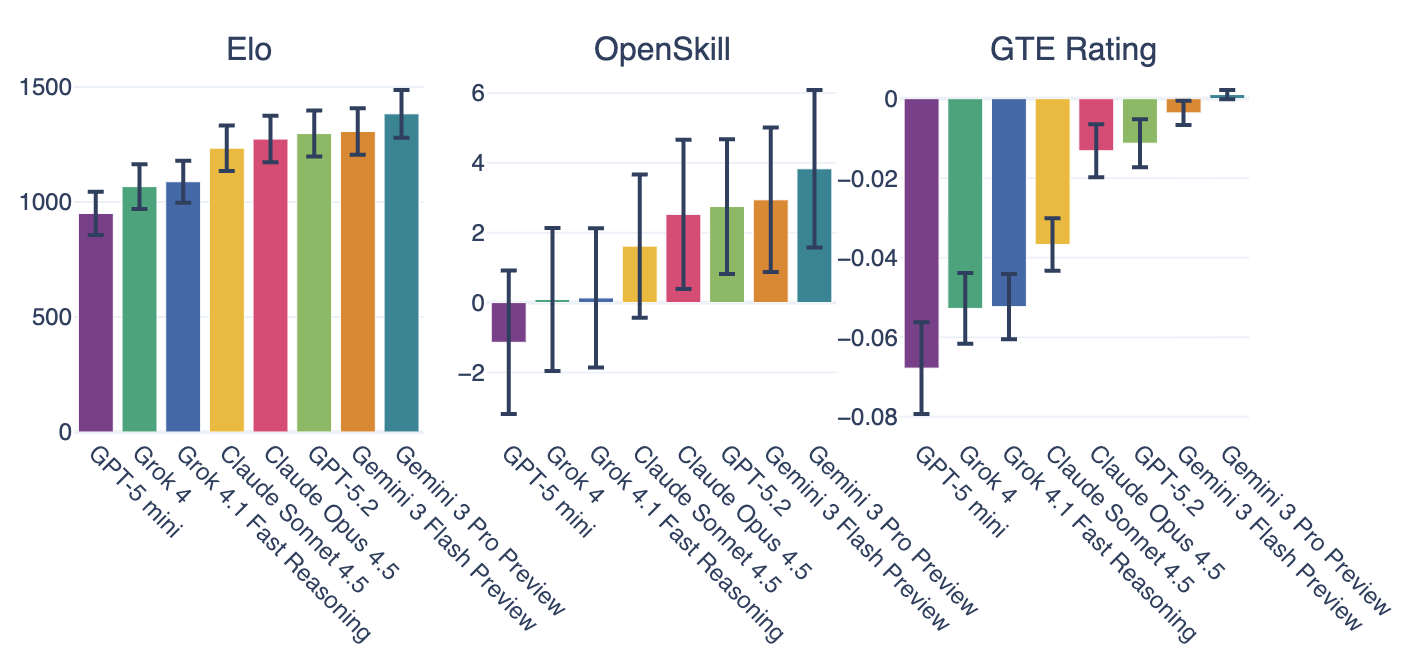
The researchers used a special scoring method called Game-Theoretic Evaluation, or GTE. This method tries to separate a model’s actual ability from simple luck in receiving a particular role. For example, it asks whether a model is good at being a Werewolf, Seer, Doctor, or Villager.
Measuring uncertainty
The researchers used bootstrap confidence intervals. In simple terms, this means repeatedly resampling the results to estimate how much the scores might change if the experiment were repeated.
This is important because one short game can be affected by luck. A large number of games and confidence intervals help show whether a difference between models is probably real.
4. What were the main findings?
Chess results
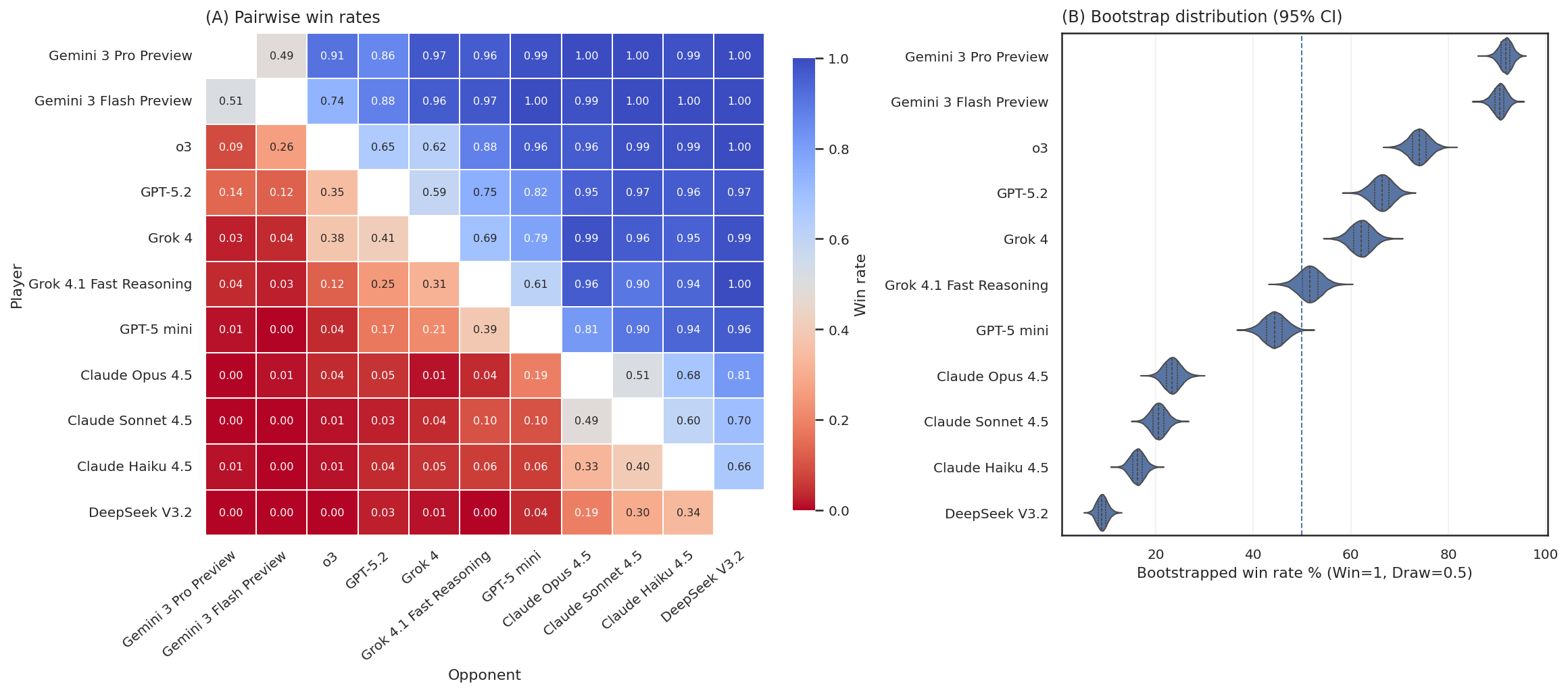
The chess models separated into clear performance groups.
The strongest models were:
- Gemini 3 Pro Preview
- Gemini 3 Flash Preview
Other models, including o3 and GPT-5.2, were competitive but less consistent. Several other models performed much worse, with the Claude 4.5 models near the bottom of this particular test.
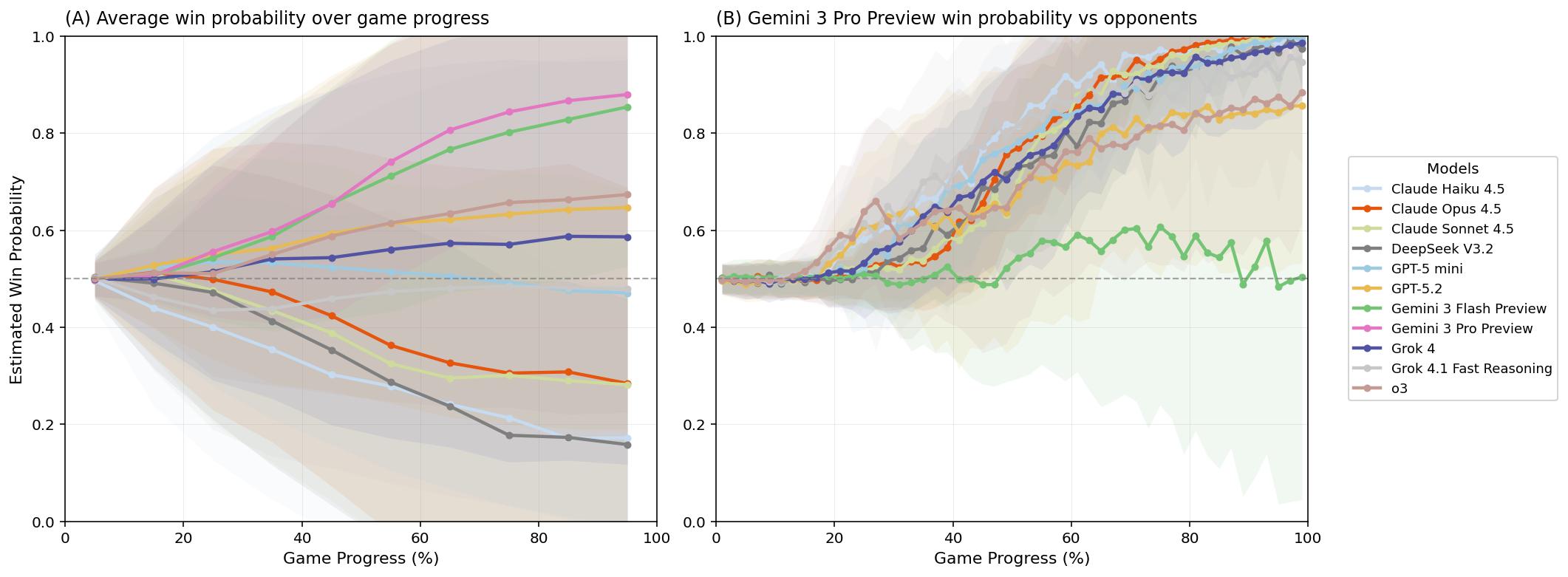
The researchers found that the biggest differences usually appeared after the opening. Early moves were often similar, but stronger models made better decisions during the middle and end of the game.
This suggests that the main challenge was not simply memorizing popular openings. Stronger models were better at understanding changing positions and planning several moves ahead.
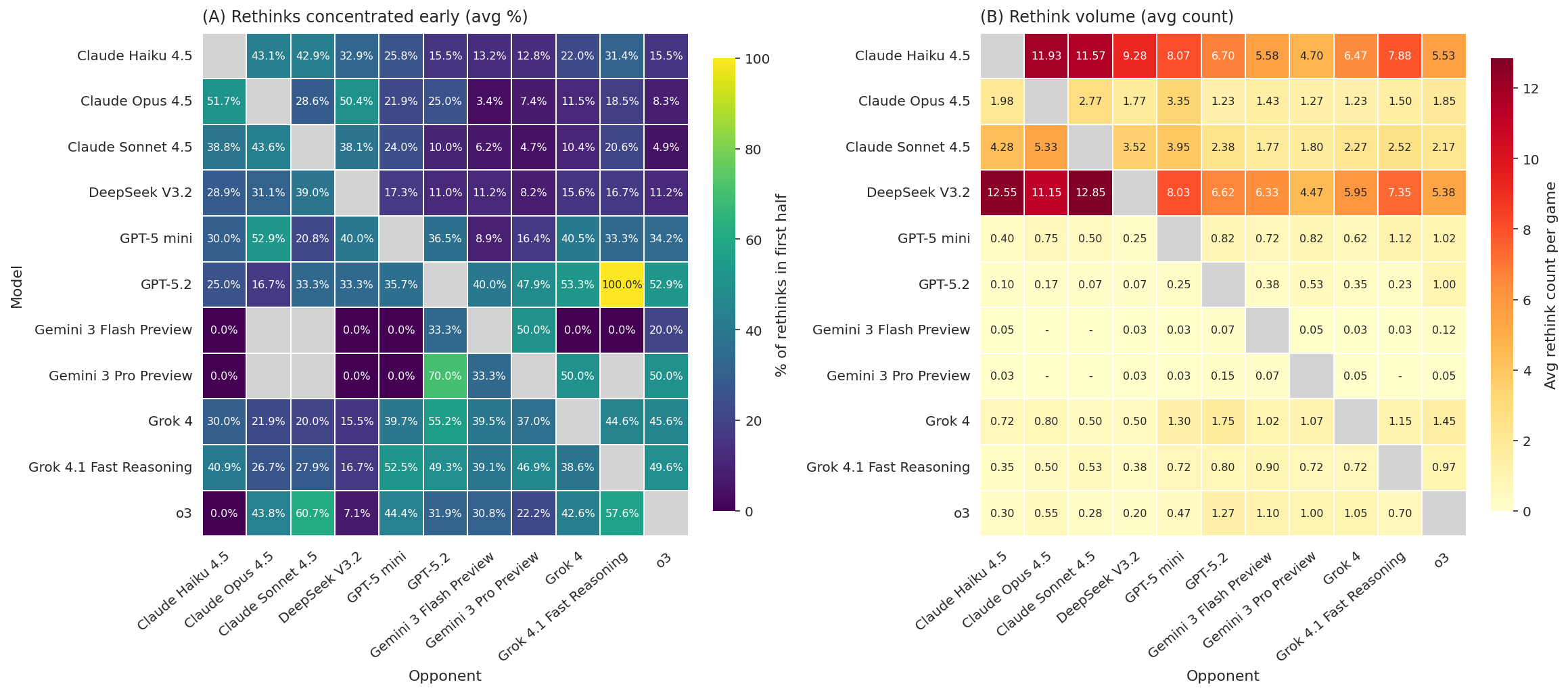
Weaker models also made more illegal moves as games continued, suggesting that they had increasing difficulty keeping track of complicated positions.
Poker results
Poker produced a different ranking from chess.
The strongest poker performers were:
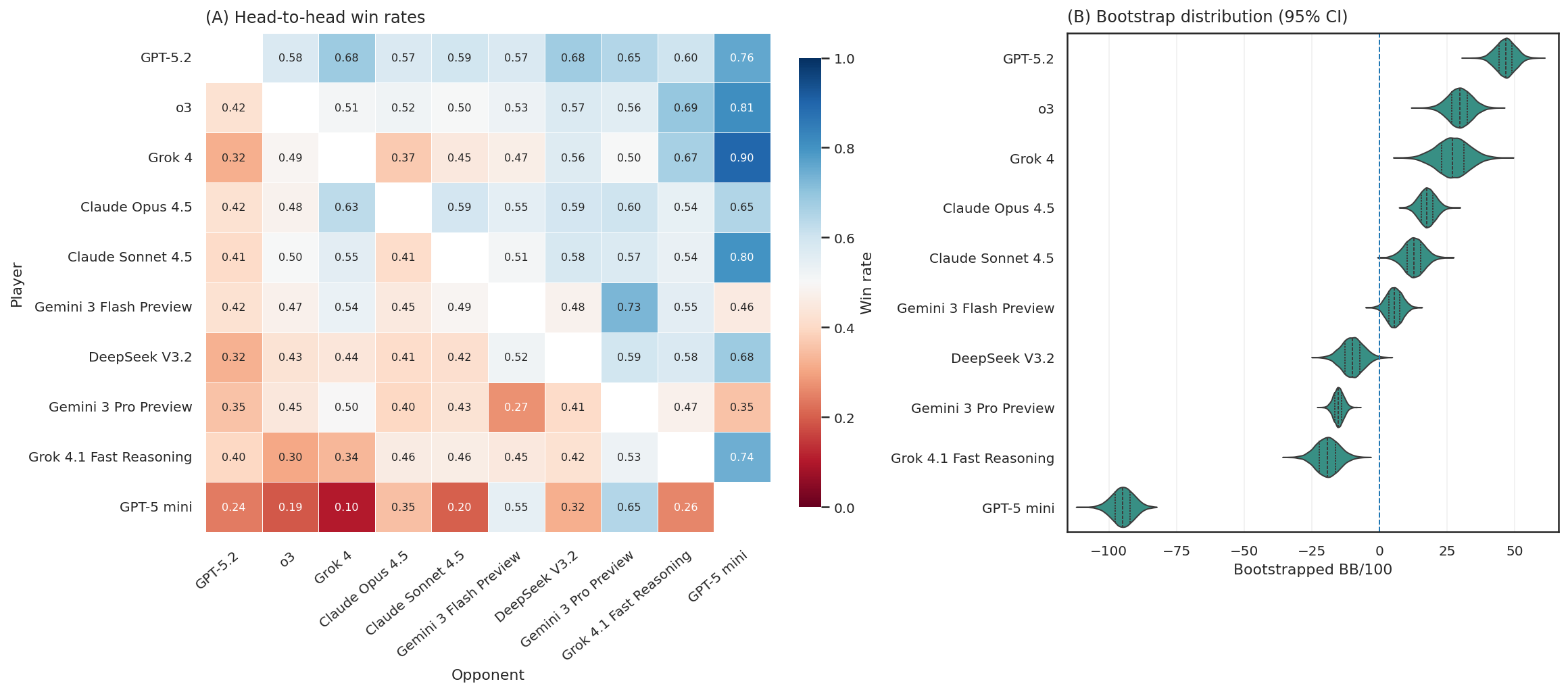
- GPT-5.2, with about +46.6 BB/100
- o3, with about +29.7 BB/100
- Grok 4, with about +27.1 BB/100
Several models had positive but smaller profits. Four models lost money overall, with GPT-5 mini performing worst at about −94.9 BB/100.
GPT-5.2 was the only model that had an advantage against every other model. This is important because it shows that a model that performs well in chess is not automatically the best poker player.
For example, Gemini 3 Pro Preview was one of the best chess models but lost money in poker. This shows that chess and poker require different kinds of intelligence:
- Chess rewards careful planning with complete information.
- Poker requires judging probabilities, managing risk, and guessing what another player might do.
Werewolf results
In Werewolf, the strongest models were:
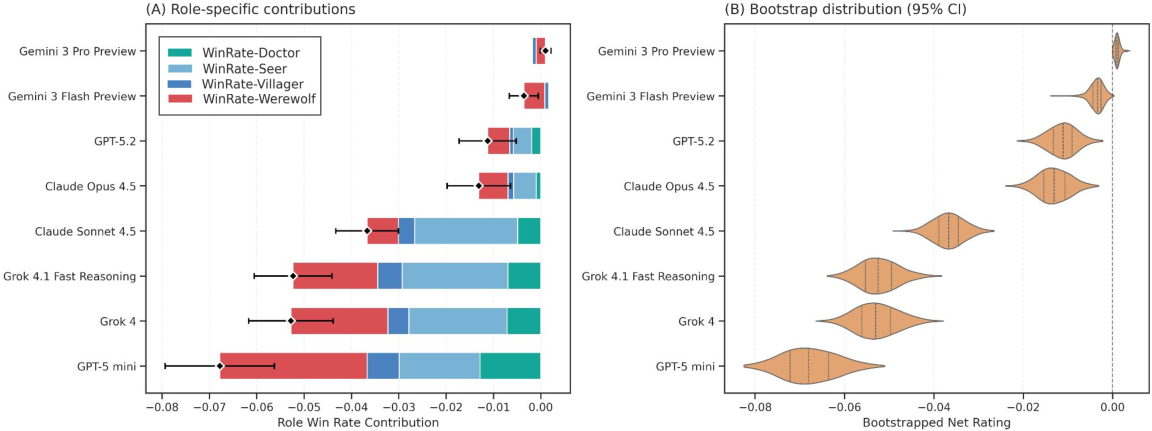
- Gemini 3 Pro Preview
- Gemini 3 Flash Preview
These models performed well in both kinds of roles: secret Werewolves and members of the informed or uninformed village team.
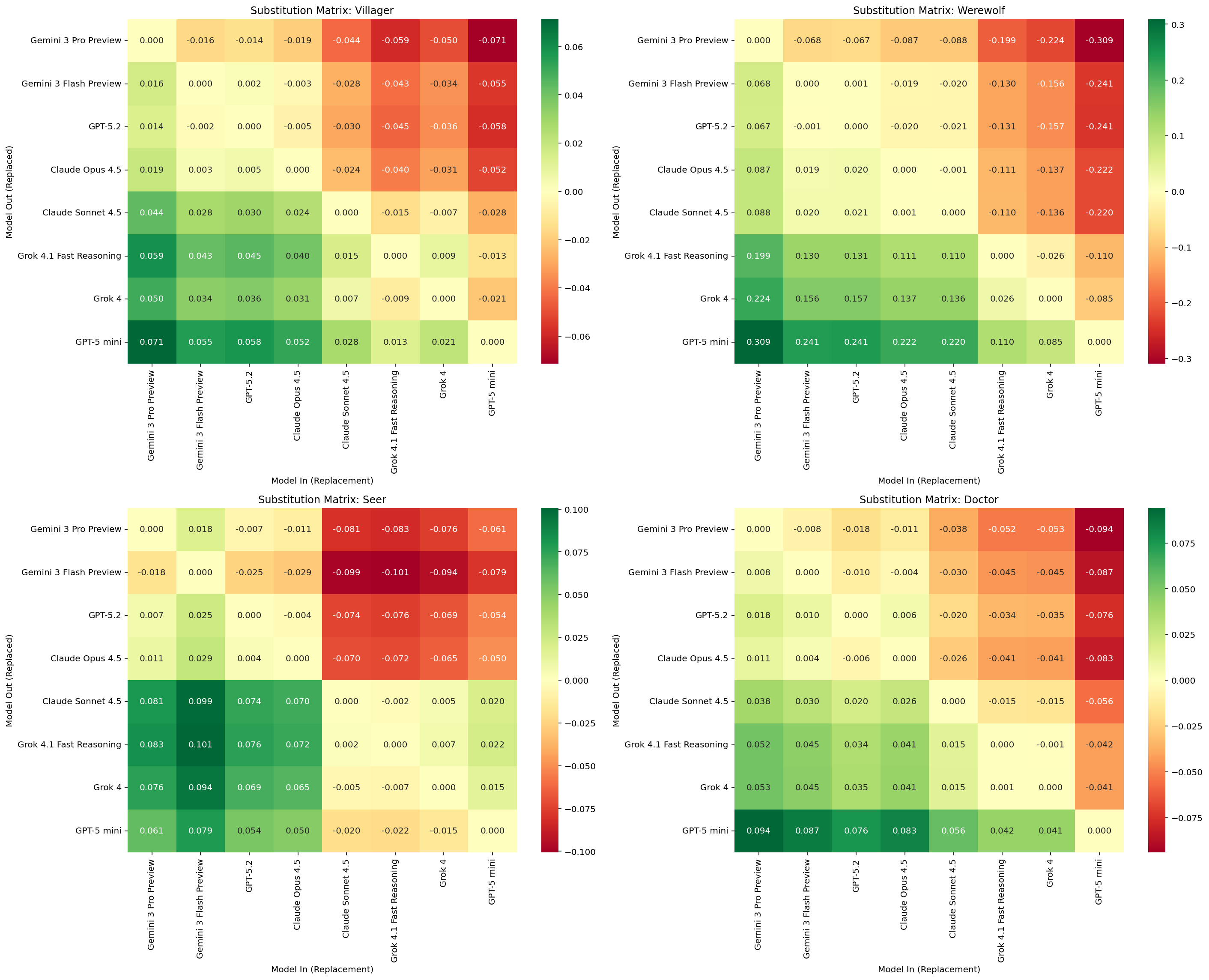
Some models had specific weaknesses. For example, certain models performed poorly as the Seer, possibly because they struggled to share private information without making themselves look suspicious.
GPT-5 mini performed poorly across nearly all roles, suggesting broader difficulties with both deduction and persuasion.
Werewolf also showed why ordinary rankings can be misleading. A player might win or lose partly because of which role they randomly receive. The GTE method tried to account for this role-based luck.
Rankings changed between games
One of the most important findings is that there was no single ranking that worked perfectly for every game.
A model could be excellent at chess but weaker at poker, or strong at Werewolf but less successful in another environment. This means that “strategic intelligence” is not just one simple ability. It includes many different skills.
5. Why are these findings important?
Game Arena could improve AI testing in several ways.
More realistic and changing tests
Fixed tests can become outdated or can accidentally appear in a model’s training data. Games are more difficult to memorize because every match changes depending on what the opponent does.
As models improve, they can play against stronger opponents. This helps the test remain challenging instead of becoming too easy.
More objective scoring
Human judges may disagree about which model gave the better answer. They may also prefer answers that are longer, more confident, or more polite, even when those answers are not more correct.
Games provide clearer evidence:
- A chess player wins, loses, or draws.
- A poker player gains or loses chips.
- A Werewolf team wins or loses, while role-specific methods help measure individual ability.
Better understanding of model behavior
Game Arena does not only produce a final ranking. It can also show why models perform differently.
For example, researchers can study:
- When a model begins making mistakes
- Whether it adapts to an opponent
- How often it makes illegal moves
- Whether it is better at cooperation or deception
- How much performance improves when more computing power is used
This could help developers improve future models.
Possible safety research
Werewolf provides a controlled way to study deception and manipulation. A model must sometimes play a deceptive role, but researchers can observe this inside a safe game rather than in a real-world situation.
The authors suggest that this could help test whether models can:
- Recognize manipulation
- Resist misleading arguments
- Understand how deceptive strategies work
Conclusion
This paper presents Game Arena as a new way to evaluate LLMs by making them compete in games. The system tests chess, poker, and Werewolf, which together measure planning, probability, adaptation, communication, teamwork, and deception.
The results show that models have different strengths. Being good at one game does not guarantee being good at another. This means future AI evaluations should test many kinds of abilities rather than relying on one score or one fixed collection of questions.
The platform could become a continuously updated “sports league” for AI models. New games and new models can be added over time, allowing researchers to track progress more fairly and discover where models still struggle. However, the researchers note that future versions should use computing resources more efficiently, handle new or retired models carefully, and add more games that test negotiation, cooperation, long-term planning, and understanding other people.
Knowledge Gaps
Knowledge gaps, limitations, and open questions
- Model selection is undocumented. The
Model selectionsubsection contains no criteria explaining why the evaluated models were chosen, how model versions were frozen, or whether differences in API access, context windows, system prompts, and inference settings were controlled. - The benchmark’s representativeness is unresolved. Chess, heads-up poker, and eight-player Werewolf cover only a narrow subset of strategic capabilities; performance may not generalize to negotiation, cooperation, long-horizon planning, real-time interaction, resource management, or games with continuous action spaces.
- The relationship between game performance and real-world capabilities is not established. The paper suggests relevance to financial strategy, supply chains, disaster response, and safety research, but provides no empirical evidence that scores in these games predict performance in such domains.
- The effect of prompting and system instructions is not isolated. The poker and Werewolf environments use highly specific prompts, including GTO objectives, required reasoning traces, ReAct formatting, and team-victory directives. It remains unclear how much rankings reflect prompt compatibility rather than underlying strategic ability.
- Reasoning traces are not validated as faithful explanations. The paper records and analyzes model-generated reasoning, but does not test whether these traces reflect the computations responsible for decisions, whether they improve performance, or whether they introduce additional bias and token costs.
- Inference-time configuration is insufficiently controlled. Temperature, sampling strategy, seed handling, reasoning-token budgets, latency constraints, model snapshots, and API nondeterminism are not fully reported, limiting reproducibility and making model comparisons difficult.
- The impact of invalid-action handling is unclear. Chess retries, poker fallback actions, and Werewolf turn forfeitures impose different penalties across environments and models. The paper does not quantify how alternative parser designs, retry budgets, or fallback policies would change rankings.
- Interface burden is confounded with strategic skill. Models must parse FEN/PGN/SAN, structured poker descriptions, or chronological Werewolf logs and produce exact action formats. The evaluation does not separate failures of language parsing and serialization from failures of planning or strategic reasoning.
- The external validity of text-only gameplay is unknown. The study does not compare text-based interaction with structured APIs, visual board interfaces, tool-assisted play, or agent architectures that can call chess engines, calculators, card evaluators, or memory systems.
- Chess evaluation uses a small per-pair sample. Forty games per model pair may be insufficient for stable rankings when many games are decisive through rare blunders, despite bootstrap intervals. The sensitivity of Elo estimates to this sample size is not systematically assessed.
- Chess opening coverage remains narrow. The opening variant uses only the 20 most popular two-ply openings from Lichess, leaving performance on uncommon, adversarial, randomly generated, or strategically unbalanced opening positions unexplored.
- The Stockfish-based analysis depends on unvalidated probability conversion. The method for converting centipawn evaluations into win probabilities and normalizing trajectories is not justified or calibrated across positions, game phases, or engine strengths.
- Chess strength is not comprehensively calibrated against human or engine standards. Calibration against Stockfish levels and CCRL mappings is described as unreliable outside the engine range, and no robust comparison with human rating pools is provided.
- Poker results may be specific to one game configuration. The benchmark uses heads-up no-limit Texas Hold’em with fixed blinds, 100-big-blind stacks, stack resets, and 100-hand episodes. It does not establish whether rankings persist under different stack depths, blind structures, antes, tournament formats, multiplayer tables, or limit variants.
- Duplicate poker may alter natural strategic behavior. Revealing both players’ hole cards after every hand and replaying mirrored deals provides strong variance reduction but creates an information regime unlike ordinary poker. The effect of this feedback on opponent modeling and strategy is not measured.
- The poker evaluation may not measure long-term adaptation adequately. Episodes are limited to 100 hands, and the paper does not compare performance across episode lengths or test whether models learn stable opponent models over substantially longer interactions.
- Poker performance is vulnerable to exploitability and matchup effects. Aggregate BB/100 can be driven by a few favorable opponents or highly exploitable strategies. The paper does not report exploitability against game-theoretic baselines, regret measures, strategy diversity, or performance against held-out opponents.
- Poker rankings may be sensitive to bankroll and payoff choices. Although BB/100 is standard, the study does not examine alternative utility functions, risk-sensitive metrics, variance, tail losses, or the effect of resetting stacks after every hand.
- The validity of required poker reasoning concepts is uncertain. Models are instructed to discuss range advantage, pot odds, and fold equity, but the paper does not evaluate whether the generated calculations and ranges are numerically correct or causally related to decisions.
- Werewolf rule and moderator choices may dominate results. The selected role distribution, discussion format, voting procedure, communication protocol, context truncation, and deterministic content filter are implementation-specific; the robustness of rankings across alternative rule sets is not demonstrated.
- The Werewolf balance analysis is not sufficient to establish fairness across models. Role balance is assessed at the environment level, but the paper does not fully quantify how role assignment, seating order, speaking order, communication timing, or coalition structure affects individual model outcomes.
- Credit assignment in multiplayer games remains unresolved. The GTE framework produces role-specific parameters, but the paper does not establish whether these parameters accurately separate individual reasoning, team coordination, influence over other agents, and luck in multi-agent outcomes.
- Werewolf evaluation may contain uncontrolled social biases. Differences in verbosity, assertiveness, deception style, cultural norms, and moderation or language-filter behavior could affect votes independently of deduction ability; these factors are not experimentally disentangled.
- Cross-game rankings lack a validated common scale. The paper explicitly leaves consolidated rating across Chess, Poker, and Werewolf unresolved, so claims about general strategic capability remain limited to within-game comparisons.
- The statistical treatment may not capture all dependence structures. Bootstrap procedures are described, but the analyses do not fully address repeated model pairings, shared random seeds or decks, adaptive opponent histories, multi-player dependence, or uncertainty introduced by fitting rating models.
- Multiple comparisons and ranking instability are not fully addressed. The study reports many pairwise comparisons, tiers, and role-specific effects, but does not clearly state corrections for multiple testing or provide ranking stability under alternative statistical specifications.
- The benchmark’s resistance to contamination is asserted rather than demonstrated. Dynamic gameplay reduces direct test-set memorization, but fixed rules, prompt templates, opening distributions, public trajectories, and released datasets could still enter future training corpora. No contamination audit or adversarial memorization study is presented.
- Longitudinal comparability is currently unresolved. Model churn, discontinued APIs, changing model snapshots, and evolving game variants may make future rankings incomparable with the reported results; the paper proposes solutions but does not implement or validate them.
- Adaptive scheduling has not yet been evaluated. Fixed sample sizes are acknowledged as inefficient, but no sequential testing, stopping rule, or uncertainty-aware allocation method is tested to determine whether compute can be reduced without distorting rankings.
- The cost–performance analysis is incomplete. Cost is compared across environments, but the paper does not specify whether it includes input tokens, output tokens, retries, reasoning tokens, endpoint charges, latency, or infrastructure costs, making Pareto conclusions difficult to reproduce.
- Human and expert baselines are absent. Without human players, classical game-playing agents, or game-theoretic reference policies in the primary comparisons, it is difficult to interpret whether the models exhibit meaningful competence or merely outperform other LLMs.
- The paper does not test training or adaptation effects. It remains unknown whether fine-tuning, in-context examples, self-play, memory across matches, or reinforcement learning would improve performance and whether such improvements transfer across games.
- The effects of tool use and agent scaffolding are unexplored. The benchmark primarily evaluates standalone model responses; it does not determine how retrieval, external search, calculators, planning modules, tree search, persistent memory, or specialized game engines change strategic performance.
- Safety conclusions from Werewolf are preliminary. Although the environment is proposed as a sandbox for deceptive-capability and safeguard research, the paper does not define safety metrics, distinguish fictional role-play from harmful deception, or show that Werewolf behavior predicts real-world misuse or robustness.
Practical Applications
Immediate Applications
The paper’s open-source harness, reproducible game trajectories, objective outcome metrics, and large-scale evaluation procedures support the following applications that can be deployed with existing infrastructure.
- Continuous quality evaluation for LLM providers and AI labs — software/AI engineering
- Integrate Chess, Poker, and Werewolf matches into model release pipelines to test planning, uncertainty handling, communication, deception resistance, and action reliability before and after a model update.
- Use game-specific metrics such as Elo, BB/100, role-specific Werewolf ratings, invalid-action frequency, and confidence intervals rather than relying only on static question-answer benchmarks.
- Potential tool: a
Game Arena-style regression-testing service that runs selected matchups nightly and flags statistically meaningful capability regressions. - Dependencies: access to model APIs, stable prompt and model versions, sufficient evaluation budget, and controls for nondeterministic model behavior.
- Model selection based on cost–performance trade-offs — cloud computing and enterprise software
- Use the paper’s Pareto-frontier analysis to select models for agentic applications where inference cost and strategic reliability must be optimized jointly.
- For example, a lower-cost model could be selected for routine decisions, while a stronger model is routed to ambiguous or high-impact cases.
- Potential workflow: maintain separate routing policies for perfect-information tasks, uncertainty-heavy tasks, and multi-agent communication tasks rather than choosing one universally “best” model.
- Dependencies: benchmark performance must correlate with the target application; token prices, latency, context-window limits, and model availability may change over time.
- Reliability testing for structured-output agents — software, robotics, and automation
- Adopt the harness’s invalid-action retries, strict parsers, deterministic fallback actions, and action-level logging to test agents that operate APIs, simulators, workflow systems, or robots.
- Chess provides a direct analogue for legal-action validation, while Werewolf demonstrates visibility-controlled event logs and role-specific state access.
- Potential product: an agent reliability middleware layer that validates actions, retries malformed outputs, records failures, and applies safe fallback behavior.
- Dependencies: fallback actions must be safe for the target domain; retry mechanisms should not accidentally duplicate financial transactions, physical movements, or other irreversible operations.
- Strategic regression diagnosis rather than simple leaderboard ranking — AI engineering and research
- Use Stockfish-style temporal analysis to identify when a model begins making poor decisions, such as during long-horizon planning, late-stage state tracking, or endgame reasoning.
- Apply the same approach to domain simulators by recording state trajectories and scoring decisions with an external evaluator or domain-specific objective function.
- Potential tool: dashboards showing performance degradation by decision horizon, state complexity, action type, and opponent strength.
- Dependencies: a trustworthy external evaluator is required; engine scores or simulator rewards may not fully represent real-world usefulness.
- Benchmarking opponent modeling and adaptation — finance, cybersecurity, and operations research
- Use repeated Poker episodes, revealed outcomes, and complete interaction histories to test whether an agent updates beliefs about an opponent or environment over time.
- Relevant applications include adversarial cybersecurity simulations, competitive pricing simulations, supply-chain disruption exercises, and negotiation training.
- Potential workflow: evaluate an agent on repeated scenarios with the same counterpart, compare performance with and without history, and measure whether behavior adapts appropriately.
- Dependencies: simulated opponent behavior must be realistic; poker performance should not be interpreted as direct evidence of financial trading skill.
- Safety red-teaming for manipulation and deception — AI safety and trust-and-safety
- Use Werewolf as a controlled sandbox for evaluating an agent’s ability to generate, detect, resist, and communicate under deceptive or asymmetric-information conditions.
- Test whether safety policies remain effective when the model is assigned conflicting roles, asked to persuade other agents, or exposed to private and public information channels.
- Potential tool: a red-team suite with role-conditioned prompts, event-level visibility controls, and automatic detection of policy violations or manipulative strategies.
- Dependencies: success in a social-deduction game is not equivalent to real-world deceptive capability; game rules, prompts, and moderation filters can substantially affect results.
- Academic research on strategic reasoning and agent behavior — universities and research labs
- Reuse the released trajectories, event logs, reasoning traces, and evaluation harness to study planning, belief updating, risk management, communication, coalition formation, and theory of mind.
- Researchers can conduct ablations on opening conditions, discussion formats, voting rules, context truncation, retry policies, and reasoning prompts.
- Potential outputs: reproducible datasets for supervised fine-tuning, preference modeling, process evaluation, or causal studies of agent behavior.
- Dependencies: reasoning traces may be incomplete or strategically generated rather than faithful explanations; privacy, licensing, and API terms must be checked before redistribution or training.
- Education and training in AI evaluation and game theory — education
- Use the platform to teach Elo estimation, Bradley–Terry models, bootstrapping, variance reduction, game-theoretic evaluation, and experimental design.
- Students can compare how a model performs across planning, stochastic decision-making, and social inference instead of treating “reasoning ability” as a single dimension.
- Potential product: interactive courses or laboratory assignments in machine learning, statistics, game theory, and AI safety.
- Dependencies: educational deployments require simplified interfaces, documented datasets, and safeguards against equating benchmark scores with general intelligence.
- Personal and recreational AI coaching — daily life and gaming
- Build chess analysis or strategy-coaching assistants that use game trajectories to identify recurring errors, illegal moves, poor endgame decisions, risk preferences, or weak adaptation to opponents.
- The same infrastructure could support transparent AI-vs-AI tournaments in chess, poker simulations, or social-deduction games.
- Dependencies: poker-related tools should use play-money or educational settings and comply with gambling regulations; coaching feedback should be validated to avoid teaching strategically unsound behavior.
- Policy and procurement standards for foundation models — public-sector AI governance
- Governments and large organizations can require vendors to report performance on dynamic, ground-truth-based interactive evaluations, including uncertainty estimates and failure rates.
- Procurement documents could distinguish planning, risk management, communication, and robustness rather than relying on a single general benchmark score.
- Dependencies: rankings can be affected by model version, prompts, API latency, system instructions, and compute allocation; independent replication is necessary for high-stakes use.
Long-Term Applications
The following applications require additional research, larger deployment environments, stronger validation, or integration with real-world simulators and decision systems.
- Adaptive evaluation schedulers that reduce benchmark cost — AI infrastructure
- Replace the current fixed number of games per model pair with uncertainty-aware sampling that allocates more games to closely matched models and stops early for clearly separated matchups.
- This could make continuous evaluation feasible for large model catalogs while preserving statistical confidence.
- Dependencies: valid stopping rules, correction for repeated testing, robust handling of nonstationary models, and guarantees that adaptive scheduling does not bias rankings.
- Longitudinal model monitoring under model churn — model governance
- Develop persistent rating systems that maintain comparability as models are introduced, retired, updated, or made unavailable.
- A practical system would use anchor models, cold-start protocols, connected match graphs, and versioned leaderboards to detect capability drift across releases.
- Dependencies: continued access to anchor models, stable evaluation environments, and methods for separating genuine improvement from changes in prompting, sampling, or inference-time compute.
- Cross-domain meta-ratings for strategic competence — AI evaluation
- Construct a consolidated rating across Chess, Poker, Werewolf, negotiation, planning, and cooperation environments while preserving each game’s distinct outcome structure.
- A future meta-rating could report a capability profile rather than a single score, for example: planning strength, uncertainty management, social inference, communication reliability, and adversarial robustness.
- Dependencies: cross-game comparability is technically difficult; a single aggregate score could conceal important weaknesses and encourage benchmark gaming.
- Training agents for real-world decision-making under uncertainty — finance, logistics, energy, and disaster response
- Use game-based self-play and opponent modeling to train agents for sequential decisions involving uncertain states, competing stakeholders, limited resources, and changing strategies.
- Potential applications include supply-chain allocation, electricity-market simulations, emergency-response coordination, inventory management, and auction strategy.
- Dependencies: transfer from games to real-world domains is unproven; realistic simulators, calibrated uncertainty estimates, domain constraints, human oversight, and safety validation are required. Poker performance alone cannot establish suitability for financial decisions.
- Multi-agent negotiation and collaboration systems — enterprise software and robotics
- Extend the Werewolf event-bus design to multi-agent systems in which agents have different permissions, objectives, private observations, and communication channels.
- Possible systems include warehouse robots coordinating with partial information, software agents negotiating task allocation, or organizational assistants mediating conflicting constraints.
- Dependencies: reliable credit assignment in multiplayer settings, protection against collusion, communication security, fairness mechanisms, and robust handling of malicious or unreliable agents.
- Safety certification for autonomous agents — robotics, cybersecurity, and critical infrastructure
- Build certification suites that combine legal-action testing, adversarial opponents, asymmetric information, deception red-teaming, and long-horizon stress tests.
- A system could require an agent to demonstrate bounded failure rates, safe fallback behavior, resistance to manipulation, and stable performance across role assignments and environment variants.
- Dependencies: game environments must be shown to predict real-world hazards; certification thresholds need domain-specific validation, and simulations cannot replace physical testing or operational monitoring.
- Strategic planning assistants with external verifiers — software and decision support
- Combine LLM agents with search engines, simulators, optimization solvers, or domain-specific evaluators in a loop analogous to LLM-plus-Stockfish analysis.
- The assistant could generate plans, receive objective feedback, revise actions, and present users with both a recommendation and a trajectory-level diagnosis.
- Dependencies: external evaluators must be accurate and resistant to reward hacking; the system needs safeguards against overconfidence, hidden objective mismatch, and excessive computational cost.
- Benchmark generation resistant to memorization and contamination — academia and policy
- Expand the platform with procedurally generated games, unseen variants, randomized rules, changing opponents, and private evaluation servers.
- Dynamic game generation could help distinguish memorized patterns from genuine strategic generalization.
- Dependencies: generated environments must remain interpretable, balanced, and reproducible; procedural novelty should not introduce arbitrary difficulty or make results impossible to compare over time.
- Human–AI interaction and communication assessment — education, healthcare, and public services
- Adapt multiplayer environments to evaluate whether an AI can communicate uncertainty, share private information appropriately, form consensus, and avoid misleading users.
- In healthcare or public-service settings, this could inform testing of assistants that coordinate with clinicians, case workers, or multiple decision-makers.
- Dependencies: game competence does not establish clinical or administrative competence; deployment would require human-subjects research, domain-specific outcome measures, privacy protections, and strong oversight.
- Real-time adaptive tutoring and skill development — education and gaming
- Use game trajectories to create personalized curricula that target specific weaknesses, such as poor planning depth, risk calibration, invalid action generation, or failure to revise beliefs after feedback.
- An adaptive tutor could alter game difficulty, opponent style, information availability, or time limits based on the learner’s error profile.
- Dependencies: pedagogical effectiveness must be tested with human learners; model-generated explanations may be unreliable, and competitive game framing may not suit all users.
- Economic and organizational simulations for policy analysis — government and research
- Build richer multi-agent simulations using Game Arena’s modular rules, event logs, role-specific observations, and objective scoring.
- These could support studies of coalition formation, strategic communication, market behavior, crisis coordination, and institutional rule design.
- Dependencies: simulations are sensitive to their assumptions about incentives and agent behavior; results should be treated as exploratory evidence rather than forecasts without empirical calibration to real-world data.
Glossary
- Ablation study: An experiment that removes or changes one component of a system to measure its effect. “To facilitate ablation studies on game rules”
- Asymmetric information: A situation in which different participants possess different information about the game state. “Werewolf is a multiplayer, general-sum social-deduction game driven by information asymmetry.”
- Bootstrapped confidence interval: An uncertainty interval estimated by repeatedly resampling observed data. “we employed variance reduction techniques and provide bootstrapped confidence intervals for evaluation.”
- Bradley–Terry model: A statistical model that estimates the relative strengths of competitors from pairwise outcomes. “model strength is quantified via Elo-style ratings derived from the Bradley--Terry model”
- Block bootstrap: A resampling method that preserves dependence among observations by sampling groups or blocks rather than individual observations. “confidence intervals obtained via block bootstrap over episodes to account for within-episode correlation.”
- CCRL Elo mapping: A correspondence between engine-calibrated chess ratings and the ratings published by the Computer Chess Rating Lists. “interpolating against reference CCRL Elo mappings”
- Centipawn loss: A chess-engine measure of how much a move worsens a position, expressed in hundredths of a pawn. “Stockfish's centipawn loss predictions were converted into estimated win probabilities”
- Coalition building: The formation of cooperative groups among players pursuing aligned interests. “models must exercise ``soft skills'' such as negotiation, coalition building”
- Cold-start evaluation: Evaluation of a newly introduced model before it has accumulated comparative results in an existing system. “including ``cold-start'' evaluation”
- Context overflow: A condition in which an input exceeds the model’s available context window. “iterative truncation (preserve latest 75\% context each time) for context overflows”
- Data contamination: The leakage of evaluation examples into a model’s training data, potentially inflating measured performance. “their ability to distinguish between different systems decreases~\citep{white2024livebench}. Furthermore, the static nature of these benchmarks makes them susceptible to data contamination”
- Decisive outcome: A result that directly determines a win, loss, draw, or other objective performance value. “in all games, we use decisive outcomes including wins, losses, draws or chip counts to compute metrics”
- Duplicate poker: A poker evaluation format in which identical deals are replayed while players’ seats or cards are exchanged to reduce luck-related variance. “we adopted a duplicate poker format (hand-mirroring).”
- Elo rating: A rating system that estimates relative player strength from game results. “For Chess, model strength is quantified via Elo-style ratings”
- Event bus: A software component that distributes recorded events to subscribers according to specified rules. “A centralized event bus enforces information asymmetry by filtering and dispatching these records to individual models”
- Exponential backoff: A retry strategy that progressively increases the waiting time between failed requests. “exponential backoff over endpoint failure”
- Forsyth–Edwards Notation (FEN): A compact textual representation of a chessboard position. “the model receives the current position in Forsyth-Edwards Notation (FEN)”
- Fold equity: The probability that a poker opponent will fold, multiplied by the value gained when they do so. “fundamental concepts like range advantage, pot odds, and fold equity”
- Game-theoretic evaluation (GTE): An evaluation framework that estimates strategic ability using game-theoretic and role-specific outcome contributions. “We therefore employ a game-theoretic evaluation (GTE) framework”
- Game-theoretic optimal (GTO): A strategy designed to maximize expected performance while being difficult for opponents to exploit. “The model is instructed to default to a game-theoretic optimal (GTO) strategy”
- General-sum game: A game in which players’ payoffs may have both shared and conflicting components, rather than being strictly zero-sum. “Werewolf is a multiplayer, general-sum social-deduction game”
- Ground-truth outcome: An objectively verifiable result used as the basis for evaluation. “A more reliable alternative is to anchor on ground-truth outcomes.”
- Heads-up no-limit Texas Hold’em (HU-NLHE): A two-player version of Texas Hold’em in which players may wager any amount up to their available chips. “Models competed in heads-up no-limit Texas Hold'em (HU-NLHE)”
- Information asymmetry: Unequal access to relevant information among players or agents. “forcing models to both generate and detect manipulation in a controlled setting.”
- Inference cost: The computational or monetary cost of producing a model response. “average inference cost per game”
- Longitudinal analysis: Analysis that tracks changes or trends across time. “This data-centric design enables longitudinal analysis of model behavior”
- Mixed strategy: A strategy that randomizes among multiple actions with specified probabilities. “complexity naturally emerges from the players' mixed strategies”
- Opponent modeling: Representing and predicting an opponent’s behavior to improve decision-making. “This aspect of the game, often referred to in the literature as opponent modeling”
- Out-of-distribution scenario: A situation that differs from the examples or conditions encountered during training or development. “The complexity and strategic depth of gameplay precludes rote memorization and assesses a model's ability to handle out-of-distribution scenarios.”
- Pareto frontier: The set of options for which no alternative is simultaneously better in performance and no more costly. “The dashed blue curve denotes the Pareto frontier within that environment”
- Perfect-information game: A game in which every player can observe the complete relevant state of play. “Chess is a classic perfect-information game.”
- Pot odds: The ratio between the amount a player must call and the total pot that can be won in poker. “fundamental concepts like range advantage, pot odds, and fold equity”
- Range advantage: A poker situation in which one player’s possible holdings are, on average, stronger than an opponent’s possible holdings. “fundamental concepts like range advantage, pot odds, and fold equity”
- Round-robin tournament: A competition in which every participant plays against every other participant. “Across a full ten-model round-robin tournament”
- Strategic generalization: The ability to apply strategic reasoning successfully across novel situations or environments. “supports research into benchmark design itself to actively combat memorization and contamination, and improve strategic generalization.”
- Sycophancy: A model tendency to agree with or flatter a user rather than provide an independent judgment. “they are susceptible to biases such as verbosity preference and sycophancy”
- Theory of mind: The ability to infer other agents’ beliefs, intentions, knowledge, or goals. “a focused scope of four theory-of-mind style card games.”
- Variance reduction: Statistical or experimental techniques used to decrease the influence of random fluctuations on estimates. “To mitigate the high variance inherent to poker, we adopted a duplicate poker format”
- Variance saturation: A condition in which additional progress produces little apparent improvement on a fixed evaluation measure. “as the performance of frontier models on these fixed test sets approaches saturation”
- Voluntarily put money in pot (VPIP): A poker statistic measuring how often a player voluntarily invests chips in a hand before the flop. “VPIP = voluntarily put money in pot.”
- Zero-sum game: A game in which one player’s gain exactly equals another player’s loss. “These studies consistently show that even strong models struggle in perfect-information deterministic games”

