Two's a Crowd: Human and AI-Based Copresence for Developers with ADHD
Abstract: Effective collaboration and communication are vital to developer productivity and well-being, yet remain constrained by human factors such as attention, intrinsic motivation, and interpersonal accountability. These constraints are particularly vital for developers identifying with Attention Deficit Hyperactivity Disorder (ADHD), who navigate persistent environmental barriers in modern hybrid workplace settings. While developers with ADHD frequently rely on collaborative copresence practices (such as body doubling or pair programming) to support executive function, the recent emergence of agentic AI coding assistants has begun reshaping these collaborative dynamics. To investigate how developers with ADHD engage in human and AI-based copresence practices, we conducted semi-structured interviews with 14 software engineers with ADHD. Our findings reveal that while traditional human-human copresence provides critical social support and onboarding structure, it forces developers to constantly manage professional reputation and sacrifice personal privacy. Conversely, developers leverage emerging human-AI copresence to maintain accountability and cognitive flow without the social anxiety, performance judgment, or surveillance associated with human observation. Based on these empirical insights, we map developer copresence practices onto core dimensions of Goffman's copresence theory and Forsgren et al.'s SPACE framework of developer productivity, and provide design recommendations for AI-based tools that promote inclusive collaboration for developers with ADHD.
Paper Prompts
Sign up for free to create and run prompts on this paper.
Top Community Prompts
Explain it Like I'm 14
1. What is the paper about?
This paper studies how software developers with ADHD use other people and AI to help them work.
The researchers focus on a practice called copresence. Copresence means working while another person—or an AI tool—is present. The other “partner” does not always need to help directly. Simply knowing that someone else is there can make it easier to begin a task, stay focused, and finish work.
Examples include:
- Body doubling: Two people work near each other or on a video call, often doing separate tasks.
- Pair programming: Two developers work together on the same programming problem.
- AI copresence: A developer works alongside an AI coding assistant such as GitHub Copilot or Claude.
The paper asks whether AI can provide some of the helpful structure of a human partner without causing the worry or pressure that can come from being watched by another person.
2. What questions did the researchers ask?
The researchers wanted to understand three main things:
- How do developers with ADHD use copresence? Do they work with coworkers, friends, family members, or AI tools? Do they use body doubling or pair programming?
- What problems do they experience? Does working with another person help them focus, or does it create distractions, anxiety, or privacy concerns?
- How should AI tools be designed? What should an AI coding partner do to help developers with ADHD work effectively while also protecting their comfort, privacy, and well-being?
3. How was the research carried out?
Participants
The researchers interviewed 14 professional software developers with ADHD who lived in the United States. Some had a formal diagnosis, while others identified as having ADHD and also completed a questionnaire used to screen for ADHD symptoms.
The participants had between 1 and 25 years of experience in software development. They worked in different ways:
- In offices
- Remotely
- In hybrid workplaces, combining office and remote work
Interviews
Each person took part in a roughly one-hour interview over Zoom. The questions covered:
- Their experiences with body doubling
- Their experiences with pair programming
- Their use of AI coding tools
- The benefits and problems of working with people or AI
- Ideas for better AI support
The interviews were semi-structured. This means the researchers had prepared questions but also allowed participants to explain unexpected experiences in their own words.
Analyzing the interviews
The researchers used thematic analysis. In simple terms, they read the interview transcripts carefully and looked for repeated ideas.
For example, if many participants talked about feeling watched by coworkers, the researchers grouped those comments under a theme such as performance anxiety. After comparing the interviews, the researchers organized their findings into three major themes.
The researchers also used the SPACE framework, which describes productivity in several ways:
- Satisfaction and well-being: Do workers feel healthy and comfortable?
- Performance: Are they producing useful, high-quality work?
- Activity: What work are they doing?
- Communication and collaboration: How well do they work with others?
- Efficiency and flow: Can they focus deeply without constant interruptions?
This framework is important because productivity is not just about writing lots of code. A person’s mental health, teamwork, and ability to concentrate matter too.
4. What did the researchers find?
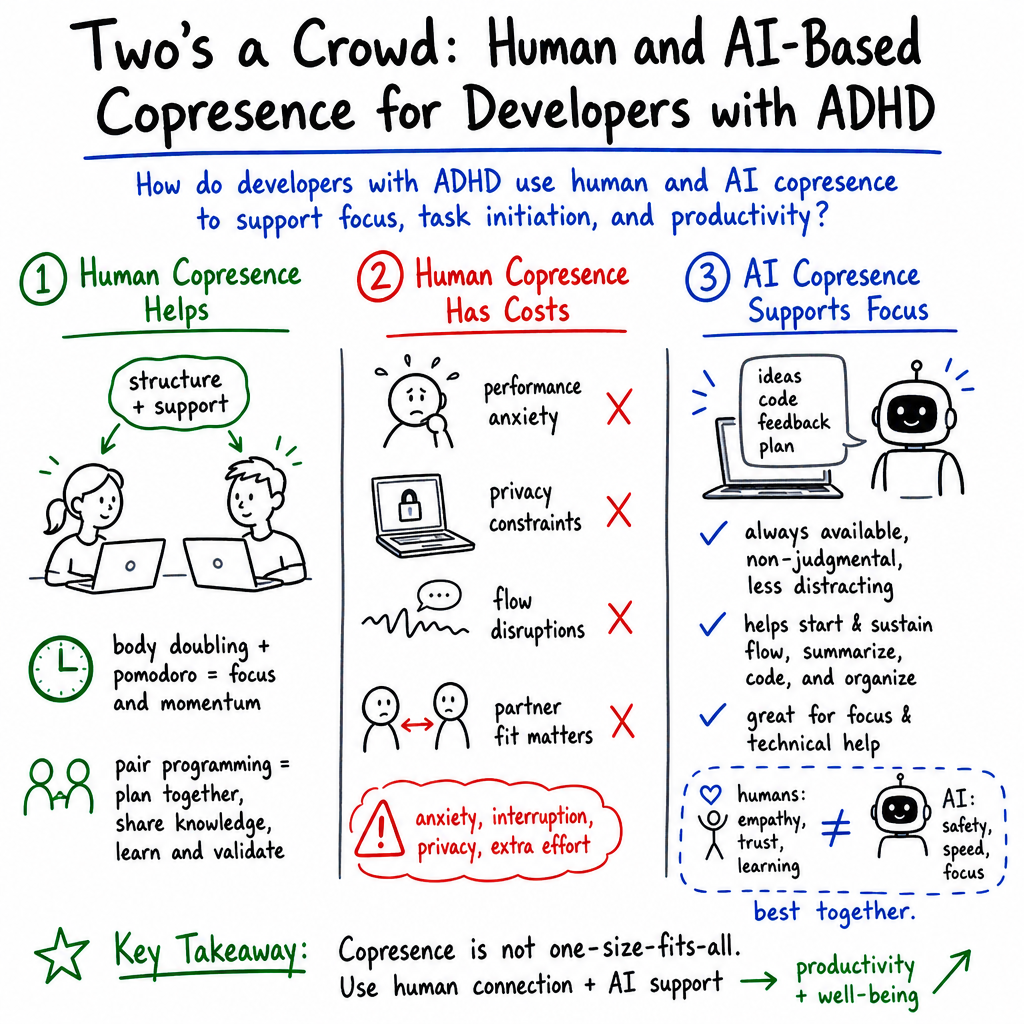
Human copresence helps people start and continue tasks
Many participants said that working near another person helped them begin tasks that otherwise felt overwhelming. Seeing someone else work created a feeling of shared effort.
For example, a developer might find it easier to start coding during a video call where both people quietly work for 25 minutes and then take a five-minute break. This is similar to the Pomodoro technique, which divides work into timed focus periods and breaks.
Human copresence helped with:
- Starting difficult tasks
- Staying accountable
- Organizing time
- Taking regular breaks
- Feeling less alone
- Getting encouragement and feedback
Human partners were especially useful when developers needed to learn a complicated system or solve a difficult problem.
Human partners can also create anxiety
Although human help was valuable, it sometimes made participants nervous. Developers worried that coworkers might judge them for:
- Working too slowly
- Asking “obvious” questions
- Making mistakes
- Losing focus
- Not understanding the code
Some participants felt they had to act like a “professional version” of themselves while others watched. This required extra mental effort and reduced their comfort.
The researchers connect this to invisible access labor. This means the hidden work people do to adjust to systems that were not designed for their needs. For example, a developer with ADHD may spend a lot of energy hiding their difficulty starting a task instead of using that energy to solve the task.
Human collaboration can interrupt deep focus
Some participants experienced flow, a state of very deep concentration in which they become fully absorbed in a task. Human conversations, unexpected calls, or changes in another person’s work could break this concentration.
For that reason, participants often preferred different types of copresence for different tasks:
- Quiet body doubling for staying focused on individual work
- Pair programming for debugging, learning, or solving a complex problem
- Human experts for checking important or risky code
This suggests that one collaboration style does not work for every situation.
AI can provide support without social pressure
Most participants had used AI coding tools, and many viewed them as useful partners. AI could help them:
- Begin a task
- Explain unfamiliar code
- Summarize a large codebase
- Create a basic starting structure
- Check or improve code
- Answer questions immediately
- Keep their thoughts organized
- Work without unrelated conversation
A major advantage was that AI did not judge them. Developers could ask the same question many times, experiment, or admit confusion without worrying about how a human coworker might react.
AI was also always available and did not need to schedule a meeting. This made it easier to use AI when motivation or attention was low.
AI does not replace human expertise
The participants also identified important limits. AI can produce code quickly, but it may produce code that is:
- Incorrect
- Difficult to maintain
- Unsafe
- Poorly designed
- Unsuitable for an important production system
When AI writes large amounts of code, the human developer still has to check it. This can create a new burden: the developer must search for hidden mistakes and make sure the code fits the larger project.
One participant compared AI to driving a very fast car without a bird’s-eye view. AI may help the developer move quickly, but a human expert is still needed to ask whether they are heading in the right direction.
Human partners were especially important for:
- Checking high-risk code
- Understanding company-specific systems
- Making architectural decisions
- Teaching and mentoring
- Providing trustworthy judgment
- Offering emotional support
Poorly coordinated AI use can confuse teams
AI can also cause problems when two humans are working together. If one person secretly or suddenly asks an AI to make changes, the other person may not understand what is happening.
This can break the team’s shared mental model—their common understanding of the problem, the plan, and the code. It is like trying to build a model together while one person changes the instructions without telling the other.
The researchers therefore found that people using AI during teamwork need to explain:
- When they are using AI
- What they asked it to do
- What changes it made
- Whether the team agrees with those changes
AI offers less emotional connection
AI can imitate check-ins or reminders, but participants said it does not truly understand emotions. A human friend or coworker can notice that someone is tired, frustrated, or needs a genuine break.
This creates a trade-off:
| Human copresence | AI copresence |
|---|---|
| Offers emotional support and expert advice | Offers immediate, judgment-free help |
| Can teach and verify difficult work | Can maintain focus and reduce interruptions |
| May cause anxiety about being watched | Usually creates less social pressure |
| Can be distracting or difficult to schedule | Is available whenever needed |
| Requires attention to privacy and reputation | May create concerns about data and code security |
5. Why are these findings important?
The study shows that developers with ADHD do not simply need to “try harder” to concentrate. The design of the workplace and the tools they use strongly affects their ability to work.
A helpful tool should not only make developers faster. It should also help them:
- Start tasks more easily
- Protect their attention
- Avoid unnecessary stress
- Feel safe asking questions
- Keep their work private
- Receive human support when needed
The researchers suggest that future AI tools should include features such as:
- Quiet focus modes
- Optional, timed check-ins
- Break reminders
- Progress tracking without judgment
- Privacy-protecting ways to show that someone is working
- Clear explanations of AI-generated code
- Warnings when code may be risky
- Better ways for humans and AI to share plans
- Controls that let users decide how often AI interrupts them
Conclusion
The paper’s main message is that both humans and AI can help developers with ADHD, but they help in different ways.
Human partners provide encouragement, emotional connection, teaching, and expert judgment. However, being watched by another person can create anxiety, interruptions, and privacy concerns.
AI partners can offer constant, judgment-free support and help developers maintain focus. However, AI does not truly understand emotions and cannot always recognize whether its code is safe or appropriate.
The best future may not be choosing humans or AI. Instead, workplaces could combine them: AI could help with focus, routine tasks, and explanations, while trusted human teammates provide guidance, emotional support, and final checks for important work. This could make software development more accessible, less stressful, and more effective for people with ADHD.
Knowledge Gaps
Knowledge gaps, limitations, and open questions
- Small, demographically narrow sample: The study includes only 14 U.S.-based participants, with a substantial gender imbalance (11 men and 3 women), limiting transferability across genders, regions, cultures, and employment contexts.
- Limited representation of ADHD experiences: Participants vary in diagnosis status and screening scores, but the study does not examine how ADHD presentation, symptom severity, comorbidities, medication use, or treatment status shape copresence preferences and outcomes.
- Reliance on self-identification and retrospective reports: The findings are based on participants’ accounts rather than direct observation or behavioral data, leaving uncertainty about how copresence practices unfold in actual development sessions.
- No neurotypical or other-neurodivergent comparison group: The study cannot establish which experiences are specific to developers with ADHD versus common to developers more broadly or shared by people with other forms of neurodivergence.
- No quantitative evidence of effectiveness: The paper reports perceived improvements in focus, task initiation, flow, and well-being but does not measure whether human or AI copresence improves objective outcomes such as task completion time, code quality, defect rates, retention, or productivity.
- No controlled comparison of copresence modalities: Human body doubling, pair programming, AI copresence, and hybrid human-AI-human arrangements are discussed, but their relative effectiveness is not experimentally compared under equivalent tasks and conditions.
- Unclear causal mechanisms: The study identifies accountability, reduced social anxiety, verbal validation, and cognitive offloading as possible mechanisms, but it does not determine which mechanisms produce improvements or whether benefits depend on task type, partner expertise, or session structure.
- Insufficient analysis of task and project differences: It remains unclear how copresence preferences vary across debugging, learning unfamiliar code, architecture, documentation, routine maintenance, on-call work, and high-stakes production tasks.
- Limited examination of long-term effects: The study does not investigate whether repeated reliance on AI copresence changes independent problem-solving, self-regulation, learning, professional confidence, or dependence on external scaffolding over time.
- AI systems are not evaluated as specific interventions: Participants report experiences with tools such as Claude Code and GitHub Copilot, but no prototype or standardized AI copresence system is designed, implemented, or tested.
- Unresolved design of AI accountability behaviors: The paper recommends AI-based support but does not determine how an AI should select check-in frequency, interruption timing, Pomodoro intervals, task prompts, or escalation to human assistance without disrupting flow.
- Insufficient evidence about AI-generated social support: Participants differ on whether simulated check-ins are helpful or inauthentic, yet the study does not examine which forms of anthropomorphic behavior, conversational tone, or emotional simulation are acceptable and effective.
- Human oversight requirements remain underspecified: The findings identify the need for human verification in complex or sensitive work but do not define when AI should require review, how expertise should be identified, or how responsibility for AI-generated code should be allocated.
- Hybrid human-AI coordination is unexplored in practice: The study identifies shared mental-model breakdowns when collaborators use AI independently, but it does not test coordination protocols such as prompt visibility, shared agent state, action logs, approval workflows, or AI-use disclosure.
- Privacy-preserving copresence is not operationalized: Participants request alternatives to full-screen sharing, but the paper does not specify or evaluate technical solutions for selective visibility, sensitive-data redaction, activity-level presence, or secure enterprise deployment.
- Organizational and policy constraints are underexamined: The impact of NDAs, security policies, monitoring systems, productivity surveillance, and employer restrictions on AI tools is described only through participant perceptions, without analysis of organizational policies or managers’ perspectives.
- Disclosure and stigma risks remain unresolved: AI copresence may reduce the need to disclose ADHD, but the study does not examine whether adoption could expose disability status, create new stigma, or discourage access to formal workplace accommodations.
- Differences between remote, hybrid, and in-person settings need systematic study: Participants report modality-specific preferences, but the study does not isolate how physical proximity, office interruptions, home environments, schedule flexibility, and team norms influence outcomes.
- Partner characteristics are not systematically modeled: Trust, expertise, familiarity, sociability, and communication style appear important, but the study does not determine how these characteristics interact or how organizations could match developers with suitable human copresence partners.
- Potential negative consequences of AI copresence are insufficiently examined: The paper does not assess hallucinated code, security vulnerabilities, privacy leakage, automation bias, excessive multitasking across agents, cognitive overload, or reduced situational awareness.
- The relationship to the SPACE framework remains largely conceptual: The paper maps findings onto SPACE dimensions but does not validate whether the framework adequately captures ADHD-specific experiences such as invisible access labor, performance anxiety, executive-function support, or privacy costs.
- No evidence about team-level effects: The study focuses primarily on individual developers, leaving open whether AI copresence improves or harms team coordination, knowledge sharing, mentoring, code ownership, and collective accountability.
- Economic and accessibility trade-offs are unknown: The study does not examine the cost, availability, technical accessibility, or organizational feasibility of deploying AI-based copresence tools for developers across different workplaces.
- Open question about generalization beyond professional software engineers: It remains unclear whether the reported benefits and risks apply to students, freelancers, open-source contributors, technical writers, or workers in other knowledge-intensive occupations with ADHD.
Practical Applications
Immediate Applications
- ADHD-inclusive software-development workflows — software engineering, HR, and team management
- Teams can make structured copresence an optional work practice: 25-minute focus blocks, five-minute breaks, explicit session goals, and end-of-session summaries.
- Developers can choose among:
- quiet body doubling for task initiation and sustained attention;
- human pair programming for debugging, onboarding, and complex reasoning;
- AI pair programming for low-pressure exploration, documentation, code scaffolding, and routine validation.
- Potential workflow: a developer schedules a focus session, states a concrete goal, works with notifications suppressed, receives a timed check-in, and records blockers or next steps afterward.
- Assumptions and dependencies: participation must be voluntary; managers must not interpret attendance, screen sharing, or AI usage as direct productivity measures. The study involved only 14 U.S.-based developers, so teams should pilot these practices rather than assume universal effectiveness.
- AI-assisted task initiation and focus support — developer tools
- Existing coding assistants can be configured as low-social-pressure “focus partners” that:
- break a large task into a first actionable step;
- ask the developer to state the intended outcome before generating code;
- summarize the current codebase or task context;
- provide periodic, nonintrusive progress prompts;
- maintain a short session log and generate a next-step checklist.
- This directly addresses reported difficulties with task initiation, planning, context switching, and maintaining cognitive flow.
- Dependencies: AI systems need access to sufficient repository and task context, but that access must be controlled through enterprise permissions, data-loss prevention, and privacy-preserving configurations.
- Privacy-preserving virtual body doubling — remote and hybrid work
- Organizations can deploy focus-room tools that show presence and session status without exposing a developer’s complete screen, code, browsing activity, or keystrokes.
- Useful features include:
- “available/in focus/on break” indicators;
- optional blurred or abstracted screen views;
- shared timers and synchronized breaks;
- camera-optional participation;
- private check-ins instead of continuous observation.
- This responds to the finding that screen sharing can support accountability but may expose confidential code or create performance anxiety.
- Assumptions and dependencies: the tool must avoid becoming surveillance infrastructure. Users need granular control over what is visible, to whom, and for how long.
- AI support for documentation and code comprehension — software engineering and education
- Developers can use AI to produce initial codebase summaries, dependency maps, documentation drafts, test outlines, and high-level implementation plans before making manual changes.
- In onboarding, an AI assistant can explain unfamiliar modules incrementally and prompt the learner to articulate their understanding rather than simply provide an answer.
- Assumptions and dependencies: generated summaries and code must be reviewed by a human; repositories may contain proprietary, personal, or regulated information; organizations need approved models and retention policies.
- Structured human pair programming for onboarding and knowledge transfer — software engineering
- Teams can use explicit pairing protocols derived from the interviews:
- agree on a shared plan before coding;
- divide system knowledge or investigate modules separately;
- alternate navigator and driver roles;
- switch roles regularly to preserve active engagement;
- document decisions during the session;
- reserve human review for architectural and high-risk decisions.
- This can reduce the cognitive burden of navigating unfamiliar codebases while supporting learning through active participation.
- Dependencies: pairing quality depends on psychological safety, complementary expertise, and protected time. Poorly matched or overly evaluative partners may increase anxiety rather than improve performance.
- Focus-oriented meeting and notification policies — organizational policy
- Engineering organizations can reduce unannounced interruptions by establishing:
- protected focus periods;
- predictable on-call handoffs;
- asynchronous escalation rules;
- visible availability states;
- meeting-free blocks;
- explicit criteria for interrupting a developer.
- These policies benefit developers with ADHD while also supporting any employee performing deep technical work.
- Assumptions and dependencies: incident response and customer-support requirements may limit uninterrupted periods. Policies must distinguish genuine emergencies from routine requests.
- Accessibility and accommodation programs — employers and occupational support
- Employers can offer copresence as one optional accommodation alongside flexible scheduling, written task expectations, structured check-ins, reduced interruption, and assistive technology.
- HR and accessibility teams can evaluate support based on well-being, satisfaction, communication, and sustainable task completion rather than lines of code or time online.
- Dependencies: accommodations should not require unnecessary disclosure of an ADHD diagnosis. Any program must comply with applicable disability, employment, privacy, and data-protection laws.
- Academic and student programming support — universities and coding education
- Universities, boot camps, and coding courses can provide optional virtual coworking rooms, timed study sessions, AI-guided task decomposition, and human tutoring for difficult conceptual problems.
- Pairing can be used for debugging and learning, while quiet body doubling can support assignments that students complete independently.
- Assumptions and dependencies: AI use must be compatible with academic-integrity policies. Human instructors remain necessary for assessment, emotional support, and detecting conceptual misunderstandings.
- Personal daily-life productivity routines — individuals
- Individuals can immediately apply the paper’s low-cost routine:
- define one specific task;
- start a 25-minute focus interval;
- use a friend, coworker, public coworking space, or AI tool as a quiet accountability partner;
- take a timed break;
- record the next action before stopping.
- AI can provide reminders, task decomposition, and summaries without requiring the user to disclose private work to another person.
- Dependencies: these practices are productivity supports, not medical treatment. Their effectiveness will vary with task type, fatigue, medication, workplace interruptions, and the user’s preference for human or AI interaction.
Long-Term Applications
- Integrated AI copresence platforms for inclusive software teams — software industry
- A future development environment could combine an AI coding assistant, focus timer, task planner, repository context, privacy controls, and optional human coworking.
- Such a system could dynamically recommend:
- AI-only support for deep-focus or low-risk tasks;
- human pairing for architecture, learning, or verification;
- human-AI-human collaboration when a developer needs both low-pressure execution and expert oversight.
- The platform could maintain a shared, transparent activity summary so that human collaborators understand when AI has proposed, changed, or tested code.
- Dependencies: this requires reliable context management, explainable AI actions, secure repository integration, and evidence that the system improves sustainable productivity rather than merely increasing activity.
- Human-AI-human collaboration protocols — software engineering and high-reliability domains
- Organizations could develop standardized protocols requiring developers to disclose AI involvement during pair sessions, summarize prompts and generated changes, and agree on who is responsible for review.
- A shared collaboration interface could display:
- the AI’s current objective;
- files it is modifying;
- assumptions and unresolved questions;
- test results;
- changes requiring human approval.
- This addresses the reported breakdown in shared mental models when one partner uses an AI agent without informing the other.
- Dependencies: protocols must be lightweight enough not to create additional cognitive or administrative burden. They also require clear legal and organizational accountability for AI-generated defects.
- Risk-adaptive AI coding assistance — healthcare, finance, energy, infrastructure, and government
- AI coding tools could automatically adjust their role according to system criticality:
- generate scaffolding and documentation in low-risk projects;
- require stronger tests and human approval in business-critical systems;
- prohibit autonomous changes to production, safety-critical, or regulated infrastructure.
- Human experts would retain responsibility for architecture, threat modeling, compliance, and final verification.
- Assumptions and dependencies: reliable risk classification, secure deployment environments, audit logs, domain-specific validation, and regulatory approval are necessary. The paper’s findings specifically caution against treating rapid AI code generation as a substitute for architectural oversight.
- Evidence-based adaptive work environments — workplace technology and accessibility research
- Future tools could learn a user’s preferred copresence modality without inferring or exposing a medical diagnosis. For example, the system might identify that a user benefits from:
- silent presence during task initiation;
- human review for unfamiliar architecture;
- short check-ins during long tasks;
- no interruptions during hyperfocus;
- more explicit planning during context switching.
- Adaptation should be user-controlled and based on declared preferences or observed interaction settings, not covert psychological profiling.
- Dependencies: substantial longitudinal research is needed to determine which signals are valid and to prevent personalization systems from stigmatizing users or converting accessibility preferences into performance surveillance.
- Neuroinclusive productivity evaluation — organizational policy and management science
- Companies could revise productivity measurement to incorporate the SPACE dimensions emphasized in the paper: satisfaction and well-being, performance, activity, communication and collaboration, and efficiency and flow.
- Evaluation systems could emphasize delivered outcomes, code quality, maintainability, learning, and sustainable collaboration rather than presence, response speed, or raw activity counts.
- Dependencies: this requires validated metrics and manager training. Qualitative findings from a small sample cannot establish which measures are predictive across organizations, roles, cultures, or neurodivergent populations.
- Clinical and occupational-support tools, with appropriate safeguards — healthcare and vocational rehabilitation
- A future intervention could combine clinician-approved behavioral strategies with optional AI reminders, focus scheduling, task initiation support, and workplace accommodation planning.
- Such tools might help users compare whether human body doubling, AI copresence, medication routines, environmental changes, or structured scheduling best support particular activities.
- Dependencies: the present study does not test clinical efficacy and should not be treated as evidence for diagnosis or treatment. Any healthcare application would require controlled trials, clinician involvement, informed consent, strong privacy protections, and clear separation between wellness support and medical claims.
- Large-scale research on copresence effectiveness — academia
- Researchers can build on the interview findings through longitudinal and comparative studies measuring:
- task initiation and completion;
- code quality and defect rates;
- flow interruptions and context switching;
- burnout, anxiety, and job satisfaction;
- learning and onboarding outcomes;
- differences between human, AI, and human-AI-human copresence.
- Studies should include larger, more diverse samples across gender, race, geography, seniority, job role, diagnosis status, and workplace modality.
- Dependencies: future work must address the current study’s small, U.S.-based, predominantly male sample, self-identification and screening limitations, interview-based design, and lack of direct productivity measurement. Randomized or longitudinal evaluations are needed before broad organizational claims can be made.
- Public policy and procurement standards for neuroinclusive AI workplaces — government and industry regulation
- Policymakers and procurement bodies could require workplace AI systems to provide:
- non-surveillant accessibility settings;
- user control over presence and screen visibility;
- transparent AI action histories;
- data minimization and retention controls;
- accommodation without mandatory diagnostic disclosure;
- human review for consequential decisions.
- Public-sector software contracts could favor tools that support flexible copresence and protect employees from productivity monitoring based on screen time or AI activity.
- Dependencies: standards must balance accessibility with cybersecurity, intellectual-property protection, labor law, and sector-specific regulation. They should be developed through consultation with disabled and neurodivergent workers rather than inferred solely from productivity objectives.
Glossary
- Accessibility paradox: A situation in which efforts to employ disabled workers coexist with inaccessible tools and productivity systems that shift accommodation work onto those workers. “reliance on product-driven goals and normative productivity metrics leads to the de-prioritization of internal tool accessibility”
- Agentic AI: An AI system capable of pursuing tasks and taking actions with limited step-by-step human direction. “the recent emergence of agentic AI coding assistants”
- Axial coding: A qualitative-analysis technique that organizes and relates initial codes into broader categories or themes. “the axial coding phase allowed us to condense our original codes into 23 distinct codes”
- Body doubling: A practice in which a person performs a task while another person is physically or virtually present to support focus and accountability. “body doubling, where an individual performs a task in the presence of another person”
- Cognitive load: The amount of mental effort required to process information or perform a task. “These structured intervals provided external time management while reducing ADHD-specific cognitive fatigue and cognitive load”
- Cognitive validation: Confirmation or reinforcement of one’s reasoning through another person’s feedback during problem-solving. “the motivational mechanism evolved from accountability to cognitive validation”
- Copresence: The experience or practice of being together in a shared physical or virtual environment, often involving mutual attention, emotion, and behavior. “Copresence involves leveraging the physical or virtual presence of another individual to enhance task initiation, self-regulation, and accountability during focus periods”
- Divergent thinking: A cognitive process that generates multiple distinct ideas or solutions rather than converging on one answer. “high levels of creativity, divergent thinking, and hyperfocus”
- Executive dysfunction: Difficulty initiating, organizing, regulating, or completing goal-directed activities. “executive dysfunction and emotional task avoidance raise barriers to task initiation”
- Externalized accountability: Accountability created by making a person’s commitments or progress visible to another individual or system. “Beyond motivation, our participants also expressed that body doubling provided externalized accountability”
- Flow state: A condition of sustained, deeply focused engagement in an activity. “a state of uninterrupted, deep focus that is essential for complex programming tasks”
- Goffman’s copresence theory: A sociological framework that explains shared presence through dimensions such as mutual attention, mutual emotion, and mutual behavior. “we map developer copresence practices onto core dimensions of Goffman’s copresence theory”
- Harmonic co-working: A participant’s term for synchronized, mutually compatible working rhythms during collaborative activity. “P6 described this as a lack of ‘harmonic co-working.’”
- Hyperfocus: An unusually intense and sustained concentration on a task or activity. “hyperfocus (a state of deep, immersive engagement with complex tasks)”
- Inductive coding: A qualitative-analysis process in which codes and themes emerge from the data rather than being determined entirely in advance. “while remaining open to nuances within developer workflows”
- Inter-Rater Reliability (IRR): A measure of the degree to which different researchers assign consistent codes or judgments to the same data. “we did not calculate Inter-Rater Reliability (IRR)”
- Interpretivist approach: A research perspective that emphasizes subjective meaning, context, and participants’ interpretations of their experiences. “the reflexive, interpretivist approach to thematic analysis used”
- Location multiplicity: Unpredictability in where workers are physically located across hybrid-work settings. “an unpredictability in physical office attendance that causes workers to default to digital tools”
- Low-intensity copresence: A form of shared presence involving limited direct interaction, such as working quietly alongside another person. “less is known about how ‘low-intensity’ forms of copresence, such as body doubling or virtual coworking”
- Mutual attention: Reciprocal focus between participants in a shared interaction. “Mutual attention refers to two individuals who are ‘reciprocally focused on one another’”
- Mutual behavior: A shared or coordinated behavioral pattern in which participants’ actions influence or mirror one another. “mutual behavior refers to a combined behavior pattern in which one person mimics another’s motor activity”
- Mutual emotion: Shared awareness or experience of another participant’s emotional state. “mutual emotion refers to the sharing of the other person’s emotion through conscious awareness”
- Neurodivergence: Variation in cognitive functioning from socially typical or “neurotypical” patterns, including ADHD. “individuals with broader neurodivergence, including ADHD”
- Neurotypical: Describing a person whose cognitive functioning conforms to dominant societal expectations. “the differences between individuals with ADHD and neuro-typical individuals”
- Open coding: The initial stage of qualitative analysis in which descriptive codes are generated from raw data. “Open coding: The 14 anonymized interview transcripts were randomly divided among three members of the research team”
- Pair programming: A software-development practice in which two developers collaborate synchronously on the same task or code. “pair programming involves a high degree of mutual behavior where a partner’s actions directly influence the developer’s next step”
- Pomodoro technique: A time-management method that alternates short, timed work periods with scheduled breaks. “we use Pomodoro, so it’s basically the 25 minutes and the 5-minute break”
- Psychological safety: A shared belief that people can communicate, ask questions, and make mistakes without fear of humiliation or punishment. “effective collaboration required psychological safety and a sense of mutual respect”
- Reflexive thematic analysis: A qualitative method in which researchers interpret patterns in data while acknowledging their own analytical role. “the reflexive, interpretivist approach to thematic analysis used”
- Scaffolding: Structured support that helps a person perform tasks or develop capabilities that would otherwise be difficult. “copresence practices, such as body doubling or pair programming, could theoretically scaffold the cognitive needs of this population”
- Self-regulation: The ability to manage one’s attention, behavior, emotions, and actions toward a goal. “Unstructured workplace cues and fragmented, asynchronous communication forces developers with ADHD into continuous, exhausting self-regulation”
- Social Model of Disability: A disability framework that attributes disability-related limitations primarily to social, environmental, and institutional barriers rather than individual deficits. “Following the Social Model of Disability, we frame these barriers not as individual deficits”
- SPACE framework: A multidimensional framework for evaluating developer productivity through Satisfaction and well-being, Performance, Activity, Communication and collaboration, and Efficiency and flow. “The SPACE framework is a multidimensional model for measuring developer productivity across five key dimensions”
- Shared mental model: A common understanding among collaborators of a task, system, goals, and relevant processes. “uncoordinated AI usage increases cognitive load and disrupts shared mental models”
- Thematic analysis: A qualitative research method for identifying, organizing, and interpreting recurring patterns or themes in data. “we followed Deterding and Waters’ flexible approach to thematic analysis”
- Vibe coding: An informal style of programming in which developers rely heavily on natural-language interaction with generative AI to produce code. “With this recent increased usage of AI in programming and software engineering contexts (e.g. ‘vibe coding’)”
- Virtual coworking: Working alongside others through a digital environment without necessarily collaborating directly on the same task. “less is known about how ‘low-intensity’ forms of copresence, such as body doubling or virtual coworking”