Adaptive Color Grading
Abstract: Independent control of tonescale regions (e.g., shadows, highlights) is essential for painters, photographers and cinematographers to bring 2D images to life. In image manipulation software this is most directly addressed by color grading modules, which use intensity thresholds to segment distinct illumination regions for local manipulation. In this work we develop an open source color grading tool and use it to annotate a large dataset of video frames with tonescale region thresholds. Using these thresholds we conduct modeling experiments with strategies based on both practitioners' conventional wisdom and machine learning. Results show that K-nearest neighbors is an effective prediction strategy, outperforming state-of-the-art end-to-end methods for image enhancement. This outcome demonstrates the benefit of focusing on a compact set of core parameters when modeling creative stylization processes. Our adaptive color grading interface and data are available at https://github.com/SamsungLabs/adaptive-color-grading.
Paper Prompts
Sign up for free to create and run prompts on this paper.
Top Community Prompts
Explain it Like I'm 14
1. What is this paper about?
This paper is about automatically improving the colors and lighting of images.
Photographers and movie colorists often divide an image into areas such as:
- very dark areas, or deep shadows
- ordinary shadows
- bright areas
- extremely bright areas, such as lamps or shiny reflections
They then give these areas different colors. For example, they might make shadows slightly blue and sunlight slightly yellow. This can make a flat-looking image seem more three-dimensional.
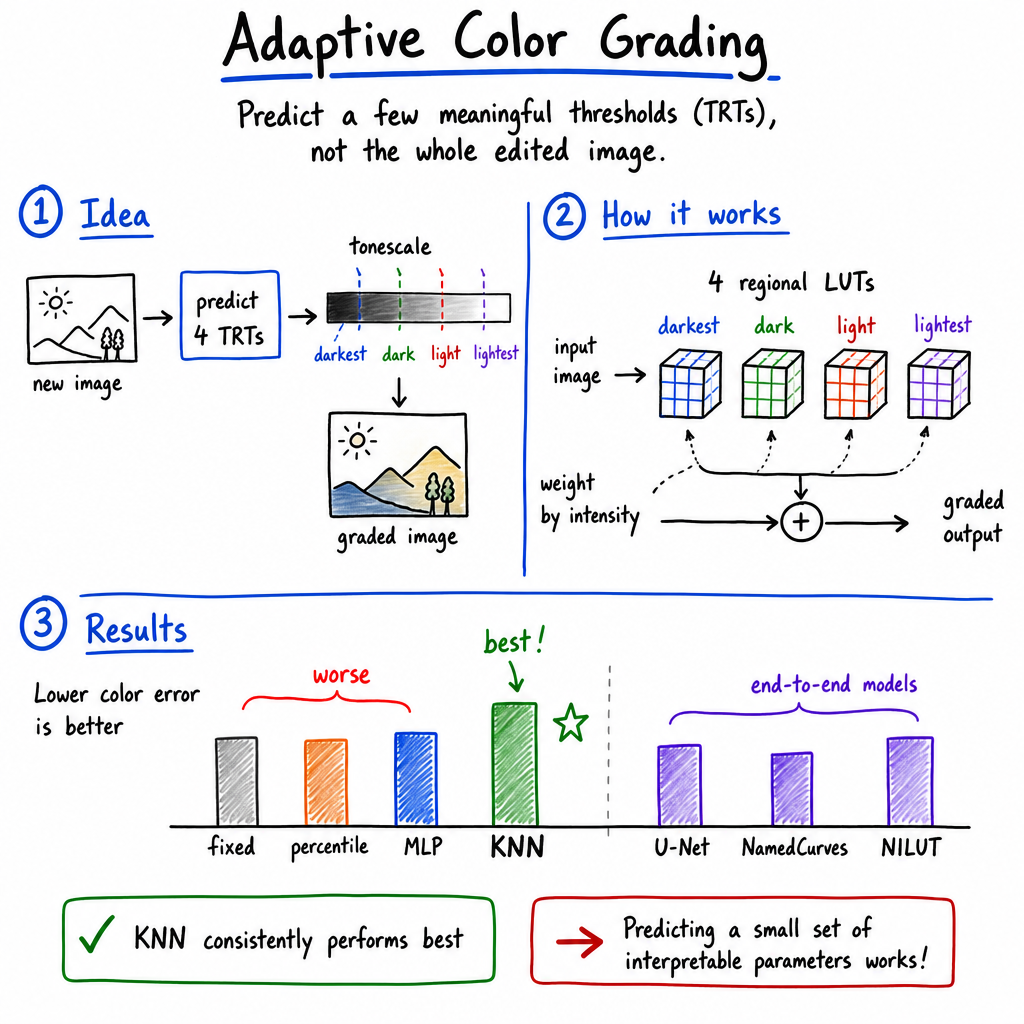
The researchers created a tool that learns where these brightness regions should begin and end in a new image. They call these boundaries tonescale region thresholds, or TRTs.
Their main discovery was that a simple machine-learning method called K-nearest neighbors (KNN) worked better than several larger, more complicated deep-learning systems.
2. What questions did the researchers ask?
The researchers wanted to find out:
- Can a computer learn how people divide an image into dark and bright regions?
- Can these learned divisions be used to apply color grading automatically to new images?
- Are simple rules, such as always using the same brightness levels, good enough?
- Is it better to predict a few important settings or to let a large neural network learn the entire editing process at once?
The paper especially tests the idea that it may be easier and more reliable to predict a small number of meaningful settings instead of trying to copy every editing decision directly.
3. How was the research done?
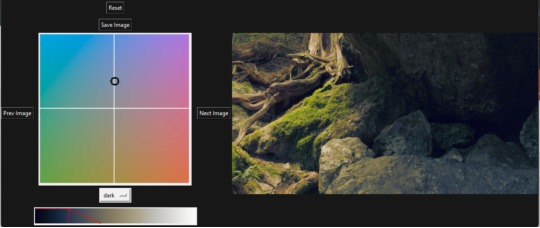
Creating a color-grading tool
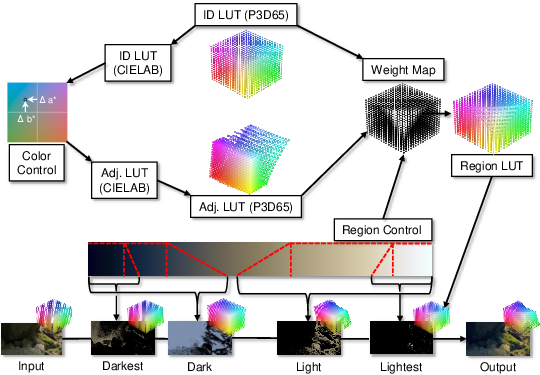
The researchers built an open-source color-grading program. It allowed a user to:
- choose the boundaries between dark and bright regions
- add color changes to each region
- see how those changes affected the image
For example, the user could make:
- shadows more blue
- normally lit areas more yellow
- the darkest blacks remain neutral
- bright light sources remain protected from strong color changes
The software used a tool called a 3D lookup table, or 3D-LUT. A LUT is like a giant color-conversion chart: it tells the computer, “When you see this color, change it into that color.”
Building a dataset
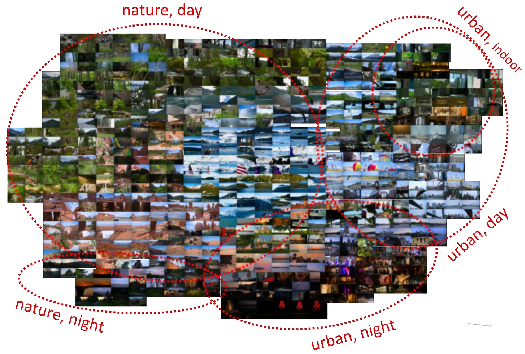
The researchers selected 782 video shots from different locations and environments, including:
- cities
- forests and other natural areas
- indoor scenes
- sunsets
- nighttime scenes
They took two still frames from each shot, creating 1,564 images.
A person manually adjusted the images using the new tool. These adjustments recorded the best locations for the four brightness boundaries. The resulting information became the “correct answers” that the computer models tried to predict.
Testing different prediction methods
The researchers compared several approaches.
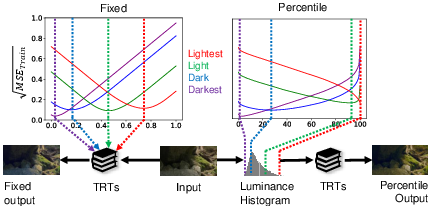
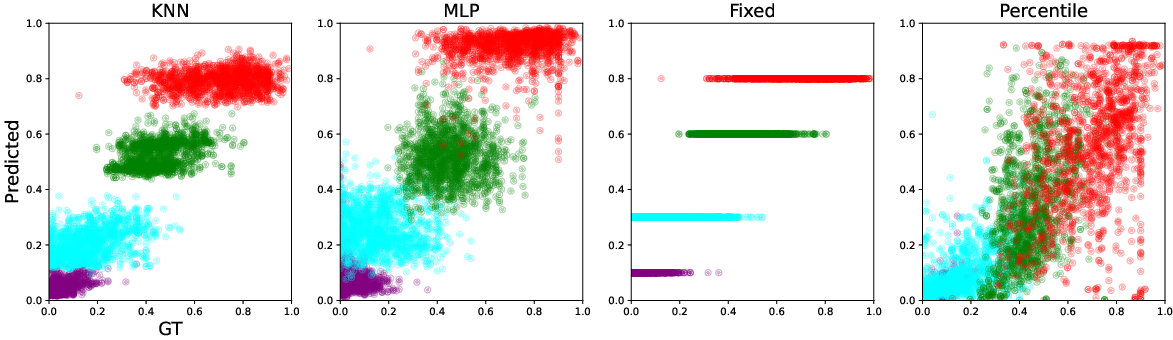
Fixed settings always used the same brightness boundaries, no matter what the image looked like. This is like using the same pair of scissors to cut every piece of paper, even when the papers are different sizes.
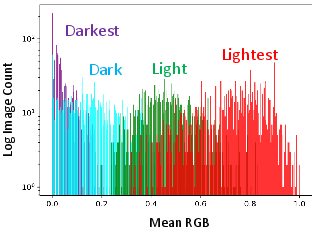
Percentile settings based the boundaries on the brightness distribution of each image. For example, a method might define the darkest 20% of pixels as shadows.
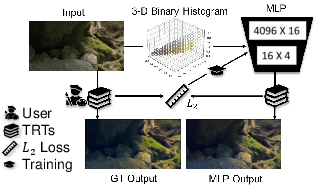
MLP, or multilayer perceptron, was a small neural network. It looked at information about the image and tried to predict the four thresholds.
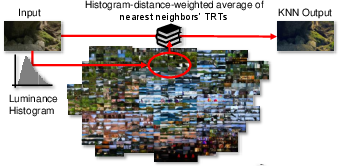
K-nearest neighbors, or KNN, compared a new image with images it had already seen. It found the 16 most similar images and averaged their threshold settings. This is similar to asking, “Which previously graded pictures look most like this one, and what settings did they use?”
The researchers also compared these methods with larger end-to-end image-editing systems. These systems try to learn the entire transformation from an original image to a finished image, rather than predicting only the region boundaries.
Measuring success
The researchers compared each computer-generated result with the manually graded version.
They used two measures:
- PSNR, which checks how closely two images match in their pixel values
- , which measures how different two colors look to human vision
In general, a higher PSNR and a lower mean better results.
4. What did the researchers find?
KNN was the strongest method
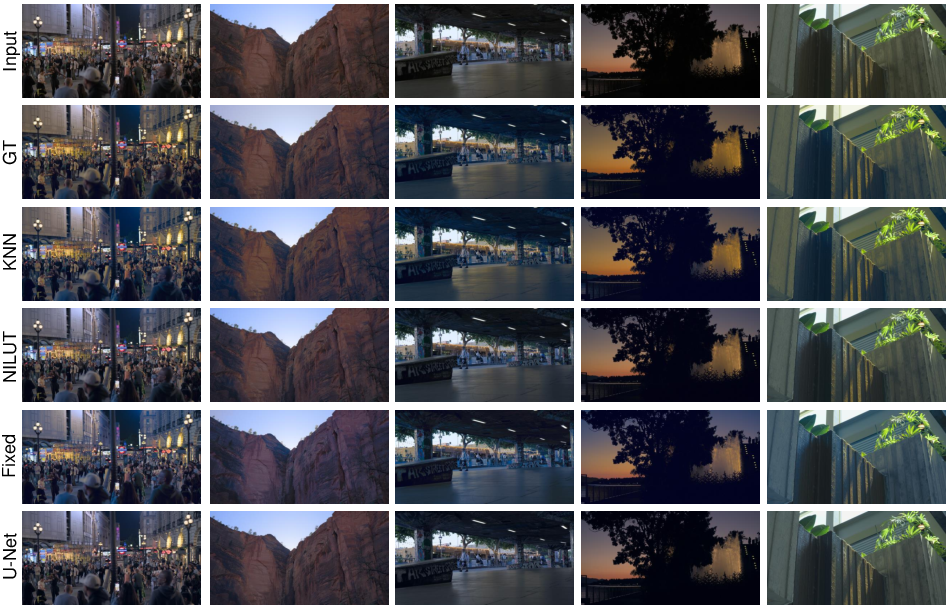
KNN consistently performed best among the methods tested. It predicted the brightness boundaries well and created images whose shadows and highlights were colored in ways similar to the manually graded examples.
For example, when the intended style made shadows blue and directly lit areas yellow, KNN usually placed the boundaries correctly. Other methods often made too much of the image blue or yellow.
Simple fixed rules were not reliable enough
Using the same boundaries for every image sometimes worked reasonably well. However, brightness levels change from scene to scene.
A nighttime picture, a sunny outdoor picture, and an indoor picture do not have the same distribution of dark and bright pixels. Therefore, one fixed setting cannot work perfectly for all of them.
Percentile rules performed poorly
The percentile method seemed reasonable because it adapted to each image’s brightness distribution. However, it often made mistakes.
For example, a shadow may cover a large part of one image and a small part of another. Simply calling the darkest 20% “shadows” does not guarantee that those pixels actually represent shadows.
This shows that brightness alone does not always reveal what caused a region to look dark or bright.
The small neural network was not very effective
The MLP did not learn the relationship between image brightness patterns and the correct thresholds as well as KNN did.
The researchers suggest that the problem is difficult because color grading is partly subjective. Different artists may make different reasonable choices for the same picture.
Large end-to-end systems were not always better
The larger deep-learning systems, including U-Net, NamedCurves, and NILUT, tried to learn the entire image-editing task. Most did not beat the simpler methods.
Only NILUT performed better than the fixed method in the numerical tests. However, its results often stayed very close to the original image, which helped it avoid making large mistakes but also meant that it did not always apply the desired color style strongly.
Important numerical result
In the main tests, KNN achieved better results than the other approaches. For example, when tested on images from the larger collection after training on a special subset, KNN reached a PSNR of 37.53, compared with:
- 35.80 for NILUT
- 35.24 for the MLP
- 34.39 for the fixed method
- 34.17 for the percentile method
These numbers show that predicting the four meaningful thresholds was more effective than trying to learn every color change at once.
5. Why are the findings important?
The paper suggests that smaller, understandable problems can sometimes be easier for computers to solve than one huge problem.
Instead of asking a computer to learn all parts of color grading at once, the researchers asked it to predict only four important settings. This made the system:
- easier to understand
- faster to train
- faster to run
- easier to adapt to different users
- better suited to phones, cameras, and other devices with limited computing power
The method could also be useful for video. Since it focuses on brightness regions rather than tracking every object, it may be able to work efficiently across many video frames.
Limitations
The study has some important limits.
The dataset was graded by one person and followed one particular style: blue-ish shadows and yellow-ish bright areas. Other colorists might choose different thresholds or colors.
Also, the four thresholds are only one part of professional color grading. Real colorists may also adjust exposure, contrast, saturation, individual objects, and many other details.
Finally, the method can still struggle when brightness is confusing. For example:
- a shiny object in shadow may look brighter than a dull object in sunlight
- haze can make distant shadows look bright
- the transition between light and shadow may be gradual rather than sharp
Conclusion
The paper presents a way to make image color grading adaptive, meaning that it changes its settings depending on the image.
Its main lesson is that predicting a few meaningful controls—especially the boundaries between dark and bright regions—can work better than using a large system that tries to learn the entire editing process at once.
The KNN method was the best performer in the experiments. In the future, this idea could help cameras, photo-editing apps, movie-production tools, and mobile devices automatically create more attractive and consistent images while still giving artists understandable controls.
Knowledge Gaps
Knowledge Gaps, Limitations, and Open Questions
The paper leaves the following issues unresolved:
- Single-annotator bias: All threshold annotations were produced by one user pursuing one specific blue-shadow/yellow-highlight grading intent, so the results do not establish whether the learned TRT patterns generalize across colorists, users, or stylistic goals.
- No measurement of inter-annotator agreement: The paper does not quantify how consistently different practitioners choose TRTs for the same image or how much of the observed variation reflects genuine ambiguity versus individual preference.
- Limited creative scope: Only tonescale thresholds were modeled, while real color grading also involves chroma choices, exposure, contrast, white balance, saturation, local masks, spatial adjustments, and temporal decisions.
- Fixed chroma offsets during evaluation: The application-specific models predict only TRTs, whereas chroma offsets are fixed manually for every image. It remains unclear whether the approach would remain superior when chroma shifts must also be predicted adaptively.
- Potentially narrow grading objective: The annotations were designed specifically to separate directly and indirectly illuminated regions and protect extreme tones. Other common grading objectives—skin-tone preservation, subject emphasis, mood creation, color harmony, and stylistic emulation—were not evaluated.
- Restricted dataset diversity: The dataset contains 1,564 frames from 782 shots, 44 scenes, and six geographic regions, but its coverage of camera systems, lenses, genres, production styles, indoor environments, artificial lighting, skin tones, and extreme HDR conditions is not established.
- Unclear independence of samples: Two frames were extracted from each shot, yet the experimental protocol does not clarify whether frames from the same shot or scene can occur across training and test sets. Such overlap could inflate generalization performance.
- Limited external validation: The models were evaluated only on the HVS dataset and were not tested on unrelated photographic, cinematic, animation, rendered, mobile-camera, or consumer-image datasets.
- Dependence on a specific preprocessing pipeline: All images were converted from RAW to P3D65 with a Resolve luminance-preserving tone map. The robustness of the learned thresholds to different RAW renderers, transfer functions, color spaces, tone-mapping operators, and display-referred pipelines remains unknown.
- Simplified tonescale representation: TRTs are defined from
mean(R,G,B)intensity, which ignores hue, chroma, spatial context, material identity, and semantic illumination cues. The paper does not determine when a one-dimensional intensity segmentation is fundamentally insufficient. - Fixed support-function design: The regions use predetermined linear falloff slopes and a fixed arrangement of four overlapping bands. Alternative numbers of regions, nonlinear falloffs, asymmetric regions, or learned mask functions are not investigated.
- No systematic comparison of color spaces or intensity measures: The study does not compare RGB mean against luminance standards, logarithmic luminance, perceptual lightness, scene-linear intensity, or learned representations.
- Ambiguity is not explicitly modeled: The paper recognizes that multiple TRT settings can produce nearly equivalent or acceptable results, but models are trained against a single ground-truth setting using loss. Probabilistic, set-valued, or preference-based formulations could better represent this ambiguity.
- Threshold error may not reflect perceptual or creative quality: Evaluation emphasizes PSNR and relative to the annotated output. These metrics do not establish whether predicted grades preserve the intended illumination separation, visual quality, or professional acceptability.
- No human perceptual study: Colorists, photographers, or general viewers were not asked to compare outputs, judge stylistic fidelity, or assess whether KNN predictions are preferable to competing methods.
- No temporal consistency evaluation: Although the method is motivated in part by motion-picture workflows, experiments use still frames. Stability across adjacent frames, resistance to flicker, shot cuts, camera motion, and changing illumination is unresolved.
- No analysis of online or real-time video adaptation: The paper does not evaluate update frequency, latency over continuous streams, temporal smoothing, or behavior when a video gradually transitions between lighting conditions.
- KNN scalability is untested: KNN performs well on the reported dataset, but memory use, query cost, and performance as the training corpus grows substantially are not analyzed.
- Sensitivity to KNN design choices is unclear: The effects of the number of neighbors, distance metric, histogram binning, normalization, feature weighting, and retrieval strategy are not fully reported.
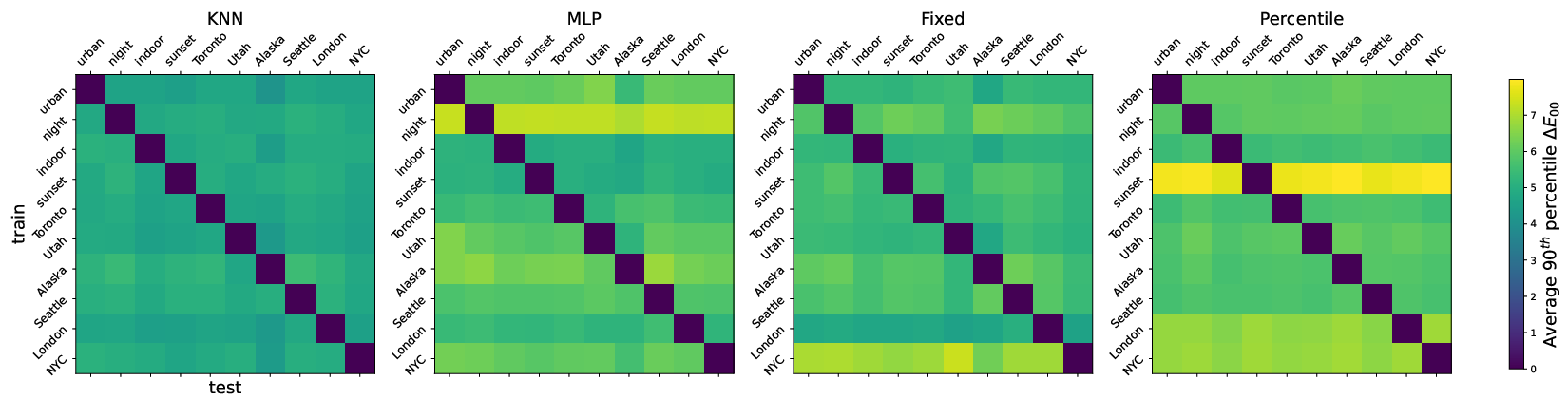
- Generalization to out-of-distribution scenes remains uncertain: The subset experiments reveal strong dependence on training subsets, but the paper does not characterize which visual or illumination properties cause failure or provide an explicit out-of-distribution detector.
- Insufficient statistical reporting: The results do not include confidence intervals, repeated train/test splits, significance tests, or per-scene variance, making it difficult to assess the stability of the reported rankings.
- Baseline comparability is incomplete: The end-to-end methods may not have been optimized specifically for this dataset or task, and the paper does not provide systematic hyperparameter tuning, architecture matching, parameter-count comparisons, or ablations isolating the effects of training procedure.
- Possible conservative behavior of end-to-end baselines: The claim that NILUT succeeds by staying close to the input is based mainly on qualitative inspection; this behavior is not quantified through input-output change magnitudes or task-specific fidelity measures.
- No comparison with stronger application-specific alternatives: The study does not evaluate decision trees, random forests, Gaussian-process regression, attention-based histogram models, differentiable retrieval, or hybrid KNN/neural approaches.
- No personalization experiment: The paper argues that lightweight models enable on-device personalization, but it does not test adaptation to a new user’s preferences, few-shot annotation requirements, or performance under user-specific styles.
- No assessment of annotation effort: The time required to select TRTs, the usability of the proposed interface, and the extent to which annotation difficulty varies across image types are not measured.
- Limited examination of threshold ordering and region validity: The paper does not explain whether predicted TRTs are constrained to remain ordered or non-overlapping in meaningful ways, nor how invalid or visually redundant region configurations are handled.
- No causal interpretation of learned image statistics: KNN uses luminance histograms successfully, but the paper does not establish which histogram structures correspond to shadows, direct illumination, haze, penumbrae, or reflective-object ambiguities.
- Local and semantic extensions are only proposed, not demonstrated: The conclusion suggests applying the method to local image regions and motion pictures, but no experiments test spatially localized grading, object-aware masks, or semantic segmentation.
- Display and viewing-condition effects are unexamined: The perceptual consequences of the grades under different HDR/SDR displays, brightness levels, surround conditions, and viewing environments are not evaluated.
- Reproducibility details are incomplete: The paper does not fully specify data splits, random seeds, grid-search ranges, implementation details for all baselines, or the complete annotation protocol needed to reproduce every reported result.
Practical Applications
Immediate Applications
- Adaptive photo-editing and color-grading software (software, photography, content creation) Integrate the open-source grading interface and its four-threshold KNN predictor into desktop or web-based editors. Given an input image’s luminance histogram, the system can automatically estimate darkest, dark, light, and lightest tonescale-region thresholds, then apply region-specific chroma shifts through compact 3D LUTs. Potential workflow: import image → predict tonescale thresholds → preview blue-shadow/yellow-light grading → allow artist refinement → export a LUT or final image. Dependencies: the current model reflects one annotator’s specific creative intent and requires compatible color management, such as P3D65 or a calibrated display.
- Assisted color grading for photographers and cinematographers (film, television, streaming, advertising) Use KNN-based threshold prediction as an initial grade or “smart grading” suggestion rather than a fully autonomous replacement for a colorist. It can accelerate repetitive footage preparation while preserving artist control over chroma offsets and threshold positions. The method is particularly useful when a static LUT fails because shadows and highlights occupy different intensity ranges across shots. Dependencies: the reported results are based on still frames and a limited grading style; shot continuity, temporal consistency, and inter-frame flicker must be checked in production.
- Adaptive LUT generation for image and video pipelines (camera software, post-production, mobile imaging) Build lightweight image-adaptive LUT modules that dynamically modify a base color grade according to the input luminance distribution. Because the grading function is explicit and uses only four predicted parameters, it is more interpretable and potentially easier to integrate than a large end-to-end enhancement network. Potential products: camera-app filters, video-editor presets, adaptive cinema LUTs, and real-time preview effects. Dependencies: LUT resolution, interpolation quality, input transfer function, HDR range, and display calibration affect the visual result.
- On-device personalization of creative styles (smartphones, tablets, consumer cameras) A user or professional could annotate a small set of preferred images, after which a local KNN model could retrieve similar examples and predict personalized tonescale thresholds. The low computational cost and approximately $0.1$-second inference time reported for KNN make CPU-based deployment plausible. Dependencies: sufficient representative examples are needed; nearest-neighbor retrieval may perform poorly on scenes outside the user’s training distribution. Storage and privacy constraints must also be considered if image histograms or reference data are retained locally.
- Open-source educational and research tooling (academia, photography education, color science) The released interface and dataset can support laboratory exercises and reproducible experiments on tone mapping, CIELAB color manipulation, LUT construction, histogram features, and interpretable machine learning. Students can compare fixed thresholds, percentile rules, MLPs, KNN, and end-to-end enhancement models under a common grading task. Dependencies: dataset licensing, availability, annotation quality, and the incomplete paper repository or implementation details may affect exact reproducibility.
- Human-in-the-loop grading assistance (professional post-production workflows) Present predicted thresholds as editable handles with visual masks showing which pixels belong to each tonescale region. This makes the model’s decisions inspectable and enables artists to correct errors caused by reflective objects, haze, or gradual penumbras. Dependencies: global intensity segmentation cannot reliably distinguish semantic illumination regions in every image, so manual correction remains necessary.
- Benchmarking compact versus end-to-end image enhancement models (computer vision research) Researchers can use the released annotations and evaluation protocol to test whether a model predicts meaningful intermediate parameters rather than merely producing visually plausible outputs. Metrics such as and PSNR can be combined with threshold correlation and user studies. Dependencies: the current ground truth represents one annotator, one intended style, and only four threshold parameters; broader conclusions require multi-user and multi-style annotations.
- Practical guidance for automated color correction policy and product design (industry R&D, standards, workflow engineering) The results support designing adaptive image-processing systems around a small set of perceptually meaningful controls rather than assuming that generic end-to-end enhancement is always preferable. Product teams can use this principle when specifying explainability, latency, memory, and user-editability requirements for imaging features. Dependencies: the advantage over end-to-end methods was demonstrated on this specific grading task and dataset, not universally across all enhancement operations.
Long-Term Applications
- Real-time adaptive color grading for motion pictures (cinema, broadcast, virtual production) Extend threshold prediction from independent frames to temporally coherent video. A production system could estimate thresholds per shot, smooth them over time, and preserve consistent grades across camera motion, exposure changes, and cuts. This could assist automatic shot matching and reduce manual keyframing. Required development: temporal filtering, shot-boundary detection, exposure normalization, and evaluation of flicker and color continuity. Dependencies: luminance histograms alone may change substantially because of object motion or framing, even when the intended grade should remain stable.
- Local-region and object-aware adaptive grading (visual effects, robotics, computational photography) Apply the compact threshold-prediction approach separately to spatial regions or semantically identified objects. For example, skies, faces, foreground objects, and backgrounds could receive independent tonescale segmentation and chroma treatment. Required development: reliable segmentation, region tracking, and safeguards against seams or inconsistent color relationships. The paper explicitly notes that local extension is promising but does not evaluate it.
- Adaptive HDR tone mapping and display rendering (consumer displays, HDR television, imaging hardware) Use learned tonescale boundaries to identify perceptually meaningful dark and bright regions before mapping HDR content to a target display. Region-specific transformations could preserve highlight sources, shadow detail, and midtone contrast more effectively than fixed global curves. Dependencies: HDR scene metadata, display peak luminance, ambient viewing conditions, and perceptual validation are required. Thresholds learned from the P3D65/gamma representation may not transfer directly across HDR standards.
- General adaptive exposure and white-balance systems (camera systems, autonomous vehicles, mobile imaging) The paper’s broader design principle—predict compact, interpretable parameters instead of a complete output image—could be applied to automatic exposure, tone curves, white balance, and color-constancy correction. A camera could infer meaningful illumination partitions and adjust controls independently for shadows, midtones, and highlights. Dependencies: these applications require new datasets and parameter definitions; tonescale thresholds alone do not solve sensor saturation, mixed illuminants, motion, or object-specific exposure requirements.
- Style-transfer systems with interpretable controls (generative media, games, animation, virtual reality) Future systems could represent a visual style as a small collection of region-specific transformations—thresholds, chroma offsets, contrast parameters, and falloff functions—rather than as an opaque image-to-image network. This would enable interpolation between styles and explicit controls such as “cooler shadows” or “warmer illumination.” Dependencies: stylistic similarity is subjective, and the current study does not establish that four thresholds are sufficient for complex artistic styles.
- Hybrid models that constrain end-to-end enhancement networks (machine learning, computational photography) KNN or similar parameter predictors could provide structured intermediate outputs to a neural model, constrain its tone-region boundaries, or serve as an interpretable fallback when confidence is low. This could combine the flexibility of neural enhancement with the stability and inspectability of explicit grading functions. Dependencies: the hybrid architecture would need uncertainty estimation, differentiable LUT operations, and experiments showing improved perceptual quality without restricting legitimate creative variation.
- Personalized professional grading assistants (media production platforms) Collect multiple colorists’ annotations to learn distinct style profiles, then recommend thresholds based on both image content and the selected artist’s preferences. A system could offer ranked alternatives—for example, conservative, high-contrast, warm, or cool grades—while retaining editable parameters. Dependencies: substantial multi-annotator data are needed to model disagreement and style diversity. Privacy, copyright, and ownership of professional grading decisions must also be addressed.
- Policy and standards for transparent AI-assisted image manipulation (media governance, digital provenance) Because the method exposes explicit threshold and chroma parameters, it could support audit logs describing how an image was altered. Such records may be useful for professional provenance, newsroom workflows, advertising disclosures, or archival preservation. Dependencies: parameter logs do not prove artistic intent or image authenticity by themselves; interoperability standards and provenance infrastructure would be required.
- Perceptually adaptive visualization in scientific and engineering systems (medical imaging, remote sensing, geospatial analysis) Region-aware tone mapping could improve visualization of low-contrast structures while protecting saturated highlights. Potential uses include satellite imagery, microscopy, industrial inspection, and medical image presentation. Dependencies: these are high-stakes domains where color changes can mislead interpretation. Any deployment would require domain-specific validation, calibrated displays, preservation of quantitative values, and clear separation between visualization and diagnostic data.
- Adaptive illumination-aware rendering for robotics and simulation (robotics, autonomous systems, game engines) A renderer or robot perception system could use illumination-region thresholds to produce more stable visual representations across changing environments, or to generate training data with controlled shadow and highlight variation. Dependencies: global histograms do not encode scene geometry or semantics, and grading changes that improve human aesthetics may harm machine perception. Joint evaluation for both visual quality and task accuracy would be necessary.
Glossary
- Achromatic: Lacking color; represented only by intensity or lightness. “The TRT control interface features an achromatic gradient”
- Adaptive image processing: Image processing that changes its behavior according to the input image’s characteristics. “More recent works have expanded adaptive image processing”
- Bilateral grid: A data structure that jointly represents spatial and intensity information for efficient edge-aware image operations. “or bilateral grids”
- CIELAB: A perceptual color space with lightness and two opponent-color dimensions, commonly denoted , , and . “a CIELAB \cite{CIELAB} chroma offset control”
- Chroma offset: An additive adjustment to a color’s chromatic components. “The interface consists of two primary components: a CIELAB \cite{CIELAB} chroma offset control and a TRT control.”
- Chromatic affine transform: A color transformation that applies linear scaling and translation to chromatic coordinates. “chromatic affine transforms applied to three separate tonescale regions”
- Color constancy: The perceptual or computational ability to maintain consistent perceived colors under changing illumination. “This challenge has most notably been addressed in camera pipelines in the form of automatic exposure”
- Color grading: The deliberate adjustment of an image’s tonal and color characteristics, especially in photographic or cinematic post-production. “These operations constitute the core of the cinema post-production process known as color grading”
- Color lookup table (3D-LUT): A table that maps input color triplets to output colors. “The tool applies user-defined additive channel offsets to four separate ID 3D-LUTs”
- Color segmentation: Partitioning an image into regions according to color or intensity properties. “the inherent ambiguity of masking semantic regions with global color segmentation”
- Cubic falloff: A smooth weighting decrease governed by a cubic function, used to blend neighboring regions. “The tonescale regions are defined as three bands containing an equal number of pixels with cubic falloff and 10\% overlap.”
- End-to-end learning: Learning a complete transformation directly from inputs to desired outputs rather than modeling intermediate parameters. “Common to these works is the goal of learning many editing operations simultaneously from input/output pairs (end-to-end)”
- Exposure: The amount of light captured or represented in an image, affecting its overall brightness. “This challenge has most notably been addressed in camera pipelines in the form of automatic exposure”
- Falloff slope: The rate at which a region’s weighting decreases away from its threshold. “and falloff slope .”
- Gamut: The range of colors that a device, color space, or representation can encode or reproduce. “The chroma offset interface shows a limited range of values at an value of 60.”
- High dynamic range (HDR): An imaging technology or representation that accommodates a broad range of luminance levels. “Recent advances in high dynamic range camera and display technology”
- Ill-posed problem: A problem lacking a unique, stable, or sufficiently determined solution. “These observations demonstrate why predicting creative stylization is an ill-posed problem.”
- Illumination region: An image area characterized by a particular lighting condition or intensity range. “The intention of color grading was to introduce chroma shifts to directly illuminated and shadowed regions”
- Identity 3D-LUT: A lookup table whose output is the same as its input, serving as an unchanged baseline transformation. “The support functions take the of an identity (ID) 3D-LUT as input”
- Image-to-image translation: Learning a mapping that converts images from one visual domain or style into another. “Later, more general solutions for learning image-to-image translation were introduced.”
- Intensity histogram: A distribution showing how frequently different image intensity values occur. “via the luminance histogram of each training image in the percentile case”
- K-nearest neighbors (KNN) regression: A nonparametric regression method that predicts an output from a weighted combination of nearby training examples. “At inference time, the predicted TRTs are computed as a weighted average over the 16 training-set neighbors closest to the test histogram by Euclidean distance.”
- Luminance: The perceived or measured brightness of a color or image region. “We used 12-bit luminance histograms scaled to unit variance.”
- Multilayer perceptron (MLP): A feed-forward neural network composed of interconnected layers of weighted neurons. “The first was a small multilayer perceptron (MLP) for modeling the TRTs.”
- Non-linear function: A function whose output does not change proportionally with its input. “learning independent non-linear functions for separate color name categories”
- Out-of-distribution: Describing data that differs substantially from the distribution used to train a model. “implying that its context extraction block may make it particularly sensitive to out-of-distribution images.”
- Penumbra: A partially shaded region, especially the gradual boundary between illuminated and unilluminated areas. “Also, certain images featured smooth, extensive penumbras (partially shaded regions)”
- Percentile: A value below which a specified percentage of observations in a distribution falls. “These materials suggest that properly exposed images on a calibrated camera system can be separated into shadow, midtone and highlight tonescale regions with fixed intensity thresholds or percentiles”
- Perceptual color space: A color representation designed so that numerical distances approximately correspond to perceived color differences. “The interface consists of two primary components: a CIELAB \cite{CIELAB} chroma offset control and a TRT control.”
- Photometric tone mapping: Transforming luminance values to fit a target display or representation while preserving perceptual appearance. “This can be accomplished through tonemapping and chromatic shifts”
- PSNR: Peak signal-to-noise ratio, a logarithmic measure of reconstructed-image fidelity based on mean squared error. “errors are computed between ground truth and predicted graded images in terms of PSNR and ”
- Regularization: A technique that constrains a model or representation to improve generalization or reduce unwanted dependence on data. “Other TRTs may require some form of input regularization to reduce dependence on the specific pixel-area proportions”
- Scene-linear representation: An image representation in which numerical values are proportional to scene light rather than perceptually encoded brightness. “Frames were extracted from the RAW video files in a scene-linear representation”
- Sigmoid function: An S-shaped function that maps arbitrary real values, commonly into the interval . “Outputs were passed through a sigmoid function to constrain results to the range.”
- Specular highlight: A bright image region caused by direct reflection from a surface. “the darkest and lightest TRTs were used to protect the blackest regions, visible illumination sources, specular highlights, and the sky”
- Tone mapping: The transformation of an image’s intensity or luminance range to another range while attempting to preserve visual detail. “The adjacent examples extend the effect with chromatic shifts applied to intensity threshold masks.”
- Tonescale region threshold (TRT): An intensity value defining the boundary of a region used for localized color or tonal manipulation. “In this work we demonstrate that by focusing on the compact parameter set of tonescale region thresholds (TRTs)”
- Trilinear interpolation: Interpolation within a three-dimensional grid using linear interpolation along each of three coordinate axes. “In all of the following experiments we apply 3D-LUTs with nodes using trilinear interpolation.”
- Unit variance: A normalization in which a variable’s variance is scaled to equal one. “We used 12-bit luminance histograms scaled to unit variance.”
- White balance: Adjustment of an image’s color response to compensate for the color of the illumination. “This challenge has most notably been addressed in camera pipelines in the form of automatic exposure \cite{onzon21, sampat99, yang08}, white balance \cite{afifi19, funt96, liu95} and tone mapping”
- Weighted average: An average in which some values contribute more strongly than others according to assigned weights. “A weighted average is then taken between the ID 3D-LUT and the chroma-adjusted lookup tables according to the weight maps.”

