Block Parallelism For Efficient Distributed Long-Context Diffusion Language Model Training
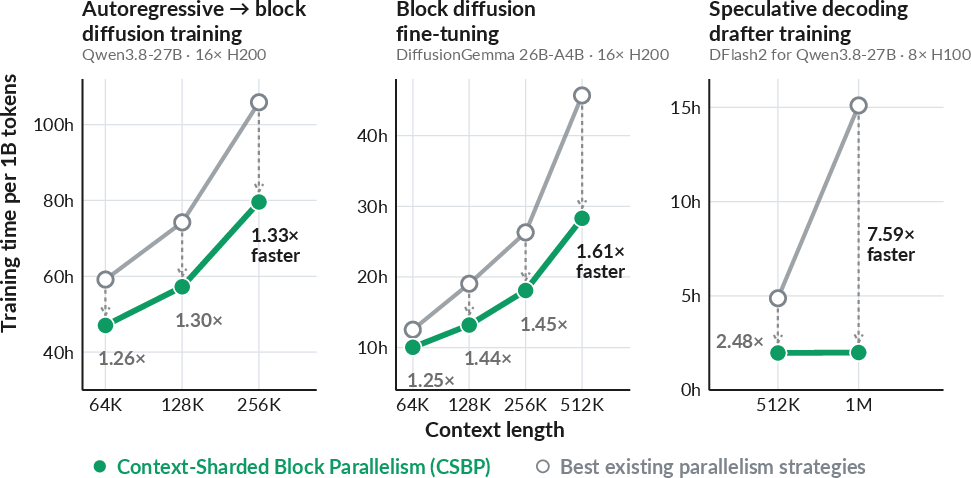
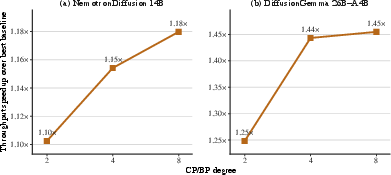
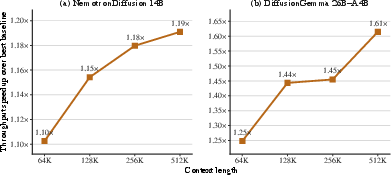
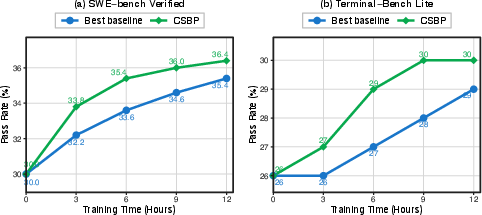
Abstract: Block diffusion LLMs (BDLMs) combine autoregressive dependencies across blocks with parallel denoising within blocks, but long-context training is constrained by distributed attention communication and activation memory. Conventional context parallelism (CP) shards the combined clean-plus-corrupted sequence by position, communicating shared clean K/V together with block-specific corrupted K/V and their gradients. We observe that the BDLM objective separates over target blocks. We introduce block parallelism (BP), a new distributed parallelism dimension that assigns each corrupted-block computation to one rank. To scale BP to long contexts, we introduce context-sharded block parallelism (CSBP), which also shards the shared clean sequence across those ranks. CSBP keeps corrupted K/V and gradients local, avoids replicated clean prefixes, and preserves BDLM training semantics. On 16 H200 GPUs at 256K context, CSBP improves throughput over the best baseline by 1.18-1.45x for supervised fine-tuning and 1.27-1.33x for conversion of autoregressive models to BDLMs, while matching or reducing peak HBM. Full-model speedup reaches 1.61x at 512K. On eight H100 GPUs, CSBP accelerates DFlash2 speculative-decoder training by 2.48x at 512K and 7.59x at 1M. In matched 12-hour DiffusionGemma 26B-A4B SFT runs, CSBP achieves higher pass rates at every trained checkpoint on SWE-bench Verified and Terminal-Bench Lite. Code: https://github.com/ScalingIntelligence/Turbo-dLLM
Paper Prompts
Sign up for free to create and run prompts on this paper.
Top Community Prompts
Explain it Like I'm 14
1. What is this paper about?
This paper introduces a new way to train block diffusion LLMs faster, especially when they need to handle very long pieces of text.
A LLM normally reads or generates text one token at a time. A block diffusion LLM works differently:
- It generates groups of tokens, called blocks, from left to right.
- Inside each block, it can work on many tokens at the same time.
- It gradually improves, or denoises, the tokens until they form a good prediction.
This method can make text generation faster, but training these models with very long inputs—such as large coding projects or long conversations—can require enormous amounts of computer memory and communication between GPUs.
The paper proposes a solution called context-sharded block parallelism, or CSBP.
2. What questions are the researchers asking?
The researchers mainly want to know:
- Can different parts of a block diffusion model be assigned to different GPUs more efficiently?
- Can GPUs avoid sending unnecessary information to one another during training?
- Can this method reduce memory use while training on very long sequences?
- Does faster training also lead to better practical results, such as better coding performance?
The central idea is to notice that each target block has its own training loss. In simple terms, the model’s work can be divided into separate jobs, much like dividing homework questions among several students.
3. How did the researchers approach the problem?
Block diffusion LLMs
Imagine a sentence split into groups:
1 |
[The cat] [sat on] [the mat] [quietly] |
The model predicts the blocks from left to right. When predicting [the mat], it can use the earlier clean text, such as [The cat] [sat on], but the words inside the target block may initially be partly scrambled or noisy.
The model learns to repair the noisy block. This repair process is called denoising.
The problem with ordinary context parallelism
Training is spread across several GPUs. A common technique called context parallelism divides a long sequence by position. Each GPU handles one section.
This is like giving each student a different part of a long book. However, the students must repeatedly exchange information so that everyone can understand the whole story.
The problem is that ordinary context parallelism sends both:
- Clean information, which many blocks need, and
- Corrupted block information, which is usually needed by only one target block.
Sending the second type is wasteful. It is like making every student exchange notes about a homework question that only one student is solving.
Block parallelism
The paper first introduces block parallelism (BP).
With BP, each GPU becomes responsible for complete target blocks, including:
- Computing the block’s prediction,
- Calculating its error, or loss, and
- Calculating how the model should improve.
The corrupted information for a block stays on the GPU handling that block. Therefore, it does not need to be repeatedly sent between GPUs.
Context-sharded block parallelism
BP by itself creates another problem: each GPU may need to store a large copy of the earlier clean text. These overlapping copies could use too much memory.
The researchers solve this with context-sharded block parallelism (CSBP):
- Each GPU receives certain target blocks.
- The clean context is divided among the GPUs.
- GPUs exchange only the parts of the clean context that other GPUs need.
- Corrupted information stays local to the GPU responsible for its block.
A useful analogy is a library:
- The clean context is a shared reference book divided among several librarians.
- The corrupted blocks are individual assignments given to particular students.
- Students keep their own assignments, while librarians share only the relevant pages of the reference book.
The researchers also use a balancing strategy. Early blocks need less previous context, while later blocks need more. To avoid giving one GPU much more work than another, they pair early and late blocks together.
Experiments
The researchers tested CSBP on:
- Several LLMs,
- Supervised fine-tuning,
- Converting ordinary autoregressive models into block diffusion models,
- Training speculative-decoding models,
- Context lengths from 256,000 tokens to 1 million tokens.
They compared CSBP with highly optimized existing methods using NVIDIA H100 and H200 GPUs.
They measured:
- Throughput: how many tokens were processed per second,
- Memory use,
- MFU, or useful model FLOPs utilization, which estimates how effectively the GPUs are doing useful model work,
- Performance on coding benchmarks.
4. What did the researchers find?
Faster training
At a context length of 256,000 tokens, CSBP improved training speed by:
- About 1.18× to 1.45× for fine-tuning block diffusion models,
- About 1.27× to 1.33× for converting autoregressive models into block diffusion models.
For one model, the improvement reached 1.61× at 512,000 tokens.
A speedup of 1.45× means that a training job taking 145 minutes with the old method might take about 100 minutes with the new method, assuming the conditions are comparable.
Much larger gains for some speculative-decoding models
For DFlash2 training, which teaches a smaller model to suggest possible answers for a larger model, CSBP produced even larger improvements:
- 2.48× faster at 512,000 tokens,
- 7.59× faster at 1 million tokens.
These gains happened because the older method repeated some block-specific work across multiple GPUs, while CSBP assigned each block’s work to only one GPU.
Similar or lower memory use
CSBP generally matched or reduced peak GPU memory use compared with the best existing methods.
This is important because very long sequences can exceed a GPU’s memory limit. In the experiments, ordinary block parallelism sometimes ran out of memory, while CSBP continued to work.
Better results with the same training time
The researchers also gave two methods the same 12-hour training budget.
The CSBP-trained model achieved higher pass rates on:
- SWE-bench Verified, a benchmark for solving software tasks,
- Terminal-Bench Lite, a benchmark involving computer-terminal tasks.
The CSBP model remained about one percentage point ahead at the end of training on both benchmarks.
The training goal stayed the same
An important result is that CSBP did not change what the model was learning. It only changed how the work was divided among GPUs.
The researchers argue that CSBP produces the same model calculations and gradients as the normal method. A gradient is information telling the model how its settings should change to make fewer mistakes.
This means the speedup comes from better organization, not from using a less accurate shortcut.
5. Why are these results important?
Long-context models are useful for tasks such as:
- Understanding large software projects,
- Remembering long conversations,
- Analyzing lengthy documents,
- Helping coding agents work through many steps.
However, training with long contexts is expensive. GPUs must store large amounts of information and communicate constantly.
CSBP helps by matching the way the work is divided to the structure of block diffusion models:
- Block-specific work stays with the GPU that owns the block.
- Shared clean context is divided across GPUs.
- Unnecessary communication is removed.
- Memory is used more evenly.
In everyday terms, the researchers found a better way to organize a large group project. Instead of everyone copying everyone else’s work, each person keeps the part they are responsible for and shares only the common information.
Conclusion: Potential impact
The paper suggests that CSBP could make it more practical to train block diffusion LLMs with extremely long inputs. This could lead to:
- Faster development of long-context AI systems,
- Lower training costs,
- The ability to train models on longer documents and coding histories,
- Better progress when the amount of training time is limited,
- More efficient speculative decoding systems.
The method is not a complete solution for every situation. It is designed mainly for training block diffusion models with known target blocks and very long contexts. It does not directly speed up the generation of unknown future text.
Still, the main lesson is powerful: carefully matching the division of computer work to the model’s mathematical structure can make AI training much faster without changing what the model learns.
Knowledge Gaps
Knowledge gaps, limitations, and open questions
- Generalization beyond the evaluated hardware: The experiments use only NVIDIA H100 and H200 GPUs on small clusters (one or two nodes), leaving CSBP’s performance on other accelerators, larger multi-node systems, and different network topologies unresolved.
- Scaling to substantially larger parallel groups: Results evaluate CP/BP degrees up to eight, but the effects of dozens or hundreds of ranks on communication latency, synchronization, load balance, and collective-operation scalability are not established.
- Comparison with a broader set of baselines: The paper compares against optimized conventional CP configurations but does not comprehensively evaluate hybrid alternatives such as Ring Attention, Ulysses, Striped Attention, head-context parallelism, sequence parallelism variants, or optimized combinations of these methods.
- Sensitivity to network bandwidth and topology: The reported gains depend on reducing K/V communication, but there is no systematic study across NVLink, PCIe, InfiniBand, Ethernet, or oversubscribed network configurations.
- Performance under realistic variable-length batches: Most throughput and memory profiles use sequences with exactly the reported context length. The robustness of CSBP to highly variable sequence lengths, padding, packing, and heterogeneous block counts remains unclear.
- Dynamic load balancing: The dual-end pairing is analyzed for balanced, equal-sized blocks, but the paper does not evaluate workloads with variable block sizes, uneven target-block sampling, skipped blocks, or dynamically changing computational costs.
- Applicability to other BDLM objectives: Exactness is demonstrated for the separable objectives considered, but it is unresolved whether CSBP applies without modification to objectives involving cross-block losses, global normalization, bidirectional corrupted context, auxiliary losses, or jointly coupled diffusion timesteps.
- Assumptions behind gradient equivalence: The practical effects of floating-point reduction order, asynchronous communication, mixed-precision accumulation, and nondeterministic kernels on the claimed equivalence to reference gradients are not quantified.
- Numerical reproducibility: The paper does not report tolerance bounds or long-run divergence measurements between CP and CSBP training under identical seeds, particularly for BF16 training over hundreds or thousands of optimization steps.
- Training-quality equivalence at scale: Downstream results are shown for a limited number of models and benchmarks, but the effect of CSBP on loss curves, calibration, perplexity, generation quality, diffusion likelihood, and robustness is not systematically isolated from the effect of processing more tokens within the same wall-clock budget.
- Statistical significance of downstream improvements: The reported SWE-bench and Terminal-Bench differences are small, and the paper does not provide multiple random seeds, confidence intervals, variance estimates, or significance tests.
- Broader downstream evaluation: The quality evaluation focuses on two coding-agent benchmarks. CSBP’s effect on general language understanding, reasoning, mathematics, multilingual performance, long-context retrieval, and non-agent generation remains untested.
- Inference-time implications: The method accelerates training but does not provide a corresponding distributed strategy for generating unknown future tokens. The end-to-end trade-off between faster training and inference latency, memory usage, communication, and deployment complexity is therefore unresolved.
- Impact of block size and number of blocks: The experiments do not systematically characterize how throughput, memory, load balance, and model quality vary with block size , number of blocks , and the relationship between and the BP degree.
- Small-block and large-block regimes: It is unclear whether CSBP remains beneficial when blocks are very short, where scheduling and communication overhead may dominate, or very long, where block-local activations and computation may reduce the advantage of BP.
- Overlap between communication and computation: The paper reports aggregate throughput and selected communication timings but does not fully decompose the benefits attributable to communication elimination, kernel fusion, scheduling, reduced replication, and topology changes.
- Memory behavior beyond peak HBM: Peak allocated HBM is reported, but fragmentation, allocator overhead, activation lifetime, temporary buffers, communication buffers, and memory pressure during optimizer steps are not analyzed.
- Optimizer and parallel-state interactions: Results use particular combinations of ZeRO, tensor, expert, data, and context parallelism. The compatibility and performance of CSBP with ZeRO-3, fully sharded data parallelism, pipeline parallelism, optimizer offloading, and other training-state sharding methods remain open.
- Fault tolerance and elasticity: The paper does not address rank failure, checkpointing and restoration of CSBP-specific distributed states, elastic membership changes, or recovery when block owners and clean-context shard owners change.
- Implementation complexity and maintainability: The correctness and engineering costs of the custom CUDA kernels, layouts, scheduling logic, and backward paths are not compared with those of existing CP implementations, leaving the practical adoption burden unclear.
- Portability to other attention and model architectures: Evaluation is limited to the reported transformer-based models. Applicability to grouped-query or multi-query attention, multimodal transformers, recurrent or hybrid architectures, sparse attention, and models with unconventional normalization or routing is not demonstrated.
- Effect of data and model parallelism on gains: The results use selected topology configurations, but there is no systematic sensitivity analysis showing when CSBP’s benefit disappears or reverses as tensor, expert, pipeline, or data parallelism changes.
- Energy and cost efficiency: The study reports throughput, MFU, and memory but not energy consumption, power usage, cloud cost per training token, or total cost to reach a target quality level.
- Very-long-context limits: Experiments reach 1M tokens only for DFlash2 drafter training. Whether CSBP remains stable and advantageous at multiple millions of tokens, where metadata, scheduling, communication volume, and numerical issues may change, is unresolved.
- Interaction with gradient accumulation and batch size: The best configurations are selected for throughput, but the effects of microbatch size, gradient accumulation steps, global batch size, and optimizer dynamics on CSBP’s efficiency and convergence are not isolated.
- Limited analysis of unfavorable cases: The paper reports that CSBP can be slower than data parallelism for Qwen3.8-27B at 256K, but does not provide a general decision rule or break-even model for selecting CSBP versus pure data parallelism or conventional CP.
Practical Applications
Immediate Applications
- Faster long-context BDLM fine-tuning for AI model developers (Software/AI infrastructure)
1.18–1.45×higher throughput for supervised fine-tuning at 256K context;- up to
1.61×speedup at 512K context; - comparable or lower peak HBM usage.
- A practical product would be a CSBP-enabled PyTorch, Megatron, DeepSpeed, or TorchTitan training backend with topology selection for data, tensor, expert, context, and block parallelism.
- Dependencies: The workload must use a BDLM objective whose loss decomposes over target blocks; the cluster must provide multiple GPUs with sufficiently fast interconnects; kernel and collective-communication support must be available.
- Lower-cost training of long-context coding agents (Software engineering/enterprise AI)
- fine-tuning agents on multi-hour or multi-day coding sessions;
- retaining larger repository and tool-use contexts during training;
- running more checkpoints or experiments within the same cloud budget.
- Dependencies: Improved downstream performance was demonstrated for specific DiffusionGemma-style models and coding benchmarks; gains may not transfer automatically to other domains, datasets, or agent architectures.
- AR-to-BDLM conversion of existing LLMs (Model conversion/platform engineering)
Teams can convert autoregressive checkpoints into block diffusion models without training a new model from scratch, using CSBP to accelerate the conversion objective. The paper reports
1.27–1.33×speedups at 256K context for the evaluated Qwen backbones. This enables a practical workflow in which an organization:- starts with an existing autoregressive checkpoint;
- applies a block-diffusion conversion objective;
- uses CSBP to fit longer training sequences or reduce conversion time;
- deploys the resulting model for parallel block generation. Dependencies: Conversion quality depends on the underlying AR checkpoint, masking scheme, noise schedule, distillation procedure, and inference sampler. CSBP accelerates training but does not itself guarantee faster or higher-quality inference.
Faster training of speculative-decoding draft models (Inference systems/cloud serving)
2.48×at 512K context;7.59×at 1M context for one evaluated configuration.- A deployable tool could automatically assign each draft block to a GPU while sharding the shared context, reducing duplicated decoder, vocabulary-loss, and candidate-selection computation. This can shorten the development cycle for speculative decoding systems and reduce training cost for high-throughput inference services.
- Dependencies: The paper also reports that at 256K, a simpler data-parallel configuration was faster in one setting. CSBP is therefore most attractive when context is long enough for sequence-parallel communication and replication to dominate.
- Reduced GPU memory pressure for long-context experiments (Research infrastructure/HPC)
- larger context windows on the same hardware;
- larger per-GPU batch sizes;
- fewer activation-offloading or recomputation steps;
- continued training of models that otherwise exceed HBM limits.
- Dependencies: Memory savings depend on balanced block assignment and effective context sharding. Communication buffers, optimizer states, tensor/expert parallelism, and activation-checkpointing choices still affect total memory.
- Open-source distributed-training components for academia and industry (Academic tooling/software)
- communication volume;
- GPU utilization;
- memory scaling;
- block-size choices;
- interactions with tensor, expert, and data parallelism.
- Dependencies: The implementation may require specific CUDA, NCCL, PyTorch, FlashAttention, GPU, and driver versions. Independent validation is needed because the reported results use H100/H200 systems and optimized custom kernels.
- Cluster-level scheduling and capacity planning (Cloud computing/HPC operations)
- place ranks within the same high-bandwidth node or fabric domain;
- select GPU counts based on context length and block count;
- avoid configurations where communication overhead outweighs savings;
- estimate throughput and HBM requirements before job submission.
- Dependencies: Actual benefits depend strongly on network topology, inter-GPU bandwidth, node placement, block-count divisibility, and load balancing.
Long-Term Applications
- Long-context personal and enterprise assistants (Productivity/knowledge management)
- persistent workplace assistants;
- legal or financial document-analysis systems;
- research assistants with large literature and experiment histories;
- customer-support agents retaining long case histories.
- Dependencies: The paper addresses training rather than unknown-token generation. Practical deployment also requires advances in privacy, retrieval, context selection, latency, reliability, and evaluation over very long inputs.
- Interactive coding agents with longer working memory (Software engineering/robotics-like tool use) CSBP-enabled training may eventually enable agents that maintain larger state across code edits, tests, shell commands, and debugging attempts. Longer training contexts could improve planning over multi-step tasks and reduce the need to summarize or discard earlier interactions. Potential tools include repository-scale debugging agents, autonomous issue-resolution systems, and continuous integration agents that reason over complete build histories. Dependencies: Longer context does not necessarily imply better reasoning. Future work must establish whether performance improvements arise from genuinely using distant information rather than from increased training volume or benchmark-specific effects.
- High-throughput, low-latency language-model serving through improved speculative decoding (Cloud inference/mobile systems)
- lower latency for interactive assistants;
- higher requests-per-second in inference clusters;
- reduced energy consumption per generated token;
- more responsive coding, search, and customer-service applications.
- Dependencies: CSBP accelerates drafter training, not the inference protocol itself. End-to-end serving gains depend on draft acceptance rates, target-model verification cost, batch composition, hardware, memory bandwidth, and scheduler overhead.
- Training on million-token or larger contexts (AI research/HPC)
- entire software repositories;
- long scientific or legal records;
- multi-session agent trajectories;
- multimodal or structured sequences with large serialized context.
- Dependencies: Attention remains quadratic in total valid attention pairs, even though CSBP reduces communication and replication. Scaling beyond the demonstrated range will likely require sparse, hierarchical, recurrent, retrieved, or otherwise subquadratic attention mechanisms.
- General block-aware parallelism beyond language diffusion (Machine learning systems/robotics/multimodal AI)
- multimodal generation with shared visual or textual context and independent output blocks;
- video or audio diffusion with independently denoised temporal segments;
- trajectory models for robotics with block-local action prediction;
- structured sequence prediction with separable regional losses.
- Dependencies: The objective must be mathematically separable, and target-specific activations must not require unmodeled cross-block interactions. Exact gradient equivalence would need to be proven for each new architecture.
- Compiler and runtime automation for parallelism selection (AI compiler/software infrastructure)
- shared context representations;
- block-local target computations;
- appropriate BP and CP degrees;
- balanced early/late block assignments;
- communication and memory trade-offs.
- This could produce an optimized schedule without requiring model developers to manually implement custom CUDA kernels or distributed backward passes.
- Dependencies: Such automation requires accurate cost models, support for dynamic sequence lengths, robust handling of non-divisible block counts, and integration with existing data, tensor, expert, and pipeline parallelism.
- Energy- and carbon-efficient foundation-model training (Energy/policy/sustainability) By reducing redundant computation and cross-GPU communication, CSBP could lower energy use per training token for long-context BDLM workloads. Cloud providers and research institutions could use measured throughput and HBM reductions to improve carbon-aware job scheduling and report more efficient training runs. Dependencies: Higher throughput does not automatically reduce total energy if users respond by training larger models or longer datasets. Lifecycle analysis must include networking, cooling, hardware utilization, and the additional cost of distributed synchronization.
- Policy and procurement standards for reproducible long-context AI (Policy/academia)
- context length and block size;
- GPU type and count;
- communication topology;
- peak HBM;
- useful throughput and MFU;
- downstream performance at equal wall-clock budgets.
- Such standards would help distinguish algorithmic improvements from hardware scaling and encourage efficient public-sector AI training.
- Dependencies: The benchmarks should be expanded beyond coding tasks and evaluated across languages, domains, model sizes, and hardware vendors before being used as formal standards.
Glossary
- Activation checkpointing: A memory-saving technique that recomputes intermediate activations during backpropagation instead of storing them all. “Full-model runs use activation checkpointing”
- Autoregressive (AR) model: A model that generates each token conditionally on previously generated tokens. “Conversion provides a route to parallel generation without training a diffusion model from scratch”
- Block-causal attention mask: An attention mask that permits access to preceding clean blocks and controlled access within the current block. “A block-causal attention mask gives the clean tokens in block access to the preceding clean blocks and causal access within block .”
- Block diffusion LLM (BDLM): A LLM that generates blocks sequentially while denoising tokens within each block in parallel. “A block diffusion LLM (BDLM) generates blocks from left to right while denoising the tokens within each block in parallel”
- Block-local dynamic convolution: A convolution operation whose computation is restricted to an individual block and whose parameters or behavior may vary dynamically. “DFlash2 adds block-local dynamic convolutions and candidate-path selection to improve draft quality.”
- Block parallelism (BP): A distributed-parallelism strategy that assigns complete corrupted-block computations to individual ranks. “We introduce block parallelism (BP), which makes target-block computation a new distributed parallelism dimension.”
- Candidate-path selection: A procedure for choosing promising token-generation paths from multiple speculative candidates. “DFlash2 adds block-local dynamic convolutions and candidate-path selection to improve draft quality.”
- Causal attention: Attention in which a token can attend only to preceding or permitted current-position tokens. “Causal attention produces uneven work across sequence shards because later queries see longer prefixes.”
- Clean-prefix K/V caching: Reusing key and value representations computed from the uncorrupted preceding context. “Block Diffusion combines autoregressive dependencies between blocks with parallel denoising within blocks, supporting variable-length generation and clean-prefix K/V caching”
- Context parallelism (CP): A distributed-training method that partitions sequence positions across devices while collectively computing attention over the full context. “Context parallelism (CP) uses token position as its ownership dimension”
- Context-sharded block parallelism (CSBP): A method that combines block parallelism with context parallelism by sharding the shared clean sequence across the ranks that own corrupted blocks. “We call this context-sharded block parallelism (CSBP).”
- Corruption process: The stochastic process that transforms clean training data into a noisy or corrupted version at a specified diffusion time. “where is the corruption process”
- Cross-rank communication: Data transfer between separate distributed-computation ranks or devices. “CSBP removes the length- corrupted component from this communication in both forward and backward.”
- Data parallelism: A distributed-training strategy that replicates a model across devices and assigns different data batches to each replica. “The near-equal 1M values show the gains reflect genuine reductions in executed work and increased data parallelism.”
- Denoising: Iteratively or continuously recovering clean data from a corrupted representation. “They retain autoregressive dependencies across consecutive token blocks while generating the tokens within each block through parallel denoising.”
- Diffusion process: A probabilistic process that progressively corrupts data and defines a reverse procedure for generating or reconstructing it. “where each conditional distribution is modeled by a diffusion process.”
- Distributed attention: Attention computation whose inputs or intermediate representations are partitioned across multiple devices. “Both clean and corrupted K/V therefore participate in cross-rank attention communication.”
- Distributed parallelism dimension: An independent axis along which a computation is divided among multiple devices or ranks. “target-block computation as a new distributed parallelism dimension”
- Drafter: A smaller or specialized model trained to propose candidate tokens for verification by a target model during speculative decoding. “We also train long-context DFlash2 drafters”
- Executed-GEMM utilization: The ratio of matrix-multiplication floating-point operations actually executed to the hardware’s peak capability. “Executed-GEMM utilization (executed GEMM FLOP/s relative to BF16 peak)”
- Expert parallelism: A distributed strategy that assigns different neural-network experts, typically in a mixture-of-experts model, to different devices. “the best baseline is the highest-throughput tested feasible combination of data, tensor, expert, context, and sequence parallelism”
- FlashAttention: An exact attention algorithm that reduces memory traffic and improves efficiency through tiling and input/output-aware computation. “Online softmax combines the local within-block contribution with the distributed clean-prefix contributions”
- Gradient accumulation: The process of summing gradient contributions from multiple computations before applying an optimization update. “its gradients accumulate on its owner.”
- HBM (high-bandwidth memory): Specialized high-throughput memory attached to accelerators such as GPUs. “while matching or reducing peak HBM.”
- Loss separability: The property that a total objective can be expressed as a sum of independent per-block losses. “exploiting the BDLM objective's per-block loss separability”
- LoRA adapters: Low-rank trainable parameter additions used to fine-tune a larger frozen model efficiently. “We train with LoRA adapters on eight H100 GPUs”
- Mixture-of-experts (MoE): A model architecture that routes each input through a subset of specialized expert networks. “DiffusionGemma 26B-A4B”
- Online softmax: A numerically stable softmax computation that incrementally combines partial results without materializing the complete attention matrix. “Online softmax combines the local within-block contribution with the distributed clean-prefix contributions”
- Pass rate: The proportion of evaluation tasks successfully completed by a model. “CSBP achieves a higher pass rate at every trained checkpoint”
- Recomputation: Recalculating intermediate neural-network activations during backward propagation to reduce memory usage. “Reducing Activation Recomputation in Large Transformer Models”
- Ring attention: A distributed attention method that circulates key/value blocks among devices, often overlapping communication with computation. “Ring Attention overlaps K/V communication with attention computation”
- Sampler distillation: Training a model to reproduce the behavior of a sampling procedure or teacher sampler more efficiently. “DiffusionGemma adapts an AR model through denoising SFT followed by sampler distillation and reinforcement learning.”
- Sequence parallelism: A method that partitions sequence-related activations across devices, often alongside other forms of model parallelism. “Megatron sequence parallelism reduces activation replication alongside tensor parallelism”
- Speculative decoding: A generation method in which a draft model proposes tokens that a target model verifies in parallel. “Speculative decoding verifies draft tokens in parallel while preserving the AR target distribution”
- Stratification: Dividing a sampling interval or population into structured subregions to obtain more controlled samples. “standard BDLM uses uniform stratification over across batch/block pairs”
- Tensor parallelism: A method that splits the tensors and associated computations of a neural network layer across multiple devices. “the best baseline is the highest-throughput tested feasible combination of data, tensor, expert, context, and sequence parallelism”
- Token-position sharding: Partitioning a sequence among devices according to token positions. “Conventional CP shards by token position”
- Useful model FLOPs utilization (MFU): The fraction of a model’s theoretically required floating-point operations achieved relative to the hardware’s peak computational throughput. “We report useful model FLOPs utilization (MFU)”
- Zigzag partitioning: A load-balancing scheme that assigns early and late sequence chunks to the same device to offset unequal causal-attention workloads. “Zigzag partitioning pairs early and late chunks on each rank to balance their attention work”