A proof of Sylvester's conjecture
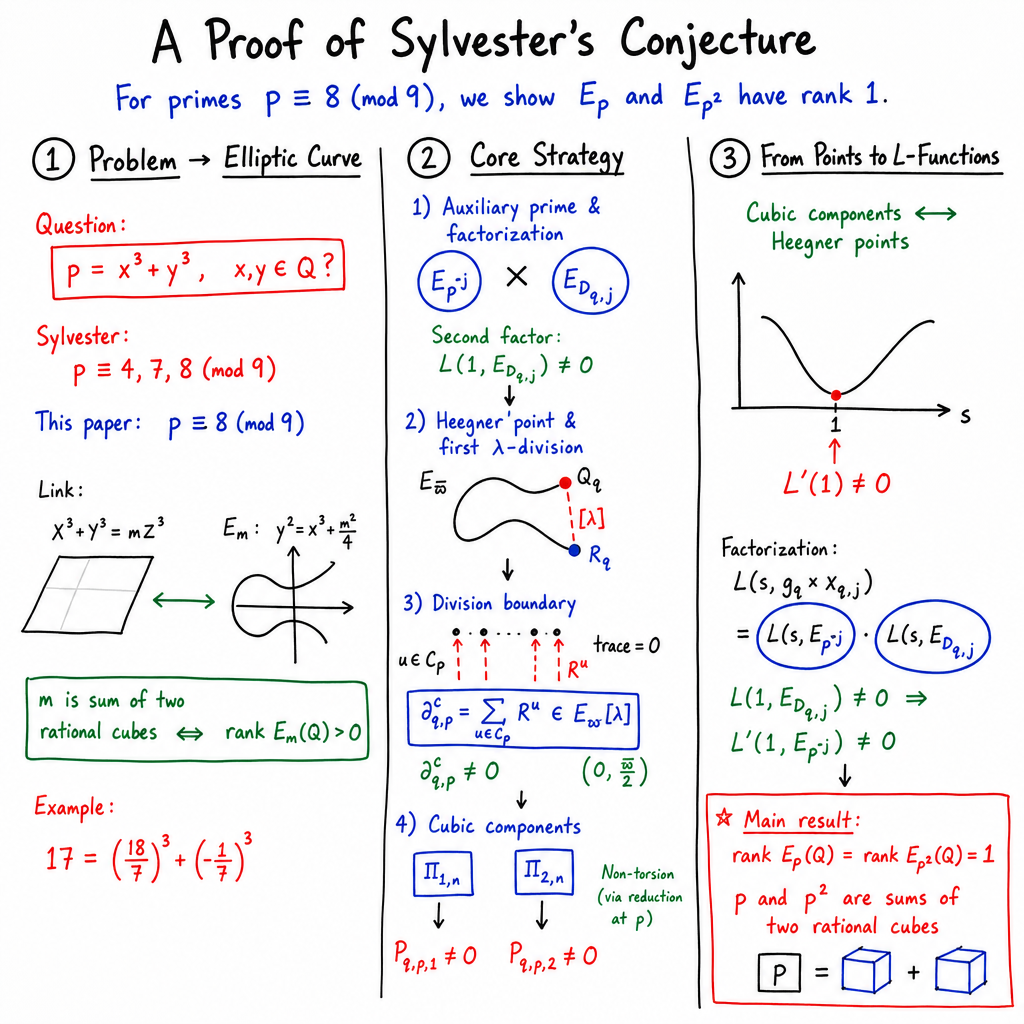
Abstract: We prove Sylvester's conjecture, originating in his 1879 study of ternary cubic equations, that every prime is a sum of two rational cubes. Elkies announced a proof for the classes $4$ and $7$ in 1994, and Yin recently supplied a complete proof. For the remaining class , we prove that the elliptic curve has analytic rank one, as predicted by the Birch and Swinnerton-Dyer conjecture, and so is a sum of two rational cubes. The proof begins by adapting the auxiliary Rankin--Selberg construction from the authors' work on the rank one converse for CM elliptic curves. The Rankin--Selberg -function factors as the -function of times a complementary -function. Chan's $3$-isogeny descent and the rank zero converse show that the complementary central -value is non-zero, and so it suffices to prove that a cubic component of the associated Heegner point is non-torsion. A basic difficulty is that the unweighted Hecke trace of the underlying CM orbit vanishes. Our decisive idea is to take -division before taking the trace, where and is a primitive cube root of unity. We prove that the resulting division boundary is non-zero by analysing Frobenius at . The Galois action on the CM orbit and ramification theory then transfer this non-vanishing to the cubic component.
Paper Prompts
Sign up for free to create and run prompts on this paper.
Top Community Prompts
Explain it Like I'm 14
1. What is this paper about?
This paper proves a famous problem in number theory called Sylvester’s conjecture.
The conjecture says:
Every prime number that leaves a remainder of 4, 7, or 8 when divided by 9 can be written as the sum of two rational cubes.
A rational cube is a number such as , where and are whole numbers. For example, the paper gives
Since $17$ leaves a remainder of $8$ when divided by $9$, this is an example of the conjecture.
Earlier mathematicians had proved the cases where the prime is $4$ or $7$ modulo $9$. This paper proves the final case: primes that are $8$ modulo $9$.
2. What questions did the researchers ask?
The main question was:
If a prime satisfies , can it always be written as the sum of two rational cubes?
Instead of trying to find the two cubes directly, the researchers translated the problem into a question about a special kind of curve called an elliptic curve.
For each number , they studied the curve
They focused especially on the curve when .
Their important research goals were:
- Show that the elliptic curve has infinitely many rational points.
- Prove that its related -function has a simple zero at a special point.
- Use known connections between elliptic curves and cube equations to prove that is a sum of two rational cubes.
They also studied a related curve, .
3. How did they do the research?
The proof uses advanced ideas from number theory. Here is the basic strategy in simpler language.
Turning the cube problem into a curve problem
The equation
describes whether can be written as a sum of two rational cubes. This equation is closely connected to the elliptic curve .
A classical result says that, for the primes considered here,
is a sum of two nonzero rational cubes exactly when has positive rank.
The rank measures how many independent rational points the curve has. Rank greater than zero means that there are infinitely many rational points.
This is similar to finding one useful pattern in a puzzle and then being able to generate infinitely many more solutions from it.
Studying -functions
The researchers used an object called an -function. An -function is a complicated mathematical expression that stores information about an elliptic curve.
The number of times the -function equals zero at its central point, , is called its analytic rank.
The paper proves that
and also
In everyday terms, this means that the curves have exactly the amount of hidden arithmetic complexity expected for curves with rank one.
A major prediction called the Birch and Swinnerton-Dyer conjecture says that this analytic information should match the number of rational points on the curve.
Using an auxiliary prime
The proof introduces another prime , chosen carefully so that it satisfies certain conditions involving cubic residues. These conditions make the later calculations work.
The researchers combine information from the curves related to and using a construction called a Rankin–Selberg convolution. In this case, the resulting function splits into two pieces:
This is useful because the researchers can show that the second factor does not vanish at . Therefore, the important information must come from the first factor, .
Constructing Heegner points
The researchers then use special points called Heegner points. These points are built from special locations on modular curves and can be transferred to elliptic curves.
A major theorem, the Gross–Zagier formula, connects the height of a Heegner point with the derivative of an -function. Roughly speaking:
- if the Heegner point is nonzero and has infinite order,
- then the -function has a simple zero,
- and the elliptic curve has rank one.
The main difficulty was that the usual sum of the relevant points was zero. It was like adding many arrows that perfectly cancel each other out.
The “division boundary” idea
To get around this cancellation, the authors first divided the points by
where is a complex cube root of $1$. They then added the divided points instead of the original points.
The resulting object is called the division boundary.
The important discovery is:
Even though the original sum is zero, the division boundary is not zero.
They prove this by examining what happens when the points are reduced modulo and studying the action of Frobenius. Frobenius is a mathematical operation that describes how numbers and points behave when viewed in a finite field with elements.
The special condition on the auxiliary prime ensures that Frobenius acts nontrivially. This proves that the division boundary survives and is genuinely nonzero.
Finally, they use a “cubic projector” to extract the part of the point related to cube roots. They show that this part has infinite order rather than being a repeating, finite-order point.
4. What did the paper find?
The central result is:
If is prime, then the elliptic curves and both have analytic rank one.
Using deep theorems about Heegner points and elliptic curves, the authors then prove that both curves have ordinary rational rank one.
The main consequence is the completion of Sylvester’s conjecture:
This is important because the $4$ and $7$ cases had already been established by earlier work, while the $8$ case was the remaining part.
The result also explains why examples such as
exist, and proves that similar representations exist for every prime in the required congruence classes.
5. Why does this research matter?
The paper solves a problem that began in the nineteenth century. It shows that a simple-looking question about adding cubes is connected to several deep areas of mathematics:
- elliptic curves,
- prime numbers,
- modular forms,
- special points on curves,
- symmetry in finite fields,
- and -functions.
The new idea of taking a division boundary before forming a trace may also be useful in other problems. It provides a way to recover information when a normal sum disappears because of cancellation.
In the future, similar methods might help researchers study sums of cubes for composite numbers, or understand more completely how elliptic curves behave. Thus, the paper does more than prove one conjecture: it introduces a strategy that could be useful for solving other difficult problems in number theory.
Knowledge Gaps
Knowledge gaps, limitations, and open questions
- The paper proves the prime case , but does not establish comparable results for composite integers, including products of two primes where multiple cubic local conditions interact.
- The method is not shown to apply to the congruence class , where descent permits ranks $0$ or $2$ and the expected analytic behavior is substantially less determined.
- The argument depends on choosing an auxiliary prime satisfying , but it does not produce a canonical or computationally optimal choice of , nor does it quantify the effectiveness of finding such a prime.
- The proof uses a rank-zero converse theorem for CM elliptic curves to deduce ; the paper does not analyze whether this step can be replaced by a more elementary or directly explicit non-vanishing argument.
- The complementary-factor argument establishes non-vanishing of the central -value but does not determine the associated BSD arithmetic invariants, such as the Tate–Shafarevich group, regulator, Tamagawa numbers, or the precise leading-term formula.
- The Heegner-point construction proves non-torsion through the division boundary, but it does not give a general criterion for when analogous boundaries are non-zero outside the specific CM family .
- The division-boundary mechanism is developed only for first -division. The proposed higher -division analogues and their relation to deeper arithmetic information are not constructed or tested.
- The paper does not establish an explicit relationship between higher division boundaries and Selmer groups, Iwasawa-theoretic invariants, Euler systems, or higher derivatives of -functions.
- The transfer from the non-zero boundary to the non-torsion cubic component relies on a local argument involving ramification and the height-two supersingular formal group, but the scope of this argument for other reduction types, CM fields, or isogeny degrees remains unexplored.
- The proof is specific to the prime $3$, the CM field , and the associated cubic descent. It is not shown whether an analogous construction exists for sums of two rational -th powers or for CM elliptic curves with other endomorphism rings.
- The method does not address whether the division-boundary construction can yield information when the relevant Hecke trace vanishes for reasons other than a zero Hecke eigenvalue.
- The paper proves analytic rank one for both and , but it does not determine explicit generators of or in general.
- Although numerical examples identify the constructed Heegner components with multiples of rational points, the paper does not provide bounds for the multiple, a uniform formula for it, or an algorithm with proven complexity.
- The numerical computations are presented for finitely many primes below $500$; no systematic computational verification or statistical analysis is given for larger ranges.
- The relation between the constructed rational points and minimal-height representations with is not investigated.
- The proof establishes existence of non-zero rational cubes in the representations but does not study whether one can impose additional conditions on the numerators and denominators, such as coprimality, size, or prescribed local behavior.
- The paper does not quantify the height of the rational cube-sum representations produced by the Heegner-point method.
- The argument proves rank one over , but does not describe the full Mordell–Weil groups over the CM field , the auxiliary fields , or the relevant ring-class fields.
- The Galois-module structure of the non-torsion Heegner points beyond the cubic projector component is not determined.
- The paper does not clarify whether different admissible auxiliary primes produce compatible Heegner points, division boundaries, or rational generators, nor whether these constructions satisfy norm relations.
- The identification of the cubic projector with the projected YZZ Heegner point is established up to a non-zero rational factor; that factor is not generally made explicit.
- The normalization dependence of the modular parametrizations and Heegner points is not fully translated into an explicit arithmetic normalization of the resulting rational points.
- The approach relies on several deep external inputs, including the YZZ Gross–Zagier formula and CM converse theorems; the paper does not provide an independent proof of these inputs or assess how sensitive the result is to their hypotheses.
- The paper does not extend the result to a full BSD theorem for or ; in particular, it proves only the order of vanishing, not the leading coefficient predicted by BSD.
- The conjectural relationship between the division boundary and the leading term of the Rankin–Selberg -function remains unformulated beyond the non-vanishing argument.
- The method does not address effective determination of the Tate–Shafarevich group or its $3$-primary component for the curves and .
- The paper leaves open whether the division-boundary phenomenon has an interpretation in terms of a canonical cohomology class, rather than depending on choices of division points and local reductions.
- The claimed generalizability of the boundary mechanism beyond the present curves is stated as an expectation, but no abstract theorem identifies the necessary hypotheses or proves such an extension.
Practical Applications
Immediate Applications
- Constructive verification of rational cube representations — Number theory/software. For any prime , the theorem guarantees a representation
For the newly resolved class , the paper’s CM and Heegner-point construction can be implemented as a computational workflow: 1. choose an auxiliary prime satisfying ; 2. compute the relevant cubic residue symbols and CM data; 3. evaluate the division boundary and cubic projector; 4. recover a non-torsion rational point on ; 5. map that point through the $3$-isogeny to obtain explicit rational cubes.
Dependencies: This requires reliable implementations of elliptic-curve arithmetic, cubic reciprocity, CM points, modular parametrizations, and height-based rational-point recovery. The proof establishes existence and constructiveness, but not necessarily an efficient algorithm for very large .
- Computer-algebra benchmarks for elliptic-curve arithmetic — Mathematical software.
- rank computations for and ;
- $3$-isogeny descent;
- CM Hecke-character calculations;
- Heegner-point evaluation;
- rational-point recognition from numerical approximations;
- cubic descent and Mordell–Weil basis computations.
Dependencies: The data are most useful if the authors’ normalization conventions, curve models, and auxiliary-prime choices are reproduced exactly.
- Automated discovery of explicit cube-sum identities — Software and computational number theory. A practical tool could accept a prime and output a certificate
together with the associated point on the elliptic curve and an independently checkable algebraic certificate. This would turn the paper’s “constructive” feature into a reproducible computational pipeline.
Dependencies: Numerical CM evaluations may require high precision; recovering exact rational coordinates can be difficult when the relevant Heegner point has large height.
- Educational use in advanced mathematics — Academia.
- elliptic curves and rational points;
- $3$-isogeny descent;
- complex multiplication;
- Heegner points;
- Rankin–Selberg -functions;
- Gross–Zagier and Kolyvagin methods;
- Frobenius and reduction modulo ;
- Tate cohomology and group-ring projectors.
It can support graduate courses, seminars, or research training modules on how analytic rank-one results produce explicit Diophantine solutions.
Dependencies: The paper is technically advanced and would need supplementary exposition, computational notebooks, and prerequisite material on modular forms and algebraic number theory.
- Benchmark for BSD-related rank computations — Academia and mathematical research. The theorem provides a family in which the analytic rank and Mordell–Weil rank are both established to be one:
These curves can serve as controlled examples for testing conjectural BSD formulas, regulators, Tamagawa-number calculations, and numerical -function evaluations.
Dependencies: The paper proves rank one and finiteness of the Tate–Shafarevich group in the stated setting, but a complete numerical BSD formula still requires additional computations.
- Reusable method for vanishing-trace problems — Research methodology.
- lift orbit points through a -isogeny;
- take the trace after division rather than before it;
- detect the resulting torsion boundary by reduction and Frobenius;
- transfer non-vanishing to a character-selected component.
This is immediately useful as a conceptual and computational template for researchers studying arithmetic objects with vanishing traces, norm relations, or cancellation among Galois conjugates.
Dependencies: Direct transfer to another problem requires an appropriate isogeny, a controllable local reduction theory, and a character decomposition analogous to the cubic projector.
- Policy and funding prioritization for computational mathematics — Research infrastructure. The paper identifies concrete computational needs—CM-point evaluation, exact Heegner-point arithmetic, descent matrices, and reproducible databases of rational cube identities. Agencies and institutions could use these needs to support open-source arithmetic-geometry software, verified datasets, and formalized proofs.
Dependencies: This is an indirect application rather than a direct technological deployment; its value depends on community adoption and reproducibility standards.
Long-Term Applications
- Extension from prime inputs to composite integers — Number theory and algorithms. The paper explicitly proposes studying cube sums for composite integers, beginning with products of two primes. A successful extension could yield algorithms and classification results for
for broader families of cube-free . Such work would need to manage several simultaneous local cubic-residue conditions and more complicated Selmer groups.
Dependencies: The prime case benefits from a single inert prime and a particularly structured ring-class field. Composite inputs may introduce interacting local obstructions, larger class groups, and higher-dimensional descent computations.
- Higher division boundaries in conductor towers — Arithmetic geometry. The first -division boundary may be generalized to compatible higher divisions,
across ring-class or anticyclotomic towers. These higher boundaries could detect arithmetic information that is invisible to the ordinary trace and might contribute to: - higher-rank point constructions; - refined Selmer-group information; - -adic height formulas; - Euler-system or Kolyvagin-system constructions.
Dependencies: One would need compatible choices of division points, control of ramification, integral group-ring operators, and non-torsion criteria in higher formal groups.
- Generalization to other CM elliptic curves and isogeny degrees — Research mathematics.
- CM curves with different endomorphism rings;
- $2$-, $5$-, or higher-degree isogenies;
- other diagonal Diophantine equations;
- vanishing Hecke traces in modular or automorphic families.
A successful general theory would turn the division-boundary mechanism into a reusable converse theorem for analytic rank.
Dependencies: The cubic case relies heavily on explicit CM geometry, a simple $3$-isogeny, cubic Kummer theory, and manageable supersingular reduction. These features may not persist for other primes or non-CM curves.
- Refinements toward the full Birch–Swinnerton-Dyer formula — Arithmetic research.
- the leading coefficient of at ;
- the Néron–Tate regulator;
- periods and Tamagawa factors;
- the order of $\Sha(E/\mathbf Q)$;
- the exact index of the constructed Heegner point in .
These results could produce explicit BSD formulas for an infinite family of elliptic curves.
Dependencies: This requires substantially finer control than non-vanishing: exact height formulas, integral models, local correction factors, and precise comparison of Heegner points with Mordell–Weil generators.
- Improved algorithms for rank-one elliptic curves — Computational number theory.
- select an auxiliary prime automatically using Chebotarev conditions;
- certify non-vanishing of the complementary -value;
- construct a provably non-torsion point;
- certify the Mordell–Weil rank.
Dependencies: Runtime and numerical stability are unresolved, especially for large conductors, large class groups, and high canonical heights.
- Formal verification of advanced arithmetic proofs — Mathematical logic and software.
- CM elliptic-curve constructions;
- isogeny descents;
- cubic residue calculations;
- Heegner-point non-torsion criteria;
- selected BSD consequences.
Dependencies: Formalizing the required analytic number theory, modular curves, -functions, and algebraic geometry would be a major long-term effort.
- Broader Diophantine applications through elliptic-curve parametrization — Mathematics and symbolic computation.
- generalized Fermat-type equations;
- diagonal cubic surfaces;
- rational points on twists of CM curves;
- norm-form and cubic-residue equations.
Dependencies: Each new equation may have different local solubility conditions, geometric models, and modular parametrizations; the existence of a suitable Heegner-point construction is not automatic.
Glossary
- Abelian surface: A two-dimensional abelian variety, often arising from a modular form. “The pair determines an abelian surface ”
- Adeles: A restricted product of local completions of a number field used in global number theory. “For a number field , and denote its adeles and finite adeles.”
- Artin map: A reciprocity map connecting ideles or ideals with Galois groups of abelian extensions. “The Artin maps use arithmetic Frobenius”
- Automorphic induction: A construction that transfers automorphic representations from a number field to a smaller field. “Automorphic induction gives”
- Birch and Swinnerton-Dyer conjecture: A conjecture relating the rank of an elliptic curve to the order of vanishing of its -function. “as predicted by the Birch and Swinnerton-Dyer conjecture”
- Bloch--Kato Selmer group: A Selmer group defined using Bloch–Kato local conditions on Galois representations. “The preceding equalities imply the vanishing of the Bloch--Kato Selmer group”
- CM elliptic curve: An elliptic curve whose endomorphism ring is larger than , giving complex multiplication. “the rank-one converse for CM elliptic curves”
- CM point: A special point on a modular curve corresponding to an elliptic curve with complex multiplication. “there exists a CM point ”
- CM Hecke character: A Hecke character encoding the arithmetic of a complex-multiplication elliptic curve. “For , let denote the elliptic curve given by the same equation as \eqref{eq,ell}, and let be its CM Hecke character.”
- Complex multiplication: An extra endomorphism structure on an elliptic curve arising from an imaginary quadratic field. “The underlying elliptic curves have complex multiplication”
- Conductor: An arithmetic invariant measuring the ramification of a character, field extension, or elliptic curve. “The conductor $3p$ ring-class extension is totally ramified at ”
- Cubic character: A character whose values lie in the group of cube roots of unity. “Let be the cubic character describing the action on ”
- Cubic residue symbol: A higher-power analogue of the Legendre symbol that detects cubic residuacity in a number field. “where is the cubic residue symbol”
- Cubic descent: A descent method based on a $3$-isogeny and cubic covering equations. “Moreover, a cubic descent shows that is not -divisible over ”
- Cubic projector: A group-ring operator extracting the component of an orbit transforming under a cubic character. “The point reduces to at ”
- Cubic torsion: Torsion points on an elliptic curve whose order is a power of three. “The rational $3$-torsion on the $3$-isogenous model ”
- Elliptic curve: A nonsingular genus-one algebraic curve equipped with a chosen origin. “For , put”
- Étale isogeny: A finite morphism between algebraic groups that is unramified and has finite kernel. “multiplication by extends to a finite etale isogeny”
- Frobenius: An endomorphism or Galois action associated with raising coordinates to a power equal to a residue-field cardinality. “The Galois action on the CM orbit and ramification theory then transfer this non-vanishing to the cubic component.”
- Gross--Zagier formula: A formula relating derivatives of Rankin–Selberg -functions to heights of Heegner points. “The Yuan--Zhang--Zhang (YZZ) generalization of the Gross--Zagier formula”
- Hecke character: A character of ideals or ideles generalizing Dirichlet characters and producing -functions. “For , let be the CM Hecke character of ”
- Hecke correspondence: An algebraic correspondence on a modular curve encoding the action of a Hecke operator. “The prime-to-level Hecke correspondence at , applied to , consists of CM points.”
- Hecke trace: The sum of points or functions obtained from a Hecke correspondence. “the natural conductor- Hecke trace of an underlying CM orbit vanishes.”
- Heegner point: A point on an elliptic or abelian variety obtained from a CM point on a modular curve. “The construction of Yuan--Zhang--Zhang \cite{YZZ} attaches to the pair a Heegner point”
- Iwasawa theory: The study of arithmetic objects across towers of number fields, especially -power extensions. “use Iwasawa theory to deduce that a suitable Heegner point is non-torsion”
- Isogeny: A surjective morphism between elliptic curves or abelian varieties with finite kernel. “the diagonal cubic is $3$-isogenous to over .”
- Kolyvagin derivative: A group-ring construction used to extract arithmetic information from Euler-system classes. “As with Kolyvagin derivatives, the group ring identity”
- Kummer theory: The study of field extensions generated by roots of elements and their associated Galois characters. “The two characters of exact order three that we need arise from this Kummer construction.”
- Mordell--Weil rank: The rank of the finitely generated group of rational points on an elliptic curve. “Consequently, the theorems of Gross--Zagier and Kolyvagin imply that and have Mordell--Weil rank one”
- Rankin--Selberg convolution: An analytic construction combining automorphic forms or representations to produce an -function. “The auxiliary Rankin--Selberg -function factors as the -function of times a complementary -function.”
- Ray-class field: An abelian extension determined by congruence conditions on ideals and specified ramification. “$F_q\subset K_{3\varpi}^{\mathrm{ray}}\subset K_{9q}^{\mathrm{ray}$”
- Relative Frobenius: The Frobenius morphism between reductions of varieties over finite fields. “Relative -Frobenius from the reduction of to the reduction of .”
- Ring-class field: An abelian extension associated with the ideal classes of a nonmaximal order in a number field. “The conductor-$3p$ ring-class extension is totally ramified at ”
- Selmer group: A subgroup of a Galois cohomology group encoding locally soluble divisibility conditions on rational points. “the -Selmer corank is one”
- Shimura reciprocity law: A reciprocity theorem describing the Galois action on special points of modular and Shimura varieties. “Shimura's reciprocity law governs the Galois action on the CM points.”
- Specialization: The process of reducing an algebraic or geometric object at a chosen prime or point. “At a fixed prime , denotes specialization.”
- Supersingular formal group: A formal group associated with a supersingular reduction of an elliptic curve. “the height-two supersingular formal group at ”
- Tate cohomology: A modification of group cohomology suited to finite groups and periodic exact sequences. “It has the following Tate-cohomological interpretation.”
- Theta series: A generating series constructed from arithmetic data, often producing a modular form. “Let be the associated theta series”
- Torsion point: A point on an elliptic curve having finite order under the group law. “Thus has infinite order.”
- Trace-zero orbit: An orbit of points whose group-theoretic sum is zero. “This is the division boundary of the trace-zero orbit”
- Unramified extension: A field extension introducing no additional ramification at a specified prime. “after passing to a finite unramified extension ”
- 3-isogeny descent: A descent calculation using an isogeny of degree three to study rational points and Selmer groups. “Chan's $3$-isogeny descent and the rank-zero converse show”
- -division: The process of finding a point whose image under multiplication by is a specified point. “This description also makes the first -division of explicit.”
- Division boundary: A torsion-valued invariant obtained by tracing chosen divisions of a trace-zero orbit. “It is the division boundary of the trace-zero orbit”
- -kernel: The kernel of the endomorphism given by multiplication by . “Since has degree , it is injective on the -kernel.”

