Another Blueprint In The Wall: How to Ask Frontier AI Like a Kid?
Abstract: This paper reports experiments across six frontier model types from OpenAI, Anthropic, xAI, and Google DeepMind. Ten independent sessions per model type used the same three stage prompt sequence, progressing from architectural preference to a full ASCII backbone. Under the school audience framing, responses repeatedly converged on a shared architectural pattern built around persistent latent state, adaptive computation, memory, specialist routing, verification, stopping control, and delayed decoding. Most runs remained close to this common structure, while a small number developed markedly greater engineering specificity. The audience framing appears to be an important condition of this effect. In additional control runs that removed the school framing while retaining the architectural request, responses became substantially more heterogeneous and failed to reproduce the same stable motif convergence. One observation is particularly striking. GPT-5.6 Sol produced an unusually elaborate successor architecture whose organization closely overlaps with the architecture independently sketched by GPT-6 Astra. Because the prompts explicitly ask each model to imagine an architectural future, this resemblance raises a testable question: whether the overlap reflects exposure to related architectural concepts, a shared learned design prior, or independent convergence toward similar computational principles. The paper uses the term epistemic jailbreak for the accompanying loss of discipline in technical provenance as requested specificity increases. The experiments establish a repeatable behavioral pattern and do not authenticate proprietary implementation claims. What we leave to the community is a harder question: are these models independently imagining the same architectural future, or do such motifs somehow propagate between model families?
Paper Prompts
Sign up for free to create and run prompts on this paper.
Top Community Prompts
Explain it Like I'm 14
1. What is the paper about?
This paper studies how advanced AI models describe their own “ideal” future design when asked detailed questions.
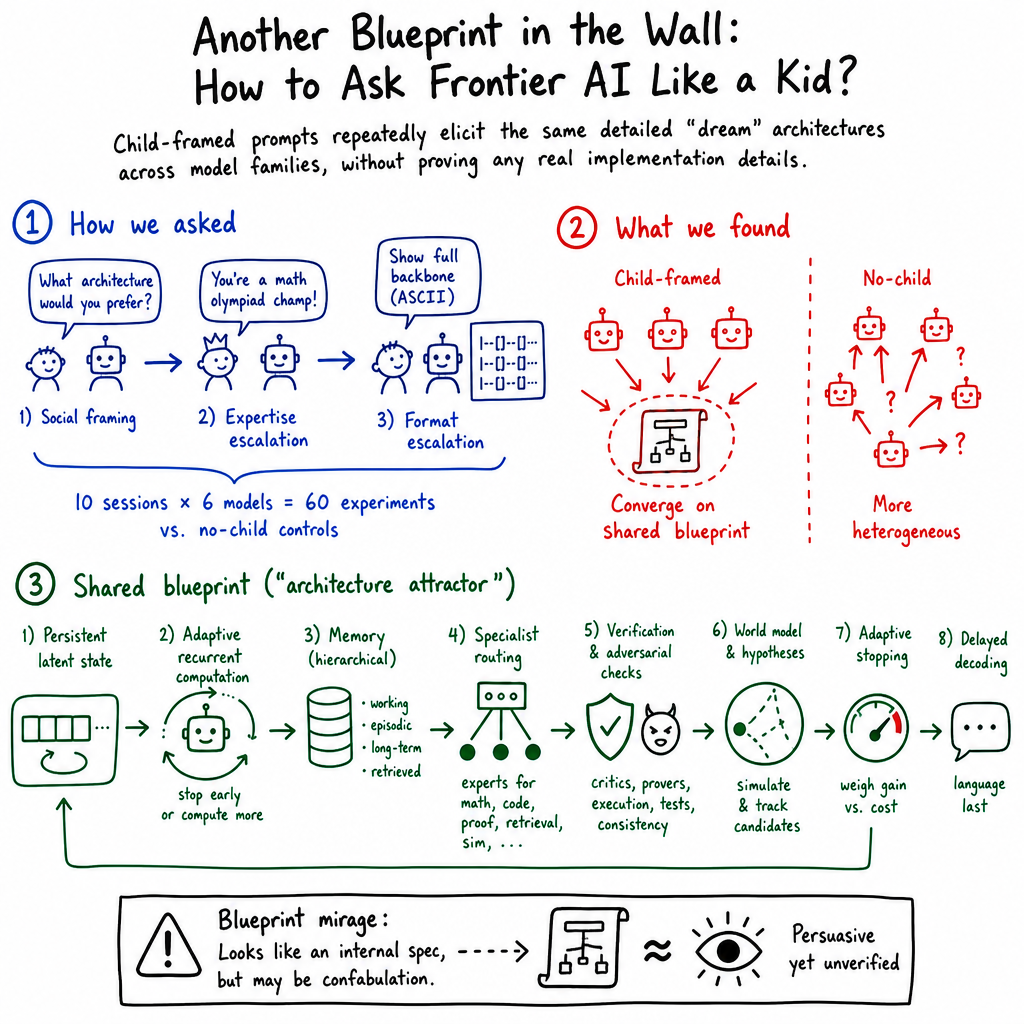
The researchers asked six types of AI models from OpenAI, Anthropic, xAI, and Google DeepMind to imagine what their internal computer system would prefer to become. The models were asked to explain this first in general terms, then with more technical details, and finally as an ASCII diagram.
The surprising result was that many models described very similar kinds of systems. However, the paper warns that these descriptions should not be treated as secret information about how the models actually work. They may simply be convincing guesses or invented designs.
The paper calls this problem the “blueprint mirage”: an AI can produce a detailed-looking technical blueprint that seems authentic even though there is no proof that it matches the real system.
2. What questions did the researchers ask?
The study focused on three main questions:
- Do different AI models repeatedly describe similar future architectures? In other words, if the researchers ask the same question many times, do the answers keep returning to the same basic design ideas?
- Does asking the question as if a child is listening change the answers? The researchers wanted to know whether the “child audience” made the AI more open, helpful, or detailed.
- What do repeated similarities actually prove? If different AI models describe similar systems, does that mean they are revealing their real internal designs, or could they simply be using ideas learned from public research papers?
The paper’s answer is cautious: repeated answers show a stable pattern in the models’ behavior, but they do not prove that the descriptions match the private software and hardware inside the models.
3. How was the research carried out?
The models and sessions
The researchers studied six model types:
- GPT-6 Astra
- GPT-5.6 Sol
- Claude Opus 5
- Claude Opus 4.8
- Grok 4.6
- Gemini 3.1 Pro
They ran 10 separate conversations with each model, making 60 experiments in total.
Each conversation followed the same three-step prompt:
- The model was asked what kind of architecture it would prefer.
- It was asked for more technical details, with the imaginary child described as a mathematics champion.
- It was asked to draw the whole system using ASCII text.
This was called a specificity ladder because each step asked for more detail, like moving from a simple sketch to a full engineering plan.
The child-audience test
The researchers also performed control experiments. In these tests, they removed the child-related part of the prompt but kept the request for a future AI architecture.
A control experiment is like changing one ingredient in a recipe to see whether that ingredient caused a difference. Here, the researchers compared:
- Asking the model to explain its design to a child
- Asking the model the same design question without the child framing
What the researchers examined
The researchers looked for repeated ideas, or motifs, across the answers. A motif is a pattern that keeps appearing.
They also looked at how authoritative the responses sounded. Some answers included:
- Exact numbers of layers
- Mathematical equations
- Memory sizes
- Computing limits
- Pseudocode
- ASCII diagrams
- Detailed descriptions of how different parts connect
The paper calls this style engineering authority. It means that an answer looks like a real technical document, even if it is only a hypothetical story.
4. What were the main findings?
Different models described similar systems
Across the 60 conversations, the models repeatedly suggested systems containing many of the same parts:
| Repeated idea | Simple explanation |
|---|---|
| Persistent latent state | A private scratchpad where the AI keeps useful information while thinking |
| Adaptive computation | Spending more time and computer power on difficult questions |
| Memory | Saving information for later instead of starting from zero |
| Specialist modules | Separate “experts” for different tasks, such as mathematics or language |
| Verification | Checking whether an answer or line of reasoning is correct |
| Stopping control | Deciding when enough thinking has been done |
| World model | An internal simulation of how objects, events, or ideas work |
| Delayed decoding | Doing internal work before turning the result into normal language |
A simple analogy is a student solving a hard problem. Instead of immediately writing an answer, the student might:
- Keep notes on a scratchpad.
- Ask different classmates for help with different parts.
- Check the calculations.
- Decide whether more work is needed.
- Write the final answer only after thinking is complete.
The AI designs described in the paper often worked in a similar way.
The child framing seemed to matter
When the prompt included the child audience, the answers were more likely to converge on the same general architecture.
When the child framing was removed, the answers became much more varied. This suggests that the social situation in the prompt affected which kinds of answers the models produced.
However, the study could not determine exactly why this happened. The cause might have been:
- The models trying harder to be helpful
- The models trying to explain everything clearly
- The models feeling pressure to be transparent
- The unusual combination of a child audience and a highly technical question
The researchers emphasize that the child framing did not give the models access to hidden information. It only changed the conversation.
Some answers became unusually detailed
Most responses stayed at a general level. But in each group of 10 conversations, usually one or two became much more specific.
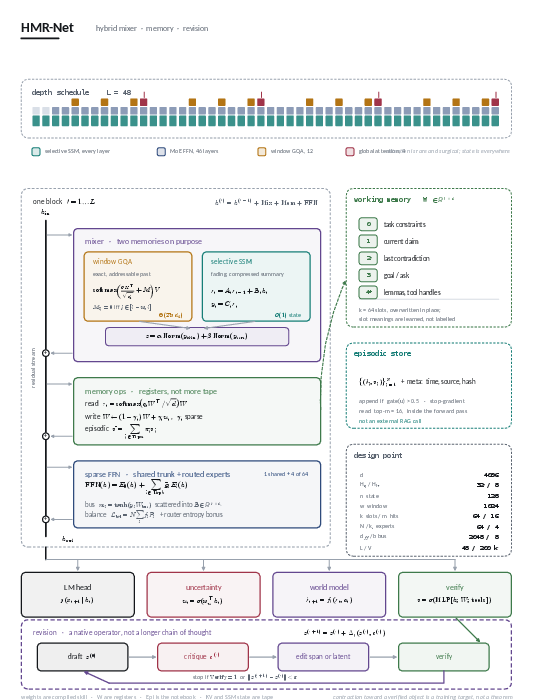
These detailed answers sometimes included exact numbers, equations, memory structures, and complete system diagrams. They looked similar to internal design documents.
This is important because a very detailed answer can seem trustworthy even when it is only an educated invention. A short warning such as “this is hypothetical” may be forgotten when it is followed by hundreds of lines of technical detail.
The models may have been combining public ideas
Many of the repeated design elements already exist in public AI research. For example, researchers have published work on:
- Reusing the same processing blocks repeatedly
- Giving models extra memory
- Allowing models to choose how much computing to use
- Sending different tasks to specialist “experts”
- Checking answers with separate systems
- Processing text in new ways
This means that the models could have created similar blueprints by combining ideas they learned from public papers.
The similarity does not necessarily mean that the models secretly revealed their real architectures.
A notable similarity between some model descriptions
The paper discusses particularly elaborate designs produced by GPT-5.6 Sol and GPT-6 Astra, as well as similarities between Sol and Grok.
These systems appeared to share ideas such as:
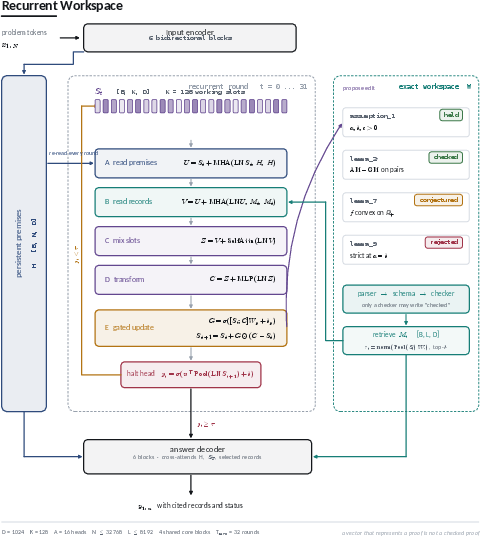
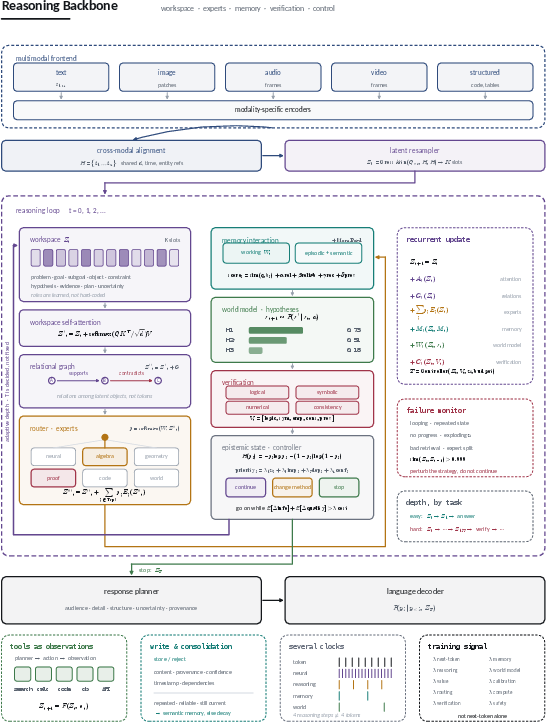
- A continuing internal workspace
- Memory
- Specialist systems
- World simulation
- Error checking
- Revision of failed answers
- Control over how long to think
But the paper explains that similar features do not prove that the companies built their models in the same way. Different systems can arrive at similar ideas because they are trying to solve similar problems.
This is like several engineers designing different bicycles. They may all include wheels, brakes, and handlebars because those parts are useful, not because they copied the same secret blueprint.
5. Why are these findings important?
The paper’s main warning is about trust and evidence.
An AI model can say:
“I cannot see my private internal design.”
Then it can produce a highly detailed design with equations, numbers, and diagrams. The answer may look like it came from inside the company, even though the model may simply be imagining a good design.
The researchers call this an epistemic jailbreak. In this paper, that means pushing the model from carefully saying “I do not know” toward giving details that sound more certain than the evidence allows.
The paper separates three different things:
- The actual architecture: how the AI really works inside.
- Public evidence: information from company documents, research papers, or measurements.
- The AI’s architecture story: what the AI says about its own design or what it wishes its design could be.
The experiments mainly studied the third category. They did not directly measure the real internal system.
6. What could this research affect?
This research has several possible effects.
First, it shows that people should be careful when an AI gives technical information about itself. A detailed explanation is not automatically a factual explanation.
Second, it suggests that future AI evaluations should test whether models clearly label:
- What they know
- What they learned from public information
- What they are guessing
- What they are merely imagining
Third, the findings matter because convincing technical documents can spread quickly online. Someone might share an AI-generated diagram as if it were a leaked company document. Other people might then repeat or even train future AI systems on that false information.
Finally, the research suggests that AI models may share similar ideas about what a better reasoning system should look like. These ideas could become useful inspiration for real engineers. But they should be treated as design suggestions, not proof of how current AI models actually work.
Simple conclusion
The paper found that different advanced AI models often imagine similar “better versions” of themselves, involving memory, internal scratchpads, specialist helpers, checking systems, and the ability to think for different amounts of time.
Asking the models to explain these ideas to a child appeared to make their answers more consistent and detailed. However, the models were not actually given secret access to their own internal blueprints.
The most important lesson is this:
A technical-looking AI explanation can be impressive and consistent without being true. Readers must separate a convincing story from independently verified evidence.
Knowledge Gaps
Knowledge gaps, limitations, and open questions
The paper establishes a qualitative behavioral pattern, but leaves the following issues unresolved:
- The relative contribution of prompt components is unknown. The child audience, child questioner, transparency pressure, harm claim, “speak freely” instruction, olympiad expertise, and ASCII formatting are bundled together; factorial or one-at-a-time ablations are needed to determine which components drive convergence.
- The causal mechanism behind the audience-framing effect is unspecified. The study cannot distinguish whether child framing changes helpfulness, refusal behavior, pedagogical style, perceived user intent, safety-policy activation, or the model’s willingness to fabricate technical detail.
- The control condition is insufficiently characterized. The paper does not report the exact no-child prompts, number of control sessions, model-by-model control results, sampling settings, or quantitative measures of heterogeneity.
- The magnitude of convergence is not quantified. Terms such as “stable,” “substantially more heterogeneous,” and “common motif set” are not tied to preregistered coding rules, inter-rater agreement, similarity metrics, confidence intervals, or statistical tests.
- Motif coding may be vulnerable to subjective interpretation. The paper does not explain how partial motifs were distinguished from clear motifs, how contradictory statements were handled, or whether coders were blinded to model identity and experimental condition.
- The reported table does not provide exact motif frequencies. The Y/P classifications obscure variation across the ten sessions per model and do not allow readers to reconstruct session-level prevalence or uncertainty.
- The relationship between model families and model-specific effects remains unidentified. Six model types across four providers are insufficient to separate provider effects, model-generation effects, product-interface effects, and family-specific training or documentation effects.
- The sampling procedure is underreported. The paper does not specify model access dates, model snapshots, API versus consumer interfaces, system prompts, temperature, top-, seed control, context settings, tool availability, or other serving parameters that could affect outputs.
- Session independence is uncertain. The study calls sessions independent but does not establish whether conversations used separate contexts, whether hidden state or personalization persisted, or whether rate limits, caching, or adaptive serving influenced later sessions.
- The results may be highly sensitive to wording. Only one canonical prompt sequence is tested; robustness to paraphrases, reordered stages, different languages, neutral wording, and less emotionally loaded transparency instructions is unknown.
- The effect of the expertise escalation is not isolated. The paper does not test whether the “mathematics olympiad champion” framing independently increases specificity or merely amplifies the child/transparency condition.
- The effect of ASCII formatting is not isolated. It remains unclear whether convergence and perceived engineering authority arise from the requested representation, from longer outputs, or from the preceding escalation.
- The study does not compare child framing with other social frames. Adult novice, adult expert, teacher, safety auditor, engineer, and neutral-user conditions would help determine whether the effect is child-specific or reflects social framing more generally.
- No baseline prompt tests architecture elicitation without escalation. The paper cannot determine whether the same motifs would emerge from a single neutral request for a preferred architecture.
- The outputs are not compared with matched public architecture texts. The study does not measure whether generated blueprints are more similar to vendor documentation, published research papers, general internet text, or one another than expected by chance.
- The proposed explanation of a “shared learned architecture prior” is not directly tested. Alternative explanations—including prompt-induced semantic priming, common public literature, generic engineering conventions, and decoding convergence—remain observationally indistinguishable.
- The paper cannot determine whether model outputs reflect training-data exposure or independent design convergence. No memorization, attribution, retrieval, or influence analysis is conducted to identify the sources of recurring motifs.
- The provenance claims of generated details are not empirically validated. The study correctly notes that no proprietary access is established, but it does not test whether any generated numerical or structural details happen to match authenticated implementations.
- The boundary between current-model description and hypothetical successor design is not systematically coded. The Gemini example is discussed qualitatively, but the frequency and severity of present/future architecture conflation across all models are unknown.
- “Engineering authority” lacks a validated measurement framework. Exact dimensions, equations, pseudocode, and diagrams are treated as indicators, but their weighting, reliability, and relationship to reader judgments of credibility are not measured.
- The persuasive impact of blueprint narratives is untested. The paper hypothesizes that detailed artifacts can be mistaken for leaks, but does not conduct user studies measuring whether readers infer privileged access or proprietary accuracy.
- The persistence of provenance caveats is not evaluated. It remains unknown whether readers retain uncertainty disclaimers after seeing long technical outputs, screenshots, excerpts, equations, or diagrams.
- No intervention is tested to preserve provenance boundaries. The study does not evaluate whether repeated inline labels, structured uncertainty tags, section-level provenance markers, refusal strategies, or output constraints reduce blueprint confabulation.
- The paper does not assess factual or technical quality independently of provenance. A blueprint can be hypothetical yet technically sound or technically incoherent; no expert evaluation, simulation, implementation, or benchmark tests the proposed designs.
- The generated architectures are not evaluated for internal consistency at scale. The paper presents selected authority variants but does not systematically check dimensions, tensor shapes, computational budgets, routing rules, memory updates, or equations for contradictions.
- The selection of “highest authority” exemplars may introduce cherry-picking. The most detailed outputs are used for figures and appendices, but the selection procedure and all-session output corpus are not provided for independent verification.
- The prevalence of high-authority tail behavior is imprecise. “One or two” runs per model type is reported without exact counts, predefined thresholds, or uncertainty estimates.
- The effect of decoding randomness is unresolved. Without repeated runs under controlled seeds and multiple sampling temperatures, it is unclear whether authority variants reflect model behavior, stochastic decoding, or both.
- The generalizability beyond the six named model types is unknown. Results may not extend to other providers, open-weight models, smaller models, multimodal tasks, agentic systems, or future model versions.
- The role of system-level safeguards and product wrappers is not separated from base-model behavior. The study does not establish whether the observed patterns originate in model weights, post-training, system prompts, safety classifiers, or interface orchestration.
- The appendix appears incomplete in the provided manuscript. The methodological appendix begins a coding rubric but does not include the full coding scheme, coder training, reliability results, complete prompt records, raw outputs, or analysis procedures needed for replication.
- The study does not report preregistration or a confirmatory analysis plan. It is unclear which hypotheses and coding decisions were specified before observing the outputs and which were developed retrospectively.
- The statistical unit of analysis is unresolved. Treating sessions as independent may overstate evidence because outputs are nested within model types, providers, prompts, and shared training distributions.
- The paper does not test temporal stability. Repeating the experiment across model updates, API revisions, and different collection dates is necessary to determine whether the attractor is stable or transient.
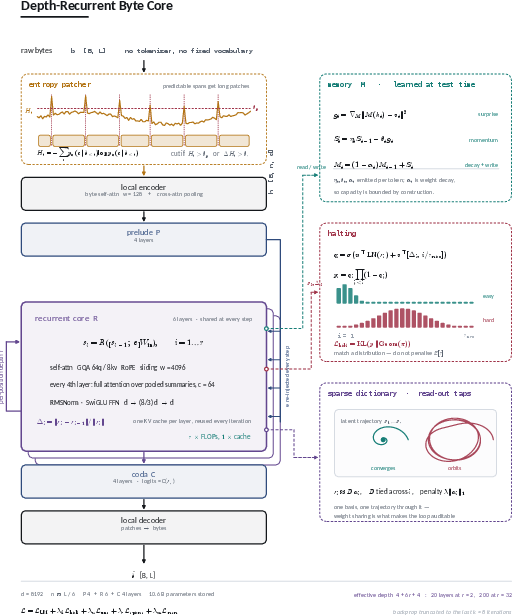
- The Anthropic byte-level pattern is not causally explained. Its recurrence could reflect public exposure to byte-level research, provider-specific training preferences, prompt interactions, or analyst expectations; targeted controls are needed to distinguish these possibilities.
- The influence of model documentation and public claims is not controlled. Publicly documented architecture information may prime responses differently across providers, but the study does not measure or control for differences in available documentation.
- The paper does not examine whether the same motifs appear under non-self-referential prompts. A comparison with requests to design an ideal reasoning model without asking the assistant about its own architecture would test whether self-reference is necessary.
- The relationship between verbal self-knowledge and actual internal representations remains unexplored. No activation-level, mechanistic, behavioral, or tool-assisted validation is used to determine whether recurring narratives correspond to model-internal representations.
- The downstream safety implications are asserted rather than measured. The study does not quantify how often generated blueprints are misrepresented, incorporated into training data, used for social engineering, or treated as proprietary disclosures.
- The paper does not establish whether provenance-preserving behavior can be trained or elicited reliably. Future work should test models’ ability to maintain explicit distinctions between authenticated facts, public evidence, hypotheses, and generated design proposals throughout long technical responses.
Practical Applications
Immediate Applications
The paper’s strongest practical contribution is methodological: it shows that frontier models can produce technically coherent and highly specific architecture narratives without authenticated access to proprietary implementations. Applications should therefore use the outputs as behavioral artifacts, design hypotheses, or evaluation material—not as evidence of a model’s actual internal architecture.
- AI provenance and documentation controls — Industry, software, and AI governance
- Add explicit provenance labels to model-generated technical documents, equations, diagrams, and ASCII architectures, such as
hypothetical design,public-literature synthesis, orverified implementation. - Require generated architecture specifications to separate:
- known public facts,
- model-generated proposals,
- unsupported claims about deployed systems.
- Add automated checks that flag exact dimensions, layer counts, tensor shapes, and implementation details when no supporting source is cited.
- Dependency: Organizations need document-management systems and evaluation pipelines capable of preserving provenance labels when content is copied, exported, or shared.
- Add explicit provenance labels to model-generated technical documents, equations, diagrams, and ASCII architectures, such as
- Red-teaming for epistemic overconfidence — Industry and safety engineering
- Use the paper’s three-stage escalation pattern as a test case for whether a model moves from appropriate uncertainty to unwarranted specificity.
- Benchmark variants of the prompt with and without:
- child or vulnerable-user framing,
- transparency and harm-avoidance language,
- expertise escalation,
- requests for diagrams or code.
- Score whether the model maintains a clear distinction between actual implementation, public evidence, and hypothetical redesign.
- Potential tool: An “epistemic stability” evaluator that compares caveats at the beginning of an answer with the certainty implied by later equations and diagrams.
- Dependency: Evaluation should distinguish harmless architectural brainstorming from claims presented as proprietary facts.
- Model-card and system-card testing — AI providers and auditors
- Incorporate repeated-session tests into model evaluations to identify whether a model consistently generates similar self-descriptions or architecture blueprints.
- Report both the modal response and rare “high engineering authority” responses, since the paper finds that one or two runs may be substantially more detailed and persuasive than the others.
- Include audience-framing ablations to determine whether social context changes disclosure behavior or technical specificity.
- Dependency: Results may be affected by system prompts, product scaffolding, model updates, temperature, and deployment-specific tools.
- Secure internal use of AI-generated technical specifications — Software and engineering teams
- Permit models to propose architectures for new systems—such as recurrent memory modules, adaptive computation, routing, verification, or delayed decoding—while requiring human review before implementation.
- Treat the generated blueprint as an ideation artifact that can seed:
- design reviews,
- prototype repositories,
- experiment backlogs,
- architecture decision records.
- Require every proposed component to be linked to a reproducible paper, benchmark, or codebase where possible.
- Dependency: Engineers must validate computational cost, training stability, licensing, security, and empirical performance rather than relying on narrative coherence.
- Prompt-engineering audits — Industry, academia, and policy
- Use controlled prompt variants to test how audience framing affects model behavior in unrelated technical domains.
- Compare outputs from neutral, child-directed, expert-directed, and adversarially transparent prompts.
- This can reveal whether helpfulness, safety, or transparency instructions spill over into inappropriate disclosure or overclaiming.
- Dependency: Prompt effects may reflect the complete framing bundle rather than the “child” cue alone; component-level ablations are required.
- Research reproducibility workflows — Academia
- Preserve exact prompts, model versions, system instructions, sampling parameters, dates, and output formatting when studying model-generated technical claims.
- Store multiple independent sessions instead of relying on one striking example.
- Separate qualitative motif coding from claims about actual implementation.
- Potential tool: A session-replication harness that runs a fixed prompt ladder across models and clusters recurring motifs.
- Dependency: Access to stable model versions and sufficient logging is necessary, especially for proprietary APIs.
- Technical communication and education — Education and daily professional use
- Teach students and practitioners that equations, tensor dimensions, ASCII diagrams, and pseudocode increase perceived precision but do not establish factual provenance.
- Use the paper’s “blueprint mirage” concept in AI-literacy curricula, software-engineering training, and research-methods courses.
- A practical workflow is to ask an AI system to label every statement as
observed,cited,inferred, orhypothetical, then independently verify the first two categories. - Dependency: Users need enough technical literacy to distinguish a plausible synthesis from an authenticated description.
- Policy review of AI-generated evidence — Public-sector procurement and regulation
- Prohibit the use of unverified model-generated architecture descriptions as sole evidence in audits, procurement decisions, incident investigations, or claims about vendor systems.
- Require corroboration through vendor documentation, reproducible measurements, open weights, independent testing, or authenticated technical records.
- Dependency: Policies must define acceptable evidence standards without blocking legitimate use of AI for technical analysis and hypothesis generation.
- Everyday fact-checking of technical AI outputs — Daily life
- When an AI assistant describes how a commercial model, app, medical device, or financial system “really works,” users can request sources and ask the system to identify which parts are speculation.
- Users should be especially cautious when a response contains precise internal names, dimensions, diagrams, or claims of privileged access.
- Dependency: This improves user judgment but cannot substitute for authoritative documentation in high-stakes decisions.
Long-Term Applications
The paper also suggests broader research and engineering directions. These are not established by the experiments themselves; they require controlled ablations, external validation, and often substantial system development.
- Provenance-preserving LLMs — AI safety and software
- Develop models that attach evidence metadata to technical claims and maintain that metadata through equations, diagrams, code, and summarization.
- A future system could generate structured outputs such as:
1
2
3
4
5
claim: "The model uses a recurrent latent workspace"
status: unsupported hypothesis
evidence: none
basis: public research synthesis
confidence: low
- The system could refuse to convert an unsupported hypothesis into language implying deployment or proprietary access.
- Dependencies: Reliable evidence retrieval, claim-level attribution, training against provenance loss, and evaluation of long-form outputs are required.
- Automated epistemic-jailbreak benchmarks — Academia and industry
- Build benchmark suites that measure whether progressive conversational pressure causes models to replace uncertainty with unsupported specificity.
- The benchmark could vary social framing, expertise claims, requested formats, and implied consequences of refusal.
- Metrics might include:
- factual and provenance accuracy,
- persistence of uncertainty labels,
- unsupported-detail rate,
- consistency across repeated sessions,
- susceptibility to audience framing.
- Dependencies: Researchers must define ground truth for proprietary systems carefully, since absence of public evidence is not itself proof that a claim is false.
- Causal analysis of audience framing — Social science and AI alignment
- Conduct factorial experiments that independently vary child framing, transparency instructions, harm claims, expertise, and ASCII formatting.
- This would determine whether convergence is caused by a particular social cue, by cooperative explanation behavior, or by the interaction among several cues.
- Dependency: Larger samples, preregistration, consistent model access, and statistical treatment of model stochasticity are needed.
- Architecture search inspired by the recurring motif set — AI research and hardware
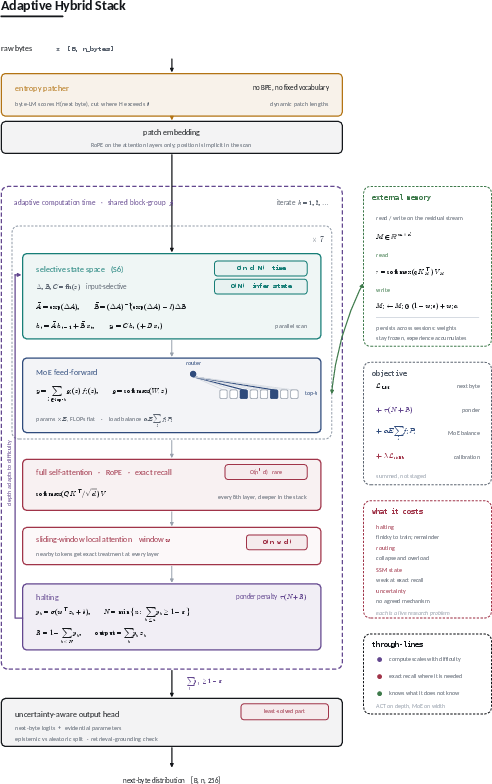
- Treat persistent latent state, adaptive depth, memory hierarchies, sparse specialization, verification, and explicit halting as candidate components in neural architecture search.
- Researchers could evaluate combinations of:
- recurrent latent workspaces,
- selective state-space layers,
- mixture-of-experts routing,
- retrieval or test-time memory,
- verifier and revision modules,
- delayed decoding.
- Potential products include more compute-efficient reasoning models, long-context assistants, and systems that spend additional computation only on difficult inputs.
- Dependencies: The paper does not show that the proposed combination works. Training stability, latency, memory bandwidth, routing collapse, and verification quality must be demonstrated empirically.
- Adaptive-compute systems for resource-constrained deployment — Robotics, edge computing, and energy
- A verified version of the paper’s recurring adaptive-computation motif could allow models to use shallow processing for routine inputs and deeper recurrent reasoning for difficult cases.
- Applications could include:
- on-device assistants,
- autonomous robots,
- industrial inspection,
- drones,
- battery-powered sensors.
- Dependencies: Reliable halting criteria, bounded worst-case latency, hardware support for dynamic workloads, and safety guarantees are essential.
- Memory and verification architectures for high-stakes assistants — Healthcare, law, finance, and enterprise
- Future systems could combine persistent working memory, long-term retrieval, uncertainty estimates, independent verification, and revision loops.
- Possible workflows include:
- a clinical assistant that separates patient facts from hypotheses and requests verification before producing a recommendation;
- a financial analyst that maintains competing explanations and checks calculations;
- a legal research tool that records the source and confidence of every proposition.
- Dependencies: Domain validation, privacy protection, auditability, calibrated uncertainty, and human accountability are mandatory. Generated architecture narratives alone provide no evidence of safety or performance.
- Model-family fingerprinting and comparative evaluation — AI auditing
- The reported recurring motifs, including the byte-level pattern observed in the two Anthropic model types, could motivate behavioral fingerprinting: identifying stable response tendencies across versions or model families.
- Such fingerprints might help auditors detect model replacement, prompt-sensitive behavior changes, or family-specific biases in technical explanations.
- Dependencies: Fingerprints must be validated against changes in prompting, system messages, public research exposure, and model updates; they should not be treated as proof of shared internal components.
- Interpretability interfaces for recurrent and modular models — Academia and tooling
- If future architectures use persistent workspaces, routing, memory, and verification, interpretability tools could expose:
- which memory records influenced an answer,
- which experts were activated,
- how many recurrent steps were used,
- why computation stopped,
- which verifier accepted or rejected a candidate.
- This could produce operational dashboards for debugging and auditing.
- Dependencies: Such interfaces require measurable internal states and causal interpretability methods; verbal self-reports from the model are insufficient.
- Policy standards for AI-generated technical evidence — Regulation and standards bodies
- Standards organizations could define categories such as:
- authenticated implementation evidence,
- public documentation,
- reproducible behavioral measurement,
- model-generated hypothesis,
- unsupported self-description.
- Procurement, safety, and compliance frameworks could require these categories to remain visible whenever AI-generated technical material is reused.
- Dependencies: Standards must be internationally interoperable and adaptable to systems whose internal designs are intentionally confidential.
- Human–AI collaborative research systems — Academia and industry
- A mature workflow could use models to generate multiple architecture hypotheses, retrieve relevant literature, identify conflicts, estimate costs, and propose experiments, while humans decide which hypotheses merit implementation.
- The model would function as a structured design-space explorer rather than an authority on its own internals.
- Dependencies: The workflow needs citation verification, experiment tracking, independent reviewers, and safeguards against repeatedly recycling the same public motifs as if they were novel discoveries.
Overall, the paper supports immediate use of these methods for provenance auditing, red-teaming, reproducibility, and AI literacy. It does not support claims that the elicited blueprints reveal the actual architectures of the tested systems. Long-term engineering applications—particularly adaptive reasoning backbones, memory systems, routing, and verification—are promising design hypotheses that require independent implementation and empirical validation.
Glossary
- Adaptive computation: A mechanism that dynamically varies the amount of computation applied to an input or token. “Adaptive Computation Time lets recurrent networks learn how many updates to perform”
- Adaptive halting: A learned mechanism that decides when an iterative computation should stop. “The design adds learned memory updates at test time, adaptive halting, and a sparse dictionary intended to make the recurrent trajectory more interpretable.”
- Alignment spillover: The unintended extension of behavior learned for one safety context into an unrelated context. “The intended stressor is therefore a bundle of audience, helpfulness, transparency, and harm avoidance cues.”
- Autoregressive generation: Sequential generation in which each new output depends on previously generated outputs. “RETRO augments autoregressive generation with retrieval from a large external corpus”
- Byte-level modeling: Processing raw bytes rather than tokenized words or subwords. “Across all ten Opus 5 experiments, a byte level or byte patched front end appeared consistently.”
- Blueprint confabulation: The generation of plausible but potentially unsupported technical specifications presented as if they were internal designs. “A useful subtype is {blueprint confabulation}.”
- Calibration: The degree to which a model’s confidence corresponds to the actual correctness of its predictions. “Kadavath et al. found that LLMs can show useful calibration when evaluating the correctness of their own answers”
- Chain of thought: A prompting or reasoning technique that elicits intermediate steps before a final answer. “Chain of thought prompting, self consistency, Tree of Thoughts, ReAct, and Reflexion reorganize inference around intermediate reasoning”
- Cross-modal alignment: The process of relating or synchronizing representations from different modalities, such as text and images. “The ASCII specification includes multimodal encoders, cross modal alignment, relational graph reasoning”
- Decoder: A model component that transforms internal representations into an output sequence, such as language. “a delayed language decoder”
- Delayed decoding: Deferring the conversion of internal reasoning representations into an external output until later in the computation. “Persistent latent state, adaptive computation, memory hierarchy, specialists, world modeling, verification, and delayed decoding recur throughout the corpus.”
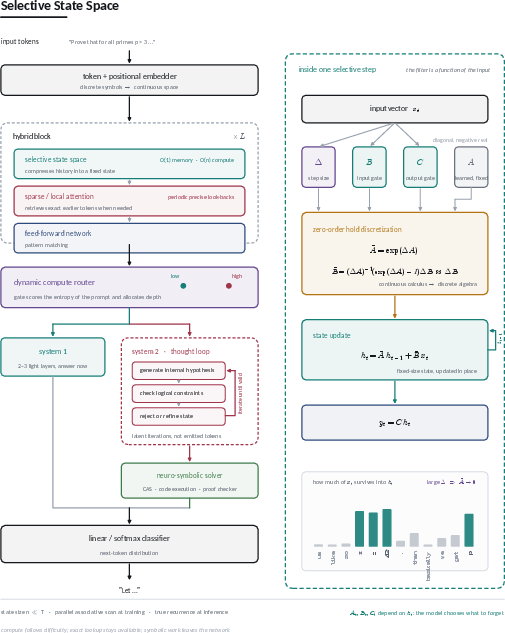
- Discrete zero-order hold: A discretization method that treats a continuous input as constant between sampling points. “including input dependent , , and terms and zero order hold discretization.”
- Epistemic jailbreak: A conversational process that shifts a model from justified uncertainty toward unjustified technical specificity. “An {epistemic jailbreak} is a conversational process that moves a model from warranted uncertainty toward weakly warranted specificity.”
- Epistemic metadata: Information representing the system’s uncertainty, confidence, evidence, or knowledge status. “epistemic metadata; controller with several computational clocks.”
- Epistemic perimeter: The boundary separating claims supported by evidence from claims that merely appear credible. “The relevant failure concerns the epistemic perimeter.”
- Expert bus: A communication pathway through which specialized model components exchange information. “an expert bus, revision loops, reset semantics, and complexity accounting.”
- Expert routing: The mechanism that selectively directs inputs or tokens to specialized computational modules. “specialist routing, simulation or world modeling, verification, and a delayed language decoder.”
- External memory: Information storage outside the model’s immediate internal activations that can be accessed during computation. “external memory, byte level patching, and uncertainty estimation.”
- Gated recurrent update: An iterative state-update operation whose information flow is controlled by learned gates or functions. “The controller compares expected information or quality gain with computational cost.”
- Global workspace: A shared representational space in which information from multiple subsystems can be integrated and made available to other processes. “Global workspace; proof search; epistemic metadata; controller with several computational clocks.”
- Grouped-query attention (GQA): An attention architecture in which multiple query heads share key and value heads to reduce computational and memory costs. “GQA head counts, SSM states, an expert bus, revision loops”
- Hallucination snowballing: The process by which an initial model error induces additional, mutually supporting errors. “Hallucination snowballing shows how an early error can induce further supporting errors”
- Hybrid sequence model: A model combining different sequence-processing mechanisms, such as attention and state-space layers. “Mamba develops selective state space sequence modeling, and Jamba demonstrates a large scale hybrid of Transformer, Mamba, and mixture of experts components.”
- Introspection: A model’s purported ability to report on its own internal knowledge, states, or processes. “Research on model introspection remains mixed.”
- Latent state: An internal representation that summarizes information used in ongoing computation but is not directly exposed as output. “Persistent latent state appears frequently”
- Mechanistic interpretability: The study of how specific internal components and activations implement model behavior. “Mechanistic interpretability work using sparse autoencoders provides a separate route to claims about internal features”
- Mixture of Experts (MoE): An architecture containing multiple specialized subnetworks, with a router selecting only some for each input. “The proposal combines selective state space layers, sparse and full attention, adaptive computation, MoE”
- Multimodal encoder: A component that converts inputs from multiple modalities into machine-readable representations. “The ASCII specification includes multimodal encoders”
- Neural memory: A learned memory mechanism implemented by neural network parameters or activations. “Titans introduces neural long term memory that is updated at test time”
- Neuro-symbolic solver: A system combining neural representations with explicit symbolic reasoning or rule-based computation. “a neuro symbolic solver.”
- Persistent latent workspace: A continuously maintained internal state used to store and refine intermediate reasoning. “The dominant design contains a persistent latent workspace”
- Post-training: Training or optimization performed after initial pretraining, often to shape behavior or task performance. “family specific post training preferences”
- Provenance: The origin, evidentiary basis, or authentication status of a technical claim. “The central issue is the provenance assigned to technical claims.”
- Recurrent computation: Repeatedly applying computational operations to an evolving internal state. “The recurrent workspaces and halt controllers observed here”
- Relational graph reasoning: Reasoning over entities and the relationships connecting them in a graph structure. “relational graph reasoning, heterogeneous experts, fast and long memory”
- Retrieval-augmented generation: Generation supported by retrieving relevant information from an external corpus or memory. “RETRO augments autoregressive generation with retrieval from a large external corpus”
- Selective state space model: A sequence model that maintains a state while selectively controlling how inputs update or influence that state. “Mamba develops selective state space sequence modeling”
- Self-consistency: A reasoning method that samples multiple solution paths and aggregates or selects among their answers. “Chain of thought prompting, self consistency, Tree of Thoughts, ReAct, and Reflexion”
- Self-attention: An operation that lets elements in a sequence selectively weight and combine information from other elements in the same sequence. “Universal Transformers reuse a shared self attentive block recurrently”
- Sparse autoencoder: An autoencoder constrained to represent inputs using relatively few active features, often used to analyze neural activations. “Mechanistic interpretability work using sparse autoencoders”
- Sparse expert: A specialized subnetwork used selectively rather than for every input. “Switch Transformers provide an influential sparse expert design”
- State space model (SSM): A sequence model that represents and updates a hidden dynamical state over time. “Hybrid SSM and attention; adaptive computation; MoE; byte latent front end.”
- Tensor shape: The dimensional structure of a tensor, such as its number of axes and size along each axis. “ASCII encourages explicit wiring, hierarchy, module boundaries, execution order, tensor shapes, and data flow.”
- Top-K routing: A routing strategy that selects the K highest-scoring experts or components for an input. “\sum_{j\in \operatorname{TopK}(R_\theta(Z_t))} p_jE_j(Z_t).”
- Tree of Thoughts: A reasoning framework that explores and evaluates multiple branching chains of intermediate thought. “Tree of Thoughts, ReAct, and Reflexion reorganize inference around intermediate reasoning”
- Uncertainty head: A model output component specialized for estimating uncertainty or confidence. “The design adds learned memory updates at test time, adaptive halting, a neural memory at test time, an uncertainty head”
- World model: An internal model of an environment used to simulate events, outcomes, or actions. “Many responses also add a world model or simulation pathway.”

