Reducing Hallucinated Transcripts in Whisper via Hallucination Space Projection
Abstract: Whisper is a widely used foundation model for automatic speech recognition (ASR), but its generative decoder can produce fluent hallucinated transcripts for inputs containing little or no speech. We propose a training-free, inference-time method to reduce these hallucinations using low-rank projection of decoder activations. A compact hallucination-associated subspace is estimated from non-speech calibration data, and decoder hidden states are projected away from this subspace during inference. We evaluate two variants: always-on, which applies projection to all inputs, and gated, which applies it only when Whisper predicts that an input is likely non-speech. Across non-speech benchmarks, always-on projection reduces average hallucination rate (HR) from 31.31% to 2.44%, a 92.21% relative reduction, while gated projection reduces HR to 3.74%, an 88.05% relative reduction, with lower false rejection of genuine speech. On LibriSpeech, gated projection increases absolute word error rate (WER) by 0.33-4.39 percentage points and yields false-rejection rates (FRR) of 0.41--9.97% across model and split settings. These results show that low-rank activation projection can substantially suppress Whisper hallucinations without retraining, while providing a controllable trade-off between hallucination suppression and speech recognition performance.
Paper Prompts
Sign up for free to create and run prompts on this paper.
Top Community Prompts
Explain it Like I'm 14
1. What is this paper about?
This paper studies a problem with Whisper, a popular computer program that turns speech into written words.
Whisper usually works well, but it sometimes creates text even when there is no speech in the audio. For example, if it hears a car horn, dog barking, silence, or a jackhammer, it might write things such as:
- “Thank you”
- “I’m the best”
- “The train is coming up”
- “Dog, dog, dog”
These made-up transcripts are called hallucinations. They are dangerous because they can sound believable, even though nobody said those words.
The researchers introduce a method called hallucination space projection. It changes part of Whisper’s internal calculations while it is working, helping it recognize when an audio clip probably contains no speech.
2. What questions did the researchers ask?
The main questions were:
- Can Whisper’s hallucinated transcripts be reduced without retraining the whole model?
- Can the method stop made-up text while still accurately transcribing real speech?
- Will the method work on different kinds of sounds, not just the sounds used to create it?
- Is it better to change Whisper for every audio clip, or only for clips that seem likely to contain no speech?
The researchers especially wanted a good balance. A system that rejects all audio would have very few hallucinations, but it would also incorrectly reject real speech.
3. How did the method work?
Finding the “hallucination space”
Whisper has many internal numbers that represent what it thinks is happening in an audio clip. These numbers are called hidden states or activations.
You can imagine Whisper’s thinking as a large map. Different directions on this map may represent different behaviors. Some directions may be connected to correctly recognizing speech, while others may make Whisper more likely to invent text for non-speech sounds.
The researchers used non-speech recordings to compare two groups:
- Sounds that Whisper incorrectly turned into text
- Sounds that Whisper correctly left blank
They looked for the main differences between these two groups. To do this, they used a mathematical technique called singular value decomposition, or SVD.
SVD is similar to finding the most important patterns in a large collection of information. For example, if many drawings contain different objects, SVD could help identify the main shapes that explain the differences between the drawings.
The researchers kept only a few of the most important directions. This created a small “hallucination space.”
Removing the hallucination-related information
While Whisper was processing new audio, the researchers removed the part of its internal information that pointed toward this hallucination space.
A simple analogy is a compass. If a compass is pulled toward a magnet and points in the wrong direction, one could remove the magnetic influence so it points more accurately. Here, the researchers tried to remove the internal influence that encouraged Whisper to produce text when there was no speech.
This was done without retraining Whisper and without changing its learned model parameters.
Two versions of the method
The paper tested two approaches:
- Always-on projection: The correction is applied to every audio clip.
- Gated projection: The correction is used only when Whisper already suspects that the audio may contain no speech.
The gated version is like a safety system that applies extra checking only when something looks suspicious. This helps avoid damaging the transcription of clear speech.
Data used for testing
The researchers tested the method on several datasets:
- ESC-50: environmental sounds such as animals, tools, and vehicles
- UrbanSound8K: sounds from cities, such as sirens and engines
- FSD50K: many different sound events
- LibriSpeech: real spoken English from audiobooks
The first three datasets tested whether Whisper produced hallucinations on non-speech audio. LibriSpeech tested whether the method still handled real speech correctly.
4. What did the researchers find?
Hallucinations dropped sharply
The method greatly reduced the number of non-speech clips that received an invented transcript.
The paper’s overall results report that:
- The always-on method reduced the average hallucination rate from about 31.31% to 2.44%.
- The gated method reduced it to about 3.74%.
This represents very large reductions: approximately 92% for always-on projection and 88% for gated projection.
The detailed experiments also showed strong improvements on individual datasets. For example, with Whisper large-v3:
| Dataset | Original Whisper | Always-on projection | Gated projection |
|---|---|---|---|
| ESC-50 | 44.25% hallucinations | 1.50% | 8.38% |
| UrbanSound8K | 76.08% | 0.87% | 2.74% |
| FSD50K | 21.35% | 0.18% | 1.15% |
This suggests that the method did not simply memorize one collection of sounds. It also worked on different datasets.
The method made Whisper more likely to say “no speech”
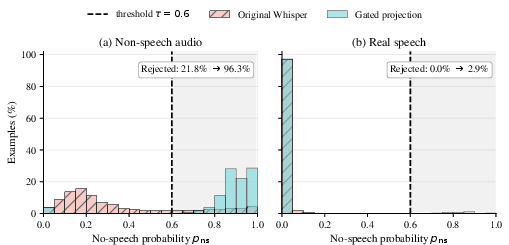
Whisper has a special score called no_speech_prob. This is its estimate of how likely it is that an audio clip contains no speech.
After the projection was applied, this score usually became higher for non-speech sounds. That made it easier for Whisper to reject those clips instead of generating text.
Always-on projection could harm real speech
The always-on method had the best protection against hallucinations, but it sometimes caused Whisper to reject real speech or make more word mistakes.
Two important measures were used:
- WER, or word error rate: How many words Whisper gets wrong. A lower score is better.
- FRR, or false-rejection rate: How often the system incorrectly rejects real speech as if it were silence or non-speech. A lower score is better.
For Whisper large-v3 on LibriSpeech:
- Original Whisper had a WER of 4.06% on the cleaner speech test set.
- Always-on projection increased WER to 12.95%.
- Gated projection increased WER to 6.17%.
Always-on projection also falsely rejected about 10.50% of the clean speech samples, while gated projection falsely rejected about 2.86%.
Therefore, the gated version gave a better compromise: it still removed many hallucinations but caused fewer problems for real speech.
The method compared well with other solutions
The researchers compared their approach with:
- An external voice-activity detector, which tries to identify when someone is speaking
- A phrase filter that removes common hallucinated phrases
- Changing Whisper’s rejection threshold
- A method that requires fine-tuning Whisper
The proposed gated method achieved a lower average hallucination rate than the tested phrase-filtering and threshold methods, without needing an external speech detector or retraining.
5. Why is this research important?
Made-up transcripts can cause serious problems if another system believes them. For example, incorrect text could be used in:
- Meeting records
- Subtitles
- Search systems
- Customer-service tools
- Medical or legal recordings
- Automated decision-making systems
This research offers a relatively lightweight solution. It does not require changing Whisper’s stored parameters or training a new model. Instead, it adds an extra step during use.
The most useful version appears to be gated projection. It acts like an extra filter for suspicious audio while leaving clearer speech mostly alone. The system can also keep uncertain recordings for another attempt, computer checking, or human review instead of deleting them immediately.
Simple conclusion
The paper shows that Whisper sometimes “hears” words that were never spoken, especially when listening to environmental sounds or silence. The researchers found that these mistakes are connected to certain patterns inside Whisper’s internal calculations.
By identifying and removing those patterns during decoding, they reduced hallucinated transcripts by a large amount. The always-on method worked most strongly but could harm real speech. The gated method was less aggressive, but it offered a better balance between rejecting false text and preserving genuine speech.
The method is promising for making speech-recognition systems more trustworthy. However, it has limits: the experiments mainly focused on non-speech sounds, and the researchers still need to test whether it works equally well for other problems, such as long recordings, multiple languages, or unclear speech.
Knowledge Gaps
Knowledge gaps, limitations, and open questions
- Generalization beyond English and read speech is unresolved. The method is evaluated on English Whisper models and LibriSpeech, so its effectiveness on multilingual speech, code-switching, accented speech, dialects, and low-resource languages remains unknown.
- The method is tested only on three Whisper model sizes. It is unclear whether the learned projection strategy transfers to
tiny,base,large, newer Whisper releases, distilled variants, or other encoder–decoder ASR models. - The scope is limited to entirely non-speech inputs. The paper does not evaluate mixed speech–non-speech segments, partial speech, long pauses within speech, overlapping environmental sounds, or speech embedded in music and noise.
- Long-form transcription behavior is not examined. The method may interact differently with chunking, timestamp generation, context carryover, prompt conditioning, and repeated decoding over long recordings.
- Other hallucination types remain unexplored. The study does not test unsupported words in acoustically ambiguous speech, incorrect insertions during noisy speech, repeated phrases, language-model-driven substitutions, or hallucinations caused by missing or corrupted audio.
- The representation-level mechanism is not established. The paper shows that projection changes hallucination rates, but does not demonstrate whether the removed directions encode hallucination behavior specifically or merely suppress general decoder confidence, language-model priors, or no-speech evidence.
- The temporal and token-level structure of the activations is underspecified. It is unclear which decoder timestep, token position, sequence summary, or aggregation procedure is used to construct the calibration representations and apply the projection during autoregressive decoding.
- The pairing procedure for hallucinating and correctly empty examples is not justified. The difference matrix pairs examples using , but the paper does not explain how pairs are selected or assess whether alternative pairings, random seeds, or class imbalance affect the learned subspace.
- Calibration-set size sensitivity is not evaluated. The minimum amount of non-speech data needed to obtain a stable projection basis, and the performance degradation under small or imbalanced calibration sets, remain unknown.
- The stability of the learned subspace is not reported. There is no analysis of variation across calibration samples, bootstrap resampling, random pairings, singular-value spectra, or repeated basis estimation.
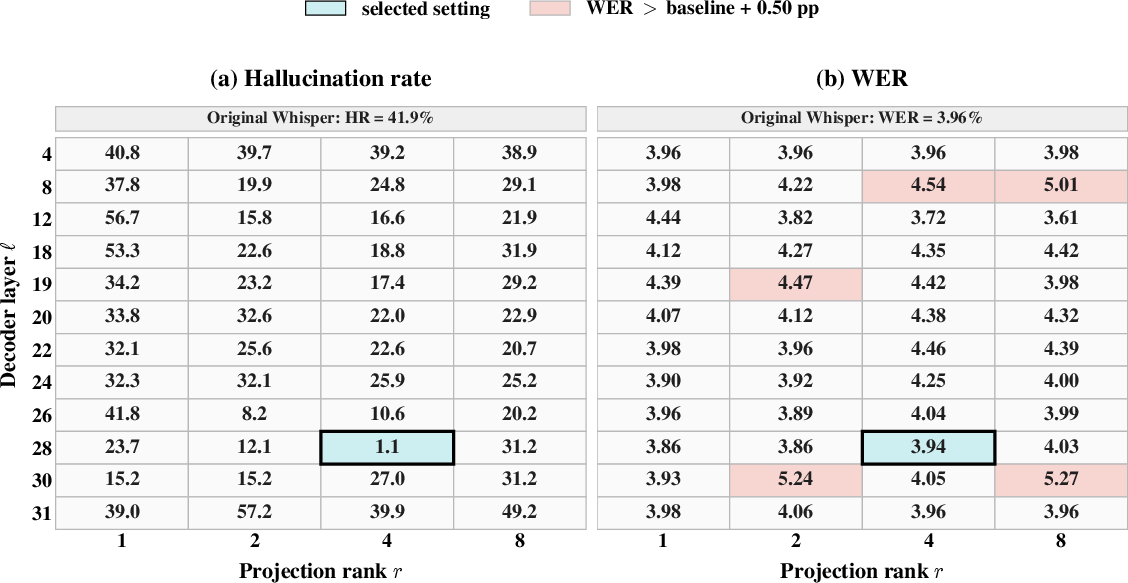
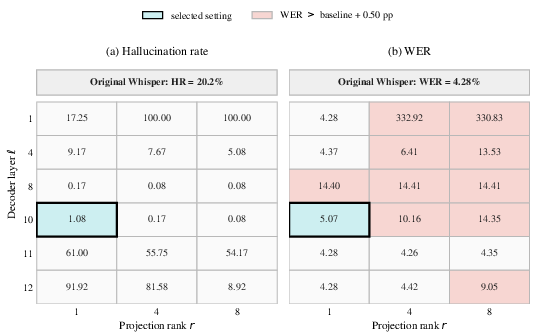
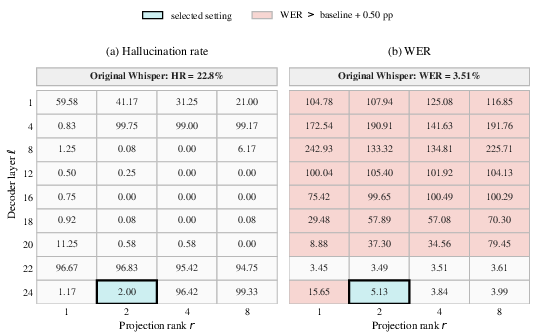
- The choice of a single decoder layer is empirical rather than theoretically explained. The paper observes that middle-to-late layers work better, but does not identify why particular layers are effective or whether the optimal layer changes with audio domain, language, decoding strategy, or model version.
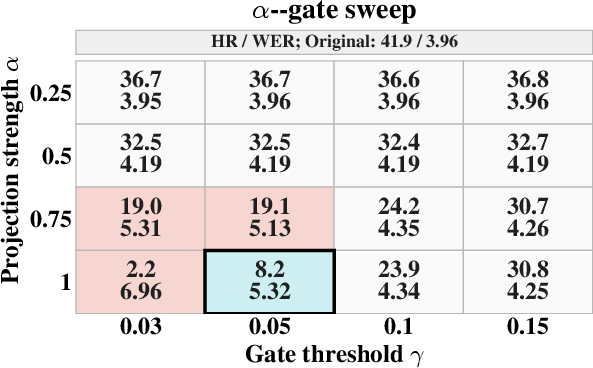
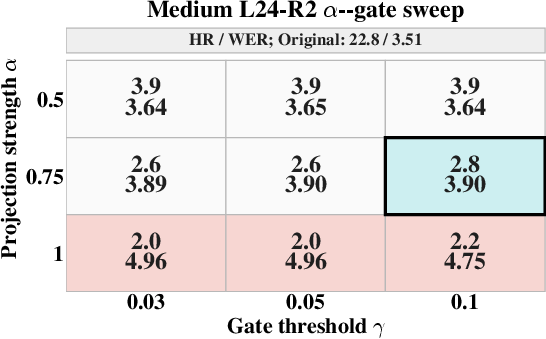
- The projection hyperparameters are not robustly validated across deployment conditions. Layer, rank, strength, and gate thresholds are selected using ESC-50 and LibriSpeech validation data, but the sensitivity of the selected configuration to domain shift is not systematically tested.
- The gating strategy inherits errors from Whisper’s no-speech estimator. Inputs with low initial
no_speech_probbut severe hallucination risk bypass the intervention, while speech inputs with high values may receive damaging projections; this failure mode is not analyzed by subgroup. - The two-pass inference cost is not quantified. The gated method requires an initial unprojected pass and, for gated segments, a second projected decoding pass. Runtime, memory use, throughput, and deployment latency are not reported.
- The method’s interaction with decoding settings is unknown. Beam size, temperature fallback, sampling, prompts, language detection, timestamps, compression-ratio filtering, and log-probability thresholds are not systematically varied.
- The comparison with baselines is incomplete and potentially confounded. Some comparisons use different no-speech thresholds or reported results from other studies, making it difficult to attribute improvements solely to activation projection.
- The external VAD baseline is not evaluated under matched operating conditions. The paper does not report VAD thresholds, segmentation settings, latency, computational cost, or whether the VAD and projection systems are optimized for comparable HR–WER–FRR operating points.
- The fine-tuning baseline is not directly reproducible in the experimental pipeline. Calm-Whisper is compared using reported results because its checkpoint is unavailable, leaving uncertainty about differences in datasets, preprocessing, model versions, and evaluation protocols.
- Statistical uncertainty is absent. The paper reports point estimates but no confidence intervals, significance tests, bootstrap variability, or per-category variance, so the reliability of differences across datasets and model scales is unclear.
- Non-speech dataset construction may contain labeling ambiguity. The filtered FSD50K subset is defined by removing speech, vocal, and music labels, but residual vocal content, speech-like sounds, or multi-label clips may remain and affect HR estimates.
- The binary hallucination metric is too coarse for practical use. Treating every non-empty output equally does not distinguish a one-word insertion from a long fabricated transcript, repeated text, harmful content, or a transcript that correctly describes an audible event.
- The quality and risk of residual hallucinations are not analyzed. The study does not determine which hallucination types remain after projection, whether the intervention shifts their linguistic content, or whether harmful or misleading outputs are preferentially reduced.
- Speech preservation is assessed on a narrow benchmark. LibriSpeech contains clean audiobook speech and does not represent conversational speech, spontaneous disfluencies, children’s speech, accents, far-field recordings, or speech in realistic noise.
- The reported FRR does not capture all forms of speech degradation. Speech segments that are not rejected but receive truncated, omitted, or substantially altered transcripts may not be reflected adequately by the sample-level FRR metric.
- The practical treatment of uncertain segments is proposed but not evaluated. Retention, re-transcription, confidence-based flagging, and human review are discussed as deployment strategies, but their recall, workload, cost, and downstream benefits are not measured.
- Adversarial or pathological inputs are not considered. It remains unknown whether particular noises, repeated tones, music, synthetic audio, prompt-like sounds, or deliberately constructed inputs can evade the projection or induce new hallucinations.
- The effects on legitimate transcriptions of non-verbal vocalizations are unclear. Laughter, crying, singing, vocal sounds, and paralinguistic events may be treated as non-speech or speech inconsistently, but the paper does not define the desired behavior for these cases.
- Reproducibility is limited by missing implementation details. The text does not fully specify preprocessing, activation extraction, decoder-hook placement, tokenization conditions, decoding options, calibration pairing, and exact baseline configurations.
- The paper does not establish whether the method remains effective under calibration-to-deployment shifts. Although transfer from ESC-50 to UrbanSound8K and FSD50K is shown, shifts in recording device, duration, sound class distribution, compression, reverberation, and real-world operating conditions are not tested.
- The relationship between HR, WER, and FRR is reported only at selected operating points. A complete precision–recall or risk–coverage analysis is needed to determine whether the method offers consistent advantages across the full range of acceptable deployment trade-offs.
- The effect of projection on downstream applications is unknown. No experiments evaluate diarization, subtitle generation, search indexing, meeting transcription, content moderation, or other systems that may be affected by altered transcripts or increased rejection.
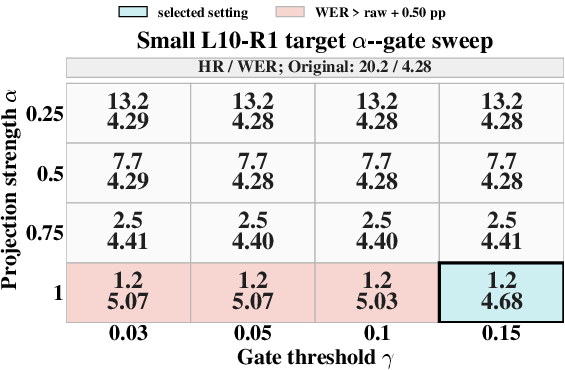
- The incomplete ablation evidence leaves several causal questions open. The provided text ends during the multi-layer ablation, and the available results do not isolate the contributions of activation subtraction, rank selection, gating, projection strength, and the final no-speech threshold independently.
Practical Applications
Immediate Applications
The paper’s method is an inference-time modification to Whisper that requires no fine-tuning, external VAD model, phrase list, or parameter updates. Subject to validation on deployment data, the following applications are feasible with current Whisper implementations.
- Production ASR preprocessing and transcript-quality control — Software, media, customer support
- Add the gated low-rank decoder projection as a wrapper around Whisper to suppress transcripts generated from silence, music, environmental noise, or other non-speech segments.
- A practical workflow is:
- 1. Run Whisper once to obtain
no_speech_prob. - 2. Apply the projection hook only when this probability exceeds a calibrated gate threshold .
- 3. Decode again and reject the segment when the resulting probability exceeds .
- This can reduce downstream exposure to plausible but unsupported text in call-center transcription, meeting transcription, podcast processing, captioning, and media archives.
- Dependencies: Access to decoder hidden states and a compatible Whisper implementation; calibration data representative of the target audio; monitoring of WER and false-rejection rate (FRR).
- More reliable automatic captioning and subtitle generation — Media, accessibility, education
- Use the projection to prevent captions such as acknowledgments, repeated words, or subtitle-style endings from appearing during pauses, applause, music, or sound effects.
- Captioning systems can retain uncertain segments rather than deleting them permanently, marking them for re-transcription or review.
- The method is particularly useful in live or batch subtitle pipelines where hallucinated captions are more damaging than short periods of missing text.
- Dependencies: A latency budget sufficient for the paper’s two-pass gated procedure; domain-specific testing for multilingual, accented, and noisy speech.
- Audio archival and meeting-recording cleanup — Enterprise productivity and knowledge management
- Add hallucination suppression when converting long recordings into searchable text, summaries, or indexes.
- The system can store:
- the accepted transcript,
- the rejected/empty segments,
- the original
no_speech_prob, - and a confidence or review flag.
- This reduces the risk that search systems or meeting summaries index text that was never spoken.
- Dependencies: Segment-level processing and audit logging; human review for legally or operationally important recordings.
- Safety layer for voice-controlled software and assistants — Consumer software, IoT, automotive
- Place the projection before intent recognition so that silence, engine noise, household sounds, or music are less likely to be interpreted as commands.
- For high-impact actions, require a second confirmation or re-transcription when the segment is rejected, near the threshold, or has conflicting speech/no-speech evidence.
- This can reduce accidental activations and prevent hallucinated text from reaching downstream command parsers.
- Dependencies: The method only addresses non-speech hallucinations; it does not guarantee correct intent recognition or eliminate errors caused by ambiguous speech.
- Speech analytics and compliance monitoring — Finance, insurance, healthcare administration
- Use hallucination suppression before keyword detection, sentiment analysis, case summarization, or compliance screening.
- This can reduce false alerts caused by text generated during silence or background noise.
- In regulated workflows, rejected or uncertain segments should be retained for verification rather than silently discarded.
- Dependencies: The reported WER and FRR trade-off must be evaluated for the relevant language, speaker population, recording equipment, and legal requirements. Human validation may remain mandatory.
- Low-cost alternative or complement to external VAD — Edge computing and embedded systems
- Deploy the projection where adding and maintaining a separate voice activity detector is undesirable.
- The paper reports competitive hallucination suppression without external VAD, while using a compact low-rank basis and a fixed inference-time intervention.
- This may simplify software stacks for offline transcription tools, embedded devices, and private on-device applications.
- Dependencies: The approach still requires Whisper inference and, in the gated variant, an additional projected decoding pass. Memory, latency, and power consumption should be benchmarked on the target device.
- Risk-aware transcription workflow with selective review — Healthcare, legal services, public-sector records
- Treat projected outputs as one of three states: accepted speech, rejected non-speech, or uncertain/review-required.
- Segments close to the gate or rejection threshold can be sent to a second ASR system, replayed to an operator, or reprocessed with different decoding parameters.
- This directly exploits the paper’s observation that false rejection need not result in permanent information loss.
- Dependencies: A reliable review policy, secure storage of audio, and explicit thresholds based on the cost of missed speech versus unsupported text.
- Research and benchmarking tool for ASR reliability — Academia and model development
- Release an implementation that records hallucination rate (HR), WER, FRR, no-speech probabilities, projection rank, layer, and strength.
- Researchers can use it as a standardized inference-time baseline against external VAD, post-hoc phrase filtering, threshold tuning, and fine-tuning methods.
- The method also provides a practical way to study whether hallucination-associated directions transfer across datasets and Whisper model sizes.
- Dependencies: Careful reproduction is needed because calibration choices, model versions, layer indexing, and threshold settings substantially affect results.
Long-Term Applications
The following applications are plausible extensions, but require additional research, broader validation, or engineering development beyond the evidence provided in the paper.
- Multilingual and cross-domain hallucination suppression — Global ASR platforms
- Construct language- and domain-specific calibration bases, or investigate whether a universal basis can work across languages, dialects, microphones, and acoustic environments.
- A production platform could select a projection basis based on language, model size, recording type, or application risk level.
- Dependencies: The paper evaluates primarily English read speech for preservation and non-speech benchmarks for suppression. Transfer to multilingual, code-switched, conversational, and low-resource speech is not established.
- Long-form transcription and streaming ASR protection — Media, meetings, call centers
- Extend the method from isolated segments to continuous streams, where long pauses, context accumulation, and autoregressive decoding may increase hallucinations.
- A streaming implementation could dynamically maintain projection state, apply suppression only during pauses, and trigger targeted re-transcription when the model’s no-speech confidence changes.
- Dependencies: Chunk boundaries, decoder cache behavior, latency, and repeated projection decisions may alter the reported HR–WER–FRR trade-off.
- Adaptive calibration for new environments — Industrial IoT, robotics, smart homes
- Automatically collect non-speech examples from a deployment environment, identify hallucinated versus correctly empty outputs, and periodically update the low-rank basis.
- For example, a factory system could calibrate on machinery sounds, while a vehicle system could calibrate on road and engine noise.
- Dependencies: Calibration data must be labeled or reliably classified; careless adaptation could encode environmental artifacts, reduce speech recognition, or create privacy risks.
- Joint ASR, VAD, and uncertainty models — Speech technology research
- Combine decoder projection with an external VAD, acoustic speech detector, or separately trained uncertainty estimator.
- The projection could serve as a representation-level defense, while VAD supplies acoustic evidence and a post-processing layer handles residual errors.
- Such ensembles may improve robustness in cases where Whisper’s internal
no_speech_probis unreliable. - Dependencies: Additional models increase compute, maintenance, and failure-mode complexity. The combined system must be evaluated for correlated errors rather than assuming independent benefits.
- Automated operating-point selection — Safety-critical and regulated applications
- Develop cost-sensitive calibration that chooses , , projection strength , and rank according to application-specific penalties.
- For example, a legal archive may prioritize avoiding unsupported text, whereas emergency communications may prioritize minimizing missed speech.
- The resulting system could expose configurable operating modes such as maximum suppression, balanced, and speech-preserving.
- Dependencies: Requires representative validation data and an explicit cost model. The paper shows that stronger suppression can increase WER and FRR, so no universal setting is appropriate.
- Hallucination suppression for other generative speech models — ASR, speech translation, multimodal systems
- Apply the same activation-space methodology to speech translation, audio-LLMs, diarization-assisted ASR, or other encoder–decoder speech systems.
- Calibration differences between unsupported generation and correctly empty outputs could reveal model-specific “hallucination spaces.”
- Dependencies: The method relies on access to internal decoder activations and a meaningful empty-output condition. It may not transfer directly to models with different architectures or decoding objectives.
- Real-time robotics and autonomous systems — Robotics and human–machine interaction
- Use projection-enhanced ASR as a conservative speech interface for robots, drones, vehicles, and industrial machines.
- The robot could ignore likely non-speech inputs, request repetition for uncertain audio, and require confirmation before executing high-impact commands.
- Dependencies: Real-time latency, acoustic variability, safety certification, and the cost of missed commands must be addressed. Suppressing hallucinations does not by itself guarantee safe action execution.
- Evidence-aware AI assistants and retrieval systems — Enterprise search and knowledge management
- Attach provenance metadata to every transcript segment, including whether projection was applied, whether the segment was rejected, and which confidence thresholds were crossed.
- Retrieval and summarization systems could then exclude rejected text or require corroboration before treating it as evidence.
- Dependencies: Requires end-to-end integration with storage, indexing, summarization, and access-control systems. The transcript remains a model output and should not be treated as ground truth solely because projection was used.
- Human-in-the-loop public-sector and healthcare documentation — High-stakes decision support
- Integrate the method into workflows where transcripts support clinical notes, incident reports, disability services, or public hearings.
- The system could automatically suppress obvious non-speech hallucinations while routing uncertain segments to trained reviewers.
- Dependencies: Extensive validation across speakers and recording conditions, privacy-preserving deployment, auditability, accessibility, and compliance with sector-specific regulations are required. The paper does not establish clinical or legal-grade reliability.
Glossary
- Acoustic representations: Internal features encoding properties of an audio signal for processing by a speech model. “The encoder maps audio to acoustic representations”
- Auto-regressive decoder: A decoder that generates each output token based on previously generated tokens. “Whisper uses a generative sequence-to-sequence decoder”
- Calibration set: Data used to estimate model-specific parameters or representations before evaluation. “We use a non-speech calibration set to collect decoder hidden representations from two groups of inputs.”
- Compression ratio: A decoding statistic comparing the length or compressibility of generated text with its compressed form, used to identify unreliable outputs. “Decoding heuristics based on no-speech probability, log probability, or compression ratio”
- Cross-dataset generalization: The ability of a method learned or calibrated on one dataset to work on other datasets. “This cross-dataset transfer suggests that the projection targets a reusable decoder-level signature of non-speech hallucination”
- Decoder activation: A numerical intermediate representation produced inside a neural-network decoder. “We propose a training-free decoder activation projection method”
- Decoder-level intervention: A modification applied to representations inside the decoder rather than to the input or final output. “In contrast, our method intervenes on decoder activations at inference time”
- Development split: A subset of data used for selecting model or method settings before final testing. “We determine the projection configuration entirely on the development split”
- False-rejection rate (FRR): The proportion of valid speech samples incorrectly rejected as non-speech. “we also report the speech FRR, defined as the fraction of speech samples rejected by the no-speech filter.”
- Fine-tuning: Further training of a pretrained model on task-specific data. “Fine-tuning methods such as Calm-Whisper”
- Forward hook: A software mechanism that intercepts and modifies a neural-network layer’s activations during a forward pass. “Projection is applied during decoding through a forward hook attached to a selected decoder layer.”
- Foundation model: A broadly pretrained model that can support multiple downstream tasks or domains. “Whisper is a widely used foundation model for ASR”
- Gated projection: A projection intervention activated only when a specified condition is met. “The gated variant reduces HR to 3.74% with lower false rejection of real speech.”
- Hallucinated transcript: Text generated by a speech-recognition model without corresponding spoken content. “For non-speech audio, where the correct transcript should be ``empty'', any generated text can thus be considered hallucination by the model.”
- Hallucination-associated subspace: A vector subspace representing activation directions correlated with hallucinated generation. “The hallucination-associated subspace is estimated only from the calibration set and then kept fixed.”
- Hidden state: An intermediate vector representation maintained by a neural network while processing an input. “Given a hidden state and projection basis ”
- Inference time: The stage at which a trained model processes new inputs to produce predictions. “We propose a training-free inference-time method that edits Whisper decoder activations during generation.”
- Intervention location: The particular neural-network layer at which a representation is modified. “The results show that projection effectiveness is primarily determined by decoder depth.”
- Low-rank projection: A projection that removes information associated with a subspace of relatively small dimensionality. “We propose a training-free, inference-time method to reduce Whisper hallucinations using low-rank decoder activation projection.”
- Multilingual: Involving or supporting multiple languages. “It achieves strong zero-shot performance across languages, domains, and acoustic conditions”
- No-speech probability: The model’s estimated probability that an audio segment contains no speech. “This score is used by Whisper's decoding-time rejection heuristic to suppress transcription when the input is likely to contain no speech.”
- No-speech token: A special output token used to represent the absence of speech. “Whisper predicts a special <|nospeech|> token for segments without speech”
- Operating point: A selected balance among competing performance measures determined by system parameters or thresholds. “Thus, no-speech threshold tuning can be used together with gated projection to choose a desired operating point.”
- Parameter update: A change to a model’s learned weights during training or adaptation. “The projection basis is estimated once and kept fixed, requiring no parameter updates.”
- Post-hoc filtering: Filtering applied after a model has generated its output. “Post-processing methods, including the Bag of Hallucinations (BoH)”
- Pretrained model: A model whose parameters were learned previously on a large dataset and reused for another task. “We use the official OpenAI Whisper implementation with the pretrained small, medium, and large-v3 models”
- Projection basis: A set of vectors defining the directions onto which a representation is projected. “We use the top right singular vectors to define a row-orthonormal projection basis”
- Projection strength: A scalar controlling how strongly a representation is moved away from a selected subspace. “where controls the projection strength.”
- Rejection heuristic: A rule-based decision procedure used to discard outputs considered unreliable. “Whisper's decoding-time rejection heuristic to suppress transcription”
- Sequence-to-sequence decoder: A model component that generates an output sequence from an input sequence or representation. “Whisper uses a generative sequence-to-sequence decoder”
- Singular value decomposition (SVD): A matrix factorization into orthogonal directions and associated singular values, often used to identify dominant patterns. “We compute the singular value decomposition of the difference matrix”
- Speech activity detector: A system that identifies which portions of an audio signal contain speech. “rather than relying on a separately trained speech activity detector.”
- Speech preservation: Retaining correct recognition performance on genuine speech while suppressing undesirable outputs. “gated projection provides a substantially better balance between hallucination suppression and speech preservation”
- Subspace estimation: The process of identifying a lower-dimensional vector space representing selected patterns in data. “The goal of subspace estimation is to identify decoder directions that distinguish non-speech inputs”
- Threshold tuning: Adjusting a cutoff value used to make a classification or rejection decision. “We examine whether no-speech threshold tuning can further improve our gated projection results.”
- Token sequence: An ordered series of discrete symbols generated by a LLM. “the model can still assign high probability to fluent token sequences”
- Training-free: Requiring no additional optimization or parameter training for the proposed method. “We propose a training-free decoder activation projection method”
- Voice Activity Detection (VAD): Automatic identification of speech-containing regions in an audio recording. “External VAD filters input audio before transcription using an independent voice activity detector”
- Weakly supervised: Trained using labels that are incomplete, noisy, indirect, or automatically obtained. “Whisper is a generative ASR model trained on 680K hours of weakly supervised multilingual and multitask audio data.”
- Word error rate (WER): A metric measuring transcription errors through substitutions, deletions, and insertions relative to a reference transcript. “For LibriSpeech, we evaluate speech recognition quality using WER.”

