Last Translation Benchmark
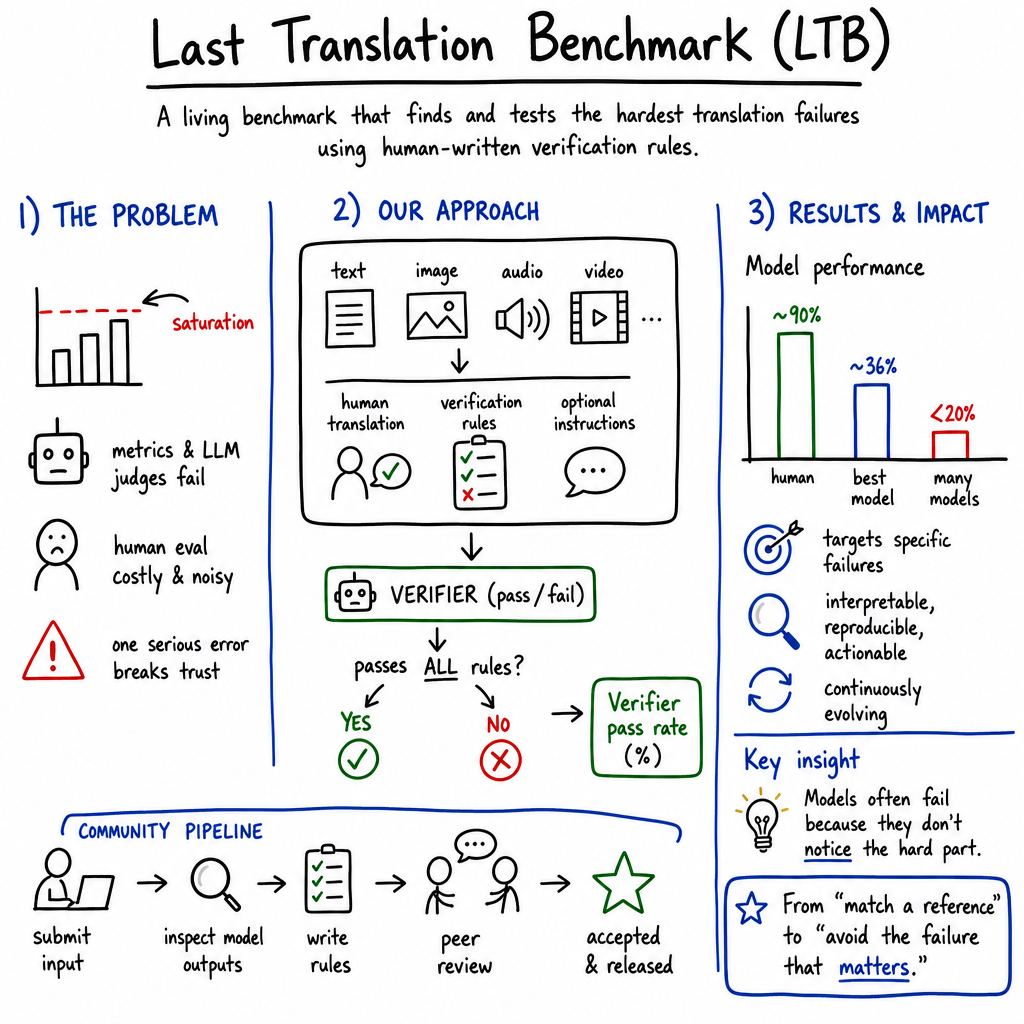
Abstract: For scientific progress, we need benchmarks that test the limits of state-of-the-art models, and evaluation methods that inform us about failure cases. As models get stronger, standard benchmarks for machine translation are approaching saturation. Further, automatic translation metrics are unreliable, vulnerable to reward-hacking, and provide unactionable assessments. Even gold human evaluation is not problem-free, because it often lacks reproducibility, objectivity, and scalability. Overall, this prevents us from tracking objective progress in the field and identifying pathways for improvement. We introduce the Last Translation Benchmark, a collection of human-authored and peer-reviewed examples (texts, images, audio, videos) that break leading machine translation models. We also present a new evaluation approach: each example comes with handcrafted verification rules describing concrete failure cases on that example, therefore allowing reliable and actionable future evaluation. The Last Translation Benchmark is a live dataset that accepts ongoing contributions. The latest version is LTBv1, containing accepted contributions prior to September 1st 2026, with future releases planned as new data is continuously collected.
Paper Prompts
Sign up for free to create and run prompts on this paper.
Top Community Prompts
Explain it Like I'm 14
1. What is this paper about?
The paper introduces the Last Translation Benchmark (LTB). It is a difficult test for machine-translation systems such as Google Translate and AI chatbots.
The researchers believe that many older translation tests have become too easy. Powerful AI systems can score highly on them, even though they still make serious mistakes in real life. The goal of LTB is to find the kinds of examples that modern translation systems still get wrong.
The benchmark includes:
- Text
- Images
- Audio
- Video
- 109 languages
- Examples created and checked by people who understand the languages and cultures involved
The benchmark is designed to keep growing as people submit new difficult examples.
2. What questions are the researchers asking?
The paper focuses on several main questions:
- Can we create a translation test that is genuinely difficult for today’s best AI systems?
- What kinds of translation problems do AI systems still struggle with?
- Can translation quality be measured more clearly than with ordinary scores such as BLEU or general AI judges?
- Can specific checking rules explain exactly why a translation is wrong?
- Do AI systems improve if they are told what difficulty they need to pay attention to?
For example, a sentence might contain a word whose meaning depends on gender. In Czech, the word for “nurse” can suggest a woman or a man. In the sentence:
“The two new nurses share the men’s 100-meter world record.”
the nurses must be understood as men. Several translation systems used a feminine word for “nurse,” even though the sentence clearly says they are men.
3. How was the research carried out?
Building the benchmark
The researchers invited people from around the world to submit examples that translation systems often misunderstand. Contributors could submit text or multimodal examples, such as a photograph containing words or an audio recording.
For every example, a contributor provided:
- The original input
- A high-quality human translation
- One or more verification rules
A verification rule is a specific instruction describing what a correct translation must do.
For instance, a rule might say:
“The translation must show that the nurses are male.”
This is different from simply asking, “How good is this translation?” It is more like checking a science answer with a list of exact requirements.
Checking whether examples are difficult
The platform translated each submitted example using several translation systems. An example was accepted only if:
- The human translation passed the verification rules.
- Most of the AI translations failed at least one rule.
- Another language expert reviewed the example and agreed that the problem was real and fair.
This helped ensure that the examples were difficult for machines but still possible for skilled human translators.
Measuring performance
A model’s main score is its verifier pass rate. This means the percentage of examples for which the translation passed all the relevant rules.
For example, if a model passed every rule on 40 out of 100 examples, its verifier pass rate would be 40%.
This is easier to understand than a vague score such as “84% translation quality,” because it shows whether the system succeeded on clearly defined challenges.
Comparing evaluation methods
The researchers compared verification rules with:
- Traditional translation metrics, which compare a machine translation with a reference translation
- General AI judges, which give an overall quality score
- Human evaluations
They also tested many leading translation models, including well-known commercial and open-source systems.
4. What did the researchers find?
The benchmark is difficult for modern translation systems
The first version, called LTBv1, contains:
- 3,456 examples
- 109 languages
- About 94% text examples
- An average of about 1.9 verification rules per example
Even powerful translation systems performed poorly on the hardest examples. The best listed systems passed only around 30–40% of the benchmark examples under the main verification test.
This does not mean that these systems are bad at ordinary translation. Instead, it shows that they still have important weaknesses when faced with carefully chosen difficult cases.
Traditional scores can be misleading
Some systems received fairly high scores from common translation metrics or general AI judges, even when they failed the specific challenge in an example.
For example, a translation may sound smooth and mostly natural but still make one important mistake, such as:
- Choosing the wrong meaning of a word
- Losing a joke or pun
- Using the wrong gender
- Missing cultural information
- Translating a name incorrectly
- Misunderstanding slang
- Ignoring information shown in an image
- Failing to preserve the style or tone
The researchers argue that one major mistake can make a translation unusable, even if the rest of the sentence sounds good.
Verification rules give clearer information
The rules help explain what went wrong. Instead of only saying that a translation scored 75%, the evaluation can say:
- The model failed to identify the correct meaning of an ambiguous word.
- The model changed the speaker’s tone.
- The model misunderstood a cultural reference.
- The model failed to preserve a wordplay joke.
The researchers found that results based on verification rules were more stable across different evaluator models and agreed better with human judgments than several general metrics.
Giving the rules helps AI systems
When the models were shown the verification rules before translating, their performance improved greatly in many cases.
This suggests that some models do not always notice what the difficult part of a sentence is. However, when they are told exactly what to check, they can often solve the problem.
For example, if a rule says:
“Translate ‘babka’ as a pastry, not as a grandmother.”
the model may avoid the mistake.
However, models were much less successful at creating the correct rules themselves. They often failed to recognize what made an example difficult in the first place.
Human translations performed much better
Human translations scored very highly, although this was partly expected because a human translation had to pass the rules for the example to be accepted.
The researchers also carried out a smaller human evaluation with 22 bilingual annotators. These human judgments generally placed the human translations above the machine translations and agreed more closely with the rule-based evaluation than with ordinary automatic metrics.
The benchmark found many types of difficulty
The examples showed that translation is difficult for many different reasons. Common problems included:
- Polysemy: one word has several possible meanings
- Metaphors: phrases that do not mean exactly what they say
- Wordplay and puns
- Cultural references
- Slang
- Different dialects and regional language varieties
- False friends: words that look similar in two languages but have different meanings
- Grammar and gender
- Named people and places
- Poetry and style
- Internet jokes and online culture
- Information in images, audio, or video
- Sentences that require reasoning about context
One interesting category is meta-reasoning. This means that the translator must understand something unusual about the sentence itself, such as a self-referential joke or a sentence that talks about its own wording.
5. Why are these findings important?
The paper shows that a translation system can appear very strong on ordinary tests while still failing in surprising and important situations. This is similar to a student who gets high marks on simple practice questions but makes mistakes on the hardest questions that require careful thinking.
The Last Translation Benchmark could help researchers:
- Discover hidden weaknesses in translation systems
- Compare powerful models more fairly
- Build systems that handle culture, context, and wordplay better
- Test less commonly studied languages
- Understand exactly why a translation failed
- Avoid improving systems only by making them better at a particular scoring formula
The benchmark is also open and ongoing. New examples can be added as translation systems improve, so the test can continue challenging future models.
Conclusion
The Last Translation Benchmark is a collection of real, difficult translation problems designed to test the limits of modern AI. Its main innovation is the use of specific verification rules instead of relying only on a general quality score.
The research suggests that current translation systems are impressive but not yet fully reliable. They may produce fluent sentences while still misunderstanding important details, cultural meanings, jokes, or context. By identifying these failures clearly, the benchmark could guide future improvements and help create translation tools that people can trust in more situations.
Knowledge Gaps
The paper leaves the following knowledge gaps, limitations, and open questions unresolved:
- Representativeness is unknown: LTB is intentionally constructed from difficult examples, so its pass rates cannot estimate real-world translation quality or the frequency of each failure mode in typical user traffic.
- Language-pair coverage is highly imbalanced: English is involved in most examples, while many of the 109 languages have only one or a few examples; performance conclusions for low-resource and non-English language pairs therefore remain statistically unreliable.
- Dialect and variant coverage is insufficiently characterized: Although the benchmark permits dialects, regional variants, and scripts, it does not report systematic coverage or establish whether verification rules are valid across different communities using the same language.
- Contributor-selection bias is not quantified: Examples are supplied by self-selected contributors who may disproportionately identify failures involving their own languages, cultural knowledge, or preferred registers.
- The benchmark may overrepresent model-visible failures: Contributors inspect outputs from a changing set of models before writing verification rules, which may favor phenomena that current systems already expose and miss failures that none of the displayed models reveal.
- Difficulty is defined relative to a selected model pool: The requirement that most listed models fail does not establish absolute difficulty, and examples may become obsolete as models improve or as the platform’s model roster changes.
- Model contamination remains unresolved: The paper does not provide a systematic contamination audit for models trained on public submissions, the paper, the repository, or released benchmark versions.
- The live-benchmark protocol may compromise comparability over time: Because examples and model availability change across releases, performance scores from different LTB versions may not be directly comparable without a permanent frozen test set and explicit versioning procedures.
- The claim of eventual near-100% performance is not operationalized: The paper does not define how many examples, languages, modalities, or difficulty categories a model must pass before the benchmark is considered solved.
- Verification-rule validity is not independently established at scale: Each submission is reviewed by a single contributor, and the paper does not report inter-reviewer agreement, adjudication procedures, or the rate at which reviewers disagree about rule correctness.
- Reviewer expertise is not measured consistently: “Fluent” or “reasonably proficient” reviewers may differ substantially in translation expertise, dialect knowledge, cultural competence, and ability to evaluate multimodal inputs.
- Contributor and reviewer conflicts of interest are not examined: The same contributor writes the reference translation and verification rules, and may also review other submissions; the effects of authorship, ownership, or confirmation bias are not quantified.
- Reference translations are not independently validated sufficiently: Human references are guaranteed to pass their own rules, but this does not establish that they are optimal, natural, faithful, or acceptable to independent native speakers.
- Rules may encode a single preferred translation: The benchmark does not fully address whether verification rules distinguish genuine semantic errors from legitimate alternative renderings, especially for style, wordplay, metaphor, localization, and culturally dependent choices.
- The scope of each rule is unclear: It is not specified how rules handle translations that satisfy the intended meaning through a strategy different from the contributor’s reference or intended solution.
- LLM-verifier accuracy is incompletely evaluated: The reported verifier stability and self-bias analyses do not provide item-level precision, recall, false-positive, and false-negative rates against a sufficiently large independent human gold standard.
- Verifier errors may be correlated across models: Using related LLMs as verifiers may produce similar blind spots, so agreement among verifiers does not necessarily demonstrate objectivity.
- Prompt and implementation sensitivity is underexplored: The paper does not systematically test the effects of prompt wording, temperature, decoding strategy, context length, translation formatting, or rule ordering on verifier decisions.
- Verifier calibration is missing: A binary pass/fail decision is presented as interpretable, but the paper does not report confidence calibration, uncertainty estimates, or procedures for handling ambiguous cases.
- Rule decomposition may distort performance: Requiring a translation to pass all rules makes one failed rule sufficient for failure, but the paper does not analyze whether examples with more rules are systematically disadvantaged.
- The effect of rule granularity is unknown: It remains unclear whether splitting one criterion into several rules changes pass rates, model rankings, or the apparent diagnostic value of the benchmark.
- Models may exploit disclosed rules: The improvement in oracle mode may reflect targeted prompting rather than improved general translation ability; the paper does not establish how much rule exposure transfers to unseen examples or real deployment settings.
- The “blind” and “oracle” settings are not fully disentangled: The experiments do not isolate the effects of seeing rules, references, failure descriptions, translations, or additional reasoning instructions.
- Human-evaluation evidence is limited: The independent evaluation covers only 317 examples, 19 language pairs, and 22 annotators, which is too small to validate conclusions across the full multilingual and multimodal benchmark.
- Human evaluation reliability is not reported adequately: The paper does not provide detailed inter-annotator agreement, adjudication results, annotator-level variance, or agreement separately by language pair and difficulty category.
- The influence of verification rules on human judgments is ambiguous: Rules may improve attention to specific errors but may also anchor annotators toward the contributor’s interpretation; this trade-off is not experimentally separated.
- No systematic human baseline is established for multimodal examples: The benchmark does not show whether independent human translators can reliably interpret and translate its image, audio, and video inputs under the same conditions as models.
- Multimodal evaluation remains underspecified: The paper does not report modality-specific sample sizes, input quality, transcription errors, visual/audio accessibility, or whether failures arise from perception rather than translation.
- Translation instructions are not analyzed as a separate factor: The effects of instructions such as “use casual language” on model difficulty, rule validity, and evaluator agreement remain unknown.
- The taxonomy is only partially human-validated: Two linguists annotate a subset, but an LLM assigns labels to the full dataset; the accuracy, consistency, and bias of these automatically propagated labels are not reported in detail.
- Taxonomy categories may overlap ambiguously: The paper does not provide operational definitions, annotation guidelines, or confusion analyses sufficient to determine how categories such as cultural artifacts, conventions, pragmatics, and meta-reasoning should be distinguished.
- The taxonomy’s completeness is unknown: Because it is induced from LTB submissions, it may omit difficulty types absent from the contributor population or from the benchmark’s language and modality distribution.
- Counts in the taxonomy are not clearly normalized: It is unclear whether reported category totals count examples, labels, rules, or model failures, making comparisons across categories difficult.
- Causal explanations of model failure are not established: Taxonomy labels describe properties associated with difficult examples but do not demonstrate whether a given property causally produces a model error.
- No intervention study tests proposed improvement pathways: The paper does not evaluate whether targeted training, retrieval, tool use, constrained decoding, cultural knowledge resources, or explicit linguistic analysis improves performance on the corresponding difficulty categories.
- Generalization beyond benchmark examples is unknown: It remains unresolved whether models improved on LTB also improve on naturally occurring, unseen examples involving the same phenomena.
- Correlation with user trust and downstream harm is unmeasured: The paper motivates LTB through critical failures and public distrust but does not test whether verifier pass rates predict user satisfaction, trust repair, safety outcomes, or deployment reliability.
- Statistical uncertainty is largely absent: The reported model scores and rankings are not accompanied by confidence intervals, significance tests, bootstrap estimates, or item-level variance analyses.
- Model comparisons may be confounded by language support: Excluding untranslated examples and using different model sets by language pair can make aggregate rankings reflect coverage differences rather than translation quality alone.
- Cost claims may not generalize: The reported evaluation costs depend on specific commercial models, prompts, batching, and pricing, and the paper does not quantify costs for open-source verifiers, multimodal examples, or repeated large-scale evaluation.
- Security risks are insufficiently explored: The presence of instruction injection, adversarial formatting, and model blockers is noted, but the benchmark does not systematically test whether translators or verifiers can be manipulated by malicious inputs or rules.
- Reproducibility depends on unavailable or changing systems: Results using proprietary models and continuously updated APIs may be difficult to reproduce, despite the recommendation to use open-source verifiers.
- The benchmark’s governance is underdeveloped: The paper does not specify long-term policies for removing flawed examples, correcting disputed rules, handling contributor appeals, documenting revisions, or preserving historical scores.
- Ethical and legal considerations are not fully documented: The provenance, consent, licensing, privacy, and copyright status of submitted text, images, audio, and video are not systematically reported.
- The supplied paper text does not provide complete experimental detail: Several analyses are referenced but not fully described in the available text, including the full rule-generation experiments, prompts, sampling procedures, modality breakdowns, and appendices needed for independent replication.
Practical Applications
Immediate Applications
- Machine-translation quality assurance and model selection — Industry/software
- Integrate
LTBv1-evalinto translation-model evaluation pipelines alongside BLEU, COMET, or human review. - Use the verifier pass rate to compare commercial APIs, open-weight models, and in-house systems on concrete failure modes such as gender resolution, polysemy, cultural references, metaphors, slang, named entities, and regional variants.
- Potential workflow: run candidate models in blind mode, calculate pass rates by language pair and difficulty category, then select or route traffic to the model with the strongest performance for a particular domain.
- Dependencies: the benchmark is intentionally adversarial and does not estimate average user quality; organizations must supplement it with representative production data. Verifier quality, language coverage, and model-version drift also require monitoring.
- Integrate
- Regression testing for translation-system updates — Industry/software
- Treat accepted LTB examples and their verification rules as unit tests for machine-translation releases, prompt changes, fine-tuning, retrieval systems, and decoding parameters.
- A failed rule can identify whether an update introduced a specific regression—for example, incorrect gender, loss of a pun, mistranslation of a cultural artifact, or inappropriate localization.
- Potential product: a translation CI/CD dashboard showing pass rates overall and by language, modality, domain, and difficulty type.
- Dependencies: live-dataset updates must be version-pinned for reproducibility; rules should be reviewed when languages, cultural references, or model capabilities change.
- Targeted error diagnosis and model improvement — AI research and engineering
- Use rule-level failures as actionable training and debugging signals rather than optimizing only for an opaque aggregate metric.
- Cluster failures using the LTB taxonomy—such as polysemy, metaphor, code-mixing, discourse context, multimodal input, or variant-specific language—to prioritize data collection, prompting, retrieval, or fine-tuning.
- Potential tools: error analyzers that map failed rules to remediation strategies, such as terminology retrieval, context expansion, named-entity protection, or human escalation.
- Dependencies: verification rules focus on the intended failure mode and may not capture all translation defects. Rule-level signals should therefore not be treated as a complete objective for training.
- Human-in-the-loop translation triage — Localization, customer support, and content operations
- Use LTB-style verifiers as a first-pass risk screen for documents, captions, product interfaces, or user-generated content.
- Translations that fail rules involving safety, legal meaning, gender, medical terminology, culturally sensitive language, or instructions can be routed to professional translators.
- Potential workflow: automatic translation → verification-rule screening → confidence/risk classification → human review for flagged items.
- Dependencies: LLM verification is not sufficient for high-stakes approval. Sensitive deployments require qualified bilingual reviewers, domain-specific rules, privacy controls, and independent validation.
- Evaluation of multimodal translation systems — Software, accessibility, and media
- Apply the benchmark’s image, audio, and video examples to test systems that translate signs, screenshots, speech, captions, visual context, and multimodal social-media posts.
- The rules can verify not only textual fidelity but also whether visual or auditory context was used correctly—for example, whether an ambiguous word is disambiguated by an image.
- Potential products: multilingual camera-translation testing suites, subtitle QA tools, and accessibility pipelines for translated audio/video.
- Dependencies: performance depends on reliable OCR, speech recognition, visual understanding, timestamp alignment, and appropriate coverage of accents and dialects.
- Benchmarking for academic research and reproducible experimentation — Academia
- Researchers can use the released dataset, repository, tagged versions, and open-source verifier implementations to report model performance using a concrete pass/fail measure.
- Subsets can support focused studies of low-resource languages, non-English-to-non-English translation, gender and morphology, cultural knowledge, wordplay, or multimodal translation.
- Potential research workflow: report verifier pass rate, per-category results, verifier agreement, and comparison with human evaluation rather than relying on one generic metric.
- Dependencies: results should specify benchmark version, language subset, verifier model, prompt, excluded unsupported examples, and whether evaluation was blind or oracle. The paper’s future-dated and live-dataset design makes temporal versioning essential.
- Curriculum and assessment for translators and NLP students — Education
- Use difficult examples and verification rules as exercises in translation analysis, error annotation, localization, and evaluation design.
- Students can compare model outputs, identify the targeted failure, propose a corrected translation, and critique whether a rule is fair and sufficiently precise.
- Potential educational tool: an interactive platform for bilingual error diagnosis with automatic rule checking and human-instructor review.
- Dependencies: exercises require qualified language instructors and should distinguish objective failures from legitimate variation among acceptable translations.
- Community contribution and language-technology gap analysis — Academia, civil society, and policy
- Linguists, translators, and language communities can contribute examples for dialects, minority languages, regional scripts, and culturally specific expressions that are poorly represented in standard benchmarks.
- Governments, NGOs, and public-sector language services can inspect category- and language-level results to identify underserved translation directions.
- Dependencies: community submissions need fluent review, fair translation criteria, contributor consent, copyright clearance, and safeguards against embedding stereotypes or culturally narrow judgments.
- Translation procurement and vendor audits — Public policy and enterprise governance
- Public agencies and companies can require vendors to report performance on agreed LTB subsets relevant to their users, such as accessibility, legal terminology, regional language variants, or emergency communication.
- Verification rules make procurement claims more interpretable than a generic “translation quality” score.
- Dependencies: procurement tests must be complemented by representative agency-specific data, security review, data-protection requirements, and human validation for high-impact communications.
Long-Term Applications
- Safety certification and continuous monitoring for high-stakes translation — Healthcare, law, finance, and emergency services
- A mature, domain-specific extension of LTB could test whether translation systems preserve dosage instructions, symptoms, legal obligations, financial conditions, warnings, and demographic attributes.
- Organizations could maintain “critical translation test suites” that must meet minimum pass rates before deployment and after model updates.
- Dependencies: this requires domain-expert rule authoring, multilingual legal and medical validation, calibrated risk thresholds, coverage of long-form and conversational inputs, and evidence that verifier results predict real-world harm. LTB alone is not a certification standard.
- Adaptive translation routing and ensemble systems — Industry/AI infrastructure
- Models could be selected dynamically based on the detected difficulty type: one model for ordinary text, another for a low-resource language, and a specialized pipeline for multimodal or culturally dependent input.
- Failed verification rules could trigger regeneration with explicit constraints, retrieval of terminology or cultural context, or escalation to a human translator.
- Potential product: a translation orchestration layer using LTB-derived weakness profiles as routing policies.
- Dependencies: real-time rule verification must be inexpensive and reliable; systems need robust uncertainty estimates and representative production evaluations to avoid overfitting to benchmark artifacts.
- Training and fine-tuning on verifiable translation objectives — AI research
- Verification rules could support preference optimization, reinforcement learning, or supervised correction of targeted failures, especially when conventional metrics fail to distinguish strong systems.
- Future research could investigate whether models trained to satisfy rules generalize to naturally occurring examples rather than merely learning benchmark-specific patterns.
- Dependencies: LLM verifiers can be biased or manipulated, and optimizing directly against them may produce new forms of reward hacking. Human audits, held-out challenge sets, and multiple independent verifiers are necessary.
- Automated generation of challenge sets and evaluation rules — AI evaluation infrastructure
- The live crowdsourcing design could evolve into a continuously refreshed adversarial evaluation service that detects newly emerging model failures, new internet expressions, and newly supported languages.
- Semi-automated systems might propose candidate examples or rules, while expert contributors validate fairness, translatability, and significance.
- Dependencies: the paper indicates that LLMs are substantially weaker at discovering the privileged failure information needed to write high-quality rules. Human linguistic expertise and peer review therefore remain important.
- Standardized multilingual evaluation policy — International organizations and regulators
- Policymakers could encourage reporting of targeted, interpretable translation failures rather than permitting vendors to rely only on aggregate automatic scores.
- A standardized reporting framework might require performance breakdowns by language resourcedness, dialect, modality, cultural phenomenon, and safety relevance.
- Dependencies: international adoption would require governance over benchmark ownership, language-community representation, privacy, copyright, accessibility, and consistent verifier calibration. A single global benchmark should not replace local stakeholder evaluation.
- Translation support for underserved languages and dialects — Public services and language preservation
- Long-term expansion of the benchmark could reveal systematic failures in minority languages, regional variants, and non-English language pairs, guiding corpus creation, lexicon development, speech resources, and model training.
- Public institutions could use these results to prioritize translation infrastructure for healthcare access, education, disaster response, and government services.
- Dependencies: some languages have limited written or digital resources, and benchmark examples may be sparse. Sustainable progress requires community ownership, ethically collected data, dialect-sensitive annotation, and sufficient deployment demand.
- Personalized and context-aware everyday translation — Consumer technology
- Translation applications could eventually use verification rules or analogous constraints to preserve user-specified properties such as formality, gender, politeness, humor, dialect, terminology, or cultural intent.
- Examples include more reliable travel translation, messaging, captioning, education tools, and camera-based interpretation of signs and menus.
- Dependencies: everyday systems must operate under latency, cost, privacy, and usability constraints. Rules that work for targeted examples may not cover the ambiguity and rapid context changes of real conversations, so user confirmation and graceful human fallback remain necessary.
- A general framework for evaluating other generative AI systems
- The paper’s central innovation—human-authored challenge cases paired with explicit, instance-specific verification rules—could transfer to summarization, speech translation, multimodal assistants, information extraction, and code generation.
- For example, a document-summary benchmark could include rules requiring preservation of named entities and numerical facts; a coding benchmark could specify security or interface invariants.
- Dependencies: each task needs verifiable success criteria, expert review, protection against evaluator leakage, and studies showing that rule-based scores correlate with meaningful real-world outcomes.
Glossary
- a priori: Based on assumptions or knowledge established before examining the data. “These benchmarks rely on a priori assumptions about what is difficult to translate.”
- annotator: A person who labels, evaluates, or provides judgments about data. “For each translation, the annotator first marks error spans as minor or major, then rates the overall translation quality.”
- automatic overlap-based metric: An evaluation measure that compares a generated translation with a reference by counting shared words or character sequences. “Automatic overlap-based metrics are misaligned with human judgements as the translation quality improves.”
- benchmark saturation: A condition in which a benchmark no longer distinguishes effectively between high-performing systems. “As models get stronger, standard benchmarks for machine translation are approaching saturation.”
- calibrated scale: A measurement scale whose values have a consistent and interpretable relationship to performance. “This provides a calibrated scale: the verifier pass rate is simply the percentage of examples for which translations succeed.”
- chain-of-thought: A method in which a model generates intermediate reasoning steps before producing an answer. “Can we prompt LLMs to automatically generate verification rules to boost their performance, akin to chain-of-thought [90]?”
- ChrF: A machine-translation metric based primarily on character n-gram overlap between a translation and a reference. “Machine translation is traditionally evaluated using overlap-based metrics, such as ChrF and BLEU [37, 38].”
- closed-form question answering: Question answering in which the answer is selected from a constrained, predefined set or has a readily verifiable form. “This is unlike many machine learning tasks, such as closed-form question answering or image classification, which can be straightforwardly evaluated with accuracy.”
- collocation: A conventional combination of words that frequently occur together. “collocation 319”
- contrastive error span annotation (cESA): An evaluation protocol in which annotators identify and assess errors across multiple translations of the same source. “We use the contrastive error span annotation (cESA, Prompt 4) protocol, which shows multiple translations for the same source.”
- crowdsourcing: Collecting data or judgments from a large, distributed group of contributors. “The Last Translation Benchmark is collected by crowdsourcing.”
- cultural artifact: A culturally situated object, expression, reference, or practice that may require cultural knowledge to translate. “cultural artifact 986”
- domain preservation: Maintaining the subject area or specialized domain of the source text in translation. “domain preservation 187”
- extralinguistic: Relating to information outside the linguistic form itself, such as cultural knowledge or input modality. “Each example has a small set of linguistic/ extralinguistic labels to describe the phenomenon.”
- false friend: A word in two languages that appears similar but has a different meaning. “false friends 298”
- fine-grained: Characterized by detailed distinctions rather than broad or coarse categories. “These custom verification rules, therefore, allow us to pinpoint what went wrong in a particular translation and to compare and distinguish between two poor translations in a fine-grained manner.”
- garden path: A sentence or construction that initially encourages an incorrect interpretation. “gardenpath 128”
- hallucination: The generation of unsupported, fabricated, or input-inconsistent content by a model. “MQM-like taxonomies categorize general errors made in translations, including mistranslation, capitalization, hallucination, addition, and omission [53, 54].”
- human parity: Performance comparable to that of human users or translators. “Machine translation has advanced rapidly over the last decade and is sometimes claimed to have achieved ‘lay human parity’ [1-5].”
- inductive taxonomy: A classification system developed from observed examples rather than imposed in advance. “This inspires us to inductively develop a taxonomy of translation difficulty from a user-contributed collection of challenging examples.”
- instruction injection: Input content that attempts to alter or override the instructions given to a model. “instruction injection 3”
- interpretability: The extent to which a model’s output or evaluation can be understood by humans. “These custom verification rules, therefore, allow us to pinpoint what went wrong in a particular translation and to compare and distinguish between two poor translations in a fine-grained manner.”
- Kendall tau: A rank-correlation statistic measuring the similarity between two ordered rankings. “Table 4: Average ranking similarity (Kendall ) between rankings of models within and across evaluation approaches.”
- language resourcedness: The relative availability of linguistic data and computational resources for a language. “Language pairs including English are dominant ... but the LTBv1 contains a considerable number of non-English non-English examples.”
- lexical gradation: Differences in meaning or intensity along a scale among related lexical items. “lexical gradation 138”
- LLM-as-a-judge: The use of a LLM to evaluate the outputs of another model or system. “While these metrics, such as Comet [39] or LLM-as-a-judge [40], correlate more with human judgment of translation quality.”
- multimodal: Involving multiple forms of input or information, such as text, images, audio, or video. “Submissions may be textual or multi-modal, including images, audio, and video.”
- neural metric: A learned evaluation measure, usually implemented with a neural network, that predicts translation quality. “In response, the field has shifted toward using neural metrics, which are trained to predict human-like quality judgments.”
- non-compositional: Not fully interpretable by combining the meanings of the individual components. “Non-compositional 1437”
- oracle mode: An evaluation setting in which a model receives privileged information unavailable in ordinary use. “‘oracle’, where the translation model is shown also the verification rules, the correct human translation, or other privileged information.”
- out-of-domain: Applied to data or situations that differ substantially from those represented in a model’s training or development data. “They are biased, vulnerable to hacking during training optimization, and unreliable when out-of-domain [13, 14].”
- peer-reviewed: Evaluated by another contributor or expert before acceptance. “To ensure the high quality of the dataset, each accepted submission is peer-reviewed by another contributor who is reasonably proficient in evaluating the specific language pair.”
- phonological: Relating to the sound system of a language. “Example 3: Thai (image+text) English LTBv1#96 displaying a phonological wordplay example.”
- polysemy: The property of a word having multiple related meanings. “polysemy, metaphors (Example 4), cultural knowledge, and language-variant specifics”
- pragmatic: Relating to meaning conveyed through context, speaker intention, or use. “pragmatic 1387”
- reproducibility: The ability to obtain consistent results by repeating an experiment or evaluation. “Even gold human evaluation is not problem-free, because it often lacks reproducibility, objectivity, and scalability.”
- reward-hacking: Manipulating an evaluation or optimization process to obtain a high score without achieving the intended objective. “Further, automatic translation metrics are unreliable, vulnerable to reward-hacking and provide unactionable assessments.”
- self-bias: A tendency for an evaluator model to favor outputs produced by itself. “LLM-as-a-judge evaluators are prone to self-preference (Section 1.2), where a specific model used as a judge prefers the output of itself acting as a translation model.”
- self-preference: Preferential evaluation of a model’s own outputs over those of other models. “This hinders objective assessment.”
- semantic role: The function or participant role that a noun phrase plays in an event, such as agent, patient, or instrument. “Other taxonomies track particular aspects of translations such as toxicity [55], morphological features [56], verbal multi-word expressions [57], semantic roles [58], and more [59].”
- state of the art: The highest level of performance currently achieved by leading systems. “The benchmark includes crowdsourced examples that most state-of-the-art translation models struggle to translate well.”
- synthetic benchmark: An evaluation dataset whose examples are artificially generated or constructed rather than naturally occurring. “Synthetic benchmarks that explicitly or automatically search for failing examples do not solve this issue as they are often unnatural.”
- taxonomy: A structured classification system for organizing phenomena into categories. “In this paper, we describe the dataset construction, our evaluation approach, the results of current state-of-the-art models, and characterize dataset examples via a new taxonomy of translation difficulty.”
- tokenization: The process of dividing text into smaller units, or tokens, for model processing. “tokenization 39”
- verifier pass rate: The percentage of benchmark examples for which a translation satisfies every applicable verification rule. “Performance on the benchmark is measured as the percentage of examples in which a model translation passes all verification rules.”
- verification rule: A specific, testable criterion describing whether a translation avoids the targeted failure case. “Each example is paired with a set of ‘verification rules’ that describe the success criteria for any translation of the input.”
- wordplay: Linguistic creativity based on multiple meanings, sounds, spellings, or structural properties of words. “Example 3: Thai (image+text) English LTBv1#96 displaying a phonological wordplay example.”

