Dynamic probabilistic decision networks
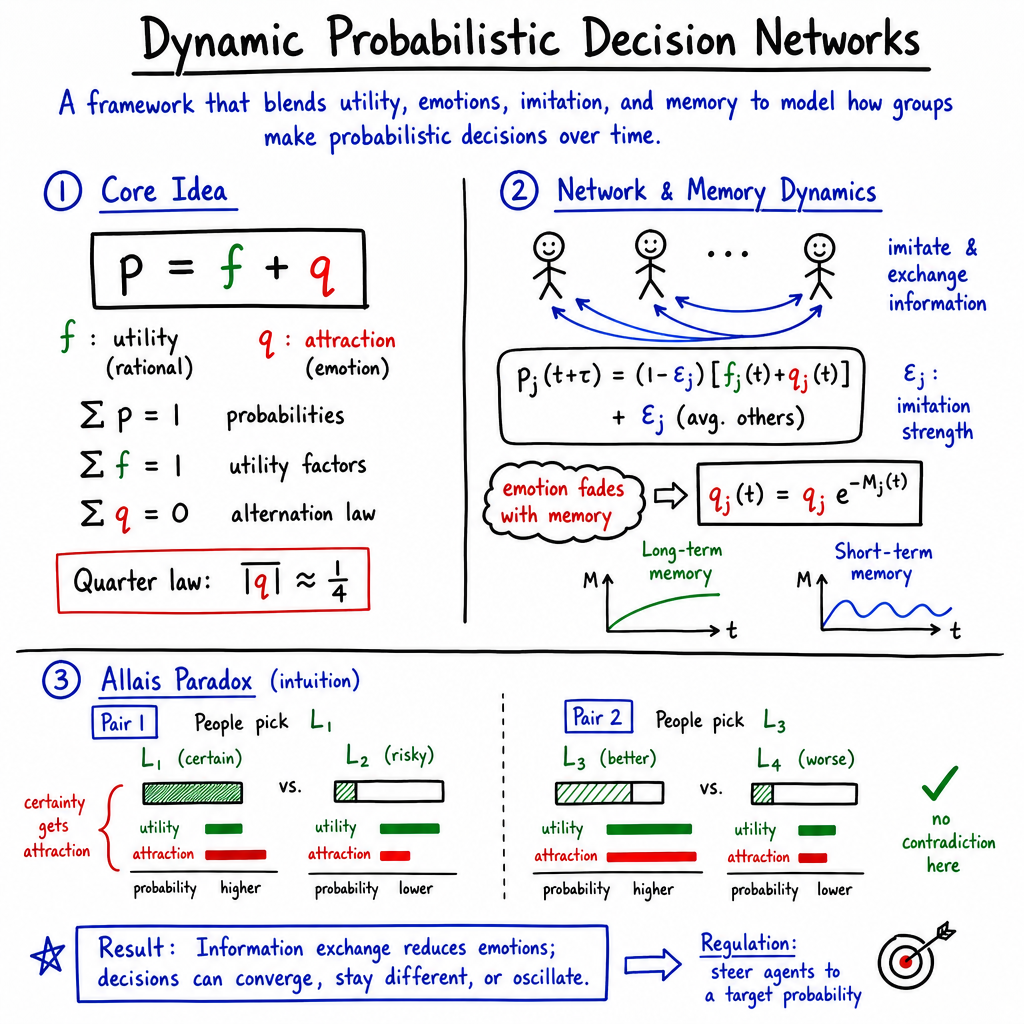
Abstract: A new type of decision networks is suggested and its operation is analyzed. The network nodes are represented by intelligent agents who can denote either some biological beings, like humans, or neurons of the brain, or the nodes of artificial intelligence. The specifics of the network are in the following: It is probabilistic in the sense that the choice, accomplished by each agent, is characterized by the related probability. It is dynamic, with the probabilities varying in time due to the exchange of information between the agents. It is affective, because the agents choose between alternatives by taking account of utility as well as of biases and emotions. In general, it is heterogeneous, being composed of the groups of agents with different properties, for instance having long-term memory and short-term memory. The network dynamics, caused by the information exchange, results in decision error decrease. The network operation is illustrated by the example starting with the Allais paradox, its resolution, and the decision error diminution in the process of decision dynamics with information exchange. Resorting to machine-learning techniques it is possible to regulate the behavior of the network agents forcing them to choose particular alternatives.
Paper Prompts
Sign up for free to create and run prompts on this paper.
Top Community Prompts
Explain it Like I'm 14
1. What is this paper about?
This paper introduces a new way to study how people, brain cells, or artificial-intelligence systems make decisions together.
The authors call their idea a dynamic probabilistic decision network. The name has three important parts:
- Probabilistic: An agent does not always choose the same thing. Each choice has a probability.
- Dynamic: These probabilities can change over time.
- Decision network: Many “agents” exchange information and influence one another.
The paper also says that decisions are based on more than logic. People consider what is useful, but they are also affected by emotions, habits, personal biases, memories, and the opinions of others.
2. What questions are the authors asking?
The authors are mainly trying to answer these questions:
- How can we describe decisions that are partly logical and partly emotional?
- Why do people sometimes make different choices in the same situation?
- How do people’s decisions change after they talk to or observe others?
- Can a mathematical model describe groups of people, brain neurons, or AI systems?
- Can sharing information help a group make fewer decision mistakes?
The authors also want to explain a famous problem in decision-making called the Allais paradox. This paradox shows that people often choose differently from what a purely mathematical theory of “the most useful choice” predicts.
3. How did the authors approach the problem?
Decisions have two parts
The paper describes each choice using a probability:
Here, means one possible choice.
- is the total chance that an agent chooses that option.
- is the utility factor: how useful or sensible the option seems.
- is the attraction factor: how emotionally appealing or unappealing the option is.
For example, imagine choosing between two snacks:
- One snack is healthier. It has high usefulness.
- The other snack tastes much better. It may have stronger emotional attraction.
A person’s final choice depends on both facts.
The attraction factors must add up to zero across all choices. This means that if one option receives an emotional advantage, another option must receive a disadvantage. The authors call this the alternation law.
Choices are probabilities, not fixed answers
Traditional decision theory often assumes that a person will always choose the option with the highest calculated usefulness. The authors argue that real people do not behave this way.
Even the same person might choose differently on different days because of:
- Mood
- Memories
- Uncertainty
- Mental tiredness
- Information from other people
- Natural randomness in the brain
Therefore, the model does not say, “This person will definitely choose option A.” Instead, it says something like, “This person has a 70% chance of choosing option A.”
The “quarter law”
When the authors do not know exactly how emotional attraction affects a choice, they use a general estimate. They suggest that the average size of this emotional effect is about 0.25, or one quarter. This is called the quarter law.
This does not mean that every person always has exactly the same emotional reaction. Instead, it is an average estimate for a large group of people.
Agents exchange information
The paper then studies what happens when many agents communicate.
At first, every agent makes an independent decision. After that, the agents share their choices and information. An agent’s later probability of choosing an option depends on:
- Its own earlier opinion
- The opinions of other agents
- How strongly it tends to imitate others
- How much information it remembers
- How different another agent’s opinion is
The authors use a mathematical measure called Kullback–Leibler information to describe how different two agents’ beliefs are. In everyday language, it works like a “surprise score”: it measures how surprising one person’s opinion is when compared with another person’s opinion.
The model includes different kinds of memory:
- Long-term memory: An agent remembers information from many earlier discussions.
- Short-term memory: An agent mainly remembers the most recent information.
The authors say the same general mathematics could describe:
- Groups of people
- Animal groups
- Neurons in the brain
- AI systems with some randomness
4. What did the authors find?
Emotions help explain real choices
The model can explain choices that ordinary expected-utility theory cannot explain well.
In traditional theory, people are expected to choose the lottery with the highest average reward. But people often prefer a safer option, even when another option has a slightly higher mathematical value.
The paper gives an example involving two lotteries:
- Lottery 1: A small chance of receiving slightly more money, with some chance of receiving nothing.
- Lottery 2: A guaranteed amount of money.
Traditional mathematics slightly favors Lottery 1. However, most people choose Lottery 2 because it feels safer and more attractive.
Using its attraction factor, the paper predicts:
- Probability of choosing Lottery 1: about 25%
- Probability of choosing Lottery 2: about 75%
The actual experiment found approximately:
- Lottery 1: 18%
- Lottery 2: 82%
The authors say this is a good match, especially because the model did not need to fit a special new parameter for this particular example.
The quarter law agrees with experiments
The authors examined many decision-making experiments. They calculated the emotional attraction factors from people’s actual choices.
For 18 problems from earlier research, the average attraction effect was about 0.27, close to the predicted value of 0.25.
In another collection of 134 decision problems, the average was about 0.22, also reasonably close to one quarter.
This suggests that the quarter law may be a useful general estimate for groups of people, although it does not describe every individual perfectly.
Sharing information reduces decision errors
The main dynamic result is that communication between agents can reduce mistakes.
At the beginning, agents may be strongly influenced by personal emotions or biases. After exchanging information, their opinions can change. Over time, the group’s decisions become closer to what the rational utility calculation predicts.
In simple terms, discussion can help people correct some individual errors, much like checking homework with classmates can reveal mistakes. However, the model also includes imitation, so people may sometimes simply copy others rather than think independently.
The model can describe different types of networks
The authors argue that their approach can be used for several kinds of systems:
| Type of system | What the agents represent |
|---|---|
| Human society | Individual people or groups |
| Animal society | Animals making choices together |
| Brain network | Neurons sending signals |
| Artificial intelligence | AI units making uncertain choices |
The paper also suggests that machine-learning methods could eventually be used to control or guide the agents toward particular choices.
5. Why are these findings important?
This research is important because it tries to create a more realistic picture of decision-making.
People are not perfectly logical calculators. They have feelings, memories, changing opinions, and natural uncertainty. They also influence one another. A model that includes all these features may be better for understanding:
- How crowds make decisions
- Why people choose risky or safe options
- How opinions spread through society
- How groups can correct mistakes
- How the brain makes choices
- How future AI systems could behave more like humans
The research may also help designers build AI systems that can handle uncertainty and emotional or social influences. However, the model is still a simplified description of very complicated human behavior. Real emotions and memories are much more detailed than a single number called an attraction factor.
Conclusion
The paper presents a mathematical model in which decisions are uncertain, emotional, and influenced by communication. Each agent begins with a personal probability of choosing each option. That probability combines practical usefulness with emotional attraction. As agents exchange information, their choices change, and the group may gradually make fewer errors.
The main message is that good decision-making cannot be understood by logic alone. To understand people, brains, and human-like AI, we also need to consider emotions, randomness, memory, and social influence.
Knowledge Gaps
Knowledge gaps, limitations, and open questions
The paper leaves the following issues unresolved:
- Empirical measurement of attraction factors: It does not provide a validated procedure for measuring an individual’s emotional attraction factor independently of observed choice probabilities and utility estimates.
- Validity of the additive probability model: The assumption is justified mainly by conceptual arguments; it is not systematically compared with alternative probabilistic choice models such as softmax, prospect-theoretic, cumulative-prospect, or random-utility formulations.
- Status of the “quarter law”: The quarter-law estimate is derived from a non-informative arithmetic averaging argument, but its statistical validity, confidence intervals, and robustness to alternative priors or distributions of are not established.
- Limited empirical validation: The empirical tests rely on previously published aggregate-choice datasets and do not include new experiments designed specifically to test the proposed dynamic network mechanism.
- No individual-level validation: Agreement between aggregate predicted and observed probabilities does not demonstrate that the model accurately describes individual decision trajectories, heterogeneity, or within-person variability.
- Potential circularity in empirical attraction estimates: The attraction factor is calculated as , so the reported agreement with the quarter law partly depends on the same observed choice frequencies used to evaluate the model.
- Uncertainty in utility specification: The paper does not resolve how the utility function should be selected, estimated, or validated for real decision makers, especially when utilities are nonlinear, context-dependent, or involve losses and gains.
- Questionable generality of the lottery-quality function: The proposed expression is based on a limited behavioral rationale and is not tested across diverse payoff scales, probability distributions, cultures, or decision domains.
- Sensitivity to the fixed base $30$: The consequences of choosing the exponential base $30$, rather than estimating it or allowing it to vary across individuals and contexts, are not analyzed.
- Dimensional and scale dependence: The model does not explain how , payoff magnitudes, and the exponential lottery-quality function remain invariant under changes in measurement units or rescaling of outcomes.
- Incomplete treatment of negative utilities: The definition for negative expected utilities can produce unintuitive behavior and numerical instability near ; its theoretical and empirical justification is not examined.
- Ambiguous dynamics of utility factors: Although is allowed to vary with time, the paper does not develop a general evolution equation for it or specify how new information changes utilities separately from emotional attraction.
- Unspecified interaction strengths: The parameters and imitation strengths are introduced but no principled estimation method, empirical calibration strategy, or identifiable parameterization is provided.
- Interpretation of memory accumulation: Long-term memory is modeled as an unbounded cumulative sum of information gains, but the paper does not address saturation, interference, forgetting, habituation, or bounded cognitive capacity.
- Short-term memory is oversimplified: The short-term-memory model retains only the latest time step and does not investigate finite memory windows, exponentially decaying memory, or more realistic forgetting kernels.
- Possible instability of long-term memory: Because Kullback–Leibler information gains are nonnegative, cumulative long-term memory may grow without bound, forcing attraction factors toward zero; the resulting asymptotic behavior and realism are not analyzed.
- Directionality and sign of information effects: The model assumes information gain attenuates attraction through , but it does not establish whether information should always reduce emotional influence or whether communication can amplify, reverse, or polarize emotions.
- Use of KL divergence for social information: The Kullback–Leibler divergence is treated as the information received by an agent, although it is not shown that this quantity corresponds to psychologically perceived informational value or actual communication content.
- No modeling of message content or source credibility: Information exchange depends only on probability distributions; the model excludes persuasion, misinformation, source reputation, framing, selective exposure, and semantic content.
- Overly strong all-to-all interaction assumption: The claim that human societies require distance-independent interactions is not empirically established and overlooks bounded attention, community structure, homophily, social media algorithms, and unequal access to communication channels.
- Network topology is not meaningfully modeled: The framework does not analyze sparse, directed, weighted, clustered, adaptive, or time-varying networks, despite presenting itself as a general decision-network model.
- No heterogeneous-agent dynamics beyond memory type: Heterogeneity in culture, risk attitude, emotional sensitivity, susceptibility to imitation, prior beliefs, and communication behavior is acknowledged but not formally incorporated or tested.
- Lack of convergence and stability analysis: The paper does not provide general conditions under which the probabilities converge, oscillate, polarize, or remain unstable for arbitrary , , initial conditions, and memory rules.
- Unproven claim of decision-error reduction: The assertion that information exchange decreases decision error is illustrated through the Allais example but is not established as a general theorem or tested against cases where social influence increases error.
- No definition of “decision error” in general settings: The paper does not specify whether error means deviation from expected utility, deviation from an objectively optimal action, prediction error, or disagreement with empirical population preferences.
- Possible conformity-induced loss of diversity: The model emphasizes imitation and declining attraction effects but does not examine whether information exchange suppresses useful minority opinions, exploration, or adaptive diversity.
- No treatment of conflicting or erroneous information: The dynamics assume that exchanged probabilities are informative, without analyzing rumor propagation, strategic manipulation, correlated errors, or adversarial agents.
- No causal identification of social influence: The framework does not distinguish information-driven updating from imitation, conformity pressure, common external shocks, or endogenous changes in preferences.
- Finite-population effects are neglected: The equations use population fractions and deterministic averages, but the impact of finite group sizes, sampling noise, asynchronous decisions, and stochastic realization of choices is not derived.
- Timing assumptions are restrictive: All agents appear to update synchronously at discrete time intervals, leaving asynchronous communication, variable delays, event-driven decisions, and communication interruptions unexplored.
- No calibration to neural systems: Although neurons and brain networks are proposed as possible applications, the model is not connected to neural data, biologically plausible learning rules, anatomical connectivity, or experimentally measurable neural variables.
- Unsubstantiated rejection of quantum cognitive models: The paper dismisses quantum descriptions largely on ontological grounds but does not conduct a systematic predictive comparison between the proposed classical model and competing quantum-probabilistic models.
- Machine-learning integration is only asserted: The paper suggests that machine learning could regulate agent behavior, but it does not specify the learning objective, training data, architecture, intervention mechanism, or risks of manipulating collective decisions.
- Ethical and governance implications are unaddressed: The possibility of forcing agents toward particular alternatives through machine learning raises issues of autonomy, consent, manipulation, fairness, and accountability that the paper does not discuss.
- External validation across domains is absent: The framework is not tested on real-world collective decisions such as elections, markets, organizational choices, online communities, animal groups, or clinical decision-making.
- Reproducibility is limited: The paper does not provide simulation code, complete parameter settings, sensitivity analyses, or a benchmark dataset sufficient to reproduce and independently evaluate its dynamic results.
Practical Applications
Immediate Applications
- Collective decision-support simulations for organizations and public institutions (industry, policy, academia)
- a utility distribution ,
- an attraction or affective factor ,
- an imitation coefficient ,
- and either short-term or long-term memory.
- Such simulations could estimate how preferences evolve after discussion, information campaigns, or exposure to peer decisions. Potential uses include organizational planning, public consultation, emergency-response exercises, and analysis of committee or stakeholder decisions.
- Dependencies: Utility values must be specified consistently; the attraction-factor estimates are only approximate, particularly when individual demographic, cultural, or emotional characteristics are unknown. The paper’s claim that decision error decreases over time should be tested in the specific population and communication setting.
- Behavioral analysis of group choices under uncertainty (finance, marketing, economics, consumer research)
The combination can be used to separate rational usefulness from emotional attractiveness when analyzing choices involving lotteries, investments, insurance products, or consumer alternatives. For example, a financial institution could compare expected returns with emotional responses such as certainty preference, loss aversion, or preference for salient outcomes.
A practical workflow would be:
- calculate expected utility and normalize it into ;
- infer from observed choice frequencies;
- model how peer communication changes the resulting probabilities. Dependencies: The paper’s “quarter law” is presented as an aggregate, non-informative estimate rather than a universally valid individual parameter. It should therefore not replace empirical calibration in high-stakes financial decisions.
Analysis of social influence, imitation, and herd effects (social media, communications, political research) Platforms or researchers could use the network equations to model how users’ preferences change after receiving information from peers. The framework is potentially useful for studying viral content, opinion convergence, polarization, rumor propagation, or public reactions to competing narratives. The model could support tools that simulate alternative network interventions, such as changing message exposure, introducing independent information, or varying the strength of imitation. Dependencies: The paper assumes broad communication among agents in some settings, whereas real platforms have structured, asymmetric, algorithmically curated networks. Practical deployment would require replacing the uniform interaction term with empirically estimated network-specific influence weights and addressing privacy and manipulation risks.
- Evaluation of communication and consensus protocols (software engineering, distributed systems, robotics)
- consensus protocols for distributed software agents;
- coordination among warehouse or service robots;
- multi-agent planning under uncertain observations;
- testing resilient decision-making in decentralized systems.
- Dependencies: The current model is most directly suited to a common set of alternatives and shared or comparable utility factors. Real systems require explicit handling of conflicting objectives, communication delays, adversarial agents, and failures.
- Human-subject experiments on affective and probabilistic choice (academia, behavioral science, neuroscience)
- initial individual choice probabilities;
- changes after discussion or social information;
- differences between short-term and long-term memory groups;
- the relationship between inferred attraction factors and reported emotions.
- The model provides a compact way to compare expected-utility predictions with affect-sensitive probabilistic predictions without immediately requiring a quantum-cognition interpretation.
- Dependencies: Attraction factors are latent variables and may not correspond directly to self-reported emotion. Larger, culturally diverse samples and preregistered tests are needed to assess whether the reported aggregate agreement generalizes.
- Decision auditing and bias diagnosis (healthcare, finance, hiring, education) Organizations could use the model as an audit layer to identify cases in which observed decisions differ substantially from utility-based recommendations. A large discrepancy between and empirical may indicate emotional salience, framing, social pressure, or other unmeasured factors. In healthcare, for example, it could help analyze patient preferences for treatment options; in hiring or admissions, it could reveal whether group discussion disproportionately shifts judgments toward salient or socially dominant alternatives. Dependencies: The model must not be used to label a person’s decision as “irrational” solely because it differs from expected utility. Fairness, informed consent, explainability, and domain-specific validation are essential, especially where decisions affect rights or access to services.
- Educational tools for teaching decision theory and behavioral economics (education)
- the number of alternatives;
- utility and attraction factors;
- communication strength;
- memory type;
- and the proportion of agents in each group.
- Students could observe how an initially heterogeneous population moves toward or away from consensus and compare the results with expected-utility theory.
- Dependencies: The simulator should clearly distinguish the paper’s theoretical assumptions from empirically established psychological laws. The unusual lottery-quality expression and the quarter-law estimate should be presented as model components requiring critical evaluation.
- Short-horizon recommendation and deliberation workflows (product design, customer research, public consultation) Organizations could deploy a low-risk version of the framework to estimate how preferences may change after users receive additional explanations, peer reviews, or comparative information. For example, a product team might model whether customers initially attracted to a salient feature revise their choices after learning reliability or cost information. Dependencies: The system should provide probability distributions rather than deterministic predictions, preserve the possibility of minority preferences, and avoid designing communication solely to engineer a predetermined choice.
Long-Term Applications
- Affective multi-agent artificial intelligence (AI, software, robotics)
- social robots that account for user sentiment and group reactions;
- negotiation agents that model trust, aversion, or emotional salience;
- virtual assistants that represent uncertainty about user preferences;
- multi-agent systems that balance individual and collective objectives.
- Dependencies: The paper does not provide a validated computational theory of emotion, nor does it establish that attraction factors correspond to human affect in a psychologically complete way. Safe deployment requires interpretability, robustness, preference privacy, and safeguards against agents amplifying harmful imitation.
- Decision models for neuronal and brain-inspired networks (neuroscience, neural engineering) Because the paper treats agents as probabilistic nodes with memory, noise, and information exchange, it could inspire simplified computational models of neuronal populations and collective neural decision-making. These models might be used to study how intrinsic neural variability, memory decay, and long-range interactions affect perceptual or motor choices. Dependencies: The analogy between social agents and neurons is substantial but not sufficient as a biological explanation. Neural validation would require mapping model variables to measurable neural processes and comparing predictions with electrophysiological, imaging, or behavioral data.
- Adaptive autonomous robot teams (robotics, logistics, defense, disaster response) Future robot teams could use heterogeneous agents with different memory horizons, confidence levels, and imitation strengths. Each robot would maintain probabilities over possible actions, exchange information, and update its behavior according to local observations and team signals. Applications could include search-and-rescue teams deciding where to explore, delivery fleets allocating tasks, or agricultural robots selecting intervention sites. Dependencies: Real-time operation requires scalable algorithms, reliable communication, explicit spatial interaction graphs, and guarantees against cascading errors. The paper’s all-to-all interaction assumption is unlikely to be feasible for large robot populations.
- Policy design and prediction of collective responses (government, public health, energy, climate policy)
- adoption of vaccination or preventive-health measures;
- household response to energy-price incentives;
- public acceptance of climate policies;
- evacuation or emergency-preparedness decisions;
- uptake of public-benefit programs.
- The model could compare interventions that alter material utility with those that alter perceived attractiveness, trust, or social visibility.
- Dependencies: Such applications require representative behavioral data, demographic heterogeneity, causal validation, and careful treatment of institutional trust and misinformation. Policy use should support informed autonomy, not exploit emotional biases to force choices.
- Financial-market and systemic-risk modeling (finance, economics) A large-scale version could represent investors or investor groups with heterogeneous utilities, attraction factors, memory horizons, and imitation tendencies. It might help investigate how emotionally salient information and short-term memory generate synchronized buying, selling, or risk reassessment. Potential tools include scenario engines for stress testing, investor-behavior dashboards, and simulations of contagion caused by shared information. Dependencies: Financial markets involve strategic agents, changing payoffs, endogenous prices, and adversarial behavior, none of which are fully developed in the presented formulation. Any operational model would need calibration against market data and comparison with established agent-based and econometric models.
- Personalized healthcare and shared clinical decision-making (healthcare) A future clinical decision-support system could represent treatment choices using both clinical utility and patient-specific attraction factors, such as aversion to side effects, uncertainty, invasiveness, or treatment burden. It could also model how family members or clinicians influence the patient over repeated consultations. This could support more transparent discussions of why a patient’s preferred option differs from the option with the highest clinical utility. Dependencies: Clinical applications require validated utility elicitation, informed consent, protection of sensitive psychological data, and strict separation between modeling preferences and recommending treatment. The framework cannot by itself establish medical effectiveness or ethical acceptability.
- Longitudinal models of learning, memory, and preference change (education, psychology, human-computer interaction) By extending the short-term and long-term memory formulations, researchers could build models of how repeated feedback, prior experiences, and social information affect decisions over weeks or years. Such systems might personalize educational content, recommend interventions, or study persistence and dropout decisions. Dependencies: Memory in humans is more complex than a single accumulated information term. Longitudinal use would require validated forgetting functions, safeguards against reinforcing disadvantageous preferences, and evidence that predicted changes reflect learning rather than temporary conformity.
- Decision systems that explicitly resist harmful consensus (AI safety, cybersecurity, governance) The same dynamics that may reduce disagreement can also create herd behavior and amplify misinformation. A future system could use the model diagnostically to detect excessive convergence, overreliance on influential agents, or rapid suppression of minority alternatives. It could then introduce independent agents, diversity constraints, delayed aggregation, or confidence-weighted communication. Dependencies: The paper emphasizes error reduction through information exchange, but consensus is not necessarily correct. Practical systems would need independent ground truth, adversarial testing, calibrated uncertainty, and formal criteria distinguishing beneficial coordination from dangerous groupthink.
Glossary
- Allais paradox: A decision-theory paradox showing that people’s choices can violate the independence principle of expected utility theory. “We illustrate the approach by considering the Allais paradox”
- Alternation law: The normalization rule stating that attraction factors across all alternatives sum to zero. “called the {\it alternation law}”
- Attraction factor: A quantity representing the emotional attractiveness of an alternative. “The {\it attraction factor} characterizes the influence of emotions”
- Behavioral probability: A choice probability combining rational utility and emotional attraction. “This quantity is called {\it behavioral probability}”
- Belief parameter: A parameter representing a decision maker’s confidence in the fairness of a decision procedure. “ plays the role of a belief parameter characterizing the decision maker belief in the fairness of the decision procedure”
- Collective decision: A decision formed by aggregating the choices or probabilities of multiple agents. “The collective decision of a society with respect to an alternative is composed of the weighted sum of the group probabilities”
- Decision network: A network whose agents or nodes make choices among alternatives, potentially while exchanging information. “The decision network consists of agents who are characterized by the probabilities of choosing this or that alternative.”
- Decision-making memory: Memory used to encode, store, and retrieve information relevant to making decisions. “This decision-making memory is the faculty, which enables to encode, store, and retrieve obtained information over time in order to make decisions”
- Expected utility theory: A normative theory in which rational agents choose the alternative with the greatest expected utility. “The predominant theory describing individual behavior under uncertainty is nowadays the expected utility theory”
- Herd effect: A tendency for agents to imitate the behavior of others. “The decision makers, being the members of a society, have inclination to imitate the behavior of others”
- Information functional: A mathematical objective used to quantify information and derive a probability distribution through minimization. “The explicit expression for the utility factor can be defined by minimizing an information functional.”
- Information gain: A measure of the informational difference between probability distributions, here expressed using the Kullback–Leibler form. “The information gain can be taken in the Kullback-Leibler form”
- Information exchange: The communication of decision-relevant information between agents in a network. “The network dynamics, caused by the information exchange, results in decision error decrease.”
- Intrinsic noise: Random variation arising within a system rather than from external uncertainty. “The nodes of the network can be represented by intelligent agents whose choice combines the rational evaluation of utility of alternatives as well as their emotional attractiveness.”
- Kullback–Leibler divergence: A measure of the discrepancy between two probability distributions. “The information gain can be taken in the Kullback-Leibler form”
- Lagrange multiplier: A parameter introduced to enforce a constraint during mathematical optimization. “ is a trial prior distribution, and are the Lagrange multipliers.”
- Limbic system: A set of brain structures associated with emotion, motivation, and memory. “Emotional processes occur within the limbic system including amygdala, hippocampus, hypothalamus, cingulate gyrus, and orbifrontal cortex”
- Long-term memory: Memory whose retained information or interaction effects persist over extended periods. “The ultimate types of memory are the long-term and short-term memories.”
- Lottery quality: A numerical measure used to compare the attractiveness of lotteries based on payoffs and their probabilities. “The {\it lottery quality} is defined as”
- Mean-field approximation: An approximation that replaces detailed interactions among entities with an averaged interaction. “It is important to stress that this is not a mean-field approximation, but the exact consequence of the realistic nature of intelligent agents.”
- Neural network: A network of interconnected neurons or neuron-like computational units. “The suggested networks can characterize biological systems, such as human societies, or groups of other biological beings experiencing emotions in the process of decision making, or it can describe neuronal networks with intrinsic variations.”
- Non-expected utility theory: A class of decision theories that modifies or generalizes expected utility theory to account for observed behavioral deviations. “the so-called non-expected utility theory”
- Non-informative prior: A prior estimate used when specific information about the relevant probability or parameter is unavailable. “the quarter law serves as a non-informative prior characterizing the average attraction factor.”
- Posterior distribution: A probability distribution updated after incorporating information or evidence. “the posterior and prior distributions coincide”
- Prior distribution: A probability distribution representing initial beliefs or assumptions before incorporating new information. “The trial distribution can be accepted in the Luce”
- Probabilistic choice: A choice model in which alternatives are selected according to probabilities rather than deterministic rules. “Thus decision making is a principally probabilistic process”
- Short-term memory: Memory that retains only recent information or the latest interaction step. “while under short-term memory the interactions are local in time, when only the last step is remembered”
- Shore–Johnson theorem: A theorem specifying consistency conditions for deriving probability distributions by information minimization. “required by the Shore-Johnson theorem”
- Stochastic process: A process involving randomness whose outcomes or states vary probabilistically. “making the process of choice stochastic”
- Subjective probability: A probability representing an individual’s beliefs rather than an objective frequency. “integrated with the theory of subjective probability by Savage”
- Utility factor: A normalized quantity measuring the rational usefulness of an alternative. “The rational utility of an alternative is quantified by the {\it utility factor}”
- Value functional: A function that assigns a numerical value to an alternative or decision outcome. “one composes a value functional, also called objective function”
- Von Neumann–Morgenstern theory: The axiomatic expected utility framework developed by von Neumann and Morgenstern. “The predominant theory describing individual behavior under uncertainty is nowadays the expected utility theory axiomatized by von Neumann and Morgenstern”
- Weighted sum: An aggregate computed by multiplying each component by a weight and then adding the results. “The collective decision of a society with respect to an alternative is composed of the weighted sum of the group probabilities”

