Large-Language Models as a Cognitive Virus
Abstract: Large-LLMs are rapidly becoming part of human culture, reshaping how information is produced, transmitted, and used. Here we propose that their diffusion can be understood through a viral analogy, with LLM use spreading through populations, becoming embedded in cognitive and cultural practices. We model transitions among uncoupled, coupled, and persistently dependent users, and show that the interplay between social transmission, recovery, and collective reinforcement can generate tipping points and technological lock-in. A central consequence is the possibility of runaway dynamics: once a critical threshold is crossed, small increases in adoption can trigger rapid population-level shifts toward persistent dependence, with abrupt losses in cognitive competence. The same framework, however, identifies conditions for cognitive immunization, based on reducing transmission and facilitating reversibility. Our results highlight how LLM adoption may involve nonlinear collective transitions with important consequences for cognitive autonomy.
Paper Prompts
Sign up for free to create and run prompts on this paper.
Top Community Prompts
Explain it Like I'm 14
1. What is this paper about?
This paper asks an important question:
What might happen if people become increasingly dependent on large-LLMs, such as ChatGPT, for thinking, writing, learning, and solving problems?
The authors compare the spread of LLM use to the spread of a virus. They do not mean that LLMs are biological viruses or that they are always harmful. Instead, they use the comparison to describe how LLM habits can spread from person to person through schools, workplaces, social media, and institutions.
The paper focuses especially on the difference between:
- Using an LLM as a helpful tool, while still thinking independently.
- Depending on an LLM, so that important thinking skills are gradually replaced by the machine.
2. What questions are the researchers asking?
The paper mainly explores these questions:
- How can LLM use spread through a population?
- Can regular use turn into strong dependence?
- Could society suddenly shift from mostly independent thinking to widespread dependence?
- Would such a shift be easy to reverse, or could technology become “locked in”?
- What could people and institutions do to protect independent thinking while still using AI?
The authors are particularly interested in whether small, gradual changes in AI adoption could eventually cause a sudden and large change in human behavior.
3. How did the researchers study this?
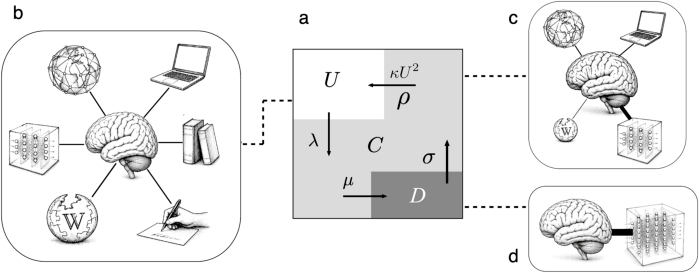
The researchers built a mathematical model. A model is a simplified description of a complicated real-world system. It is similar to using a map: a map does not show every tree and building, but it helps us understand the main roads and directions.
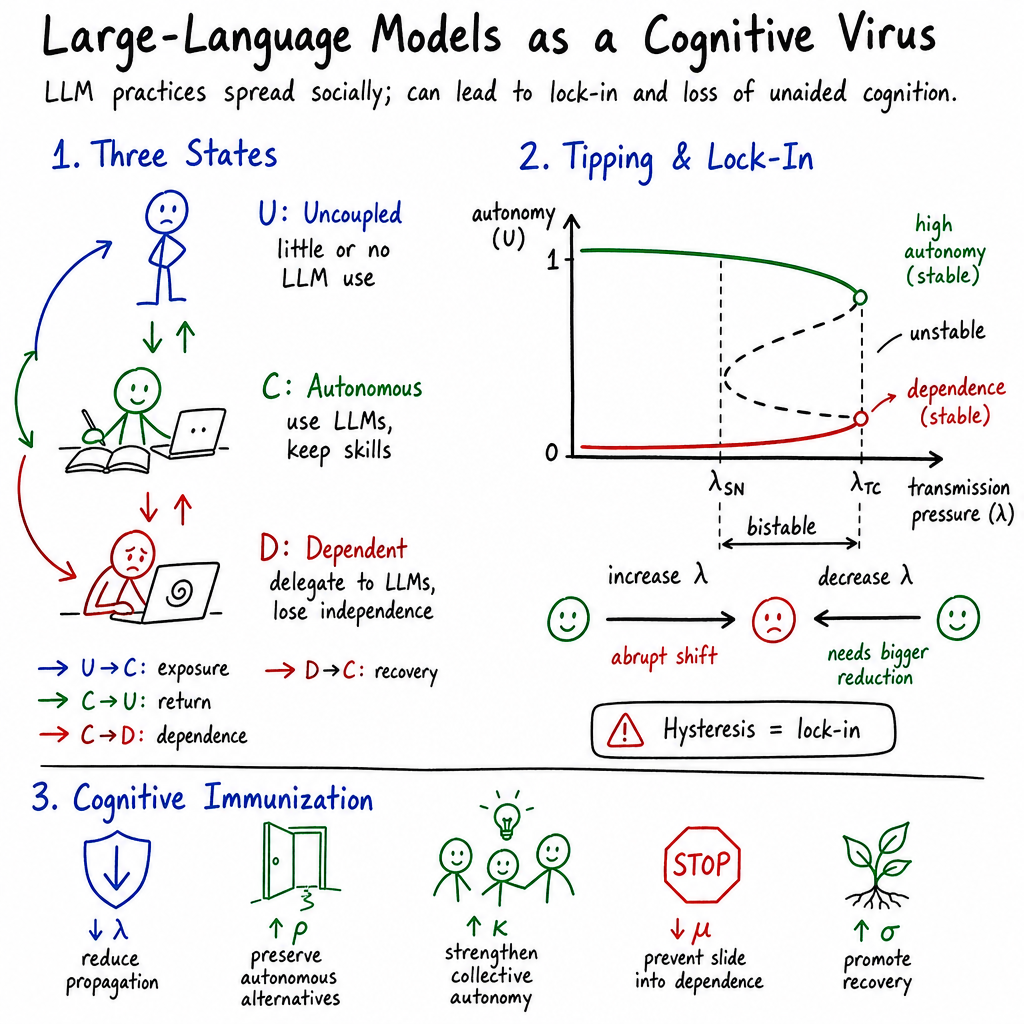
They divided people into three groups:
| Group | Meaning |
|---|---|
Uncoupled users (U) |
People who do not use LLMs much, or who remain mostly independent from them |
Autonomous users (C) |
People who use LLMs but still read, write, reason, check information, and solve problems independently |
Dependent users (D) |
People who regularly let the LLM perform important thinking tasks for them |
The model allows people to move between these groups:
- People may begin using LLMs because of friends, schools, workplaces, or online platforms.
- Autonomous users may become dependent if they repeatedly let the AI do their thinking.
- People may also reduce their use and return to more independent thinking.
- Dependent users may recover some independence through practice, education, checking information, and completing tasks without AI.
The authors use ideas from epidemiology, the study of how diseases spread. In this paper, the “infection” is not a disease. It is the spread of a habit or way of using technology.
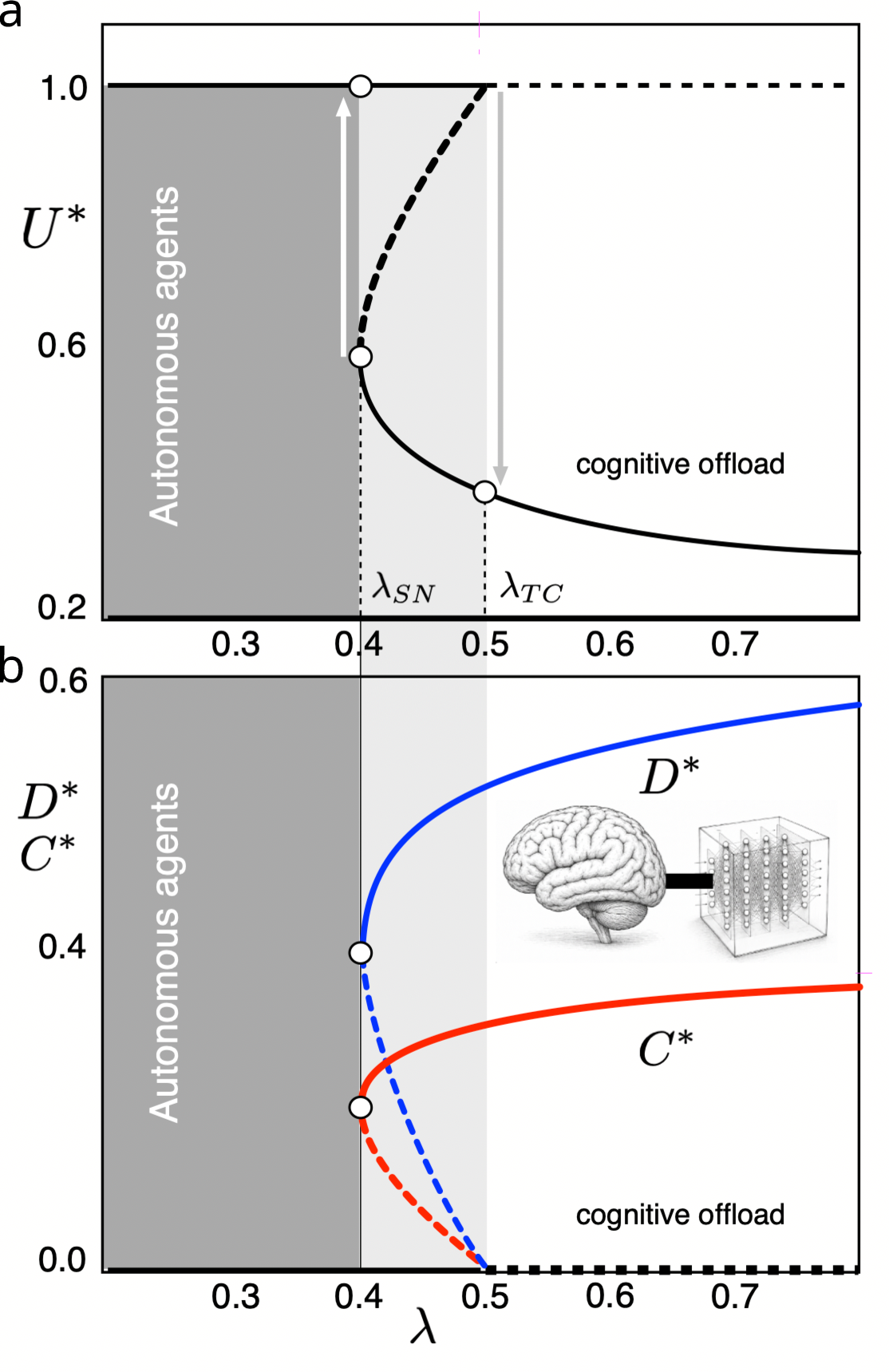
They also study a tipping point. A tipping point is a level at which a system changes quickly. For example, a small amount of snow may sit safely on a roof, but after enough snow collects, the whole pile may suddenly slide off.
Another important idea is hysteresis, which means that returning to the old conditions may not immediately return the system to its old state. For example, a forest might catch fire after becoming very dry. Even if the weather later becomes slightly wetter, the forest may not quickly return to its original condition.
4. What did the model show?
Gradual adoption could cause a sudden change
The model suggests that LLM use might increase slowly at first. However, after a critical point, dependence could spread quickly.
This could happen because of a feedback loop:
- More people use LLMs for thinking and writing.
- Schools and workplaces begin to expect or encourage this use.
- Independent practice becomes less common.
- People become less confident doing tasks without AI.
- Using the LLM becomes even easier and more attractive.
- Dependence spreads further.
In this way, the social environment may begin to reward AI dependence while giving people fewer chances to practice independent thinking.
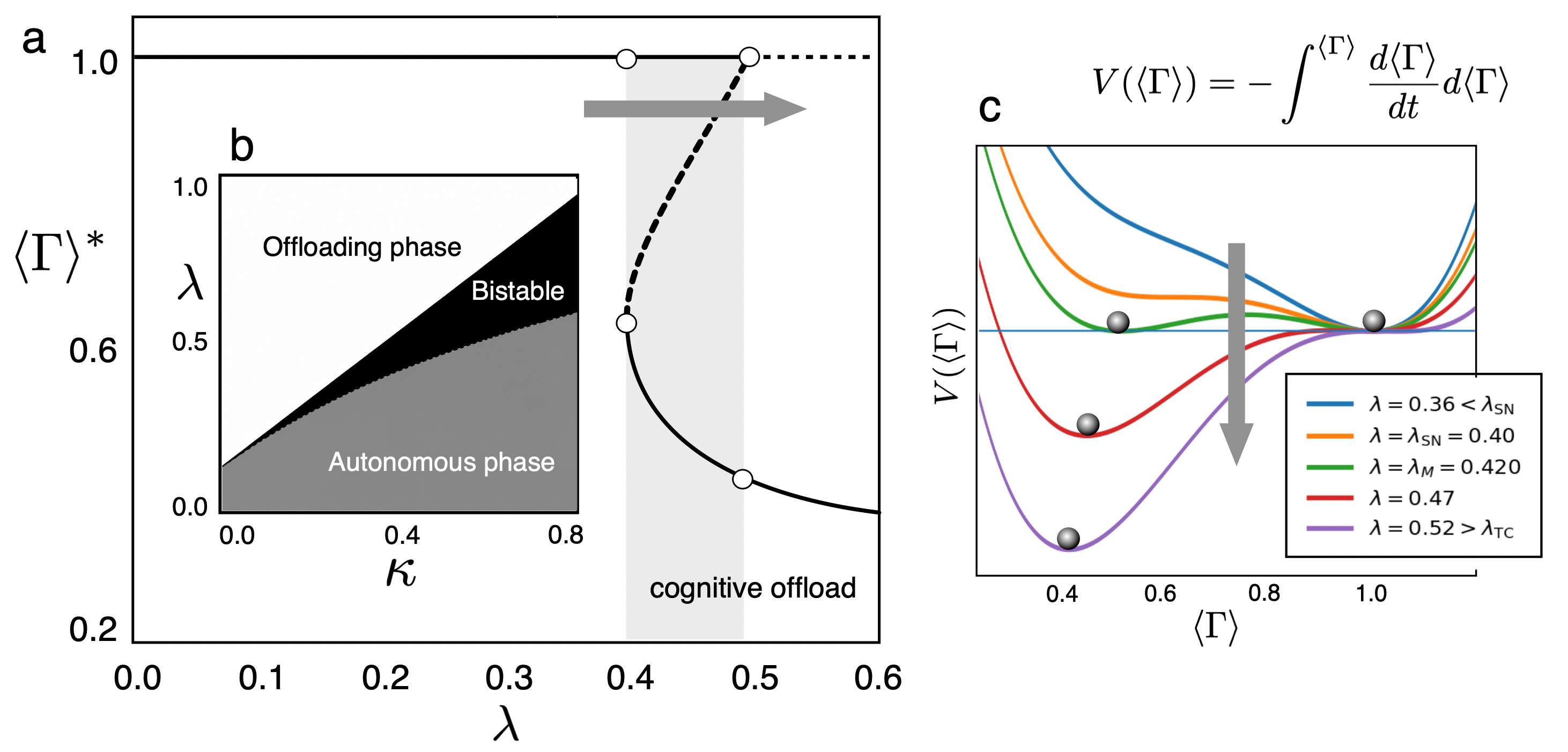
Society could have two stable states
The model allows for a period in which two different situations can both continue:
- A society where people mostly think independently.
- A society where people commonly rely on LLMs.
Which state occurs may depend on the society’s history. This is called bistability, meaning that two stable conditions are possible.
For example, a society that has protected independent reading and problem-solving may remain autonomous even while AI use increases. But a society that has already lost many of those habits may continue moving toward dependence.
Dependence may be harder to reverse than to prevent
One of the paper’s most important findings is that prevention may be easier than recovery.
Before widespread dependence develops, reducing the social pressure to use LLMs may stop the transition. But after dependence becomes common, simply returning to earlier levels of AI use may not be enough. Society may need to reduce AI pressure much further and actively rebuild independent skills.
This is the paper’s idea of technological lock-in: once a technology becomes deeply embedded in daily life, moving away from it can be difficult.
Cognitive ability may fall in the model
The researchers include a measure called cognitive competence. In simple terms, this means how well people can think, write, reason, and solve problems when the external AI support is removed.
The model assumes that:
- Independent users have the highest competence.
- Autonomous LLM users have somewhat lower competence.
- Dependent users have the lowest competence.
Using these assumptions, the model predicts that society’s average independent competence could suddenly drop when dependence passes a tipping point.
However, the authors clearly state that this result depends on their assumptions. LLM use does not automatically reduce ability. If AI is used like a tutor or a helpful tool, it might preserve or even improve people’s skills.
The model identifies possible protections
The paper calls these protections “cognitive immunization.” This does not mean avoiding AI completely. Instead, it means designing AI use so that people continue to think for themselves.
Helpful strategies include:
- Practicing some tasks without AI.
- Checking and questioning AI answers.
- Keeping books, teachers, human experts, and other information sources available.
- Asking students to think before using an AI tool.
- Using AI to explain ideas rather than complete every task.
- Reducing automatic or unnecessary AI use.
- Making it easier for people to return to independent work.
- Preventing regular use from turning into permanent dependence.
The model also separates two problems:
- Stopping dependence from spreading, which involves changing social and institutional pressures.
- Reducing dependence after it develops, which involves practice, recovery strategies, and sometimes psychological support.
5. Why are these findings important?
The paper does not claim that LLMs are always dangerous. Instead, it says that the effects of AI depend greatly on how people use it.
The authors distinguish between two kinds of AI assistance:
AI as scaffolding
A scaffold helps someone learn or build something while still requiring their participation. For example, a teacher might give hints instead of giving the complete answer.
In this form of AI use, the person still:
- Thinks through the problem.
- Checks the answer.
- Learns the underlying skill.
- Becomes more capable over time.
AI as substitution
Substitution happens when the AI takes over the task completely. The person may get a good result but fail to develop or maintain the skill needed to do the task independently.
For example, a student who asks an AI to write every essay may receive finished work but get less practice organizing ideas, explaining evidence, and writing clearly.
The paper argues that the most important question is not simply “Do people use AI?” It is:
“What abilities remain when the AI is taken away?”
6. Overall implications
The paper suggests that LLMs could become a powerful extension of human thinking. They may help people learn faster, explore ideas, access information, and solve difficult problems. In the best case, AI could work like an “external brain” that supports human judgment.
But the paper warns that society should not assume that helpful individual use will always produce helpful results for everyone. If people gradually stop practicing independent thinking, a whole population could become more dependent on AI. Because of social feedback and tipping points, this change might happen more suddenly than expected.
The main lesson is:
AI should support human thinking, not quietly replace it.
Schools, workplaces, and technology designers should encourage people to question AI, verify information, practice unaided skills, and keep alternative ways of learning and reasoning alive. The goal is not to reject LLMs, but to use them in ways that preserve human independence and make recovery possible if dependence begins to grow.
Knowledge Gaps
Knowledge gaps, limitations, and open questions
The paper leaves the following issues unresolved:
- No empirical estimates for model parameters: The rates , , , , and are treated as abstract parameters, with no procedures for estimating them from longitudinal behavioral, educational, workplace, or platform data.
- Unvalidated tipping points: The predicted thresholds and are mathematical consequences of the assumed equations, but it remains unknown whether real populations exhibit comparable discontinuities, bistability, or hysteresis in LLM use.
- Unclear operational definition of dependency: The dependent state is not linked to measurable criteria such as frequency of unaided-task failure, inability to work without an LLM, reduced skill retention, loss of metacognitive monitoring, or compulsive use.
- Cognitive competence is imposed rather than measured: The values , , and are illustrative assumptions. The paper does not establish how LLM use affects specific cognitive abilities such as recall, reasoning, writing, problem formulation, creativity, or verification.
- No distinction among cognitive domains: The model treats cognition as a single competence variable, leaving unresolved whether LLM dependence produces domain-specific effects—for example, reduced writing ability but improved information search or programming performance.
- Insufficient separation of scaffolding and substitution: The framework classifies users into broad states but does not specify observable thresholds for distinguishing beneficial scaffolding from harmful substitution across tasks and populations.
- No causal evidence linking LLM use to declining competence: The discussion cites studies suggesting reduced engagement or unaided performance, but the model does not establish whether these effects are caused by LLM use, pre-existing user characteristics, task selection, or educational and occupational contexts.
- No longitudinal account of skill acquisition and recovery: The model assumes constant transition rates and does not determine how quickly competence is lost, whether losses are reversible, or how much unaided practice is required for recovery.
- Homogeneous population assumption: Individuals are assumed to share the same transition and recovery rates, despite likely differences in age, education, baseline ability, occupation, motivation, socioeconomic status, disability, and prior technology use.
- No demographic or institutional stratification: The model does not examine how schools, workplaces, professions, households, or national education systems may experience different adoption dynamics and intervention thresholds.
- Mean-field mixing is unrealistic: Social exposure is represented by population averages, without modeling clustered networks, homophily, unequal influence, institutional hierarchies, or highly connected users and organizations.
- No platform-level or algorithmic feedbacks: Changes in recommendation systems, default AI integration, pricing, interface design, model quality, and product availability are absorbed into rather than modeled explicitly.
- Autonomy is modeled as a single reinforcing norm: The quadratic term assumes that autonomous cognition is strengthened by the prevalence of autonomous users, but this mechanism is not empirically justified or compared with alternative functional forms.
- Potential ambiguity in the direction of collective reinforcement: The paper does not establish whether widespread LLM use weakens autonomous norms, whether autonomous norms can remain strong under high adoption, or whether both processes operate simultaneously in different settings.
- No direct transition from uncoupled to dependent use: The model assumes that dependency arises only through regular use (), leaving unexplored whether intensive or vulnerable users can move directly from to .
- No direct transitions from dependency to autonomy: Recovery is constrained to , although some users may regain unaided competence directly, while others may oscillate repeatedly between states.
- Constant rates ignore adaptation: The parameters do not change as users gain experience, as LLM reliability improves, as institutions revise policies, or as users learn to verify outputs and manage reliance.
- No stochasticity or individual-level variability: The deterministic model cannot capture random adoption events, heterogeneous thresholds, rare reversals, temporary shocks, or fluctuations that may trigger transitions near a tipping point.
- No explicit time-scale analysis: Although the model predicts equilibrium states, it does not determine how long adoption, dependency, competence loss, or recovery would take in real populations.
- No treatment of repeated or cyclical use: Users may alternate between LLM-assisted and unaided work depending on task difficulty, deadlines, professional norms, or personal goals; such temporal patterns are not represented.
- The model excludes LLM and model-lineage evolution: It does not represent changes in model capabilities, training data, autonomy, interface design, or competition among model providers, despite framing LLMs as evolving technological lineages.
- Viral analogy is not formally compared with alternative theories: The paper does not test whether epidemic models explain LLM diffusion better than models of economic adoption, habit formation, social learning, institutional change, or rational technology choice.
- Benefits and harms are not jointly modeled: The competence variable focuses on unaided human capacity and does not quantify total human–AI performance, productivity, accessibility, decision quality, error rates, or welfare.
- No accounting for heterogeneous LLM quality: The framework treats “LLM use” as a uniform exposure, without distinguishing reliable and unreliable systems, domain-specific models, hallucination rates, personalization, or human oversight.
- Risks of overreliance are not separated from risks of model error: Cognitive dependence and automation bias may have different mechanisms and consequences, but the model combines them within the dependent state.
- No analysis of distributional effects: The paper does not examine whether LLM adoption increases or reduces inequalities in cognitive performance, educational opportunity, labor-market outcomes, or access to alternative cognitive resources.
- Intervention effects are theoretical rather than tested: Claims that increasing , reducing , increasing , or changing will prevent lock-in or improve competence lack experimental or field validation.
- Possible intervention trade-offs are underexplored: Measures that increase verification, friction, or unaided practice may reduce productivity, accessibility, user autonomy, or beneficial uses of LLMs, but these costs are not included.
- The role of regulation and institutional policy is unspecified: The framework does not model how school rules, workplace requirements, disclosure policies, assessment design, or platform governance alter adoption and dependence.
- No criteria for identifying a harmful population-level transition: A shift toward greater coupling may reduce some unaided skills while improving collective knowledge production, accessibility, or scientific output; the paper does not define when such a transition should be considered harmful.
- No cross-cultural validation: The assumptions about autonomy, independent reasoning, social reinforcement, and acceptable cognitive offloading may differ across cultures, languages, educational systems, and occupational environments.
- Interactions with other technologies are omitted: Smartphones, search engines, social media, calculators, writing assistants, and traditional information sources may either buffer or amplify LLM-related dependence, but they are not represented as competing or complementary cognitive supports.
- No examination of adversarial or strategic behavior: Users, institutions, and providers may strategically manipulate adoption incentives, verification practices, or reported dependence, which could undermine the assumed transition rates.
- No empirical test of “cognitive immunization”: The concept remains a theoretical analogy; the paper does not identify validated biomarkers, behavioral indicators, or intervention protocols that reliably preserve autonomy while retaining LLM benefits.
- The potential is illustrative rather than independently predictive: The effective-potential representation is derived from the reduced deterministic model and does not establish that real cognitive populations possess an equivalent energy landscape or Maxwell-point behavior.
- Unresolved ethical and normative questions: The paper does not specify who should decide which cognitive capacities must be preserved, how much dependence is acceptable, or how interventions should balance autonomy, efficiency, accessibility, and individual choice.
Practical Applications
Immediate Applications
- AI-use audits and dependency-risk monitoring (industry, education, public institutions)
U: little or no LLM use;C: regular use with retained independent reasoning and verification;D: persistent dependence, where the LLM performs most cognitive operations.- Surveys, task-performance tests, audit logs, and unaided follow-up assessments could estimate transitions among these states. This would help identify departments, courses, or job roles approaching a dependency threshold before large-scale competence loss occurs.
- Dependencies: The model’s categories are coarse-grained and require validated behavioral indicators. Usage frequency alone is insufficient to distinguish beneficial scaffolding from substitution.
- “AI-off” and independent-verification protocols (software, education, professional services, research)
Organizations can introduce mandatory unaided stages before or after LLM use: employees first formulate an answer, students solve selected problems without AI, and researchers independently check model-generated claims, code, or analyses. A practical workflow is:
think first → use LLM → verify and explain → complete an unaided recall or application task. This directly increases the modeled recovery rate and reduces progression toward dependency through lower . Dependencies: Protocols must be adapted to task risk and should not impose unnecessary friction on low-stakes activities. - Human-in-the-loop verification requirements (healthcare, finance, law, engineering, public administration) High-consequence workflows can require users to document sources, assumptions, alternative interpretations, and reasons for accepting or rejecting an LLM output. In healthcare, for example, an LLM may draft a differential diagnosis, but a clinician must independently review evidence and make the final decision. In finance or law, generated recommendations should be checked against primary documents and applicable regulations. This limits automation bias and preserves the user’s ability to operate without the model. Dependencies: Verification must be performed by appropriately qualified professionals; logging and accountability systems must protect confidential data.
- Design of LLM products as scaffolding rather than substitution (software and enterprise technology)
- asking users to state an initial answer before revealing the model’s response;
- presenting hints progressively rather than immediately generating a complete solution;
- requiring users to explain or edit generated text and code;
- displaying uncertainty, citations, and alternative answers;
- providing “show your work” or rationale-checking prompts;
- including scheduled unaided practice modes.
- These features operationalize the paper’s distinction between complementary coupling and substitutive dependence.
- Dependencies: Interface interventions may be bypassed, and their effects need to be tested across user populations and task types.
- Educational curricula for cognitive immunization (schools, universities, professional training) Institutions can preserve independent reading, writing, calculation, coding, source evaluation, oral examination, and problem-solving exercises alongside permitted AI use. Assessment can combine AI-assisted assignments with supervised unaided demonstrations of competence. Teachers can explicitly teach when AI is useful, how to challenge it, and how to verify its outputs. This strengthens autonomous practice and collective reinforcement, corresponding to higher and . Dependencies: Implementation requires teacher training, equitable access to non-AI learning resources, and assessment methods that measure durable competence rather than only AI-assisted performance.
- Workplace policies that preserve non-LLM alternatives (industry and public-sector organizations) Employers can avoid making LLM use the default route for every task by maintaining conventional documentation, human review channels, manual procedures, and training opportunities. Periodic “no-assistance” exercises can test whether workers retain essential skills in writing, analysis, customer interaction, programming, or emergency response. This reduces lock-in and ensures that staff can recover autonomy if a model becomes unavailable, inaccurate, or compromised. Dependencies: Policies must distinguish critical skill preservation from inefficient resistance to useful automation. Metrics should assess outcomes and retained capability, not merely tool usage.
- Organizational early-warning dashboards (enterprise analytics and governance)
Organizations can monitor indicators associated with the model’s transition from
CtoD, such as declining unaided performance, increased acceptance of unverified outputs, inability to explain generated work, reduced source diversity, and growing dependence on a single model or vendor. Dashboards can trigger targeted retraining or temporary restrictions before dependency becomes entrenched. Dependencies: Monitoring must respect privacy and labor protections. Correlation between these indicators and genuine cognitive decline remains an empirical assumption requiring validation. - Policy impact assessments for large-scale AI adoption (government and regulation)
- human override and appeal mechanisms;
- access to independent information sources;
- documentation of training and verification procedures;
- continuity plans for outages or model withdrawal;
- evaluation of effects on vulnerable populations and children.
- The paper’s prevention–reversal asymmetry suggests that avoiding harmful lock-in may be easier than reversing it later.
- Dependencies: The model does not estimate real-world parameter values, so policy thresholds should be treated as risk-management heuristics rather than precise forecasts.
- Personal routines for preserving cognitive autonomy (daily life) Individuals can apply simple practices: draft emails or arguments before asking an LLM for revision, verify important answers using primary sources, periodically complete tasks without AI, maintain multiple information sources, and avoid using a model for decisions they cannot independently explain. These practices reduce habitual delegation and support recovery from overreliance. Dependencies: Benefits depend on consistency and on the user’s ability to identify which tasks require retained competence.
- AI-assisted research workflows with independent replication (academia and scientific communication) Researchers can use LLMs for literature exploration, coding assistance, translation, or hypothesis generation while requiring independent source checks, reproducible code, expert review, and explicit disclosure of model involvement. Research groups can preserve non-AI reasoning sessions before using a model to expand or critique ideas. This allows LLMs to function as an “exocortex” or research scaffold without making generated content the sole cognitive or evidential substrate. Dependencies: Model hallucinations, opaque training data, copyright constraints, and disciplinary differences in verification remain significant limitations.
Long-Term Applications
- Empirically calibrated models of LLM adoption and dependency (academia, policy research) The compartmental model can be extended using longitudinal data from schools, workplaces, and online communities. Researchers could estimate , , , , and from observed adoption, unaided performance, recovery, and social reinforcement patterns. This would test whether tipping points, bistability, and hysteresis occur in real populations rather than only in the theoretical system. Dependencies: Reliable measures of “cognitive competence,” dependency, and social transmission are not yet established. The paper’s competence values, such as , , and , are illustrative assumptions rather than empirical estimates.
- Network-aware risk prediction and intervention systems (social platforms, education, enterprise governance) Future models could replace the mean-field assumption with heterogeneous networks that represent peer groups, institutions, platforms, and influential users. Such systems might identify highly connected communities where adoption pressure is likely to create rapid transitions, then target interventions toward those networks rather than applying uniform restrictions. Potential tools include network simulations, institutional “digital resilience” maps, and scenario-testing platforms for AI deployment. Dependencies: Real networks are dynamic, correlated, and potentially affected by users’ cognitive states. Data access, privacy, and the risk of stigmatizing groups would need careful management.
- Adaptive “cognitive immunization” platforms (education technology and workplace software) Long-term products could dynamically adjust the degree of AI assistance based on demonstrated user competence. For example, a tutoring system might provide more direct help when appropriate but switch to hints, delayed answers, or unaided tests when it detects substitution or declining retention. Enterprise systems could similarly require additional review when users repeatedly accept incorrect outputs or cannot explain generated work. Dependencies: Such systems require validated indicators of learning and dependence, accurate detection of user state, and safeguards against over-monitoring or paternalistic control.
- Personalized recovery and treatment programs for problematic LLM use (mental health and behavioral science) If persistent dependence develops, interventions could combine usage reduction, cognitive-behavioral techniques, metacognitive training, unaided practice, and gradual restoration of alternative information-seeking habits. Digital therapeutics might track compulsive use, loss of control, and functional impairment while providing structured recovery plans. Dependencies: The paper only proposes a population-level analogy and does not establish that LLM dependence is a clinical disorder. Clinical applications require independent psychological research, diagnostic criteria, and evidence of treatment efficacy.
- AI systems optimized for durable human learning (education, workforce development, accessibility) Future LLMs could be trained or evaluated not only on immediate task performance but also on whether users retain knowledge and can perform independently after assistance is removed. Product benchmarks could measure delayed recall, transfer to new problems, error detection, and performance during model unavailability. This would shift optimization from short-term productivity toward long-term human–AI complementarity. Dependencies: Durable competence is difficult to measure across domains, and maximizing learning may conflict with speed, convenience, or accessibility needs.
- Resilient multi-model and multi-source cognitive infrastructures (software, public services, critical infrastructure) To prevent technological lock-in, organizations could maintain multiple models, human expertise, conventional databases, local documentation, and offline procedures. In healthcare, energy, transportation, and emergency management, critical decisions should remain possible if an LLM provider fails or produces unreliable outputs. This addresses the paper’s concern that concentration of cognitive activity in a single human–machine coupling can reduce reversibility. Dependencies: Redundancy increases cost and may create inconsistent recommendations. Governance must define which source has authority when systems disagree.
- Sector-specific regulation based on reversibility and competence retention (public policy) Future regulation could classify LLM applications according to whether they augment or replace human cognition. High-risk applications would need evidence that users retain the ability to perform essential tasks without the system, together with plans for recovery after prolonged reliance. Regulatory sandboxes could test adoption pressure, dependency formation, and the effectiveness of verification or disengagement requirements. Dependencies: The model does not provide universal thresholds for acceptable risk, and regulatory criteria would need to account for domain-specific benefits, disability access, labor impacts, and unequal exposure to automation.
- Agentic human–AI ecosystems with continuous autonomy measures (robotics, autonomous software, organizational systems) As LLMs become components of multi-agent systems, future research could track not only human users but also AI agents, tools, and institutional workflows as interacting cognitive nodes. This could support design of systems in which agents amplify human exploration while preserving human judgment, explanation, and intervention capacity. Dependencies: The paper explicitly does not model reproduction or evolution of model lineages, agent networks, or continuous human–machine cognitive states. Substantial theoretical and empirical work is required before the proposed framework can guide autonomous-system design.
- Population-level experiments on tipping-point prevention (academia and public-interest technology) Universities, employers, or online communities could conduct ethically governed experiments comparing unrestricted LLM access with scaffolded use, independent practice, verification requirements, and scheduled disengagement. Outcomes could include adoption patterns, unaided performance, retention, diversity of information sources, and recovery after interventions. Such studies would determine whether increasing , reducing , increasing , or modifying social reinforcement produces the predicted benefits. Dependencies: Randomized interventions must avoid depriving participants of beneficial tools, and long-term studies are needed because the model concerns gradual dependence and possible hysteresis rather than only short-term performance.
Glossary
- Affordance: A possibility for action that an object, technology, or environment makes available to its users. “Such technologies do not merely transmit language: their affordances reshape how it is produced, circulated, interpreted, and selected.”
- Allee effect: A population-level phenomenon in which cooperation or positive density dependence makes growth especially difficult when a population is small. “The nonlinear term introduces a cooperative (Allee-like) mechanism”
- Attractor: A stable long-term state or set of states toward which a dynamical system tends. “The model displays qualitatively distinct long-term regimes of LLM use.”
- Automation bias: The tendency to over-rely on automated systems and accept their outputs without sufficient critical evaluation. “creating conditions for automation bias and superficial competence”
- Basin of attraction: The set of initial conditions from which a dynamical system converges to a particular attractor. “the intervening maximum represents the unstable branch separating their basins of attraction.”
- Bifurcation: A qualitative change in the structure or stability of a dynamical system as a parameter varies. “The uncoupled equilibrium remains stable while ... and loses stability at through a transcritical bifurcation.”
- Bistability: The coexistence of two stable states under the same parameter conditions. “For , the system is bistable”
- Cognitive autonomy: The capacity to perform cognitive activities independently of external technological assistance. “The model describes transitions among host-coupling states, which we link to an illustrative measure of cognitive competence”
- Cognitive competence: The cognitive capacity available to a person when external technological support is removed. “the capacity available to the human when external support is removed”
- Cognitive coupling: The functional integration of human cognitive activity with an external technological system. “transitions among human states of cognitive coupling”
- Cognitive offloading: The delegation of mental operations to external tools, representations, or technologies. “Cognitive offloading is itself a normal and often adaptive component of human cognition”
- Cognitive substitution: The replacement of an individual’s underlying cognitive operation by an external system. “the transition toward persistent cognitive substitution”
- Compartment model: A mathematical model that divides a population into classes and represents transitions between those classes. “Classical epidemic models describe the transmission of biological agents through transitions between host states”
- Complementary cognitive artifact: An external tool that supports performance while preserving or developing the user’s internal abilities. “Following \cite{krakauer2016will}, these correspond broadly to complementary and competitive cognitive artifacts.”
- Coarse-graining: The reduction of detailed heterogeneous processes into a smaller number of aggregate variables or states. “These rates coarse-grain heterogeneous individual processes into population-level transitions”
- Contagion-like transmission: The spread of behavior, information, or technology through exposure and social interaction in a manner analogous to infection. “adoption has a contagion-like component.”
- Cultural transmission: The socially mediated transfer of behaviors, information, or practices across individuals or generations. “Through cultural transmission, language is also adapted to the cognitive and communicative demands of its users”
- Epidemiological layer: A level of analysis concerned with the spread of states or practices through a population. “we coarse-grain one epidemiological layer of the larger LLM ecology”
- Equilibrium: A state of a dynamical system in which relevant variables no longer change over time. “An equilibrium (fixed point) is the fully uncoupled state”
- Extended mind: The theoretical view that cognitive processes can include external objects, representations, and structures beyond the biological brain. “This points to cognition as distributed across minds and external structures---the extended mind”
- Frequency dependence: A process in which the success or effect of a behavior depends on how common it is in the population. “This positive frequency dependence”
- Gradient system: A dynamical system whose motion follows the slope of a potential function. “the resulting dynamics can be written as a gradient system”
- Heterogeneous network: A network whose nodes differ substantially in their numbers or patterns of connections. “real social and technological networks are heterogeneous and correlated”
- Hysteresis: Dependence of a system’s current state on its history, such that the transition thresholds differ depending on whether a parameter is increasing or decreasing. “The difference between these thresholds ... defines the width of the hysteretic region”
- Incidence term: A mathematical expression representing the rate at which individuals enter a newly adopted or affected state. “the incidence term should be interpreted as an effective host-side social or institutional transmission pressure.”
- Lock-in: The persistence of a technology or state because feedback mechanisms make switching away difficult. “provides a simple mechanism for technological lock-in.”
- Mean-field approximation: A simplification that replaces detailed interactions among individuals with interactions based on average population-level properties. “Mean-field approximations like the one we take here provide a valuable, analytically tractable baseline”
- Metacognitive training: Instruction designed to improve awareness and regulation of one’s own thinking and learning processes. “Examples include metacognitive training, verification requirements, periodic unaided practice”
- Multicompartment model: A model containing several interacting population classes or states. “as well as in multicompartment models of drug ... and social media addictions.”
- Nonlinear dynamics: The study of systems in which outputs are not proportional to inputs and interactions can produce thresholds, feedback, or abrupt changes. “The nonlinear term introduces a cooperative (Allee-like) mechanism”
- Path dependence: A property whereby a system’s present state depends on the sequence of previous states or events. “implying hysteresis and path dependence.”
- Phase diagram: A graphical representation showing which qualitative system states occur under different parameter values. “Phase diagram in the plane.”
- Potential landscape: A representation of system states as positions in a landscape whose minima correspond to stable states and barriers separate competing states. “The potential landscape shows how the single autonomous minimum is replaced by two competing minima”
- Quasistatic parameter variation: The gradual alteration of a parameter slowly enough for the system to remain near equilibrium. “under quasistatic parameter variation.”
- Runaway transition: A rapidly accelerating change driven by positive feedback after a critical threshold is crossed. “producing a runaway transition: greater reliance on LLMs promotes further cognitive offloading”
- Saddle-node bifurcation: A bifurcation in which a stable and an unstable equilibrium appear or disappear together. “The two branches exist when .”
- Scaffolding: Temporary external support that reduces task difficulty while preserving or increasing the user’s later competence. “Scaffolding reduces immediate cognitive demands while preserving or increasing the user's subsequent capacity to perform the task”
- Simplex: A constrained geometric space representing valid combinations of state variables whose proportions sum to a fixed total. “the formal saddle-node lies outside the physical simplex”
- Substitutive use: Use of a technology that performs a cognitive operation instead of the user rather than supporting the user’s own performance. “To illustrate a substitutive-use regime”
- Tipping point: A critical threshold beyond which a small change can trigger a large and potentially abrupt system-wide transition. “Beyond the tipping point, the sharp decrease in is accompanied by a rapid increase”
- Transcritical bifurcation: A bifurcation in which two equilibrium branches exchange stability as a parameter passes through a critical value. “loses stability at through a transcritical bifurcation.”
- Viral ecology: A system-level framework describing interactions among propagating entities, hosts, environments, and transmission processes. “It represents one population-level layer of the broader viral ecology”
- Viruses of the mind: A metaphor for culturally transmitted informational patterns that reproduce and persist across cognitive or social hosts. “the ``viruses of the mind''”

