- The paper introduces a nonlinear opinion dynamics framework where adaptive awareness reshapes the social reinforcement process, leading to discontinuous transitions and memory effects.
- The methodology employs mean-field reduction and bifurcation analysis, with simulations on various network topologies confirming extinction, threshold, and bistable regimes.
- The framework’s implications extend to resource management and epidemic control, highlighting the need for interventions targeting both social influence and adaptive awareness.
Collective Action through Adaptive Awareness: An Analytical Perspective
Introduction and Motivation
The dynamical mechanisms underlying collective action in networked populations have informed disciplines ranging from statistical physics to computational social science. "Collective action through adaptive awareness" (2607.05608) formulates a nonlinear opinion dynamics framework wherein awareness not only modulates individual responsiveness to social influence but fundamentally reshapes the population-level adoption nonlinearity. By directly coupling environmental state variables to a dynamically-adapted reinforcement exponent, the work establishes awareness as a pivotal link between exogenous pressures, network structure, and the phase transitions governing collective adoption.
The core opinion dynamics are instantiated on a network, with adoption at each node driven by two factors: social influence, parameterized by β, and a reinforcement exponent d that encodes the degree of awareness or sensitivity. Abandonment, due to factors such as fatigue or changing perceptions, occurs at rate γ. The adoption rate is a nonlinear function of the local density of adopters, capturing complex contagion and threshold phenomena.
The governing dynamics for the fraction of adopters xi at node i are:
x˙i=−γxi+β(1−xi)j∑Aijxjd,
where Aij is the adjacency matrix. Analytical tractability is attained via a degree-based mean-field reduction, yielding an effective equation for the average adoption level:
⟨x˙⟩=−γ⟨x⟩+β~⟨x⟩d(1−⟨x⟩),
with β~=β⟨k⟩, integrating both intrinsic influence propensity and network amplification.
Bifurcation Analysis and Phase Transitions
The mean-field model displays rich nonlinear phenomenology as parameters are varied. Three macroscopic regimes are determined by the competition between the abandonment rate γ and the effective influence d0, modulated by the awareness exponent d1:
- Extinction Regime (d2): Only the zero-adoption equilibrium is stable; collective action cannot persist.
- Threshold Regime (d3): A transcritical bifurcation separates extinction from persistent action; the system is poised at the boundary of collective adoption.
- Bistable/Hysteretic Regime (d4; d5): Discontinuous transitions and hysteresis emerge. Both low- and high-adoption equilibria coexist, separated by an unstable branch, allowing for history-dependent outcomes and memory effects.
Direct simulations on Erdős–Rényi networks confirm the analytical bifurcation structure, with similar agreement in scale-free and empirical topologies.
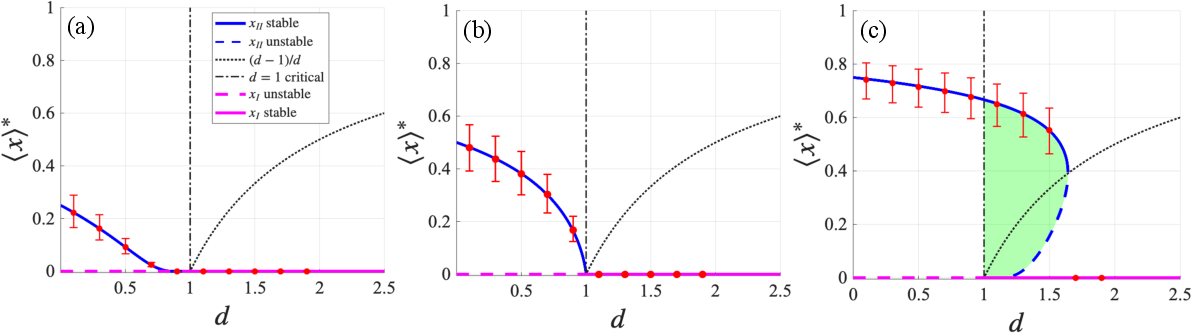
Figure 1: Bifurcation diagrams for different d6 pairs highlight extinction, threshold, and bistable regimes as predicted by the mean-field reduction.
Critical features include:
- For d7, adoption is highly sensitive, and any positive influence can trigger global adoption.
- For d8, reinforcement is essential; adoption requires exceeding a critical mass, leading to sharp transitions and multistability.
- Hysteresis allows persistent collective action even as initial promoting conditions are relaxed.
Adaptive Awareness Feedback and Coupled Dynamics
The framework is extended by coupling opinion adoption to environmental dynamics via feedback on the awareness exponent. Specifically, d9 is made a function of system state variables—such as resource abundance or disease prevalence—via periodic updates:
γ0
where γ1 is the relevant variable (e.g., γ2 for resources or γ3 for epidemic prevalence), γ4 is a feedback gain, and γ5 is an update period.
Two canonical settings are explored:
- Resource Management: Adoption influences both resource consumption and regeneration rates. Increased adoption (collective restraint) mitigates exploitation, while awareness feedback modulates the responsiveness to depletion dynamics.
- Epidemic Mitigation (SIS Model): Adoption (behavioral interventions) affects disease transmission and recovery rates. Prevalence-dependent feedback adjusts awareness, dynamically modulating the social reinforcement needed for widespread protective behaviors.
The coupled dynamics exhibit transitions among regime-locked equilibria, oscillatory behaviors near bifurcation thresholds, and history-dependent step-changes associated with periodic awareness resetting.
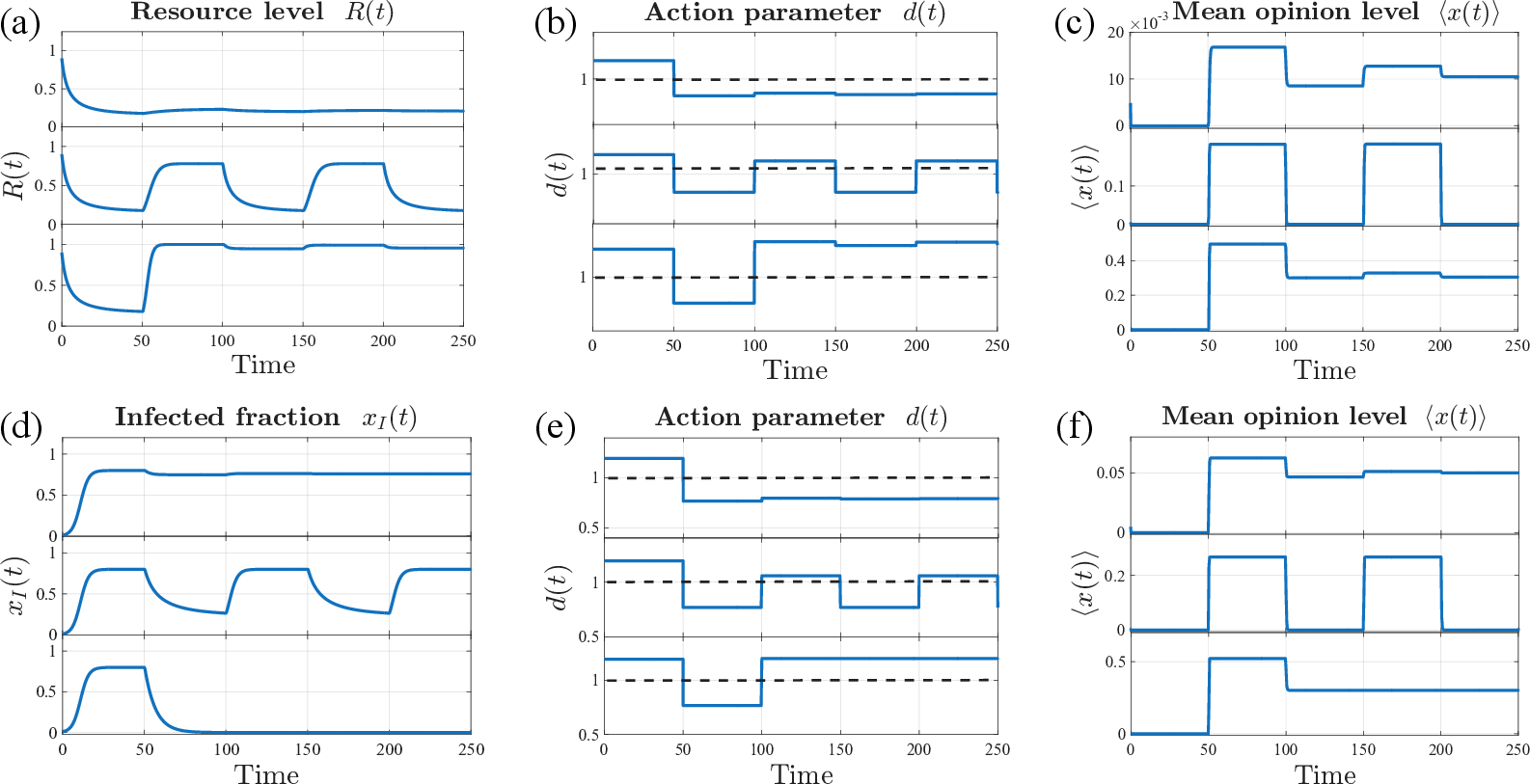
Figure 2: Coupled dynamics in resource and epidemic models, showing trajectories of system state, adaptive reinforcement parameter γ6, and mean opinion γ7 under different parameter regimes.
Key observations:
- For γ8, adoption is weak, resulting in resource exhaustion or endemic disease.
- Near γ9, oscillatory solutions arise from coupled feedback and slow recovery dynamics.
- For xi0, strong awareness-driven reinforcement sustains high adoption, enabling resource recovery or disease eradication.
Theoretical Implications and Future Directions
By introducing feedback that reshapes the adoption nonlinearity—rather than merely modulating rates—this framework uncovers new mechanisms for discontinuous transitions, multistability, and memory in collective behaviors. This generalizes conventional models where environmental feedback linearly rescales influence terms. The explicit awareness mediation deepens the understanding of how exogenous shocks (e.g., epidemics, environmental crises) can have persistent social effects even as underlying drivers retreat, illuminating the potential for path dependence and resilience.
From a practical perspective, the results imply that interventions intending to trigger or suppress collective action in social-ecological or socio-epidemiological systems should target both direct social influence and the meta-cognitive landscape that tunes group awareness. The mathematical generalizations also lay the groundwork for extensions incorporating network heterogeneities, multi-layer feedbacks, and stochastic influences—directions that could further sharpen predictive control of complex social phenomena.
Conclusion
The analysis demonstrates that adaptive awareness fundamentally conditions the emergence and persistence of collective action in networked populations by dynamically reshaping the underlying social reinforcement process. By identifying the interplay between abandonment, influence, and awareness-mediated nonlinearity as the critical driver of phase transitions, the framework extends conceptual and technical understanding of feedback-coupled opinion dynamics and collective behavior. Future work can exploit and generalize these mechanisms for improved governance and prediction in socio-environmental and public health contexts.