Tail-Likelihood Reinforcement Learning
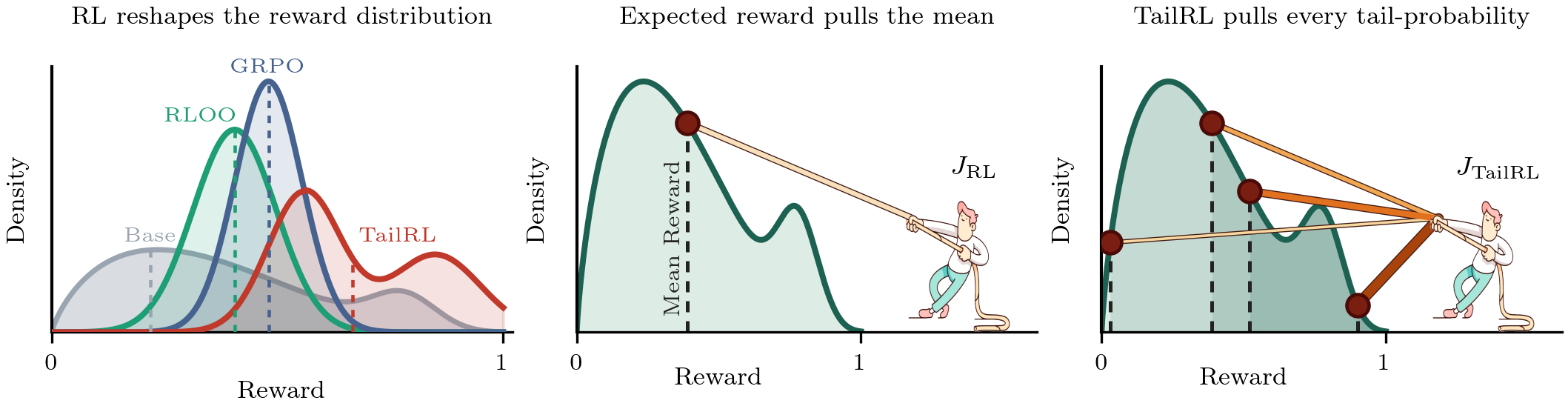
Abstract: Reinforcement learning typically optimizes average reward. For generative policies, the average can hide an important distinction: two policies can achieve the same mean reward while having very different chances of producing a rare but high-reward rollout. This matters as sampling increases during training and inference, since its benefit depends on retaining probability mass on high-reward outcomes. We propose to optimize this coverage directly. Rather than considering only expected reward, we consider all of its upper tails: for each reward threshold, how likely is the policy to exceed it? This turns a continuous reward into a family of binary success events. We introduce Tail-Likelihood Reinforcement Learning (TailRL), which maximizes the log-probability of exceeding a randomly chosen reward threshold. Its gradient gives more weight to rare, high-reward rollouts and can be interpreted as a mixture of Best-of-(k) gradients. TailRL requires only a simple modification to the advantage function, making it compatible with existing reinforcement learning pipelines. Across object localization, maze navigation, GUI grounding, and code optimization, TailRL leverages rare high-reward training samples to avoid suboptimal solutions and yields models that benefit more from additional samples at inference time.
Paper Prompts
Sign up for free to create and run prompts on this paper.
Explain it Like I'm 14
1. What is this paper about?
This paper introduces a new way to train artificial intelligence systems using reinforcement learning.
In reinforcement learning, an AI tries something, receives a score, and learns to make better choices. For example, an AI might:
- draw a box around an object in a picture,
- find its way through a maze,
- click the right button in a computer program, or
- improve a computer program.
Most reinforcement-learning methods try to improve the average score. The authors argue that this is not always enough. An AI might have a good average score but almost never produce an excellent answer.
The paper proposes a method called Tail-Likelihood Reinforcement Learning, or TailRL. Its goal is to help the AI keep producing rare but very high-quality answers.
2. What questions are the researchers asking?
The paper mainly asks:
- Can training focus more on rare, excellent answers instead of only average answers?
- Does this help when the best answers are possible but difficult to find?
- Does TailRL make an AI improve more when it is allowed to try many answers at test time?
- Can it stop the AI from settling for a common but merely “okay” solution?
- Can the method work with existing reinforcement-learning systems without requiring a completely new training process?
The key idea is that two AIs can have the same average score but behave very differently.
For example:
- AI A gets a score of 6 almost every time.
- AI B usually gets 5, but sometimes gets 10.
Both might have similar average scores. However, if we let each AI try many times and choose its best attempt, AI B is more useful because it still has a chance of producing an excellent answer.
3. How does the method work?
Average reward versus high-reward outcomes
Traditional reinforcement learning looks mostly at the average reward:
“How well does the AI do on a typical attempt?”
TailRL also asks:
“How likely is the AI to achieve a score above each possible level?”
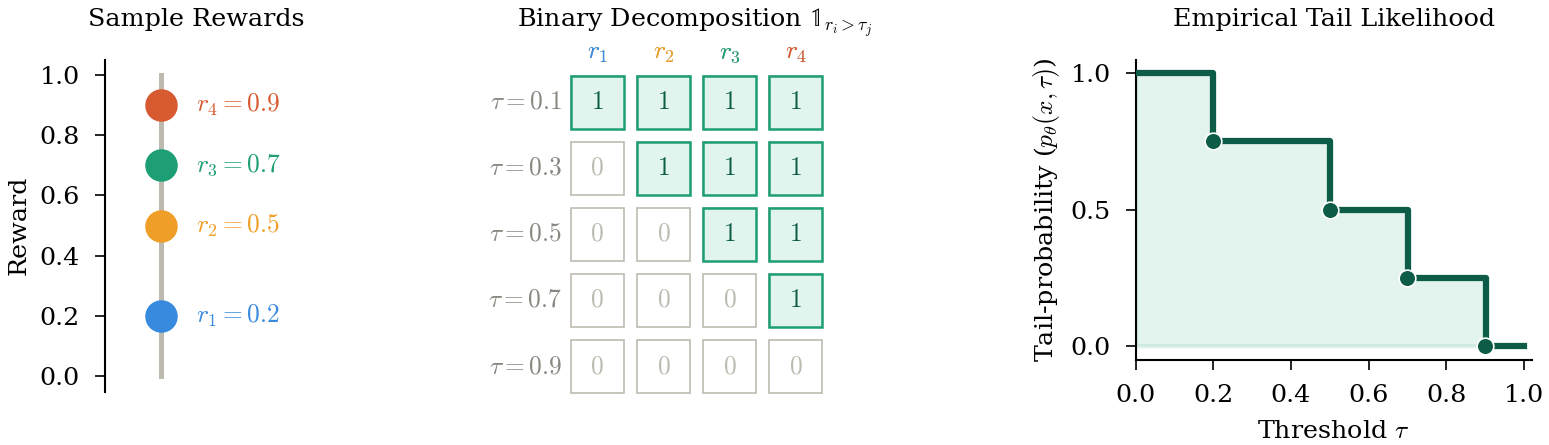
Suppose an AI receives scores between 0 and 1. The researchers consider many score thresholds:
- Is the score above 0.2?
- Is it above 0.5?
- Is it above 0.8?
- Is it above 0.95?
For each threshold, they calculate the chance that the AI will beat it. This is called a tail probability.
A tail probability is simply the chance of reaching at least a certain score. For example, if an AI gets a score above 0.9 in 2 out of every 100 attempts, then its tail probability at 0.9 is 2%.
Why use logarithms?
TailRL maximizes the log-probability of passing these thresholds rather than just maximizing the probabilities directly.
This makes rare successes especially important. If a very high score is possible but happens only rarely, TailRL gives it extra attention.
An everyday analogy is searching for treasure:
- A normal method might mostly reward finding ordinary rocks because they are common.
- TailRL gives more importance to the difficult-to-find gold, because discovering it could greatly improve the final result.
Connection to trying multiple times
The paper also studies Best-of- performance. This means the AI generates answers and keeps the best one.
For example:
- Best-of-1 means using one attempt.
- Best-of-10 means trying 10 times and choosing the best answer.
- Best-of-1,000 means trying 1,000 times and choosing the best answer.
The authors show mathematically that TailRL is related to improving Best-of- performance for many different values of . In other words, it is designed to help whether the AI gets only a few attempts or many attempts.
How is it trained?
The AI generates a group of possible answers, called rollouts. Each rollout receives a reward.
TailRL then:
- Sorts the answers by their rewards.
- Gives more credit to answers that exceed difficult, high reward thresholds.
- Uses these credits to update the AI so that similar answers become more likely in the future.
A useful analogy is grading a group of students. Instead of only rewarding the student with the highest average grade, the teacher also asks:
“Who managed to solve the hardest problems?”
Students who solve rare, difficult problems receive extra attention.
The method can be added to existing policy-gradient reinforcement-learning systems by changing how rewards are turned into advantages. An advantage is a number that tells the AI whether an action was better or worse than expected.
The paper also explains that the number of training attempts matters:
- With only one rollout, TailRL behaves like ordinary expected-reward training.
- With more rollouts, it increasingly focuses on higher and rarer rewards.
- With very many rollouts, it approaches the full TailRL objective.
4. What did the researchers find?
The paper reports experiments in several areas, including:
- object localization in images,
- maze navigation,
- graphical user-interface interaction, and
- code optimization.
The provided text gives detailed results for the image-localization experiment and summarizes results from the other tasks.
Image localization
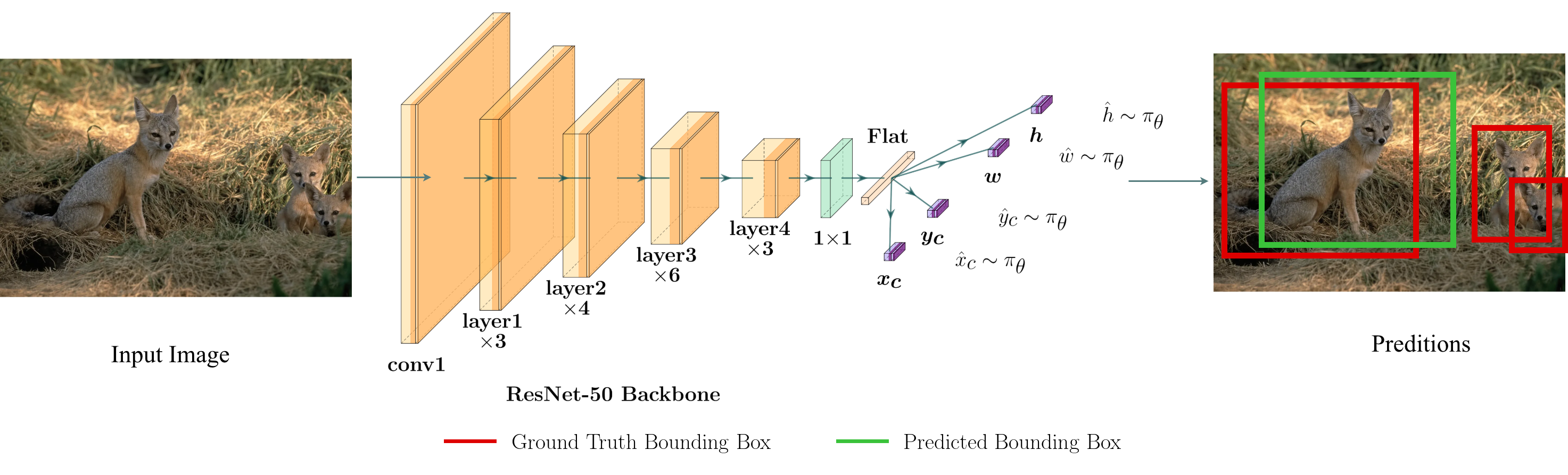
In the image task, the AI had to draw a box around an object. Its reward was based on intersection over union, or IoU. IoU measures how much the AI’s box overlaps with the correct box.
The researchers found that:
- Population-level TailRL matched or outperformed several methods that were given the exact correct box during supervised training.
- TailRL performed better than standard reinforcement-learning methods such as GRPO and RLOO in the reported comparisons.
- With only 16 training attempts, TailRL sometimes performed better than other methods using 1,024 attempts.
- As the number of rollouts increased, the finite-sample TailRL estimate became more similar to the exact TailRL objective, as predicted by the theory.
These results suggest that TailRL can use training examples more efficiently, especially when excellent answers are uncommon.
Other tasks
The paper’s abstract and summary report that TailRL also helped in other settings:
- Maze navigation: It learned successfully even when the starting policy succeeded only about 0.01% of the time.
- GUI grounding: It achieved performance similar to RLOO with far fewer inference attempts.
- Code optimization: It avoided getting stuck copying the original code and achieved a large improvement in Best-of-1024 performance.
The broad pattern is that TailRL is especially useful when:
- very good answers are possible,
- those answers are rare, and
- the AI is allowed to try several times.
5. Why are these findings important?
Standard reinforcement learning can accidentally make rare good solutions disappear. If the AI stops producing an excellent answer, it may stop learning about that answer entirely. This creates a harmful cycle:
- A very good solution is rarely sampled.
- The AI receives little training information about it.
- The solution becomes even less likely.
- The AI settles on a common but weaker solution.
TailRL tries to prevent this by giving more learning importance to rare, high-reward outcomes.
This matters for generative AI because users often care about the best useful answer, not just the average answer. If a model can generate many attempts, it is valuable for at least one of those attempts to be excellent.
6. Overall implications
The main message of the paper is:
Training an AI should not focus only on making its average answer better. It should also preserve the possibility of producing exceptional answers.
TailRL offers a way to do this without completely replacing existing reinforcement-learning systems. It changes how the training algorithm values different rewards, giving extra attention to difficult and unusually good outcomes.
If the results hold across more tasks, this approach could make AI systems better at:
- reasoning,
- solving difficult problems,
- writing or improving code,
- navigating complicated environments, and
- taking advantage of extra computation by trying many possible answers.
However, the method may require several rollouts during training, and the paper’s strongest benefits are expected when high-quality solutions are rare but still reachable. Further research would be needed to understand its computational cost, its behavior on more tasks, and how well it works when rewards are noisy or poorly designed.
Practical Applications
Immediate Applications
- Large-language-model post-training for reasoning and code generation — Software/AI
- Replace the standard group advantage calculation in GRPO-, RLOO-, or REINFORCE-style pipelines with TailRL’s rank- and reward-based weighting.
- This is actionable for tasks with verifiable or scalar rewards, such as:
- mathematical problem solving,
- code generation and optimization,
- program repair,
- GUI action generation,
- structured data transformation,
- tool-use planning.
- The practical benefit is preserving probability mass on rare, high-quality solutions rather than concentrating the model on common but mediocre outputs.
- A resulting product could be a TailRL post-training module that accepts existing rollout batches, sorts rewards, computes the recurrence-based weights, centers the advantages, and sends them to an existing policy-optimization implementation.
- Dependencies: rewards must be reasonably reliable and comparable within a task; training must generate multiple independent rollouts per prompt; the model and optimizer must tolerate higher-variance emphasis on rare outcomes.
- Inference-time scaling and Best-of- deployment — Software/AI
- Use TailRL-trained models in systems that draw multiple candidate responses and select the best one using a verifier, evaluator, compiler, simulator, or reward model.
- Suitable workflows include:
- sample-and-rank coding assistants,
- theorem-proving systems,
- mathematical reasoning engines,
- automated UI agents,
- content-generation systems with quality filters.
- Because the objective is theoretically related to a harmonic mixture of Best-of- objectives, TailRL is useful when the deployment sampling budget may vary—for example, from in an interactive setting to in batch processing.
- Dependencies: deployment needs a trustworthy selection function and enough inference compute to sample multiple candidates. TailRL does not eliminate the cost of evaluating or ranking those candidates.
- Code optimization and program synthesis — Software engineering
- Train models to retain rare transformations that produce large performance or correctness gains, instead of collapsing onto a safe strategy such as copying the input.
- A practical pipeline can sample several candidate patches or optimized programs, execute them against tests and benchmarks, compute a continuous reward from correctness, runtime, memory, or code quality, and apply TailRL weighting.
- Potential tools include:
- compiler-optimization agents,
- automated refactoring systems,
- program-repair services,
- benchmark-driven code-generation assistants.
- Dependencies: execution-based rewards must be deterministic or controlled for noise; benchmark coverage must prevent reward hacking; sandboxing is required for untrusted generated code.
- GUI agents and browser automation — Software/productivity
- Apply TailRL to agents that generate action sequences for websites, desktop applications, or mobile interfaces.
- Rewards can combine task completion, partial progress, number of steps, recovery from errors, and safety constraints. TailRL can preserve rare trajectories that successfully complete difficult tasks.
- A deployable workflow is: generate action traces, execute them in isolated environments, score completion, compute TailRL advantages, and update the policy.
- At deployment, multiple traces can be sampled and selected by a task verifier.
- Dependencies: the environment must be resettable or simulatable; action execution can be expensive; UI changes and reward-model errors may reduce transfer to real applications.
- Object localization and other vision policies — Computer vision
- Train visual policies using a scalar geometric reward such as intersection-over-union (IoU), without requiring every training example to expose a fully supervised target.
- Similar uses may include:
- object detection box refinement,
- visual tracking,
- keypoint placement,
- image segmentation proposal selection,
- camera-view or region selection.
- The paper’s localization results suggest that a carefully designed continuous reward can compete with direct coordinate supervision, particularly when high-quality predictions are rare.
- Dependencies: the reward must provide meaningful partial credit; exact population-level TailRL is practical mainly when the action space is enumerable or the reward distribution can be estimated accurately.
- Robotics and navigation policy learning — Robotics
- Use TailRL for trajectory policies in maze navigation, manipulation, and mobile robotics where successful trajectories are rare but partial progress can be scored continuously.
- Example rewards include distance-to-goal, collision avoidance, completion, energy use, grasp quality, or trajectory smoothness.
- TailRL is especially relevant during early training when the success probability is extremely low and expected-reward optimization may fail to rediscover rare successful trajectories.
- Dependencies: independent rollouts require simulation, parallel robots, or reliable resets; safety constraints should be enforced outside the learned reward; sim-to-real transfer must be validated.
- Research benchmarking and diagnostics — Academia
- Evaluate RL and generative policies using more than mean reward. Report:
- Best-of- performance,
- reward-quantile coverage,
- success probabilities at multiple thresholds,
- performance as inference compute increases,
- retention of rare high-quality trajectories.
- This can reveal cases in which two policies have similar average reward but substantially different potential under additional sampling.
- A practical benchmark extension would provide reward-survival curves and Best-of- curves alongside conventional averages.
- Dependencies: comparisons require consistent reward definitions, fixed sampling protocols, and sufficient evaluation rollouts to estimate upper-tail behavior reliably.
- Adaptive allocation of training and inference compute — Industry/operations
- Use the empirical rollout budget as a controllable way to move between ordinary expected-reward learning and stronger tail-focused learning.
- Organizations can use smaller for inexpensive routine tasks and larger for difficult prompts where rare high-reward outcomes are valuable.
- This supports tiered workflows such as:
- low-latency single-sample responses,
- moderate-budget Best-of- responses,
- high-budget search for high-stakes tasks.
- Dependencies: larger rollout groups increase computational and evaluation costs; the best budget may vary by task difficulty and reward sparsity.
- Decision support and daily-life assistants — Consumer applications
- TailRL-trained assistants could generate several plans or recommendations and retain unusual but high-quality options—for example:
- travel itineraries,
- study plans,
- household scheduling,
- meal planning under constraints,
- troubleshooting procedures.
- The system should present candidates and evidence rather than automatically selecting a rare option when the reward model is uncertain.
- Dependencies: subjective or poorly specified rewards can cause undesirable optimization; user preferences and safety constraints need explicit modeling.
Long-Term Applications
- High-reliability healthcare decision support — Healthcare
- Train systems to preserve rare action sequences or recommendations that achieve exceptionally good outcomes in simulation or retrospective evaluation, such as treatment planning, clinical workflow selection, or medical-image localization.
- A possible workflow would combine a generative policy, a calibrated clinical outcome model, safety constraints, and TailRL post-training over simulated or carefully reviewed trajectories.
- Tail-focused optimization could be useful when average performance hides a small but clinically important set of highly successful plans.
- Dependencies: clinical rewards are delayed, confounded, noisy, and ethically constrained. Deployment would require prospective trials, clinician oversight, calibration, distribution-shift testing, and safeguards against optimizing an imperfect proxy.
- Autonomous driving and long-horizon planning — Robotics/transportation
- Apply TailRL to planning policies that generate multiple trajectories and retain rare trajectories with strong safety, comfort, and efficiency scores.
- Potential products include:
- trajectory-generation modules,
- scenario-based planning systems,
- simulation-trained driving policies,
- rare-event recovery planners.
- TailRL may help preserve successful behavior in unusual traffic or weather conditions that ordinary average-reward training under-samples.
- Dependencies: tail rewards must prioritize safety rather than merely efficiency; rare-event simulation must be representative; formal validation, redundancy, and fail-safe control remain necessary.
- Energy-system control and grid optimization — Energy
- Train policies for battery dispatch, demand response, microgrid operation, or renewable-energy scheduling using rewards that combine cost, reliability, emissions, and resilience.
- TailRL could emphasize rare operating trajectories that maintain service during demand spikes, generation failures, or extreme weather.
- A future product could be a tail-aware model-predictive controller that samples candidate schedules and selects the best verified plan.
- Dependencies: physical constraints, nonstationary demand, delayed rewards, and uncertain forecasts complicate reward estimation. Deployment requires robust optimization and guarantees against unsafe high-reward artifacts.
- Finance and risk-sensitive decision systems — Finance
- Use TailRL to train generative policies for portfolio construction, execution scheduling, or market-making simulations where rare high-quality strategies may otherwise be discarded.
- The method could also be used to optimize coverage of favorable but plausible scenarios rather than only average simulated return.
- Dependencies: historical rewards are nonstationary and subject to selection bias; optimizing the upper tail can increase exposure to overfitting, leverage, or catastrophic downside. Any financial implementation would require explicit risk constraints, stress testing, and conservative out-of-distribution evaluation.
- Scientific discovery and engineering design — Academia/industry
- Apply TailRL to generative design of molecules, materials, circuits, mechanical components, or experimental protocols when a small number of candidates may achieve exceptional objective values.
- Candidate designs could receive continuous rewards from simulators or surrogate models, and TailRL could preserve rare high-scoring structures during optimization.
- At inference time, Best-of- generation could produce a larger set of designs for laboratory or engineering validation.
- Dependencies: simulator bias and reward hacking are major risks; generated candidates require physical experiments, manufacturability checks, intellectual-property review, and uncertainty estimates.
- General-purpose verifier-guided generative models — AI infrastructure
- Develop a reusable training framework in which any scalar verifier—compiler, theorem checker, simulator, safety evaluator, or human preference model—can provide the reward for TailRL.
- This could yield model families explicitly optimized for scalable inference: increasing sampling compute would produce predictable quality gains rather than diminishing returns caused by loss of high-quality modes.
- Dependencies: the theoretical objective assumes meaningful independent samples and a sufficiently stable reward distribution. Correlated sampling, reward-model drift, threshold regions with almost zero probability, and finite-batch bias may require regularization or alternative threshold weighting.
- Tail-aware policy evaluation and regulation — Policy
- Establish reporting standards for AI systems that distinguish mean performance from attainable high-end performance under additional compute.
- Regulators or procurement bodies could require:
- Best-of- curves at standardized budgets,
- upper-tail reliability metrics,
- reward-threshold coverage,
- audits for collapse of rare successful behaviors,
- documentation of sampling and selection procedures.
- This is particularly relevant for systems used in healthcare, transportation, public services, and education.
- Dependencies: metrics must be resistant to gaming and must not reward unsafe rare outcomes. Standardized reward definitions and independent evaluation infrastructure would be needed.
- Personalized education and tutoring — Education
- Train tutoring agents to retain rare instructional strategies that lead to unusually strong student understanding, rather than optimizing only average short-term response ratings.
- Rewards could combine learning gains, misconception correction, engagement, and long-term retention.
- A future system could generate multiple explanations or lesson plans and select among them based on learner-specific evaluation.
- Dependencies: educational outcomes are delayed and difficult to measure; excessive exploration may confuse learners; human teachers, privacy protections, and longitudinal validation are essential.
Glossary
- Advantage function: A quantity assigning credit to an action or rollout based on how much better it performs than a baseline. “TailRL requires only a simple modification to the advantage function”
- Bernoulli distribution: A probability distribution over two outcomes, typically success and failure. “The reward distribution is therefore a Bernoulli distribution over success and failures.”
- Best-of-: The expected maximum reward obtained from independently sampled rollouts. “Best-of- depends strongly on the upper part of the reward distribution.”
- Categorical policy: A policy that assigns probabilities to a finite set of discrete choices. “a bounding box drawn from the categorical policy”
- Centering: Subtracting the average value of a group of estimates to reduce variance while preserving useful relative differences. “In practice, we center the rollout weights within each group”
- Critic-free policy gradient: A policy-gradient method that estimates policy updates without learning a separate value-function critic. “TailRL admits a simple critic-free policy-gradient estimator”
- Cosine similarity: A measure of directional agreement between two vectors, computed from the cosine of the angle between them. “the cosine similarity between the sampled finite rollout gradient and the population-level gradient rises steadily”
- Critic-free rollout: A sampled trajectory used for policy optimization without a learned critic providing value estimates. “critic-free rollout based policy gradient methods draw independent rollouts”
- Expected maximum reward: The average of the highest reward among multiple independently sampled outcomes. “expected maximum reward among (Best-of-) when rewards are continuous”
- Expected-reward objective: An optimization objective that maximizes the average reward generated by a policy. “standard RL training can progressively lose coverage over rare, high-reward rollouts”
- Finite-order objective: A truncated objective that combines only the first finite number of terms in an otherwise infinite decomposition. “define an order ”
- Finite-rollout estimator: An estimator of a population-level policy gradient based on a finite group of sampled rollouts. “We show that a rollout budget of naturally defines an order- truncation of the TailRL objective”
- Generative model: A model that produces samples from a learned or specified probability distribution. “the policy is a generative model over rewards”
- Gradient estimator: A computable approximation to a gradient, often based on random samples. “an unbiased policy-gradient estimator”
- GRPO: Group Relative Policy Optimization, a group-based reinforcement-learning algorithm that estimates policy updates from sampled rollouts. “We compare TailRL with GRPO”
- Harmonic mixture: A weighted combination whose coefficients are reciprocals of positive integers, such as $1/k$. “Its gradient decomposes into a harmonic mixture of Pass@ gradients”
- Inference-time scaling: Improving performance by allocating additional computation or samples during inference. “This distinction matters whenever additional samples can be drawn, both during training and at inference time.”
- Intersection-over-union (IoU): The ratio of the intersection area to the union area of two regions, commonly used to evaluate bounding-box overlap. “the continuous reward is its intersection-over-union (IoU) with the ground-truth box”
- Likelihood objective: An objective that optimizes the probability, or log-probability, assigned to observed or desired events. “A likelihood objective for continuous rewards.”
- Marginal value: The incremental change in an objective resulting from increasing the probability of a particular event or outcome. “It is the marginal value that the objective assigns to making that level more likely.”
- MaxRL: A reinforcement-learning objective that maximizes the log-probability of success rather than its raw probability. “MaxRL maximizes $J_{\mathrm{MaxRL}(\theta;x) = \log q_\theta(x)$”
- On-policy policy gradient: A policy-gradient method that estimates updates using trajectories sampled from the current policy. “under pure on-policy policy gradient setup”
- Order statistic: A value determined by the sorted position of a sample within a collection. “Let denote the sorted rewards”
- Pass@: The probability that at least one successful outcome occurs among independently sampled rollouts. “performance is measured by probability of at-least one success (Pass@)”
- Pareto dominates: Performs at least as well on every measured criterion and strictly better on at least one. “TailRL also pareto dominates PKPO”
- Policy gradient: The gradient of an expected objective with respect to the parameters of a stochastic policy. “Thus, the policy gradient is a weighted combination of the score-function”
- Population-level objective: An objective defined using the full underlying distribution rather than a finite sample. “We call \cref{eq:tailrl-objective} the population-level TailRL objective.”
- Riemann sum: A finite sum that approximates a definite integral by evaluating a function over partitioned intervals. “The right-hand side of \cref{eq:tailrl-audit-rate} is therefore a Riemann sum over the reward range.”
- RLOO: Leave-One-Out policy optimization, a group-based reinforcement-learning method that uses other samples in a group to construct comparative estimates. “We compare TailRL with GRPO, RLOO”
- Rollout: A complete sampled execution, response, program, or trajectory produced by a policy. “A rollout may be a generated response, program, or trajectory.”
- Score-function identity: An identity expressing the gradient of an expectation as an expectation involving the gradient of a log-probability. “the score-function identity gives its policy gradient as follows”
- Tail probability: The probability that a random reward exceeds a specified threshold. “define the tail probability at threshold ”
- TailRL: Tail-Likelihood Reinforcement Learning, which maximizes the log-probability of exceeding reward thresholds across the reward range. “We propose to optimize this coverage directly.”
- Threshold reparameterization: Transforming reward thresholds through a monotonic change of the reward scale while preserving their ordering. “Any strictly positive normalized weighting is exactly equivalent to applying TailRL after a monotone transformation of the rewards”
- Truncation: Restricting an infinite series or objective to a finite number of terms. “a rollout budget of naturally defines an order- truncation”
- Unbiased estimator: An estimator whose expected value equals the quantity being estimated. “The resulting policy-gradient estimator has the standard score-function form”
- Upper tail: The high-value portion of a probability distribution. “TailRL explicitly optimizes upper-tail probabilities across reward levels.”
- Variance reduction: A technique for making a statistical estimator less variable across samples. “Centering reduces variance”
- Weighted combination: A sum of components in which each component is multiplied by a possibly different coefficient. “the policy gradient is a weighted combination of the score-function”

