SkillGLoW: Procedural-Family Skill Consolidation for Self-Improving Agents on Long-Horizon Task Streams
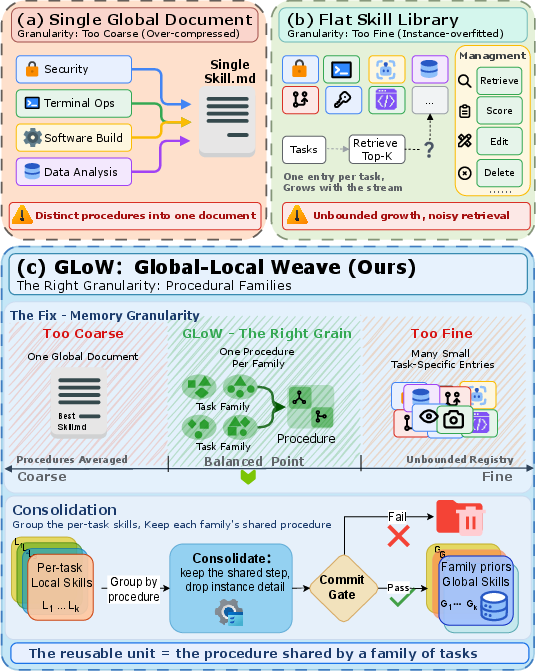
Abstract: LLM agents increasingly self-improve by writing and reusing textual skills, kept either as one global document or as a flat pool of per-task entries, though most of the evidence comes from domains with structurally similar tasks. On long-horizon workloads where each task demands a different solution, the two forms fail in opposite ways: the document collapses into generic discipline, while the pool inflates and its entries stay bound to the instance that wrote them. We argue the missing unit of reuse is the solving procedure shared by a cluster of related tasks, and build SkillGLoW (Global-Local Weave) around it: the local skills a task writes from its own execution are aggregated into procedural families and compressed into de-instantiated global priors, while the instance detail they hold is regenerated per task rather than stored; a commit gate admits a prior only when real execution shows it does not degrade the deployed library. Across four benchmarks (mathematical reasoning, terminal automation, software repair, and embodied control) and three models, the priors gain 17.2 points (hard) over the no-skill baseline on average, with positive gains in all 12 continual-improvement runs, and 18.0 with local regeneration, while the library holds one prior per procedural family, 3.6x more compact than the per-task pool. Under the same protocol GLoW leads a published single-document optimizer on 15 of 21 cells. Unmodified, the library lifts success on unseen ALFWorld tasks from 73.9% to 83.9%, evidence that what transfers is procedure rather than task memory.
Paper Prompts
Sign up for free to create and run prompts on this paper.
Top Community Prompts
Explain it Like I'm 14
1. What is the paper about?
This paper presents SkillGLoW, a system designed to help AI agents get better at solving many difficult tasks over time.
An AI agent might solve tasks such as:
- Fixing computer code
- Using a command-line terminal
- Solving mathematics problems
- Completing tasks in a virtual world
After solving a task, the agent can write down a “skill” or lesson to use later. The paper asks an important question:
What is the best way for an AI agent to organize the lessons it learns?
The researchers argue that two common methods do not work well:
- Keeping one giant document containing every lesson
- Keeping a separate memory for every task
SkillGLoW uses a middle option. It groups similar tasks into procedural families—groups of tasks that can be solved in similar ways.
2. What questions did the researchers investigate?
The paper focuses on several main questions:
- Can an AI learn useful procedures from its own past attempts?
- Is it better to organize knowledge by the method used to solve a task rather than by the task itself?
- Can the AI keep only the general parts of a lesson and leave out details that apply to just one situation?
- Can this approach improve performance on new tasks?
- Can the AI avoid filling its memory with too many old, unnecessary entries?
- How can the system prevent a bad new lesson from damaging its existing knowledge?
The central idea is that different tasks may have different details but still share the same basic strategy. For example, several tasks may involve finding an object, moving it, and using it, even if the objects and locations are different.
3. How did the researchers conduct the study?
The basic idea of SkillGLoW
SkillGLoW has two kinds of knowledge:
- Global knowledge: A general procedure shared by a family of tasks
- Local knowledge: Details learned while solving the current task
An everyday analogy is cooking:
- A global skill might say, “To make soup, prepare the ingredients, cook them in the correct order, and check the taste.”
- Local knowledge might say, “For this soup, use carrots instead of potatoes and cook for ten minutes longer.”
The general recipe can be reused, but the details must be adjusted for each particular meal.
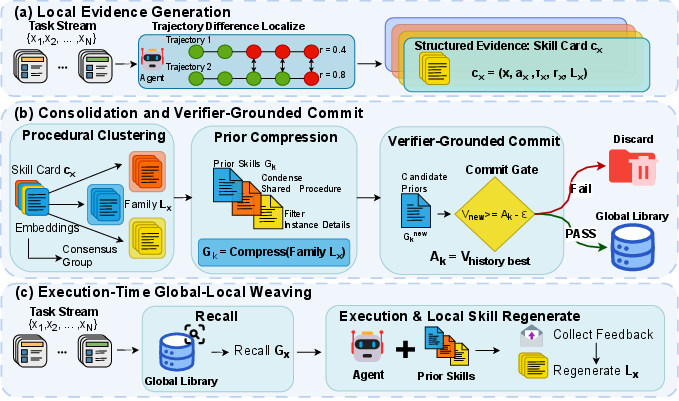
Step 1: Learn from real attempts
The AI first tries to solve a task. It records:
- What actions it took
- What changed between attempts
- Whether the attempt succeeded
- Which parts of its strategy seemed helpful
The success score comes from a verifier. A verifier is like a teacher or automatic checker that decides whether the task was completed correctly.
Step 2: Create a local skill
The AI writes a temporary lesson based on feedback from the current task. This is called a local skill.
This local skill is not saved permanently because it may contain details that only make sense for that one task.
Step 3: Group similar procedures
The researchers group task experiences according to how the tasks were solved, not simply according to their topics.
For example, two tasks about completely different objects might be placed in the same group if both require:
- Inspecting the surroundings
- Finding the correct object
- Carrying it somewhere
- Using it in a final action
This grouping process is called clustering. In everyday language, it means sorting similar examples into piles.
Step 4: Compress each group into a general prior
For every group, SkillGLoW creates a shorter, more general lesson called a global prior.
The prior keeps:
- When the procedure should be used
- The main steps of the procedure
- Common mistakes to avoid
It removes details that only belong to one task, such as the exact name or location of an object.
Step 5: Test before saving
SkillGLoW does not automatically save every new lesson. It tests the candidate lesson on real tasks first.
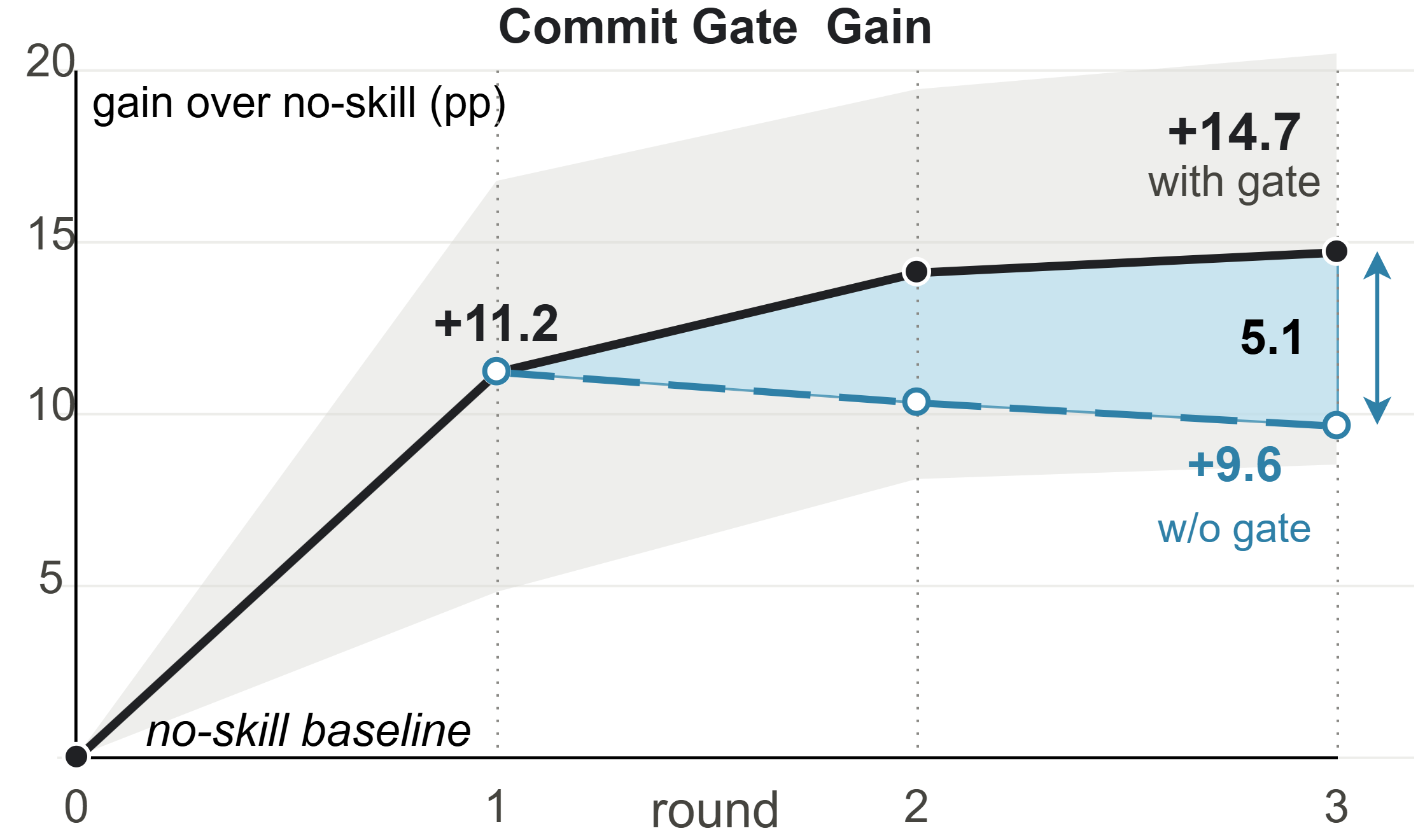
A new lesson is saved only if it performs at least as well as the existing library. This safety check is called a commit gate.
The commit gate is similar to testing a software update before installing it everywhere. If the update causes problems, it is rejected.
The experiments
The researchers tested SkillGLoW using:
- Four types of tasks: mathematics, terminal use, software repair, and virtual-world control
- Three different LLMs
- Twelve continual-improvement runs
They compared SkillGLoW with:
- No stored skills
- One large combined document
- A collection of separate task memories
- A searchable pool of individual memories
- A published method called SkillOpt
4. What did the researchers discover?
SkillGLoW improved task performance
Compared with using no skills at all, SkillGLoW’s general global procedures improved the success score by an average of:
- 17.2 percentage points on the main “hard” measure
- 13.0 percentage points on the softer partial-credit measure
When the system also regenerated local details for each task, the improvement rose to:
- 18.0 percentage points on the hard measure
- 14.6 percentage points on the soft measure
Importantly, the system improved in all 12 continual-improvement runs.
It worked especially well on difficult, different tasks
The method was particularly useful for tasks where each problem required a different solution, such as software repair and terminal tasks.
This is important because a single general document often becomes too vague to help. A collection of separate memories can also become too large and too tied to the original task.
SkillGLoW tries to keep the shared strategy while removing unnecessary details.
Its library was smaller
The SkillGLoW library was about 3.6 times more compact than a library containing one entry per task.
This means the AI could remember useful procedures without storing a separate long memory for everything it had ever done.
It transferred to new tasks
The researchers tested the learned procedures on unseen tasks in the ALFWorld benchmark.
The average success rate increased from:
- 73.9% without the learned library
- 83.9% with SkillGLoW’s global procedures
The learned knowledge also helped on unseen software-repair tasks, where performance increased from 40.0% to 45.6% in one reported experiment.
This suggests that the system learned general ways of solving problems rather than simply memorizing old answers.
It was better than one-document optimization in many cases
SkillGLoW performed better than SkillOpt in 15 out of 21 comparisons. However, SkillOpt performed better on some ALFWorld tasks.
This makes sense because ALFWorld tasks often share one broad action system, so one large general document can work reasonably well there.
The safety gate prevented harmful updates
The researchers report that the commit gate rejected 7 out of 26 possible library updates.
This matters because a newly created summary may accidentally remove an important rule or make a procedure too general. Testing the summary before saving it helped protect the existing library.
5. Why are these results important?
The paper suggests that the best memory unit for an AI agent is not always:
- One giant document
- One memory per task
Instead, the useful unit may be a shared procedure used by a family of related tasks.
This is similar to how people learn. A person does not usually memorize every individual math problem they have seen. Instead, they learn methods such as:
- How to factor an equation
- How to debug a program
- How to search for information
- How to organize a complicated project
The person then adjusts the method to fit each new situation.
SkillGLoW tries to give AI agents this same ability:
- Save the general method
- Recreate the specific details when needed
- Test new lessons before trusting them
Conclusion: What could this research lead to?
If the results hold up in future studies, SkillGLoW could help create AI agents that improve safely over long periods of time.
Such agents might become better at:
- Using computer tools
- Repairing software
- Managing long projects
- Operating robots
- Solving new problems that resemble earlier ones
The main potential benefit is that the agent could build a compact library of useful procedures instead of collecting a messy pile of memories.
However, the research also has limits. The experiments mainly tested new tasks that were related to the original task categories. It is still uncertain whether the learned procedures would work well in completely different areas. The researchers also did not test whether one model’s skill library could be successfully given to another model.
Overall, the paper’s main message is simple:
AI agents may improve most effectively when they remember reusable ways of solving problems, not the exact details of every problem they have seen.
Knowledge Gaps
Knowledge gaps, limitations, and open questions
- Generalization beyond related task categories remains untested. Transfer is demonstrated mainly across unseen instances within recurring ALFWorld categories and, to a lesser extent, unseen software-repair instances; genuine cross-domain transfer is explicitly left unresolved.
- Cross-model portability is unknown. The paper does not test whether a library consolidated by one base model remains useful, interpretable, or safe when deployed with another model.
- The evidence base is small for continual learning claims. Results rely on 12 runs across four benchmarks, with relatively short streams of 20–53 tasks, so long-term behavior under substantially larger and more diverse task streams is unknown.
- Statistical reliability is limited by the experimental design. Most benchmark–model–method cells appear to come from a single run and fixed task order; apart from held-out software-repair results, there is little evidence across independent seeds, task permutations, or repeated environments.
- The effect of task ordering is unresolved. Because continual consolidation operates over sequential rounds, different arrangements of easy, hard, related, and unrelated tasks could produce different families, priors, admission decisions, and final performance.
- The claimed procedural families are not independently validated. The study compares its clusters with ALFWorld’s human-defined classes and provides qualitative examples, but it does not establish that automatically inferred families correspond reliably to human-identified procedures across all benchmarks.
- Clustering is sensitive to manually fixed design choices. The method depends on view weights, embedding choices, linkage rules, consensus construction, and Kneedle-based cluster selection, but the paper does not provide systematic sensitivity analyses or show how performance changes under alternative settings.
- The fixed recall threshold may not be optimal across domains or models. A cosine threshold of
0.45is shared across benchmarks, yet the paper does not evaluate calibration, threshold tuning, false-positive retrieval, or whether adaptive thresholds improve transfer and reduce negative interference. - The top-1 retrieval assumption is unexplored. The system recalls at most one family prior; it is unknown whether multiple compatible priors, hierarchical retrieval, or compositional retrieval would improve tasks requiring several procedures.
- Family membership is static during an execution episode. Recall occurs before task execution and is not updated as new evidence emerges, leaving open whether online family reassignment or dynamic prior selection would help on ambiguous or multi-stage tasks.
- The local regeneration procedure is underspecified and insufficiently ablated. Local skills are generated by the same frozen model from trajectory differences and verifier scores, but the paper does not isolate the effects of trajectory length, number of adaptation iterations, prompt design, or local-skill verbosity.
- The computational and interaction cost of local regeneration is not fully quantified. The method may require multiple executions per task, repeated verifier calls, clustering, compression, and gate evaluation, but the paper reports compactness mainly in terms of library size rather than token, latency, API, GPU, or environment-interaction costs.
- The gate’s evaluation data may not reflect future deployment. Admission uses measured performance on a task set that also supplies the consolidation evidence, creating possible overfitting to the current stream; the paper does not establish how well gate decisions predict performance on future, shifted, or adversarial tasks.
- The gate’s statistical safeguards are unclear. The fixed tolerance
ε = 0.02and anchor construction are not justified through confidence intervals, repeated evaluations, or formal control of false admissions and false rejections. - The revision gate operates at library level rather than family level. A globally better revision may preserve a harmful prior or reject useful changes because of aggregate performance; the paper does not compare this design with per-family gates or multi-objective admission policies.
- Negative transfer and regressions remain significant. The analysis reports cases in which priors break previously solved tasks, including a regression within ALFWorld and a problematic heterogeneous terminal-task family, but does not characterize the frequency, causes, or mitigation of such failures in depth.
- The safety of de-instantiation is not established. Compression is intended to remove instance-specific details, yet the paper does not measure privacy leakage, accidental memorization, unsafe generalization, or the retention of repository- or task-specific information in priors.
- The relationship between compression ratio and utility is incomplete. The reported
3.6×compactness compares library entry counts or pool sizes, but does not fully account for prior length, duplicated text, metadata, trajectory storage, clustering artifacts, or the runtime context budget. - The comparison with prior methods is not fully controlled. SkillOpt is evaluated through its published implementation with internal hyperparameters unchanged, while several alternative organizations are implemented within GLoW’s framework; differences in optimization budgets, prompts, verification procedures, and retrieval mechanisms may confound organizational comparisons.
- The baseline set omits broader adaptive-memory and retrieval strategies. The study does not systematically compare against learned retrievers, graph-structured memories, external vector databases, exemplar-plus-summary hybrids, or methods that jointly optimize retrieval and skill content.
- The frozen base-agent assumption limits applicability. GLoW changes only textual context and does not study agents that fine-tune, update policies, learn tools, or modify their execution strategies; interactions between skill consolidation and parameter learning remain unknown.
- The verifier assumption may not hold in open-ended environments. The framework treats verifier scores as the only trustworthy measure of progress, but many real-world tasks lack reliable, dense, or non-gameable verifiers; performance under noisy, delayed, incomplete, or adversarial feedback is not evaluated.
- Soft verifier scores may distort optimization. The paper uses benchmark-specific partial-credit signals, including a multiplicative software-repair score, but does not test whether conclusions persist under alternative reward definitions or whether the gate can exploit proxy metrics.
- The method’s dependence on high-quality language compression is not isolated. It remains unclear whether gains arise from procedural-family organization itself or from the specific compression model, prompts, and textual format used to produce priors.
- Prior conflicts and compositionality are not studied. The paper does not examine what happens when two family priors recommend incompatible actions, when a task belongs to multiple procedural families, or when a generic prior conflicts with local feedback.
- The persistence and stability of priors over many rounds are unknown. Although the gate rejects some harmful updates, the paper does not evaluate semantic drift, oscillation between prior versions, accumulation of append-only repairs, or eventual library saturation.
- The choice to regenerate rather than store local details has unresolved trade-offs. Regeneration may improve de-instantiation but can repeatedly incur adaptation cost and may fail when a task’s necessary detail is not recoverable from current feedback; the paper does not compare this policy with selective storage of verified instance-specific facts.
- The unseen-task transfer evaluation is narrow. Transfer is tested on 60 ALFWorld tasks and 30 software-repair instances, but not on unseen procedural families, out-of-distribution task formats, different tool interfaces, or adversarially selected tasks.
- The reported improvements may partly reflect benchmark-specific regularities. The strongest transfer results occur where task categories recur, and the paper does not disentangle reusable procedural knowledge from exploitation of dataset conventions, action spaces, or benchmark artifacts.
- Human oversight and interpretability are not evaluated. Although priors are textual and potentially inspectable, the paper does not assess whether researchers can correctly identify their scope, detect harmful generalizations, or efficiently edit erroneous families.
- The method’s behavior with ambiguous or underspecified tasks is unknown. The recall mechanism uses task-instruction similarity, but the paper does not examine ambiguous instructions, incomplete observations, paraphrases, or tasks whose wording is semantically similar while requiring different procedures.
- Scalability to large libraries and many procedural families remains open. Experiments involve relatively small libraries; latency, memory use, retrieval degradation, and clustering quality when thousands or millions of priors accumulate are not established.
- The optimal granularity of a procedural family is not theoretically characterized. The paper motivates an intermediate unit between global documents and individual tasks, but does not provide formal criteria for determining when a family should be split, merged, or represented hierarchically.
- The causal contribution of each information source is incomplete. Clustering uses task instructions, signatures, local skills, and trajectories with fixed weights, but the experiments do not separately determine which views provide the substantive gains or whether trajectory information is necessary.
- Robustness to noisy or incorrect local skills is not tested. Since local evidence is generated by the agent itself, systematic reasoning errors, hallucinated lessons, or failed trajectories could be consolidated into priors; resilience to such contamination remains unresolved.
Practical Applications
Immediate Applications
- Software engineering: reusable repair and debugging playbooks
- Deploy SkillGLoW as a memory layer for coding agents used in issue triage, repository navigation, test-driven repair, dependency updates, and debugging.
- The system could cluster successful repair trajectories by procedure—such as reproducing a failure, tracing a call path, updating a migration, or repairing a configuration—rather than by repository or issue wording.
- A production workflow would retain a compact prior containing applicability conditions, repair steps, and known failure modes, while regenerating repository-specific details during each task.
- This is supported by the paper’s software-repair results, where global priors improved performance substantially and lifted an unseen-instance resolve rate from 40.0% to 45.6%.
- Dependencies: reliable test suites or other execution verifiers are essential; unsafe commits must be prevented through sandboxing, regression tests, and human approval for high-impact changes.
- Terminal and DevOps automation
- Integrate procedural-family priors into agents that manage shell environments, diagnose deployment failures, inspect logs, recover services, perform data migrations, or automate routine system administration.
- A terminal agent could learn reusable procedures such as byte-level inspection, log-based diagnosis, permission recovery, or rollback handling while regenerating host-, service-, and incident-specific commands locally.
- The compact family-based library is particularly useful for organizations with many heterogeneous infrastructure incidents, where storing one complete memory per incident would create a large and stale knowledge base.
- Dependencies: command execution must occur in isolated environments; verifier design must measure not only task completion but also system safety, data integrity, and absence of regressions.
- Embodied robotics and household assistants
- Apply the global–local architecture to robots performing manipulation, navigation, inspection, or household tasks.
- A robot could maintain priors for procedural families such as “find and transport an object,” “clean before placing,” “heat then place,” or “examine an object under a light,” while reconstructing the precise object locations and scene constraints from current visual feedback.
- The ALFWorld transfer results—an increase from 73.9% to 83.9% on average unseen tasks—suggest that the method can transfer procedures without simply memorizing object identities or locations.
- Potential products: warehouse picking assistants, laboratory automation systems, elder-care support robots, and simulation-trained household agents.
- Dependencies: real-world deployment requires robust perception, calibrated action feedback, recovery behavior, physical safety constraints, and verification beyond language-model judgments.
- Enterprise workflow automation
- Use procedural priors to improve agents handling recurring but heterogeneous business processes, including procurement exceptions, customer-support escalation, claims processing, compliance checks, and document-based operations.
- The system can preserve a general workflow skeleton while regenerating case-specific details such as customer information, policy constraints, deadlines, and required approvals.
- A verifier-grounded commit gate can prevent a newly consolidated workflow from entering production unless it performs at least as well as the existing workflow on representative cases.
- Dependencies: workflows need explicit outcome metrics, access controls, audit logs, and protection against leakage of personally identifiable or confidential information.
- Agent-memory and prompt-management infrastructure
- Build a middleware component that manages long-term agent context using three stages: local trajectory analysis, procedural clustering, and verifier-based admission.
- This can replace unbounded transcript storage or flat retrieval with a smaller library containing one prior per recurring procedure.
- The reported $3.6\times reduction relative to a per-task pool could lower prompt length, inference cost, retrieval latency, and maintenance burden.
- Potential tools: a skill registry, trajectory-to-skill extractor, consensus clustering service, prior compressor, similarity-based recall module, and deployment evaluation dashboard.
- Dependencies: embedding quality, clustering stability, context-window limits, and the representativeness of the evaluation set determine whether compression improves rather than harms performance.
- Evaluation and governance for self-improving agents
- Adopt the verifier-grounded commit gate as an operational safety pattern for systems that modify their own prompts, policies, tools, or memories.
- Candidate updates should be evaluated through actual downstream execution against a baseline and rejected when they degrade performance, even if the textual summary appears plausible.
- This is immediately useful in continuous deployment pipelines for AI agents, where memory updates can be treated like software changes requiring regression testing.
- Dependencies: verifiers must capture meaningful real-world outcomes; the paper shows that consolidation-time scores can overestimate deployment performance, so evaluation should occur in the same environment and configuration used at inference.
- Academic research tooling for continual agent learning
- Researchers can use SkillGLoW as a reproducible baseline for studying memory granularity, procedural abstraction, cross-task transfer, and lifelong learning without fine-tuning the underlying model.
- The framework supports controlled comparisons among single-document memory, flat per-task memory, retrieval-based memory, global priors, and global-plus-local regeneration.
- It can also generate structured research datasets containing task cards, trajectories, verifier scores, family assignments, candidate priors, and accepted or rejected updates.
- Dependencies: stronger statistical protocols are needed for broader claims; the main experiments contain 12 continual-improvement runs, and several reported cells represent single runs.
- Personal productivity and daily-life assistants
- A personal assistant could learn reusable procedures for recurring activities such as travel planning, expense submission, appointment scheduling, household purchasing, or troubleshooting consumer devices.
- Instead of memorizing one prior trip or one previous purchase, it could retain a general procedure and regenerate current details from the user’s latest constraints.
- For example, a travel-planning prior might encode how to compare options, check constraints, and produce an itinerary, while dates, budgets, and destination-specific information remain local.
- Dependencies: user consent, privacy-preserving storage, correction mechanisms, and confirmation before external actions are required; the paper does not directly evaluate consumer-facing assistants.
Long-Term Applications
- Cross-domain autonomous agents
- Develop agents that consolidate procedural families across multiple domains—such as coding, research, operations, and physical control—while maintaining domain-specific applicability conditions.
- Such systems could identify that superficially different tasks share abstract procedures such as diagnosis, verification, staged planning, rollback, or constraint satisfaction.
- This would support general-purpose agents that improve through use without storing every past task.
- Dependencies: the paper explicitly leaves genuine domain-change transfer open. Cross-domain clustering may create harmful analogies, and family boundaries may require hierarchical or human-supervised representations.
- Cross-model and portable skill libraries
- Since priors are represented as plain text, organizations could potentially transfer a validated procedural library between different foundation models or agent runtimes.
- A shared library might encode institutional procedures independently of the model used to execute them, enabling model upgrades without rebuilding all organizational memory.
- Potential products: model-agnostic skill registries, versioned procedure packages, and benchmark suites for portability testing.
- Dependencies: cross-model inheritance is untested in the paper. Different models may interpret instructions differently, require different tool formats, or have different failure modes, so portability requires compatibility tests and model-specific adaptation.
- Safety-critical robotics and industrial control
- Extend the method to manufacturing, energy, logistics, and laboratory systems where agents must perform long-horizon procedures under changing conditions.
- Global priors could encode validated operating procedures, while local regeneration adapts to the current machine state, material batch, fault condition, or work order.
- A strict commit gate could be combined with digital twins, hardware-in-the-loop testing, formal constraints, and human authorization.
- Dependencies: the current evidence is largely benchmark-based and does not establish safety in physical systems. Deterministic safeguards, fail-safe control, uncertainty estimation, and regulatory certification would be required.
- Healthcare decision-support and clinical operations
- Use procedural-family memory for non-autonomous clinical workflows such as chart review, differential-diagnosis preparation, referral processing, discharge planning, and protocol compliance.
- The system could retain general procedures while regenerating patient-specific details from the current record and verified clinical feedback.
- A verifier gate could compare proposed workflow updates against historical cases, guideline checks, and clinician review before deployment.
- Dependencies: this requires clinical validation, privacy protection, demographic fairness analysis, auditability, and strict separation between workflow assistance and unsupervised medical decisions. The paper provides no healthcare experiments.
- Education and adaptive tutoring
- Build tutors that consolidate reusable instructional procedures—diagnosing misconceptions, scaffolding proofs, generating practice sequences, or giving feedback—while adapting examples and explanations to each learner.
- Local skills could be generated from the current student’s errors and progress, whereas global priors would encode broadly effective pedagogical strategies.
- The commit gate could require measurable improvement in learning outcomes rather than relying on the fluency of generated explanations.
- Dependencies: educational outcomes are delayed and difficult to verify, and inappropriate abstraction could reinforce misconceptions. Longitudinal studies and teacher oversight are necessary.
- Financial operations and compliance
- Apply the framework to fraud investigation, loan-document review, reconciliation, audit preparation, and regulatory reporting.
- Procedural priors could represent recurring investigation or verification patterns while keeping account-, transaction-, and jurisdiction-specific information local.
- Candidate workflow revisions could be tested against historical cases and shadow deployments before being admitted.
- Dependencies: financial data privacy, explainability, fairness, regulatory approval, adversarial manipulation, and low tolerance for false positives or negatives make simple verifier scores insufficient.
- Multi-agent organizations
- Extend GLoW so multiple specialized agents contribute local skill cards and jointly consolidate shared procedural priors.
- For example, planning, execution, verification, and recovery agents could each provide evidence about different parts of a workflow, producing a shared organizational memory.
- A skill graph could be added to represent prerequisites, dependencies, and escalation paths between procedural families.
- Dependencies: multi-agent feedback may be correlated or mutually reinforcing, making false procedures appear validated. Independent verification, provenance tracking, and role-specific permissions would be needed.
- Continuous policy and public-sector operations
- Government agencies could use the framework to improve case-management procedures for benefits administration, inspections, emergency response, or permit processing.
- The system could preserve general procedural knowledge while adapting to the details of each case and changing regulations.
- Accepted priors could be versioned and audited, with rejected candidates retained for analysis rather than silently discarded.
- Dependencies: public accountability, legal compliance, transparency, appeal rights, bias monitoring, and human decision authority are prerequisites. Automated procedural consolidation must not replace statutory interpretation or due process.
- Advanced lifelong learning and autonomous research agents
- A future research agent could consolidate procedures for literature search, hypothesis testing, experiment design, code execution, and result validation across long-running projects.
- Local evidence would capture the current experiment or research question, while global priors would retain reusable scientific workflows and known failure modes.
- This could support laboratory automation, data-analysis assistants, and software agents that improve across projects without fine-tuning.
- Dependencies: scientific verification is often slow, noisy, and non-binary; reproducibility, causal attribution, provenance, and resistance to self-confirming errors would need to be addressed before autonomous deployment.
Glossary
- Agent harness: A system that coordinates an agent’s interaction with tasks, tools, and execution environments. “solved through an agentic harness”
- Agentic: Characterizing systems that autonomously plan and act through multiple steps. “agentic tool use”
- Black box: A system whose internal behavior is inaccessible, so only its inputs and outputs can be observed. “ is a black box”
- Candidate revision: A proposed updated version of a persistent library or model state. “the round's candidate revision”
- Consensus clustering: A clustering method that combines the results of multiple clustering configurations according to their agreement. “That co-occurrence frequency becomes a consensus similarity”
- Context compression: The reduction of textual context while attempting to preserve information relevant to task performance. “context compression”
- Cosine similarity: A measure of similarity between vectors based on the cosine of the angle between them. “takes the cosine-similarity top-1”
- Cross-domain transfer: The use of knowledge learned in one domain to improve performance in another domain. “cross-domain memory transfer”
- De-instantiated induction: Deriving a general procedure from examples while removing details tied to particular instances. “The goal of prior compression is de-instantiated induction over the group's local skills”
- Embodied control: Decision-making and action in an environment through an agent’s interaction with the physical or simulated world. “embodied control”
- Embedding: A numerical vector representation of text or another object that supports comparison and retrieval. “the system builds an embedding for the full text of each committed prior”
- Fail-closed: A design in which the system takes a conservative fallback action when a required condition is not met. “otherwise falling back to $G_{\mathrm{base}$ alone (fail-closed)”
- Flat library: A collection of stored items without hierarchical or family-based organization. “a flat retrievable library”
- Held-out split: A portion of data reserved for evaluation rather than used during optimization. “improves performance on a held-out split”
- Hierarchical clustering: A clustering technique that builds nested groups of data points according to similarity. “A single hierarchical clustering is sensitive to the linkage rule”
- Inference time: The stage at which a trained or fixed model is used to produce outputs. “reused at inference time”
- Instance adaptation: Modification of a general method to account for the details of a particular task instance. “adapted; ours comes from the current task's own feedback”
- Long-horizon task: A task requiring a sequence of interdependent actions over an extended interaction. “long-horizon workloads”
- Local skill: A task-specific procedure generated from the current task’s execution feedback. “A local skill is generated from trajectory differences between multiple real executions of the same task.”
- Negative transfer: A situation in which applying knowledge from another task or domain reduces performance. “cross-domain retrieval induces negative transfer”
- No-Skill baseline: A reference condition in which the agent receives no additional skill context. “No-Skill leaves it empty and establishes the baseline.”
- Partial-credit signal: An evaluation measure that assigns credit for progress even when a task is not fully completed. “Soft is the partial-credit signal the benchmark defines”
- Procedural family: A group of tasks that share a common method of solution. “Similar tasks form families and share a solving procedure”
- Procedural memory: Stored knowledge representing how to carry out reusable actions or workflows. “procedural-memory work”
- Prompt injection: Supplying additional instructions or content to a model through its input context to influence its behavior. “reused by prompt injection”
- Quantization: Representing numerical model parameters with lower-precision values to reduce memory or computational requirements. “Qwen3-Embedding-8B under 4-bit quantization”
- Retrieval: Selecting stored information that is judged relevant to the current task. “the pool is queried by retrieval”
- Silhouette curve: A plot of clustering-quality scores used to assess how well data points fit within their assigned clusters. “the Kneedle knee point of the silhouette curve”
- Soft score: A graded evaluation value that measures partial progress rather than only success or failure. “Soft records progress short of it.”
- Trajectory: The sequence of states, actions, and observations produced during an agent’s execution. “one execution returns a trajectory and a verifier score”
- Verifier score: A task-evaluation value produced by an external checking mechanism. “with ”
- Verifier-grounded gate: An admission mechanism that accepts an update only after testing its effect through actual execution. “Admission therefore rests on measured execution.”
- Within-task adaptation: Improvement made using feedback from the current task without consulting historical task records. “isolating within-task adaptation”