Normalized Low-Rank Adaptation
Abstract: While low-rank adaptation (LoRA) is widely used for parameter-efficient model adaptation, how to regularize its training dynamics for stable and effective optimization remains underexplored. Because LoRA initializes the up-projection to zero, its early optimization dynamics are largely governed by the down-projection. Building on this observation, we introduce Normalized Low-Rank Adaptation (NoRA), a simple yet effective method that normalizes the down-projection matrices during training. We further show that the same normalization can be applied only at initialization, improving standard LoRA without requiring repeated normalization throughout training. Across pretraining, supervised finetuning, and reinforcement learning, NoRA consistently accelerates convergence, improves performance and training stability, and mitigates catastrophic forgetting. These benefits require neither additional trainable parameters nor inference-time computation, making NoRA a simple and broadly applicable enhancement to LoRA.
Paper Prompts
Sign up for free to create and run prompts on this paper.
Top Community Prompts
Explain it Like I'm 14
1. What is this paper about?
This paper introduces a new way to improve LoRA, a popular method for teaching LLMs new skills without changing all of their billions of original settings.
The new method is called Normalized Low-Rank Adaptation, or NoRA. Its main idea is simple: carefully control the size of part of LoRA’s small added model so that learning becomes more stable and effective.
The authors report that NoRA can help models:
- Learn faster
- Reach better results
- Train more steadily
- Forget less of what they already knew
- Work well during normal training and reinforcement learning
NoRA does this without adding extra trainable parameters or making the model slower when it is being used.
2. What questions are the researchers asking?
The researchers focus on a part of LoRA called the down-projection matrix, written as .
Their main questions are:
- Does the size and shape of affect how well LoRA learns?
- Would making the columns of have equal size improve training?
- Is it enough to normalize at the beginning, or should it be normalized during the entire training process?
- Does this idea work in different situations, such as:
- Pretraining a LLM
- Teaching it specific tasks, such as mathematics and coding
- Reinforcement learning, where the model receives rewards for good answers?
- Can this method help the model learn new things without forgetting too much of its old knowledge?
3. How does the method work?
A simple explanation of LoRA
Imagine a huge machine with millions or billions of adjustable knobs. Changing every knob would require a lot of computer memory and time.
LoRA avoids this by adding two much smaller matrices, called and . Together, they create a small update to the original model:
Here:
- is part of the original model.
- is the change LoRA wants to make.
- and are small trainable matrices.
- controls the overall size of the change.
This is like improving a giant machine by attaching a small control panel instead of replacing every part inside it.
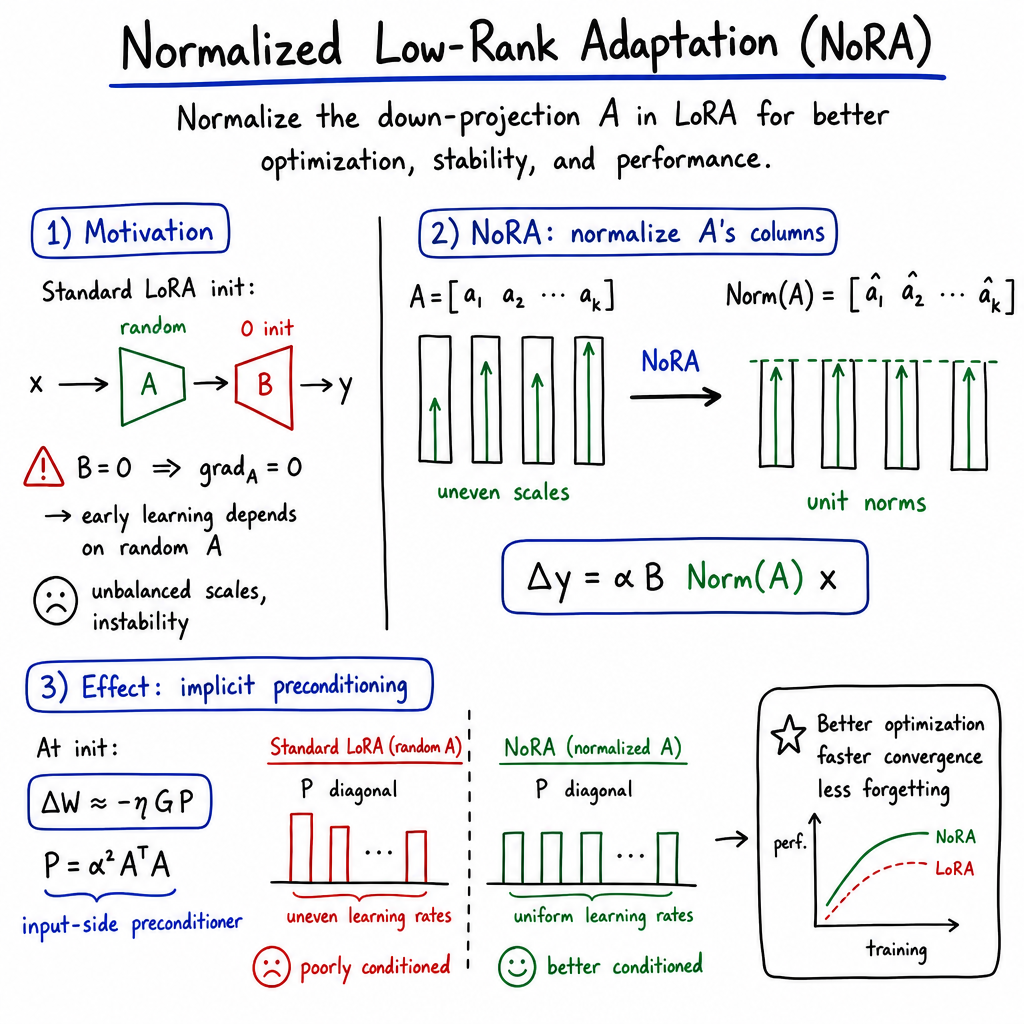
In standard LoRA, starts with random values, while starts as all zeros. Because begins at zero, the first important learning steps are controlled mostly by .
The problem with standard LoRA
The columns of randomly created can have different sizes. This means that some input features may receive a strong learning signal while others receive a weak one.
An analogy is a classroom where each student is given a different-sized microphone:
- Some students can be heard very loudly.
- Others can barely be heard.
- The difference is random and does not depend on which student has something important to say.
This can make training slower or unstable.
What NoRA changes
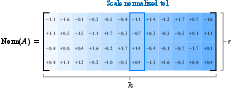
NoRA makes the columns of have the same length. In other words, it normalizes them so that each input feature starts with a balanced influence.
The NoRA update looks like this:
The normalization is based only on the model’s parameters, not on each individual input. This is important because the operation remains linear. As a result, after training, NoRA can still be combined directly with the original model weights, just like ordinary LoRA.
The authors also study NoRA-init, a simpler version:
- Normalize only once, at the beginning.
- Then train it normally without repeatedly enforcing normalization.
They also introduce BIMI, which starts using a pattern similar to repeated identity matrices rather than random numbers.
Technical idea: preconditioning
The paper says that LoRA acts somewhat like giving different input features different learning speeds. This is called a preconditioner.
A preconditioner is like a set of adjustable gears on a bicycle:
- Some gears make certain movements faster.
- Others make them slower.
- If the gears are badly chosen, progress is inefficient.
Random can create random learning speeds. NoRA makes these speeds more balanced, helping the model learn in a direction closer to full fine-tuning.
4. What did the researchers find?
The researchers tested NoRA in several settings.
Normalization direction matters
They compared:
- Row normalization, which normalizes across the input dimension
- Column normalization, which normalizes across the low-rank dimension
Column normalization—the version used by NoRA—worked much better.
For example, in supervised math training:
| Method | Average score |
|---|---|
| Standard LoRA | 29.27–31.05, depending on initialization |
| Row normalization | About the same as standard LoRA |
| NoRA-style column normalization | About 36.7–37.2 |
This suggests that the researchers chose the important direction for normalization.
NoRA improves supervised fine-tuning
The authors tested the methods on mathematics and programming tasks. The average score was:
| Method | Average score |
|---|---|
| Standard LoRA | 37.93 |
| NoRA-init | 42.38 |
| NoRA | 43.37 |
NoRA improved the average by about 5.44 points compared with ordinary LoRA.
It performed especially well on:
- GSM8K, a grade-school math problem dataset
- HumanEval, a programming test
NoRA also performed better on average than several other LoRA-related methods, including PiSSA, RSLoRA, and MiSS.
NoRA helps training stay stable
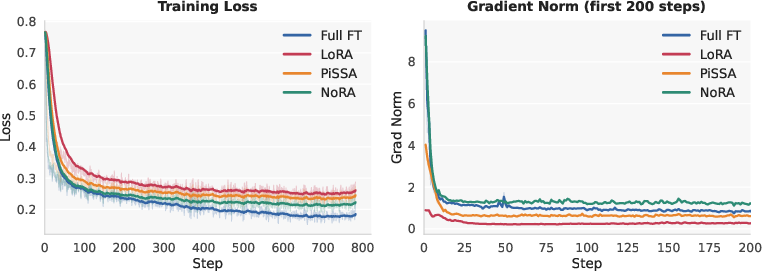
In some pretraining experiments, standard LoRA almost stopped learning. Its gradients—the signals that tell the model how to improve—became extremely small.
NoRA-init kept these signals at healthier levels. This led to:
- Faster convergence, meaning the model reached useful performance sooner
- More stable loss curves
- Better results on language and reasoning tests
- Less chance of training collapsing
NoRA reduces forgetting
When a model learns a new skill, it can sometimes lose old knowledge. This is called catastrophic forgetting.
After supervised fine-tuning, standard LoRA caused a noticeable drop on earlier knowledge tests. NoRA preserved the old abilities better.
The paper reports an average knowledge-retention change of:
- Standard LoRA:
- MiSS:
- NoRA-init:
- NoRA: approximately
A value near zero means the model kept its previous abilities. The slightly positive result for NoRA suggests that it adapted to new tasks without seriously damaging its original knowledge.
NoRA also works with reinforcement learning
The researchers tested NoRA using reinforcement learning with verifiable rewards. In this setup, the model receives a reward when its answer is correct, especially on mathematical problems.
The overall scores were:
| Method | Average score |
|---|---|
| Base model | 41.0 |
| Standard LoRA | 42.8 |
| NoRA | 44.4 |
NoRA improved the result by 1.6 points over standard LoRA.
Some other methods based on analyzing the original model’s special mathematical structure performed well in supervised training but became very unstable during reinforcement learning. NoRA remained more reliable because it does not depend on that complicated analysis.
5. Why are these findings important?
NoRA is useful because it improves LoRA while keeping LoRA’s main advantages.
It:
- Uses the same basic small-matrix idea
- Adds no extra trainable parameters
- Does not need an expensive calculation called singular-value decomposition
- Does not require extra work when the model is being used
- Can still be merged into the original model after training
- Works across pretraining, supervised learning, and reinforcement learning
The results also suggest a broader lesson: the way a model starts learning can be just as important as how large the model or adapter is. Even when two methods use the same number of parameters, a better starting arrangement can lead to much better learning.
Conclusion
This paper shows that standard LoRA can sometimes learn unevenly because its randomly initialized down-projection gives different input features different strengths.
NoRA fixes this by making those projection directions have equal size. This creates a more balanced learning process, similar to making sure every important road in a city has a reasonable width.
The experiments suggest that NoRA helps LLMs learn faster, perform better, remain stable, and preserve more of their original knowledge. Even the simpler version, NoRA-init, gains much of the benefit by normalizing the model only at the start.
Overall, NoRA could make adapting LLMs cheaper, safer, and more dependable, especially when training them for mathematics, coding, and other specialized tasks.
Knowledge Gaps
Knowledge gaps, limitations, and open questions
- Limited model-scale validation: The experiments primarily use models in the approximately 340M–3B parameter range; it remains unclear whether NoRA provides comparable benefits for modern models at tens or hundreds of billions of parameters.
- Narrow architectural coverage: The study focuses mainly on MHA, MLA, and decoder-only language-model settings. Its effectiveness in encoder–decoder models, vision transformers, multimodal models, diffusion models, convolutional networks, and recurrent architectures is not established.
- Restricted task diversity: Downstream evaluation emphasizes mathematical reasoning, code generation, and general language-model benchmarks. NoRA’s behavior on classification, instruction following, multilingual adaptation, factual knowledge editing, long-context tasks, and domain-specific applications remains unexplored.
- Limited pretraining evidence: The pretraining experiments use a single main corpus and a relatively controlled training setup. It is unknown whether the improvements persist across substantially different data mixtures, data quality levels, token budgets, and curriculum strategies.
- Insufficient statistical validation: The paper does not clearly report multiple random seeds, confidence intervals, or significance tests. The robustness of the reported gains, especially on relatively small benchmark differences, therefore remains uncertain.
- Incomplete hyperparameter-controlled comparisons: It is not fully established whether NoRA’s gains remain after independently tuning learning rates, LoRA scaling factors, optimizer settings, warmup schedules, and ranks for every baseline method.
- Unclear interaction with LoRA scaling conventions: The theoretical discussion alternates between and the implementation convention, but the practical sensitivity of NoRA to , rank-dependent scaling, and layer-specific scaling is not systematically characterized.
- Unresolved optimal normalization strength: The method uses hard unit-norm normalization with a fixed . The effects of alternative target norms, soft normalization, norm clipping, learnable normalization scales, and different values of are not investigated.
- Unclear behavior for zero or near-zero columns: The normalization rule uses , but the optimization dynamics and representational consequences of columns whose norms are below are not analyzed.
- Mechanism not fully isolated: The paper attributes the gains primarily to correcting the diagonal of the implicit preconditioner , but does not experimentally disentangle the effects of column norms, off-diagonal crosstalk, latent directions, and the altered gradient parameterization.
- Preconditioning theory is only approximate: The theoretical analysis focuses on the initial update when and treats later terms as negligible or second order. A complete analysis of the coupled, nonlinear optimization dynamics after becomes nonzero is missing.
- Optimizer dependence is unknown: The explanation is largely framed around gradient descent, while practical experiments presumably use adaptive optimizers. The interaction between NoRA and Adam-like moment estimates, weight decay, gradient clipping, momentum, and second-order optimizers is not established.
- Normalization-gradient implementation is underspecified: The paper does not provide sufficient detail on how gradients through are implemented, especially under mixed precision, distributed training, gradient accumulation, and optimizer state updates.
- Potential optimization trade-offs are underexplored: Continuous normalization may improve stability but could restrict useful scale adaptation or introduce optimization bias. The paper does not identify settings in which NoRA hurts performance or converges to inferior solutions.
- NoRA-init’s long-term behavior is unresolved: Although initialization-only normalization captures much of the reported gain, the study does not explain when the column norms later become imbalanced again or why this does not consistently degrade performance.
- Layer-wise effects are not analyzed: It remains unclear which Transformer layers and projection matrices benefit most from NoRA, whether normalization should be applied selectively, and whether optimal normalization differs across query, key, value, output, MLP, embedding, and head layers.
- Rank dependence is incomplete: Results include some rank comparisons, but the method’s scaling behavior across very small and very large ranks, and its interaction with adaptive-rank methods such as AdaLoRA, are not systematically evaluated.
- No principled rank-selection rule is provided: The paper shows that normalization can improve a fixed-rank adapter but does not determine how to choose the rank under a fixed parameter or compute budget.
- Comparison with initialization baselines is incomplete: The experiments do not comprehensively compare NoRA with all relevant initialization and optimization methods, such as EVA, OLoRA, LoRA-GA, LoRA+, QLoRA, orthogonal initialization, and activation-informed projections under equally tuned conditions.
- Relationship to BIMI and MiSS remains ambiguous: BIMI and MiSS have similar unit-column norms but substantially different crosstalk structures. The paper does not determine which geometric properties explain their similar or differing performance.
- Randomness and deterministic structure are not separated: The study does not establish whether BIMI’s benefits arise from normalization, orthogonality, repeated coordinate structure, reduced randomness, or a particular alignment with the input basis.
- Catastrophic forgetting analysis is limited: Knowledge retention is measured on only three benchmarks and with a single supervised adaptation setting. The durability of retention under longer training, multiple sequential tasks, domain shifts, and repeated adapter composition remains unknown.
- RLVR evaluation is narrow: Reinforcement-learning experiments use a single mathematical training framework and dataset family. NoRA’s stability under other reward models, noisy or sparse rewards, policy-optimization algorithms, preference optimization, and non-mathematical RL tasks is unresolved.
- RL instability is not diagnosed mechanistically: The paper reports severe degradation for PiSSA and MiLoRA under RLVR but does not identify whether the cause is initialization scale, spectral alignment, optimizer interaction, reward sparsity, policy drift, or implementation details.
- Inference and deployment costs are not measured quantitatively: Although NoRA preserves mergeability in principle, the paper does not report actual merging time, memory overhead, serving latency, checkpoint size, or numerical discrepancies before and after merging.
- Quantization compatibility is untested: The behavior of NoRA with QLoRA, weight-only quantization, activation quantization, low-precision optimizers, and post-merge quantization is not evaluated.
- Adapter composition is unexplored: It is unknown whether NoRA adapters can be safely combined, interpolated, stacked, or merged across tasks without introducing norm or crosstalk problems.
- Generalization beyond single-adapter training is unclear: The paper does not test continual learning, multi-task training, federated adaptation, or simultaneous adaptation of multiple modules.
- Data efficiency is not examined: The reported improvements may depend on the available training data. NoRA’s sample efficiency and performance in few-shot, low-resource, or highly noisy regimes remain unknown.
- Robustness to distribution shift is untested: The study does not evaluate whether NoRA improves or worsens out-of-distribution generalization, robustness to adversarial inputs, or transfer to domains unlike the adaptation data.
- The role of input normalization is assumed rather than verified: The motivation relies on pre-normalized Transformer inputs, but the method is not tested with different normalization placements, RMSNorm versus LayerNorm, removed normalization, or poorly scaled input activations.
- Potential basis dependence is unresolved: Column-wise normalization operates in the original input-coordinate basis. Its sensitivity to input rotations, feature reparameterizations, tokenizer changes, and equivalent linear-layer transformations is not studied.
- Capacity versus conditioning is not fully separated: The experiments suggest that initialization geometry matters beyond rank, but they do not provide controlled experiments showing whether NoRA improves optimization at equal effective update norm, equal parameter-update magnitude, or equal training loss trajectory.
- No universal explanation for benchmark variation is given: NoRA improves some tasks substantially while producing smaller or mixed gains on others. The paper does not identify task, layer, data, or gradient properties that predict when the method will be effective.
- Reproducibility is incomplete: The presented manuscript contains malformed or incomplete equations, inconsistent notation, and limited implementation details, making it difficult to verify the method precisely or reproduce all experimental results.
Practical Applications
Immediate Applications
- Drop-in improvement for LLM supervised fine-tuning (Software, education, enterprise AI) Replace standard LoRA initialization or training with NoRA-init or NoRA when adapting pretrained LLMs for mathematics, coding, instruction following, customer support, or domain-specific generation. The paper reports substantial gains over standard LoRA on GSM8K, mathematical reasoning, HumanEval, and MBPP, while using the same number of trainable parameters. Potential workflow: select a base model → insert NoRA adapters into attention or other linear projections → train with an existing LoRA/PEFT pipeline → merge the adapter weights into the base model for deployment. Dependencies: compatibility with the model architecture, appropriate rank and scaling choices, and validation on the target domain. The reported evidence is concentrated on relatively small LLMs and selected tasks.
- Parameter-efficient code-model customization (Software engineering, developer tools) Use NoRA to adapt code-generation models to an organization’s programming languages, APIs, style guides, internal libraries, or secure coding policies. Improved early optimization can reduce the number of training steps and lower GPU costs compared with ordinary LoRA. Potential products: private code assistants, IDE plugins, automated documentation systems, code-review models, and repository-specific copilots. Dependencies: high-quality and legally usable code data, secure handling of proprietary repositories, and evaluation for functional correctness and security rather than benchmark accuracy alone.
- Domain-specific instruction tuning with limited hardware (Healthcare, finance, legal services, public administration) Organizations can train task-specific adapters without updating the full model, reducing memory and storage requirements. Separate NoRA adapters could represent different domains, departments, languages, or workflows while sharing one frozen base model. Potential workflow: maintain a centrally hosted base model and distribute small, versioned adapters for medical summarization, financial reporting, legal retrieval, or government forms. Dependencies: domain validation, privacy controls, regulatory review, and safeguards against hallucination. The method improves optimization but does not itself provide factuality, fairness, or compliance guarantees.
- More stable reinforcement-learning post-training (LLM alignment, reasoning systems, robotics software) Apply NoRA to reinforcement learning with verifiable rewards, preference optimization, or other post-training procedures where unstable updates can damage model quality. The paper reports improved RLVR performance and greater robustness than spectral initialization methods such as PiSSA and MiLoRA. Potential tools: NoRA-enabled training components for mathematical reasoning models, tool-use agents, theorem-proving systems, and automated planning models. Dependencies: reliable reward functions or verifiers, careful monitoring for reward hacking, and confirmation that the reported stability transfers beyond mathematical tasks.
- Catastrophic-forgetting mitigation during adaptation (Education, enterprise knowledge systems, multilingual AI) Use NoRA for adapting a general model to a narrow task while retaining general capabilities. In the reported experiments, NoRA preserved benchmark performance better than standard LoRA and several alternatives. Potential workflow: train a task adapter, evaluate both target-task performance and a retention suite, then deploy the adapter only if general capabilities remain within an acceptable threshold. Dependencies: retention must be measured on representative organizational or user tasks; the paper’s forgetting evaluations use a limited set of benchmarks and should not be treated as a universal guarantee.
- Efficient pretraining or continued pretraining of smaller models (Cloud computing, edge AI, research infrastructure) Use NoRA-init in low-rank continued-pretraining experiments when full-parameter updates are too expensive. The method can improve convergence while preserving the linear form of LoRA updates and exact weight merging. Potential products: domain-adapted compact models, local-LLMs, edge-deployable assistants, and rapid experimental model variants. Dependencies: evidence for large-scale pretraining remains limited; users should compare total training cost, wall-clock time, optimizer memory, and final quality rather than assuming that faster convergence always reduces cost.
- Integration into existing PEFT libraries and training platforms (Machine-learning software)
Implement NoRA as a lightweight extension to common LoRA modules. NoRA-init can be exposed as an initialization option, while NoRA can normalize the columns of the down-projection during forward computation or parameter updates.
Potential tools: configuration flags such as
init="nora"ornormalization="rank"in PEFT libraries, experiment-tracking templates, and automated comparisons against LoRA, QLoRA, DoRA, and rsLoRA. Dependencies: correct treatment of optimizer states, mixed precision, quantization, distributed training, checkpoint conversion, and numerical stability through the parameter. - Deployment of merged adapters without inference overhead (Consumer applications, enterprise serving) After training, absorb into the low-rank update and merge it with the pretrained weight matrix. This enables the adapted model to use standard inference infrastructure without an additional normalization operation or trainable parameter set. Potential products: standalone customized models, lower-latency APIs, and simplified model-serving pipelines. Dependencies: the merge implementation must exactly reproduce the training-time parameterization, and teams must retain the unmerged adapter for rollback, auditing, or multi-task composition.
- Educational and research use as a preconditioning case study (Academia, machine-learning education) NoRA provides a practical demonstration that LoRA behaves like full fine-tuning under an implicit input-side low-rank preconditioner. It can be used in courses, laboratories, or optimizer research to study initialization, gradient flow, conditioning, and low-rank optimization. Potential outputs: teaching notebooks comparing LoRA, NoRA-init, NoRA, BIMI, and full fine-tuning; diagnostic plots of gradient norms; and experiments on rank-dependent learning behavior. Dependencies: the preconditioning interpretation is most directly applicable during the early stage when the up-projection is initialized to zero; later training dynamics may differ.
Long-Term Applications
- Scalable adaptation of very large foundation models (Cloud AI, search, productivity software) NoRA could reduce the cost and instability of adapting large multimodal or language foundation models across many customers and tasks. Its lack of SVD, extra parameters, and inference overhead makes it attractive for large adapter banks. Potential products: customer-specific model personalization, multilingual model fleets, and large-scale adapter marketplaces. Dependencies: validation at substantially larger model sizes, longer training runs, multimodal layers, quantized training, and distributed optimizer implementations. The paper does not establish that gains scale monotonically with model size.
- Personalized on-device and federated learning (Mobile devices, privacy-preserving AI, healthcare) Small NoRA adapters could allow local or federated personalization while keeping the base model frozen. Users or institutions could adapt models to writing style, accessibility needs, professional terminology, or local workflows without transmitting all model parameters. Potential workflow: distribute a frozen base model → train a small adapter locally → aggregate, select, or keep adapters private → deploy locally or through secure serving. Dependencies: communication-efficient aggregation, protection against poisoned updates, heterogeneous hardware, differential privacy, and evaluation of whether normalized initialization remains beneficial under highly non-IID data.
- Continual-learning systems with modular adapters (Robotics, autonomous systems, enterprise automation) The reported resistance to catastrophic forgetting suggests a route toward adding new skills through separate NoRA adapters rather than repeatedly overwriting the base model. A robot or agent could acquire task-specific modules for navigation, manipulation, dialogue, or tool use. Potential products: skill libraries, adapter routers, and systems that activate different adapters according to context. Dependencies: reliable adapter composition, conflict resolution, routing, safety verification, and experiments in nonstationary environments. NoRA alone does not solve interference between multiple adapters.
- Low-rank adaptation beyond LLMs (Computer vision, speech, robotics, scientific computing) The paper argues that rank-dimensional normalization is a general principle for low-rank adaptation and demonstrates transfer to a DoRA-style parameterization. Future systems could apply it to vision transformers, speech encoders, diffusion models, control policies, and scientific surrogate models. Potential tools: normalized low-rank modules for image classification, medical imaging, speech recognition, robot policies, and pretrained simulation models. Dependencies: the core assumption that input activations are already reasonably controlled by normalization layers may fail in convolutional, recurrent, physical-control, or unnormalized architectures.
- Adaptive rank and normalized preconditioners (Optimization research, high-performance computing) NoRA’s preconditioning interpretation could motivate methods that combine rank-dimensional normalization with adaptive rank allocation, curvature estimation, or layer-wise scaling. Such systems might preserve unit diagonal gains while learning which low-rank directions deserve additional capacity. Potential research products: rank schedulers, optimizer-aware adapter allocation, and diagnostics based on the spectrum or diagonal of . Dependencies: theoretical analysis beyond initialization, computationally efficient monitoring, and evidence that controlling diagonal gains remains optimal when data-dependent curvature is strongly anisotropic.
- Stable post-training for embodied agents and reinforcement-learning policies (Robotics, autonomous vehicles, industrial control) NoRA could eventually support parameter-efficient policy adaptation from simulation or real-world feedback, particularly when repeated updates risk destabilizing a pretrained policy. The method’s linear mergeability could simplify deployment to constrained inference hardware. Dependencies: extensive safety testing, offline-to-online reinforcement-learning studies, non-verifiable and delayed rewards, distribution shift, real-time constraints, and guarantees on policy degradation. Results from language-model RLVR cannot be directly generalized to physical control.
- Energy-efficient model training and carbon-aware adaptation (Energy, sustainability, data centers) If NoRA consistently reduces optimization steps or prevents failed runs, it could lower GPU-hours, energy use, and the environmental cost of maintaining many specialized models. This is particularly relevant for organizations training numerous adapters rather than one full model. Potential workflow: compare LoRA and NoRA using energy-aware experiment tracking, early-stop unstable runs, and deploy merged adapters from the best-performing checkpoints. Dependencies: actual energy savings depend on hardware utilization, normalization overhead during NoRA training, checkpoint frequency, and whether the same final quality can be reached with fewer steps.
- Regulated, auditable adapter ecosystems (Finance, healthcare, government) Modular NoRA adapters could support controlled customization: each adapter can be versioned, evaluated, approved, revoked, and merged only after validation. This may help separate institution-specific behavior from the general-purpose base model. Dependencies: adapter provenance, reproducibility, secure signing, bias and safety audits, data-governance rules, and formal evidence that improved benchmark retention corresponds to improved behavior in regulated operational settings.
- Everyday personal AI personalization (Daily life, accessibility, consumer software) In the longer term, NoRA could enable lightweight personalization of assistants to household routines, preferred communication styles, calendars, accessibility requirements, or private knowledge. Small adapters may be stored locally and switched without maintaining separate full models. Dependencies: consumer-grade training efficiency, privacy-preserving local updates, protection from unintended behavior changes, user controls, and clear separation between harmless personalization and high-stakes decisions.
Glossary
- Ablation study: An experiment that systematically removes or changes one component to measure its effect. “We further perform ablation studies to investigate the effect of the normalization dimension and initialization distribution.”
- Catastrophic forgetting: The loss of previously learned knowledge when a model is adapted to new data or tasks. “They also mitigate catastrophic forgetting during supervised adaptation”
- Convergence: The process by which an optimization procedure approaches a stable solution or performance level. “NoRA consistently accelerates convergence”
- Crosstalk: Unintended interaction between different input coordinates or feature directions. “The second term is crosstalk between input coordinates induced by the rank bottleneck”
- Curvature-based method: An optimization method that uses information about the curvature of the loss surface to adjust parameter updates. “Right-multiplication by a matrix is exactly where curvature-based methods~\citep{martens2015optimizing} place an input-side preconditioner.”
- Down-projection: A mapping from a high-dimensional input space into a lower-dimensional latent space. “NoRA requires the down-projection matrix to be normalized along the output rank dimension.”
- Downstream performance: A model’s effectiveness on target tasks performed after pretraining or adaptation. “Across a diverse range of base models, tasks, and training configurations, both methods consistently accelerate convergence, improve training stability, and enhance downstream performance.”
- Exact mergeability: The ability to combine an adapter’s learned weight update with the original model weights without changing the resulting computation. “After training, the normalized down-projection can be absorbed into the low-rank update, preserving exact weight mergeability.”
- Full finetuning: Updating all or nearly all parameters of a pretrained model for a new task. “Full finetuning takes the step , i.e., \eqref{eq:precond} with .”
- Gradient descent: An iterative optimization algorithm that updates parameters in the direction opposite to the loss gradient. “Since \alpha^{\top}, alone fixes the learning rates and the input subspace during the decisive early phase”
- Gradient norm: The magnitude of a gradient vector or matrix, often used to assess update strength. “NoRA produces substantially stronger early gradients than standard LoRA, with gradient norms approaching those of full finetuning”
- Hidden preconditioner: An implicit transformation that modifies optimization gradients before they update parameters. “LoRA can be viewed as performing full-finetuning gradient descent under a hidden preconditioner that is determined by and acts on the input coordinates.”
- Implicit preconditioner: A preconditioning operation that arises from a model’s parameterization rather than being explicitly added as an optimization algorithm. “From a preconditioning perspective, LoRA can be viewed as full finetuning under an implicit low-rank, input-side preconditioner determined by the down-projection”
- Initialization distribution: The probability distribution used to generate a model’s initial parameter values. “We further perform ablation studies to investigate the effect of the normalization dimension and initialization distribution.”
- Input-side preconditioner: A gradient transformation that operates on dimensions associated with the model input. “Right-multiplication by a matrix is exactly where curvature-based methods~\citep{martens2015optimizing} place an input-side preconditioner.”
- Input-to-latent projection: The transformation that maps input coordinates into a lower-dimensional latent representation. “NoRA continuously normalizes the down-projection matrix along the low-rank dimension throughout training.”
- Inference-time computation: Computation performed when a trained model generates predictions or outputs. “These benefits require neither additional trainable parameters nor inference-time computation”
- Latent feature: A learned or computed representation in a lower-dimensional internal space. “where denotes the latent feature presented to the up-projection.”
- Latent representation: An internal vector representation that encodes information in a model’s lower-dimensional feature space. “Therefore, the earliest optimization of LoRA is entirely determined by the latent representation induced by the initial projection”
- Low-rank adaptation: A method that represents model-weight updates using factors whose inner dimension is much smaller than the original dimensions. “While low-rank adaptation (LoRA) is widely used for parameter-efficient model adaptation”
- Low-rank bottleneck: A restricted intermediate dimension that limits the rank and expressive capacity of a parameterized update. “The second term is crosstalk between input coordinates induced by the rank bottleneck”
- Low-rank factorization: The representation of a matrix as a product of smaller matrices with a constrained intermediate rank. “By representing weight updates through low-rank factorization, LoRA greatly reduces the number of trainable parameters”
- Low-rank subspace: A restricted vector space spanned by a small number of directions. “Methods such as PiSSA~\citep{meng2024pissa} and MiLoRA~\citep{wang2025milora} construct the initial low-rank subspace from the spectral structure of pretrained weights”
- Matrix-shard sharing: A strategy in which parts of a matrix or parameterization are reused across multiple input blocks. “MiSS~\citep{kang2026miss} is a recent PEFT method that improves parameter efficiency through a matrix-shard sharing strategy.”
- Mergeability: The property that an adapter update can be incorporated into the original model weights for deployment. “Among them, LoRA~\citep{hu2021lora} is widely adopted due to its simplicity, efficiency, and mergeability at inference time.”
- Multi-head attention: An attention mechanism that computes several attention operations in parallel and combines their outputs. “We further evaluate NoRA-init under the standard MHA architecture for LLM pretraining.”
- Normalized latent representation: A latent vector whose magnitude or components have been rescaled according to a normalization rule. “Our investigation begins with the observation that the normalized latent bottleneck used in Multi-head Latent Attention (MLA) substantially stabilizes training”
- Numerical stability: The degree to which computations remain reliable despite finite-precision arithmetic or problematic parameter values. “where is a small constant for numerical stability.”
- Optimization dynamics: The way model parameters, gradients, and performance evolve during training. “Despite its effectiveness, LoRAâs optimization dynamics remain poorly understood.”
- Optimization geometry: The structure of the loss landscape and parameter space that influences how optimization proceeds. “This suggests that controlling the scale and structure of the input-to-latent projection provides a more favorable optimization geometry under limited-rank parameterizations”
- Parameter-efficient finetuning: Adapting a pretrained model while updating only a small fraction of its parameters. “Among parameter-efficient finetuning (PEFT) approaches, Low-rank adaptation (LoRA)~\citep{hu2021lora} has become particularly popular”
- Positive semidefinite matrix: A symmetric matrix whose quadratic form is nonnegative for every vector. “LoRA is full finetuning with the gradient right-multiplied by a positive semidefinite matrix of rank that acts on the input coordinates.”
- Preconditioning: Transforming gradients or updates to improve optimization efficiency or conditioning. “\subsection{Why Does NoRA Work? A Preconditioning Perspective}”
- Pre-normalized: Designed so that normalization is applied before a principal computational operation, such as a Transformer layer. “Modern Transformer architectures are typically pre-normalized, such that the magnitude of the input to each linear layer is already well controlled by LayerNorm.”
- Pretraining: Training a model on a broad dataset before adapting it to specific tasks. “We evaluate both NoRA and NoRA-init across pretraining, supervised finetuning, and reinforcement learning with verifiable rewards.”
- Rank-dimension normalization: Normalizing each projection vector across the low-rank dimension so that its norm is controlled. “We therefore normalize each column of along the LoRA rank dimension.”
- Reinforcement learning with verifiable rewards: Reinforcement learning in which generated outputs can be checked automatically to assign rewards. “Reinforcement learning with verifiable rewards.”
- Spectral decomposition: Decomposing a matrix according to eigenvalues or singular values and their associated directions. “A notable difference emerges for initialization methods based on pretrained-weight spectral decomposition.”
- Singular-value decomposition: Factoring a matrix into orthogonal matrices and a diagonal matrix of singular values. “However, they require singular-value decomposition and modify the initial decomposition of the pretrained weights”
- Structured initialization: Initializing parameters according to a deliberate mathematical structure rather than independent random samples. “BIMI achieves comparable performance and satisfies NoRA by construction, serving as a structured and deterministic instance of NoRA.”
- Supervised finetuning: Adapting a pretrained model using labeled input–output examples. “We evaluate NoRA on Llama 3.2-3B across a diverse set of downstream tasks”
- Training stability: The consistency and numerical reliability of optimization throughout model training. “NoRA consistently accelerates convergence, improves training stability, and enhances downstream performance.”
- Up-projection: A mapping from a lower-dimensional latent space back into a higher-dimensional output space. “Because LoRA initializes the up-projection to zero, its early optimization dynamics are largely governed by the down-projection.”
- Weight normalization: A parameterization or constraint that controls the magnitude of weight vectors separately from their direction. “Performing in the forward pass adds two things: (1) the loss becomes invariant to each column's scale, so gradients are tangential and, under gradient descent, norms can only grow while the effective step anneals automatically, as in weight-normalized training~\citep{liu2017deep,salimans2016weight,liu2018decoupled}”
- Zero-shot performance: Performance on a task without task-specific examples being provided during evaluation or adaptation. “\caption{\footnotesize Zero-shot performance of 340M models trained on SlimPajama~\citep{cerebras2023slimpajama}.”

