Breaking the Exponential Barrier: The First Polynomial-Time Algorithm for the Győri-Lovász Theorem
Abstract: We give the first polynomial-time algorithm, after half a century, for the celebrated Győri-Lovász theorem, which resolved a conjecture of Frank (1975). The theorem, one of the simplest existential theorems to explain, states that every -connected graph can be partitioned into disjoint connected subgraphs of arbitrary prescribed positive sizes. This is a fundamental structural result with broad applications, such as flexible allocation of connected subnetworks of prescribed sizes in sufficiently connected cloud infrastructures. While Lovász (1977) gave a highly non-constructive proof for a stronger directed version using algebraic topology, Győri's original constructive proof (1976) requires exponential time. Despite more than 50 years of effort, no polynomial-time algorithm was known even for $k>4$. Determining the computational complexity of the Győri-Lovász theorem---whether it admits even a sub-exponential-time algorithm or is computationally hard (in particular, PLS-complete or PPAD)---has remained one of the central open problems in algorithmic graph theory. In this paper, we finally resolve this long-standing problem by a fundamentally new proof of the existential theorem via introducing the novel concept of \emph{flow-essential assignment}, which genuinely marries matching and cut structures and yields the first polynomial-time constructive algorithm for the Győri-Lovász theorem. In fact, we obtain a polynomial-time algorithm for Lovász's stronger directed version, whose proof was non-constructive even for DAGs; for DAGs, we further obtain a near-linear-time algorithm. We also develop polynomial-time algorithms for weighted generalizations where the seminal work of Chen, Kleinberg, Lovász, Rajaraman, Sundaram, and Vetta (JACM'07) on confluent flows established only existential non-constructive results.
Paper Prompts
Sign up for free to create and run prompts on this paper.
Top Community Prompts
Explain it Like I'm 14
1. What is the paper about?
This paper presents the first polynomial-time algorithm for the Győri–Lovász theorem, an important result in graph theory.
A graph is a collection of vertices connected by edges. We can think of vertices as places and edges as roads between them.
The theorem says:
If a graph is connected strongly enough, it can be divided into separate connected groups, each containing a chosen “root” vertex and having a required size.
For example, suppose a network has three important locations, , , and . The theorem says that, under strong enough connectivity, we can divide all the network’s locations into three groups so that:
- each group contains one of the important locations;
- every location in a group can reach its group’s important location;
- the groups do not overlap;
- each group has exactly the requested number of locations.
The theorem has been known for about 50 years, but previously known methods could take an extremely long time—exponential time—as the graph became larger. This paper gives a method that runs in polynomial time, meaning its running time grows much more manageably with the size of the graph.
2. What questions does the research address?
The main question is:
Can we actually find the partition promised by the Győri–Lovász theorem efficiently?
Earlier proofs showed that the desired partition must exist, but they did not provide an efficient way to construct it.
The authors also study several related questions:
- Can the stronger directed version of the theorem be solved efficiently?
- Can the method handle vertices with different weights, rather than treating every vertex as equal?
- Can the problem be solved especially quickly for directed acyclic graphs, or DAGs—graphs with no directed loops?
- Can the same ideas help with networking problems such as confluent flows, where traffic leaving a location must follow one chosen route?
3. How does the method work?
The basic strategy
The algorithm builds the final groups step by step. It does not try every possible partition, because there may be far too many possibilities.
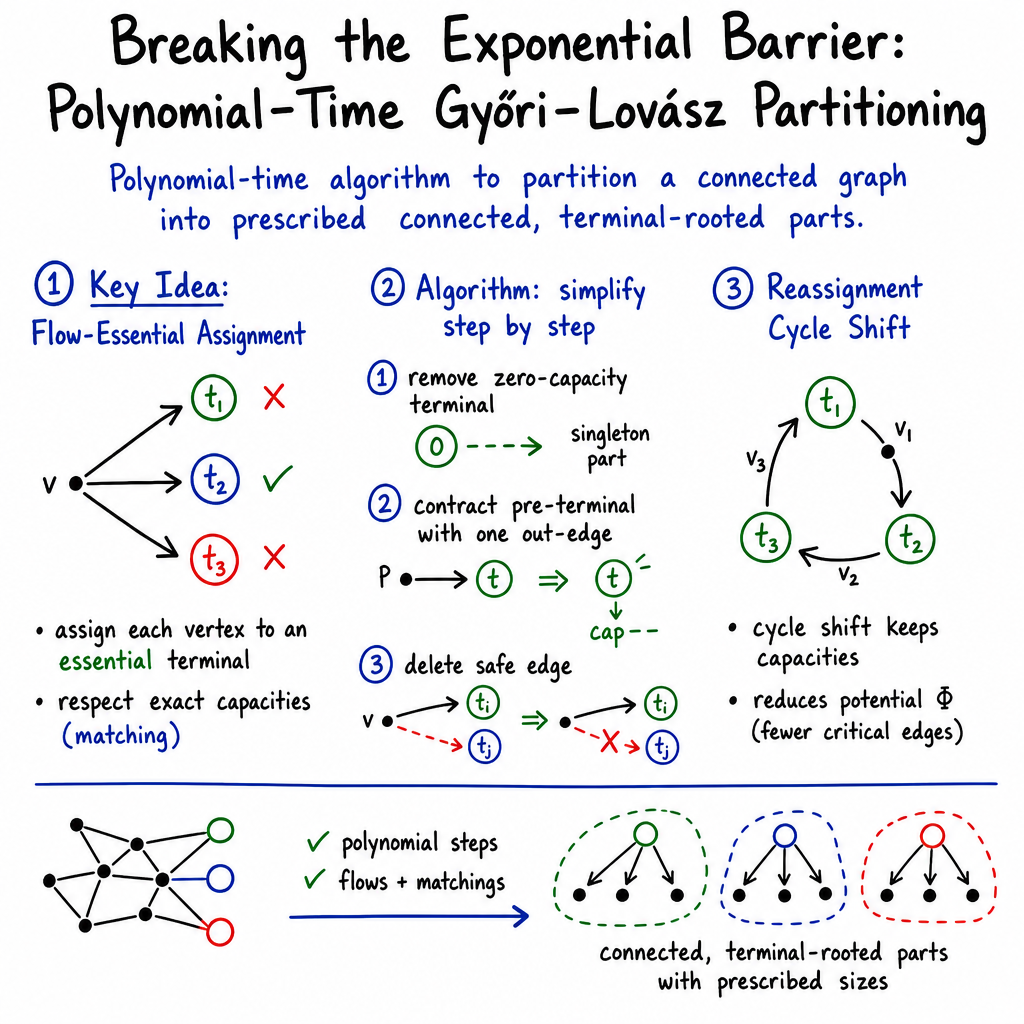
Instead, it gradually “locks” vertices into their final groups. One important operation is called contraction.
Imagine that a vertex has a road leading directly to terminal . The algorithm can merge into . This permanently decides that belongs to the group of .
The difficulty is that merging the wrong vertex might destroy the useful connectivity of the graph. The authors therefore need a rule that tells them which changes are safe.
Flow-essential terminals
The paper introduces a new idea called a flow-essential assignment.
For each ordinary vertex , the algorithm asks:
Which terminals are truly necessary for to have as many separate routes as possible to the terminal set?
A terminal is called essential for if removing that terminal makes the number of independent routes from to the terminals decrease.
This can be understood using a road analogy. Suppose several roads leave a town and lead to different destinations. If one destination is part of every best collection of separate routes, that destination is essential for the town.
The algorithm assigns each vertex to one of its essential terminals. At the same time, it makes sure that every terminal receives exactly the required number of vertices.
This combines two kinds of ideas:
- Connectivity: A vertex may only be assigned to a terminal that is important for keeping its routes available.
- Counting: Each terminal must receive the correct number of vertices.
The authors compare this to a matching problem. In a matching problem, objects are paired with suitable choices while respecting limits. Here, vertices are paired with terminals, and each terminal has a capacity.
Checking the condition efficiently
The algorithm uses standard network tools called maximum flow and minimum cut.
A maximum flow asks how many separate “units” can travel through a network. In this paper, it measures how many vertex-disjoint paths can connect a vertex to different terminals.
A minimum cut asks for the smallest set of vertices or edges whose removal would block those routes. It is similar to finding the narrowest bridge or bottleneck in a road system.
The authors use these tools to determine:
- which terminals are essential for each vertex;
- whether a valid assignment exists;
- how to update the assignment after making changes.
They also use bipartite matching, which is a way of pairing items from two groups. One side contains ordinary vertices, and the other contains terminals.
Removing edges when contraction is not yet safe
Sometimes no vertex can be safely contracted immediately. The paper solves this problem in an unusual way.
Rather than forcing a contraction, the algorithm first removes carefully selected edges while preserving a valid assignment. Eventually, some vertex has only one edge leading toward a terminal. At that point, its assignment is forced, so the algorithm can safely contract it.
If an edge seems important, the algorithm changes the vertex-to-terminal assignments. It performs several changes at once in a cycle, so that no terminal receives too many or too few vertices.
The authors use a potential function to measure how many edges are still causing trouble. Each reassignment lowers this number. Since the number cannot decrease forever, the process must eventually find an edge that can be removed safely.
4. Main findings
The paper’s central result is that the Győri–Lovász theorem is constructively solvable in polynomial time.
In simpler terms, the authors show that:
- the required connected partition can be found efficiently for any number of groups ;
- the method works for the stronger directed version of the theorem;
- the method also works under the paper’s broader flow-essential assignment condition;
- weighted versions can be solved in polynomial time;
- directed acyclic graphs can be handled even faster.
For DAGs, the authors obtain a running time of approximately
where is the number of vertices and is the number of edges. This is called near-linear time, because it is only slightly more than the time needed to examine the graph itself.
The weighted version
The paper also allows each vertex to have a positive integer weight. A vertex’s weight might represent:
- the amount of data it stores;
- the amount of computing power it requires;
- the number of people or resources associated with it.
Each terminal has a capacity, or a limit on the total weight it should receive.
The algorithm guarantees that each group’s weight is at most
where is the terminal’s capacity and is the largest individual vertex weight.
The extra amount is necessary in some cases. For example, one very large vertex cannot be split between different groups, so it may cause one group to exceed its capacity slightly.
Why these findings matter
This is important because it changes the result from a statement about existence into a practical method for finding the partition.
Previous proofs were like proving that a hidden treasure must exist somewhere without giving a reasonable map to find it. This paper provides the map.
5. Possible impact and implications
The algorithm could be useful wherever a large connected system must be divided into smaller connected regions of planned sizes.
Possible applications include:
- dividing cloud-computing infrastructure into connected subnetworks;
- assigning connected areas of a road network to different services;
- splitting an image into connected regions of chosen sizes;
- organizing robot movement areas;
- routing network traffic toward different destinations;
- allocating weighted resources while keeping each assigned region connected.
The paper also gives a broader lesson for computer science. Earlier approaches treated the problem mainly as a question of connectivity: are there enough separate paths?
The authors show that connectivity alone is not enough. The requested group sizes create a second challenge: vertices must also be assigned to terminals in the correct numbers. The successful algorithm works because it combines:
the structure of network bottlenecks with the balancing rules of matching problems.
Overall, the research removes a long-standing efficiency barrier. It shows that a problem that seemed possibly computationally difficult can, in fact, be solved efficiently using a new combination of flow, cuts, matching, and carefully controlled graph changes.
Knowledge Gaps
The paper resolves polynomial-time constructibility under its stated connectivity and flow-essentiality assumptions, but leaves the following issues open:
- Complexity classification beyond polynomial solvability: Since a polynomial-time algorithm does not by itself rule out membership or completeness in classes such as PLS or PPAD under alternative formulations, the precise complexity status of related local-search, equilibrium, or restricted-output versions remains unresolved.
- Weaker connectivity assumptions: The paper proves the theorem under -terminal connectivity and a stronger compact-connectivity condition, but does not establish whether the result or its algorithm extends to the weaker local-connectivity condition. In particular, Conjecture A.5—that some contraction always preserves local connectivity—remains open.
- Efficient recognition of local connectivity: Even if Conjecture A.5 is true, the paper does not provide an efficient method for checking local connectivity when is part of the input.
- Optimality of the flow-essential assignment invariant: It is not characterized whether every instance admitting a valid rooted partition satisfies the Flow-Essential Assignment Condition, or how far this condition is from being necessary.
- Structural characterization of feasible assignments: The paper gives a matching/flow test for the existence of a flow-essential witness, but does not provide a broader combinatorial characterization of the graphs and capacity vectors for which such witnesses exist.
- Sharper running-time bounds in general directed graphs: The algorithm is polynomial, but the precise dependence on , , , maximum weight, and the chosen maximum-flow/minimum-cost-flow routines is not optimized or compared with known lower bounds.
- Near-linear time outside DAGs: The near-linear-time result relies heavily on acyclicity. It remains open whether substantially faster algorithms are possible for general directed graphs, especially sparse graphs or graphs with additional structural restrictions.
- Optimality of the DAG running time: The bound for DAGs is not shown to be optimal. Whether the logarithmic factor can be removed, or whether an algorithm exists, remains unanswered.
- Weighted capacity violation: The additive violation of is shown to be unavoidable for the stated general weighted formulation, but the paper does not determine whether better guarantees are possible under natural restrictions such as bounded weight ratios, divisible weights, uniform weights, or additional connectivity.
- Exact weighted feasibility: The weighted algorithm permits capacity overflow, whereas the unweighted theorem achieves exact capacities. The paper does not identify broad conditions under which an exact weighted connected partition can be found in polynomial time.
- Alternative weight representations: The analysis assumes positive integer weights and discusses binary encoding, but does not address real-valued, rational, or streaming representations of weights and capacities.
- Undirected algorithmic consequences: The directed framework implies the undirected Győri–Lovász theorem, but the paper does not fully investigate whether exploiting undirected structure yields simpler, faster, or more specialized algorithms.
- Parameterized complexity: The dependence on parameters such as fixed , treewidth, maximum degree, connectivity surplus, or maximum vertex weight is not systematically studied. Possible fixed-parameter or improved parameterized algorithms remain open.
- Robustness under imperfect inputs: The algorithms assume that the input satisfies the required connectivity or assignment condition. The paper does not study efficient certification, repair, or approximate partitioning when these assumptions fail.
- Extensions to broader graph models: The treatment assumes simple directed graphs, distinct terminals, and terminals with no outgoing edges. It remains unclear how the framework adapts to parallel edges, terminal-to-terminal arcs, prescribed terminal out-neighbors, or mixed directed/undirected networks.
- Dynamic and distributed settings: The algorithms are presented for static centralized inputs. Updating a partition efficiently after edge, vertex, capacity, or weight changes—and computing such partitions in distributed or decentralized networks—is not addressed.
- Practical evaluation: The paper provides theoretical algorithms and illustrative examples but does not evaluate implementation performance, scalability, or solution quality on real network, routing, cloud-infrastructure, road, robotics, or image-processing instances.
- Applications to confluent flows: Although the weighted result supplies a constructive step for the confluent-flow existence theorem, the paper does not experimentally or theoretically compare the resulting flow constructions with existing approximation algorithms in terms of congestion, runtime, or practical routing quality.
- Canonical or unique partitions: The algorithm may depend on choices of matchings, witnesses, critical edges, and contractions. The paper does not study whether partitions can be made canonical, balanced beyond prescribed capacities, or optimized according to secondary objectives.
- Optimization variants: It remains open whether the method can be extended to optimize additional criteria—such as boundary size, diameter, total number of inter-part edges, maximum radius, or robustness—while preserving connectivity and prescribed sizes.
Practical Applications
Immediate Applications
- Connected partitioning of resilient communication and cloud networks — Industry / software
- Deploy the paper’s polynomial-time
GLPartitionalgorithm as a network-planning tool that assigns every node to one of designated hubs, terminals, or service regions. - Each region has a prescribed size and remains connected to its assigned terminal, enabling workload placement, fault-domain design, and subdivision of highly connected cloud or data-center fabrics.
- Dependencies: The input network must satisfy the required -connectivity or, more generally, the flow-essential assignment condition. The model also assumes that connectivity is represented accurately by a static graph and that vertex-disjoint paths are an appropriate resilience measure.
- Deploy the paper’s polynomial-time
- Resilient network segmentation with exact quotas — Industry / telecommunications
- Network operators can partition routers, switches, sensors, or edge-computing nodes among gateways while enforcing exact node quotas.
- The prescribed roots can represent data centers, base stations, network controllers, or regional gateways; the resulting connected parts can support localized routing, monitoring, or maintenance.
- Dependencies: The theorem guarantees connected parts, not bandwidth, latency, link-disjointness, load balancing, or security isolation. Those constraints would need to be added through further optimization layers.
- Confluent-flow routing and traffic aggregation — Telecommunications / logistics
- The weighted algorithm provides a constructive method for assigning weighted demand nodes to sinks while ensuring that each sink’s assigned subnetwork is connected.
- It can support routing workflows in which traffic leaving a node follows a single outgoing direction, such as hierarchical Internet aggregation, warehouse distribution, or tree-based sensor collection.
- Dependencies: The capacity guarantee allows an additive violation of at most . Practical deployment therefore requires either sufficient slack, suitably small maximum demands, or a post-processing step for overloaded sinks. The paper’s graph-theoretic connectivity assumptions must also hold.
- Capacity-aware geographic and infrastructure zoning — Energy, utilities, and public infrastructure
- A utility planner could assign substations, roads, pipeline junctions, or grid nodes to designated facilities with prescribed capacities while preserving connectivity to each facility.
- The weighted formulation is suitable when vertices represent heterogeneous assets—for example, substations with different loads, hospitals with different service populations, or distribution centers with different demand weights.
- Dependencies: Vertex weights are treated as indivisible during the final partition, which explains the capacity violation. Real systems may also require edge capacities, geographical contiguity, travel-time limits, and dynamic failure scenarios.
- Connected image and spatial-region segmentation — Computer vision / image processing
- Pixels, superpixels, or spatial graph vertices can be partitioned into connected regions of exact or predicted sizes, each anchored at a prescribed seed.
- Potential workflows include seeded image segmentation, connected object decomposition, medical-image region assignment, and terrain partitioning.
- Dependencies: The graph must meet a strong connectivity condition, which ordinary image grids may not satisfy. In practice, preprocessing, graph augmentation, or a relaxed version of the method may be necessary. The theorem guarantees connectivity and size, not visual similarity or semantic accuracy.
- Road-network and transportation-region partitioning — Transportation / GIS
- A road graph can be divided into connected service territories of specified sizes around depots, emergency stations, or control centers.
- Applications include assigning road segments or intersections to maintenance depots, dividing a resilient road network among emergency-response bases, and constructing connected geographic clusters.
- Dependencies: Vertex connectivity may be a poor proxy for real travel resilience because roads have directional, capacity, and time-dependent properties. Travel time, congestion, and edge failures would need to be modeled separately.
- Robotics and multi-agent territory allocation — Robotics
- The algorithm can assign connected sets of locations to robots or robot bases, with each region containing a designated starting point and satisfying a target number or weight of locations.
- This could support warehouse coverage, search-and-rescue zoning, sensor deployment, and connected exploration tasks.
- Dependencies: The static graph model does not directly account for robot motion constraints, collision avoidance, battery life, communication range, or changing obstacles. The method is most immediately useful for offline mission planning.
- Research and teaching tools for combinatorial optimization — Academia
- The flow-essential assignment framework can be implemented as a benchmark solver and teaching module combining maximum flow, minimum-cost flow, matching, minimum cuts, contractions, and Menger-type connectivity.
- Researchers can use it to generate constructive examples for graph partitioning, connectivity, confluent flows, and the relationship between cuts and capacity-constrained assignments.
- Dependencies: The practical value depends on availability of a complete implementation, experimentally validated runtime bounds, and reproducible code. The paper establishes polynomial time but does not, in the supplied text, provide engineering performance results.
- Network-resilience assessment and policy planning — Government / policy
- Public agencies can use the algorithm to test whether resilient infrastructure can be divided among emergency hubs according to population, asset, or service quotas.
- It may help produce connected administrative or response regions in communication, transportation, or utility networks.
- Dependencies: The result should be treated as a planning primitive rather than a complete policy solution. Equity, jurisdictional boundaries, service quality, socioeconomic constraints, and probabilistic failure models are not included.
- Daily-life applications through connected service zones — Consumer and civic systems
- Municipal or commercial platforms could use the method to create connected delivery, maintenance, school-service, or neighborhood-support zones around designated facilities.
- Weighted inputs could represent households, demand points, or workload units, allowing approximate balancing while preserving geographic connectivity.
- Dependencies: Real-world “connectedness” may need to mean reachable by roads or public transit rather than graph-theoretic vertex connectivity. Exact quotas may also conflict with fairness, distance, or accessibility requirements.
Long-Term Applications
- Fault-tolerant cloud and data-center partitioning — Cloud computing
- A future production system could integrate
GLPartitionwith placement engines to allocate connected, quota-controlled clusters to independent services while preserving resilience under node failures. - The flow-essential invariant could become part of an automated reconfiguration workflow that incrementally contracts or reallocates infrastructure as capacities change.
- Dependencies: Further work is needed for edge capacities, latency constraints, replication, heterogeneous hardware, online updates, and explicit optimization of failure probability. The input graph must also remain sufficiently connected after operational restrictions are applied.
- A future production system could integrate
- Dynamic and failure-aware network reconfiguration — Telecommunications, energy, and transportation
- The contraction-and-maintenance framework could be extended into a reconfiguration engine that preserves connected service regions while nodes or links fail and recover.
- Such a tool could recommend minimal reassignment operations rather than recomputing an entire partition after every topology change.
- Dependencies: The paper addresses static instances. Dynamic guarantees, bounded disruption, rollback, fault probabilities, and rapid recomputation are not established and require new research.
- Large-scale weighted confluent-routing products — Networking
- The weighted algorithm could evolve into a routing optimizer for capacitated sink networks, content-delivery aggregation, sensor networks, and hierarchical supply chains.
- A practical product might combine minimum-cost flow witnesses with congestion optimization, energy minimization, latency limits, and multiple traffic classes.
- Dependencies: The current guarantee is connectivity plus bounded additive capacity violation, not optimal congestion, latency, energy use, or robustness to simultaneous failures. These objectives may substantially complicate the problem.
- Near-linear partitioning for real-time DAG workflows — Software systems and data engineering
- The DAG algorithm could support scalable partitioning of dependency graphs, workflow pipelines, build systems, or data-processing graphs among executors or sinks.
- Possible tools include DAG schedulers that assign connected dependency regions to services while respecting approximate workload capacities.
- Dependencies: The DAG model requires the relevant -terminal connectivity condition, and the result concerns graph connectivity rather than execution time, precedence feasibility, memory, or communication cost. Integration with scheduling objectives remains open.
- Connected multi-robot task allocation at scale — Robotics and autonomous systems
- Future systems could combine the partition algorithm with motion planning to allocate connected exploration or surveillance regions of prescribed workload to robots, even when tasks have heterogeneous weights.
- The resulting regions could serve as stable task boundaries for distributed planning and communication.
- Dependencies: A graph partition is not automatically physically traversable. Research is needed on geometric connectivity, obstacles, motion costs, time windows, communication failures, and reassignment during operation.
- Medical-image and anatomical-region analysis — Healthcare
- A specialized segmentation system could use the weighted and seeded partitioning framework to divide anatomical graphs into connected regions with controlled voxel counts or clinically meaningful workload weights.
- Potential uses include parallel image annotation, distributed radiology pipelines, and decomposition of large volumetric scans.
- Dependencies: Medical validity requires intensity, texture, anatomical priors, uncertainty, and clinical-label constraints beyond connectivity and size. Safety-critical use would require extensive validation and regulatory review.
- Fair and resilient geographic allocation — Public policy
- The method could serve as a foundation for designing connected electoral, emergency-response, school, or healthcare service regions with prescribed population or demand targets.
- Its explicit treatment of connectivity and capacity could complement fairness-aware districting and resource-allocation models.
- Dependencies: The theorem does not encode fairness, compactness, protected-group representation, travel distance, or political constraints. Combining these objectives may require multiobjective or constrained formulations whose complexity is unknown.
- General matching–cut optimization frameworks — Academia / algorithm design
- The flow-essential assignment concept may inspire algorithms for other problems combining bottleneck connectivity with exact or capacitated allocation, including survivable clustering, rooted connected matching, and capacitated network decomposition.
- The key methodological innovation is to maintain a polynomially checkable witness rather than preserve the strongest connectivity property directly.
- Dependencies: The paper’s potential-function and reassignment arguments may not transfer automatically to other objectives. New structural lemmas, complexity analyses, and counterexample studies are required.
- Approximation and optimization beyond feasibility — Industry and research
- The constructive theorem could become a subroutine in larger optimization systems seeking to minimize communication cost, maximize resilience, reduce energy use, or balance loads subject to connected-part constraints.
- For example, a higher-level solver could repeatedly call the algorithm to produce feasible connected allocations during branch-and-bound, local search, or approximation procedures.
- Dependencies: The paper solves a feasibility problem under strong assumptions; it does not optimize among all valid partitions. The quality of the partition for operational objectives is therefore not guaranteed and would require additional algorithms or approximation bounds.
Glossary
- Algebraic topology: A branch of mathematics applying algebraic structures to study topological spaces and their properties. “Lovász [Lov77] independently established a stronger directed version in 1977 via a highly non-constructive algebraic topological argument”
- Arborescence: A directed tree in which all vertices have directed paths to a designated root. “where an arborescence is a directed tree in which every vertex reaches the root.”
- Bipartite matching: A set of edges in a bipartite graph with no shared endpoints, often used to assign objects to resources. “Together, the two properties ask for a bipartite matching between the vertices and their essential terminals.”
- Bottleneck: A structural constraint or narrow region that limits the number of possible paths or flows. “the essential terminals of 𝑣 are the terminals inside the bottleneck between 𝑣 and the terminal set.”
- Brouwer’s fixed-point theorem: A theorem stating that every continuous function from a compact convex set to itself has a fixed point. “Just as Nash used Brouwer’s fixed-point theorem to establish existence”
- Cascade: A recursively dependent sequence of choices or component adjustments in a graph algorithm. “creating a chain of dependent choices known as a cascade.”
- Chaining: The use of sequences of dependent structures or operations, particularly in recursive graph transformations. “By carefully rerouting vertices along such cascades”
- Confluent flow: A flow in which all flow leaving a node uses a single outgoing edge. “Confluent flows—where all flow leaving a node follows a single outgoing edge—arise naturally in networking and Internet routing.”
- Congestion: The maximum amount of flow routed through an edge or network resource relative to its capacity. “gave a polynomial-time algorithm achieving congestion 1 + ln 𝑘 whenever a splittable flow of congestion 1 exists”
- Connected subgraph: A subgraph in which the relevant vertices remain mutually connected according to the graph’s path structure. “can be partitioned into 𝑘 disjoint connected subgraphs of arbitrary prescribed positive sizes.”
- Contractible edge: An edge whose contraction preserves the invariant or feasibility condition required by an algorithm. “we identify an edge (𝑣𝑖, 𝑢) whose contraction permanently assigns 𝑢 to the part rooted at 𝑣𝑖”
- Contraction: The operation of merging the endpoints of an edge, thereby reducing the graph. “The contraction of an edge (𝑝, 𝑡) from a pre-terminal 𝑝 into a terminal 𝑡 permanently adds 𝑝 to the part of 𝑡.”
- Directed acyclic graph (DAG): A directed graph containing no directed cycles. “It also extends to directed acyclic graphs, where we get a near-linear-time algorithm”
- Edge-disjoint paths: Paths that share no edges. “The contraction of the edge translates every family of disjoint paths across it”
- Existential theorem: A theorem asserting that a mathematical object exists without necessarily providing an efficient method for constructing it. “We give the first polynomial-time algorithm, after half a century, for the celebrated Győri–Lovász theorem”
- Flow-essential assignment: An assignment of vertices to terminals such that each assigned terminal is structurally necessary for the vertex and terminal capacities are respected. “introduces the novel concept of flow-essential assignment”
- Flow-essential split-assignment: A weighted assignment that distributes each vertex’s weight among terminals that are essential for it while respecting capacity upper bounds. “We therefore relax the condition in two ways and obtain the Flow-Essential Split-Assignment Condition.”
- Fixed-point theorem: A theorem guaranteeing a point that remains unchanged under a specified function. “Just as Nash used Brouwer’s fixed-point theorem to establish existence”
- Hall-deficient set: A set of vertices in a bipartite graph whose neighborhood is smaller than the set itself, violating Hall’s matching condition. “there is an inclusion-minimal Hall-deficient set 𝑆 of terminals”
- Hall’s theorem: A theorem characterizing when a bipartite graph has a matching that covers one side. “By Hall’s theorem, there is an inclusion-minimal Hall-deficient set 𝑆 of terminals”
- Harmonic number: The sum of the reciprocals of the first positive integers, commonly denoted . “the 𝑘-th harmonic number.”
- Homological connectivity: Connectivity expressed through algebraic invariants such as homology groups. “Drawing on homological connectivity arguments”
- Induced subgraph: A subgraph containing a selected vertex set and every edge of the original graph whose endpoints are in that set. “the induced subgraph 𝐺 [𝑉𝑖 ] is connected to 𝑡𝑖 .”
- Inclusion-minimal: A set satisfying a property such that no proper subset satisfies the same property. “Let 𝑆 ⊆ 𝑇 be an inclusion-minimal Hall-deficient set of terminals”
- Matching: A collection of graph edges with no common endpoints. “The two classical proofs of the Győri–Lovász theorem—the constructive proof of Győri [Győ76] and the topological proof of Lovász [Lov77]—treat the theorem as a pure connectivity problem”
- Menger’s theorem: A theorem relating the maximum number of pairwise vertex-disjoint paths to the minimum size of a separating vertex cut. “The second view, using cuts and illustrated in Figure 1, follows from Menger’s theorem.”
- Minimum-cost flow: A flow satisfying demands or capacities while minimizing a specified cost function. “one minimum-cost-flow computation finds a cheapest witness”
- Minimum cut: A smallest set of vertices or edges whose removal separates specified parts of a graph. “The terminal connectivity of 𝑣 equals the size of a minimum cut that separates 𝑣 from 𝑇”
- Nash equilibrium: A game-theoretic state in which no participant can improve their outcome by changing strategy alone. “other important problems such as Nash Equilibrium and Weighted Local Max-Cut”
- Near-linear time: A running time close to linear in the input size, such as . “for DAGs, we further obtain a near-linear-time algorithm.”
- Non-constructive proof: A proof establishing existence without giving an explicit procedure for finding the object. “Lovász (1977) gave a highly non-constructive proof for a stronger directed version using algebraic topology”
- NP-complete: A class of decision problems that are both in NP and NP-hard. “the problem is NP-complete even when all parts have equal size and no roots are prescribed”
- PLS-complete: A complexity classification for problems believed to require local-search methods and considered complete for Polynomial Local Search. “whether it is PLS-complete”
- PPAD: A complexity class for total search problems whose solutions are guaranteed by parity arguments. “whether it lies in PPAD.”
- Polynomial-time constructivity: The property that an object guaranteed by an existence theorem can be found in time polynomial in the input size. “yielding the first polynomial-time constructive algorithm for the Győri–Lovász theorem.”
- Rerouting: Redirecting paths or flows through alternative edges while preserving required connectivity or flow properties. “Using inclusion-minimality and a rerouting argument”
- Separator: A set of vertices or edges whose removal disconnects specified vertices or regions of a graph. “the separator of such a cut can contain terminals.”
- Splittable flow: A flow that may divide the quantity sent between a source and destination across multiple paths. “whenever a splittable flow of congestion 1 exists”
- Terminal connectivity: The maximum number of vertex-disjoint paths from a vertex to distinct terminals. “For a non-terminal vertex 𝑣, let 𝜅𝐺 (𝑣) denote the maximum number of vertex-disjoint paths from 𝑣 to distinct terminals.”
- Topological space: A mathematical space equipped with a notion of continuity and neighborhood structure. “the proof considers a topological space 𝐾 representing feasible spanning configurations”
- Topological argument: A proof based on properties of continuous spaces and mappings rather than direct combinatorial construction. “via a highly non-constructive algebraic topological argument”
- Tightest minimum cut: The intersection of all minimum cuts of a particular separation problem, which is itself a minimum cut. “The intersection of all these minimum cuts is again a minimum cut, the tightest one.”
- Vertex-disjoint paths: Paths sharing no vertices, except where explicitly permitted, such as a common starting vertex. “suppose 𝐺 is 𝑘-connected to 𝑆, i.e., each vertex 𝑣 ∉ 𝑆 can be joined to 𝑆 by 𝑘 paths which are vertex-disjoint except for the common vertex 𝑣.”
- Witness: A feasible assignment or certificate demonstrating that a graph satisfies the stated condition. “We call such an assignment a witness.”

