- The paper proposes an O(n log⁴ n)-time algorithm that constructs well-spread perfect matchings by ensuring each minimal 3-edge-cut is intersected exactly once.
- It leverages a novel cactus representation and recursive reduction strategy to efficiently manage the structural complexities induced by 2-edge-cuts.
- The method’s prescribed-edge matching control supports advances in approximation algorithms for TSP and cycle double cover conjecture problems.
A Near-Linear-Time Algorithm for Well-Spread Perfect Matchings in Bridgeless Cubic Graphs
Problem Statement and Context
The paper addresses the problem of efficiently finding a well-spread perfect matching (WSPM) in bridgeless cubic graphs, i.e., 3-regular graphs without bridges. A perfect matching M in such a graph is well-spread if, for every 3-edge-cut C, ∣M∩C∣=1. The guaranteed existence of WSPMs was established previously by Kaiser et al., but the efficient computation thereof remained a challenge, particularly for bridgeless cubic graphs not 3-edge-connected. Earlier algorithms had O(n3) or, with significant caveats, O(nlog4n) running time, but their applicability was restricted to 3-edge-connected graphs.
The main contribution is an algorithm that constructs a WSPM in any bridgeless cubic graph in O(nlog4n) time, where n is the number of vertices, thus matching the state of the art for regular perfect matching computation but now under the strong well-spread constraint. This addresses both theoretical and practical aspects of matching theory in cubic graphs, situating the result within the field of combinatorial optimization and graph algorithms.
Algorithmic Techniques and Core Innovations
Central to the approach is the sophisticated treatment of 2-edge-cuts via cactus representations, circumventing the inapplicability of tree representations for 3-edge-cuts in non-3-edge-connected graphs. The reduction procedure efficiently decomposes a graph along its 2-edge-cuts into smaller subgraphs, ultimately reaching 3-edge-connected components, while tracking the correspondence of edge cuts through the cactus structure.
The following schematic illustrates the reduction process:
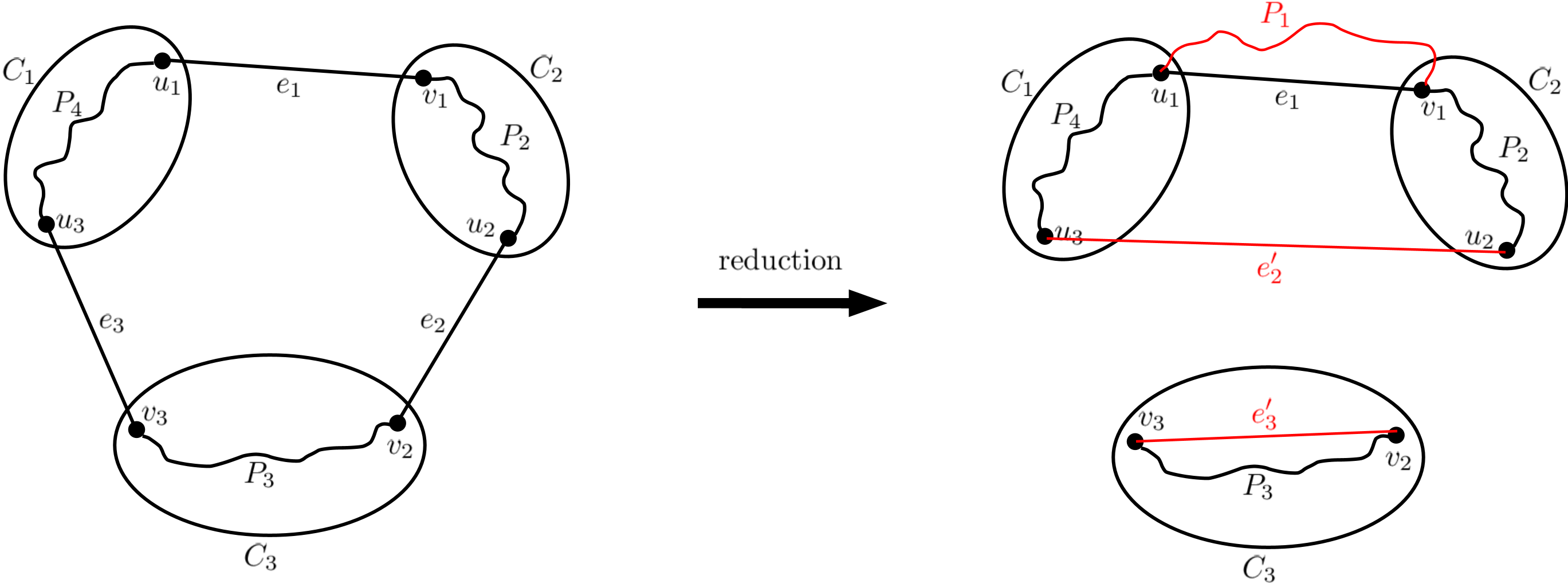
Figure 1: Demonstration of the paths P1,P2,P3 and P4 in the proof of key lemmas on the reduction strategy.
A critical lemma shows that a 2-cut reduction on a bridgeless cubic graph preserves both bridgelessness and cubicality. Each reduction step, guided by the cactus, allows for divide-and-conquer: find WSPMs in each piece and then "glue" them using prescribed-edge versions of the WSPM problem. The algorithm leverages the fact that in 3-edge-connected cubic graphs, a WSPM can always be found that either contains or avoids a specific edge, enabling consistent gluing across reductions.
A succinct depiction of the cactus representation and its preservation under reductions:
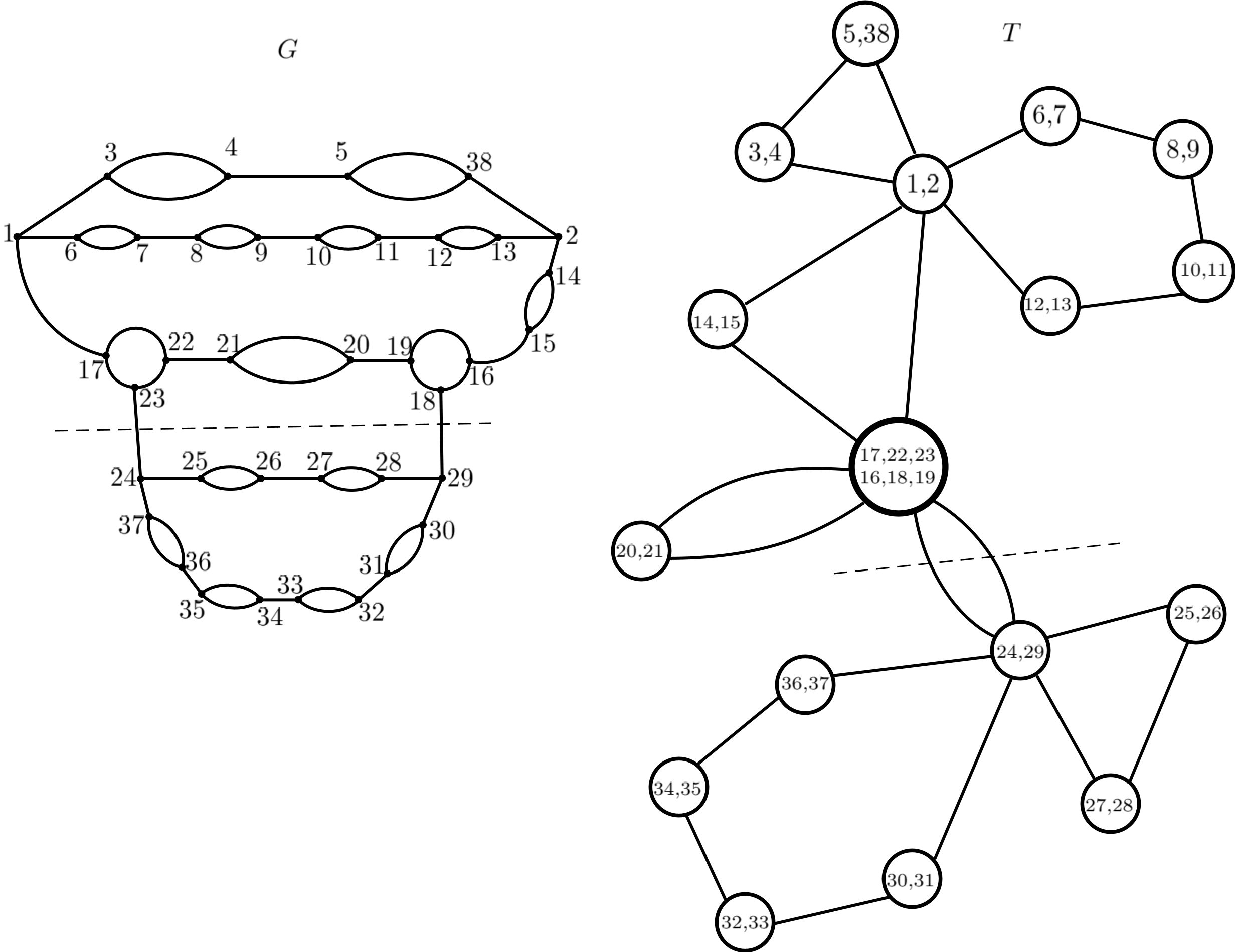
Figure 2: A cubic graph G and its cactus representation of the 2-edge-cuts. Dashed lines represent a 2-edge-cut in C0 and its mapping in the cactus C1.
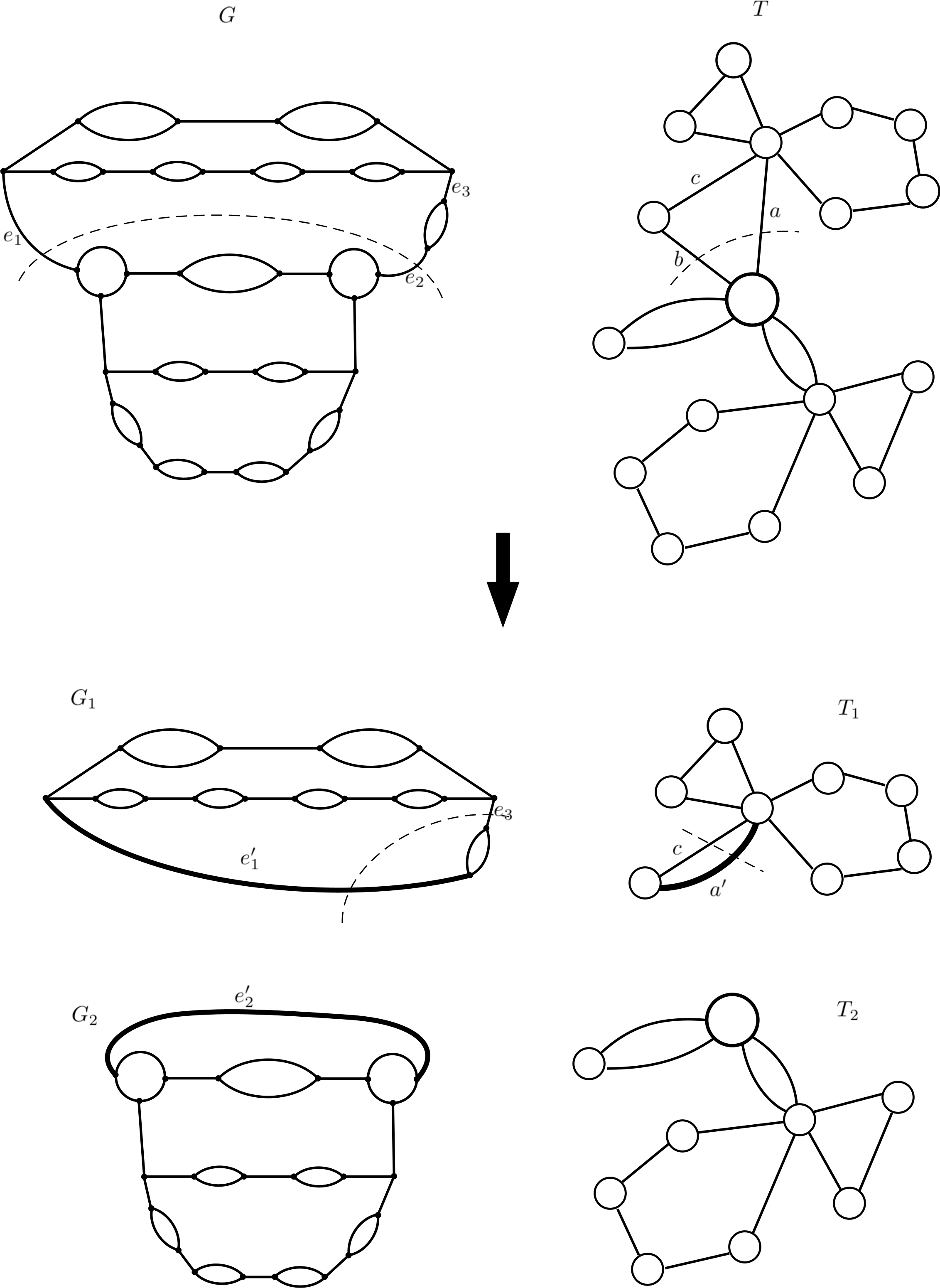
Figure 3: Illustration of the C2-reduction and cactus update; the structure of the cactus accurately tracks the persistence and correspondence of 2-edge-cuts during reductions.
Efficient updates to the cactus, the main technical advance, guarantee that all 2-edge-cuts can be maintained, tracked, and mapped back correctly in the final assembly phase.
Correctness and Running Time
Correctness is established by maintaining a strong invariant: at every reduction step, both the graph component and its associated cactus encode all 2-edge-cuts, so the recursive solving and backward gluing procedure yields a WSPM in C3 time. Each graph arising in the decomposition is bridgeless and cubic, with well-controlled size thanks to linearly bounded cactus size.
Notably, the running time is dominated by the recursive matching computations on the 3-edge-connected pieces, each solvable in near-linear time due to recent advances in perfect matching algorithms for cubic graphs. Cactus representation construction and updates are achieved in C4 total time.
Theoretical and Practical Implications
This result sharpens understanding of structural matchings in cubic graphs, moving beyond mere existence to efficient construction. The approach generalizes previous tree-based reductions to arbitrary bridgeless cubic graphs, removing the 3-edge-connectivity restriction.
From a theoretical perspective, the algorithm tightly links the structure of edge cuts, perfect matchings, and cactus representations, illustrating a deep combinatorial relationship. It also impacts related problems such as 2-factors hitting every 3- and 4-edge-cut, and connects to approximation algorithms for TSP and subgraph connectivity.
On the practical side, this facilitates faster algorithms for problems in computer science and discrete mathematics involving regular graphs, particularly in network design, combinatorial optimization, and robust matching-based decompositions.
A salient byproduct is an efficiently computable approximation to the Cycle Double Cover conjecture: the algorithm constructs, in near-linear time, a surface embedding of any bridgeless cubic graph with at most C5 singular edges, substantially improving prior approaches for this classical open problem.
Prospects for Future Research
An open question, posed explicitly in the paper, concerns extending these near-linear-time methods to efficiently compute 2-factors intersecting all minimal 3- and 4-edge cuts simultaneously, furthering the algorithmic reach in regular graph structures. Additionally, refining the algorithmic dependence on C6 or addressing more general graphs (beyond cubic) are compelling avenues.
Deeper exploration of cactus (and more complex cut) representations may unlock efficient ways to reason about intricate combinatorial structures in broader classes of subcubic or higher-degree graphs.
Conclusion
This work delivers an efficient, near-linear-time algorithm for well-spread perfect matchings in bridgeless cubic graphs by leveraging cactus representations of 2-edge-cuts and efficient reduction/gluing strategies. The approach both solves an outstanding combinatorial problem and provides a robust foundation for further advances in edge-connectivity, perfect matching computation, and related approximation algorithms in graph theory.