ATGS: Anchored Temporal Gaussian Splatting for Long Volumetric Video Representation
Abstract: Volumetric video enables immersive free viewpoint rendering of dynamic real world scenes, yet existing methods struggle with long sequences and complex motions, often leading to temporal instability and visual artifacts. To address these challenges, we propose \ourname, a Gaussian splatting based framework for volumetric video reconstruction. Our key insight is that explicitly tracking long term complex motion with individual Gaussian primitives is inherently unstable. Instead, we organize Gaussians around time conditioned anchors that localize their spatial and temporal support, thereby reducing long range motion complexity. We further introduce a temporal windowing strategy to activate only anchors relevant to the queried time, which improves scalability and temporal coherence. In addition, to ensure spatial and temporal stability, we design a compact set of multi level anchor features that encode global features, local spatial features, and local temporal features, jointly constraining Gaussian generation. Extensive experiments demonstrate that \ourname \ consistently outperforms prior methods on long sequence volumetric videos with complex motions. Project page: https://github.com/WuJH2001/ATGS.

Paper Prompts
Sign up for free to create and run prompts on this paper.
Top Community Prompts
Explain it Like I'm 14
1. What is this paper about?
This paper introduces ATGS, a computer-vision system for creating 3D videos from many regular videos recorded by different cameras.
A normal video shows a scene from one viewpoint. A volumetric video tries to capture the scene in 3D, including its shape, color, and movement. This allows a viewer to look at the scene from almost any direction, as if they were standing inside it.
This could be useful for:
- Virtual reality and augmented reality
- Sports broadcasts
- Video games
- Virtual events
- Immersive training and education
The main problem is that existing systems often work well only for short videos or slow movements. They may produce flickering, blurry objects, missing body parts, or other visual errors when a video is long and people move quickly.
ATGS is designed to handle both long videos and complicated, fast movements.
2. What questions does the research ask?
The researchers mainly want to find out:
- Can a 3D video system reconstruct scenes that last for hundreds or thousands of frames?
- Can it accurately represent fast and complicated movements, such as basketball players running and jumping?
- Can it avoid visual problems such as flickering, motion blur, drifting objects, and missing body parts?
- Can it produce high-quality novel views without requiring too much storage or computation?
- Which parts of the ATGS design are most important for its performance?
A novel view means a viewpoint that was not directly recorded by any camera. For example, if cameras filmed a basketball game from the sides, the system might generate a view from behind the players.
3. How does the method work?
Gaussian splatting
ATGS is based on a technique called 3D Gaussian Splatting.
Instead of describing a scene using a solid 3D model made from many connected triangles, Gaussian splatting represents it using many small, fuzzy 3D shapes called Gaussians. Each Gaussian has information such as:
- Its position
- Its size
- Its direction
- Its transparency
- Its color
Imagine covering a 3D scene with thousands of tiny colored, semi-transparent balls. When these balls are viewed together, they form an image of the scene. This makes rendering—creating an image from a chosen viewpoint—very fast.
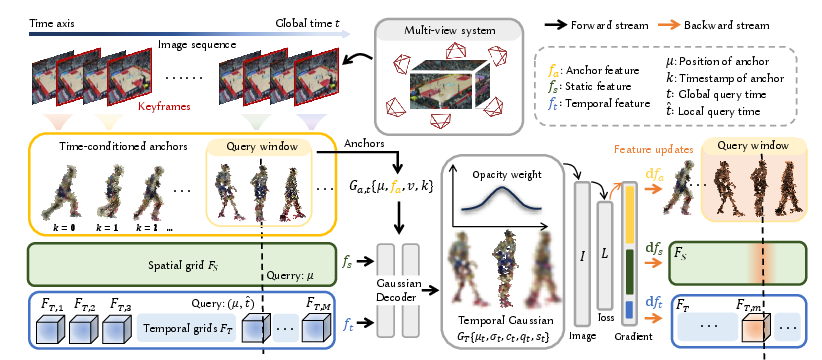
Time-conditioned anchors
The main idea in ATGS is to use anchors.
An anchor is like a small reference marker placed in a particular region of the scene at a particular time. Each anchor stores information about:
- Where it is located
- Which part of the video it belongs to
- What the nearby scene looks like
- How large an area it controls
Rather than trying to track every small Gaussian through the entire video, ATGS lets nearby anchors create and control Gaussians when they are needed.
This is similar to tracking a moving person by using several local reference points—such as one around the head, one around the hands, and one around the feet—instead of trying to follow every tiny pixel on their body for several minutes.
This makes long-term motion easier to manage and reduces the chance that errors build up over time.
Temporal windows
ATGS also uses a temporal window. At any moment, it only uses anchors from a short period around the current time.
For example, with a window of seven frames, the system uses the current frame and a few nearby frames instead of all frames in a long video. As time moves forward, the group of active anchors changes gradually.
This is like looking through a small window that slides along a long timeline. The system does not need to study the whole video at once, and nearby frames share enough information to avoid sudden changes or flickering.
Three kinds of features
The system gives each anchor three types of information, called features:
- Anchor features describe the main content near the anchor, such as the basic shape and appearance.
- Static spatial features come from a shared 3D grid. They help nearby anchors agree about stable parts of the scene, such as the floor or a person’s general shape.
- Temporal features describe what changes over a short period, such as a moving arm or a player running.
These features are passed to a small neural network, which generates the appropriate Gaussians for the current time.
Training the system
The researchers train ATGS by comparing its rendered images with real camera images.
The system receives a penalty when:
- Its pixels have the wrong colors or brightness
- Its overall structures do not look similar to the real images
- Its Gaussians become unnecessarily large
The last rule encourages the Gaussians to stay compact and close to their anchors.
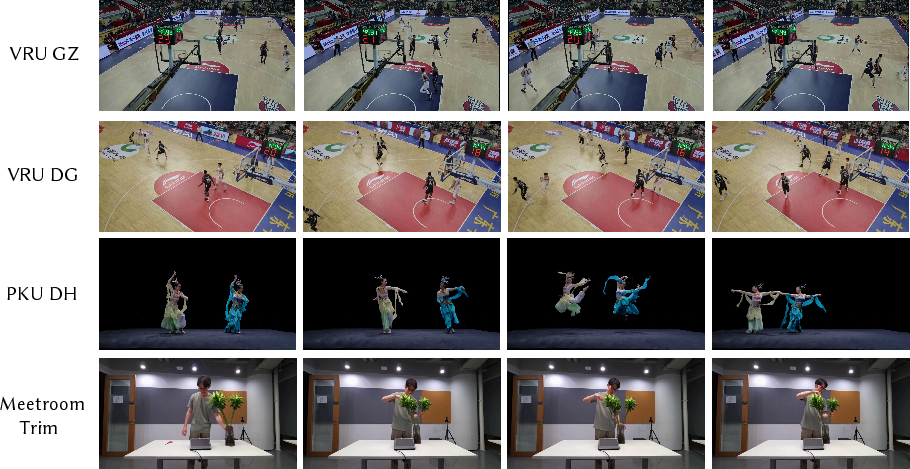
The researchers use several datasets containing multi-camera videos, including:
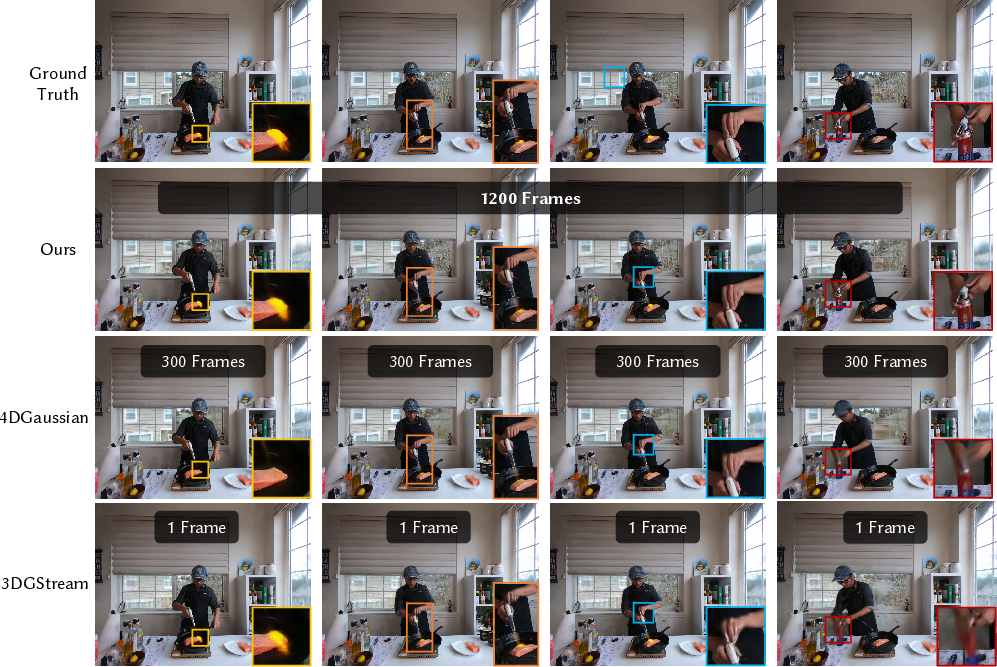
- N3DV, with up to 1,200 frames
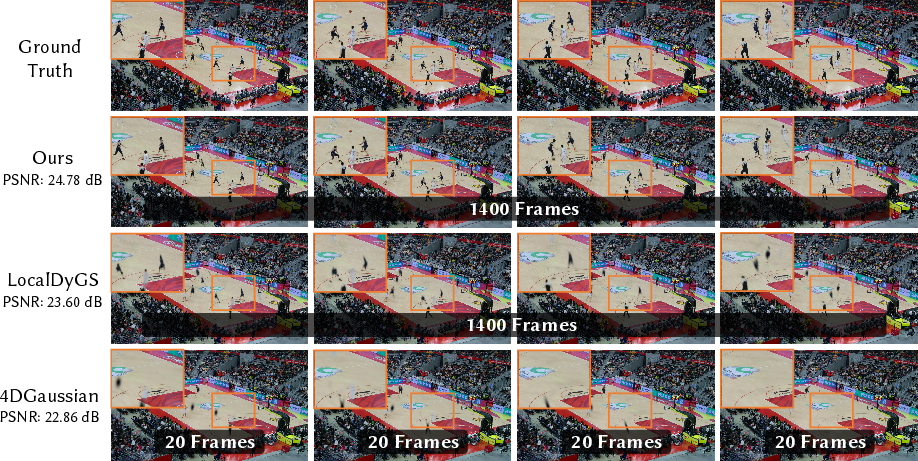
- VRU basketball, including a 1,400-frame sequence with fast movement
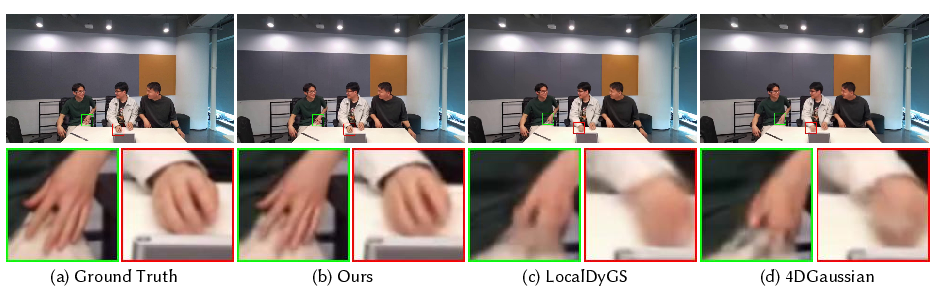
- MeetRoom, recorded from relatively few camera viewpoints
- SelfCap, with videos lasting several minutes
- PKU-DyMVHumans, containing many human actions and scenes
They compare ATGS with other systems and measure image quality using metrics such as PSNR, SSIM, and LPIPS. In simple terms:
- Higher PSNR usually means the pixels are more accurate.
- Higher SSIM means the structure and appearance are more similar.
- Lower LPIPS means the images look more similar to people.
4. What did the researchers find?
Better quality on several datasets
ATGS generally produced better images than the other tested methods.
For example, on the MeetRoom dataset, ATGS achieved a PSNR of 32.79, compared with:
- 30.27 for 4DGaussian
- 30.79 for 3DGStream
- 26.72 for StreamRF
On the N3DV dataset, ATGS achieved a PSNR of 32.56, which was higher than the other listed methods. It also produced detailed images of difficult areas, such as hands, that other systems sometimes blurred.
Better handling of long videos
A major result is that ATGS can reconstruct long sequences in one training process.
The paper reports that it can handle:
- Up to 1,200 frames in an N3DV scene
- Up to 1,400 frames in the long VRU basketball scene
- About 2,000 frames in one SelfCap experiment
- Videos lasting several minutes in the larger datasets
Some competing methods were designed for only very short clips, sometimes around 20 frames. ATGS therefore covers a much longer period without having to divide the video into many separate pieces.
Better handling of fast motion
In the VRU basketball experiments, ATGS performed better than the compared methods on long, fast-moving scenes.
For the long VRU sequence, ATGS achieved:
- PSNR: 24.78
- SSIM: 0.881
This was better than LocalDyGS, which achieved a PSNR of 23.21 and an SSIM of 0.875.
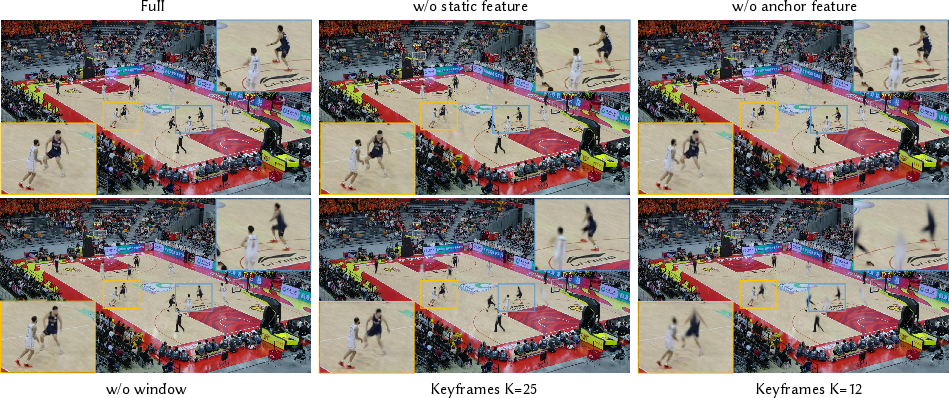
The visual comparisons showed fewer missing body parts, less blur, and fewer accumulated errors.
The different components are useful
The researchers also removed parts of ATGS to see what happened. This is called an ablation study—like taking parts out of a machine one at a time to discover which parts matter.
They found that:
- Using more temporal grids improved the results.
- Using keyframes more frequently improved the results.
- Removing the temporal window made the images worse.
- Removing either the anchor features or the static spatial features reduced image quality.
- The combination of all three feature types worked best.
Fast rendering, but not real-time training
ATGS can render images quickly after training. On one test, generating a frame took about 15.6 milliseconds, which is suitable for fast viewing.
However, the entire reconstruction process is offline. This means the system must finish training before the 3D video can be viewed. It does not yet process the camera videos live as they are being recorded.
5. Why are these findings important?
Creating a high-quality 3D video from many cameras is difficult because the system must understand both:
- The 3D shape of the scene
- How every part changes over time
For long videos, small mistakes can accumulate. An object may slowly drift away from its correct location, flicker, become blurry, or disappear. ATGS reduces this problem by dividing the motion into many local, time-based pieces instead of trying to follow everything over the entire video at once.
This could make volumetric video more practical for:
- Recording long sports events
- Creating immersive concerts
- Capturing longer VR experiences
- Building interactive game scenes
- Recording human performances from many viewpoints
6. Limitations and future impact
The method still has important limitations.
First, it depends on accurate camera positions and an initial 3D point cloud, which are estimated using a tool called COLMAP. COLMAP can be slow, especially for large datasets.
Second, ATGS may still produce slight flickering in areas that are seen by very few cameras, such as distant spectators. When the cameras do not observe a region well, the system has too little information to reconstruct it reliably.
Third, the method is trained offline rather than in real time. Future research could try to make it process long videos live and improve its performance in poorly observed areas.
Overall, the paper suggests that time-based anchors are a useful way to represent long, complicated 3D videos. ATGS does not solve every problem, but it shows that high-quality free-viewpoint video can be created for much longer and faster-moving scenes than many earlier approaches could handle.
Knowledge Gaps
未解决的知识空白、局限性与开放问题
- 尚不清楚方法能否扩展到更长时长和更高帧数。 实验主要覆盖 1,200–2,000 帧,尽管 SelfCap 和 PKU-DyMVHumans包含分钟级数据,但论文未提供完整的定量结果、训练资源或随序列长度增长的复杂度分析。
- 缺乏对计算和存储复杂度的系统分析。 论文报告了部分训练时间、模型大小和推理速度,但没有给出这些指标随关键帧数 、时间网格数 、序列长度、分辨率和锚点数量变化的规模规律。
- 关键超参数依赖人工设置。 、 和固定窗口大小 根据场景运动幅度手动调整,尚未提出能够根据运动复杂度、场景尺度或观测质量自动确定这些参数的方法。
- 时间窗口边界处的连续性尚未得到充分验证。 锚点集合按离散关键帧窗口激活,论文声称可以保证平滑演化,但没有分析窗口切换时是否存在梯度不连续、几何突变或边界闪烁。
- 锚点初始化对关键帧采样策略的敏感性未知。 锚点由周期性采样的关键帧和 COLMAP 稀疏点云初始化,但论文未比较均匀采样、运动感知采样、场景变化检测采样等策略,也未评估初始化失败对最终质量的影响。
- 快速运动、拓扑变化和遮挡变化的建模能力仍不明确。 方法主要通过锚点控制高斯的生成与消失来表示动态变化,但尚未系统评估人体肢体交叉、物体分裂或合并、显著拓扑改变、突然进入或离开场景等情况。
- 对非刚体变形与多主体交互的适用范围缺乏细致研究。 VRU 等数据集能够体现大幅运动,但论文没有分别量化单主体非刚体运动、多人遮挡、主体间接触和复杂交互对重建质量的影响。
- 动态光照、反射、透明物体和材质变化未被单独评估。 引言将动态光照列为复杂运动场景的一部分,但实验没有针对光照变化、镜面反射、透明表面或阴影运动进行控制变量分析。
- 稀疏视角下的几何可靠性仍然有限。 论文承认远处观众区域和 VRU 内场区域存在轻微抖动或欠约束问题,但没有提出或验证针对稀疏观察区域的几何先验、时序正则化或不确定性建模方案。
- 极端稀疏视角和更大视角外推的性能未知。 MeetRoom 仅使用单个测试相机,其他数据集也采用固定测试视角;尚未验证大幅偏离训练相机分布的新视角,以及相机数量进一步减少时的鲁棒性。
- 相机位姿和几何初始化误差的影响没有量化。 方法依赖 COLMAP 的相机位姿和稀疏点云,但没有进行位姿扰动、点云噪声、动态区域误匹配或 COLMAP 失败情况下的敏感性实验。
- 离线训练瓶颈尚未解决。 论文明确不支持实时处理,但没有报告端到端数据预处理、COLMAP、训练和模型加载的总时延,因此“实时渲染”并不等于实时 volumetric video 捕获或更新。
- 在线增量重建和持续更新能力未被研究。 当前方法需要完整序列进行离线优化,尚不清楚新帧到达后能否增量添加锚点、更新时间网格而不破坏已有帧的时空一致性。
- 动态特征的实际作用机制仍缺乏解释。 可视化结果显示 和 编码了大部分场景内容,而 主要控制高斯的出现和消失;论文尚未阐明该机制如何表示连续运动,也没有与显式运动场、光流或轨迹进行比较。
- 模型的可解释性和可编辑性有限。 由于动态变化通过高斯属性的联合解码产生,尚未验证能否独立编辑运动速度、动作时间、主体外观或局部区域,也不清楚锚点是否对应稳定的语义或物理实体。
- 缺少更完整的消融实验。 论文分别分析了 、、 和特征组件,但没有报告空间网格分辨率、哈希表大小、特征维度、高斯数量、解码器结构、体积正则化权重及学习率策略的影响。
- 窗口大小实验的结论不够充分。 在 VRU Long 上, 的指标差异较小,论文却将窗口机制归因于明显的时序稳定性提升;缺少专门的时序指标、长时间曲线或逐帧闪烁分析来支持这一结论。
- 时序稳定性缺少专门的评价指标。 实验主要使用 PSNR、SSIM、LPIPS 等逐帧图像指标,没有报告时序一致性、光流误差、轨迹漂移、闪烁频率或跨帧几何稳定性,因此视觉质量提升与时序稳定性之间的关系尚未被严格分离。
- 基线比较的公平性仍需加强。 部分基线只在短片段上训练,而 ATGS 在长序列上训练;不同方法可能使用不同的输入帧数、相机划分、分辨率、训练预算和初始化方式,论文未提供统一资源约束下的比较。
- 未与部分最相关方法进行直接定量比较。 由于 FreeTimeGS 和 SelfVolCap 未公开实现,论文将其排除在比较之外;缺乏通过作者提供结果、统一数据或复现版本进行的直接验证,限制了对先进方法相对优势的判断。
- 泛化实验的证据不完整。 论文声称在 SelfCap 和 PKU-DyMVHumans 上进行了广泛验证,但主要结果被放在补充视频或材料中,正文未报告跨主体、跨动作、跨场景和跨分辨率的详细统计结果。
- 对训练失败和异常场景的分析不足。 尚未说明在 COLMAP 无法估计位姿、运动模糊严重、曝光变化明显、视角覆盖不均或动态区域占比较高时,ATGS 的失败模式和恢复策略。
- 模型的实际部署成本仍不清楚。 论文未报告显存峰值、预处理耗时、不同 GPU 上的性能、模型压缩后的质量变化,以及在消费级硬件或边缘设备上的可运行性。
- 渲染质量与高斯数量之间的权衡尚未明确。 每个锚点生成 个高斯,但没有研究 对细节恢复、模型大小、推理速度和长序列扩展性的影响,也未给出自适应高斯分配策略。
- 缺乏对真实捕获噪声和传感器变化的鲁棒性研究。 实验数据的相机同步误差、曝光差异、压缩噪声、镜头畸变和深度估计误差对 ATGS 的影响尚未被单独分析。
- 论文结论部分不完整,限制了对方法边界的总结。 提供的全文在结论段落中截断,因而没有完整说明方法适用条件、已知失败案例、资源限制和未来研究方向。
Practical Applications
Immediate Applications
- Immersive sports replay and analysis — sports broadcasting, VR/AR
- Use ATGS to reconstruct extended multi-camera recordings of basketball, football, gymnastics, or martial arts and generate free-viewpoint replays at arbitrary times.
- Broadcasters could offer user-controlled viewpoints, pause-and-orbit replays, and close examination of fast movements that are difficult to capture with conventional cameras.
- Coaches and athletes could inspect body positioning, tactics, and ball-player interactions from viewpoints not present in the original footage.
- Dependencies: Requires synchronized multi-view cameras, calibrated camera poses, sufficient coverage of the playing area, and offline processing. The reported system is not a real-time capture solution and may show jitter in poorly observed regions.
- Post-produced immersive entertainment and live-event content — media, concerts, theater, museums
- Convert multi-camera recordings of performances or events into volumetric assets for later use in VR, XR, virtual production, and interactive online viewing.
- A production workflow could consist of multi-view capture, COLMAP-based camera-pose and point-cloud estimation, ATGS reconstruction, and GPU-based rendering of selected viewpoints and timestamps.
- The method is particularly suitable for long performances because it avoids independently reconstructing every short clip, reducing temporal discontinuities between segments.
- Dependencies: Offline reconstruction time, substantial GPU resources, camera synchronization, and appropriate handling of performers, lighting changes, occlusions, and audience areas.
- Free-viewpoint replay libraries — streaming and content platforms
- Build searchable archives in which users can select both a viewpoint and a moment in a long recording rather than watching a fixed camera feed.
- The temporal-anchor representation can support efficient retrieval or activation of only the anchors relevant to a requested time window, potentially reducing inference workload compared with activating the full sequence.
- A platform could expose controls such as “view from the left,” “orbit the subject,” or “replay this action from above.”
- Dependencies: The paper demonstrates real-time rendering performance on GPU hardware, but not an end-to-end streaming service. Compression, asset distribution, view-transition quality, and latency would require engineering validation.
- Human-motion visualization and training — education, fitness, dance, and professional coaching
- Use reconstructed long sequences to create interactive demonstrations of dance, martial arts, sports drills, or workplace procedures.
- Instructors could select arbitrary angles and timestamps to explain movement phases, while learners could compare their own recordings with a reference performance.
- The method’s improved handling of rapid motion may reduce blur and missing geometry in hands, limbs, and other high-motion regions.
- Dependencies: The reconstruction is primarily visual and does not itself provide biomechanical measurements, anatomical correctness, or automated skill assessment. Additional pose estimation and measurement validation would be necessary.
- Interactive VR/XR scene playback — gaming and immersive applications
- Integrate reconstructed people, rooms, or events into VR and mixed-reality experiences where users can move around a recorded scene.
- ATGS can serve as an offline asset-generation component for volumetric characters, environmental sequences, or recorded multiplayer events.
- Temporal windowing may help maintain smoother visual evolution when users scrub through long sequences or select nearby timestamps.
- Dependencies: Rendering must be optimized for headset frame rates and stereo or multi-user viewing. The current results are GPU-based, and the paper does not establish performance on mobile XR hardware.
- Sparse-view reconstruction in controlled spaces — meeting rooms, studios, and telepresence
- Reconstruct meeting-room recordings, demonstrations, interviews, or studio content from relatively sparse camera arrays and render views between or around the cameras.
- This could support remote participation, recorded telepresence, virtual site visits, and interactive review of group discussions.
- The MeetRoom results indicate that ATGS can retain detail under sparse-view conditions better than several compared methods, although the problem remains under-constrained.
- Dependencies: Performance depends strongly on camera placement and scene content. Areas hidden from most cameras may remain blurry, unstable, or geometrically inaccurate.
- Academic research infrastructure — computer graphics, computer vision, and robotics
- Use the open-source implementation and its anchor-based representation as a baseline for research on dynamic Gaussian splatting, long-duration neural rendering, temporal consistency, and sparse-view reconstruction.
- Researchers can reproduce the reported ablations by varying the number of keyframes , temporal grids , and temporal window size , then evaluate PSNR, SSIM, LPIPS, storage, training time, and rendering speed.
- The framework also provides a practical testbed for studying local versus global temporal modeling and motion decomposition.
- Dependencies: Reproducibility requires compatible datasets, accurate camera calibration, COLMAP preprocessing, and high-memory GPUs such as the reported NVIDIA A100.
- Visual documentation and cultural heritage — museums, archives, and education
- Preserve long recordings of performances, demonstrations, artifacts being manipulated, or historical reenactments as navigable 3D video rather than fixed-view footage.
- Students and visitors could inspect an event from multiple viewpoints and revisit specific temporal stages.
- Dependencies: The method captures appearance and geometry inferred from cameras; it does not guarantee archival-grade measurement accuracy. Long-term storage formats, metadata standards, provenance, and privacy controls would be needed.
- Daily-life applications: reviewing recorded events from arbitrary viewpoints
- Consumers could eventually use multi-camera home or personal recordings to create navigable memories of celebrations, sports activities, or performances.
- The most realistic near-term implementation is an offline or cloud workflow in which users upload synchronized footage and receive a rendered volumetric asset.
- Dependencies: Consumer deployment depends on reducing capture complexity, cloud cost, processing time, and privacy risks. Single-camera casual video is not sufficient for the demonstrated reconstruction quality.
Long-Term Applications
- Real-time volumetric telepresence — communications and remote collaboration
- A future version could reconstruct and stream people or groups during meetings, lessons, medical consultations, and social interaction, allowing remote users to change viewpoint naturally.
- ATGS’s temporal anchors and localized activation provide a possible basis for incremental or streaming reconstruction, but the current system is explicitly offline.
- A complete product would require online pose estimation, continuous anchor updates, low-latency encoding, adaptive bandwidth control, and synchronization across capture sites.
- Dependencies: Real-time processing, camera calibration drift, network latency, privacy, and robustness to occlusion remain unresolved.
- Large-scale sports broadcasting and stadium-scale capture — media infrastructure
- Apply the method to full-length games or events with many athletes, spectators, changing illumination, and moving cameras.
- Temporal anchors could partition complex long-duration motion while avoiding the error accumulation associated with frame-by-frame or short-clip systems.
- Potential products include interactive game replays, tactical analytics interfaces, and volumetric highlights.
- Dependencies: The paper’s experiments use fixed, calibrated multi-camera datasets. Stadium-scale deployment would require handling much larger spatial extents, more subjects, camera synchronization, moving cameras, severe occlusions, and substantially larger models.
- Robotics and embodied AI — simulation, imitation learning, and perception
- Use long multi-view reconstructions as photorealistic dynamic environments for robot navigation, manipulation, human-robot interaction, and imitation learning.
- Robots could train or be evaluated against recorded human actions from viewpoints that were not directly captured.
- Anchor-localized dynamic representations may allow temporal regions or moving objects to be queried selectively during simulation.
- Dependencies: Visual fidelity alone is insufficient for robotics. The representation would need metric-scale geometry, collision surfaces, physically meaningful object identities, uncertainty estimates, and reliable handling of unseen viewpoints.
- Healthcare and rehabilitation — clinical motion analysis
- Reconstruct long, complex patient movements for rehabilitation assessment, gait analysis, remote physical therapy, or surgical and procedural training.
- Clinicians could review motion from arbitrary viewpoints and compare movement across sessions.
- Dependencies: This application requires clinical validation, calibrated metric measurements, robust privacy protection, consent procedures, and reliable anatomical tracking. ATGS does not currently establish diagnostic accuracy or suitability for medical decision-making.
- Industrial inspection and worker training — manufacturing, energy, and construction
- Capture maintenance procedures, assembly operations, hazardous work, or equipment behavior as navigable 3D videos for training, incident review, and process optimization.
- Long-sequence modeling could preserve an entire procedure, while arbitrary-view rendering would help users inspect occluded steps or equipment interactions.
- Dependencies: Industrial deployment requires accurate scale, stable geometry, sensor fusion, handling of reflective or textureless surfaces, and integration with enterprise asset-management systems. Safety-critical use would require independent verification.
- Digital twins and operational monitoring — smart facilities and energy
- Extend reconstructed dynamic scenes into time-indexed digital twins of factories, laboratories, buildings, or energy facilities.
- Operators could review how people, vehicles, and equipment moved through a facility and use the data for layout analysis or incident reconstruction.
- Dependencies: ATGS is a visual reconstruction method rather than a complete digital-twin system. Integration with sensors, semantic labels, object tracking, physical simulations, access control, and continuous updating would be necessary.
- Policy, public safety, and legal evidence — government and justice
- Fuse synchronized camera footage into a navigable record of public events, emergency responses, traffic incidents, or infrastructure failures.
- Investigators could examine an event from multiple synthesized viewpoints and inspect its evolution over time.
- Dependencies: Novel-view synthesis is not automatically forensic truth. Any use as evidence would require provenance, immutable raw data, calibration records, uncertainty quantification, auditability, and safeguards against treating synthesized views as directly observed footage. Privacy and surveillance regulation are major constraints.
- Long-term volumetric video compression and delivery standards — telecommunications and software
- Develop compact, temporally addressable asset formats based on anchors, local features, temporal grids, and Gaussian parameters.
- A decoder could activate only the temporal window needed for playback, enabling adaptive delivery of long volumetric sequences and potentially lowering memory or bandwidth requirements.
- Dependencies: The reported model sizes and rendering results are dataset- and hardware-dependent. Standardization would require rate-distortion studies, robust compression, random-access benchmarks, cross-platform decoders, and quality guarantees under network constraints.
- Generative editing of captured 4D scenes — creative software
- Build tools for temporal replacement, viewpoint-aware cropping, object removal, relighting, retiming, or compositing of reconstructed events.
- The separation between static spatial features and local temporal features could support editing workflows that modify motion while preserving stable scene structure.
- Dependencies: The paper does not demonstrate semantic disentanglement, editable object identities, relighting, or physically correct appearance manipulation. These capabilities would require additional scene understanding and generative models.
- Mass-scale human-motion datasets and behavioral research — academia and public research
- Apply the framework to datasets such as long multi-view human-action collections to create navigable training data for pose estimation, action recognition, animation, and social interaction research.
- It could help convert large multi-view archives into temporally coherent assets without independently storing a full Gaussian model for every frame.
- Dependencies: Dataset bias, consent, biometric privacy, demographic representation, annotation quality, and the computational cost of processing millions of frames must be addressed before broad deployment.
- Consumer-grade volumetric cameras and personal media — daily life
- Combine several smartphones or inexpensive cameras with automated calibration and ATGS-style reconstruction to create interactive 3D memories, remote family experiences, or personal performance reviews.
- A future workflow could automatically select keyframes, estimate poses, construct anchors, compress the resulting asset, and render it on a phone or headset.
- Dependencies: Current requirements—synchronized multi-view input, COLMAP preprocessing, offline optimization, and powerful GPUs—are substantially beyond ordinary consumer workflows. Advances in feed-forward calibration, edge acceleration, privacy-preserving processing, and model compression are required.
Glossary
- 6-DoF free-viewpoint rendering: Rendering that allows independent control of three translational and three rotational viewing degrees of freedom. “enables full 6-DoF free-viewpoint rendering.”
- 4D Gaussian representation: A representation of dynamic scenes using Gaussian primitives defined over three spatial dimensions and time. “4D Gaussian based methods represent dynamics using explicit spatio temporal Gaussian primitives”
- 4D hash grid: A hashed feature grid defined over three spatial coordinates and one temporal coordinate. “each is instantiated as a 4D hash grid.”
- Ablation study: An experiment that removes or varies components of a method to measure their individual contributions. “The ablation study on the number of temporal grids on GZ.”
- Anchor feature: A learnable feature associated with an anchor that encodes local scene information. “each anchor is augmented with both spatial and temporal features”
- Canonical space: A reference spatial configuration to which dynamic observations are transformed. “learning deformation fields that warp a canonical space over time.”
- COLMAP: A structure-from-motion and multi-view-stereo system used to estimate camera poses and sparse 3D geometry. “our approach relies on camera poses and sparse point clouds estimated by COLMAP.”
- Compactness regularization: A constraint that penalizes overly large representations to encourage spatially concentrated primitives. “a compactness regularization term”
- Deformation field: A learned function that maps points from one spatial configuration to another, often across time. “model dynamic scenes by learning deformation fields that warp a canonical space over time.”
- DSSIM: A dissimilarity measure derived from the Structural Similarity Index, with lower values indicating greater image similarity. “DSSIM sets data range to 1.0 while DSSIM to 2.0”
- End-to-end training: Joint optimization of all components of a model using a single overall objective. “the entire model is trained end-to-end with image-based losses and regularization”
- Feed-forward camera pose estimation: Direct prediction of camera poses by a learned model without iterative scene-specific optimization. “the rapid progress of feed-forward camera pose estimation and scene reconstruction methods”
- Free viewpoint rendering: Synthesis of images from arbitrary camera positions or orientations. “enabling photorealistic free viewpoint rendering.”
- Gaussian decoder: A neural function that converts learned features into the parameters of Gaussian primitives. “We decode these features using a Gaussian decoder”
- Gaussian primitive: A parameterized volumetric element, typically described by position, orientation, scale, opacity, and color. “explicitly tracking long term complex motion with individual Gaussian primitives”
- Gaussian splatting: A rendering technique that projects and composites 3D Gaussian primitives into images. “a Gaussian splatting based framework for volumetric video reconstruction.”
- Geometric prior: Pre-existing structural information or assumptions about scene geometry used to constrain reconstruction. “stronger temporal regularization or additional geometric priors”
- Hash encoding: A memory-efficient technique that stores multiresolution spatial features in hashed tables. “Instant-NGP introduces a multi-resolution hash encoding to store node features efficiently”
- Hierarchical feature representation: A multilevel feature design that combines information at different spatial or temporal scales. “we introduce a hierarchical anchor feature formulation”
- Image-based rendering: Rendering novel images using visual observations rather than explicitly reconstructing complete surfaces. “Computing methodologies~Image-based rendering”
- Implicit feature: A learned feature stored in a continuous or discretized field and decoded into scene properties. “4D grid based methods adopt compact spatio temporal grids to store implicit features”
- Inter-frame error accumulation: Progressive propagation of reconstruction errors from one video frame to subsequent frames. “they require substantial storage and often suffer from inter-frame error accumulation”
- Keyframe: A selected representative video frame used to initialize or supervise scene representations. “periodically sampled keyframes”
- LPIPS: A perceptual image-distance metric based on deep neural network feature activations. “our method consistently achieves superior reconstruction quality in terms of PSNR, SSIM, and LPIPS”
- MLP: A multilayer perceptron, or feed-forward neural network composed of fully connected layers. “The function is a lightweight MLP”
- Motion drift: Gradual deviation of estimated motion from the correct trajectory over time. “where temporal instability, motion drift, and visual artifacts often emerge.”
- Multi-level feature: A feature representation combining global, local spatial, and local temporal information. “a compact set of multi level anchor features”
- Multi-plane factorization: Decomposition of a high-dimensional scene representation into multiple lower-dimensional planes. “multi-plane factorizations”
- Multi-view stereo: A technique for recovering 3D structure from multiple images captured from different viewpoints. “COLMAP provides accurate and robust geometric initialization”
- Neural radiance field (NeRF): A neural representation that predicts scene density and view-dependent color for volumetric rendering. “Neural Radiance Fields (NeRF) have attracted significant attention”
- Neural rendering: The use of learned models to synthesize images or videos from scene representations. “data driven volumetric representations have become the dominant approach”
- Novel view synthesis (NVS): Generation of images from viewpoints not present in the input captures. “enables novel view synthesis (NVS) at arbitrary viewpoints and time steps.”
- Opacity: A parameter describing the degree to which a primitive attenuates or blocks light. “orientation , scale , opacity , and color ”
- Photorealistic rendering: Image synthesis designed to achieve visual realism comparable to photographs. “enabling photorealistic free viewpoint rendering.”
- Point trajectory: The time-varying path followed by a represented 3D point. “the model no longer needs to explicitly model Gaussian point trajectories”
- Quadrilinear interpolation: Interpolation over a four-dimensional grid, here involving three spatial coordinates and time. “via quadrilinear interpolation to obtain a temporal feature”
- Radiance field: A function describing the color and emitted light at points in a scene as viewed from different directions. “Neural Radiance Fields (NeRF)”
- ReLU activation: The rectified linear unit function, commonly defined as , used in neural networks. “with ReLU activation”
- Scene geometry: The spatial structure and shape of objects and surfaces in a scene. “By jointly modeling geometry and appearance”
- Sparse point cloud: A set of relatively few 3D points representing observed scene structure. “camera poses and sparse point clouds estimated by COLMAP.”
- Spatio-temporal representation: A representation that jointly models spatial structure and temporal variation. “a hierarchical spatio-temporal feature representation”
- SSIM: Structural Similarity Index, an image-quality metric comparing luminance, contrast, and structure. “we adopt standard image reconstruction losses, including the loss and the structural similarity loss”
- Temporal coherence: Consistency of appearance, geometry, and motion across adjacent times or frames. “improves scalability and temporal coherence.”
- Temporal jitter: Unwanted frame-to-frame fluctuations in reconstructed geometry or appearance. “it effectively reduces temporal jitter”
- Temporal windowing: Restricting computation to representations associated with a local interval around a queried time. “we employ a temporal windowing strategy that activates only anchors relevant to the queried time”
- Trilinear interpolation: Interpolation within a three-dimensional grid using the eight neighboring grid values. “each anchor queries the spatial grid via trilinear interpolation”
- Volumetric rendering: Image formation by integrating scene properties through a three-dimensional volume. “The resulting set of Temporal Gaussians is then used for volumetric rendering.”

