TRiGS: Temporal Rigid-Body Motion for Scalable 4D Gaussian Splatting
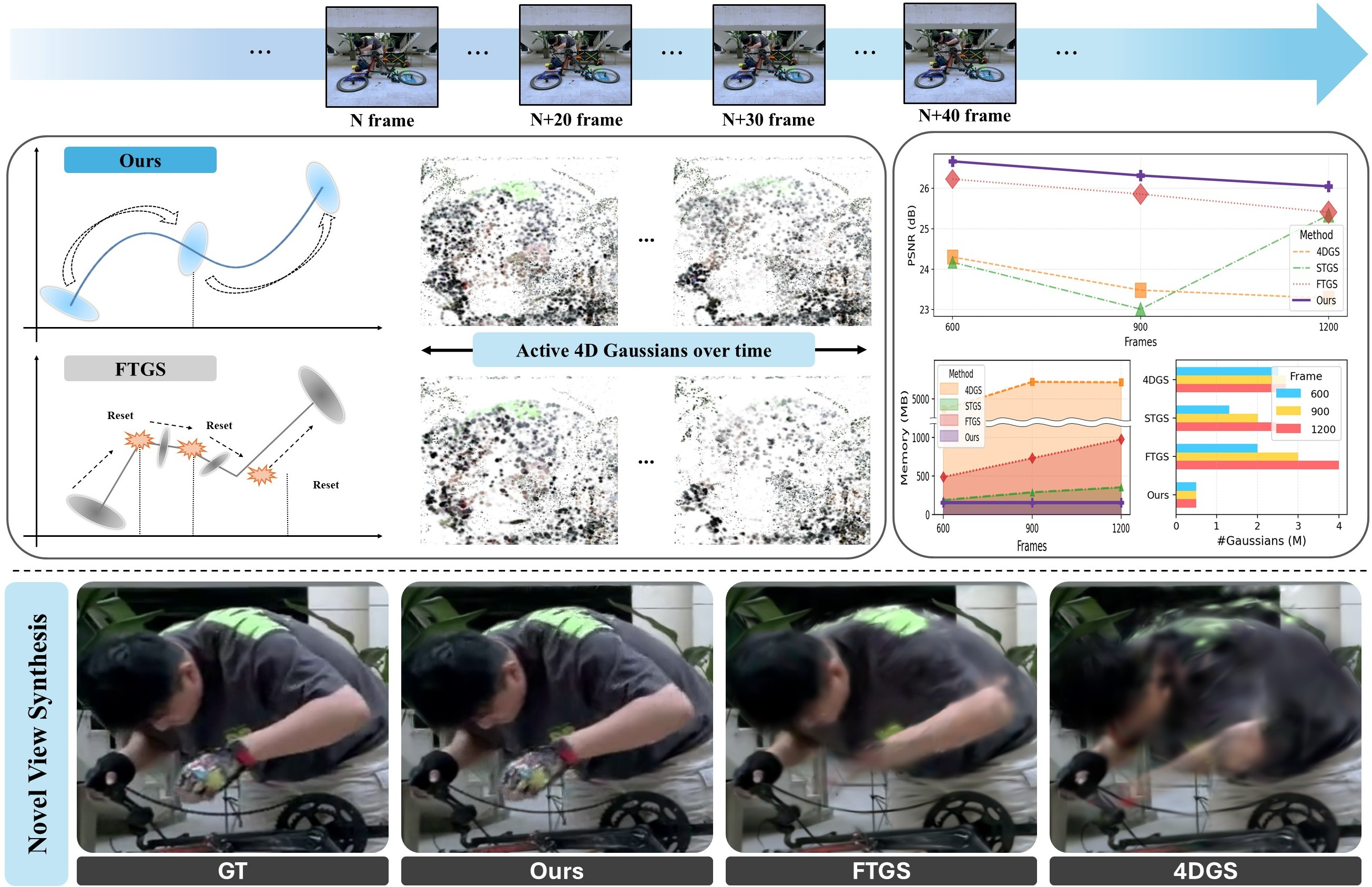
Abstract: Recent 4D Gaussian Splatting (4DGS) methods achieve impressive dynamic scene reconstruction but often rely on piecewise linear velocity approximations and short temporal windows. This disjointed modeling leads to severe temporal fragmentation, forcing primitives to be repeatedly eliminated and regenerated to track complex nonlinear dynamics. This makeshift approximation eliminates the long-term temporal identity of objects and causes an inevitable proliferation of Gaussians, hindering scalability to extended video sequences. To address this, we propose TRiGS, a novel 4D representation that utilizes unified, continuous geometric transformations. By integrating $SE(3)$ transformations, hierarchical Bezier residuals, and learnable local anchors, TRiGS models geometrically consistent rigid motions for individual primitives. This continuous formulation preserves temporal identity and effectively mitigates unbounded memory growth. Extensive experiments demonstrate that TRiGS achieves high fidelity rendering on standard benchmarks while uniquely scaling to extended video sequences (e.g., 600 to 1200 frames) without severe memory bottlenecks, significantly outperforming prior works in temporal stability.










Paper Prompts
Sign up for free to create and run prompts on this paper using GPT-5.
Top Community Prompts
Explain it Like I'm 14
TRiGS: An easy-to-understand explanation
Overview: What is this paper about?
This paper introduces TRiGS, a new way to make realistic 3D videos from regular videos. Think of it like building a moving 3D scene out of lots of tiny, soft “glow points” (called Gaussians). TRiGS helps these points move smoothly over time so you can look around the scene from any angle—like in VR—without blurriness or weird motion glitches, even for long videos.
What questions does the paper try to answer?
The authors focus on two main questions:
- How can we model moving objects in 3D videos so their motion stays smooth and consistent over time?
- How can we keep the memory use small and steady, even for long videos with hundreds or thousands of frames?
How does it work? (Using simple analogies)
Most older methods let each “glow point” move in short, straight-line bits. That’s like trying to follow a curvy road using only straight lines—you constantly have to stop and redraw, which causes mistakes. Those mistakes lead to creating more and more points, which eats up memory and causes flickering or blurring.
TRiGS fixes this with three key ideas:
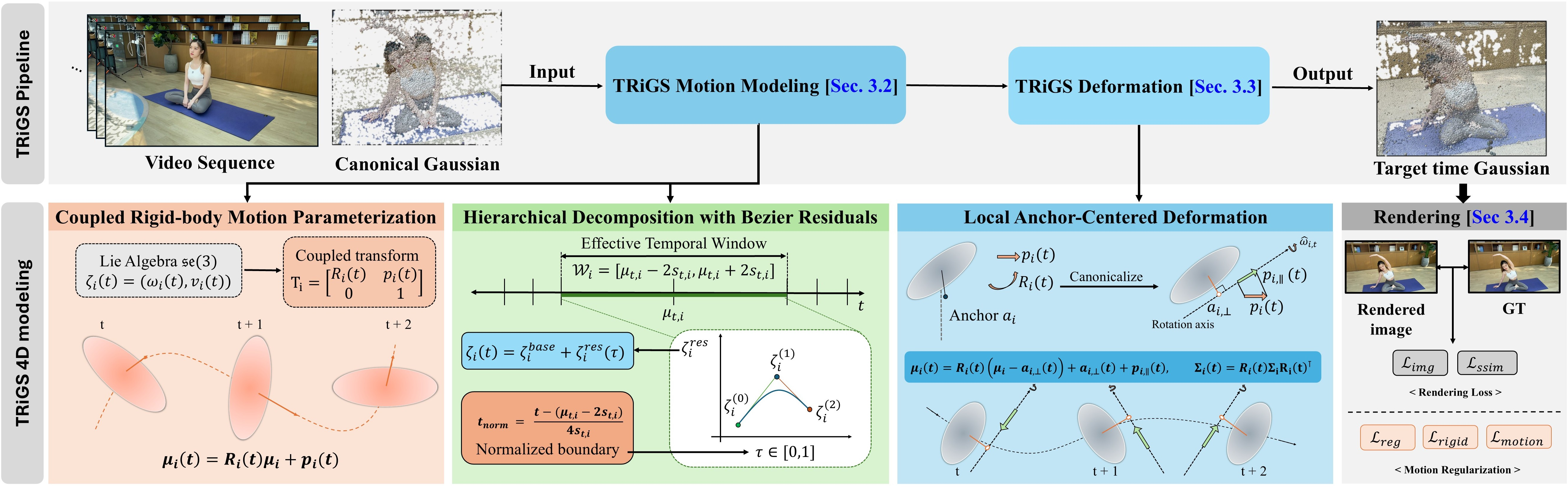
- Continuous rigid motion (move + rotate together): Imagine each point is part of a tiny toy block that can move and spin in one smooth motion. TRiGS uses a math toolbox (called ) that bundles moving and rotating into one clean, continuous motion. This helps each point stick to an object’s real path instead of drifting off.
- Curved motion corrections (Bézier residuals): Real motion often curves (like a swinging arm or a turning wheel). TRiGS adds a gentle, smooth “curve” adjustment using a Bézier curve—think of it as drawing a smooth arc instead of a jagged line. This keeps motion accurate without chopping it into many pieces.
- Local anchors (each point has its own pivot): Different parts of an object can rotate around different spots—like a door around its hinge or a wheel around its axle. TRiGS gives each point its own “anchor” (pivot) to rotate around. It also uses a trick (called gauge fixing) to remove ambiguity so the system learns a clear, stable motion.
To keep everything efficient, TRiGS:
- Trains the points by comparing rendered images to real video frames, using extra rules that encourage smooth, consistent motion.
- Recycles unused points instead of endlessly creating new ones. If a point isn’t helping much, TRiGS moves it to a harder area—like reassigning a player to where the action is.
What did they find, and why is it important?
The team tested TRiGS on popular dynamic-scene datasets (N3V and SelfCap) and compared it to leading methods. The main results:
- Better and more stable quality over long videos: TRiGS kept images sharp and prevented flickering or ghosting even for long sequences (600–1200 frames), where other methods started to break down.
- Much lower memory usage with steady speed: While other methods needed more and more points (and memory) as videos got longer, TRiGS kept the number of points constant (about 0.5 million) and used far less memory. It also stayed fast (over ~110 frames per second in tests).
- State-of-the-art accuracy on standard-length videos: Even on normal-length scenes, TRiGS achieved top or near-top scores, showing it’s not just good for long videos—it’s strong overall.
Why this matters:
- Smooth, reliable motion makes 3D scenes look real from any viewpoint.
- Using fewer points and less memory makes the system practical, especially for real-time experiences like VR/AR or interactive 3D video.
What’s the impact?
TRiGS shows a better way to handle motion in 3D video: treat motion like real-world moving and rotating objects, not as a bunch of short, straight segments. This leads to:
- More realistic, stable 3D videos over time
- Consistent memory use (good for long recordings and limited hardware)
- Faster rendering, enabling interactive applications
In short, TRiGS helps build high-quality, long, dynamic 3D scenes that are efficient and stable—paving the way for better VR, AR, film production, and any technology that needs smooth, believable 3D video.
Knowledge Gaps
Knowledge gaps, limitations, and open questions
Below is a concise list of concrete gaps and open questions that remain unresolved and could guide future research.
- Non-rigid, elastic, and topological changes
- How does a per-primitive rigid-body model with quadratic Bézier residuals handle strongly non-rigid phenomena (e.g., cloth, hair, fluids) or topology changes (object splitting/merging)? Are additional non-rigid degrees of freedom or per-primitive scaling needed beyond rotation-only covariance updates?
- Limited deformation model for shape changes
- Covariances are only rotated () without time-varying scaling or shearing. Can introducing per-primitive time-dependent scaling/anisotropy improve representation of local expansions/compressions without sacrificing rigidity?
- Expressivity of quadratic Bézier residuals
- Are quadratic Bézier residuals sufficient for high-frequency, periodic, or abruptly changing motions? What is the trade-off when moving to higher-order splines, piecewise splines with continuity constraints, or learned basis functions?
- Effective temporal window and long-range motion
- Temporal modeling is restricted to an “effective window” with clamped . How are initialized/learned, and can the method maintain identity through long occlusions, cyclic motions, or returns after long gaps when gradients vanish outside ?
- Stability near zero rotation and gauge fixing
- The anchor gauge-fixing projects onto the plane orthogonal to the rotation axis and relies on small-angle stabilization (in supplement). How numerically stable and identifiable are anchors when or when axes rapidly change over time?
- Independent per-primitive motion vs. object-level constraints
- Motions are coupled only through local appearance-based regularization . Can learned part-level or skeleton constraints improve global rigidity and prevent shearing across occluded regions? How to automatically discover groups of primitives that share articulated constraints?
- Sensitivity to hyperparameters and initialization
- No systematic study of sensitivity to weights, neighbors, , opacity thresholds (), relocation interval (), or initialization (RoMa). Which settings are critical and how robust is training under different initializations or camera pose noise?
- Handling of illumination and photometric changes
- The method assumes photometric consistency. How does TRiGS cope with time-varying lighting, exposure, and specularities? Are time-dependent appearance models or photometric normalization necessary to maintain stability on in-the-wild videos?
- Camera assumptions and pose quality
- Experiments assume calibrated cameras; robustness to pose noise, rolling shutter, or synchronization errors is not analyzed. How does performance degrade with realistic pose uncertainty or when only monocular inputs are available?
- Training cost and scalability beyond 1200 frames
- While inference FPS is reported, training time, memory usage during optimization, and scaling beyond 1200 frames are not reported. What are the compute/memory trends for very long recordings (tens of thousands of frames)?
- Streaming/online training and continual adaptation
- The approach targets a fixed primitive budget but does not propose an online/streaming optimization scheme. How can TRiGS be adapted for continual learning without revisiting past frames, and how stable is it under streaming data with distribution drift?
- Motion-guided relocation design choices
- The relocation policy relies on difficulty cues defined in the supplement and an opacity threshold. How sensitive is performance to these heuristics, and how do different selection strategies compare (e.g., information-theoretic or uncertainty-driven)?
- Fairness and budget-controlled comparisons
- Baseline methods are allowed gradient-based densification while TRiGS uses fixed-budget relocation. A thorough budget-controlled comparison (same number of Gaussians and memory for all methods) is missing to isolate motion-model benefits from capacity differences.
- Temporal consistency metrics
- Evaluations focus on PSNR/SSIM/LPIPS; no explicit temporal stability metrics (e.g., tLPIPS, optical-flow warping error) are reported. How does TRiGS compare on motion-consistency metrics, especially under long sequences and fast motions?
- Occlusion/disocclusion robustness
- It is unclear how well the model handles large disocclusions or persistent occlusions, especially with local temporal windows and fixed budgets. Are there failure cases with sudden visibility changes or large parallax?
- Dataset breadth and generalization
- Results are shown on SelfCap and N3V. How does TRiGS generalize to diverse, challenging in-the-wild datasets with complex backgrounds, handheld monocular videos, or scenes with extreme non-rigidity?
- Appearance-based regularization across object boundaries
- The local coherence term uses DC SH color similarity (). How often does this inadvertently couple different objects with similar colors or fail at textured boundaries, and can geometry-/segmentation-aware affinities mitigate this?
- Identity preservation vs. temporal opacity
- Temporal opacity enforces finite lifetimes for primitives. How does this reconcile with claims of long-term identity preservation for very long videos, and could adaptive or learnable lifetime scheduling be necessary?
- Numerical stability of exponential map and Jacobians
- Robustness of the left Jacobian computation under large rotations, very small angles, and single-precision arithmetic is not quantified. Are there edge cases where the parameterization causes drift or artifacts?
- Interaction with densification and pruning
- The method avoids standard densification to keep memory fixed. Can a hybrid scheme (budget-aware densification with aggressive pruning/relocation) further improve quality without memory bloat?
- Covariance and color dynamics over time
- Covariance and SH appearance are not explicitly time-conditioned beyond rigid rotation and opacity. Would time-varying covariance magnitudes or appearance parameters (e.g., learned temporal emissivity) reduce ghosting or improve fine detail reproduction?
- Robustness to motion blur and fast dynamics
- No evaluation under motion-blurred inputs or extremely high-speed motions. Can the model disambiguate blur-induced appearance changes from geometry-induced motion, or does it misfit trajectories?
- Scene editing and controllability
- Given the explicit parameterization and local anchors, can TRiGS support controllable motion editing or constraint-based animation? How can the learned motion parameters be mapped to user-editable controls?
- Failure case analysis and qualitative diagnostics
- The paper emphasizes improvements but lacks a systematic failure analysis (e.g., common artifacts, conditions that trigger drift, anchor misestimation, or relocation failures). Diagnostic tools to detect and correct such failures remain unexplored.
- Code and reproducibility details
- Critical components (e.g., difficulty cues, small-angle stabilization, implementation of gauge fixing) are relegated to the supplement. Public code and detailed reproducibility guidelines would clarify how sensitive results are to these implementation choices.
Practical Applications
Immediate Applications
Below is a concise set of near-term, actionable uses that can be deployed with today’s multi‑camera capture setups, GPU resources, and existing 3DGS toolchains.
- High‑fidelity, long‑sequence free‑viewpoint video in production pipelines (Media/Entertainment, Sports Broadcasting)
- What: Produce temporally stable novel views of dynamic scenes (e.g., performances, stunts, sports plays) over hundreds–thousands of frames without memory bloat.
- Why TRiGS: Continuous motion with Bézier residuals and local anchors maintains temporal identity and quality over long sequences at 110+ FPS with ~160 MB memory for 0.5M Gaussians.
- Tools/workflows:
- A “TRiGS Authoring” module that ingests calibrated multi‑view footage, trains the model, and exports 4DGS assets.
- Viewer plugins for Unreal/Unity/Blender to render TRiGS assets in real time for editorial, virtual camera moves, and previz.
- Assumptions/dependencies: Synchronized, calibrated multi‑camera rigs; offline training time (e.g., 30k iterations on a high‑end GPU); mostly locally rigid motion; stable lighting or appearance modeling via 3DGS SH colors.
- Volumetric sports replays and analysis at broadcast scale (Sports Tech)
- What: Create 6‑DoF replays for extended sequences (full plays or routines) without degrading quality over time.
- Tools/workflows: Stadium multi‑cam capture → TRiGS reconstruction → replay engine for producers and analysts.
- Assumptions/dependencies: Multi‑view camera coverage and calibration; offline processing latency; data governance for athlete capture.
- Memory‑compact 4D content for VR/AR experiences (XR Content Production)
- What: Deliver precomputed, dynamic 4D assets (concerts, dance, theater) with stable playback on head‑mounted devices.
- Tools/products: TRiGS-to-XR asset exporter; lightweight runtime renderer (GPU/WebGPU) embedded in XR apps.
- Assumptions/dependencies: Pre‑recorded content; client‑side GPU rendering support; content distribution pipeline for 4D assets; consistent lighting.
- Game development: dynamic character and prop capture (Gaming/Interactive Media)
- What: Replace or augment traditional mocap/meshing for certain scenes with faithful 4D reconstructions of complex articulated motions.
- Tools/workflows: TRiGS capture on soundstage → asset bake into engine‑compatible format → in‑engine playback.
- Assumptions/dependencies: Multi‑cam stage; offline asset preparation; acceptance of appearance‑driven rendering versus mesh‑rig pipelines for specific use cases.
- Cultural heritage and performance archiving (Museums/Arts)
- What: Long‑duration, high‑fidelity recording of performances or demonstrations with efficient storage and robust temporal consistency.
- Tools/products: Curatorial archive tools with TRiGS encoding and a web viewer for interactive playback.
- Assumptions/dependencies: Multi‑camera capture environment in venues; permissions and rights management.
- Product demos with dynamic mechanisms (E‑commerce/Marketing)
- What: Interactive 4D demos of devices with moving parts (folds, hinges), enabling users to explore motions from any view.
- Tools/products: In‑house TRiGS pipeline for product studios; web viewer integration.
- Assumptions/dependencies: Studio capture rig; limited scene scale; web‑friendly renderers.
- Robotics and autonomy dataset generation and simulation assets (Robotics/Autonomous Systems)
- What: Build realistic, long‑sequence dynamic scenes for perception model training and evaluation; generate synthetic viewpoints cheaply.
- Tools/workflows: Capture lab scenes → TRiGS reconstruction → render multi‑view training sets or serve as dynamic background in simulators.
- Assumptions/dependencies: Offline processing acceptable; scenes with locally rigid dynamics; domain gap with outdoor conditions.
- Academic benchmarks and reproducible long‑video 4D recon (Academia)
- What: Use TRiGS as a baseline for research on dynamic scene representations, motion priors, and long‑term temporal consistency.
- Tools/workflows: Open‑source training scripts; standardized evaluation on long sequences; ablation frameworks.
- Assumptions/dependencies: Access to compute (e.g., single high‑end GPU) and multi‑view datasets; reproducible camera calibration.
- Enterprise archives and internal video compression for dynamic scenes (Enterprise Media Asset Management)
- What: Store complex multi‑view recordings as compact 4D representations for later interactive viewing.
- Tools/workflows: Ingest → TRiGS encoding → asset management system → interactive player.
- Assumptions/dependencies: Archives with multi‑view footage; institutional acceptance of neural representations; retention and access policies.
Long‑Term Applications
These applications are feasible with further advances in online optimization, reduced capture requirements, standardization, and integration with broader systems.
- Live volumetric telepresence with continuous updates (Communications/XR)
- What: Near‑real‑time 4D reconstruction and streaming of people/objects for teleconferencing and events.
- Enablers: Incremental/online TRiGS training; sparse camera setups; low‑latency streaming of Gaussian updates; edge/cloud acceleration.
- Dependencies/assumptions: Robust online calibration and synchronization; bandwidth‑aware codecs for 4DGS; privacy and consent frameworks.
- On‑device dynamic scene mapping for AR glasses (Consumer XR, Mobile Computing)
- What: Real‑time reconstruction of dynamic environments to support occlusion, physics, and shared AR interactions.
- Enablers: Fast on‑device inference; fusion with SLAM/IMU; compact GPU/ASIC implementations; energy‑aware rendering.
- Dependencies/assumptions: Limited compute/power; need for online adaptation, single/few‑view capture; resilience to non‑rigid deformations and lighting changes.
- Dynamic world models for robots and autonomous vehicles (Robotics/AV)
- What: 4D representations of dynamic scenes for prediction, planning, and simulation across long horizons without memory blow‑up.
- Enablers: Multi‑sensor fusion (LiDAR/RGB/IMU) with TRiGS‑style motion priors; uncertainty modeling; integration with tracking and forecasting.
- Dependencies/assumptions: Outdoor/complex scenes with non‑rigid agents; real‑time updates; fail‑safe behavior and safety certification.
- Standardized 4D Gaussian codecs and interchange formats (Media Technology, Policy/Standards)
- What: Industry standards for storage, streaming, and playback of 4DGS assets (akin to glTF/NPZ for 3DGS).
- Enablers: Reference decoders, compression schemes (quantization/pruning), compatibility layers for engines.
- Dependencies/assumptions: Broad industry adoption; IP and interoperability considerations; regulatory guidance for volumetric media.
- Sports biomechanics and coaching analytics at scale (Sports Science/Health)
- What: Quantitative analysis pipelines using long 4D reconstructions for kinematics, technique feedback, and injury prevention.
- Enablers: Fusion of TRiGS assets with pose estimation and physics‑based models; automated segmentation of body parts from local anchor motions.
- Dependencies/assumptions: Accurate multi‑view capture in training facilities; athlete data governance; validated metrics.
- Surgical training and intraoperative guidance (Healthcare)
- What: High‑fidelity, interactive 4D recordings of procedures for education and, eventually, augmented guidance.
- Enablers: Multi‑scope calibrated capture; sterile, compact rigs; robust handling of non‑rigid tissues and specularities.
- Dependencies/assumptions: Regulatory approval; strong privacy/security; integration with medical imaging standards; real‑time capability remains a research goal.
- Smart factory digital twins with long‑horizon dynamics (Manufacturing/Industry 4.0)
- What: Persistent, memory‑efficient 4D twins depicting machine/line operations for monitoring and training.
- Enablers: Continuous ingestion from calibrated industrial camera arrays; TRiGS‑style motion priors per machine component.
- Dependencies/assumptions: Integration with OT/IT systems; safety and IP protection; handling of non‑rigid materials and variable illumination.
- Public safety, forensics, and incident reconstruction (Government/Public Sector)
- What: 4D reconstructions from multi‑camera CCTV for event analysis and evidence visualization.
- Enablers: Automated calibration from existing infrastructure; robust handling of occlusions and low‑light.
- Dependencies/assumptions: Legal frameworks for capture/use; chain‑of‑custody standards; data minimization and privacy safeguards.
- Consumer social volumetric posts (Social Media/UGC)
- What: Multi‑phone ad‑hoc capture of dynamic moments to create shareable 4D experiences.
- Enablers: Automatic multi‑phone calibration/synchronization; cloud/mobile TRiGS; simple viewers.
- Dependencies/assumptions: User consent; device heterogeneity; bandwidth‑efficient distribution; simplified capture UX.
Cross‑Cutting Assumptions and Dependencies
- Capture requirements: Current best performance assumes synchronized, calibrated multi‑view video; monocular or very sparse capture will require future research.
- Compute profile: Training is offline and GPU‑intensive; rendering is real‑time, but live applications need incremental/online optimization and acceleration.
- Motion characteristics: TRiGS excels with locally rigid motions; highly non‑rigid topology changes may demand model extensions.
- Appearance/lighting: The presented pipeline uses SH color attributes; dynamic relighting is out of scope and may affect realism under changing illumination.
- Data governance: Volumetric captures of people/devices require clear consent, privacy policies, and secure storage/distribution.
- Integration: Practical deployments depend on engine plugins, file formats, and viewers for web/desktop/mobile, plus pipelines for calibration and quality assurance.
Glossary
- 3D Gaussian Splatting (3DGS): A point-based real-time rendering method that represents static 3D scenes with anisotropic Gaussian primitives. "Recently, 3D Gaussian Splatting (3DGS) \cite{kerbl20233d, yu2024mip, guedon2024sugar, huang20242d} has advanced static scene rendering by achieving real-time performance while maintaining high visual fidelity."
- 4D Gaussian Splatting (4DGS): An extension of 3DGS that models spatiotemporal (dynamic) scenes by adding a time dimension to Gaussian primitives. "Recent 4D Gaussian Splatting (4DGS) methods achieve impressive dynamic scene reconstruction..."
- Bézier residuals (quadratic Bézier curve): A smooth, polynomial residual trajectory (quadratic Bézier) added to base motion parameters to capture non-linear dynamics over time. "represented by a quadratic Bézier curve."
- Canonical space: A fixed reference coordinate frame to which deformations are mapped from each time frame. "learns implicit deformation fields ... that describe each frame with respect to a canonical space."
- DC spherical-harmonics color: The zero-frequency (average) coefficient of a spherical harmonics color representation assigned to a Gaussian primitive. "where denotes the DC spherical-harmonics color of primitive in canonical space."
- Densification (gradient-based): The process of increasing the number of primitives based on gradients to better fit data, at the cost of memory. "we permitted standard gradient-based densification."
- Exponential map: The mapping from a Lie algebra (e.g., ) to its Lie group (e.g., ) used to produce continuous rigid transformations from twist parameters. "map it to via the exponential map"
- Free-viewpoint rendering: Rendering images from arbitrary, unseen camera viewpoints. "enabling immersive applications such as virtual reality, augmented reality, and free-viewpoint rendering."
- Gauge fixing: Choosing a specific parameterization to remove unidentifiable degrees of freedom (e.g., along a rotation axis) to stabilize optimization. "The anchor projection acts as a gauge fixing"
- Gaussian primitive: An anisotropic 3D Gaussian that serves as a renderable element representing local geometry and appearance. "We represent the scene as a set of 3D Gaussian primitives ."
- k-nearest-neighbor (k-NN): Selecting the k closest primitives to a given one (in 3D space) for local regularization. "Concretely, we compute the penalty over -nearest-neighbor Gaussian primitives "
- Left Jacobian (of ): A matrix function that relates perturbations in the Lie algebra to increments on the rotation group, used for coupling translation with rotation in . "using the left Jacobian "
- Lie algebra : The vector space of twists encoding instantaneous rotation and translation used for parameterizing rigid-body motions. "parameterize motion directly in the Lie algebra "
- Motion-guided relocation: A strategy that recycles low-utility primitives by cloning informative ones based on motion cues, keeping model size fixed. "Coupled with a motion guided relocation strategy, it actively recycles redundant Gaussians, effectively mitigating unbounded memory growth."
- Neural Fields: Continuous neural function representations that map coordinates (and possibly time) to scene properties like deformation or radiance. "implicitly predicting the deformations of Gaussians over time using Neural Fields."
- Novel view synthesis: Generating photorealistic images from new viewpoints not present in the input. "Consequently, our approach delivers temporally stable, high-fidelity novel view synthesis without visual degradation or motion artifacts."
- Null space: The set of vectors that a linear operator maps to zero; here used to explain unidentifiable components in parameters. "lies in the null space of "
- Piecewise linear velocity approximation: Modeling motion with multiple linear segments over time, which can fragment temporal consistency. "piecewise linear velocity approximations"
- PSNR (Peak Signal-to-Noise Ratio): A pixel-wise quality metric indicating reconstruction fidelity; higher is better. "TRiGS achieves state-of-the-art performance with the highest PSNR (33.36)"
- Rigid transformation (rigid-body motion): A motion consisting only of rotation and translation that preserves distances and angles. "Naive SE(3) ... models rigid transformations around a global origin"
- Rodrigues' formula: A closed-form expression to compute a rotation matrix from an axis-angle representation. "We compute via Rodrigues' formula"
- : The Lie group of 3D rigid-body motions (rotations and translations). "we model the motion of each Gaussian primitive with an formulation:"
- : The Lie group of 3D rotations. "where "
- Stop-gradient operator: An operation that blocks gradient flow through a value during backpropagation to stabilize learning. "We denote the stop-gradient operator by ."
- Streaming chunks: Splitting long video sequences into consecutive segments processed sequentially to manage memory. "divide the video into sequential streaming chunks;"
- Temporal fragmentation: A failure mode where object identity over time breaks into short, inconsistent segments due to disjoint motion modeling. "flexible formulations suffer from a fundamental limitation known as temporal fragmentation"
- Temporal opacity: A time-dependent visibility weighting that limits when a primitive contributes to rendering. "Temporal opacity is used to restrict the visibility of each primitive to a local neighborhood in time."
- Temporal window (effective temporal window): A bounded time interval within which a primitive is supervised and motion is modeled/refined. "using Bézier residuals within an effective temporal window."
- Wedge operator: The operator that maps a twist vector into its matrix (skew-symmetric) representation in a Lie algebra. "where $\hat{\mathbf{u}_i(t)$ denotes the standard wedge operator in ."
Collections
Sign up for free to add this paper to one or more collections.