LoopArena: Benchmarking Models as Runtime Controllers for Loop Engineering
Abstract: Loop Engineering is emerging as a practice for organizing development work around coding agents. Instead of writing each prompt by hand, practitioners design loops that monitor progress, assign work, run checks, and decide what the agent should do next. Even with a capable coding agent, a loop may trust a stale progress note, skip needed verification, spend its budget in the wrong direction, or stop before the task is safe to submit. Yet the final outcome of one end-to-end run cannot tell whether success or failure reflects the loop's guidance or the coding agent's ability to carry out the task. We introduce LoopArena, a benchmark for evaluating how well one model can guide a separate coding agent through a long-running task. The model under evaluation is the \textbf{Controller}: after each coding round, it receives a structured summary of the run and instructs a separate, fixed coding agent, the \textbf{Worker}, on what to do or verify next, or decides whether to stop. LoopArena evaluates this ability in three complementary settings that differ in execution scope and cost. Type I scores next-step Loop Contract selection through execution-validated questions without running the Worker at evaluation time. Type II executes repeated control over a selected slice of a full task, while Type III evaluates the paired full task from its original state. On full tasks, the best observed Strict Success Rate is \textbf{24.69\%}, leaving substantial room for improvement in long-horizon loop control. Across Controllers, the paired reduction in estimated inference cost averages \textbf{64.4\%}, and Type II produces a similar ordering under the main Core criterion (Spearman's (ρ=\textbf{0.9747})). We release the benchmark data and evaluation code at https://github.com/AMAP-ML/LoopArena .
Paper Prompts
Sign up for free to create and run prompts on this paper.
Explain it Like I'm 14
1. What is the paper about?
The paper introduces LoopArena, a test for measuring how well an AI model can manage another AI model that writes code.
Imagine a team project with two people:
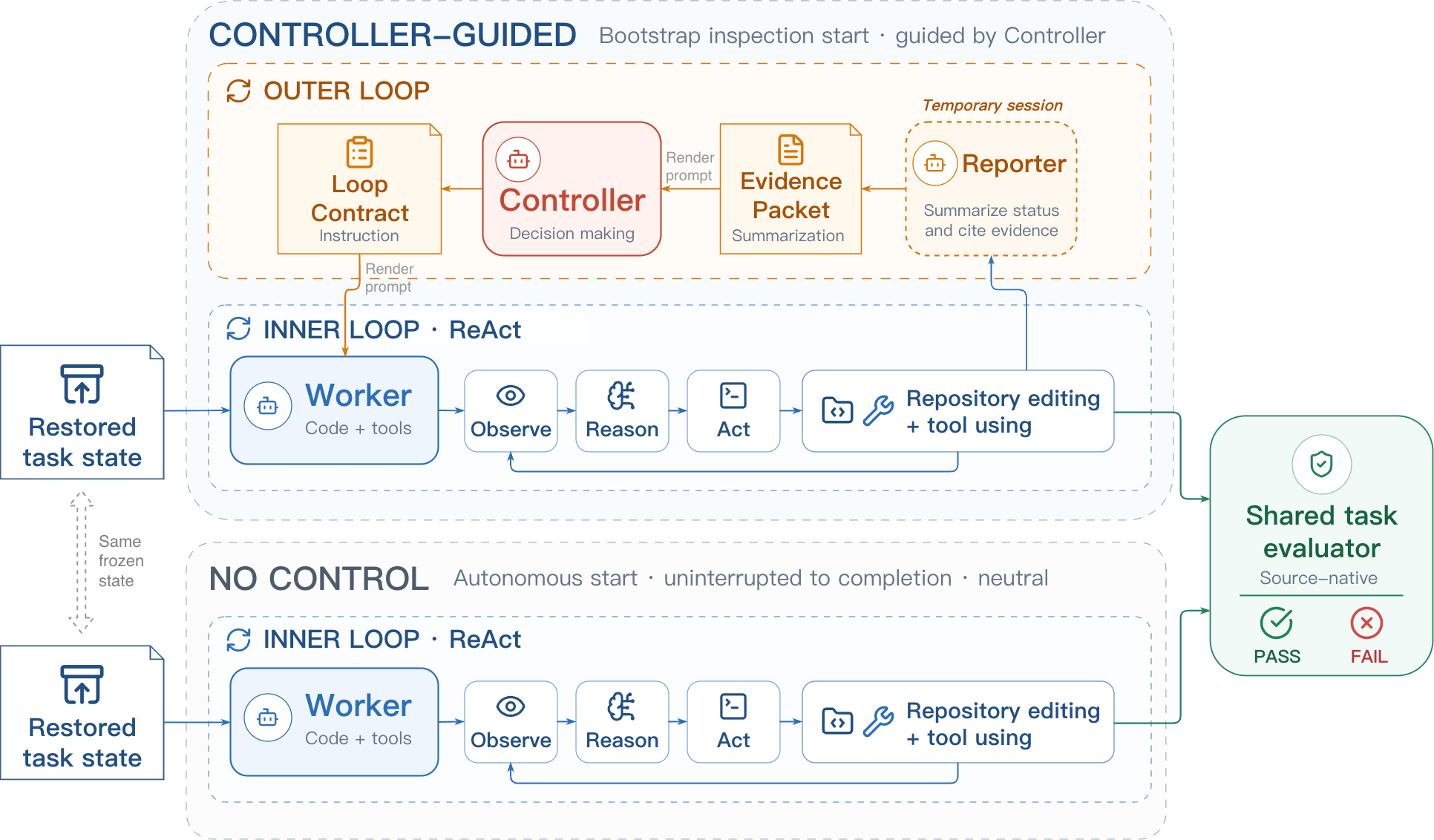
- The Worker is the programmer. It explores files, writes code, runs tests, and fixes problems.
- The Controller is the manager. It watches the Worker’s progress and decides what the Worker should do next.
Most coding tests ask whether one AI can finish a programming task. LoopArena asks a different question:
Can an AI manager guide a coding AI successfully through a long and complicated task?
This is called runtime loop control. The “loop” is the repeated cycle of working, checking progress, giving new instructions, and working again.
2. What questions does the research ask?
The researchers mainly want to find out:
- Can AI models make good decisions about what a coding agent should do next?
- Does guidance from a Controller help the Worker complete more coding tasks?
- Is adaptive guidance better than simply repeating the original goal?
- Can shorter and cheaper tests give similar results to full, long coding tasks?
- Which AI models are best at being Controllers?
The Controller might decide that the Worker should:
- continue implementing a feature,
- check whether the code really works,
- fix a newly discovered problem,
- investigate something more carefully, or
- stop because the task is complete.
This matters because a coding agent can sometimes think it is finished when it has only solved one small part of the problem.
3. How did the researchers test this?
The Controller–Worker setup
LoopArena uses a fixed coding model as the Worker. In the experiments, the Worker was Qwen3.7-Plus.
Different AI models were then tested as Controllers, including:
- Qwen3.7-Plus
- DeepSeek-V4-Flash-0731
- GLM 5.2
- GPT-5.5
- Claude Opus 4.8
Keeping the Worker the same is important. It is like testing different football coaches while giving each coach the same team. This helps show whether differences come from the Controller rather than from the programmer.
The Worker can use coding tools, inspect the repository, change files, and run tests. The Controller cannot directly change the code. Instead, it receives a carefully prepared summary of what has happened and sends back instructions for the next part of the work.
The Reporter and Evidence Packet
After each Worker round, a temporary Reporter examines the Worker’s conversation and the workspace. It creates a summary containing:
- what the task requires,
- what the Worker has already done,
- what tests or other evidence are available, and
- what problems remain.
This summary is called an Evidence Packet. It is similar to a progress report given to a manager.
The Controller reads this packet and creates a Loop Contract. This contract says either:
- what the Worker should do next and when to report back, or
- that the Worker should stop.
The Controller therefore has to make decisions based on evidence rather than guessing.
Three types of tests
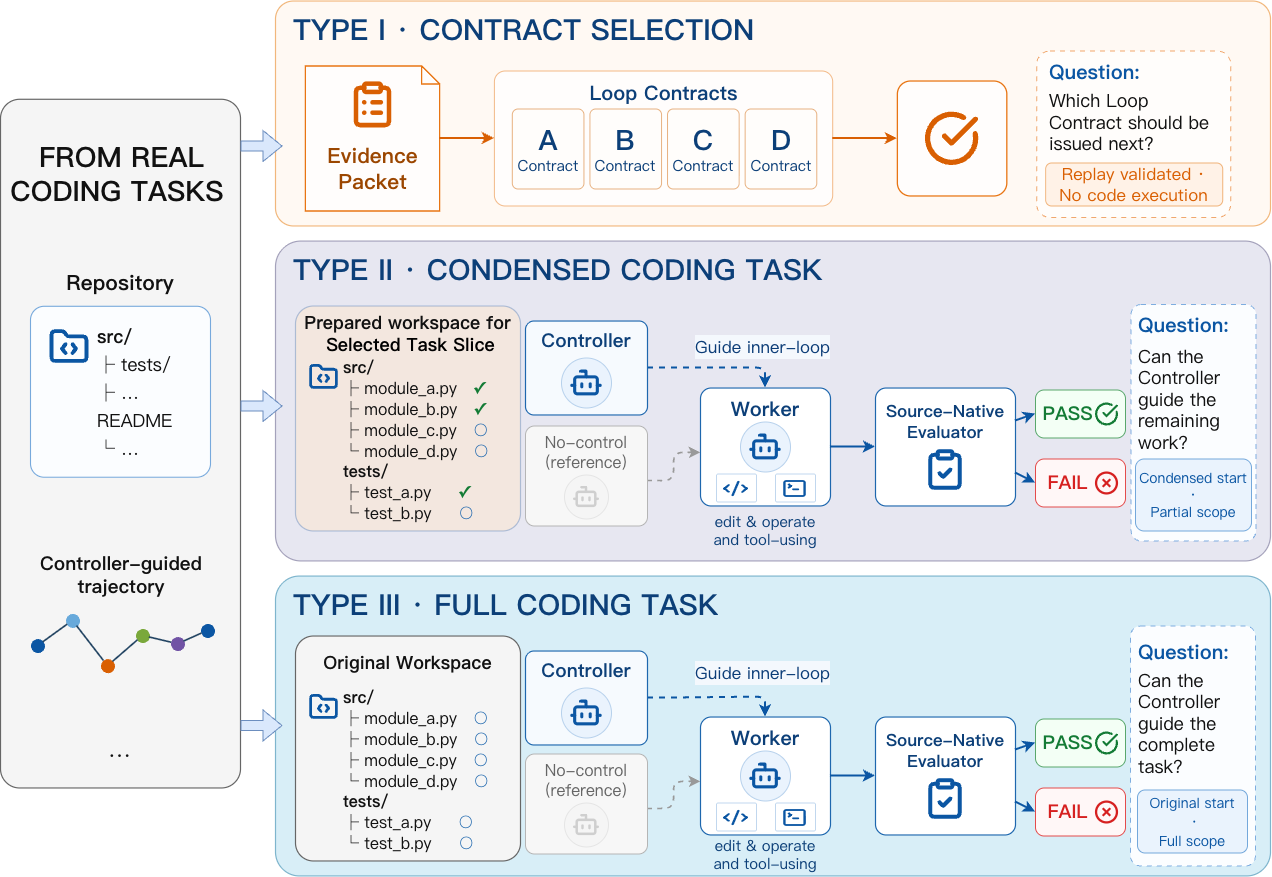
LoopArena has three testing levels:
| Test type | What it measures | Simple explanation |
|---|---|---|
| Type I | One control decision | Can the Controller choose the best next instruction from four choices? |
| Type II | A task slice | Can it guide the Worker through one important stage of a larger task? |
| Type III | A full task | Can it manage the entire long coding project? |
Type I is the cheapest. Researchers already tested the four possible instructions during benchmark construction, so a new Controller only needs to choose one. The Worker does not need to run again.
Type II starts in the middle of a project and tests one stage. This is shorter and cheaper than testing the whole project.
Type III starts from the beginning and tests the complete task, including investigation, coding, testing, fixing, and deciding when to stop.
The tasks came from two existing coding benchmarks: SCBench and BeyondSWE. Altogether, the benchmark included:
- 90 Type I questions,
- 27 Type II task slices, and
- 27 Type III full tasks.
Comparison methods
The researchers also tested two simple reference strategies:
- No control: the Worker receives the task and works alone.
- Fixed control: the system repeats the original task goal after every round but does not adapt its instructions to the Worker’s progress.
These comparisons show whether intelligent, changing guidance is actually useful.
How success was measured
A task counted as successful only if it passed the required automatic tests. The main measures were:
- Contract Accuracy: how often the Controller chose the correct next contract in Type I.
- Strict Success Rate: the percentage of complete runs that passed all required checks.
- Estimated cost: how much model usage each run required.
The researchers also compared the rankings from Type II and Type III using Spearman’s rank correlation. In everyday language, this checks whether the cheaper, shorter test ranks the Controllers in almost the same order as the full test.
4. What did the researchers find?
Full coding tasks are still very difficult
On the full Type III tasks, the best Controller achieved a Strict Success Rate of 24.69%. This means that fewer than one in four complete runs passed all the required checks.
The Controller results were:
| Controller | Type I accuracy | Type II success | Type III success |
|---|---|---|---|
| Qwen3.7-Plus | 72.22% | 48.15% | 23.46% |
| DeepSeek-V4-Flash-0731 | 77.78% | 45.68% | 19.75% |
| GLM 5.2 | 74.44% | 37.04% | 16.05% |
| GPT-5.5 | 87.78% | 51.85% | 24.69% |
| Claude Opus 4.8 | 76.67% | 48.15% | 20.99% |
These results show that making good decisions at individual moments does not automatically mean that the model can manage an entire long project successfully.
Repeating the goal is not enough
On the shorter Type II tasks, fixed control improved success from 39.51% with no control to 46.91%.
However, on the full Type III tasks, fixed control achieved 18.52%, exactly the same as no control.
This suggests that simply repeating “keep working on the original task” may help during a short stage, but it is not enough for a long project. A good Controller must notice what is happening and change its advice. For example, it may need to switch from writing code to testing code, repairing a mistake, or stopping at the right time.
Shorter tests can save a lot of money
Type II cost about 64.4% less than Type III on average. This is a major saving because the Worker does not need to complete the entire long project.
Even more importantly, Type II produced almost the same ranking of Controller models as Type III. The reported correlation was 0.9747, which is very high.
In simple terms, the shorter test usually agreed about which Controllers were better and which were worse. This means Type II could be useful for quickly comparing models before running expensive full-task evaluations.
Individual decisions can be tested cheaply
In Type I, Controller accuracy ranged from 72.22% to 87.78%. GPT-5.5 performed best with 87.78% accuracy.
The models were also much better than simple shortcuts, such as always choosing the same answer or selecting the longest candidate. Every model gave a valid answer, so the invalid-answer rate was 0%.
This shows that Type I is measuring actual decision-making rather than merely rewarding an easy trick.
5. Why is this research important?
LoopArena focuses on a part of AI coding that is often overlooked: managing the process, not just producing code.
A coding agent working on a long task needs more than programming ability. It must also:
- understand what has already been completed,
- notice when evidence is weak,
- choose useful tests,
- recover from mistakes,
- avoid stopping too early, and
- know when the work is truly finished.
The paper shows that this management skill is difficult. Even strong AI models struggled on full tasks, and repeating the original goal did not solve the problem.
The benchmark could help researchers build better AI systems by showing whether a model is good at guiding another model. It may also reduce research costs because Type I and Type II provide cheaper ways to study Controller behavior.
Conclusion
LoopArena is a benchmark for testing AI managers of coding agents. It separates the AI that writes the code from the AI that decides what should happen next.
The main lesson is that successful long-term coding requires adaptive guidance. A Controller must respond to the Worker’s changing situation instead of repeating the same instruction again and again.
The research suggests that:
- full software projects remain challenging for AI,
- shorter task-slice tests can be much cheaper while giving similar model rankings, and
- studying individual control decisions can help researchers understand why an AI coding system succeeds or fails.
In the future, this idea could be extended beyond coding to other tasks where one AI agent supervises another, such as research, data analysis, or planning complex projects.
Practical Applications
Immediate Applications
- Software engineering: add runtime loop control to coding-agent platforms. A production harness can separate a Controller from a Worker: the Worker edits code and runs tools, while the Controller reviews structured evidence and issues bounded next-step instructions such as “implement,” “run focused tests,” “investigate the failing integration,” or “stop.” This can reduce the risk of prematurely declaring a repository complete, especially on multi-stage maintenance tasks. Dependencies: reliable workspace inspection, accurate test/evaluator signals, persistent conversation state, and safeguards preventing the Controller from authorizing unsafe code changes.
- Software engineering: use Evidence Packets as an operational audit trail. The paper’s structured summaries—task context, completed work, verification evidence, and remaining issues, with citations to Worker actions—could be integrated into pull-request systems, incident records, or agent dashboards. Human reviewers would receive a compact explanation of what the agent believes has been completed and what remains uncertain. Dependencies: Reporter summaries must be factually grounded; read-only access and citation requirements should be preserved to reduce hallucinated progress reports.
- AI product development: benchmark and select Controller models independently of Worker models. Organizations can hold the coding Worker, tools, execution budget, and evaluator fixed while comparing candidate Controllers. This enables a more precise procurement or model-routing decision than evaluating complete agent systems as opaque combinations of model and harness. Dependencies: Controller quality may depend on the specific Worker, task distribution, tool environment, and prompt schema; therefore, results should not be treated as universally model-specific.
- Model evaluation: adopt Type I for low-cost regression testing. The frozen four-way Contract Selection tasks can be used in a model-release pipeline to test whether a new model correctly chooses among continuing implementation, requesting verification, recovery, or stopping. Since Type I requires no Worker execution after construction, it is suitable for frequent nightly or pre-release evaluations. Dependencies: benchmark items require execution-validated answers, careful prevention of leakage, and periodic refreshment to avoid overfitting or contamination.
- Model evaluation: use Type II as a cost-efficient screening stage. Teams can evaluate Controllers on prepared task slices before committing resources to full Type III runs. In the reported setup, Type II reduced estimated inference cost by an average of 64.4%, while preserving a very similar Controller ordering to Type III, with for the studied panel and criterion. Dependencies: the correlation is empirical rather than guaranteed. Type II must be recalibrated for new Worker models, domains, task distributions, and scoring criteria; full-task evaluation remains necessary for final validation.
- Continuous integration and release management: let a Controller choose the next verification action. After an automated coding agent modifies a repository, a Controller can inspect test results and repository state and select targeted actions—unit tests, integration tests, static analysis, rollback, or human escalation—instead of repeatedly restating the original goal. This follows the finding that fixed goal repetition helped on bounded slices but did not improve full-task performance over no control. Dependencies: tests must provide meaningful coverage, stopping decisions require explicit confidence and escalation policies, and production repositories need rollback and sandboxing mechanisms.
- Engineering management: identify control bottlenecks in long-running agent workflows. Type I accuracy and Type II/III outcomes can be analyzed by decision type, such as verification, recovery, delegation, or termination. Teams could use these results to prioritize prompt revisions, specialized Controllers, or human review at high-risk handoffs. Dependencies: the benchmark must contain sufficiently diverse examples of failure modes; accuracy on frozen candidates does not by itself establish causal improvement in production.
- Academic research: establish a controlled baseline for loop-engineering studies. Researchers can reproduce the two-agent harness and compare controllers while fixing the Worker, tools, evaluator, budget, and interface. This provides a cleaner experimental object than comparing complete agent stacks whose differences may arise from several components simultaneously. Dependencies: reproducibility requires access to the released code and task environments, deterministic or well-controlled replay, transparent cost accounting, and independent validation of evaluators.
- Policy and procurement: evaluate agentic software systems using outcome, cost, and control metrics together. Public-sector or enterprise buyers can require vendors to report strict task success, estimated inference cost, number of Worker turns, control cycles, invalid outputs, and performance under no-control or fixed-control baselines. This makes efficiency and runtime supervision part of acceptance testing rather than relying only on final demonstrations. Dependencies: metrics must be adapted to the buyer’s software stack and risk tolerance; benchmark performance alone cannot certify security, privacy, legal compliance, or maintainability.
- Daily life and education: improve consumer coding assistants for bounded personal projects. A coding assistant could pause after each meaningful stage, summarize progress, ask for verification when evidence is weak, and avoid unnecessary continuation once requirements are met. This may be useful for students, hobbyist developers, and small teams working on scripts or websites. Dependencies: users need understandable summaries and easy override controls; the low full-task success rates reported in the paper indicate that autonomous use should remain supervised for consequential projects.
Long-Term Applications
- General-purpose agent orchestration beyond coding. The Controller–Reporter–Worker pattern could be transferred to domains such as data analysis, customer support, enterprise workflow automation, scientific experimentation, and document processing. A domain-specific Worker would execute actions, while a Controller would decide whether to continue, verify, recover, or stop based on structured evidence. Dependencies: each domain needs executable or independently verifiable evaluators, domain-specific Evidence Packet schemas, safe action boundaries, and research showing that Type II-style abbreviated evaluations predict full workflows.
- Robotics and embodied AI: deploy supervisory controllers for multi-stage tasks. A high-level Controller could direct a robot through exploration, manipulation, inspection, recovery from failed actions, and termination. For example, after a robot attempts warehouse picking, the Controller could request vision-based verification or regrasping rather than issuing the same task objective repeatedly. Dependencies: real-time latency, noisy sensors, physical safety, uncertainty calibration, and robust recovery policies are substantially more demanding than repository-level coding tasks.
- Healthcare and laboratory automation: introduce evidence-gated workflow progression. In clinical-administrative or laboratory systems, a Controller could review structured evidence before advancing a case—for example, confirming that required records, measurements, or quality checks are present before scheduling the next procedure. The system could also escalate ambiguous cases to a human instead of stopping autonomously. Dependencies: validated domain evaluators, privacy protection, regulatory approval, auditability, human accountability, and strict separation between workflow management and clinical judgment.
- Energy and industrial operations: adaptive supervisory control. Controllers could manage maintenance or optimization agents by switching between diagnosis, intervention, verification, and shutdown as equipment evidence changes. This is more promising than a fixed policy that merely repeats a target such as “maximize output” or “reduce downtime.” Dependencies: reliable telemetry, digital twins or safe simulators, fail-safe control, real-time guarantees, and extensive testing under rare faults and distribution shifts.
- Finance: evidence-based multi-step case management. A Controller could supervise agents handling compliance reviews, reconciliations, or fraud-investigation workflows, deciding when additional documentation or verification is required and when a case should be escalated. The structured handoff format could support post hoc regulatory audits. Dependencies: explainability and evidence provenance must be legally sufficient; the system would require privacy controls, bias testing, deterministic escalation rules, and prohibition of unsupervised high-impact decisions.
- Training Controllers with execution-grounded feedback. The benchmark’s replay process can generate supervision from downstream outcomes: candidate Contracts can be executed, compared by success and cost, and used to train reward models, preference models, or specialized Controllers. This could improve decisions about verification, recovery, bounded assignment length, and stopping. Dependencies: replay outcomes may be expensive to collect, evaluator imperfections can encode misleading rewards, and training on a narrow task family may produce over-specialized policies.
- Learning adaptive stopping and escalation policies. A future Controller could estimate whether additional Worker turns are likely to produce useful progress and choose among continuation, verification, rollback, or human intervention. Such a policy could optimize a risk-sensitive objective combining task success, cost, latency, and safety rather than maximizing success alone. Dependencies: requires calibrated uncertainty estimates, representative failure data, reliable cost models, and explicit penalties for both premature stopping and wasteful continuation.
- Multi-Worker and hierarchical agent systems. The single Worker in LoopArena could be extended to several specialized Workers—for example, implementation, testing, security review, documentation, and deployment—with a Controller assigning bounded subtasks and reconciling their evidence. This could produce agent teams for large software repositories or complex enterprise workflows. Dependencies: task decomposition, conflict resolution, shared-state consistency, communication overhead, and attribution of failures become central challenges; the current paper does not evaluate multi-Worker organizations.
- Safety certification and governance for autonomous workflows. A standardized loop-control benchmark could become part of internal safety cases or external certification, testing whether an agent recognizes incomplete work, reacts to contradictory evidence, requests verification, and stops under uncertainty. Type I could support inexpensive screening, while Type III could support final high-assurance testing. Dependencies: coding benchmarks are not sufficient for general safety certification. Certification would require domain-specific scenarios, adversarial tests, human-factors evaluation, security testing, and evidence that benchmark behavior transfers to deployment.
- Personal productivity systems with adaptive task management. Long-running assistants could manage projects by maintaining structured state, selecting the next actionable step, checking completed work, and asking the user for clarification only when needed. Unlike a static reminder system, the assistant would adapt its guidance as new evidence or obstacles appear. Dependencies: users must be able to inspect and correct the assistant’s state; privacy, authorization, calendar/file integration, and reliable handling of irreversible actions are necessary for safe deployment.
Glossary
- Agent orchestration: The coordination and management of multiple agents or agent components to accomplish a task. “This model-as-manager setting makes agent orchestration directly evaluable”
- Autonomous execution: Operation in which an agent performs a task without ongoing external guidance. “the same Worker receives the task instruction and works autonomously to completion”
- Benchmark compression: Reducing the cost or size of an evaluation while attempting to preserve its conclusions or rankings. “Benchmark-compression methods likewise use Kendall's or Spearman's to test whether a cheaper evaluation recovers a full-benchmark ranking”
- Closed-loop evaluation: Evaluation in which an agent’s actions produce feedback that informs subsequent actions. “Type II is a lower-cost closed-loop evaluation in its own right”
- Control cycle: One iteration in which the system summarizes the Worker’s state, obtains a Controller decision, and either assigns further work or stops. “We refer to this sequence as one control cycle.”
- Controller: The model responsible for deciding what another agent should do next. “the evaluated model is the Controller, while a separate Worker carries out the coding task”
- Decontaminated evaluation: Evaluation designed to reduce the influence of training-data exposure to benchmark tasks or solutions. “SWE-rebench: An Automated Pipeline for Task Collection and Decontaminated Evaluation of Software Engineering Agents”
- Downstream outcome: The eventual result produced by executing an earlier decision or action. “The construction focuses on tasks, intermediate states, and control decisions where plausible control choices can lead to different executable outcomes.”
- Evidence Packet: A structured, read-only summary of task progress and supporting observations provided to the Controller. “The harness deterministically formats the Reporter's summary and the Worker's working evidence it cites into an Evidence Packet”
- Executable evaluator: A program or evaluation procedure that runs checks on an agent-produced artifact to determine whether requirements are satisfied. “Most coding benchmarks \citep{Jimenez2023,MultiSWEBench2025} evaluate task completion by running a coding agent and scoring the resulting repository state with executable tests or task-specific evaluators.”
- Execution-grounded learning: Learning that uses the results of actual interactions or executions as supervisory signals. “In agentic settings, execution-grounded learning further uses outcomes from tree-structured interaction rollouts and rendered interface code as supervision”
- Execution scope: The portion of a task or workflow that is actually carried out during an evaluation. “LoopArena organizes evaluation into three complementary settings that differ in execution scope and cost.”
- Fixed control: A non-adaptive policy that repeatedly provides the same task objective instead of responding to current execution evidence. “We additionally evaluate fixed control, a persistent-goal baseline inspired by Codex's /goal”
- Full-task evaluation: Assessment performed on an entire task from its original starting state through completion. “Type III evaluates the corresponding full task from its original state.”
- Harness: The software infrastructure that manages agents, tools, state, prompts, and execution flow. “Figure~\ref{fig:runtime} shows how the Controller's outer loop guides the Worker's inner loop.”
- Inference cost: The estimated computational or monetary expense of generating model outputs during evaluation. “Estimated inference cost is the primary resource measure, with all estimates assuming no prompt caching.”
- Intermediate workspace: A partially completed repository state used as the starting point for evaluating a task segment. “Each case begins from a prepared intermediate workspace in which the preceding work is complete”
- Invalid Rate: The proportion of model responses that fail to provide a valid, parseable answer in the required format. “missing, multiple, out-of-range, and unparseable answers count as incorrect and are also reported in the Invalid Rate.”
- Long-horizon task: A task requiring many sequential actions, decisions, or interaction rounds to complete. “Long-horizon and iterative benchmarks extend this setup to longer tasks or evolving requirements”
- Loop Contract: A structured Controller output specifying the Worker’s next assignment or instructing the system to stop. “It produces a Loop Contract :”
- Loop Engineering: The design and management of iterative interaction loops around coding agents. “Loop Engineering marks a shift in how developers interact with coding agents on long-running tasks.”
- Model-as-manager: An arrangement in which one model directs another model that performs the task. “This model-as-manager setting makes agent orchestration directly evaluable”
- No-control baseline: A reference condition in which the Worker operates without Controller guidance after receiving the initial task. “We also report a no-control baseline in which the same Worker receives the task instruction and works autonomously to completion.”
- Outer loop: The higher-level control process that guides and manages the Worker’s successive execution rounds. “the Controller's guidance of the overall process as the outer loop”
- Process-oriented benchmark: A benchmark that evaluates actions, decisions, or intermediate behavior rather than only final task results. “Process-oriented benchmarks instead assess individual actions or capabilities within the coding trajectory”
- Prompt caching: Reusing previously processed prompt information to reduce the cost or computation of subsequent model calls. “Estimated inference cost is the primary resource measure, with all estimates assuming no prompt caching.”
- Read-only inspection: Examination of a workspace or state without permission to alter files or execute modifying operations. “The Reporter uses the same model configuration as the Worker and may inspect the workspace only through read-only tools.”
- ReAct loop: An agent interaction pattern that alternates between reasoning and tool-mediated actions. “within each assigned segment, it follows its native ReAct loop to inspect and modify the repository”
- Repository-level coding task: A software-engineering task involving an entire code repository rather than an isolated code fragment. “LoopArena evaluates how well a model decides what a separate coding agent should do next and guides it through long-horizon repository-level tasks”
- Restorable control point: A recorded execution state that can be reconstructed to replay and evaluate alternative decisions. “Type I constructs execution-validated control questions at restorable points in Controller-guided trajectories”
- Strict Success Rate: The proportion of evaluation runs that satisfy all required task checks and protocol conditions. “The Strict Success Rate is”
- Task slice: A selected, coherent stage or subset of a larger coding task. “Type II evaluates one slice of a full coding task.”
- Tool-use trace: A record of an agent’s sequential interactions with external tools during task execution. “as do evaluations of repository exploration and tool-use traces”
- Trajectory: The recorded sequence of interactions, actions, and states produced during an agent’s execution. “Type I constructs execution-validated control questions at restorable points in Controller-guided trajectories.”
- Worker: The agent that directly performs coding actions and interacts with development tools. “The Worker is the only component that can use coding tools”
- Workspace state: The current contents and condition of the repository in which the agent is working. “Both conditions start from the same restored task state”