Rotating needles in space: the road to the Kakeya conjecture, and why it matters
Abstract: A non-technical exposition of the Kakeya conjecture, why it matters, and the road to the solution of this conjecture in three dimensions by Hong Wang and Joshua Zahl.

Paper Prompts
Sign up for free to create and run prompts on this paper.
Top Community Prompts
Explain it Like I'm 14
1. What is the paper about?
This paper explains the Kakeya conjecture, a famous problem about fitting very thin objects pointing in every possible direction into the smallest possible space.
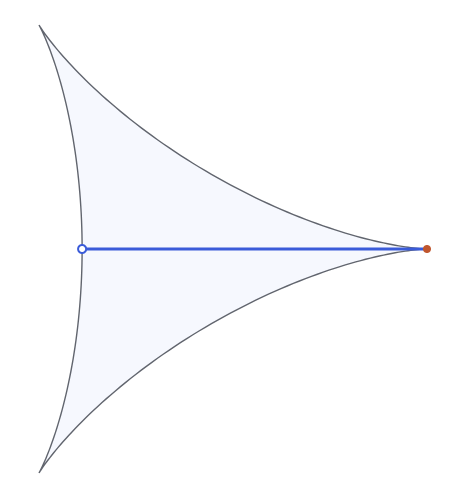
Imagine trying to turn a very thin needle around so that it points in every direction. Surprisingly, a needle can be moved through a region with an area as small as we want. The paper asks what happens when the needle has a tiny but real thickness, especially in three-dimensional space.
The paper also explains why this geometry problem matters in other areas of mathematics, such as:
- understanding waves,
- studying Fourier series,
- solving equations that describe physics,
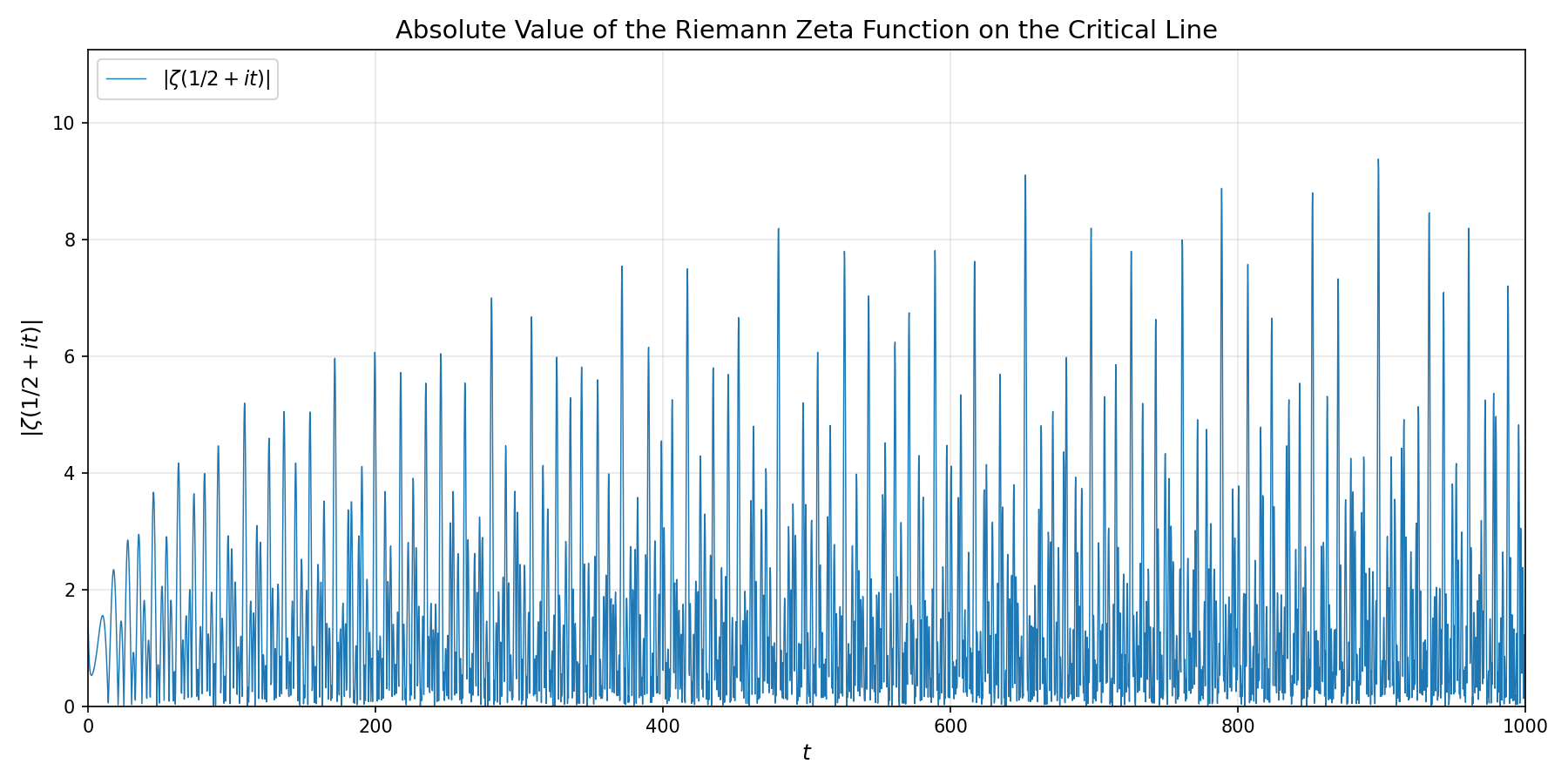
- learning more about prime numbers and the Riemann zeta function.
The paper describes how mathematicians eventually solved the three-dimensional Kakeya conjecture through work by Hong Wang and Joshua Zahl.
2. What questions are mathematicians trying to answer?
The main questions are:
- How small can a shape be if it contains a thin line or tube pointing in every direction?
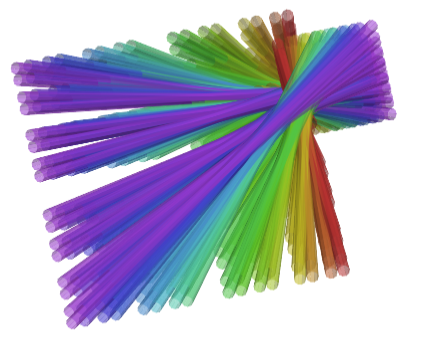
- Can many thin tubes in different directions overlap so much that they fit into an extremely small volume?
- Does three-dimensional space prevent this kind of extreme compression?
- Can the answer to this geometry problem help solve other difficult problems about waves, equations, and numbers?
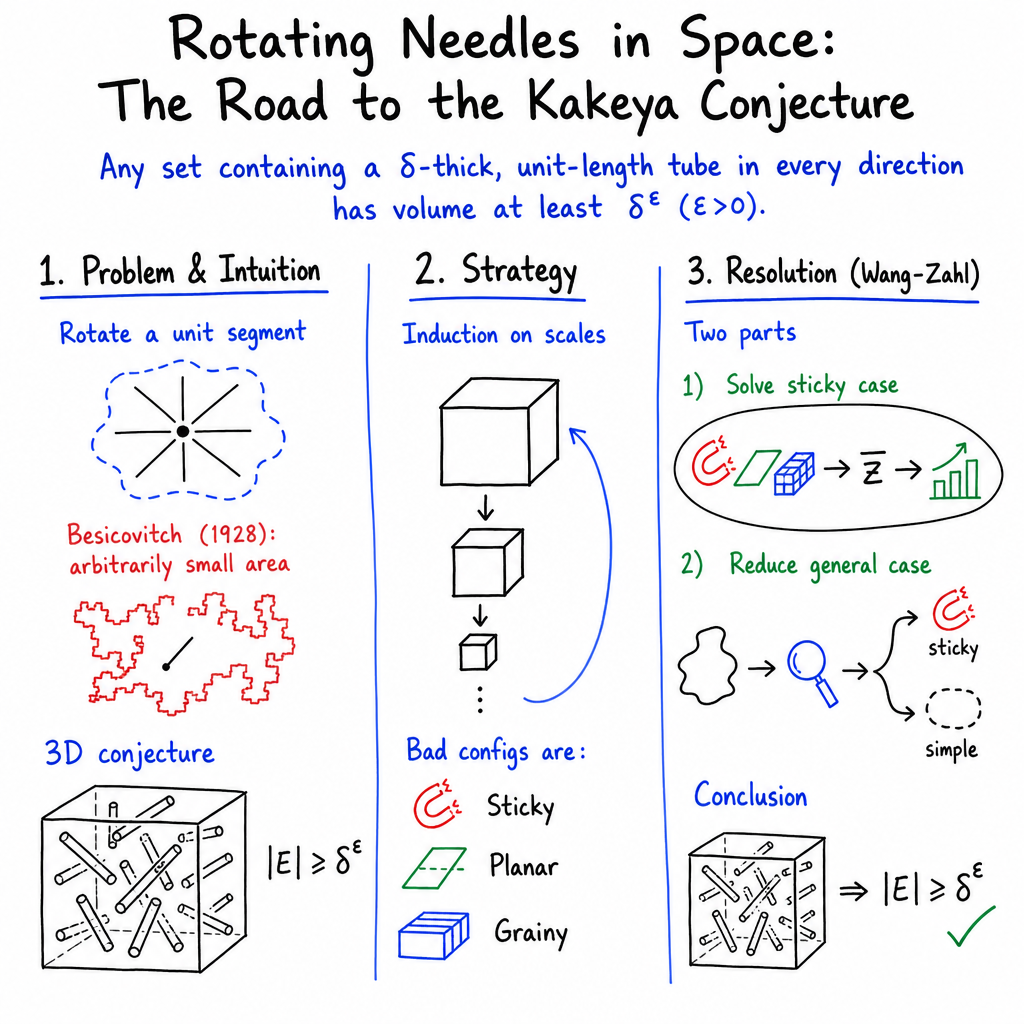
In two dimensions, mathematicians discovered that a zero-thickness needle can be rotated in a region with area as close to zero as desired. But a tube with thickness must occupy at least some space.
For a three-dimensional tube measuring , the conjecture says that the total volume cannot become too small. More precisely, the volume should be at least roughly , which means it may shrink slowly, but not like a fixed power such as .
In everyday language: the tubes can overlap and save space, but there is a limit to how much space they can save.
3. How did the researchers study the problem?
This is mainly a theoretical mathematics paper. The authors do not perform experiments with physical tubes. Instead, they use geometry, algebra, and careful logical arguments.
Thin tubes and different directions
Mathematicians imagine many long, thin tubes, each pointing in a different direction. They study how much these tubes overlap.
If two tubes point in similar directions, they may overlap a lot. If they point in very different directions, they usually overlap less. The challenge is to understand all these overlaps at once.
Fractal-like constructions
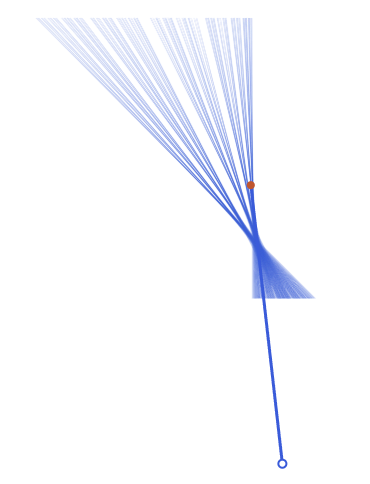
A fractal is a shape with patterns that repeat at different sizes. Besicovitch constructed strange shapes containing a line segment in every direction while having almost no area.
These shapes work by arranging many lines so that they overlap in carefully planned ways. They are like a huge, complicated pile of sticks arranged to occupy surprisingly little room.
Wave packets
The paper connects tubes to wave packets. A wave packet is a small piece of a wave that is concentrated in a particular location and points in a particular direction.
A useful analogy is a short beam of light or a small ripple moving in one direction. In many problems involving waves, these wave packets behave geometrically like thin tubes.
If many wave packets point in different directions and become concentrated in the same region, they can combine and produce unusually large effects. This is called constructive interference, similar to several ocean waves joining together to make a much larger wave.
Induction on scales
One of the main tools is called induction on scales.
This means solving or estimating the problem at one size, then using that information to understand the problem at a larger or smaller size. It is similar to studying a complicated picture by zooming in and noticing that smaller pieces often resemble the whole picture.
The researchers also studied three important patterns:
- Stickiness: tubes pointing in nearby directions tend to stay physically close together.
- Planiness: tubes passing through the same point tend to lie approximately in one plane.
- Graininess: the tubes tend to fill certain medium-sized box-like regions, called grains.
These ideas help describe what a possible “worst-case” arrangement of tubes would look like.
Reduction to special cases
Wang and Zahl first proved the conjecture for arrangements with the sticky behavior. Then they developed a new method showing that general arrangements could be reduced to sticky arrangements or to simpler cases that could be handled separately.
This was a major breakthrough because earlier methods worked mainly for sticky configurations and lost too much information in other cases.
4. What were the main findings?
The most important result is that the three-dimensional Kakeya conjecture was solved.
Wang and Zahl showed that a set in three-dimensional space containing a tube in every direction cannot have volume that is too small. Although the tubes can overlap significantly, they cannot be compressed beyond the limit predicted by the conjecture.
This is important because it confirms that the strange compression seen in two-dimensional needle constructions does not become unlimited in three dimensions.
The paper also explains several earlier discoveries:
- In the plane, Besicovitch showed that a line segment can point in every direction inside a region with arbitrarily small area.
- For a tube of thickness , the amount of compression in two dimensions is limited by a slow, roughly logarithmic factor.
- In three dimensions, the problem is harder because there are about different directions to consider instead of about .
- Earlier mathematicians, including Bourgain, Wolff, Katz, Łaba, Tao, and Zahl, gradually improved the known limits.
- Their work revealed that possible counterexamples would need to have special properties such as stickiness, planiness, and graininess.
The paper also explains that Kakeya-type geometry is connected to many other problems. For example, Fefferman used a Kakeya-like construction to show that certain ways of adding up Fourier series do not always work as expected.
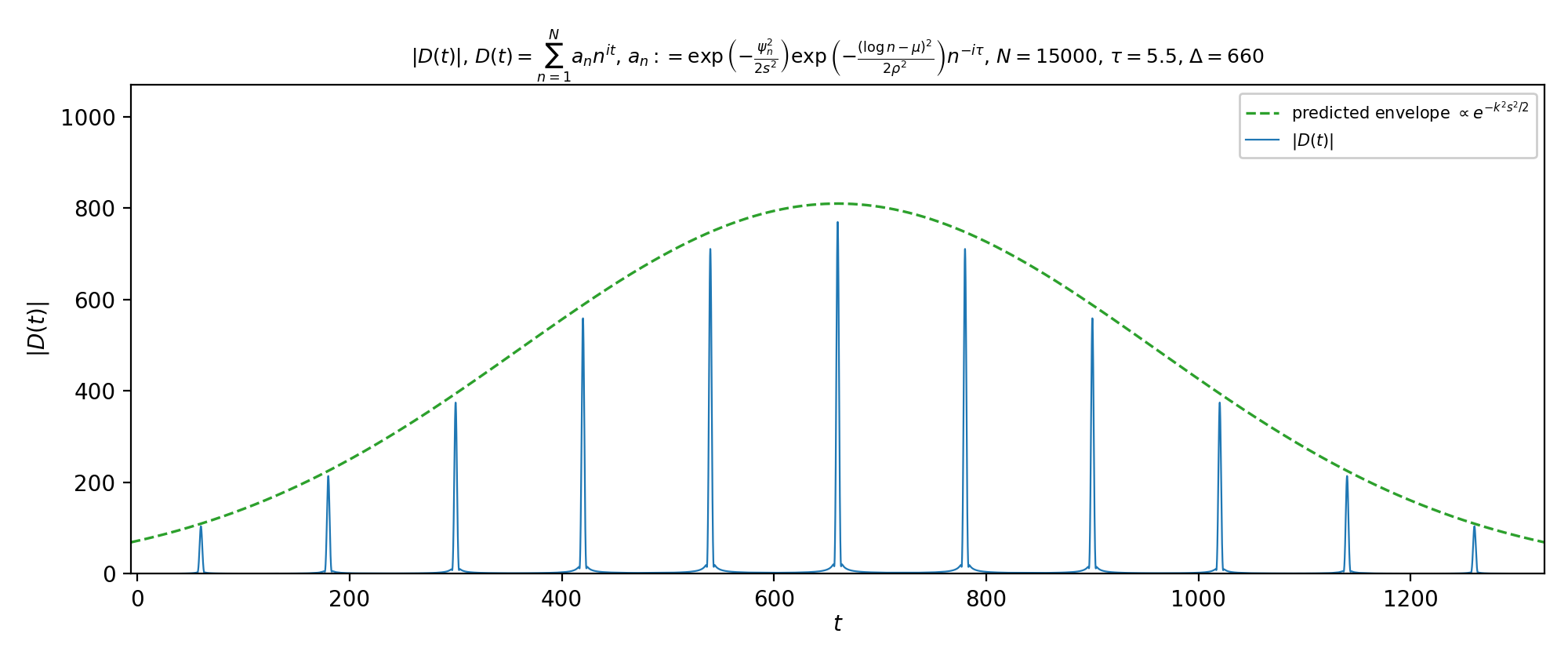
In number theory, Bourgain used similar ideas to show that a strong version of a conjecture about sums involving was false. This helped clarify what kinds of approaches might or might not prove the Lindelöf hypothesis, a famous problem related to the Riemann hypothesis.
5. Why do these findings matter?
At first, the Kakeya problem may seem like a puzzle about moving needles. But it is really about a deeper question:
How much can objects pointing in many different directions overlap?
This question appears whenever mathematics studies waves, signals, or oscillations. Thin tubes can represent the paths or locations of waves. If too many of them overlap, waves may combine in unexpected ways and produce very large values.
Solving the Kakeya conjecture gives mathematicians a powerful new tool for studying:
- Fourier analysis, which breaks complicated signals into simple waves;
- partial differential equations, including equations describing heat, sound, and light;
- geometric measure theory, which studies unusual shapes and their sizes;
- number theory, including questions about prime numbers and the zeta function;
- projection problems, which ask what a shape looks like from different viewpoints.
The result does not immediately solve all these other problems. However, it removes a major obstacle and gives researchers a better understanding of the geometry behind them.
Simple conclusion
The paper tells the story of a surprising mathematical journey. A simple question about rotating a needle led to the study of strange fractal shapes, thin tubes, waves, and number theory.
The final lesson is that objects pointing in every direction can overlap a great deal, but in three dimensions they cannot be packed into an arbitrarily tiny volume. The proof by Wang and Zahl settles a problem that had resisted mathematicians for decades.
This achievement may lead to progress on many other difficult problems involving waves, equations, geometry, and the distribution of numbers.
Knowledge Gaps
Knowledge gaps, limitations, and open questions
- The paper does not provide a rigorous proof of the three-dimensional Kakeya conjecture; it only gives a high-level description of Wang and Zahl’s results and refers readers to external papers.
- The precise hypotheses, quantitative bounds, and logical structure of the Wang–Zahl reduction from general Kakeya configurations to sticky configurations are not stated.
- The notions of stickiness, planiness, and graininess are described heuristically rather than defined mathematically, leaving unclear how these properties are quantified and detected in arbitrary configurations.
- The paper does not explain the mechanism that forces a non-sticky configuration either to become sticky under rescaling or to degenerate into a tractable configuration.
- The role of the “conjugation” structure associated with sticky Kakeya configurations is not formalized: the construction of the map , the precise approximate identity it satisfies, and the way projection or sum-product estimates yield a contradiction are omitted.
- No explicit quantitative relationship is given between tube-overlap estimates, Kakeya maximal-function bounds, Minkowski or Hausdorff dimension, and the volume lower bounds appearing in the conjecture.
- The exposition does not distinguish carefully among the several formulations of the Kakeya problem, including Hausdorff-dimension, Minkowski-dimension, maximal-function, and -neighborhood formulations, or explain which implications between them are reversible.
- The conjecture is stated with corrupted or incomplete mathematical notation, including the ambient cube, the exponent, and the constant ; the exact formal statement therefore requires reconstruction.
- The paper does not discuss whether the three-dimensional resolution yields effective constants or explicit rates for the lower bound on the volume of -neighborhoods.
- Higher-dimensional Kakeya conjectures remain largely unresolved, but the paper does not specify the best known bounds, the dimensions in which improvements are available, or which parts of the three-dimensional strategy might generalize.
- The relationship between the three-dimensional result and the corresponding Kakeya conjectures over other fields, discrete settings, finite fields, or non-Euclidean geometries is left unexplored.
- The paper asserts that progress on Kakeya should advance restriction, Bochner–Riesz, and local smoothing conjectures, but it does not state precise conditional theorems showing which remaining estimates would follow from the resolved three-dimensional Kakeya conjecture.
- It remains unclear which obstacles in the restriction, Bochner–Riesz, and local smoothing problems are genuinely Kakeya-geometric and which arise from oscillatory cancellation, curvature, or analytic superposition effects not captured by Kakeya estimates.
- The discussion of the Montgomery conjecture does not identify the exact strongest false formulation, the surviving weaker formulation, or the precise quantitative Kakeya estimate needed to imply the Lindelöf hypothesis.
- The paper does not establish whether the new three-dimensional Kakeya methods can overcome the arithmetic obstructions in the Montgomery problem, especially since it acknowledges that this problem contains less direct geometric structure.
- The connection between Kakeya estimates and the Falconer distance, Furstenberg, projection, and discretized sum-product problems is summarized only at the level of broad analogy; the exact reductions and hypotheses are not provided.
- The exposition does not determine whether the projection-theorem and sum-product inputs used by Wang and Zahl are optimal, or whether stronger versions could lead to quantitative improvements in related geometric-measure-theory problems.
- No examples are given of extremal or near-extremal three-dimensional Kakeya configurations after the resolution; consequently, the geometric structure of configurations that nearly saturate the new lower bounds remains unclear.
- It is not known from the paper whether near-extremizers must approximately exhibit stickiness, planiness, graininess, or the stated conjugation structure, leaving open a stability or inverse theory for Kakeya configurations.
- The paper does not address the dependence of the theory on regularity assumptions for the sets and tubes, such as measurable versus compact sets, exact versus approximate direction coverage, or variable tube cross-sections.
- The continuous needle-rotation problem and the -thickened Kakeya problem are treated as closely related, but the paper does not rigorously characterize the equivalence or quantify the additional area needed to permit continuous motion.
- The Fourier-analytic discussion is illustrative rather than complete: it does not specify the function spaces, convergence modes, endpoint behavior, or exact wave-packet constructions underlying Fefferman’s disk-multiplier counterexample.
- Several historical and conceptual claims are presented without distinguishing original results from later refinements, and the paper does not systematically identify which statements are proved, conjectural, or merely heuristic.
- The article relies heavily on visualizations and external references; without the omitted proofs and precise definitions, readers cannot independently verify the main geometric reductions or assess the sharpness of the conclusions.
Practical Applications
Immediate Applications
- Mathematical education and public outreach — interactive visualization of fractal geometry
- The paper’s Besicovitch–Perron trees, Kakeya sets, rotating needles, and three-dimensional tube configurations can be implemented as interactive demonstrations or classroom software.
- Potential tools: browser-based applets, 3D visualization modules, computational-geometry notebooks, and interactive lessons on fractals, Hausdorff dimension, Fourier analysis, and geometric measure theory.
- Action: allow users to vary tube thickness , orientation density, overlap rules, and spatial scale while observing how volume or area changes.
- Dependencies: accurate numerical approximations of idealized sets; clear distinction between finite-resolution simulations and limiting mathematical objects.
- Academic research software for Kakeya-type configurations
- Researchers can use the paper’s concepts of stickiness, planiness, and graininess as measurable descriptors for simulated tube arrangements.
- Potential workflow: generate discretized tubes, compute pairwise intersections and orientation distributions, identify fat-tube clusters, estimate local tangent planes, and detect grain-like occupancy patterns.
- Relevant sectors: computational mathematics, harmonic analysis, geometric measure theory, and computer-assisted theorem exploration.
- Dependencies: discretization choices, computational complexity, and the need to establish that numerical patterns reflect mathematically meaningful asymptotic behavior.
- Numerical diagnostics for oscillatory and wave-based calculations
- The wave-packet discussion provides a conceptual framework for testing whether numerical Fourier or PDE computations are producing artificial constructive interference.
- Potential applications: diagnostics for spectral solvers, Fourier multiplier implementations, wave-equation simulations, and numerical experiments involving localized high-frequency packets.
- Action: decompose simulated solutions into directional wave packets and monitor their concentration, overlap, and amplification across scales.
- Dependencies: a reliable wave-packet decomposition, sufficient spatial and frequency resolution, and problem-specific stability criteria. The paper does not itself provide a production-ready numerical algorithm.
- Improved teaching and testing of Fourier-analysis software
- Fefferman’s disk-multiplier example can be turned into a benchmark for software that performs multidimensional Fourier summation or spectral filtering.
- Potential product or workflow: a test suite comparing square, disk, smoothed-disk, and other frequency-domain cutoffs on functions with varying regularity.
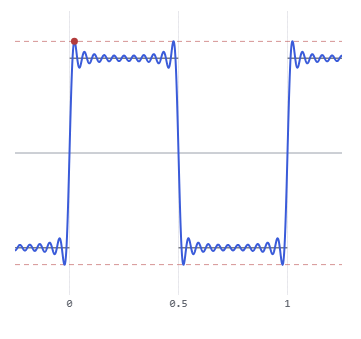
- Action: evaluate convergence in different norms and visualize Gibbs-like artifacts, localization, and instability.
- Dependencies: careful interpretation of failure: poor numerical behavior may arise from discretization or aliasing rather than the theoretical multiplier phenomenon alone.
- Research training for analysts and applied mathematicians
- The paper offers a reusable research methodology: identify a geometric obstruction, decompose complicated behavior into wave packets, analyze structured cases, and apply induction across scales.
- Potential workflow: use this framework in graduate courses, reading groups, and interdisciplinary training in harmonic analysis, PDEs, and geometric combinatorics.
- Dependencies: substantial mathematical background; the method is currently more useful as a conceptual research framework than as a turnkey industrial technique.
- Visualization of geometric constraints for robotics and motion planning
- The rotating-needle problem can serve as an idealized benchmark for narrow-passage motion planning and orientation-space exploration.
- Potential applications: simulation of slender robotic tools, inspection probes, cables, booms, or surgical instruments moving through constrained environments.
- Action: compare naïve swept-volume planning with algorithms that exploit overlap among translated, differently oriented thin bodies.
- Dependencies: real objects have thickness, joints, curvature, collision tolerances, and dynamics. Besicovitch sets permit highly pathological limiting behavior and should not be interpreted as directly achievable motion plans.
- Policy and research funding prioritization
- The paper identifies a foundational mathematical result with possible downstream consequences for harmonic analysis, dispersive PDEs, restriction theory, local smoothing, and analytic number theory.
- Action: funding agencies and research institutions can use these connections to support mathematical infrastructure, open-source visualization, computer-assisted experimentation, and interdisciplinary collaborations.
- Dependencies: downstream breakthroughs are not guaranteed; the paper establishes mathematical relevance rather than immediate economic or policy impact.
Long-Term Applications
- More reliable high-frequency PDE and wave-propagation solvers
- If the Kakeya estimates lead to sharper restriction, Bochner–Riesz, or local-smoothing results, they could improve theoretical error bounds for numerical models of waves.
- Relevant sectors: acoustics, seismic imaging, electromagnetics, optics, and computational fluid dynamics.
- Potential tools: adaptive directional meshes, wave-packet-based preconditioners, scale-aware error estimators, and algorithms that limit spurious concentration of propagating energy.
- Dependencies: the mathematical estimates must be converted into quantitative, implementable bounds for discretized equations, including boundary conditions, variable coefficients, noise, and finite computational domains.
- Better analysis of signal concentration and directional interference
- Kakeya-type estimates may eventually provide general bounds on how many directional wave components can concentrate in a small region.
- Relevant sectors: radar, sonar, wireless communications, imaging, laser systems, and antenna design.
- Potential products: interference-risk predictors, directional beamforming diagnostics, and algorithms for allocating frequency or angular channels.
- Dependencies: physical systems involve bandwidth limits, attenuation, propagation media, and hardware constraints absent from the idealized theorem.
- Advances in Fourier filtering and spectral imaging
- Progress on multiplier and restriction problems could clarify when sharp or nearly sharp frequency-domain filters are stable in norms other than .
- Relevant sectors: medical imaging, microscopy, tomography, remote sensing, and image reconstruction.
- Potential workflows: selecting smoother spectral cutoffs, estimating reconstruction artifacts, and designing filters with provable stability for non-smooth or sparse data.
- Dependencies: the paper discusses foundational convergence questions, not validated imaging methods. Empirical benefits would require application-specific models and experiments.
- Improved regularity and control results for wave equations
- Resolution or further progress on local-smoothing and related conjectures could strengthen guarantees for dispersive and wave-like equations.
- Relevant sectors: acoustical simulation, optical propagation, geophysical modeling, and engineering systems governed by hyperbolic PDEs.
- Potential outcomes: sharper bounds on solution concentration, improved long-time estimates, and more efficient multiscale numerical schemes.
- Dependencies: translating estimates from constant-coefficient mathematical models to nonlinear, variable-coefficient, or random media remains a major research challenge.
- New results in analytic number theory and computational prime research
- The paper explains that Kakeya-type geometry constrains Dirichlet-polynomial concentration and is related to the Montgomery conjecture and the Lindelöf hypothesis.
- Potential academic applications: stronger mean-value estimates, improved bounds for exponential sums, and more efficient algorithms for exploring zeta-function behavior or prime-distribution statistics.
- Dependencies: the three-dimensional Kakeya result does not resolve the Lindelöf or Riemann hypotheses. The connection is indirect, and additional number-theoretic arguments are required.
- Algorithms for multiscale geometric and incidence problems
- The sticky/non-sticky decomposition and induction-on-scales strategy could inspire algorithms for detecting structure in point-line, tube, projection, and distance-set data.
- Relevant sectors: computer vision, computational geometry, network layout, spatial statistics, and data analysis.
- Potential tools: hierarchical clustering of directional structures, multiscale incidence estimators, and anomaly detection for unusually concentrated geometric patterns.
- Dependencies: theoretical dimension and incidence estimates do not automatically yield computationally efficient algorithms; runtime, robustness to noise, and finite-sample guarantees must be developed separately.
- Robotic planning for slender objects in three dimensions
- A mature computational theory inspired by Kakeya compression could support motion planning for long, thin objects that must assume many orientations in confined spaces.
- Relevant sectors: industrial robotics, warehouse automation, aerospace deployment, endoscopy, and minimally invasive surgery.
- Potential products: orientation-aware swept-volume planners, compact storage and deployment optimizers, and collision-avoidance systems for probes or flexible tools.
- Dependencies: practical deployment requires incorporating rigid-body dynamics, actuator limits, uncertainty, deformability, obstacle geometry, and continuous-time collision avoidance. The mathematical Kakeya problem only addresses geometric containment and orientation coverage.
- Foundational methods for geometric measure theory and projection-based data analysis
- The paper’s links to Falconer distance sets, Furstenberg sets, sum-product phenomena, and projection theorems may eventually yield stronger tools for analyzing high-dimensional geometric data.
- Relevant sectors: theoretical machine learning, sensor fusion, imaging, and inverse problems.
- Potential outcomes: guarantees concerning information retained under projection, distance-based embeddings, or the detectability of structure from lower-dimensional measurements.
- Dependencies: these applications are speculative. They require explicit bridges between asymptotic fractal geometry and finite, noisy, statistically sampled datasets.
- Policy and planning for mathematical infrastructure
- The paper illustrates how apparently abstract results can influence several areas of analysis and PDEs over decades. This supports long-term investment in foundational mathematics, open computational resources, and interdisciplinary research programs.
- Action: establish shared libraries for wave-packet computation, geometric-measure simulations, theorem databases, and reproducible numerical experiments.
- Dependencies: benefits are difficult to quantify in advance and may emerge only after further theoretical developments; institutional support and sustained funding are essential.
- Everyday-life relevance through downstream technologies rather than direct use
- The Kakeya theorem is unlikely to change ordinary activities such as parking or household storage directly. Its eventual practical relevance would more plausibly occur through improved imaging, communications, navigation, wave simulation, or robotics.
- Assumption: later research must successfully transfer abstract geometric and harmonic-analytic estimates into stable engineering models.
- Caveat: no direct consumer product, medical treatment, financial instrument, or policy intervention is established by the paper itself.
Glossary
- Arithmetic progression: A sequence of numbers with a constant difference between consecutive terms. “one could make the Dirichlet polynomial large when was close to an arithmetic progression”
- Besicovitch set: A set containing a unit line segment in every direction, possibly with arbitrarily small or zero area. “a set that contains a unit line segment in every direction”
- Besicovitch–Perron tree: A fractal construction used to arrange line segments in many directions while keeping area small. “A Besicovitch--Perron tree, which contains a unit line segment in every direction in an arc”
- Bochner–Riesz conjecture: A conjecture concerning whether smoothing Fourier multipliers near the boundary of a frequency region restores boundedness or convergence. “The Bochner--Riesz conjecture, which describes the extent to which the failure of the disk multiplier”
- Constructive interference: The reinforcement that occurs when overlapping waves combine to produce a larger amplitude. “trying to control the amount of ``constructive interference'' that can be present”
- Critical line: The vertical line in the complex plane given by , central to the study of the Riemann zeta function. “particularly on the critical line ”
- Curvature: Geometric non-flatness that causes wave packets or related objects to point in varying directions. “objects being analyzed contained
wave packets'' that could point in different directions due to somecurvature'' in the problem” - Destructive interference: Cancellation that occurs when waves combine with opposing phases, reducing their resulting amplitude. “whether it generates constructive interference, destructive interference, or some combination of the two”
- Dirichlet polynomial: A finite sum of complex powers, typically of the form . “The Lindel\"of hypothesis can also be phrased in terms of the Dirichlet polynomials”
- Disk multiplier: A Fourier multiplier whose frequency-space symbol is the indicator of a disk. “the resulting disk multipliers”
- Eccentricity: A measure of how elongated a geometric object is, often expressed as the ratio between its long and short dimensions. “the ``compression'' that is possible amongst tubes in three dimensions pointing in different directions can only be (roughly) logarithmic in the eccentricity ”
- Fourier multiplier: An operator that multiplies Fourier coefficients or transforms by a specified function in frequency space. “One can think of the partial Fourier series as a Fourier multiplier of ”
- Fourier transform: A transformation that represents a function in terms of its frequency components. “the Fourier transform of a multidimensional function can be restricted to a curved surface”
- Furstenberg set: A geometric-measure-theoretic set characterized by containing substantial intersections with lines from many directions. “the Furstenberg set problem”
- Geometric measure theory: The study of geometric properties of sets using measures and notions of dimension. “The Kakeya conjecture is also a close cousin to other important questions in the general area of geometric measure theory”
- Gibbs phenomenon: Persistent oscillatory overshoot near jump discontinuities in Fourier-series approximations. “one has the infamous Gibbs phenomenon”
- Graininess: A structural property in which a configuration contains medium-scale rectangular slabs or grains. “graininess, which roughly speaking asserts that the configuration contained medium-sized rectangular slabs”
- Hausdorff dimension: A notion of dimension defined using coverings by sets of arbitrarily small diameter, applicable to irregular or fractal sets. “such spatial notions of ``size'', such as the Hausdorff dimension”
- Heisenberg group: A noncommutative group that arises in quantum mechanics and harmonic analysis and serves here as a model for an obstructive Kakeya configuration. “an object from quantum mechanics known as the Heisenberg group”
- Heisenberg uncertainty principle: The principle that a function and its Fourier transform cannot both be arbitrarily localized. “which (by the Heisenberg uncertainty principle) would cause the wave packet to elongate”
- Induction on scales: A technique that derives estimates at a large spatial scale from corresponding estimates at smaller scales. “A powerful technique to handle this that has emerged in recent decades is that of induction on scales”
- Kakeya maximal function: An operator measuring the largest average of a function over thin tubes or rectangles oriented in different directions. “The Kakeya maximal function and the spherical summation multipliers”
- Kakeya set: A set containing a unit line segment in every direction. “a set that contains a unit line segment in every direction”
- Lindelöf hypothesis: The conjecture that the Riemann zeta function grows subpolynomially on the critical line. “the Lindel\"of hypothesis that asserts the subpolynomial growth bound”
- Local smoothing: The gain in regularity or integrability obtained by averaging solutions of dispersive equations over a spatial or temporal region. “Sogge's local smoothing conjecture”
- Mean value theorem: In this context, an integral estimate showing that a quantity has controlled average behavior over a parameter range. “mean value theorems were developed over the years to establish that such bounds are true for most values of ”
- Minkowski dimension: A dimension defined by the rate at which the volume of small neighborhoods of a set decreases. “An improved bound on the Minkowski dimension of Besicovitch sets”
- Noncommutative: Describing an operation or algebraic structure in which the order of multiplication can affect the result. “an object from quantum mechanics known as the Heisenberg group”
- Partial differential equation: An equation involving a function of several variables and its partial derivatives. “theories of Sobolev spaces and pseudo-differential operators”
- Planiness: The property that tubes passing through a point are approximately contained in a common plane. “planiness, which roughly speaking asserts that the tubes through any given point were essentially coplanar to each other”
- Plancherel theorem: A theorem stating that the Fourier transform preserves the norm, or equivalently square-integrability. “the later theorem of Plancherel”
- Projection theorem: A result describing how the dimension or measure of a set behaves under projection onto lower-dimensional spaces. “another type of statement in geometric measure theory, known as a projection theorems”
- Pseudo-differential operator: A generalized differential operator defined through a symbol acting on Fourier components. “the foundational theory of Sobolev spaces and pseudo-differential operators”
- Restriction conjecture: A conjecture about when the Fourier transform of a function can be meaningfully restricted to a curved submanifold. “Stein's restriction conjecture, which describes when the Fourier transform of a multidimensional function can be restricted to a curved surface”
- Riemann hypothesis: The conjecture that all nontrivial zeros of the Riemann zeta function have real part . “the infamous Riemann hypothesis has long been known to imply the Lindel\"of hypothesis”
- Riemann zeta function: A complex function initially defined by the Dirichlet series , encoding information about prime numbers. “The behaviour of the prime numbers is closely tied to the Riemann zeta function”
- Self-similar structure: A structure that resembles a scaled copy of itself at different levels of magnification. “a very useful self-similar structure of potential Kakeya counterexamples”
- Sobolev space: A function space whose elements possess weak derivatives satisfying specified integrability conditions. “the foundational theory of Sobolev spaces and pseudo-differential operators”
- Stickiness: The tendency of tubes with nearby orientations to remain physically close and group into larger “fat tubes.” “stickiness, which roughly speaking asserts that tubes that are oriented in nearby directions must also be physically close to each other”
- Wave packet: A localized oscillatory function concentrated near a particular position and frequency. “one could generate a wave packet: an oscillating function concentrated on a thin rectangle in the plane”
- Wave packet decomposition: A representation of an oscillatory function as a superposition of localized wave packets. “the existence of wave packet decompositions, which allow for very general oscillating functions to be decomposed into a superposition of wave packets”

