A Survey of the Kakeya conjecture, 2000-2025
Abstract: We survey progress on the Kakeya conjecture in Euclidean space, with an emphasis on developments that have occurred since the previous surveys by Wolff and Katz-Tao.
- Generalized Arithmetic Kakeya (2024)
- Sticky Kakeya sets and the sticky Kakeya conjecture (2022)
- Pattern Problems related to the Arithmetic Kakeya Conjecture (2020)
- Improved bounds for the Kakeya maximal conjecture in higher dimensions (2019)
- New Kakeya estimates using the polynomial Wolff axioms (2019)
- On the arithmetic Kakeya conjecture of Katz and Tao (2017)
- Dimension estimates for Kakeya sets defined in an axiomatic setting (2017)
- Volume estimates for unions of convex sets, and the Kakeya set conjecture in three dimensions (2025)
- Introduction to the proof of the Kakeya conjecture (2025)
- The Kakeya Conjecture: where does it come from and why is it important? (2025)
Summary
- The paper establishes a full resolution of the Kakeya conjecture in ℝ³ by innovatively combining induction-on-scale, non-concentration methods, and multiscale analysis.
- The paper refines dimension bounds by proving an upper Minkowski dimension of 5/2+c₀ and a lower Hausdorff bound via granular tube decomposition and combinatorial techniques.
- The paper integrates combinatorial, geometric, and analytic methods, linking breakthroughs in tube clustering to broader impacts in Fourier analysis and incidence geometry.
Survey of Progress on the Kakeya Conjecture (2000–2025)
Introduction and Formulation
The Kakeya conjecture, centered around Besicovitch sets in Rn, posits that every compact set containing a unit segment in every direction has full Hausdorff and Minkowski dimension, i.e., dim(K)=n. The problem is deeply intertwined with discretized analogues involving families of δ-tubes, geometric measure theory, and Fourier analysis. The Euclidean version remains a focal point, with connections to the Fourier restriction conjecture through wave packet decompositions and Stein's operator framework.
Structural Barriers and Counterexamples
Research uncovered critical barriers via "near misses" to the Kakeya set conjecture, notably:
- Heisenberg Group Example: Katz, Łaba, and Tao’s construction in C3 illustrates a set with full tube content but volume ∼δ1/2, supporting only a subset of directions [KatzLabaTao2000].
- SL2 Example: Katz and Zahl’s finite ring model encodes two-scale tube clustering. While tubes fill many directions, the Hausdorff dimension falls short of three, forming a distinct obstruction in the analysis [KatzZahl2019].
Both examples demonstrate that proofs using only volume intersection arguments cannot resolve the conjecture in R3, and they delineate the boundaries for combinatorial and geometric methods.
Advances in Dimension Bounds
Upper Minkowski Dimension 5/2+c0
In R3, significant progress was achieved by Katz, Łaba, and Tao, obtaining an upper Minkowski dimension bound 5/2+c0 for Besicovitch sets. The method leverages additive combinatorics via a "three slices" application of the Balog-Szemerédi-Gowers theorem, coupled with the granular structure of tube arrangements—termed stickiness, planiness, and graininess.
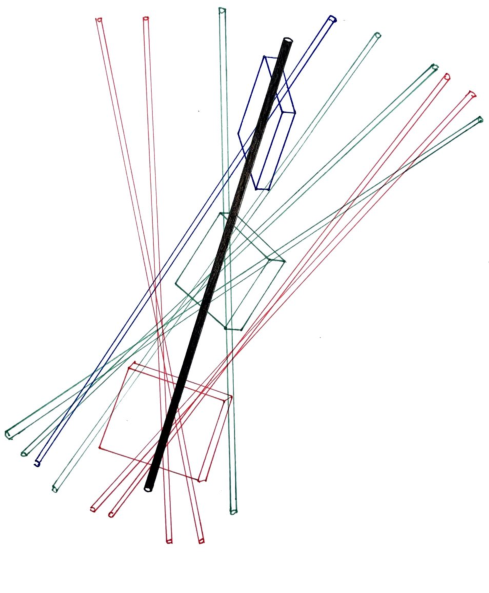
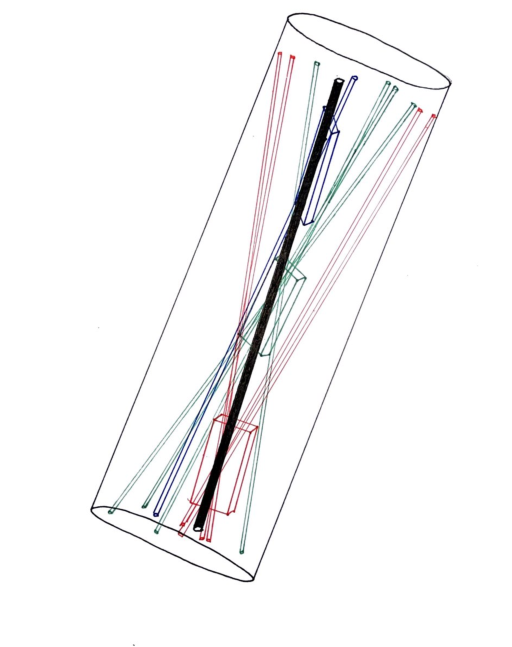
Figure 1: The set of tubes TTρ and the corresponding grains under anisotropic rescaling.
Multiscale covering techniques ensure that at each scale ρ, tubes arrange into balanced partitions, providing structural self-similarity crucial for analysis.
Hausdorff Dimension 5/2+c1
Katz and Zahl established a lower bound on Hausdorff dimension, overcoming the SL2 example. The approach depends on discretized projection theorems (Bourgain), distinguishing real from complex analytic behavior, and leverages Frostman-type non-concentration conditions. An elaborate dichotomy partitions hypothetical counterexamples into Heisenberg and SL2 types, ruling each out via projection theorems and regulus strip analysis [KatzZahl2019].
Resolution in Three Dimensions: Wang-Zahl Trilogy
A definitive breakthrough was the Wang-Zahl proof, confirming the Kakeya set conjecture in R3 [WangZahl2022, WangZahl2024, WangZahl2025]. Their argument combines induction-on-scale, multi-scale generalizations of stickiness, and new structures governing tube concentration.
Key steps involve:
- Sticky Case Reduction: Self-similarity at all scales ensures uniform granularity in tube coverage, reducing to Ahlfors-regular projection theory and circular maximal function bounds.
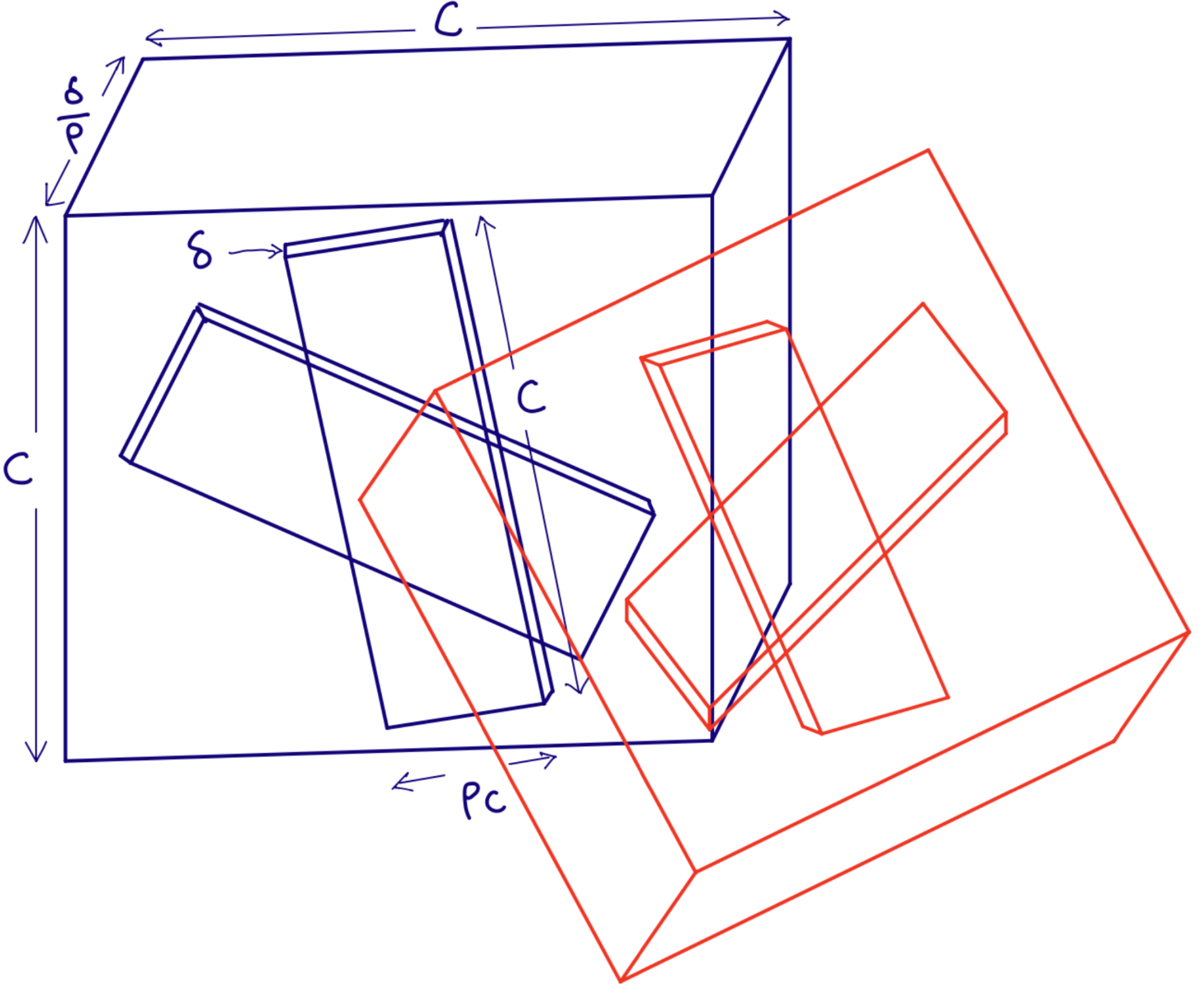
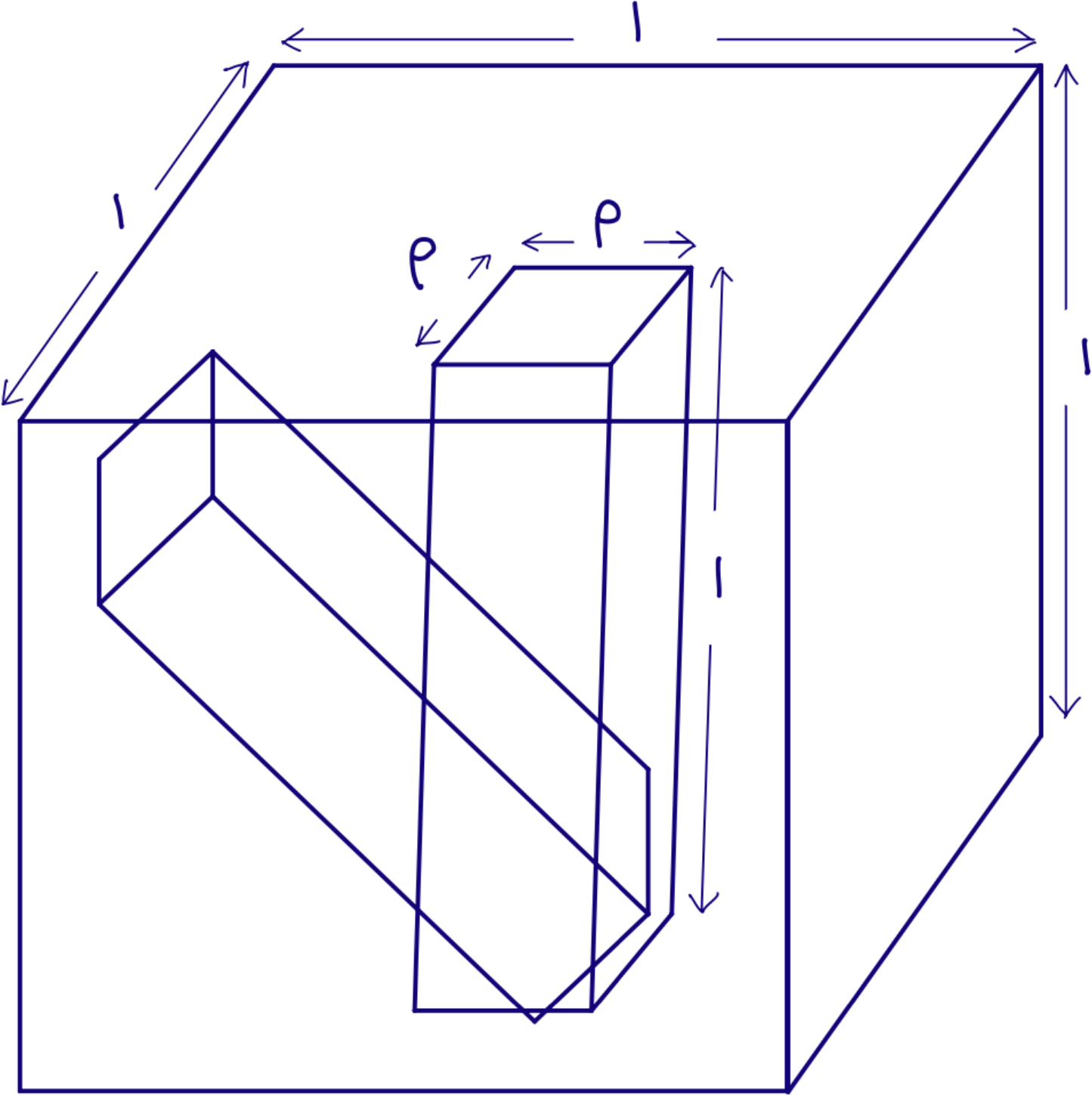
Figure 2: Partition of the grain decomposition into sets of δ×ρc×c prisms, revealing underlying tangency structure.
- Non-concentration via Frostman/Katz-Tao Convex Wolff Axioms: Replacing direction-separated hypotheses allows for finer induction steps, crucial for rescaling and truncation arguments.
Induction proceeds by iterative improvement between two main assertions, D(σ) and E(σ), quantifying progress in tube multiplicity controls. Efficient inequality formulations and structural decompositions (via grains and the structure theorem) establish the full dimensionality.
Higher Dimensions and Algebraic Barriers
Extension to n≥4 faces new obstructions: algebraic varieties (e.g., quadric hypersurfaces) can cluster tubes in high-dimensional families, violating classical Wolff-type axioms. This motivates the adoption of the Polynomial Wolff Axioms: non-concentration criteria relative to all semi-algebraic sets, a necessary generalization to avoid pathologies like those in SL2 or quadratic surfaces.
Multiscale and Multilinear Techniques
Multilinear Kakeya Theorem
The Bennett-Carbery-Tao multilinear Kakeya theorem and its algebraic/topological proofs underpin recent advances, quantifying how tube intersections enforce local planiness when unions are small. These results generalize to higher dimensions under polynomial partitioning, leading to improved broad estimates for the union volume and Lp maximal function bounds.
Bourgain-Guth Multilinear→Linear Argument
By interpolating between broad and narrow scenarios (tubes in independent directions vs. clustering near low-dimensional subspaces), Bourgain and Guth’s framework provides dimension bounds via scale induction. Improvements in broad estimates now hinge on grains decomposition and polynomial partitioning, as in the works of Guth, Zahl, Hickman, Rogers, and Zhang.
Narrow Estimates and Incidence Geometry
Recent work (Katz-Zahl, Kulkarni) refines narrow estimates for tube clusters near affine planes, leveraging incidence combinatorics (Szemerédi–Trotter type bounds) and recursive partitioning. Such techniques interplay with those for broad estimates, forming a dual approach for dimensionality bounds in Rn.
Implications and Future Work
Resolving the Kakeya set conjecture for n=3 has significant consequences for geometric measure theory and harmonic analysis, especially in informing the ongoing Fourier restriction program. Approaches developed (non-concentration, grains structure, induction-on-scale) provide templates for attacking the more recalcitrant maximal function conjecture and extending the theory to higher dimensions.
Open problems remain in efficiently managing losses in the shading parameter (λ), translating gains to the Kakeya maximal function setting, and understanding deeper structural properties of unions of regulus strips or high-degree algebraic varieties. Improvements in multilinear and narrow bounds continue to be an active research frontier, with direct applications to both discrete geometry and analytic operator theory.
Conclusion
Over the past 25 years, the study of the Kakeya conjecture has transitioned from combinatorial and geometric heuristics to rigorous multiscale analysis, culminating in a full resolution for R3 and refined bounds in higher dimensions. The synthesis of combinatorial, geometric, analytic, and algebraic methods reflects both the intricacy of the conjecture and the evolving toolkit of modern analysis. The implications for harmonic analysis, particularly Fourier restriction phenomena, and for incidence geometry, are substantial, marking the Kakeya conjecture as a central driver of methodological innovation across fields.
Paper to Video (Beta)
No one has generated a video about this paper yet.
Whiteboard
No one has generated a whiteboard explanation for this paper yet.
Paper Prompts
Sign up for free to create and run prompts on this paper using GPT-5.
Top Community Prompts
Open Problems
- Kakeya set conjecture in Euclidean space
- Discretized Kakeya conjecture (union measure lower bounds)
- Kakeya maximal function conjecture
- Stein’s Fourier restriction conjecture for n ≥ 3
- Kakeya conjectures under the Polynomial Wolff Axioms
- Efficiency of shading in Kakeya maximal function approaches in R^3
Continue Learning
- How do multiscale techniques and induction-on-scale contribute to resolving the Kakeya conjecture in ℝ³?
- What insights do the Heisenberg group and SL₂ examples provide about tube clustering and counterexamples?
- How are combinatorial methods like the Balog-Szemerédi-Gowers theorem used to derive the refined dimension bounds?
- What implications does the full resolution of the Kakeya conjecture have for Fourier restriction and related harmonic analysis problems?
- Find recent papers about multiscale geometric analysis.
Collections
Sign up for free to add this paper to one or more collections.
Tweets
Sign up for free to view the 1 tweet with 22 likes about this paper.