Black hole singularity is a surface not a point
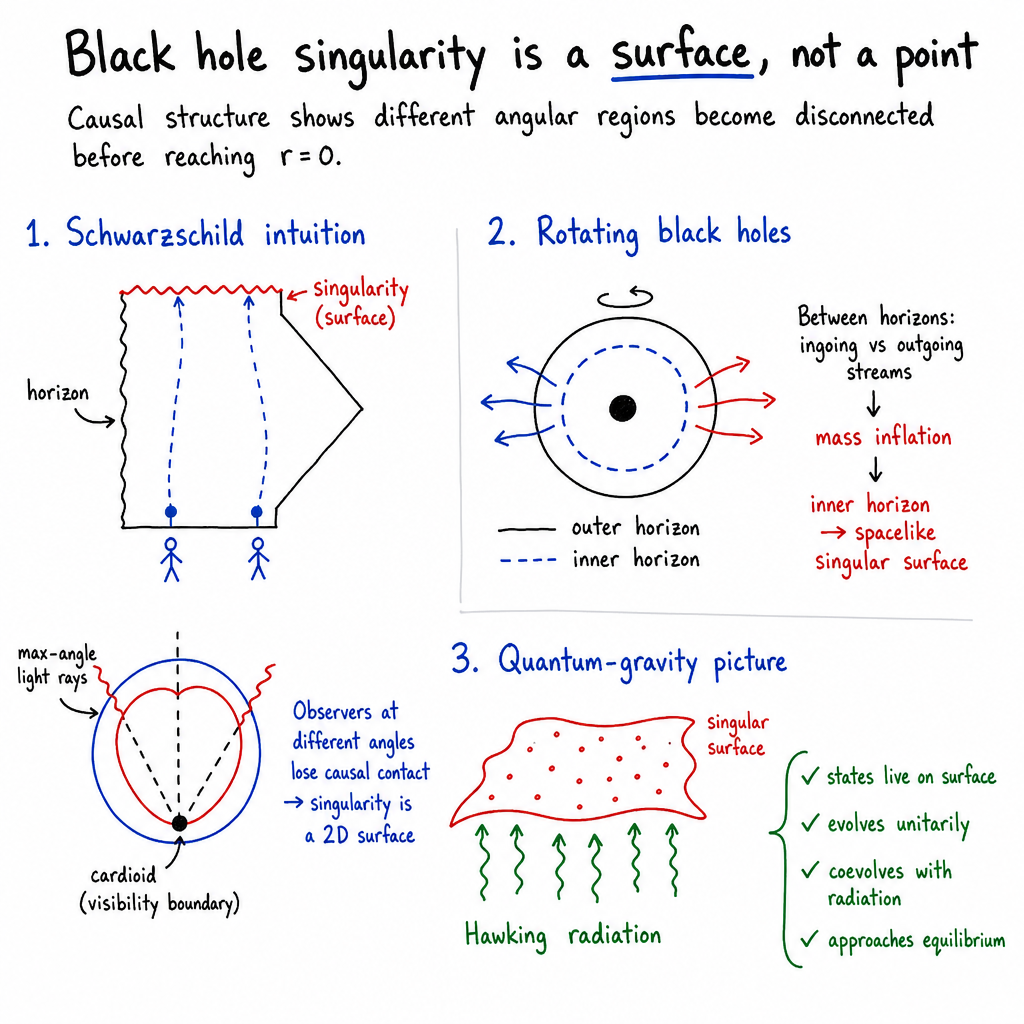
Abstract: It is widely repeated in the popular literature and elsewhere that the singularity at the center of a black hole is a point. It is not true. Two observers who free-fall into a spherical black hole along two different angular trajectories at the same time do not encounter each other at the central singularity; rather, they lose causal contact with each other already well away from the singularity. Counterintuitively, in general relativity two points can be spatially close yet causally distant. The singularity is a surface, not a point. The story for rotating black holes is more complicated, but the same conclusion holds. For a rotating black hole, the singular surface almost certainly resides at its inner horizon, where even the tiniest classical or quantum perturbations ignite the exponential mass inflation instability, precipitating collapse to a spacelike singular surface. There are implications for quantum gravity. We argue that, whatever the ultimate theory of quantum gravity may be, the quantum states of a black hole probably reside at its effectively 2-dimensional singular surface, which coevolves unitarily with, and in thermodynamic equilibrium with, the hot atmosphere of trapped Hawking radiation that the black hole generates within its event horizon.
Paper Prompts
Sign up for free to create and run prompts on this paper.
Top Community Prompts
Explain it Like I'm 14
1. Main topic
This paper asks a surprising question: Is the singularity inside a black hole really a single point?
Many popular explanations say that everything falling into a black hole is crushed into one tiny point at its center. The authors argue that this picture is misleading. They say that the singularity is better understood as a surface—more like a final boundary spread across different directions—rather than one meeting point.
The paper studies both:
- Non-rotating black holes, called Schwarzschild black holes.
- Rotating black holes, called Kerr black holes.
The authors also discuss what this idea might mean for the still-unsolved problem of quantum gravity, which is the attempt to combine gravity with quantum physics.
2. Main questions and objectives
The paper focuses on several connected questions:
- Do two people falling into a black hole from different directions meet at the singularity?
- Can two locations be physically very close but still unable to communicate with each other?
- What does the inside of a rotating black hole really look like?
- Does the strange “ring singularity” predicted by the ideal mathematical model of a rotating black hole actually exist in nature?
- Could the singularity be an important place where the information and quantum states of a black hole are stored?
The central claim is that two falling observers heading toward different angular locations do not remain in contact until the end. They lose the ability to send signals to one another before reaching the singularity. Therefore, the singularity contains many causally separate locations and should be thought of as a surface.
3. How the researchers studied the problem
The authors mainly use mathematical physics. They apply Einstein’s theory of general relativity to calculate how space, time, light, and falling objects behave near black holes.
Studying paths through spacetime
They calculate the paths followed by:
- Infallers: people or objects falling freely into a black hole.
- Light rays: used to determine what one observer can see and whether two observers can communicate.
- Geodesics: the natural paths followed by objects or light in curved spacetime. On Earth, a geodesic is similar to the shortest path on a curved surface, but in spacetime it describes free fall.
The researchers compare two infallers who enter the black hole at different angles. They ask whether light can travel from one infaller to the other.
Using spacetime diagrams
The paper uses Penrose diagrams. These are special drawings of spacetime that squeeze infinitely distant places into a manageable picture. Light is always shown traveling at a 45-degree angle, making it easier to see what can influence what.
An analogy would be a map of a huge city that keeps all roads at the same simple angle, so you can quickly tell whether one place can send a message to another.
Calculating visibility
The authors calculate the boundary of the region visible to an infaller. Inside a black hole, even light trying to move outward is forced inward because spacetime itself is falling inward faster than light can escape.
Near the singularity, an observer can see only part of the surrounding black hole. The boundary of the invisible region has a mathematical shape called a cardioid, which resembles a heart.
The authors also create ray-traced visualizations. These are computer-generated pictures showing what a falling observer might see, including distorted views of the horizon and surrounding space.
Studying rotating black holes
For rotating black holes, the researchers examine the inner horizon, an internal boundary predicted by the Kerr solution. They study how light and matter moving in opposite directions become increasingly energetic near this horizon.
This leads to a process called mass inflation. In simple terms, tiny streams of matter or light can become enormously energetic because of extreme gravitational blueshifting—similar to how a sound can seem higher-pitched when its source moves toward you, but vastly more intense.
4. Main findings
Two infallers do not meet at one central point
The paper’s most important result concerns two observers falling into a non-rotating black hole from different directions.
Although the ordinary spatial distance between them seems to shrink toward zero, they lose causal contact earlier. In other words, neither can send a final message to the other, and neither can receive new information from the other.
This may sound contradictory, but the paper emphasizes that spatial closeness and causal closeness are not always the same thing in general relativity.
A simple analogy is two houses drawn very close together on a strange map, while all roads between them have been destroyed. The houses are near each other in position, but their residents cannot communicate.
The authors therefore conclude that different directions on the singularity behave like separate locations. This is why they describe the singularity as a surface rather than a point.
The singularity looks surface-like to a falling observer
The computer visualizations suggest that an observer approaching the singularity would experience something like reaching a broad, flat-looking surface. Extreme tidal forces—the stretching and squeezing effects caused by gravity—change the observer’s view dramatically.
The observer does not simply see everything collapse into one tiny dot below them. Instead, the final region appears more like a surface that they are approaching.
Rotating black holes are more complicated
In the perfect mathematical model of a rotating black hole, the singularity is often described as a thin ring. The model also seems to allow wormholes, white holes, and travel to other universes.
However, the authors argue that these features are probably unrealistic. Real black holes are never perfectly isolated or perfectly smooth. They absorb matter, light, and even background radiation.
According to the paper, material and radiation moving in opposite directions near the inner horizon become extremely energetic. This produces mass inflation, in which the effective energy density and gravitational forces grow enormously.
The likely result is that the inner horizon collapses into a spacelike singular surface, blocking the hypothetical wormholes and ring singularity predicted by the idealized model.
Importance of the findings
These results challenge a common mental picture of black holes. Instead of imagining all matter gathered at one central dot, the authors suggest imagining the singularity as a complicated final boundary with different parts that cannot communicate with one another.
They also argue that this structure may occur in both non-rotating and realistic rotating black holes, even though the mathematical details differ.
5. Implications and possible impact
If the authors are correct, the paper could influence how scientists describe black-hole interiors. It suggests that the phrase “everything is crushed into a point” is too simple and may give the wrong idea about the structure of spacetime.
The idea may also matter for quantum gravity. General relativity predicts singularities, but it stops working when matter and curvature become infinitely extreme. A successful theory of quantum gravity would need to explain what really happens there.
The authors propose that the quantum information of a black hole might be associated with its effectively two-dimensional singular surface. They connect this idea with Hawking radiation, the faint radiation that black holes are predicted to produce because of quantum effects near the event horizon.
However, this proposal is not a settled fact. The paper presents an argument and a possible direction for future research, not a final answer accepted by all physicists. Understanding the true nature of black-hole singularities will probably require a complete theory that combines Einstein’s gravity with quantum mechanics.
In short
The paper’s central message is:
A black-hole singularity should not be imagined as one tiny point. Because different falling observers lose contact before reaching it, the singularity is better described as a disconnected, surface-like boundary of spacetime.
For rotating black holes, the authors argue that the famous ring singularity is probably destroyed by the instability of the inner horizon, leaving a surface-like singularity instead.
Knowledge Gaps
Knowledge gaps, limitations, and open questions
The paper leaves the following issues unresolved or insufficiently developed:
- No fully rigorous definition of “surface” is established. The paper uses causal disconnection and the causal-boundary framework to argue that the Schwarzschild singularity is a surface, but it does not formally construct the corresponding causal boundary or prove its dimensionality.
- The relationship between the causal-boundary description and standard singularity classifications remains unclear. It is not shown how the proposed “surface” corresponds to concepts such as incomplete geodesics, curvature singularities, spacelike singular hypersurfaces, or ideal points in different boundary constructions.
- The claimed surface character is demonstrated primarily for highly symmetric idealized geometries. It remains unknown whether the conclusion persists under generic nonspherical perturbations, including gravitational waves, anisotropic collapse, matter inhomogeneities, and dynamically evolving horizons.
- The analysis of Schwarzschild infallers relies on specially selected trajectories. The paper does not systematically examine observers with nonzero angular momentum, different energies, different infall times, or nonradial motion to determine how universal the causal separation result is.
- The physical meaning of comparing infallers at the same Schwarzschild time is not fully justified. Since Schwarzschild time is spacelike inside the horizon and coordinate-dependent, the paper does not establish whether the conclusion is invariant under alternative slicings or under a covariant prescription for synchronizing the infallers.
- The proposed “causal distance” is not shown to be a unique or physically preferred notion. Affine distance along null geodesics depends on normalization and may not define a metric on the singular boundary; the paper does not compare it with other causal-boundary or distance constructions.
- The limiting behavior at is interpreted geometrically without resolving the missing manifold boundary. Because the singularity is not part of the classical spacetime, the paper does not specify precisely what mathematical object the proposed surface is approaching or how its topology should be defined.
- The ray-traced visualization is based on a restricted observer and emission model. The figures use a radial geodesic beginning at rest at infinity and idealized horizon or blackbody coloring; the dependence on observer motion, initial conditions, realistic emission, and perturbations is not quantified.
- The observational significance of the “surface-like” appearance is not established. The paper does not determine whether the predicted visual behavior could distinguish a singular surface from other descriptions of the black-hole interior or from quantum-gravity replacements.
- The transition from the Kerr inner horizon to a spacelike singular surface is argued probabilistically rather than demonstrated generally. The paper does not provide a theorem or a complete nonlinear solution showing that realistic rotating collapse necessarily produces the proposed final geometry.
- The relative roles of classical accretion, Price tails, and quantum stress-energy are not quantitatively unified. Their competition, parameter dependence, and possible interference are not modeled in a single self-consistent dynamical calculation.
- The final state of mass inflation remains unresolved for realistic matter and radiation profiles. The paper cites weak null singularities in some settings and spacelike collapse in accreting cases, but does not map the conditions separating these outcomes.
- The claim that even vacuum quantum effects destabilize the inner horizon requires further independent validation. The cited semiclassical results are not derived in the paper, and the robustness of the divergences under different quantum states, renormalization prescriptions, field content, and back-reaction treatments is not established.
- No self-consistent semiclassical evolution is presented. Divergences in the renormalized stress-energy tensor or observed radiation are not by themselves converted into a dynamically evolved spacetime, so the location, strength, and causal character of the resulting singularity remain uncertain.
- The influence of near-extremal spin is insufficiently analyzed. Since the separation between the outer and inner horizons becomes small near extremality, the paper does not determine how mass inflation, causal separation, and singular-surface formation change in this regime.
- The analysis does not establish how charge, electromagnetic fields, or plasma processes affect the proposed picture. Although Kerr–Newman quantities appear in parts of the formalism, the physical conclusions are focused mainly on Kerr and Schwarzschild backgrounds.
- The treatment of rotating visibility is incomplete. The paper presents selected infinite-Carter-constant geodesics, but does not fully characterize the global three-dimensional causal or optical boundary for arbitrary observer positions and angular momenta.
- The extent to which the Kerr ring singularity is physically excluded is not settled. The argument assumes that instability truncates the analytic extension before the ring is reached, but does not determine whether some portion of the ring could remain relevant in particular perturbative or quantum scenarios.
- The BKL-collapse interpretation is not connected to a detailed local geometry. The paper does not calculate the topology, dimensionality, anisotropy, or Kasner/BKL structure of the proposed singular surface in a generic rotating, accreting black hole.
- The proposal that black-hole quantum states reside on an effectively two-dimensional singular surface is speculative. No microscopic degrees of freedom, Hilbert-space construction, or derivation from a candidate quantum-gravity theory is provided.
- The claimed unitary coevolution with trapped Hawking radiation is not demonstrated. The paper does not specify the dynamical map, Hamiltonian, entropy accounting, or mechanism that would establish unitarity and thermodynamic equilibrium between the surface and the interior radiation.
- The connection to black-hole entropy and horizon area is left unresolved. It is not shown whether the proposed singular surface has the appropriate number of degrees of freedom or reproduces the Bekenstein–Hawking entropy.
- The proposal does not address the information paradox in a complete way. It remains unclear how information enters, evolves on, and exits from the proposed singular surface, or how this picture relates to complementarity, holography, firewalls, and other existing approaches.
- Quantum-gravity corrections near the singular surface are not estimated. The paper does not identify the curvature, density, or length scales at which the classical surface description fails or determine whether the effective surface remains spacelike and two-dimensional after quantum corrections.
- The conclusions are not tested against numerical simulations of generic gravitational collapse. Fully dynamical three-dimensional simulations with rotation, matter, radiation, and quantum-inspired corrections would be needed to assess whether the proposed causal structure occurs beyond analytic idealizations.
- Potential conflicts with alternative interior models are not examined. Gravastars, regular black holes, fuzzball-like constructions, bouncing interiors, and other nonsingular models may produce similar observational or causal signatures, but the paper does not compare them systematically.
- The paper does not distinguish clearly between mathematical singularities and physically measurable structures. Since no observer reaches the singularity in finite continuation of the classical manifold, the operational meaning of assigning it a surface geometry remains open.
Practical Applications
Immediate Applications
- Education and public science communication — physics and astronomy
- Replace the oversimplified statement that a black-hole singularity is a spatial “point” with a more accurate explanation based on causal structure: different infalling trajectories can become causally disconnected even when their areal spatial separation tends toward zero.
- Use the paper’s Penrose diagrams, causal-distance argument, and ray-traced infaller visualizations in university courses, textbooks, planetarium programs, and public outreach.
- Potential tools: interactive Schwarzschild and Kerr interior visualizers allowing users to vary mass, spin, infall angle, and observer trajectory.
- Dependencies: educational materials must distinguish established results of general relativity from the paper’s more speculative claims about quantum gravity and the ultimate structure of realistic singularities.
- General-relativistic visualization and simulation — software and scientific computing
- Implement the derived null-geodesic boundaries—particularly the Schwarzschild cardioid visibility boundary—to show which regions of a black-hole interior are visible to a freely falling observer.
- Extend existing ray-tracing software to display:
- causal disconnection between neighboring infallers;
- horizon crossing;
- gravitational redshift and blueshift;
- apparent flattening near the singular surface;
- frame dragging and visibility boundaries in Kerr geometries.
- Potential products: research-grade ray-tracing libraries, virtual-reality demonstrations, and cinematic or game-engine plugins for physically informed black-hole rendering.
- Dependencies: the visualizations apply to idealized metrics and geodesic observers. Realistic accretion, magnetic fields, plasma emission, and quantum effects require additional modeling.
- Numerical-relativity diagnostics — academic research
- Use the paper’s distinction between metric proximity and causal proximity as a diagnostic concept when analyzing simulations of gravitational collapse, cosmological singularities, or strongly anisotropic interiors.
- Track causal domains, null congruences, affine distances, and visibility boundaries rather than relying only on coordinate radius or proper spatial distance.
- Potential workflows: post-processing pipelines that identify causally disconnected observer families and characterize whether a simulated singular region behaves as a spacelike surface, null boundary, or other structure.
- Dependencies: coordinate-dependent quantities must be replaced or supplemented by invariant or geometrically well-defined observables; singular boundaries themselves are not ordinary points of the spacetime manifold.
- Benchmarking black-hole ray-tracing codes — scientific software
- Use the analytic Schwarzschild and Kerr geodesic results as validation cases for numerical integrators, general-relativistic ray tracers, and simulation codes.
- Test whether a code correctly reproduces:
- the cardioid-shaped maximum-angular-motion boundary in Schwarzschild spacetime;
- periodic radial and polar motion in the idealized Kerr solution;
- frame dragging and the behavior of ingoing and outgoing principal null coordinates.
- Dependencies: the equations and notation in the supplied text contain apparent transcription or rendering omissions, so implementation should be cross-checked against standard Kerr–Newman geodesic formulations.
- Conceptual guidance for interpreting black-hole interiors — astronomy and scientific communication
- Improve explanations of why the event horizon, inner horizon, and singular surface are physically distinct concepts.
- Clarify that the analytically extended Kerr solution contains wormholes and additional universes as mathematical continuations, while the paper argues that mass inflation and perturbations probably prevent those regions from forming in realistic black holes.
- Dependencies: the predicted interior behavior cannot currently be directly observed by external astronomers, because information from behind the event horizon cannot reach distant observers.
- Research planning for inner-horizon instability — astrophysics
- Treat counter-streaming ingoing and outgoing radiation near the Kerr inner horizon as a key modeling component in studies of realistic black-hole interiors.
- Include accretion flows, residual gravitational radiation, Hawking-related fluxes, and quantum stress-energy effects when assessing the validity range of the ideal Kerr metric.
- Dependencies: the strength and final outcome of mass inflation depend on the accretion history, perturbation spectrum, black-hole spin, charge, and the treatment of semiclassical back-reaction.
Long-Term Applications
- Quantum-gravity models of black-hole information — theoretical physics
- Use the paper’s proposal that black-hole quantum states may reside on an effectively two-dimensional singular surface as a hypothesis for constructing or comparing quantum-gravity models.
- Possible research directions include:
- surface-based descriptions of black-hole microstates;
- information-preserving evolution between a singular surface and trapped Hawking radiation;
- entropy and thermodynamic models that associate degrees of freedom with the terminal causal boundary rather than a pointlike center;
- comparisons with holographic, membrane, and horizon-based approaches.
- Potential outputs: new toy models of unitary black-hole evaporation, surface state-counting methods, and testable consistency conditions for quantum-gravity proposals.
- Dependencies: this is explicitly speculative. It requires a consistent theory resolving curvature singularities and showing how the proposed surface states reproduce black-hole entropy, evaporation, and unitarity.
- Improved simulations of realistic rotating black holes — astrophysics and numerical relativity
- Develop fully coupled simulations that evolve Kerr-like interiors together with accretion, radiation transport, quantum stress-energy approximations, and nonlinear back-reaction.
- Such models could determine whether the inner horizon generically becomes:
- a weak null singularity;
- a spacelike singular surface;
- a chaotic Belinskii–Khalatnikov–Lifshitz-type region;
- or another structure predicted by a future theory of quantum gravity.
- Potential tools: adaptive mesh-refinement codes focused on inner-horizon dynamics and hybrid classical–semiclassical evolution frameworks.
- Dependencies: extreme scale separation, numerical stiffness, divergent curvature, and the absence of a complete quantum-gravity prescription make this a major research challenge.
- Testing competing models of black-hole interiors — fundamental physics
- Use the paper’s causal-surface interpretation as a framework for comparing classical singularities, regular black holes, fuzzballs, firewall-like models, quantum-bounce scenarios, and other proposed interiors.
- Models could be assessed according to whether they preserve:
- causal disconnection between distinct terminal regions;
- appropriate geodesic behavior;
- black-hole entropy;
- unitary evolution;
- compatibility with semiclassical exterior predictions.
- Dependencies: most proposed interior models make no direct observable prediction outside the horizon, so discrimination may require indirect effects in gravitational-wave signals, black-hole mergers, evaporation, or consistency with quantum information principles.
- Gravitational-wave theory and future observation — astrophysics
- Incorporate interior-structure assumptions into waveform and merger-model uncertainty studies, especially for near-extremal rotating black holes.
- In the long term, researchers could investigate whether transient post-merger behavior, echoes, deviations from classical ringdown, or environmental signatures constrain models in which inner-horizon instability affects the exterior.
- Dependencies: the paper does not derive an exterior observational signature, and standard general relativity predicts that the event-horizon exterior is largely insensitive to the detailed terminal singularity. Any proposed signal would require a demonstrated mechanism for information to influence the observable region.
- Causal-geometry algorithms for relativistic systems — mathematics and software
- Generalize the paper’s use of causal distance and visibility boundaries into computational tools for curved-spacetime analysis.
- Applications could include automated classification of causal boundaries in:
- gravitational-collapse simulations;
- anisotropic cosmologies;
- numerical models of wormhole-like geometries;
- spacetimes with apparent horizons or Cauchy horizons.
- Potential products: invariant causal-network representations, geodesic-connectivity maps, and software that distinguishes coordinate singularities from genuine geodesic incompleteness.
- Dependencies: robust algorithms must handle caustics, incomplete geodesics, changing topology, numerical error, and the distinction between local causal structure and global causal completion.
- Advanced immersive training and visualization — education and scientific communication
- Build interactive virtual-reality environments in which users experience the changing sky, redshift, horizon crossing, causal visibility, and apparent surface-like behavior near a black-hole singularity.
- These environments could support training in general relativity, relativistic astrophysics, and scientific visualization.
- Dependencies: the experience must clearly label which elements are observer-dependent visual effects, which follow from exact idealized metrics, and which represent speculative assumptions about the unresolved singular region.
- Policy and research-prioritization applications — science policy
- The paper can support funding and programmatic priorities in:
- numerical relativity;
- quantum field theory in curved spacetime;
- quantum gravity;
- high-performance scientific computing;
- gravitational-wave astronomy.
- A practical policy use is to promote interdisciplinary projects linking analytic causal geometry, simulation, quantum theory, and visualization rather than treating black-hole interiors as solely an observational-astronomy problem.
- Dependencies: the conclusions concerning realistic Kerr interiors remain probabilistic and theory-dependent; research policy should avoid presenting the “singularity as a surface” interpretation as an experimentally established technological result.
- Daily-life applications
- No direct consumer, medical, financial, energy, or ordinary household application follows from the paper’s findings.
- Indirect benefits may arise through improved visualization software, computational methods, science education, and advances in high-performance computing, but these are secondary and require translation into general-purpose technologies.
Glossary
- Affine distance: A parameter-based measure of separation along a null geodesic, defined up to an overall normalization. “A quantitative measure of the causal distance along null geodesics in general relativity is the affine distance”
- Analytically extended geometry: A spacetime solution continued beyond the coordinate region initially used to describe it. “The analytically extended geometry contains not only a Universe and a Black Hole, but also a Parallel Universe and a White Hole.”
- Antihorizon: A horizon associated with the time-reversed or parallel regions of an analytically extended black-hole spacetime. “The event horizon, or future horizon \cite{Hawking:1973}, the whitish grid in Fig.~\ref{schwviz}, appears out of nowhere.”
- Bardeen-type causal structure: The organization of spacetime into regions connected or separated by causal curves. “The causal structure of the Kerr geometry is illuminated by its Penrose diagram”
- Belinskii–Khalatnikov–Lifshitz collapse: A chaotic, anisotropic approach to a spacelike singularity in strong gravitational fields. “Numerical calculations of an accreting, rotating black hole \cite{Hamilton:2017qls} indicate that the collapse is of the chaotic variety discovered by Belinskii, Khalatnikov {paper_content} Lifshitz in 1970”
- Boyer–Lindquist coordinates: A coordinate system commonly used to express the Kerr black-hole metric. “The Boyer-Lindquist time and azimuthal coordinates and along a geodesic”
- Cardioid: A heart-shaped plane curve, here describing the boundary of an infaller’s invisible region. “The cardioid is the heart-shaped boundary of the zone of invisibility”
- Carter constant: A conserved quantity associated with separability of geodesic motion in Kerr spacetime. “The Carter constant $, which for a spherical black hole equals the total angular momentum squared” - **Cauchy horizon**: A boundary beyond which the evolution of spacetime cannot be uniquely predicted from initial data. “Mathematicians call the boundary of unpredictability the Cauchy horizon.” - **Causal boundary**: An extension of spacetime that characterizes limiting points through their causal relationships. “The review by \cite{GarciaParrado:2005} offers an entry to the literature on causal boundaries.” - **Causal structure**: The pattern of possible cause-and-effect relations determined by light cones and causal curves in spacetime. “Its virtue is that it clarifies the causal structure of the geometry” - **Centrifugal repulsion**: An effective outward influence associated with angular momentum in a rotating gravitational field. “centrifugal repulsion slows the inflow of space inside the outer horizon” - **Congruence**: A family of curves, such as geodesics, that fills a region of spacetime. “The corotating coordinates $t_pn\phi_pn start as outgoing at (infinitesimally outside) the outer horizon, switch to ingoing inside the ergosphere”
- Event horizon: A null boundary separating a black hole from the region that can communicate with distant observers. “The event horizon is the surface of no return”
- Geodesic: A path followed by a freely falling particle or light ray in curved spacetime. “The infaller is on a geodesic that starts at rest at infinity”
- Hamilton–Jacobi equation: A reformulation of dynamical equations whose separability can enable exact solutions for particle trajectories. “the Hamilton-Jacobi equation in the Kerr geometry is separable”
- Hamilton–Jacobi parameter: A momentum-related quantity used to describe the evolution of geodesics in separable Hamilton–Jacobi dynamics. “These parameters depend on the conserved energy and azimuthal angular momentum of the geodesic”
- Hawking radiation: Thermal quantum radiation predicted to be emitted by black holes. “the hot atmosphere of trapped Hawking radiation that the black hole generates”
- Inner horizon: The inner null boundary of a rotating or charged black hole, inside the outer event horizon. “In a Kerr black hole, the Cauchy horizon is the inner horizon.”
- Kerr–Eddington–Finkelstein coordinates: Horizon-regular, corotating coordinates adapted to principal null geodesics in Kerr spacetime. “The corotating coordinates and , also known as Kerr-Eddington-Finkelstein coordinates”
- Mass inflation: Exponential growth of the effective interior mass and curvature near a black hole’s inner horizon. “They showed that the back-reaction was such as to cause an exponential growth in the interior mass, a phenomenon they dubbed ``mass inflation.''”
- Null geodesic: A geodesic followed by light, having zero spacetime interval. “The null geodesics with the maximum angular motion inside the horizon”
- Penrose diagram: A conformal spacetime diagram that places infinity at finite locations and represents radial light rays at . “A Penrose diagram \cite{Penrose:1964ge} is a spacetime diagram constructed from radial and time coordinates”
- Principal null coordinates: Coordinates aligned with the ingoing and outgoing principal families of lightlike trajectories. “A better choice of time and azimuthal coordinates are principal null coordinates and ”
- Price tail: The late-time, decaying gravitational or electromagnetic radiation remaining after collapse. “The original scenario contemplated by Poisson {paper_content} Israel was that the crossflow of outgoing and ingoing streams would be driven by a ``Price tail''”
- Ray tracing: Computing the paths and observed properties of light through curved spacetime. “Fig.~\ref{schwviz} shows eight frames from a general-relativistically ray-traced visualization”
- Ring singularity: The ring-shaped curvature singularity in the idealized Kerr solution. “Whenever the spin is nonzero, the singularity spreads out into a ring of radius .”
- Schwarzschild metric: The exact spacetime metric describing a nonrotating, uncharged, spherically symmetric black hole. “It comes from the fact that a spherical black hole is described by the Schwarzschild \cite{Schwarzschild:1916a} metric”
- Spacelike singularity: A singular boundary whose normal direction is timelike, so that it is encountered as an evolution endpoint in time. “the likely outcome \cite{Hamilton:2017qls,McMaken:2021} is Belinskii-Khalatnikov-Lifshitz collapse to a spacelike singular surface”
- Tetrad frame: A locally defined orthonormal basis used to express physical quantities in curved spacetime. “The expression~(\ref{momentumtetrad}) for the 4-momentum of a particle in the Boyer-Lindquist tetrad frame”
- Timelike singularity: A singular boundary whose worldline or world surface has a timelike character. “The ring singularity is timelike”
- Weyl curvature: The trace-free part of the spacetime curvature tensor, representing tidal gravitational distortions not directly associated with local matter density. “The proper energy density in the center-of-mass frame of the counter-streaming streams also exponentiates, as does the Weyl curvature (tidal force).”