- The paper introduces a quantum singularity theorem demonstrating that evaporating black holes are future null geodesically incomplete even without classical energy conditions.
- It employs a novel framework that leverages the Generalized Second Law and quantum analogs of trapped surfaces to overcome traditional causality and curvature assumptions.
- The findings underscore that any quantum gravity model must contend with inherent singular behavior in black holes, challenging semiclassical paradigms.
A Quantum Singularity Theorem for the Evaporating Black Hole
Overview
The paper "A Quantum Singularity Theorem for the Evaporating Black Hole" (2605.05326) addresses the persistence of singularities in the semiclassical description of black hole evaporation. The work leverages recent progress in the replacement of classical energy conditions and global hyperbolicity—both often violated or ambiguous in evaporating black hole scenarios—by quantum and topologically permissive alternatives. Practically, the result establishes that the semiclassical evaporating black hole spacetimes considered standard in the literature remain future null geodesically incomplete, i.e., singular.
Background
Classical singularity theorems, from Penrose and Hawking, rely on three principal inputs: (i) a global causality property (typically, global hyperbolicity), (ii) a classical curvature/energy condition (often the null energy condition, NEC), and (iii) the existence of trapped surfaces. However, these conditions are challenged or fail to apply in black holes undergoing Hawking evaporation. The violation of NEC is fundamental for Hawking radiation. Further, spacetime domains describing the endpoint of black hole evaporation may exhibit topology-changing Cauchy surfaces, making global hyperbolicity too restrictive (Figure 1).
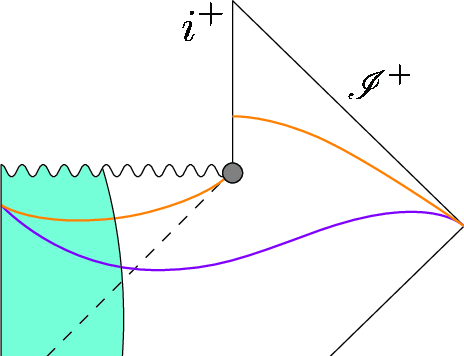
Figure 1: An evaporating black hole formed from collapse of (blue) matter, with an expected singularity (gray circle). Timeslices (purple and gold) change topology dynamically.
Semiclassical gravity has adopted the Generalized Second Law (GSL) as a replacement for energy conditions, enforcing monotonicity of generalized entropy along horizons, and has relaxed topological assumptions via weaker causal structures such as stable causality and past reflectivity. While prior work by Wall and Bousso extended singularity theorems to quantum contexts under global hyperbolicity, and Minguzzi provided a framework with relaxed causality, no theorem previously applied to the fully general setting appropriate to evaporating black holes.
Definitions and Methodology
The paper rigorously defines the new framework:
- Stable causality, past reflectivity, and spatial openness: Sufficient to avoid closed timelike curves and enable topological transitions in Cauchy surfaces.
- Generalized Second Law (GSL): Used along causal horizons reaching the asymptotic boundary, rather than requiring the NEC or global hyperbolicity.
- Robustly quantum trapped surfaces: Quantum analogues of trapped surfaces, defined via entropy-anomalousness and compact edge.
Key technical tools include the behavior of the generalized entropy Sgen on codimension-one achronal hypersurfaces, operationalized in terms of entanglement entropy and surface area. The crucial notion is that the GSL applies specifically to horizon generators reaching future null infinity, with a careful treatment of non-global hyperbolic backgrounds and topology change.
Main Theorem and Proof Strategy
The central result—the Causally Robust Quantum Singularity Theorem—can be stated as follows:
Any stably causal, past-reflecting, spatially open spacetime containing a robustly quantum trapped surface, in which the GSL and strong subadditivity of generalized entropy hold, is necessarily future null geodesically incomplete.
The proof synthesizes methods from classical and quantum singularity theorems, notably those of Minguzzi, Wall, and Bousso. The authors construct a small outward null deformation of a quantum trapped surface. By compactness arguments, they guarantee the existence of a null generator that does not enter the chronological future of the deformed region. Assuming (for contradiction) null geodesic completeness, this generator defines a causal horizon. Application of strong subadditivity and the GSL to suitably constructed hypersurface unions leads to a contradiction via the entropy-anomalous property of the initial surface.
Figure 2 visualizes the proof structure, tracking the deformation and horizon construction steps.
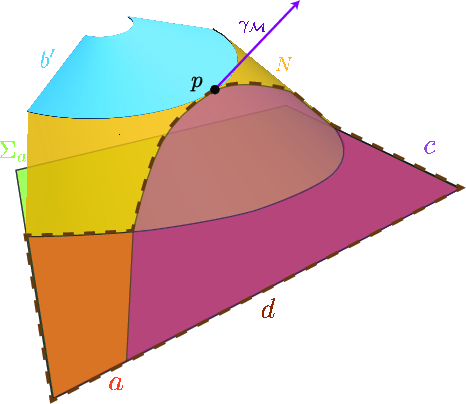
Figure 2: A schematic of the proof’s geometric construction—deformation, horizon formation, and identification of the contradictory region resulting from incompatibility between GSL and robust quantum trapping.
Implications and Theoretical Significance
Key claims:
- The theorem demonstrates that semiclassical evaporating black hole spacetimes are singular without assuming global hyperbolicity or null energy/curvature conditions.
- The quantum version of a trapped surface, in combination with the GSL, retains sufficient focusing to guarantee geodesic incompleteness.
- The framework applies even when timeslice topology changes dynamically, as in standard models of black hole evaporation.
Practical implications: Any quantum gravitational completion must either expose new physics at the would-be singularity or otherwise resolve the associated geodesic incompleteness. This result is structurally robust under the standard assumptions of semiclassical gravity and the validity of the GSL and strong subadditivity of entropy.
Theoretical ramifications: The work suggests that singularity avoidance in quantum gravity (e.g., “remnants” or unitarity-preserving pictures) cannot be simply attributed to a breakdown of classical energy or causality conditions; rather, profound modifications to the semiclassical paradigm or the GSL would be required.
Future Directions
Several generalizations are suggested:
- Relaxation of compactness assumptions for quantum trapped surfaces.
- Further study of the regime where the GSL is violated or modified at strong curvature or in the presence of quantum information-theoretic effects beyond leading order.
- Explicit characterization of the “horizon-exterior” entropy flow beyond semiclassical effective theory, especially near the endpoint of black hole evaporation.
Advanced work in quantum gravity, including island formulae and replica wormhole techniques, could be engaged to probe the saturation and potential breakdown of the strong subadditivity and GSL conjectures used here.
Conclusion
The paper establishes that the essential singularity of black holes—manifested as null geodesic incompleteness—survives even in the quantum, evaporating regime under semiclassical gravity. This result places stringent requirements on any theory aiming to resolve black hole singularities and reinforces the import of the generalized entropy framework for understanding the interplay between geometry, quantum fields, and information.

