4DAnyone: Create Anyone in 4D from a Casual Monocular Video
Abstract: We present 4DAnyone, a framework for reconstructing 4D humans from an uncalibrated monocular video by generating reconstruction-grade multiview-consistent videos and lifting them into 4D Gaussian Splatting (4DGS). Existing camera-controlled video diffusion models synthesize plausible novel-view videos but fail to maintain consistency when scaled to the tens of target views required for 4DGS reconstruction. We identify this failure as a bounded-attention-context problem: when target views exceed the capacity of a single DiT forward pass, they must be split into groups, exposing two coupled bottlenecks. On the reference-context side, conditioning on all previously generated views grows as , weakening cross-view appearance guidance. On the target-context side, disjoint groups cannot directly exchange information, causing global structural drift. 4DAnyone addresses both bottlenecks with two complementary designs: Reference Context Packing (RCP) compresses growing reference views into a fixed-length mixed-resolution context with reference-context complexity, while Target Context Routing (TCR) rotates target-view groupings during denoising to share context across groups at high-noise steps and stabilize details at low-noise steps. We further build the MVGameHuman dataset using our in-house game engine and combine it with light-stage and in-the-wild video datasets for training. Experiments on DNA-Rendering and DyMVHumans show that 4DAnyone outperforms prior methods in both novel-view video quality and downstream 4DGS reconstruction, with robust in-the-wild generalization. See our project page for video results and source code: https://4danyone.github.io.









Paper Prompts
Sign up for free to create and run prompts on this paper.
Top Community Prompts
Explain it Like I'm 14
1. What is this paper about?
The paper introduces 4DAnyone, a computer system that can turn an ordinary video of a person, filmed with just one camera, into a moving 3D model.
The name 4D means:
- 3D space: the person has a body with height, width, and depth.
- Time: the person can move, dance, or perform actions.
Normally, creating this kind of model requires many cameras filming the person at the same time. 4DAnyone tries to do it from a casual monocular video—that is, a normal video recorded with one camera.
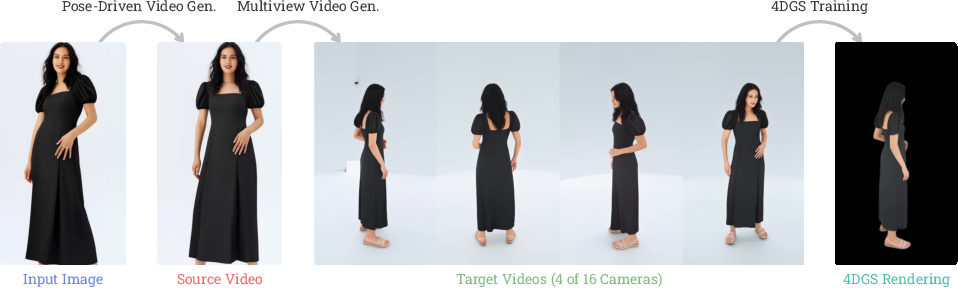
The system creates videos of the person from many new viewpoints, such as from the side or behind. These generated videos are then combined into a 4D digital avatar that can be viewed from different directions while it moves.
2. What questions are the researchers trying to answer?
The main research questions are:
- Can a single ordinary video provide enough information to build a moving 3D human model?
- How can the system keep the person looking consistent from every viewpoint? For example, the person should not have a different shirt, face, or number of fingers when viewed from different angles.
- Can the system correctly follow the person’s movements over time?
- Can it handle different people, clothes, lighting, backgrounds, and motions?
- How quickly can the complete process be done?
A major difficulty is that one camera cannot see everything. If the camera films the front of a person, the back is hidden. The system must use learned information to make a reasonable guess about unseen parts.
3. How does the system work?
The process has several main steps.
Step 1: Find the person’s body pose
First, the system examines the input video and estimates the person’s skeleton. This includes the positions of the head, shoulders, elbows, hands, hips, knees, and feet.
This is similar to placing a digital stick figure inside the video and making the stick figure copy the person’s movements.
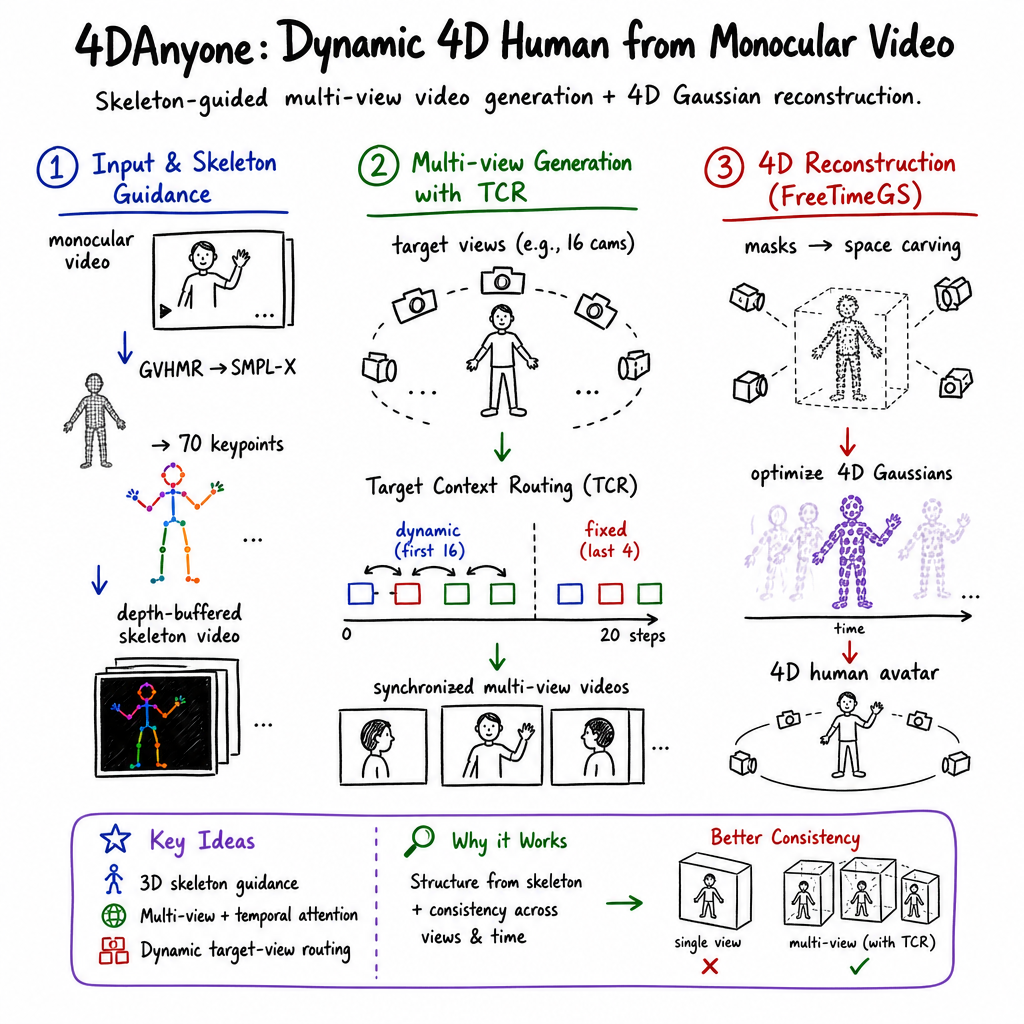
The researchers use a human-motion-recovery tool called GVHMR to estimate a 3D body shape and motion. They then convert this information into about 70 important body points.
The skeleton is drawn with different colors for different body parts. The system also uses depth information—whether a body part is closer to or farther from the camera—to understand which parts overlap.
Step 2: Generate videos from new viewpoints
The main part of 4DAnyone is a large video-generation model. It is based on a model called Wan2.2.
The model receives:
- The original video
- The estimated skeleton movement
- Several requested camera viewpoints
It then creates videos showing the same person from those viewpoints.
This is like asking an artist to draw a person from the front, side, and back while giving the artist both a reference video and a moving body outline.
Step 3: Keep different views consistent
Generating each viewpoint separately could cause problems. For example:
- The person’s face might change.
- Clothing might have different colors.
- A hand might disappear.
- The person’s movement might happen at slightly different times.
To reduce these problems, 4DAnyone uses two important ideas.
Multiview self-attention
The model allows information from different viewpoints to communicate with one another. At the same moment in time, the front view can share information with the side and back views.
This is similar to several students working on different parts of the same drawing while constantly comparing their work.
Target Context Routing
The system groups camera viewpoints together during video generation. These groups change during the process so that different viewpoints repeatedly share information.
The researchers tested several ways of changing the groups, including sliding and rearranging the views. They found that changing the groups during most of the generation process improved consistency.
Near the end, the system uses fixed groups to help finish the videos cleanly.
Step 4: Build the final 4D model
After generating the videos, the system uses a method called 4D Gaussian Splatting, or 4DGS.
A simple way to imagine this is to describe the person using many tiny, soft, colored 3D dots. Each dot has information about:
- Its location
- Its color
- Its transparency
- How it moves over time
Together, these dots form a viewable and moving digital human. This representation can be rendered from new camera positions.
The researchers use a system called FreeTimeGS to create and improve this final model.
4. What data was used for training?
The researchers trained the system with several types of video data.
One important dataset is called MVGameHuman. It contains:
- About 38,000 synchronized multi-view human videos
- 318 different actors
- 24 virtual cameras watching each sequence
- Different clothes, movements, lighting, backgrounds, and scenes
Because the videos are recorded from many cameras at the same time, the system can learn what the same person should look like from different directions.
The researchers also used:
- Other synthetic multi-view video datasets
- Regular internet-style videos
- Talk and presentation videos
- Human-rendering datasets
Training happened in three stages:
- The system first learned body movement and appearance using videos with the background removed.
- It then learned to handle backgrounds and more varied people and scenes.
- Finally, it learned from ordinary single-camera videos, where hand and finger information can be less reliable.
5. How was the system tested?
The researchers tested 4DAnyone on two human-video benchmarks:
- DNA-Rendering
- DyMVHumans
The test videos contained several scenes, many camera angles, and almost 100 frames per scene.
The system’s generated views were compared with real camera views that the system had not used directly. This tests whether the generated video matches what a real camera would have seen.
The researchers also compared 4DAnyone with other systems, including:
- MV-Performer
- TrajectoryCrafter
- ReCamMaster
They measured the results using image-quality scores such as:
- PSNR: how closely the generated pixels match the real image
- SSIM: how similar the structure and shapes are
- LPIPS: how similar the images look to human observers
For these measures, higher PSNR and SSIM are better, while lower LPIPS is better.
6. What were the main findings?
The supplementary material shows several important findings.
The system can create a 4D avatar from one video
4DAnyone can generate multiple synchronized viewpoint videos from a single-camera input. These videos can then be used to create a moving 4D Gaussian avatar.
The system can also be part of a longer process that starts with only one image. In that version:
- A separate animation model creates a video from the still image.
- 4DAnyone generates new viewpoints of the person.
- The generated videos are used to build a 4D avatar.
This means the overall technology could potentially create an animated digital person from very limited input.
Sharing information between views improves consistency
The experiments show that Target Context Routing helps the generated videos agree with one another.
In the switching-time experiment, using more sliding or rearranged viewpoint groups generally improved the results until the system reached a point where extra changes gave little additional benefit.
For example, the reported consistency scores improved from:
- PSNR: 22.21 with no sliding steps
- PSNR: 22.63 with 16 sliding steps
Similarly, SSIM increased from 0.7880 to 0.7963, while LPIPS decreased from 0.1964 to 0.1906. These changes mean that the views became more similar to the real views and to one another.
The body skeleton is a useful guide
The skeleton gives the generation model clear information about where the body should be and how it should move. This helps the system keep the person’s pose stable, even when the video has:
- Occlusion, where part of the body is hidden
- Motion blur
- Difficult movements
The researchers also created a better way to convert one body model’s points into another set of keypoints. Its average error was 3.5 millimeters, compared with 14.0 millimeters for a simpler nearest-point method. In everyday terms, the improved method located body points much more accurately.
The system is fairly fast
The complete pipeline takes approximately:
| Part of the process | Approximate time |
|---|---|
| Detecting motion and preparing skeletons | 2 minutes |
| Generating several viewpoint videos | 7 minutes |
| Building the final 4D model | 30 minutes |
These times use powerful computer hardware, so ordinary computers may take longer.
7. What are the limitations?
The system is not perfect because a single video does not contain complete information about every part of a moving person.
The researchers describe two major failure cases.
Loose or flowing clothing
The skeleton works well for the body, but it does not describe clothing that moves far away from the body. For example, a large flowing dress or piece of fabric may look different in different generated views.
This can lead to an inaccurate final 4D model.
Incorrect pose estimation
If the first stage guesses the pose incorrectly, the rest of the system may carefully follow the wrong pose.
For example, in one case a dancer stood on the tips of their toes. The pose estimator incorrectly decided that the dancer had flat feet. As a result, all generated views showed the wrong foot position.
8. Why is this research important?
4DAnyone could make it much easier to create digital humans for:
- Video games
- Virtual reality and augmented reality
- Movies and special effects
- Online meetings and virtual worlds
- Sports and dance analysis
- Digital museums and performances
- Personalized animated avatars
Instead of using a special studio with many synchronized cameras, someone might only need a normal phone video.
The research also shows a broader idea: combining body movement information with video-generation models can help computers understand and recreate people in 3D over time.
However, the results should be viewed as a strong step toward the goal rather than a complete solution. The system still needs better ways to model loose clothing, unusual poses, hands, faces, and hidden parts of the body. Nevertheless, it moves 3D human capture closer to being something that regular people could use in everyday situations.
Knowledge Gaps
Knowledge gaps, limitations, and open questions
- Generalization to real casual monocular videos remains insufficiently established. Training relies heavily on synthetic or curated data, while evaluation uses only DNA-Rendering and DyMVHumans; performance on handheld footage with uncontrolled lighting, camera motion, compression, clutter, and imperfect framing is not quantified.
- The contribution of synthetic versus real data is unclear. The paper does not report controlled experiments isolating MVGameHuman, SynCamVideo, DNA-Rendering, Pexels, and TedTalk, so it is unresolved which data sources drive cross-view consistency and whether synthetic training introduces domain bias.
- MVGameHuman’s realism and diversity are not independently validated. Although it contains 38k rendered videos and 318 actors, the paper does not measure how well its virtual actors, garments, motions, lighting, and backgrounds represent real-world distributions.
- Identity preservation is not evaluated explicitly. PSNR, SSIM, and LPIPS do not establish whether facial identity, body shape, clothing details, skin appearance, and distinctive accessories remain faithful to the monocular input across novel views.
- The method’s performance on non-human or multi-person scenes is unexplored. The pipeline is designed around a single SMPL-X/Goliath skeleton, leaving unresolved how it handles multiple people, people interacting, crowd scenes, pets, carried objects, or human–object contact.
- Loose, topology-changing, and non-body-conforming garments remain a major unresolved problem. The paper demonstrates failure on flowing fabric but does not test or quantify performance across skirts, coats, dresses, scarves, long hair, translucent clothing, or garments with independent motion.
- Dependence on GVHMR is not systematically characterized. There is no evaluation relating pose-estimation error to view-generation and 4D reconstruction quality, nor an analysis of the failure threshold at which incorrect skeletons produce unacceptable outputs.
- Unusual poses and fine-grained articulation are insufficiently covered. The reported en-pointe failure suggests weaknesses for extreme foot articulation, acrobatics, self-occlusion, hand-object interaction, and poses outside the HMR training distribution, but these cases are not benchmarked.
- The effect of omitting face and finger keypoints is unresolved. Stage 3 removes finger keypoints because of noisy monocular detections, but the paper does not quantify the resulting loss in hand articulation, facial fidelity, gesture accuracy, or identity preservation.
- Skeleton conditioning may impose an overly rigid pose prior. The paper does not investigate whether the model can represent soft-tissue motion, cloth dynamics, hair motion, body deformation, or deliberate deviations between estimated skeletons and visible appearance.
- Camera and viewpoint coverage are limited. Inference configurations use discrete camera layers and approximately uniform views; robustness to arbitrary camera trajectories, extreme elevation or azimuth, close-ups, very wide baselines, and views above or below the subject is not established.
- Absolute-scale and camera-parameter ambiguities are not fully resolved. The z-buffered skeleton is invariant to scale and shift, but the paper does not explain how metric depth, camera distance, perspective distortion, or subject scale are recovered for unconstrained input videos.
- Camera-motion robustness is not evaluated. The experiments do not isolate static-camera inputs from moving-camera videos, rapid camera motion, zoom, rolling shutter, motion parallax, or camera calibration errors.
- Temporal stability over substantially longer sequences is unknown. The model generates 121 frames and evaluation is truncated to 98 frames; long-duration drift, identity changes, repeated-motion artifacts, and consistency over minutes-long videos remain untested.
- Temporal synchronization across generated views is not directly measured. The paper reports multi-view consistency metrics but does not evaluate whether fine-grained events—hands, feet, cloth motion, or contact events—occur at the same time in every generated view.
- The 4DGS stage may conceal errors from video generation. Results are evaluated after reconstructing with FreeTimeGS, but the paper does not separate errors caused by generated videos from those caused by Gaussian initialization, optimization, or rendering.
- The method’s robustness to imperfect foreground masks is unclear. Space carving is initialized from predicted foreground masks, yet sensitivity to mask holes, background leakage, shadows, reflections, and transparent or semi-transparent regions is not reported.
- The evaluation scale is small. The main evaluation uses only 10 DNA-Rendering scenes and 3 DyMVHumans scenes, while the ablation uses eight additional DNA-Rendering scenes; statistical confidence, variance across subjects, and performance on larger and more diverse test sets are not provided.
- No user-centered or perceptual study is reported. It remains unclear whether improvements in PSNR, SSIM, and LPIPS correspond to human judgments of view consistency, realism, identity fidelity, motion quality, and usefulness of the reconstructed avatar.
- Metric validity for hallucinated novel views is uncertain. Pixel-based comparisons against captured views may penalize plausible but non-identical appearance and may not adequately measure 3D consistency, geometry accuracy, texture fidelity, or temporal coherence.
- Cross-dataset and cross-domain generalization is only partially tested. The evaluation datasets are related human-rendering benchmarks, and there is no zero-shot test on substantially different real-world domains, ethnicities, body types, age groups, indoor/outdoor environments, or lighting conditions.
- The ablation study does not isolate all architectural contributions. The interactions among multiview self-attention, multi-scale patchification, skeleton encoding, RCP, TCR, training stages, and data mixtures are not comprehensively disentangled.
- TCR’s behavior under different view counts and camera layouts is underexplored. The switching-time sweep is performed under a particular 16-view, four-view-group setup; its scalability and optimal routing schedule for fewer views, more views, irregular layouts, or nonuniform camera spacing remain unknown.
- Computational and memory costs at higher resolutions or larger view counts are not reported. Timings are given for selected hardware and configurations, but scalability with resolution, sequence length, number of target cameras, and denoising steps is not quantified.
- The claimed reduction to 10 denoising steps lacks systematic validation. The paper states that quality degradation is minimal but does not provide metrics, confidence intervals, or comparisons across diverse scenes and failure-prone inputs.
- The chained single-image-to-4D result lacks independent evaluation. The image-to-video stage uses Wan-Animate, so the paper does not determine how errors from pose-driven video synthesis propagate into 4D reconstruction or whether the final avatar preserves the original image identity.
- Failure detection and uncertainty estimation are absent. The system does not indicate when HMR, view synthesis, or 4DGS reconstruction is unreliable, which limits safe deployment on inputs with occlusion, blur, unusual poses, or unsupported clothing.
- Reconstruction quality for unseen surfaces is not rigorously analyzed. Because only one monocular source view is observed, the paper does not quantify hallucination quality on backsides, occluded body regions, garment interiors, hair, or areas never visible in the input.
- The approach’s applicability to nonstandard human appearance is unclear. Performance for diverse body shapes, mobility aids, costumes, cultural attire, children, elderly people, and subjects with significant anatomical variation is not reported.
- Reproducibility is incomplete. The paper specifies many training details but does not provide sufficient information about data-generation distributions, train/test actor overlap, preprocessing implementation, random-seed variability, or released checkpoints and code to independently verify the results.
Practical Applications
Immediate Applications
The paper presents a pipeline that converts a casual monocular human video into synchronized multi-view videos and a dynamic 4D Gaussian Splatting (4DGS) avatar. The reported runtime—approximately 2 minutes for preprocessing, 7 minutes for multi-view generation, and 30 minutes for 4DGS optimization—makes several controlled, non-safety-critical uses feasible today, assuming access to suitable GPU hardware and the model implementation.
- Rapid creation of animatable digital humans for film, advertising, and virtual production (media and entertainment)
- virtual camera placement and scene blocking;
- background replacement and compositing;
- promotional content and short-form video;
- previsualization before expensive multi-camera capture.
- Dependencies: Reliable human-motion recovery, sufficient visual quality in clothing and hands, GPU inference capacity, and consent to digitize the performer.
- Free-viewpoint playback of recorded performances (sports, dance, theater, and live events) Existing single-camera footage could be converted into an interactive 4D performance that viewers can inspect from different azimuths or limited pitch angles. The paper indicates that 16 cameras can support free-viewpoint rendering in restricted settings, while 32–48 cameras improve coverage for complex clothing and motion. Dependencies: The generated views must remain temporally and geometrically consistent; unusual poses, severe occlusions, and loose garments can produce visible artifacts. The result should be treated as an approximate reconstruction rather than archival ground truth.
- Virtual try-on and digital fashion presentation (retail, e-commerce, and fashion) A person recorded in ordinary clothing could be reconstructed as a dynamic avatar for displaying garments, evaluating fit-related presentation, or producing multi-angle product media. Retail workflows could combine the output with clothing segmentation, garment simulation, or avatar-based catalog generation. Dependencies: The paper’s method is not itself a garment-physics or measurement system. Flowing fabrics are explicitly identified as a failure case, so commercial try-on would require additional cloth reconstruction, body-measurement validation, and safeguards against misleading fit claims.
- Low-cost generation of human assets for games, animation, and virtual worlds (software and game development) Studios could use the pipeline to create expressive background characters, non-player characters, or animated virtual-world inhabitants from reference performances without installing a multi-camera capture rig. The 4DGS representation can provide a visually rich asset for playback or rendering. Dependencies: 4DGS compatibility with the target engine, memory and rendering constraints, licensing of the base models and training data, and conversion to skeletal or editable animation formats where gameplay interaction is required.
- Single-image-to-4D avatar services (consumer applications and creator tools) The supplementary results demonstrate a workflow in which an image-to-video animation model first animates a still image, followed by 4DAnyone and 4DGS reconstruction. This could support creator-facing products that generate a moving, viewable avatar from one portrait and a driving motion clip. Dependencies: The identity and clothing generated by the image-to-video stage must remain stable. Users must be informed that the output is synthesized and potentially inaccurate, and platforms would need consent, impersonation controls, and provenance labeling.
- Interactive educational and cultural visualization (education, museums, and heritage communication) Recorded demonstrations—such as dance movements, physical exercises, craft techniques, or historical reenactments—could be turned into viewable 4D assets for online lessons, museum exhibits, and immersive learning. Learners could inspect posture and movement from multiple viewpoints. Dependencies: Educational validity depends on pose accuracy. The documented failure of HMR on unusual poses means expert review is necessary for instruction involving precise biomechanics or culturally significant movements.
- Research and development tool for monocular-to-4D reconstruction (academia)
- skeleton-conditioned video diffusion;
- multiview self-attention for cross-view consistency;
- multi-scale patchification for different source-view counts;
- Target Context Routing for distributing target views across denoising steps;
- body-part-aware perceptual-loss sampling;
- SMPL-X-to-keypoint regression.
- The released or reproduced pipeline could support experiments in human reconstruction, view synthesis, motion generation, and dynamic scene representation.
- Dependencies: Reproducibility requires substantial compute—the reported training configuration uses up to 128 H20-3E GPUs—and access to compatible datasets, pretrained models, and human-body annotations.
- Performance analysis and coaching visualization (sports and biomechanics, with limited deployment) Coaches could use reconstructed viewpoints to review movements that were recorded from only one camera, such as swings, kicks, or dance sequences. The skeleton and multiview output could also serve as a visualization interface for comparing a performer with a reference motion. Dependencies: The system should not be used for clinical diagnosis or high-stakes injury assessment without validated metric accuracy. Pose-estimation errors are propagated consistently into all generated views, which can make an incorrect reconstruction appear plausible.
- Personalized virtual presence and remote communication (telepresence and social platforms) A user could generate a dynamic avatar from casual footage for virtual meetings, social experiences, or immersive messaging. Compared with conventional 2D video, the representation could enable limited viewpoint changes and more expressive spatial presentation. Dependencies: Real-time operation is not established by the paper; the reported pipeline is an offline process. Privacy, biometric-data protection, anti-fraud controls, and clear disclosure of synthetic rendering would be essential.
Long-Term Applications
The following applications are technically plausible extensions but require further validation, improved robustness, or substantial deployment infrastructure before they can be relied upon at scale.
- Real-time 4D telepresence from a single camera (robotics, telecommunications, and XR) A future system could continuously transform webcam or phone footage into a low-latency 4D avatar for remote collaboration, immersive calls, and virtual events. The paper’s efficient 10-step denoising option suggests a path toward acceleration, but the current pipeline still includes several minutes of processing and offline 4DGS optimization. Dependencies: Distillation or streaming diffusion, incremental 4DGS updates, temporal stability over long sessions, low-latency HMR, bandwidth optimization, and dedicated hardware.
- Robotic perception and human–robot interaction (robotics) Robots could use monocular video to construct a dynamic, viewable model of a person for imitation learning, gesture understanding, ergonomic assessment, or simulation. Skeleton conditioning could provide a structured intermediate representation for tracking human motion. Dependencies: The method must be extended from visually plausible synthesis to metrically accurate geometry and motion. Occlusions, multiple people, reflective objects, loose clothing, and safety-critical pose errors must be handled reliably. Generated content should not be treated as a direct substitute for sensor-based perception.
- Clinical rehabilitation and movement assessment (healthcare) A validated version could create affordable multi-view motion records for physical therapy, gait analysis, or remote rehabilitation when only a monocular camera is available. The generated viewpoints might help clinicians inspect movements that are difficult to observe from the original camera angle. Dependencies: This requires clinical trials, calibrated error estimates, demographic and clothing diversity, medical-device or clinical-software compliance, secure handling of biometric video, and explicit separation between visualization assistance and diagnosis.
- Large-scale digitization of people and performances (archives, museums, and public policy) Institutions could reconstruct historical performances or public demonstrations from legacy monocular footage, making them explorable in interactive archives. Governments and cultural organizations might use the approach to expand digital-access programs without installing capture rigs at every site. Dependencies: Historical footage often lacks camera calibration, has compression artifacts, and contains unusual clothing or motion. Provenance metadata, uncertainty visualization, archival standards, and expert verification would be required to avoid presenting generated viewpoints as authentic observations.
- Synthetic-data generation for human-centered AI (academia, robotics, and computer vision) The multi-view generation capability and datasets such as MVGameHuman could produce training examples for pose estimation, person tracking, human–robot interaction, action recognition, and dynamic rendering. Controlled variation in cameras, clothing, lighting, motion, and backgrounds is particularly useful for stress testing. Dependencies: Synthetic-to-real domain gaps, representation bias across the 318 actors and virtual environments, possible memorization, and licensing restrictions must be evaluated. Synthetic data should be combined with carefully curated real-world data rather than assumed to be universally representative.
- Virtual fitting, body measurement, and apparel simulation (retail and manufacturing) A more advanced system could combine the reconstructed body and motion with physically based garment simulation to test fit during movement, generate size recommendations, or reduce the need for physical samples. Dependencies: Accurate scale and body measurements are not guaranteed by the paper’s depth-buffered skeleton representation, which is designed to be invariant to absolute scale and shift. This use therefore requires calibrated capture, body-shape estimation, cloth dynamics, and validation across body types and garment materials.
- Immersive sports broadcasting and spectator-controlled cameras (broadcasting and XR) A broadcaster could generate interactive viewpoints of an athlete or performer from a single or sparse camera feed, allowing viewers to select viewpoints in real time or after an event. Dependencies: Broadcast-quality deployment requires reliable handling of fast motion, multiple people, equipment, shadows, and occlusion, along with strict latency and visual-fidelity guarantees. Synthetic viewpoints must be labeled to distinguish them from captured footage.
- Human motion planning and simulation for embodied agents (robotics and simulation) Reconstructed 4D human performances could populate simulated environments for training robots, autonomous systems, or virtual assistants to anticipate human movement. The multi-view representation may improve simulation diversity compared with isolated 2D clips. Dependencies: Simulation requires physically and temporally accurate trajectories, not merely perceptually convincing videos. Collision geometry, action labels, long-horizon motion, and interaction with objects would need to be modeled explicitly.
- Policy and accessibility tools for remote participation (public services and social infrastructure) Government or accessibility platforms could eventually use compact 4D avatars to support remote attendance, sign or gesture communication, and low-bandwidth visual participation. Body-part-aware processing could be adapted to prioritize hands and face in communication interfaces. Dependencies: Hand and facial detail must be substantially more reliable than in the current monocular setting. Accessibility applications require user studies, language and cultural coverage, privacy protections, and guarantees that synthesized gestures are not misinterpreted.
- Personal digital replicas and identity-preserving media production (consumer technology and finance-related identity systems) In the longer term, individuals could maintain controllable digital replicas for entertainment, education, customer support, or authorized commercial appearances. However, the same capability could enable impersonation, fraud, or non-consensual synthetic media. Dependencies: Deployment would require robust watermarking, provenance tracking, consent management, revocation mechanisms, identity verification, and legal frameworks governing ownership and authorized use of human likenesses.
Glossary
- 4D Gaussian Splatting (4DGS): A representation of dynamic scenes using Gaussian primitives that vary over space and time. “The 4D Gaussian primitives are initialized with coarse geometry obtained via space carving from the predicted foreground masks.”
- Adam optimizer: An adaptive gradient-based optimization algorithm commonly used to train neural networks. “We optimize the model using the Adam optimizer with a learning rate of for 50k iterations”
- activation variance: The statistical variance of neural-network activations, which affects signal stability during training. “to preserve activation variance.”
- azimuth: The horizontal angular direction around a reference axis, commonly used to describe camera viewpoints. “We order the 16 target views by azimuth and partition them into four-view groups.”
- camera-space depth: The depth of a point measured in the coordinate system of a camera. “each keypoint's camera-space depth drives the pixelwise z-buffer”
- camera trajectory: The path and changing poses followed by a camera during capture or rendering. “TrajectoryCrafter: Redirecting Camera Trajectory for Monocular Videos via Diffusion Models”
- camera-aligned depth map: A depth map transformed so that its scale and coordinate system correspond to a particular camera or dataset. “We use a camera-aligned Depth-Anything-3~\cite{lin2025da3} depth map as reference”
- camera parameters: Numerical variables describing a camera’s position, orientation, and imaging properties. “using the ground-truth camera parameters of the evaluation capture”
- Conv3d: A three-dimensional convolutional neural-network operation applied across spatial and temporal dimensions. “The standard Wan2.2 patchify layer is a Conv3d with kernel/stride .”
- convex combination: A weighted sum whose weights are nonnegative and sum to one. “The regressor predicts each of the 70 Goliath keypoints as a convex combination of a fixed set of nearby SMPL-X vertices”
- cross-view consistency: Agreement in appearance, geometry, or identity across images from different viewpoints. “pretrained temporal coherence serves as a natural starting point for learning cross-view consistency.”
- depth buffer: A data structure storing the depth of the closest rendered surface at each pixel. “The skeleton encoder takes the depth-buffered RGB skeleton video as input”
- depth map: An image in which each pixel records the distance from the camera to the corresponding scene surface. “We first estimate depth with Depth-Anything-3~\cite{lin2025da3} using the ground-truth camera parameters”
- depth estimation: The process of inferring scene depth from one or more images or video frames. “Depth-Anything-3: Recovering the Visual Space from Any Views”
- DiT: A diffusion-transformer architecture that applies transformer blocks to latent image or video tokens. “outputs a DiT-resolution residual added to the noisy latent tokens.”
- diffusion model: A generative model that synthesizes data by iteratively denoising a noisy sample. “TrajectoryCrafter uses warped source-video depth as the target-view condition.”
- denoising step: One iteration in the process of removing noise from a diffusion-model sample. “generating 4 videos of 121 frames each with 20 denoising steps”
- dynamic scene: A scene whose geometry, appearance, or contents change over time. “High-Fidelity and Real-Time Novel View Synthesis for Dynamic Scenes”
- en pointe: A ballet pose in which the dancer stands on the tips of the toes. “the dancer stands en pointe in the source video”
- foreground mask: A binary or probabilistic image mask identifying the subject or objects of interest rather than the background. “The 4D Gaussian primitives are initialized with coarse geometry obtained via space carving from the predicted foreground masks.”
- free-viewpoint rendering: Rendering a scene from arbitrary virtual camera positions or orientations. “A single-layer setup with 16 cameras suffices for free-viewpoint rendering at limited pitch angles.”
- Gaussian primitive: A parameterized Gaussian-shaped element used to represent geometry, color, opacity, and appearance in a rendering model. “The 4D Gaussian primitives are initialized with coarse geometry”
- ground-aligned mesh: A three-dimensional mesh positioned relative to a world ground plane or gravity-aligned coordinate system. “to estimate a ground-aligned SMPL-X~\cite{pavlakos2019expressive} mesh sequence”
- held-out view: A viewpoint excluded from model fitting and reserved for evaluating generalization or consistency. “held-out views for consistency evaluation.”
- HMR (human motion recovery): The estimation of human body pose, shape, and motion from visual input. “Given a monocular video, we run GVHMR~\cite{shen2024gvhmr} to estimate a ground-aligned SMPL-X”
- implicit camera-parameter conditioning: Controlling a generative model through camera information encoded indirectly rather than supplied as explicit geometric structure. “providing a controlled comparison between implicit camera-parameter conditioning and our explicit skeleton-geometry conditioning.”
- latent token: A learned compact representation element used by a generative model instead of directly processing pixels. “added to the noisy latent tokens.”
- LPIPS: A perceptual image-similarity metric based on distances between deep neural-network features. “All stages fine-tune Wan2.2-TI2V-5B~\cite{wan2025wan} at resolution with a learning rate of and an LPIPS~\cite{zhang2018lpips} weight of .”
- monocular video: Video captured from a single camera viewpoint. “Given a monocular video, we run GVHMR~\cite{shen2024gvhmr}”
- multi-view self-attention: An attention mechanism allowing tokens from different viewpoints to interact at corresponding times. “In multiview self-attention, we rearrange tokens to ”
- novel-view synthesis: Generating images or videos from viewpoints not present in the input observations. “Neural Body: Implicit Neural Representations with Structured Latent Codes for Novel View Synthesis of Dynamic Humans”
- patchify layer: A network layer that divides an image or video into patches and converts them into tokens. “The standard Wan2.2 patchify layer is a Conv3d with kernel/stride .”
- pixelwise z-buffer: A per-pixel depth-selection procedure that retains the nearest surface along the viewing ray. “each keypoint's camera-space depth drives the pixelwise z-buffer”
- pose-driven video generation: Synthesizing a video whose subject’s motion is controlled by a specified pose sequence. “then generate a source video via pose-driven video generation (Wan-Animate)”
- pretrained model: A model previously trained on a dataset and reused as an initialization or component for another task. “All parameters are initialized from the base model's temporal self-attention layers”
- radiance field: A continuous representation that models the visual appearance and density of a scene from arbitrary spatial locations and viewing directions. “NeRF: Representing Scenes as Neural Radiance Fields for View Synthesis”
- residual: An additive correction or feature signal applied to the output of another network component. “outputs a DiT-resolution residual added to the noisy latent tokens.”
- RGB skeleton video: A color video representation in which a human skeleton is rendered into the scene. “The skeleton encoder takes the depth-buffered RGB skeleton video as input”
- SMPL-X: A parametric human-body model representing body, hand, and facial pose and shape. “to estimate a ground-aligned SMPL-X~\cite{pavlakos2019expressive} mesh sequence”
- space carving: A volumetric reconstruction method that removes 3D regions inconsistent with silhouettes observed from multiple cameras. “obtained via space carving from the predicted foreground masks.”
- sparse vertex-to-keypoint regressor: A model that estimates keypoints as weighted combinations of a limited number of mesh vertices. “then apply a sparse vertex-to-keypoint regressor to extract 70 3D keypoints”
- temporal coherence: Consistency of an object’s appearance, geometry, or motion across successive frames. “the pretrained temporal coherence serves as a natural starting point”
- temporal self-attention: An attention mechanism that relates tokens across different times or video frames. “the video (temporal) self-attention layers in the base Wan2.2 DiT”
- token: A vector representation processed by a transformer, often corresponding to a patch or latent region. “allowing tokens from different viewpoints at the same timestep to directly attend to each other.”
- uniformly distributed cameras: Cameras positioned at approximately even angular or spatial intervals around a subject. “with 16 approximately uniformly distributed cameras and 98 frames per scene.”
- VAE (variational autoencoder): A neural architecture that encodes data into a probabilistic latent space and decodes it back into the original domain. “to match the Wan2.2 VAE encoding pattern”
- view synthesis: The generation of an image or video from a specified viewpoint using scene information. “4D Consistent Human View Synthesis from Sparse-View Videos with Spatio-Temporal Diffusion Models”
- virtual camera: A simulated camera used to render images from a computer-generated scene. “captured by 24 virtual cameras per sequence.”
- z-buffer: A depth buffer used to determine which surface is visible at each image pixel. “which depends only on relative depth ordering and is thus invariant to absolute scale and shift.”