Beyond Capacity: Scalable MoE LLM Inference via High-Bandwidth Flash with Direct GPU and HBM Paths
Abstract: Modern mixture-of-experts (MoE) LLMs increasingly strain the capacity and cost efficiency of high-bandwidth memory (HBM), as rapidly growing expert weights must be provisioned close to GPUs. High-bandwidth flash (HBF) offers substantially greater capacity, but conventional designs typically deliver HBF-resident expert weights to the GPU through HBM, leaving an additional direct GPU-HBF connection underutilized. We explore an HBF organization that simultaneously exploits two independent expert-delivery routes: a direct path that transfers expert weights from HBF to the GPU and a relay path that transfers them from HBF through the HBM base die to the GPU. Whole experts are assigned to one of the two routes, and transfers over both routes proceed concurrently, increasing aggregate expert-delivery bandwidth without replicating expert weights or introducing a shared relay bottleneck. Early expert determination identifies upcoming experts ahead of their conventional execution point, allowing HBF read latency to overlap with preceding computation, while separate management of immutable expert weights and mutable KV-cache data reduces interference between the two traffic classes. We evaluate the architecture using an event-driven continuous-batching LLM serving simulator with empirically measured GPU compute latencies. Across representative MoE workloads, concurrently utilizing the direct GPU-HBF and HBF-HBM-GPU routes consistently improves expert-delivery efficiency over designs restricted to either route alone. For a representative workload, the proposed architecture can achieve 1.94 higher throughput and 1.90 end-to-end speedup over a design that delivers all HBF-resident expert weights to the GPU through the HBM base die.
Paper Prompts
Sign up for free to create and run prompts on this paper.
Top Community Prompts
Explain it Like I'm 14
1. What is this paper about?
This paper presents DASH, a new way to help very LLMs run faster and more cheaply.
Some modern LLMs use a design called a Mixture of Experts, or MoE. These models contain many smaller “expert” networks, but each word or token uses only a few of them. This saves computing work, but the computer still needs to store all the experts.
The problem is that these expert weights can be much larger than the memory built into a GPU. The paper suggests using a new type of memory called High-Bandwidth Flash (HBF). HBF has much more storage than GPU memory, while still being able to read data quickly.
DASH improves HBF by giving the GPU two separate ways to receive data instead of only one.
2. What questions does the research ask?
The researchers mainly wanted to find out:
- Can HBF store the huge expert weights that do not fit in GPU memory?
- Can HBF send expert weights to the GPU quickly enough for language-model generation?
- Can two data paths be used at the same time to increase total speed?
- Can the system hide HBF’s startup delays while the GPU is doing other work?
- Can DASH handle both:
- Expert weights, which are large and mostly read-only, and
- The KV cache, which grows and changes while the model processes long conversations?
- Does DASH improve speed and reduce waiting time compared with systems using only one HBF-to-GPU path?
Here, the KV cache is like the model’s notebook. It stores information from earlier words so the model does not need to calculate everything again for every new word.
3. How did the researchers study the idea?
Understanding the memory problem
The paper focuses on three kinds of memory:
- HBM: Very fast memory placed close to the GPU, but with limited capacity.
- HBF: Much larger memory that can store huge amounts of data, but has longer delays before reading or writing.
- GPU memory access paths: The connections that carry data between the GPU and the memories.
A simple analogy is a kitchen:
- The GPU is the chef.
- HBM is a small counter next to the chef. It is fast, but has little space.
- HBF is a large pantry. It holds much more food, but it takes longer to fetch something.
- The data paths are the routes from the pantry and counter to the chef.
DASH’s two paths
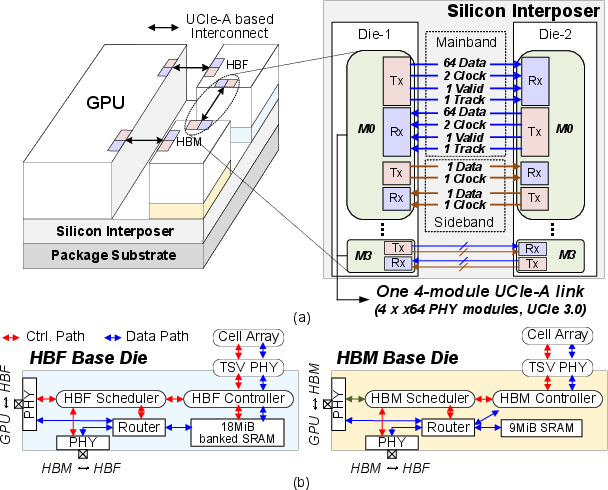
DASH connects HBF to the GPU in two ways:
- Direct path: HBF sends data straight to the GPU.
- Relay path: HBF sends data through the HBM connection before reaching the GPU.
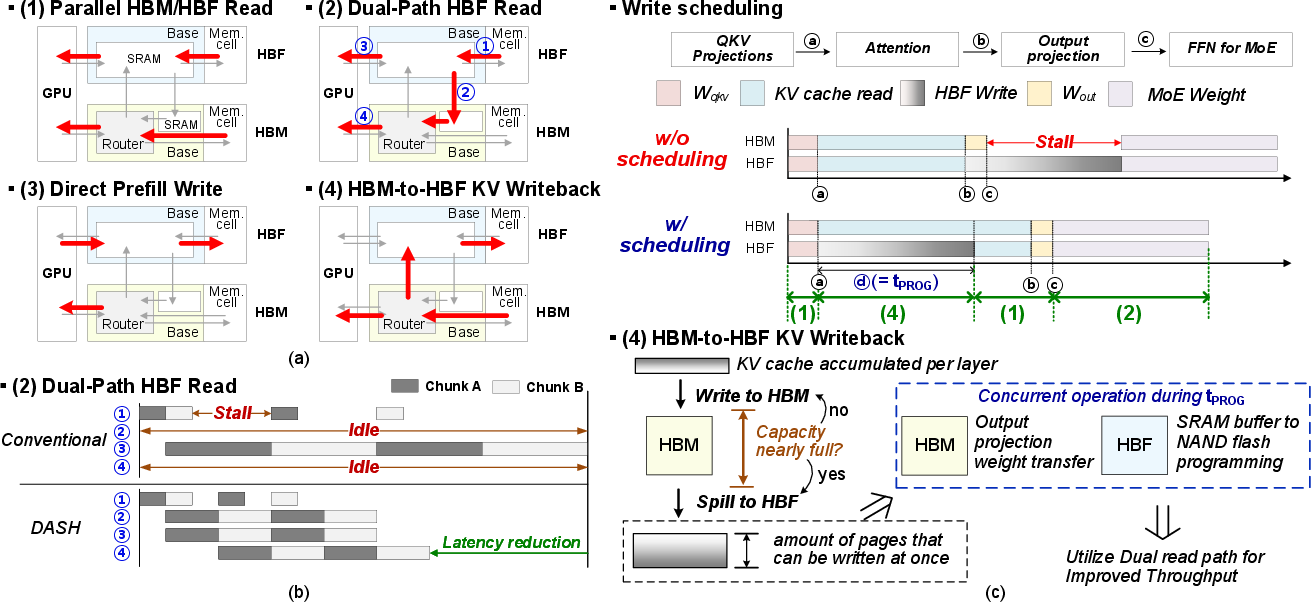
These paths can work at the same time. Different pieces of an expert can travel over different paths, like sending packages by two roads instead of one.
The system does not need to make a second copy of every expert. Instead, it divides expert weights into chunks and sends the chunks through both routes.
Placing different data in different memories
DASH uses different locations depending on how data behaves:
- Large, mostly unchanged expert weights are stored in HBF.
- Frequently changing information is kept in HBM when possible.
- Some smaller, frequently reused model weights are copied into both HBM and HBF.
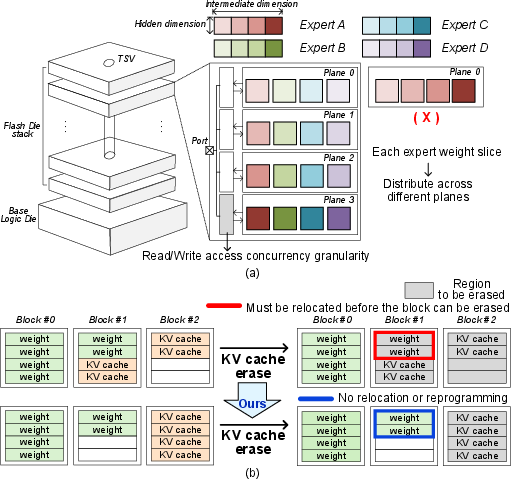
- KV-cache data is moved from HBM to HBF in large groups instead of many tiny pieces.
This is useful because HBF is better at large reads and writes than at many very small updates.
Starting expert reads early
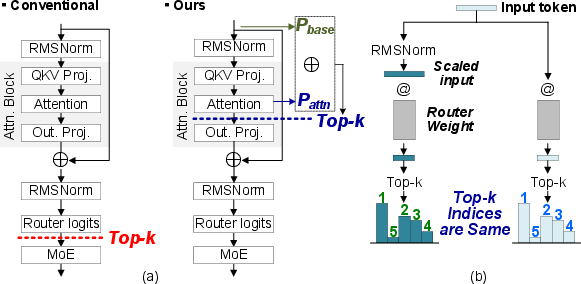
Normally, the model decides which experts it needs fairly late in the process. This could force the GPU to wait for HBF to start reading the expert weights.
DASH uses lookahead expert execution. It calculates which experts will probably be needed earlier than usual, so HBF can begin reading their weights while the GPU is still finishing other calculations.
This is similar to a student opening the next textbook page before finishing the current problem. When the student is ready, the page is already available.
Simulation rather than a physical prototype
The researchers tested DASH using an event-driven simulator. A simulator is a computer program that imitates how a real system would behave over time.
They modeled:
- Six MoE LLMs, including Qwen3, Mixtral, Grok, Llama 4, and DeepSeek.
- Different batch sizes and prompt lengths.
- Short and very long text generation.
- HBF reading and writing delays.
- The two DASH data paths.
- The growth of the KV cache.
- Continuous batching, where new requests join while other requests are still being processed.
They also measured GPU operation times on an NVIDIA H100 GPU and used those measurements in the simulator.
The main comparisons were:
- RelayOnly: Uses only the HBF–HBM–GPU route.
- DirectOnly: Uses only the direct HBF–GPU route.
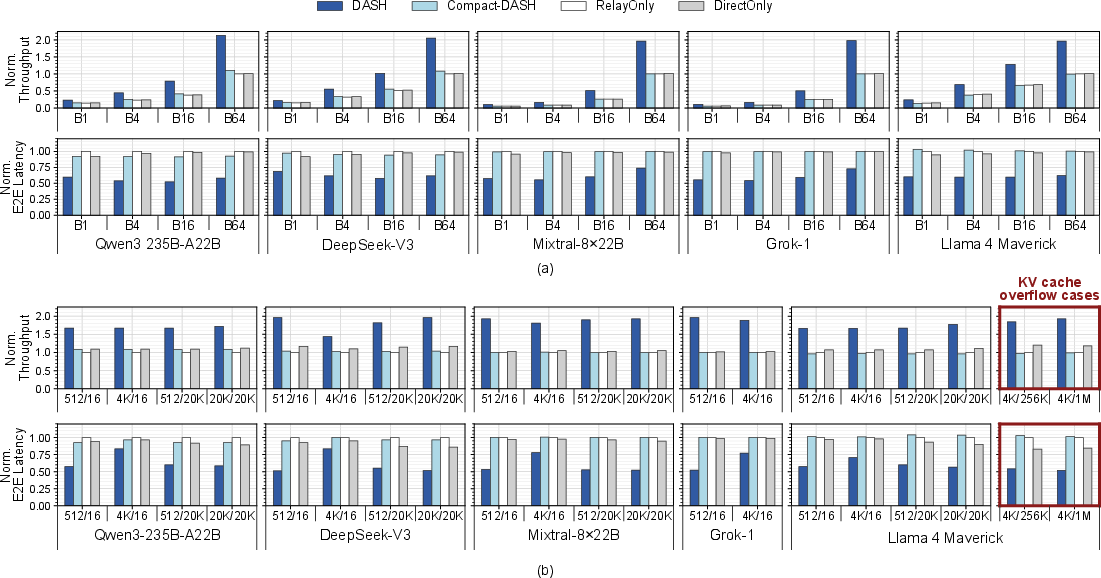
- DASH: Uses both routes at the same time.
- Compact-DASH: A smaller version with fewer memory stacks.
4. What did the researchers find?
DASH was faster than using only one path
Across the main tests, DASH consistently performed better than both single-path designs.
For workloads with a batch of requests, DASH achieved approximately:
- 1.90× higher throughput than RelayOnly.
- 1.84× higher throughput than DirectOnly.
- About 42% lower end-to-end latency than RelayOnly.
- About 41% lower end-to-end latency than DirectOnly.
Throughput means how much work the system completes in a certain amount of time. Latency means how long a user waits for a result.
For different prompt and generation lengths, DASH still achieved strong results:
- About 1.79× higher throughput than RelayOnly.
- About 1.63× higher throughput than DirectOnly.
- Around 40% lower latency than RelayOnly.
DASH handled very large KV caches
In one test with Llama 4, the KV cache grew to about 197 GB. This is far too large for the available HBM alone.
DASH moved older KV-cache information to HBF while keeping newer, smaller updates in HBM. Even in this difficult case, DASH had:
- 1.92× higher throughput than RelayOnly.
- 48% lower end-to-end latency.
This shows that DASH is not only useful for storing expert weights. It can also manage the growing memory needed for long conversations.
Early expert selection reduced delays
The early expert-selection method helped the system avoid waiting for HBF reads.
When the assumed HBF read delay was small, the improvement was modest. When the delay was increased to 32 microseconds, early selection reduced:
- End-to-end latency by about 9% for Qwen3.
- Time per generated token by about 11% for Qwen3.
- Similar amounts for DeepSeek-V2.
The improvement comes from overlapping memory work with computation instead of performing the tasks one after another.
DASH was much faster than CPU offloading
Another possible solution is to store expert weights in regular computer memory and send them to the GPU, or even run some experts on the CPU.
The paper found that these CPU-based approaches were 8.22 to 12.32 times slower than DASH in the tested cases. The main reasons are:
- The CPU is slower at this work.
- Data must travel between the CPU and GPU.
- These transfers create extra waiting.
The smaller version also worked well
Compact-DASH used fewer HBM and HBF memory stacks. Even so, it performed similarly to the single-path systems.
This suggests that DASH might improve performance without requiring the largest possible hardware setup.
5. Why are these results important?
Large MoE LLMs can have hundreds of gigabytes or even more than a terabyte of weights. A single GPU’s HBM cannot store all of that, especially when space is also needed for the KV cache and temporary calculations.
DASH offers a way to:
- Store large expert models without adding many extra GPUs.
- Use HBF’s large capacity while reducing its delay problems.
- Make better use of the connections between memory and the GPU.
- Keep the GPU busy instead of making it wait for expert weights.
- Support long prompts and long conversations.
- Reduce the need to move data through slower CPUs or storage devices.
The key idea is that HBF should not be treated merely as a slow backup storage area. With the right connections and scheduling, it can become an important part of the main memory system.
Conclusion and possible impact
The paper argues that using two independent HBF-to-GPU routes at the same time can make large MoE LLMs considerably faster. DASH also improves performance by reading experts early, organizing data carefully, and grouping small KV-cache updates into larger writes.
The results are based on simulation and measured GPU timings, not on a complete physical DASH chip. Therefore, real hardware may perform somewhat differently. Still, the study suggests a promising direction for future AI systems.
If built in practice, DASH could help companies run very LLMs with fewer GPUs, lower memory costs, and better support for long-context applications such as extended conversations, document analysis, and software assistants.
Knowledge Gaps
Knowledge Gaps, Limitations, and Open Questions
The paper leaves the following issues unresolved:
- Lack of hardware prototype validation: DASH is evaluated exclusively through simulation; the feasibility of integrating GPU, HBM, and HBF base dies with three independent UCIe links remains undemonstrated.
- Unverified HBF assumptions: Key parameters—including the assumed $1.6$ TB/s usable link bandwidth, read latency, program latency, four subarrays per plane, and SRAM organization—are based on specifications, patents, or assumptions rather than measurements from a production HBF device.
- Incomplete physical-design analysis: The paper does not quantify the area, routing complexity, thermal impact, signal integrity, power-delivery requirements, or packaging constraints of attaching multiple high-bandwidth UCIe links to the GPU and memory base dies.
- No end-to-end energy evaluation: Although link power is estimated, the study does not report total system energy, energy per generated token, HBF controller power, NAND sensing/program power, GPU power changes, or the energy cost of dual-path transfers.
- Cost claims are not substantiated: The paper claims capacity-per-cost and area-efficiency benefits but does not provide a complete cost model covering HBF stacks, HBM stacks, UCIe PHYs, base-die SRAM, packaging, cooling, controllers, and manufacturing yield.
- Limited workload diversity: Evaluation focuses on six MoE models and a small set of fixed input/output lengths; broader workloads involving varying prompt distributions, generation lengths, context lengths, batch sizes, sparsity patterns, and request arrival processes remain unexplored.
- Restricted continuous-batching evaluation: The continuous-batching study appears to focus primarily on Qwen3 with one arrival configuration, leaving the behavior of DASH under diverse traffic distributions, bursty arrivals, heterogeneous service-level objectives, and other MoE architectures uncertain.
- Idealized expert-routing distribution: The continuous-batching experiments use analytically balanced per-expert rows, which may understate contention, load imbalance, hot-expert effects, and path skew produced by real user inputs and router behavior.
- Unclear impact of expert-weight reuse and caching: The evaluation does not fully characterize how repeated expert selections, inter-request locality, expert caching policies, or partial expert residency in HBM affect DASH’s relative advantage.
- Limited baseline coverage: Comparisons omit potentially competitive alternatives such as multi-GPU systems with optimized expert parallelism, CPU/NVMe offloading with asynchronous prefetching, compressed or quantized expert caching, expert replication, and other near-memory or CXL-based designs.
- Potentially favorable baseline configuration: All configurations use the same placement policy and HBF-resident experts, but the paper does not establish whether RelayOnly, DirectOnly, or CPU-based baselines were independently optimized for placement, prefetching, buffering, routing, and scheduling.
- No comparison with state-of-the-art serving engines: The simulator-based results are not validated against optimized implementations such as production continuous-batching runtimes, expert-parallel serving systems, or GPU kernels designed specifically for MoE inference.
- Unvalidated GPU performance modeling under contention: GPU operator latencies are profiled in isolation on an H100 and interpolated over validated ranges, but the study does not establish how accurate these timings remain when simultaneous HBM/HBF transfers, DMA activity, synchronization, and memory-system contention occur.
- Router transformation applicability is limited: Lookahead Expert Execution applies only to scale-invariant routers without expert-specific additive bias; the paper does not quantify how often modern MoE models satisfy these conditions or develop a general method for routers that do not.
- No accuracy or numerical-equivalence validation: The early-routing transformation is argued to preserve top- ranking, but the paper does not report numerical comparisons across precisions, quantization schemes, ties, near-ties, router numerical errors, or full-model output equivalence.
- Additional routing overhead is not fully assessed: Computing and storing the transformed routing weights and performing FP32 early selection may introduce extra memory traffic, storage overhead, compute cost, and implementation complexity that are not separately quantified.
- Speculative or incorrect expert reads are not addressed: The paper does not explain how the system handles early decisions that become unavailable, invalid, or changed under routers with stochasticity, numerical nondeterminism, dynamic policies, or model variants requiring late routing.
- Scheduling policy details are insufficient: The criteria for assigning expert chunks to the direct versus relay path, resolving path contention, prioritizing KV traffic versus expert weights, and preventing starvation are not specified sufficiently to reproduce or analyze the scheduler.
- Buffer-sizing sensitivity is incomplete: DASH relies on two interleaved HBF transfer regions and two HBM relay regions, but the paper does not evaluate performance, backpressure, or latency sensitivity as SRAM capacity and buffering depth vary.
- HBF write endurance is not quantified: KV-cache write frequency, write amplification from out-of-place updates and garbage collection, block wear distribution, expected device lifetime, and refresh or wear-leveling overhead are not modeled in detail.
- Garbage-collection behavior is simplified: Separating weights and KV cache by erase block reduces interference, but the paper does not evaluate fragmentation, free-block exhaustion, garbage-collection pauses, migration bandwidth, or workload-dependent write amplification over long-running service periods.
- Failure and reliability mechanisms are absent: The design does not discuss NAND bad blocks, ECC failures, link errors, die failures, SRAM failures, data loss, degraded-path operation, or recovery mechanisms for persistent model weights and KV cache.
- Model loading and initialization costs are omitted: The time and bandwidth required to load hundreds of gigabytes of model weights into HBF, initialize metadata, construct placement mappings, and reach a service-ready state are not reported.
- Dynamic model management is unexplored: The architecture is evaluated with a fixed model, while multi-tenant serving, model swapping, model updates, adapter/LoRA loading, and concurrent models may substantially alter capacity and traffic demands.
- KV-cache management is not evaluated across more policies: The proposed HBM accumulation and HBF writeback strategy is not compared with paging, eviction, compression, recomputation, prefix sharing, or token-level KV-cache policies.
- No analysis of long-term online operation: Results use finite inference traces, so sustained throughput degradation from accumulated KV data, garbage collection, wear leveling, fragmentation, and changing request populations remains unknown.
- Scalability beyond the evaluated configuration is uncertain: The paper evaluates two HBF and two HBM stacks, but does not establish how performance scales with larger stack counts, multiple GPUs, multiple GPU I/O dies, heterogeneous link widths, or shared HBF resources.
- Interference among multiple concurrent GPUs is unexamined: The proposed topology and schedulers are not evaluated under multi-GPU access to shared HBF stacks, leaving contention, isolation, fairness, and routing scalability unresolved.
- Memory-coherence and software integration are unspecified: The paper does not explain how address translation, page metadata, cache coherence, synchronization, memory protection, and GPU runtime support would be implemented for HBF-resident weights and KV cache.
- Quality-of-service behavior is incomplete: Average throughput and selected P90 results are reported, but fairness across requests, P99 and worst-case latency, deadline violations, admission control, and isolation between latency-sensitive and throughput-oriented workloads are not fully analyzed.
- Sensitivity analysis is not comprehensive: The study varies read latency and selected workload parameters, but does not jointly evaluate bandwidth asymmetry, program bandwidth, SRAM size, link failures, HBF capacity, ECC overhead, expert size, routing sparsity, and GPU/HBM bandwidth.
- Benefits under compute-bound workloads are unclear: Since DASH primarily improves expert-data delivery, its advantage when inference is compute-bound, when expert weights are highly quantized, or when GPU compute latency dominates memory transfers remains uncertain.
Practical Applications
Immediate Applications
- Large-scale MoE LLM serving with reduced GPU count — Sector: cloud computing, AI infrastructure, software. Deploy DASH-like systems to host expert weights in high-bandwidth flash while retaining frequently updated activations and hot data in HBM. This can support models whose weights exceed a single GPU’s HBM capacity without adding GPUs solely for memory capacity. The reported results indicate approximately 1.8–1.9× throughput improvements and 35–45% lower end-to-end latency relative to single-path HBF designs. Potential products/workflows: inference servers, accelerator cards with HBM/HBF memory, and runtime integrations for frameworks such as vLLM, TensorRT-LLM, or custom continuous-batching engines. Dependencies: commercially available HBF devices, GPU support for independent memory paths, UCIe-compatible packaging, sufficiently high HBF read bandwidth, and model-specific expert placement.
- Capacity expansion for long-context inference — Sector: generative AI, enterprise search, coding assistants. Use HBF as a persistent tier for large KV caches generated by long prompts and extended decoding. HBM can absorb fine-grained decode updates, while page-aligned batches are written back to HBF when HBM approaches capacity. This is particularly applicable to document analysis, long-context question answering, repository-scale code generation, and multi-turn assistants. Potential tools: KV-cache managers that classify data by update frequency, perform page-level writeback, and maintain HBM/HBF address mappings. Dependencies: workload locality, acceptable flash endurance, effective garbage-collection isolation, and application tolerance for the latency of cache migration.
- Dual-path expert-weight streaming — Sector: AI accelerators and inference software. Partition each expert across HBF dies and planes, then schedule different chunks over the direct GPU–HBF path and the HBF–HBM–GPU relay path. This can be implemented as a memory-controller or runtime scheduling policy without replicating all expert weights. Potential products: expert-aware DMA engines, HBF memory controllers, and runtime schedulers that dynamically assign transfers according to path availability and buffer occupancy. Dependencies: independent link bandwidth, sufficient SRAM buffering, balanced expert striping, and a scheduler capable of avoiding contention between expert and KV traffic.
- Continuous-batching optimization for online inference — Sector: cloud services and model serving. Integrate DASH’s memory-aware scheduling into servers that mix prefill and decode requests. The scheduler can reserve resources for latency-sensitive decode tokens, admit prefill chunks opportunistically, and coordinate expert reads with KV-cache writes. This is useful for chat APIs and other workloads with asynchronous arrivals and heterogeneous prompt/output lengths. Potential workflow: jointly optimize batch admission, expert-path assignment, KV writeback, and memory credits at each iteration boundary. Dependencies: accurate GPU operator timing, request-arrival prediction or feedback control, and mechanisms to prevent large prefills from degrading P90/P99 decode latency.
- Early expert selection for compatible MoE routers — Sector: model runtime optimization. For routers whose top- ranking is invariant to the shared RMS scaling factor and that have no expert-specific additive bias, compute the input-dependent and attention-dependent routing terms earlier than conventional execution. Expert reads can then begin before output projection and final normalization complete. Potential tools: compiler passes or model-conversion utilities that precompute transformed routing weights such as and insert lookahead routing kernels. Dependencies: mathematical equivalence of the transformed router, FP32 or otherwise sufficiently accurate routing computation, and validation that early selection does not alter top- choices. The paper explicitly indicates that this method is not directly applicable to routers such as DeepSeek-V3’s when their routing rules violate these assumptions.
- Memory-aware placement of model tensors — Sector: AI systems and compiler/runtime design. Apply the paper’s placement policy to inference runtimes: keep mutable activations and hot state in HBM, store large read-mostly expert weights in HBF, and replicate smaller universally reused attention weights across both memories. Potential tools: automated placement planners based on tensor size, reuse distance, mutability, and access granularity. Dependencies: reliable profiling of model access patterns, sufficient HBM space for working data, and support for replicated-weight consistency during model loading.
- Flash-aware KV-cache management — Sector: databases, operating systems, and AI serving. Separate model-weight blocks from KV-cache blocks at erase-block granularity so that KV garbage collection does not relocate immutable expert weights. This can reduce write amplification and simplify metadata management. Potential products: flash translation layers specialized for AI inference, KV allocators with block ownership, and endurance-aware cache eviction systems. Dependencies: firmware-level control over block allocation and garbage collection, page-aligned allocation, and careful monitoring of program/erase wear.
- Infrastructure planning and cost modeling for AI data centers — Sector: cloud economics and policy. Use the reported comparisons against multi-GPU and CPU-offload approaches to evaluate whether memory capacity should be expanded with HBF rather than additional GPUs. HBF-based designs may be attractive when inference is memory-bandwidth bound and additional GPU compute would remain underutilized. Potential workflow: capacity-per-cost analysis incorporating GPU utilization, UCIe link power, HBF endurance, packaging, and cooling. Dependencies: actual HBF prices and power characteristics were not reported; the paper’s link and bandwidth figures are partly specification-based or modeled rather than measured in a complete prototype.
- Academic simulation and systems research platform — Sector: academia. Extend the described event-driven simulator to study alternative HBF organizations, routing algorithms, link allocations, KV policies, and model architectures. Researchers can reproduce sensitivity studies over read latency, program latency, batch size, context length, and arrival rates. Potential outputs: open-source simulators, benchmark suites, and design-space exploration tools for heterogeneous GPU memory. Dependencies: access to the simulator implementation, validated HBF device parameters, and real hardware measurements to replace assumptions such as four subarrays per plane and nominal s read/s program latencies.
Long-Term Applications
- Commercial GPU or accelerator packages with integrated HBM–HBF memory — Sector: semiconductor hardware and data-center infrastructure. Develop accelerator packages in which HBM and HBF are first-class, independently addressable memory tiers connected through UCIe or a similar die-to-die fabric. Such products could target trillion-parameter or multi-hundred-billion-parameter MoE models while reducing reliance on multi-GPU model parallelism. Dependencies: HBF commercialization, thermal and power feasibility, packaging yield, signal integrity, ECC, memory coherence, and production-grade controller firmware. The paper evaluates the architecture through simulation rather than a fabricated system.
- General-purpose heterogeneous memory operating systems — Sector: operating systems and runtime infrastructure. Build memory managers that automatically classify tensors, KV entries, optimizer state, embeddings, and intermediate data across HBM, HBF, CPU memory, and storage. The same principles could extend beyond inference to training checkpoints, retrieval indexes, and multimodal model state. Dependencies: hardware support for transparent addressing and migration, robust telemetry, predictable access-pattern analysis, and policies that account for flash wear as well as latency.
- Low-cost deployment of private and sovereign AI services — Sector: public policy, regulated industries, and enterprise IT. HBF-enabled inference appliances could make large MoE models deployable in hospitals, universities, government agencies, and businesses that cannot justify clusters of high-end GPUs. Keeping expert weights locally resident may also reduce dependence on external cloud APIs and support data-sovereignty requirements. Potential products: on-premises AI appliances for medical documentation, legal search, government archives, and enterprise coding. Dependencies: validated total cost of ownership, security of persistent model storage, encryption and secure boot, sufficient throughput under real multi-tenant workloads, and regulatory certification where applicable.
- Long-context healthcare and scientific assistants — Sector: healthcare, life sciences, and academia. Persistent HBF-backed KV caches could support analysis of large longitudinal patient records, genomic documents, scientific corpora, or instrument logs. The architecture is especially relevant when sessions require very long contexts or sustained generation. Dependencies: privacy-preserving storage, access control, clinical validation, predictable latency under concurrent users, and safeguards against stale or improperly retained conversational state. This is an infrastructure opportunity, not evidence that the paper’s results directly improve medical accuracy.
- Robotics and embodied AI with large expert libraries — Sector: robotics and autonomous systems. Future robots could maintain large collections of task-, environment-, or modality-specific experts in HBF and stream only the selected experts to an onboard accelerator. Dual-path delivery could reduce the need to keep every expert in scarce local HBM. Potential tools: expert libraries for navigation, manipulation, perception, and language control, managed by a real-time expert prefetcher. Dependencies: much stricter worst-case latency than the workloads evaluated in the paper, reliable routing predictions, ruggedized flash, low-power packaging, and validation under sensor-driven distribution shifts.
- Energy-efficient inference at scale — Sector: energy and sustainability. If HBF allows fewer GPUs to satisfy model-capacity requirements, data centers may reduce embodied hardware costs and potentially energy per generated token. The architecture could also support power-aware scheduling that shifts traffic between direct and relay paths according to link utilization. Dependencies: complete system-level power measurements are needed. The paper estimates approximately 6.4–7.7 W per fully utilized 1.6 TB/s UCIe direction, but this excludes all accelerator, HBF, cooling, controller, and packaging costs.
- Hardware–software co-design for routing-aware models — Sector: machine learning research and compiler design. MoE architectures could be designed with routing functions that support safe lookahead selection, predictable expert access, and balanced expert placement. Training objectives might additionally penalize routing patterns that create severe path or die imbalance. Potential innovations: routers optimized jointly for mathematical accuracy, expert locality, HBF parallelism, and tail-latency behavior. Dependencies: changes must preserve model quality, routing fairness, and robustness; early selection is only exact for a restricted class of routers, so broader applicability requires new algorithms or approximate-selection guarantees.
- Persistent AI memory and session-resumption systems — Sector: consumer software and daily life. HBF could support long-lived assistant sessions, personal knowledge bases, and locally stored conversation or application context without consuming all HBM. A device could retain large context histories and load relevant portions as needed. Dependencies: consumer-grade HBF hardware, strong privacy controls, efficient relevance-based retrieval, flash endurance under frequent updates, and user controls for deletion and data retention. The paper’s results concern server-class inference and do not establish feasibility on phones or laptops.
- Policy and procurement standards for AI memory infrastructure — Sector: technology policy and public procurement. Organizations could develop evaluation standards that compare GPU scaling, CPU offload, SSD offload, and HBF-based systems using throughput, P90/P99 latency, energy per token, cost per token, endurance, and capacity utilization. This would help public-sector and enterprise buyers avoid selecting hardware solely by GPU count. Dependencies: independent measurements on real HBF hardware, standardized MoE and long-context workloads, transparent pricing, and lifecycle data covering replacement rates and e-waste.
Glossary
- Activations: Intermediate numerical representations produced during neural-network computation. “Each model's weights alone exceed the NVIDIA H100's 80\,GB HBM capacity~\cite{nvidia_h100}, even before accounting for KV caches or activations.”
- Autoregressive decoding: Sequential generation in which each newly generated token depends on previously generated tokens. “Because autoregressive decoding is often memory-bandwidth bound, GPUs added primarily to satisfy memory-capacity requirements can leave much of their compute underutilized~\cite{pope2023scaling,sarathi_serve}.”
- BF16 (bfloat16): A 16-bit floating-point format designed to retain a relatively wide numerical range for deep-learning workloads. “Qwen3-235B-A22B & GQA & 470.19 & 128+0 / 8 & BF16”
- Continuous batching: Dynamic batching technique that admits and removes requests while inference is ongoing. “To maintain GPU utilization, modern serving systems commonly use continuous batching, admitting and removing requests at token boundaries rather than waiting for a fixed batch to complete~\cite{yu2022orca,sarathi_serve}.”
- D2D (die-to-die): Communication between semiconductor dies, typically through a high-speed interconnect. “DASH equips the GPU I/O die and both memory base dies with UCIe 3.0 physical layers (PHYs) and die-to-die (D2D) adapters, providing a common transport across the three data paths~\cite{ucie_spec3,sharma2022universal,ucie_sip_2024}.”
- Double buffering: Technique that uses two buffers so one can be processed while the other is being filled. “NAND sensing and shared-TSV SRAM fills are accounted for separately from this D2D rate and overlapped through double buffering.”
- ECC (error-correcting code): Redundant information used to detect and correct errors in stored or transmitted data. “The additional 2\,MiB accounts for 12.5\% ECC check-bit storage, assuming eight check bits per 64 data bits.”
- Endurance: The amount of program/erase activity that nonvolatile memory can withstand before reliability degrades. “Finally, finite program/erase endurance makes sustained writes a lifetime concern~\cite{hong2022guardederase}.”
- Expert routing: The process of assigning tokens to selected subnetworks, or experts, in a mixture-of-experts model. “Because MoE routing is input-dependent, the selected experts are not known until routing completes~\cite{shazeer2017moe,fedus2022switch,jiang2024mixtral,deepseekv2,deepseekv3}.”
- FP8: An 8-bit floating-point representation used to reduce the storage and computation cost of neural-network operations. “DeepSeek-V3 & MLA & 688.59 & 256+1 / 8 & FP8-mixed”
- Garbage collection: Flash-memory process that relocates live pages and erases blocks containing obsolete data. “Because HBF erases at block granularity, garbage collection may relocate live pages~\cite{agrawal2008ssd}.”
- GQA (grouped-query attention): Attention mechanism in which multiple query heads share key and value heads. “The attention block~\cite{vaswani2017attention} performs QKV and output projections while reading and updating the KV cache, whose capacity grows with context length despite the reduced number of KV heads in GQA~\cite{gqa} and MQA~\cite{mqa}.”
- HBM (high-bandwidth memory): A vertically stacked memory technology providing high data bandwidth near a processor. “DASH integrates HBM and HBF.”
- HBF (high-bandwidth flash): Die-stacked NAND flash architecture designed to combine high storage capacity with substantial parallel read bandwidth. “High Bandwidth Flash (HBF)~\cite{sandisk_hbf} offers a promising approach to alleviating this capacity wall.”
- HBM-to-HBF writeback: Transfer of accumulated data from high-bandwidth memory to high-bandwidth flash. “Once HBM approaches its capacity limit and each HBM stack has accumulated its partition of a full page wave, DASH writes the wave back in parallel over the HBM--HBF paths, as shown in Figure~\ref{fig:fig_6}(c).”
- HBM base die: The foundational logic die that controls or routes communication to stacked HBM memory dies. “This path supports HBM-to-HBF writeback and relays HBF-resident reads through the HBM base die without accessing memory cells.”
- HBM-mediated relay path: A route that transfers data from HBF through HBM-side logic to the GPU without using HBM storage cells. “At each MoE layer, selected-expert transfers can use either the GPU--HBF Direct path or the HBM-mediated Relay path, enabling effective utilization of both transfer paths even within a single HBM/HBF pair.”
- KV cache: Stored key and value tensors used to avoid recomputing prior context during transformer decoding. “Long-context requests generate larger key--value (KV) caches that must be retained throughout decoding~\cite{deepseekv4,llama4_maverick}.”
- Lookahead expert execution: Early identification and fetching of experts before conventional routing finishes. “DASH extends HBF latency hiding to input-dependent MoE expert accesses.”
- MLA (multi-head latent attention): Attention mechanism that compresses key-value information into latent representations to reduce cache requirements. “DeepSeek-V3 & MLA & 688.59 & 256+1 / 8 & FP8-mixed”
- MoE (mixture of experts): Neural-network architecture that activates only a subset of specialized subnetworks for each input token. “MoE models increase total parameter capacity by incorporating many experts, while limiting per-token computation to a small subset of activated experts~\cite{MoE, shazeer2017moe,fedus2022switch}.”
- MQA (multi-query attention): Attention mechanism in which all query heads share a single key and value head. “The attention block~\cite{vaswani2017attention} performs QKV and output projections while reading and updating the KV cache, whose capacity grows with context length despite the reduced number of KV heads in GQA~\cite{gqa} and MQA~\cite{mqa}.”
- NAND flash: Nonvolatile memory technology that stores data in electrically programmable memory cells arranged in pages and blocks. “HBF is a die-stacked NAND memory that combines high capacity with aggregate read bandwidth from concurrent accesses across multiple dies and planes.”
- NUMA (non-uniform memory access): Computer architecture in which memory-access latency depends on the processor or memory location. “We measure a shape-equivalent Qwen3 BF16 expert layer on an Intel Xeon Platinum 8452Y in the H100-local NUMA node using physical cores~\cite{intel8452y}.”
- Out-of-place writes: Flash-storage updates performed by writing new data elsewhere rather than overwriting the original page. “HBF retains NAND semantics: reads and programs operate on pages, erasure occurs at block granularity, and updates require out-of-place writes followed by garbage collection~\cite{kioxia_tc58_2019,agrawal2008ssd}.”
- Page buffer: Temporary memory inside a flash device that holds data sensed from a NAND page before transfer. “First, each read must sense a page from the NAND array into a page buffer before data transfer begins, incurring a startup latency of ~\cite{kioxia_tc58_2019,sandisk_hbf_patent_2025}.”
- Page granularity: The minimum unit at which flash data is read or programmed. “HBF retains NAND semantics: reads and programs operate on pages, erasure occurs at block granularity, and updates require out-of-place writes followed by garbage collection~\cite{kioxia_tc58_2019,agrawal2008ssd}.”
- Page wave: Aggregate page-sized data volume programmed or transferred concurrently across multiple flash components. “A full HBF page wave is the aggregate data volume that can be programmed concurrently across all HBF stacks, dies, and planes.”
- Pipeline bubbles: Idle intervals in a pipelined computation caused by dependencies or insufficient work. “Tensor parallelism incurs communication and synchronization overhead from inter-GPU collectives, whereas pipeline parallelism adds inter-stage transfers and pipeline bubbles~\cite{pope2023scaling,narayanan2021megatron}.”
- Prefill: Transformer-inference phase that processes the input prompt and constructs its initial KV cache. “Prefill generates large KV writes that can be programmed directly, whereas decode produces small updates that must be buffered and coalesced into pages.”
- Program latency: Time required to program, or write, data into flash memory. “HBF programming has substantially higher latency and lower bandwidth than reading, with $t_{\mathrm{PROG}$ typically ranging from tens to hundreds of microseconds (e.g., 100\,s), so fine-grained writes can stall inference~\cite{kioxia_tc58_2019}.”
- Residual connection: Neural-network connection that adds a layer’s input to its output. “Figure~\ref{fig:fig_3} shows an MoE Transformer layer~\cite{vaswani2017attention,shazeer2017moe,fedus2022switch}, which consists of an attention block followed by an MoE block, with RMS normalization~\cite{rmsnorm2019} and residual connections~\cite{he2016deep}.”
- RMSNorm (root mean square normalization): Normalization method that scales activations using their root-mean-square magnitude without subtracting the mean. “The conventional routing logits are”
- SRAM (static random-access memory): Fast volatile memory used for temporary buffering and caching. “It contains an HBF controller, a local scheduler, and 18\,MiB of physical banked SRAM per stack.”
- Tail latency: Latency experienced by high-percentile requests, often measured using metrics such as P90 or P99. “We integrate DASH into a continuous-batching serving simulator that co-schedules decode tokens and chunked prefills at iteration boundaries, improving throughput and tail latency under dynamic arrivals.”
- Tensor parallelism: Model-parallel technique that partitions tensor operations across multiple processors or GPUs. “Tensor parallelism incurs communication and synchronization overhead from inter-GPU collectives, whereas pipeline parallelism adds inter-stage transfers and pipeline bubbles~\cite{pope2023scaling,narayanan2021megatron}.”
- Through-silicon vias (TSVs): Vertical electrical connections passing through stacked semiconductor dies. “HBF stack vertically integrates multiple flash core dies above a logic base die, with the dies interconnected by through-silicon vias (TSVs).”
- Top- selection: Choosing the highest-scoring experts for each input token. “DASH determines the top- experts without waiting for the RMS value.”
- TPOT (time per output token): Average time required to generate each output token during inference. “At 3\,s, expert early decision reduces E2E latency by 3.33\% and 1.99\%, and TPOT by 3.86\% and 2.45\% for Qwen3 and DeepSeek-V2, respectively.”
- UCIe (Universal Chiplet Interconnect Express): Standardized high-speed interconnect for communication among chiplets and dies. “DASH attaches both HBM and HBF to the GPU through independent UCIe links~\cite{sharma2022universal}, allowing each memory to serve GPU requests without relying on the other.”
- Write amplification: Increase in physical storage writes relative to the amount of logical data written, often caused by garbage collection and out-of-place updates. “During garbage collection, a KV-owned block is erased directly if it contains no live KV pages.”

