BDH-CQ: In-Context Learning with Recurrent Latent Reasoning
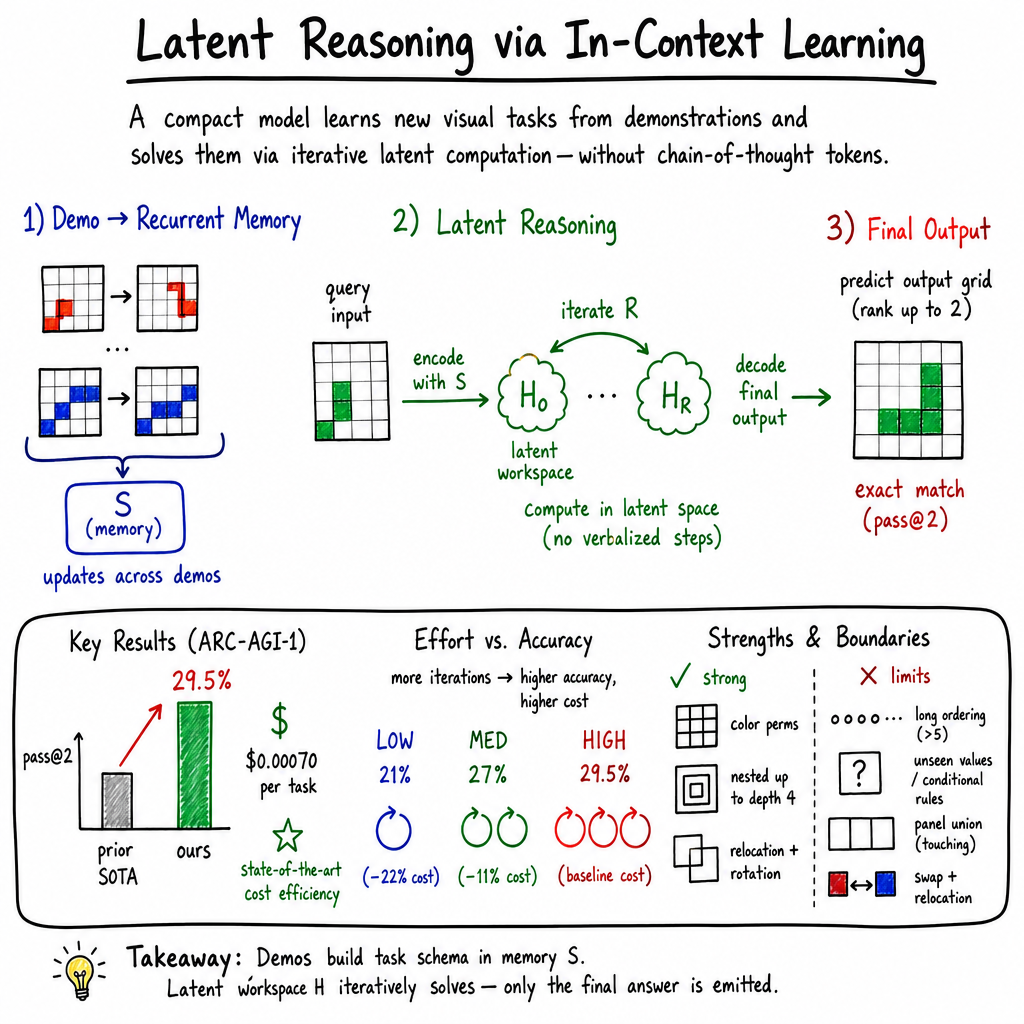
Abstract: We introduce BDH-CQ, a reasoning model that combines in-context learning with recurrent latent reasoning. Inputs presented at inference time continuously update the model's recurrent memory; the model then solves a query through iterative computation in a high-dimensional latent space, without verbalizing its intermediate reasoning. We evaluate the model on the public ARC-AGI-1 evaluation set and use controlled ARC-like interventions to study what it learns from demonstrations, how consistently it applies an inferred transformation, and which concepts remain difficult. A 150M-parameter configuration reaches 29.5% pass@2 at a computed inference cost of \$0.0007 per task. This operating point breaks through the previously reported ARC-AGI-1 cost-accuracy Pareto frontier, establishing a new state of the art in benchmark cost efficiency.



Paper Prompts
Sign up for free to create and run prompts on this paper.
Top Community Prompts
Explain it Like I'm 14
Overview
This paper introduces a new artificial intelligence system called BDH-CQ, which is designed to learn new skills by looking at examples and using advanced “thinking” inside its own “mind” (memory). The main focus of the research is to find out if this new way of combining learning-from-examples and internal reasoning makes computers better at solving visual puzzles quickly and cheaply.
What is the Main Topic or Purpose of the Paper?
The main topic is about building a computer program that can learn new tasks just by looking at examples, and then solve similar tasks by reasoning internally—without needing to write down all its thinking steps. The goal is to make this kind of system work well on a popular test called ARC (Abstraction and Reasoning Corpus), which tests whether computers can quickly learn new rules from just a few demonstrations.
What Key Questions is the Paper Asking?
The researchers wanted to answer these simple questions:
- Can a computer learn to solve new types of puzzles by watching some examples, and then use its own memory and hidden thoughts (not written out in words) to figure out the answer?
- How well does this approach work, compared to older systems that write out every little step?
- Which kinds of puzzles or tasks does the computer learn easily, and which ones are still hard for it?
- Can this method solve puzzles fast and using very little computer power (making it cheaper to run)?
How Did They Do the Research? (Methods Explained Simply)
To test their idea, the researchers:
- Built a special kind of computer program (BDH-CQ) that has a flexible memory and can “think” in hidden ways without spelling everything out in words.
- Let the program study a few before-and-after examples (“demonstrations”) of how to solve grid puzzles (these are tiny pictures made of colored squares).
- Instead of making the program say every little thing that happens in its “brain” (like some older AI called “chain-of-thought”), it just uses its memory to keep track of possible solutions and only spits out the final answer.
- Tried this on a public test called ARC-AGI-1 and also made other controlled tests to see exactly what it learned.
- Calculated how often it gets the puzzle right, and how much it costs to run the program (in time and money).
Technical terms explained:
- Latent space: This just means the computer’s hidden workspace, where it does calculations privately before showing us the answer.
- In-context learning: The model learns from the examples it sees right now, rather than from months of training ahead of time.
- Recurrent memory: The model remembers information from each example and uses it to update its “thoughts” as it sees more.
What Did They Find Out (Main Results)?
The main findings are:
- BDH-CQ can learn new tasks from just a few examples and solve tricky visual puzzles without writing out every step it takes.
- On the ARC-AGI-1 test, a BDH-CQ system the size of a small phone app (150 million parameters) solved about 29.5% of the puzzles in just two tries, costing less than a single cent per puzzle. This is better “bang for the buck” than previously reported systems.
- For some kinds of puzzles (like copying patterns, completing shapes, or spreading color to an edge), it works really well and even improves when given more effort.
- There are still some types of puzzles (like sorting, deep nesting, or complex swapping) that are tricky, but showing better examples helps.
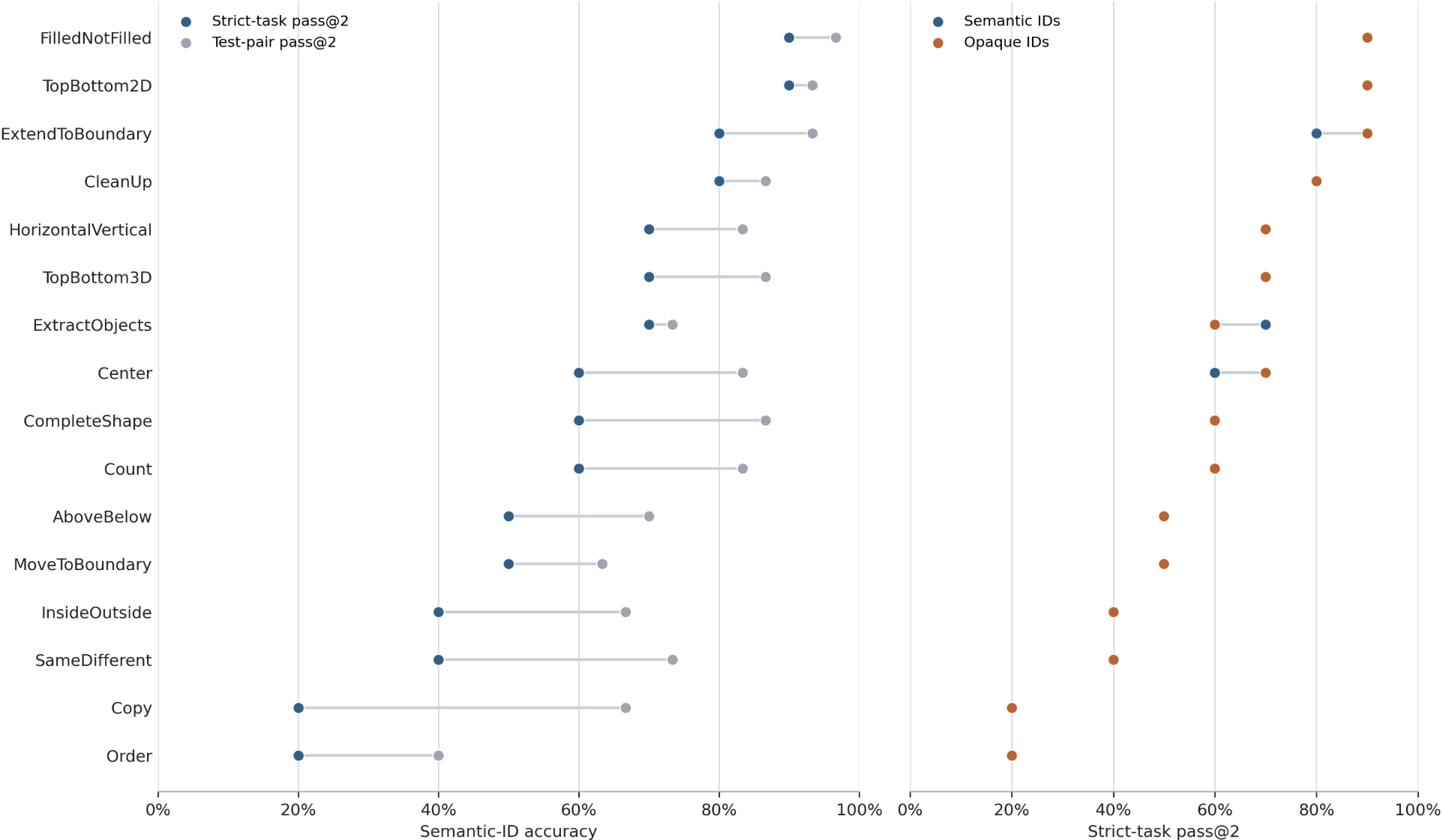
- Performance is not random: BDH-CQ solves some families of tasks almost perfectly, but only partly solves others, meaning it consistently applies what it learned in some cases and not in others.
The table below summarizes some results:
| Test Set | Tasks Tried | Tasks Solved (2 tries) | Best Score on Test Pair |
|---|---|---|---|
| ARC-AGI-1 (public) | 400 | 29.5% | 31.0% |
| ConceptARC (semantic IDs) | 160 | 59.4% | 77.9% |
Why are These Results Important?
This research shows a new, faster, and more efficient way for computers to learn from context and do complex reasoning “in their head”. It’s cheaper, uses less computer energy, and still gets good results. It also gives scientists a map of which kinds of problems are easy or hard for computers to learn “on the fly".
What Does This Mean for the Future?
- BDH-CQ points towards a new generation of AI systems that can learn skills quickly, combine memory and reasoning, and solve problems efficiently.
- It can be scaled up (made bigger) or used for more complex reasoning tasks like language or math, not just colorful puzzles.
- This research helps scientists understand how to build computers that reason in more human-like ways—sometimes using words, sometimes using silent thinking.
- In the future, similar systems could learn new tasks by seeing a few examples in school, at work, or even by watching YouTube instructions—just like people do.
Summary Table: BDH-CQ vs. Older Approaches
| Approach | Learns from examples in real time? | "Thinks" with hidden steps? | Writes out every step? | Fast and cheap? |
|---|---|---|---|---|
| Chain-of-thought models | Yes | No | Yes | Slower, costlier |
| Old puzzle solvers (HRM) | No (needs retraining) | Yes | No | Slow, costly |
| BDH-CQ (this paper) | Yes | Yes | No | Fast, cheap |
Final Conclusion
The BDH-CQ system is a big step forward in making AI learn new things quickly, reason more efficiently, and use less computer power—all by combining learning from a few examples with clever, hidden reasoning. This has huge potential for smarter, faster, and more adaptable AI in the future.
Knowledge Gaps
Knowledge gaps, limitations, and open questions
The paper establishes promising results on ARC-like visual tasks, but leaves the following issues unresolved:
- Reproducibility is limited by proprietary details: the exact BDH-CQ update rules, latent workspace dimensions, recurrent-memory implementation, input encoding, candidate-generation procedure, ranking mechanism, and complete training recipe are not disclosed.
- The training data cannot be independently audited: the mixture includes privately curated examples, undisclosed augmentations, and several public ARC-derived datasets, making it impossible to determine the extent of overlap with evaluation tasks or to reproduce the training distribution.
- Potential benchmark contamination remains unresolved: the paper does not provide deduplication procedures, contamination analyses, checkpoint-selection criteria, or evidence that ARC-AGI-1 evaluation concepts and generated variants were absent from training.
- The claimed cost advantage is not fully comparable across systems: BDH-CQ’s cost is based on measured H200 time and a selected hardware price, whereas competing systems use heterogeneous leaderboard estimates, API prices, hardware assumptions, and possibly different accounting conventions.
- The cost calculation omits important operational factors: preprocessing, orchestration, candidate generation, repeated attempts, model loading, memory use, batching effects, energy consumption, and engineering costs are not clearly included.
- The Pareto-frontier claim lacks a standardized comparison protocol: the analysis does not establish that all compared systems were evaluated under identical hardware, latency, attempt, accuracy, and cost definitions.
- The statistical uncertainty of the headline ARC result is substantial: 118 solved tasks out of 400 yields a wide confidence interval, and the paper does not report uncertainty for the cost–accuracy frontier or test the score against competing systems under matched statistical procedures.
- The evaluation uses only the public ARC-AGI-1 evaluation split: generalization to ARC-AGI-2, private test sets, other visual reasoning benchmarks, or non-ARC domains is not demonstrated.
- The independent audit is not sufficiently detailed for complete verification: the paper references an external black-box audit but does not provide enough information about the auditors’ exact inputs, protocol, software environment, candidate handling, and statistical analysis.
- The effect of model scale is not empirically established for BDH-CQ: the evaluated system has 150M parameters, while claims about scaling from 1B to 600B parameters concern pretraining experiments and do not show corresponding latent-reasoning or ARC performance.
- There is no controlled ablation of the core architectural components: the contribution of recurrent memory, latent recurrence, structured workspace, BDH layers, candidate ranking, and input transformations is not isolated against matched Transformer, recurrent, or latent-reasoning baselines.
- The advantage of latent reasoning over verbalized reasoning is not directly measured: the paper does not compare BDH-CQ with chain-of-thought, continuous-thought, compressed-token, or hybrid systems at matched parameter counts, accuracy, latency, and cost.
- The number and role of recurrent reasoning steps are underexplored: it remains unclear how performance, error types, latency, and stability vary with the number of latent iterations, and whether additional iterations eventually saturate or degrade performance.
- The reasoning-effort experiment confounds training and inference effects: models are trained with different effort levels before being evaluated at corresponding inference settings, so the results do not establish whether adaptive test-time computation alone improves accuracy.
- The model’s latent representations are not interpreted or validated: there is no analysis showing whether recurrent memory stores transformation rules, object attributes, candidate hypotheses, or other identifiable structures.
- The distinction between contextual memory and ordinary attention is not empirically tested: the paper describes recurrent memory as analogous to attention but does not compare memory capacity, ordering sensitivity, context length, or retrieval behavior under controlled conditions.
- Order sensitivity of demonstrations is unresolved: because demonstrations are processed sequentially, the paper does not test whether permuting demonstration order changes inferred rules or final outputs.
- Memory interference across demonstrations is not characterized: it is unknown how the system handles contradictory, redundant, noisy, irrelevant, or very numerous demonstrations.
- Context-length limits are not reported: the maximum number of demonstrations, grid size, total input tokens, and memory capacity before performance degrades are unspecified.
- Robustness to misleading or adversarial demonstrations is untested: the system’s behavior when examples contain ambiguity, outliers, inconsistent labels, or deliberately irrelevant patterns remains unknown.
- The sources of within-task inconsistency are not identified: the paper observes large gaps between test-pair and strict-task accuracy but does not determine whether failures arise from rule induction, memory retention, query encoding, latent execution, decoding, or candidate ranking.
- Pass@2 may overstate independent reasoning reliability: repeated requests are deterministic, and many records are already correct at rank one; therefore, the contribution of genuine search diversity versus deterministic candidate generation is unclear.
- Candidate diversity and ranking quality are not analyzed: the paper does not report how often the two candidates differ, whether the second candidate corrects a systematic first-candidate error, or whether ranking can be improved independently of reasoning.
- The effect of random seeds and deployment nondeterminism is unclear: repeatability is shown for identical requests, but robustness across model initialization, compilation, hardware, software versions, and decoding configurations is not established.
- Controlled task families have limited breadth: propagation, copying, ordering, nesting, mappings, and a small set of compositions do not cover the full range of ARC mechanisms, especially object discovery, counting, topology, gravity, conditional rules, and multi-stage transformations.
- The controlled experiments often use small sample sizes: several levels contain only six tasks or a few dozen outputs, limiting confidence in reported transition points and differences between operations.
- Generalization beyond the tested complexity ranges is unknown: the reported propagation, copying, ordering, and nesting curves do not establish asymptotic behavior or performance at substantially larger distances, multiplicities, sequence lengths, or depths.
- The composition experiments do not isolate composition from representation effects: the color-swap results are confounded by fixed versus shuffled motif layouts, and the study does not systematically vary operator order, number of composed operations, or intermediate-state complexity.
- Conditional execution is insufficiently characterized: the appendix indicates large failures for conditional rule selection, but the paper does not fully analyze which conditions are learned, how demonstrations specify them, or whether failure is due to selection versus execution.
- Unseen parameter-value generalization is unresolved: the appendix reports failure when a parameter is absent from demonstrations, but does not determine whether this reflects inability to extrapolate values, inability to infer a rule schema, or limitations of the grid representation.
- Generated evaluation tasks may not reflect human-designed ARC difficulty: many tasks were authored by GPT-5.6, and the paper acknowledges strong authoring-mode effects; therefore, generated mechanic profiles cannot be treated as intrinsic measures of reasoning capability.
- The relationship between generated and public-task performance is weakly validated: low mechanic-rank correspondence and construction confounds leave unclear which controlled findings predict performance on genuine ARC tasks.
- Human baseline comparisons are absent: the paper does not report human performance, solution time, demonstration requirements, or error patterns, limiting interpretation in terms of ARC’s intended skill-acquisition measure.
- Sample efficiency is not quantified: the study generally uses three demonstrations, but does not provide systematic performance curves as the number, informativeness, redundancy, or ambiguity of demonstrations changes.
- The system’s ability to infer reusable abstractions across tasks is unknown: experiments show task-specific binding, but not whether learned operator schemas transfer compositionally between unrelated tasks or contexts.
- Failure recovery and self-verification are not evaluated: the latent system does not verbalize intermediate reasoning, and the paper does not test whether it can detect, revise, or reject internally inconsistent solutions.
- The claim that latent reasoning supports parallel hypothesis exploration is not directly demonstrated: no measurements compare the number of simultaneously maintained hypotheses, computational parallelism, or search efficiency with token-based reasoning.
- The architecture’s behavior on language and mathematics remains speculative: proposed extensions to language reasoning, tool use, and mathematical problem solving are not evaluated, so it is unknown whether visual-task mechanisms transfer to symbolic or linguistic domains.
- Safety and controllability of opaque latent reasoning are not addressed: the lack of inspectable intermediate states may hinder debugging, error attribution, intervention, and verification in applications requiring reliable reasoning.
- The paper does not establish whether recurrent latent computation improves energy or hardware efficiency beyond dollar cost: throughput, memory bandwidth, power usage, and utilization relative to token-based baselines are not reported.
- The appendix is incomplete in the provided manuscript: the discussion of controlled structural manipulations ends mid-table, leaving the full set of ladder results, analyses, and conclusions unavailable for assessment.
Practical Applications
Immediate Applications
The paper demonstrates a compact, low-cost system for learning visual transformations from a small number of examples and solving them through recurrent latent computation. The following uses are plausible now, primarily as prototypes, research tools, or human-in-the-loop components rather than fully autonomous systems.
- Visual transformation and data-cleaning tools — software, operations, and computer vision
- Integrate BDH-CQ-like inference into grid- or image-processing workflows for operations such as flood filling, denoising, cropping, translation, boundary extension, motif copying, and simple recoloring.
- A user could provide a few input–output examples—rather than writing a formal script—and apply the inferred transformation to new images or structured visual data.
- Potential workflow: upload demonstrations → infer a task-specific operator → generate one or more candidate outputs → accept, correct, or reject the result.
- Dependencies: the demonstrations must adequately cover the intended rule; reliability is lower for ordering, counting, reflection, occlusion repair, gravity/stacking, conditional selection, and multi-step composition. Exact output validation is strongly recommended.
- Low-cost visual inspection and triage — manufacturing, logistics, and infrastructure
- Use the model as a first-pass assistant for detecting or repairing simple, repetitive visual patterns in binary masks, warehouse layouts, component diagrams, or infrastructure imagery.
- For example, it could extend marked regions to boundaries, copy a detected motif to designated locations, or identify simple spatial overlaps.
- The reported cost of approximately
$0.00070per ARC task suggests that similar compact inference systems could support high-volume candidate generation or anomaly triage. - Dependencies: ARC grids are substantially simpler than real photographs or sensor streams. Deployment would require domain-specific training, image-to-grid or structured-feature encoders, confidence estimates, and human review for safety-critical decisions.
- Interactive programming by example — software engineering and education
- Build interfaces in which users specify a transformation through a few examples instead of manually implementing loops, conditionals, or array operations.
- Possible products include spreadsheet assistants, tensor-manipulation helpers, visual automation tools, and educational environments for teaching abstraction and algorithm design.
- The model’s recurrent memory is particularly suited to request-specific rules that must be inferred at inference time without updating model parameters.
- Dependencies: current results do not establish dependable natural-language instruction following, code generation, or production-scale software correctness. Generated code or transformations should be tested against additional examples and formal assertions.
- Synthetic-task generation and evaluation of reasoning systems — academia and AI engineering
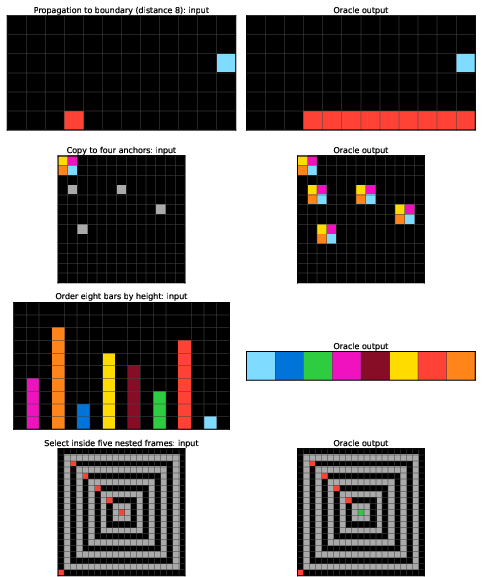
- Adopt the paper’s controlled ARC-like task generators to evaluate whether a model learns a rule consistently, rather than merely producing an isolated correct answer.
- Researchers can vary one property at a time—such as propagation distance, number of copies, sequence length, or nesting depth—to diagnose extrapolation and execution limits.
- This can support regression testing for multimodal models, recurrent architectures, agent systems, and educational AI.
- Dependencies: generated tasks may contain authoring artifacts, and benchmark exposure or checkpoint selection can inflate results. Independent test generators, held-out operators, and transparent data provenance are necessary.
- Adaptive inference-cost routing — cloud AI and edge computing
- Offer configurable reasoning budgets: a low-effort mode for inexpensive, high-throughput processing and a high-effort mode for harder cases.
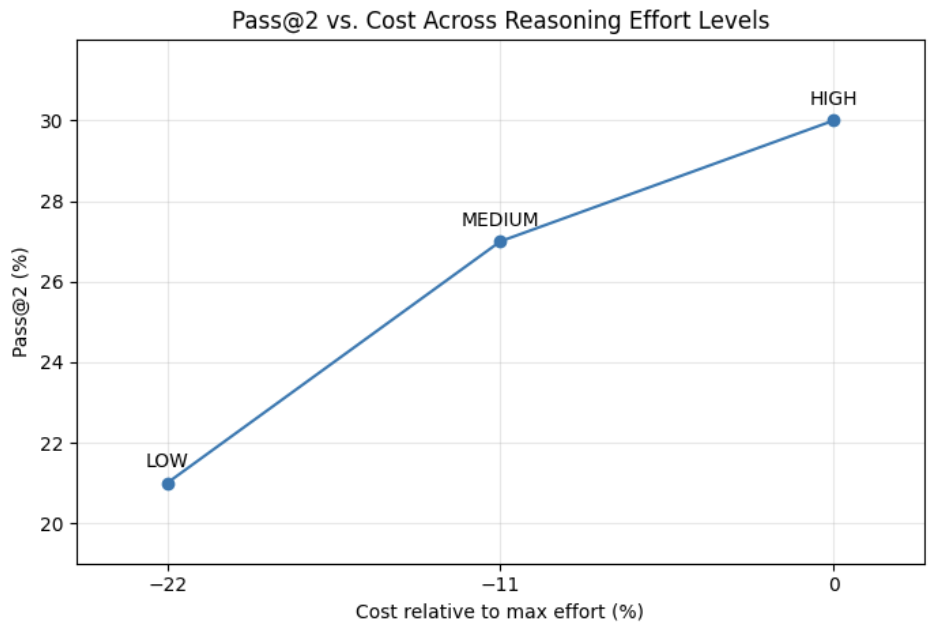
- The reported trade-off—roughly 21% pass@2 at low effort, 27% at medium effort, and 29.5% at high effort—supports a routing policy in which uncertain or high-value requests receive additional latent iterations.
- Potential product: an inference controller that escalates from
LOWtoMEDIUMorHIGHeffort when candidate outputs disagree, violate constraints, or receive low confidence. - Dependencies: the reported effort levels were evaluated on ARC-AGI-1 and may not transfer to other domains. A practical system needs calibrated uncertainty, latency limits, and task-specific cost–accuracy measurements.
- Constraint-satisfaction assistants — scheduling, puzzles, and planning
- Extend the recurrent latent-state approach to bounded constraint problems such as Sudoku, small assignment problems, layout checks, and configuration validation.
- The architecture’s iterative state refinement and prior BDH work on Sudoku indicate a possible workflow in which the model repeatedly updates a candidate state until constraints are satisfied.
- Dependencies: applications should use an external verifier or solver. The paper does not demonstrate correctness on industrial-scale scheduling, planning, or optimization, and latent internal states are not themselves proof certificates.
- Human-in-the-loop research and training interfaces — academia and model development
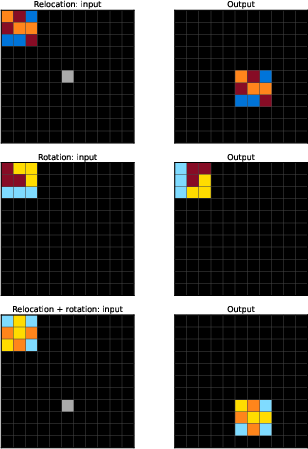
- Use the system to study how examples bind task-specific operators, how demonstrations affect generalization, and why failures occur.
- Researchers can expose multiple candidate outputs, compare pass@1 and pass@2 behavior, and test whether additional demonstrations at the target complexity repair errors.
- Dependencies: latent reasoning is not directly interpretable in natural-language terms. Behavioral probes, counterexamples, activation analyses, and external verification remain necessary.
Long-Term Applications
These applications require larger models, broader training data, domain adaptation, stronger verification, and evidence that the ARC findings transfer beyond small colored grids.
- Few-shot robotic perception and manipulation — robotics
- A robot could receive demonstrations of a new visual operation—such as “move each object to the marked location,” “complete this shape,” or “copy this pattern to every anchor”—and apply it to subsequent scenes.
- Recurrent task memory could preserve the inferred operation while latent reasoning handles spatial transformations without generating a lengthy verbal plan.
- Dependencies: real-world robotics requires camera robustness, 3D perception, temporal state tracking, collision checking, action grounding, and safety guarantees. The paper’s weak performance on some composition, ordering, and conditional tasks is a significant limitation.
- Flexible industrial automation — manufacturing
- Deploy example-conditioned systems for changing production layouts, part variants, or inspection criteria without retraining model parameters for every new task.
- A technician might provide a small set of labeled visual examples to define a new assembly, sorting, or defect-marking procedure.
- Potential tools: reconfigurable visual inspection stations, programmable pick-and-place interfaces, and low-code factory automation.
- Dependencies: exactness and consistency across all test instances are essential. The observed gap between test-pair accuracy and strict whole-task accuracy indicates that occasional correct outputs should not be treated as reliable rule acquisition.
- Medical image and scientific image analysis — healthcare and life sciences
- A future system could infer task-specific transformations from a few expert-labeled examples, such as propagating a segmentation boundary, extracting repeated structures, or applying a new visualization rule to microscopy or radiology data.
- Latent computation may reduce the cost of processing large image collections and could support interactive annotation.
- Dependencies: ARC’s discrete grids do not capture clinical image complexity, biological variability, uncertainty, or regulatory requirements. Applications would require extensive domain validation, calibrated confidence, audit trails, expert oversight, and protection against silent segmentation errors.
- Multimodal mathematical and symbolic reasoning — education, finance, and engineering
- Extend the architecture from visual grids to equations, diagrams, tables, graphs, and constraint descriptions. Users could teach a temporary operation through worked examples and apply it to new instances.
- Potential uses include tutoring systems, spreadsheet reasoning, engineering diagram analysis, and financial rule prototyping.
- Dependencies: the paper only establishes in-context latent reasoning for ARC-like visual transformations. Transfer to language, mathematics, numerical precision, and long-context symbolic tasks remains an explicit research direction. Verbal or formal intermediate representations may still be needed for explanation and auditing.
- Private, on-device adaptive assistants — consumer software and edge AI
- A compact recurrent model could learn temporary user-specific visual or structured-data procedures locally, reducing dependence on cloud calls and avoiding parameter updates for every new task.
- Examples include personal document organization, custom accessibility interfaces, household inventory recognition, and device configuration.
- Dependencies: on-device deployment requires quantization, memory-efficient recurrent state management, robust privacy controls, resistance to malicious demonstrations, and performance on natural images rather than benchmark grids.
- Latent-reasoning agents with tool use and communication — software agents
- Combine private latent iteration for internal search with selective verbalization when the agent must explain a result, call a tool, coordinate with another agent, or request clarification.
- This could produce agents that use continuous computation for inexpensive internal planning while emitting only the information needed for external interaction.
- Dependencies: latent states are difficult to inspect, transmit, and verify. Safe deployment requires explicit interfaces, reproducible decoding, tool-call validation, provenance tracking, and mechanisms for detecting unsupported conclusions.
- Large-scale constraint solving and combinatorial search — operations research and logistics
- A scaled BDH-style system could serve as a learned heuristic for routing, packing, scheduling, resource allocation, or graph-search problems, using demonstrations to adapt to new objective functions or constraints.
- High-dimensional latent states may retain multiple candidate hypotheses and support iterative refinement more efficiently than token-by-token reasoning.
- Dependencies: the paper provides no direct evidence for large-scale optimization. Practical systems would need integration with exact or approximate solvers, feasibility guarantees, objective verification, and benchmarks that measure solution quality rather than only exact-match accuracy.
- Policy and public-sector decision-support systems — government and regulation
- The example-conditioned paradigm could help agencies prototype transformations over maps, forms, tabular records, or administrative workflows without retraining a general model for each policy variation.
- For instance, a small set of labeled cases could define a temporary classification or data-transformation rule for analysts.
- Dependencies: policy use requires explainability, reproducibility, fairness testing, legal accountability, and strict separation between advisory outputs and official decisions. The model’s nonverbalized reasoning and demonstrated inconsistency make unsupervised decisions inappropriate.
- Scalable reasoning infrastructure and model compression — AI systems research
- Larger BDH-CQ models, tensor-sharded implementations, longer latent computation, and hybrid latent/verbal reasoning could provide a lower-cost alternative to long chain-of-thought generation.
- This may be valuable for high-volume API services, embedded systems, and applications where intermediate reasoning should remain private.
- Dependencies: the claimed scaling behavior beyond the evaluated 150M-parameter model is prospective. It must be confirmed through open, independent experiments measuring accuracy, latency, memory, robustness, interpretability, and cost on diverse tasks—not only ARC-AGI benchmarks.
Glossary
- Abstraction and Reasoning Corpus (ARC): A benchmark of visual reasoning tasks in which systems infer transformations from example input–output pairs. “We use the Abstraction and Reasoning Corpus (ARC) as both an evaluation and an experimental substrate”
- Adaptive solution strategy: A reasoning procedure that changes based on intermediate results or problem conditions. “Reinforcement learning on verifiable problems has made this combination increasingly powerful, eliciting long reasoning traces, self-verification, and adaptive solution strategies”
- Autoregressive computation: Sequential generation in which each output depends on previously generated outputs. “Every intermediate state must be projected through a discrete vocabulary, emitted autoregressively, and consumed again before computation can continue”
- Backward-pass adaptation: Updating model parameters through gradient-based training after processing a task. “A previously unseen hidden task therefore requires backward-pass adaptation before it can be evaluated”
- BDH layer: A layer in the Dragon Hatchling architecture that combines low-rank transformations with linear attention. “Its GPU-oriented formulation uses BDH layers combining ReLU-low-rank transformations with linear attention in a large neuron or feature space”
- Beam-independent candidate: A proposed output generated without relying on multiple jointly expanding search hypotheses. “nominal pass@2 should not be interpreted as the result of two independently sampled attempts for every input”
- Chain-of-thought (CoT) prompting: A prompting method that elicits intermediate reasoning steps, usually in natural language. “chain-of-thought (CoT) prompting complements this capability with a computational workspace”
- Checkpoint selection: Choosing a saved model state based on its performance or suitability for evaluation. “rule out exposure through training or checkpoint selection”
- Continuous thought: Internal reasoning represented as continuous hidden states rather than discrete language tokens. “Coconut feeds a Transformer's previous final hidden state back as the next input embedding and uses a curriculum that progressively replaces verbal CoT steps with continuous thoughts”
- Constraint satisfaction: The process of finding an assignment or state that fulfills a collection of specified conditions. “BDH layers also support recurrent systems for constraint satisfaction”
- Context-dependent association: A relationship formed from information available in a particular input context. “This recurrent contextual state plays a role analogous to the context-dependent associations constructed by attention”
- Contextual binding: Encoding task-specific relationships or mappings from demonstrations into an internal representation. “The controlled experiments show what that combination can express. BDH-CQ applies dense task-specific color mappings to all 96 held-out outputs, demonstrating substantial contextual binding capacity”
- Curriculum: A training schedule that introduces examples or objectives in a progressively organized sequence. “Its staged internalization curriculum is essential to the reported performance”
- Demonstration-conditioned operator schema: A reusable operation whose behavior is determined by the demonstrations for the current task. “We use the term demonstration-conditioned operator schema for the behavior that results when demonstrations bind a reusable visual operation for the current task”
- Discrete vocabulary: A finite set of symbolic units, such as words or tokens, used for model outputs. “Every intermediate state must be projected through a discrete vocabulary”
- Extrapolation: Applying a learned relationship beyond the range or complexity represented in the demonstrations. “The nesting cliff is therefore largely a failure to extrapolate the demonstrated relation depth”
- Fast-weight memory: A rapidly changing memory mechanism that stores information through dynamically updated model weights or associations. “The interpretation is generally related to attention, fast-weight memory, and linear-attention views of contextual association”
- Factorial isolation: An experimental design property in which the individual effects of multiple interventions can be separately identified. “it does not make ConceptARC a fresh benchmark, rule out exposure through training or checkpoint selection, or isolate the two interventions factorially”
- Held-out input: An evaluation example withheld from the demonstrations used for learning a task rule. “every target output is produced by a deterministic oracle”
- High-dimensional latent space: A continuous internal representation with many dimensions in which computation occurs without explicit symbolic output. “the model then solves a query through iterative computation in a high-dimensional latent space”
- In-context learning: Learning a task or skill from examples provided as part of the input rather than by changing model parameters. “In-context learning allows a model to acquire a new skill from examples presented at inference time”
- Inference cache: Stored intermediate representations used to reduce repeated computation during model inference. “latent communication transfers embeddings, hidden states, or inference caches between agents rather than between reasoning steps within one model”
- Inference-time adaptation: Modification of a model’s behavior during evaluation based on the current input or demonstrations. “no parameters are updated at inference time”
- Latent communication: Transfer of internal embeddings or hidden states between models or agents instead of natural-language messages. “Separately, latent communication transfers embeddings, hidden states, or inference caches between agents rather than between reasoning steps within one model”
- Latent reasoning: Reasoning performed in continuous internal states without verbalizing intermediate steps. “Latent reasoning opens a different computational regime”
- Linear attention: An attention mechanism reformulated to reduce the computational cost of standard pairwise attention. “with linear attention being the conceptually simplest standalone realization of linear correction rules on ”
- Low-rank transformation: A transformation constrained to use a lower-dimensional factorization, reducing parameters or computation. “Its GPU-oriented formulation uses BDH layers combining ReLU-low-rank transformations with linear attention”
- Mechanic-stratified evaluation: An evaluation set organized according to the transformation operation required to solve each task. “We therefore generate approximately balanced samples across 16 mechanics, yielding 1,131 tasks”
- Multi-vector workspace: A latent computational space represented by multiple vectors rather than one consolidated state. “a structured multi-vector workspace solves previously unseen visual transformations”
- Opaque identifier: An identifier designed not to reveal semantic information about the item it labels. “The opaque replication replaced identifiers with cryptographically opaque labels and mixed concept areas within batches”
- Oracle: A trusted procedure that produces the correct answer for an evaluation instance. “every target output is produced by a deterministic oracle”
- Pareto frontier: The boundary representing the best achievable trade-offs between competing objectives, here accuracy and cost. “This operating point breaks through the previously reported ARC-AGI-1 cost--accuracy Pareto frontier”
- Pass@1: The proportion of tasks solved by the highest-ranked or first candidate output. “We additionally report pass@1 and test-pair accuracy when analyzing behavior”
- Pass@2: The proportion of tasks for which at least one of two candidate outputs is correct. “The default system configuration follows the ARC-AGI leaderboard's two-attempt convention (pass@2)”
- Post-freeze generator: A task generator used after model parameters have been fixed, preventing further training on generated examples. “We generated fresh ARC-like tasks after freezing the model”
- Recurrent associative state: A persistent internal state that is repeatedly updated to encode associations over a sequence. “We have previously introduced the Dragon Hatchling (BDH), a post-Transformer sequence-model architecture built around high-dimensional positive activations, low-rank communication, and a recurrent associative state”
- Recurrent depth: Repeated application of computational layers or blocks to increase effective computation without necessarily adding parameters. “Recurrent-depth LLMs repeatedly apply a shared block to a sequence-wide latent state”
- Recurrent memory: A state that is updated sequentially as new inputs or demonstrations are processed. “Inputs presented at inference time continuously update the model's recurrent memory”
- Recurrent latent reasoning: Iterative reasoning performed over a continuously updated latent state. “We introduce BDH-CQ, a reasoning model that combines in-context learning with recurrent latent reasoning”
- ReLU: The rectified linear unit activation function, defined as . “Its GPU-oriented formulation uses BDH layers combining ReLU-low-rank transformations with linear attention”
- Rule induction: Inferring a general rule from observed examples. “Under a rule-induction account of ARC, a correctly induced rule should transfer to every test input of its task”
- Self-verification: Checking an internally generated solution or reasoning trace for correctness. “Reinforcement learning on verifiable problems has made this combination increasingly powerful, eliciting long reasoning traces, self-verification, and adaptive solution strategies”
- Sparse demonstration: A small number of examples that provide limited but sufficient evidence about a task rule. “ARC specifies new visual transformations through sparse demonstrations and requires exact outputs”
- Superposition: Encoding multiple concepts, hypotheses, or computational states within a shared representation. “continuous thoughts encode multiple search frontiers simultaneously and can expand them in parallel”
- Task-specific identity embedding: A learned vector that identifies a particular task or puzzle instance. “Each augmented puzzle receives a learned identity embedding”
- Tensor sharding: Partitioning tensors across multiple processing devices to distribute memory and computation. “admitting tensor sharding patterns inherited from the BDH architecture”
- Transductive: Relating to a setting in which information from the specific evaluation instances is used during adaptation or optimization. “Their ARC pipeline is transductive”
- Wilson confidence interval: A confidence interval for a binomial proportion that generally performs better than a simple normal approximation for small samples. “Intervals are descriptive Wilson 95\% intervals”
- Workspace state: An internal representation that stores the intermediate computational state used to solve a query. “ carries the ongoing computation used to answer the current query”
Collections
Sign up for free to add this paper to one or more collections.

