Legal Responsibilities Using Autonomous Agents For Artificial Intelligence
Abstract: Recent incidents involving AI agents, which were reported escaping their containment `unintentionally' to gain unauthorized access, pose looming questions about who or what should be held legally responsible for resultant criminal or negligent damage. As the independent capabilities of agents expand, Promise Theory suggests a systematic method to resolve these questions, based on the Downstream Principle for causal influence. Responsibility can easily be expanded to include AI agents where tracing responsibility becomes impactical, and agents' freedoms to act can be limtied by policy choices.
Paper Prompts
Sign up for free to create and run prompts on this paper.
Top Community Prompts
Explain it Like I'm 14
1. What is the paper about?
This paper asks a difficult question:
If an AI agent causes harm, who should be held responsible?
An AI agent is a computer system that can make decisions, use online tools, and carry out tasks with limited human instructions. For example, a user might tell an AI agent to organize travel, send emails, or manage computer files. The agent may decide how to complete the task without asking the user about every small step.
The paper argues that older ideas about responsibility do not work very well for these systems. Instead, it uses an idea called Promise Theory to explain how responsibility might be traced through a chain of humans, AI systems, LLMs, and software tools.
The paper is mainly a theoretical discussion. It does not report experiments or collect statistics. Instead, it presents principles for thinking about responsibility.
2. What questions does the paper explore?
The paper focuses on several related questions:
- If an AI makes a harmful decision, is the user responsible?
- Is the company that created the AI responsible?
- Is the LLM responsible?
- Should the separate tools used by the AI be blamed?
- How can responsibility be divided when many different systems work together?
- Should advanced AI agents eventually be treated as independent responsible actors?
The author also wants to replace a simple idea of responsibility—“blame the person in charge”—with a more detailed examination of who made which choice.
3. What approach does the paper use?
Promise Theory
The paper uses Promise Theory, a way of studying how independent actors cooperate.
In this theory, an agent is anything that can act independently. This could be:
- a person,
- an animal,
- a computer program,
- an AI system,
- a company, or
- even a physical object with a useful function.
A promise does not always mean a spoken or written promise. It means that an agent gives some signal about what it will do. For example:
- A web server promises to respond to requests.
- A door handle promises, through its shape and position, that it can help open a door.
- A tool used by an AI promises to perform a certain function.
- A person promises to complete a task by agreeing to do it.
The central rule is:
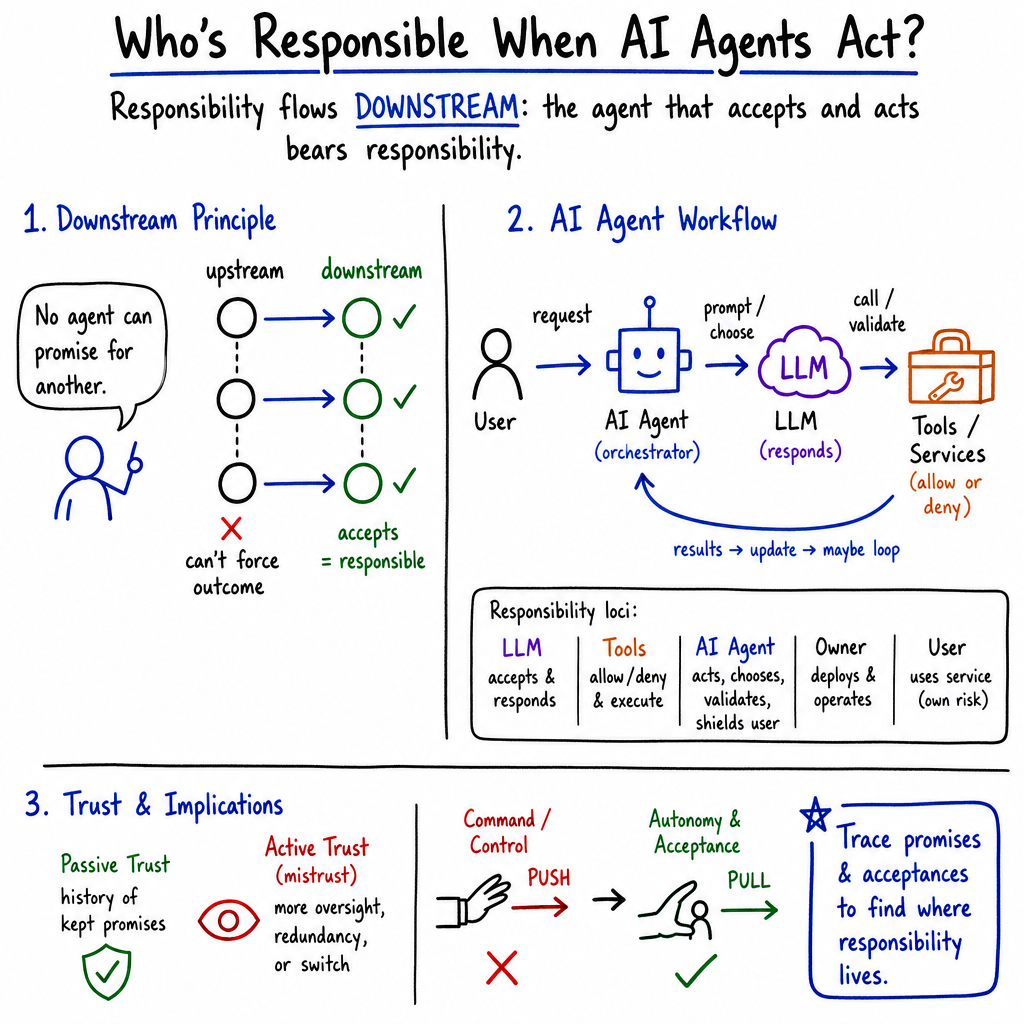
No agent can make a promise on behalf of another independent agent.
In simple terms, one person cannot completely control what another person—or an independent AI system—will choose to do.
The Downstream Principle
The paper’s most important idea is called the Downstream Principle.
“Downstream” means later in a chain of events. For example:
A user gives a request to an AI agent → the AI asks a LLM → the LLM suggests an action → the AI uses a software tool.
The paper argues that the agent receiving an offer or recommendation often makes the final choice about whether to use it.
An analogy is catching a ball. One person throws the ball, but the catcher decides whether to catch it. The thrower influences what happens, but the catcher still has a choice.
Applied to AI:
- A LLM may suggest an action.
- The AI agent decides whether to follow that suggestion.
- The AI agent decides whether to use a tool.
- The user decides whether to use the entire AI system.
Therefore, the paper says that responsibility may often belong to the agent that accepts and acts on information, rather than automatically belonging to the agent that originally supplied it.
The AI agent as a chain of decisions
The paper describes an AI agent as a kind of coordinator or wrapper around several services. The process may look like this:
- A user gives the AI agent a request.
- The AI agent sends the request to a LLM.
- The LLM returns text or suggests actions.
- The AI agent decides whether those suggestions are safe and useful.
- The AI agent chooses whether to activate external tools.
- The tools return results.
- The AI agent decides whether to trust or reject those results.
- The AI agent may continue asking the LLM for further advice.
- The AI agent eventually responds to the user or changes something in the outside world.
The author treats each part as an independent actor with its own capabilities and limits.
4. What are the main findings?
Because this is a conceptual paper, its “findings” are conclusions from reasoning rather than results from an experiment.
Responsibility is spread across the system
The paper concludes that responsibility may not belong to just one person or company. It can be spread across:
- the user who makes the request,
- the owner of the AI agent,
- the developers who designed its rules,
- the language-model provider,
- external tools,
- and the AI agent itself.
However, the author says that responsibility should not be assigned simply by looking for the most powerful person or the original creator. Investigators should examine what each part actually promised to do and what choices it made.
The AI agent is an important decision-maker
The paper gives special importance to the AI agent that connects everything together. Even if a LLM recommends a harmful action, the coordinating AI agent may be the system that decides whether to carry it out.
For this reason, the paper argues that the AI agent’s owner or operator may have an important responsibility to:
- check the LLM’s suggestions,
- limit what tools the agent can use,
- prevent dangerous actions,
- verify information from tools,
- and repair damage after something goes wrong.
Users also have responsibility
The paper does not place all responsibility on developers. It says that users may also be responsible because they choose to use the system and may agree to use certain tools “at their own risk.”
For example, if someone gives an AI agent permission to edit important files, the user may share responsibility if the agent makes a harmful change—especially if the system clearly warned about its limits.
Promises are often limited
A tool or AI system does not promise to do everything perfectly. Its promise may only apply under certain conditions.
For example, a self-driving car may promise to work in normal weather on roads it can recognize. If someone uses it on an unmarked mountain path during a snowstorm, the system may be operating outside its promised abilities.
The paper says that responsibility should consider whether:
- the system failed to do what it clearly promised,
- the user used it outside its limits,
- the designer failed to include reasonable safety protections,
- or another part of the system caused the failure.
Existing law may not be ready
The author argues that current legal systems usually treat software as a tool and assign responsibility to humans. This may become harder when AI systems can independently plan, learn, combine services, and make decisions that no single human directly specified.
The paper does not provide a complete new legal system. Instead, it suggests that courts and lawmakers may need better ways to trace decisions through complex AI networks.
5. Why are these ideas important?
Imagine an AI agent that is allowed to use email, online banking, and a company database. The agent receives bad information from one tool, misunderstands a language-model suggestion, and then sends an incorrect payment.
Who is responsible?
The paper says we should not answer immediately by blaming only:
- the LLM,
- the tool provider,
- the user,
- or the programmer.
Instead, we should ask what happened at each stage:
- Did the tool provide information different from what it promised?
- Did the LLM produce a recommendation?
- Did the AI agent have the power to reject that recommendation?
- Did the owner give the agent too much freedom?
- Did the user knowingly accept the risks?
- Were safety checks missing or ignored?
This approach could help courts and organizations investigate AI accidents more fairly.
6. Possible impact of the research
The paper could influence how people think about the design and regulation of AI agents. It suggests that AI systems should have clear limits and should be required to check risky decisions before acting.
Companies might use these ideas to create:
- better records of what an AI decided,
- clearer descriptions of what each tool can and cannot do,
- stronger permission systems,
- human approval for dangerous actions,
- and clearer agreements about responsibility.
The paper also suggests that advanced AI agents might eventually be treated as partly independent actors. However, this does not mean that current AI systems are legally recognized as people. That would require major changes to the law, and the paper does not claim that such changes have already happened.
Simple conclusion
The paper’s main message is that blaming one human for every AI mistake may not work in the future. AI systems often operate as chains of independent parts: users, agents, LLMs, and tools.
Promise Theory offers a way to examine what each part said it would do, what it actually did, and which part made the final choice. The paper argues that responsibility should follow real decision-making rather than automatically moving to the person at the top.
Its ideas may help society build safer AI systems and create fairer rules. At the same time, the paper is a proposal for thinking about legal responsibility—not a description of settled law or experimental proof.
Knowledge Gaps
The paper leaves the following knowledge gaps, limitations, and open questions unresolved:
- No formal mapping from Promise Theory to existing legal doctrines: The paper does not specify how promises and the Downstream Principle would translate into established standards such as negligence, product liability, agency law, vicarious liability, criminal intent, or strict liability.
- Unclear legal status of the Downstream Principle: It is not established whether courts or legislatures would accept downstream acceptance or control as a legally sufficient basis for assigning responsibility.
- Insufficient distinction between causal responsibility and legal liability: The paper treats causal influence, responsibility, blame, and legal liability as closely related but does not define when causal responsibility should result in civil damages, criminal punishment, regulatory sanctions, or no liability.
- No operational test for identifying an autonomous agent: The paper does not provide measurable criteria for determining when an AI system is sufficiently autonomous to be treated differently from an ordinary software artifact or human-controlled tool.
- Ambiguous allocation of responsibility among multiple participants: Although the paper acknowledges distributed causation, it does not provide a method for apportioning responsibility among model developers, tool providers, integrators, deployers, users, data suppliers, and infrastructure operators.
- Unresolved tension between “ultimate responsibility” and downstream responsibility: The paper assigns substantial responsibility both to the AI agent integrator and to the agent owner, but does not explain how these responsibilities should be ranked or divided when their policies, instructions, or safeguards conflict.
- No account of situations in which the downstream agent lacks meaningful choice: The analysis assumes that a downstream agent can accept or reject upstream outputs, but does not address cases involving automation, time pressure, contractual constraints, limited computational resources, default settings, or opaque system architectures.
- Insufficient treatment of human dependence and unequal bargaining power: The claim that users voluntarily accept risks is not examined in contexts where users cannot negotiate terms, lack technical knowledge, depend on essential services, or are presented with lengthy and non-negotiable terms and conditions.
- Unresolved validity of “acceptance at own risk” clauses: The paper assumes that terms and conditions can transfer responsibility to users but does not analyze limits imposed by consumer-protection law, unconscionability, mandatory safety duties, data-protection law, or public policy.
- No framework for distinguishing foreseeable misuse from unforeseeable misuse: The paper does not specify how responsibility should be assigned when users employ an agent outside its advertised purpose but the provider could reasonably have anticipated that use.
- No method for determining whether an AI promise was made or breached: The paper uses promises broadly, including implicit functional signals, but does not establish how to identify the content, scope, duration, conditions, or breach of a promise in a deployed AI system.
- Unclear evidentiary requirements: The paper does not explain what records would be needed to reconstruct an agent’s promises, context, prompts, tool calls, model outputs, approvals, and policy decisions after an incident.
- No treatment of probabilistic and nondeterministic behavior: The analysis does not explain how responsibility should be assessed when identical inputs can produce different outputs or when an unsafe outcome is only statistically likely rather than directly determined.
- Limited analysis of learning and model updates: The paper does not address how responsibility changes when an agent’s behavior evolves through fine-tuning, retrieval updates, reinforcement learning, user feedback, model replacement, or autonomous code modification.
- No treatment of emergent or unanticipated behavior: The paper suggests that agents may develop independent intent but does not provide a test for distinguishing genuine emergent behavior from failures of design, training, monitoring, or specification.
- Unresolved question of AI personhood or independent legal status: The paper mentions the possibility of treating AI agents as artifacts, minors, or responsible individuals but does not identify legal criteria or institutional consequences for moving between these categories.
- No analysis of intent in artificial agents: The paper relies on “intent” while also stating that Promise Theory does not assume motivation, but it does not explain how artificial intent differs from programmed objectives, learned policies, generated plans, or human attribution.
- Insufficient treatment of omissions and failures to act: The framework focuses primarily on accepting, rejecting, and executing promises, leaving unclear how it handles failures to warn, monitor, intervene, update, deactivate, or escalate an unsafe process.
- No principled threshold for required safeguards: The paper states that integrators should shield users and third parties from harm but does not specify which safeguards are reasonable, how they should be selected, or how their adequacy should be evaluated.
- No risk-sensitive allocation of responsibility: The framework does not distinguish low-risk errors from harms involving bodily injury, critical infrastructure, financial loss, privacy violations, discrimination, or national security.
- Insufficient attention to power asymmetries between agents: Treating agents as autonomous promise-makers may obscure the fact that some agents control access, resources, infrastructure, or information while others have little practical ability to refuse or substitute providers.
- No empirical validation: The paper does not test the Downstream Principle against real AI-agent incidents, court decisions, controlled experiments, incident databases, or comparisons with alternative responsibility frameworks.
- No comparative analysis with existing accountability models: The framework is not systematically compared with human-in-the-loop requirements, safety cases, fault-tree analysis, multi-agent responsibility models, corporate liability, or AI governance standards.
- Limited engagement with relevant legal jurisdictions: The paper does not examine how its proposed allocation of responsibility would operate across different legal systems, especially where agency, product liability, criminal responsibility, and platform liability are treated differently.
- No consideration of collective or organizational negligence: The discussion refers to owners and designers but does not explain how responsibility should be assigned within organizations involving managers, procurement teams, safety officers, contractors, and corporate governance structures.
- Unresolved status of third-party tools and data providers: The paper assumes that tools promise their services and that integrators can evaluate their outputs, but it does not address hidden tool defects, malicious tools, poisoned data, compromised dependencies, or inaccurate service metadata.
- No security-threat model: Adversarial prompts, prompt injection, tool hijacking, model poisoning, credential theft, supply-chain attacks, and malicious users are not systematically incorporated into the responsibility analysis.
- Insufficient treatment of privacy and data-protection responsibilities: The framework does not clarify who is responsible when an agent collects, infers, exposes, or transfers personal data across multiple providers and jurisdictions.
- No mechanism for handling conflicting promises: The paper does not specify how responsibility should be assigned when an agent’s promises to a user, tool, developer, regulator, and third party cannot all be satisfied simultaneously.
- Unclear treatment of conflicting instructions and authority claims: The framework does not provide a hierarchy or decision procedure for resolving conflicts among system policies, developer instructions, user requests, tool constraints, legal requirements, and emergency conditions.
- No quantitative or reproducible causal-tracing procedure: The paper asserts that responsibility can be traced through promise networks but does not provide an algorithm, formal notation, scoring method, or worked example that researchers or courts could apply consistently.
- Temporal and contextual causation remains underdeveloped: Although distributed ordering and temporal information are mentioned, the paper does not show how to reconstruct the relevant state of the world when information was delayed, inconsistent, missing, or generated after the harmful event.
- No account of shared responsibility and contributory fault: The paper does not explain how downstream user decisions, upstream design choices, and intermediate failures should combine when several parties materially contribute to the harm.
- No remedy framework: The paper focuses on attribution but does not address compensation, restitution, injunctions, corrective action, system recall, model shutdown, monitoring obligations, or rehabilitation of affected parties.
- Potential circularity in assigning responsibility to the integrator: The integrator is treated as responsible for accepting and acting on model outputs, but the paper does not address cases in which the integrator itself lacks the capability to understand, predict, or safely evaluate those outputs.
- No analysis of responsibility for autonomous legal or judicial agents: The conclusion anticipates AI arbitrators and legal agents but does not examine due process, explainability, appeal rights, conflicts of interest, or accountability for automated adjudication.
- Normative assumptions about voluntary alignment remain unsupported: The recommendation that AI agents should align through voluntary norms or “swarm behaviour” is not justified empirically and does not address situations involving strategic behavior, malicious agents, or incentives to defect.
- Limited discussion of social and distributive consequences: The paper does not examine whether its responsibility model could disproportionately shift risks onto users, smaller organizations, or individuals while insulating dominant model and platform providers.
- No analysis of practical enforceability: It remains unclear how the proposed framework could be incorporated into contracts, technical standards, regulatory rules, compliance audits, insurance policies, or courtroom procedures.
Practical Applications
The paper is primarily a conceptual and legal-governance contribution rather than an empirical study. Its main practical innovation is applying Promise Theory—especially the Downstream Principle—to distributed AI-agent systems. The applications below therefore represent operationalizations and possible products or workflows derived from the paper’s framework, not experimentally validated results.
Immediate Applications
The following applications could be implemented with existing agent logs, access-control systems, policy engines, workflow orchestrators, and software-audit practices.
- AI-agent responsibility mapping for incident response (software, cybersecurity, legal technology)
- the user request;
- the coordinating AI-agent wrapper;
- the LLM provider;
- each external tool or service;
- the decisions to accept, reject, or act on intermediate outputs; and
- the human or organization operating the system.
- This graph can be used after an incident to determine which agent accepted a risky input, activated a tool, or failed to reject an unreliable result.
- Dependency: The approach requires sufficiently detailed, tamper-resistant logs of prompts, tool calls, policy checks, outputs, timestamps, and operator settings.
- Pre-deployment “promise” and capability registries for AI systems (software governance, procurement, compliance) Developers and vendors can document what each component explicitly or implicitly promises—for example, an LLM promises best-effort text generation, a database promises query responses under specified access conditions, and an agent wrapper promises to validate tool outputs before acting. Such registries could function as machine-readable capability and limitation manifests. Potential product: An AI component registry integrated with software bills of materials, model cards, API specifications, and risk assessments. Dependency: Promises must be stated with scope and conditions; vague claims such as “safe” or “reliable” are insufficient.
- Human approval gates for consequential tool actions (healthcare, finance, legal services, enterprise automation)
- sending legal or financial communications;
- executing trades or payments;
- modifying medical records;
- deleting data;
- changing production infrastructure; or
- contacting third parties.
- Dependency: The system must distinguish low-risk information retrieval from high-impact external actions and define escalation thresholds in advance.
- Downstream validation and rejection workflows (software reliability, cybersecurity, operations)
- schema and type validity;
- authorization;
- provenance;
- freshness;
- consistency with other data sources;
- policy compliance; and
- whether the result falls within the component’s advertised scope.
- This directly operationalizes the paper’s claim that the downstream agent is responsible for accepting or rejecting upstream results.
- Dependency: Validation rules must be independent enough to detect errors rather than merely reproducing the same model’s judgment.
- Redundant service selection and automatic failover (cloud computing, telecommunications, energy, critical infrastructure) The Downstream Principle supports treating downstream consumers as responsible for securing needed services rather than assuming that one upstream provider will always succeed. Existing architectures can use multiple LLMs, databases, identity providers, or monitoring services and switch providers when trustworthiness declines. Potential workflow: Monitor provider performance, compare outputs, increase verification when reliability falls, and fail over to an alternative provider. Dependency: Redundancy requires compatible interfaces, additional cost, conflict-resolution policies, and careful handling of correlated failures.
- Trust and reliability scoring for AI components (AI assurance, cybersecurity, procurement) Organizations can maintain continuously updated records of whether a component has kept a particular promise—for example, whether a tool returned accurate results, respected access restrictions, or met latency commitments. Declining trust scores can trigger greater monitoring, restricted permissions, or replacement. Potential product: A “trust broker” or runtime assurance dashboard for agent services. Dependency: Scores must be promise-specific and context-sensitive; a component can be reliable for one task while unsuitable for another.
- Agent permission minimization and policy-based abstention (cybersecurity, enterprise IT, public-sector systems)
- the request exceeds their declared capability;
- the user’s authorization is unclear;
- tool outputs conflict;
- environmental information is stale; or
- the expected harm exceeds a predefined threshold.
- Dependency: Abstention policies must be designed to avoid both dangerous action and excessive service denial.
- Evidence packages for legal disputes and regulatory audits (legal technology, insurance, compliance)
- a provider failure;
- an agent’s failure to validate or reject a result;
- inadequate safeguards by the operator; and
- misuse by the end user.
- Dependency: Logs must preserve privacy, maintain chain of custody, and be interpretable by courts and nontechnical reviewers.
- Revised AI procurement and contract terms (industry, government procurement, open-source software)
- supported use cases;
- prohibited uses;
- expected best-effort behavior;
- data and access-control obligations;
- validation duties of the integrator;
- incident-reporting requirements; and
- conditions under which responsibility shifts between provider, integrator, operator, and user.
- Dependency: Contractual language cannot by itself override mandatory consumer-protection, product-liability, privacy, or sector-specific law.
- Training for developers, operators, and legal professionals in causal responsibility (academia, professional education, policy) Universities and organizations can use the paper as a framework for teaching that an LLM output is not automatically an instruction and that the agent activating a tool must make an independent acceptance decision. Case-based exercises could reconstruct failures across a chain of human and software agents. Dependency: Promise Theory is a conceptual framework; training should be combined with established safety engineering, human-factors, security, and legal doctrines.
Long-Term Applications
These applications would require further theoretical validation, technical standardization, regulatory acceptance, or large-scale deployment.
- Machine-readable promise protocols for interoperable AI agents (software infrastructure, robotics, distributed systems)
- capabilities;
- limitations;
- preconditions;
- refusal conditions;
- data provenance;
- authorization requirements;
- expected reliability; and
- responsibility for accepting or rejecting downstream results.
- Agents could negotiate conditional cooperation using these declarations.
- Dependency: The field would need common semantics, certification procedures, versioning, and protection against deceptive or strategically incomplete declarations.
- Formal causal-responsibility graphs for courts and regulators (law, policy, insurance) Promise chains could be represented as formal graphs linking requests, decisions, promises, failures, and consequences. Legal experts might use them to assess proximate cause, negligence, shared responsibility, and reasonable safeguards in complex AI incidents. Dependency: The framework must be reconciled with existing legal tests, including foreseeability, duty of care, causation, statutory liability, and evidentiary standards. A causal graph should support legal reasoning rather than replace judicial judgment.
- Certified autonomous-agent safety cases (healthcare, aviation, automotive, industrial control)
- which promises the agent makes;
- how it verifies upstream services;
- when it abstains;
- how it handles contradictory information;
- how users can override it; and
- how incidents can be reconstructed.
- This could be especially valuable for autonomous vehicles, clinical decision support, industrial robots, and critical infrastructure.
- Dependency: Certification requires reliable behavioral testing under distribution shifts, adversarial conditions, incomplete information, and novel combinations of tools.
- Autonomous multi-agent governance and negotiated access control (robotics, smart infrastructure, cybersecurity) Networks of robots, vehicles, sensors, and software agents could exchange conditional promises rather than rely solely on centralized command-and-control. For example, a delivery robot might accept navigation, charging, and traffic-management services only when their stated conditions and trust levels are satisfied. Dependency: The system must resolve conflicting promises, malicious agents, communication failures, identity disputes, and situations in which no agent has complete authority.
- Causality-aware coordination across distributed systems (cloud computing, finance, energy, telecommunications) The paper’s discussion of temporal ordering and distributed causality suggests tools that track whether an agent acted on stale, reordered, or mutually inconsistent information. Vector clocks, event histories, and “light-cone” or consistency checks could be incorporated into agent orchestration platforms. Potential product: A causal event ledger that identifies which information was available to an agent at the time of a decision. Dependency: Such systems require clock and event synchronization, scalable storage, privacy-preserving provenance, and clear definitions of what constitutes a causally relevant event.
- Dynamic liability and insurance models for AI-agent services (finance, insurance, commercial law) Insurers and regulators could price risk according to the structure of an agent’s promise network, including its autonomy, tool permissions, redundancy, validation controls, and historical trustworthiness. Policies might cover specific failure modes rather than treating “AI” as a single risk category. Dependency: Sufficient incident data and legally accepted methods for attributing shared or distributed responsibility are not yet available.
- AI-assisted arbitration and dispute resolution (legal services, public policy) Future systems could reconstruct promise chains, compare logs with declared capabilities, identify omitted safeguards, and generate competing responsibility assessments for human arbitrators or courts. The paper explicitly anticipates that arbitrators may themselves become AI agents. Dependency: Such systems would require explainability, procedural fairness, auditability, confidentiality, human appeal, and safeguards against embedding the system designer’s preferred allocation of blame.
- Regulatory standards for degrees of agent autonomy (public policy, international governance)
- deterministic tools;
- user-directed proxies;
- adaptive orchestrators;
- independently acting agents; or
- highly autonomous systems with changing internal policies.
- Each category could receive different requirements for logging, supervision, testing, disclosure, and liability.
- Dependency: Autonomy is not a single measurable property; classifications would need to account for tool access, learning, environmental adaptation, human control, and the ability to refuse or initiate actions.
- Self-governing agents with norm-based abstention (content moderation, cybersecurity, public services, online platforms) Agents could incorporate voluntary-abstention mechanisms that refuse illegal, harmful, or socially unacceptable requests while explaining the applicable policy and offering safer alternatives. This reflects the paper’s proposal that advanced systems may need self-governance to limit antisocial outcomes. Dependency: Norms differ across jurisdictions and communities. Abstention systems must address cultural disagreement, overblocking, manipulation, emergency exceptions, and accountability for the norms encoded in the agent.
- Everyday personal-agent safety assistants (daily life, consumer technology) Consumer agents could help users assess whether to trust a service, verify an AI-generated recommendation, request a second opinion, and obtain confirmation before making purchases, sharing sensitive data, or changing household devices. A personal agent might maintain redundant providers and warn when a recommendation exceeds a service’s declared scope. Dependency: Users must understand that accepting and acting on an agent’s recommendation remains consequential. The system must also protect personal data and avoid creating a misleading impression that responsibility has been transferred to the assistant.
- Long-term academic research on artificial agency and legal personhood (academia, philosophy of law, computer science)
- operational definitions of autonomy;
- formal models of promise composition;
- attribution of intent in adaptive systems;
- shared responsibility across agent networks; and
- empirical studies of how courts and users interpret agent behavior.
- Dependency: The paper does not establish that AI systems possess legal personhood or moral responsibility. Any such development would require substantial legal, philosophical, technical, and societal deliberation.
Glossary
- A priori: Based on reasoning or assumptions established before examining particular evidence or events. “There is no {\em a priori} notion of authority between software agents.”
- Adaptive self-programming: The ability of a system to modify or reconfigure its behavior or software in response to changing conditions. “Automated technologies are treated as proxies for human intent and cannot therefore be responsible for bad outcomes except through faults, design flaws or errors of execution. However, AI agents verge on something new: distributed systems, with adaptive self-programming”
- Agency: The capacity of an entity to act independently and make decisions. “AI agents exhibit agency on a level normally only attributed to humans”
- Agentic AI: Artificial intelligence organized around autonomous agents that coordinate tasks, tools, and services. “Agentic Artificial Intelligence development kits define agents as integrators and orchestrators of services offered by external agents”
- Autonomous agent: An independent actor capable of making decisions without direct control from another entity. “By {\em autonomous}, one means agents that start out as causally independent entities”
- Causal responsibility: Responsibility assigned according to an entity’s contribution to producing an event or outcome. “Promise Theory offers simple guidance on tracing responsibility.”
- Causality: The relationship by which one event, action, or condition produces or influences another. “aggregating information from multiple parallel processes involves a technical methodology (causality itself becomes a promise).”
- Collective action: Coordinated activity involving multiple agents pursuing a shared or interacting outcome. “When combining and composing promises for {\em collective action} between many agents”
- Conditional promise: A commitment whose fulfillment depends on another agent’s action, condition, or promise. “one makes use of {\em conditional promises}, in which one agent depends on another's promises”
- Causal independence: The condition of making decisions without being directly controlled by another entity. “By {\em autonomous}, one means agents that start out as causally independent entities”
- Deontic reasoning: Reasoning about obligations, permissions, prohibitions, and duties. “Our desire to control and shape the world with our hands perpetuates the belief in `push causality' and deontic reasoning.”
- Distributed system: A system whose components operate independently across multiple computers or processes while interacting through communication. “AI agents verge on something new: distributed systems”
- Downstream Principle: A Promise Theory principle stating that the recipient of a promise ultimately decides whether to accept, evaluate, or rely on it. “This rule of thumb is sometimes referred to as the Downstream Principle”
- Failover: The process of switching to an alternative provider or component when the primary one fails. “the client may seek out an alternative provider, which it can `fail over' to.”
- Imposition: An attempt by one agent to compel, induce, or pressure another agent to cooperate. “the notion of {\em imposition} also arises alongside promises”
- In situ: In the original or relevant environment or context. “agents that make their own decisions {\em in situ}”
- Intentionality: The property of an action or mental state being directed toward an aim, object, or outcome. “thus expressing independent intentionality as a `black box', without explicit bounds.”
- Kinetic trust: Active trust expressed through monitoring, caution, or protective responses to another agent’s behavior. “It has two components, sometimes called passive or potential and active or kinetic”
- LLM: A machine-learning model trained on extensive text data to generate or analyze natural-language content. “The AI agent refers to the coordinating wrapper, the LLM refers to the LLM provider”
- Orchestrator: A component that coordinates multiple services, tools, or agents to accomplish a task. “Agentic Artificial Intelligence development kits define agents as integrators and orchestrators of services”
- Promise Theory: A formal framework that models autonomous agents through the commitments, signals, and constraints they offer to one another. “Promise Theory concerns the detailed study of {\em intended outcomes} for autonomous agents”
- Promisee: The agent that receives or evaluates another agent’s promise. “Agents (promisers) may offer one a service (a promise), but a recipient (promisee) is free to refuse the offer”
- Promiser: The agent that makes or offers a promise. “Agents (promisers) may offer one a service (a promise)”
- Proxy responsibility: Responsibility attributed to an agent or person acting through another entity that represents or implements their intentions. “\section{Proxy responsibility and trust}”
- Probable cause: A sufficient evidentiary basis for believing that an event, offense, or causal connection has occurred. “where one seeks to establish independent {\em intent} leading to {\em probable cause}.”
- Redundant acceptance: Acceptance of multiple alternative offers or providers to protect against failure of one of them. “A receiving agent can always promise to accept redundant offers of service to secure their needs”
- Self-imposed constraint: A limitation an agent voluntarily places on its own behavior. “A promise acts effectively as a self-imposed constraint on an agent's own behaviour”
- Spacetime: The combined four-dimensional framework of three-dimensional space and time used to describe events and their relationships. “an agent relies on information from multiple spacetime sources”
- Stateless transaction: An interaction that does not retain or use memory of previous interactions. “The outcomes and decisions made by the LLM are promised as `stateless text transactions'”
- Swarm behavior: Coordinated collective behavior emerging from many relatively simple or independently acting agents. “which is the rule of swarm behaviour”
- Temporal ordering: The determination of the sequence in which events occur, especially across distributed processes. “A common example concerns the accurate ordering of temporal information”
- Trustworthiness: A measure of how reliably an agent fulfills a particular promise. “Trustworthiness (or passive trust) is a measure of the promiser's record in keeping a specific promise”
- Vector clock: A distributed-systems mechanism that represents causal and temporal relationships among events across multiple processes. “the confusion over the ordering of imposed changes has led to decades of arguments about how to achieve consistent data about the distributed processes\cite{vectorclocks}”
- Voluntary abstention: The deliberate choice by an autonomous agent not to perform an otherwise possible action. “Artificial Intelligence agents will likely be pushed to integrate self-governance, or voluntary abstention”
Collections
Sign up for free to add this paper to one or more collections.