Thought-Level Beam Search for Reasoning
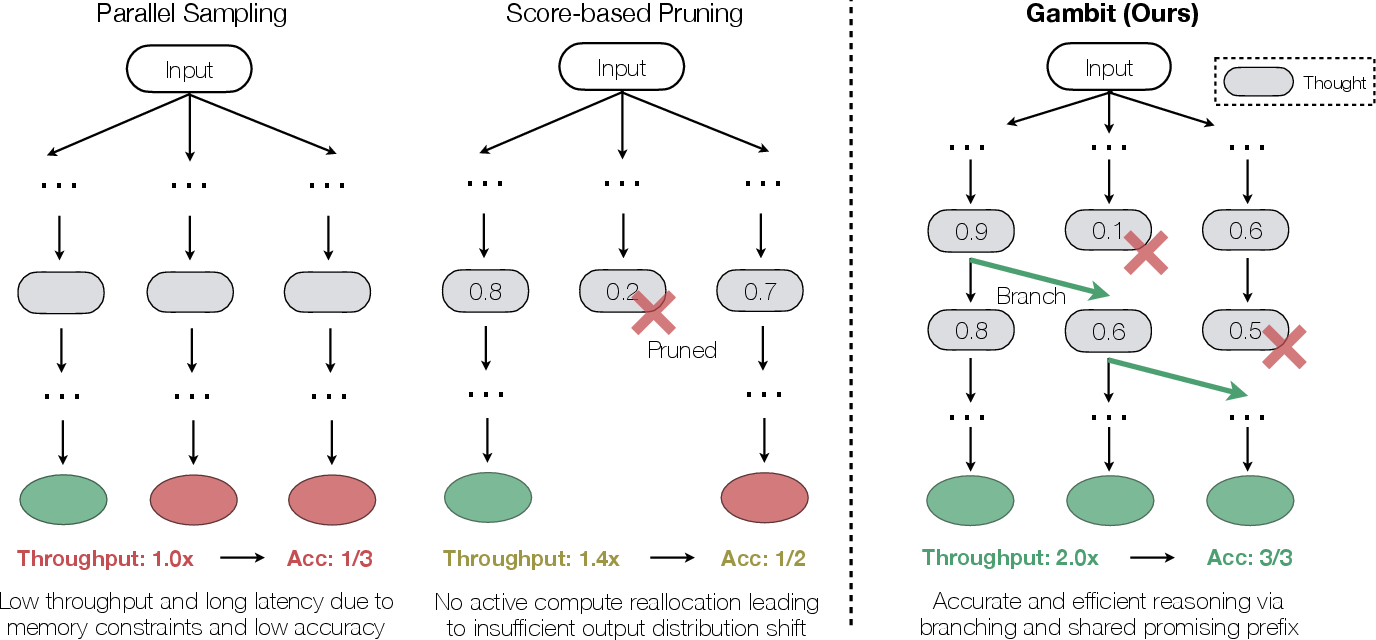
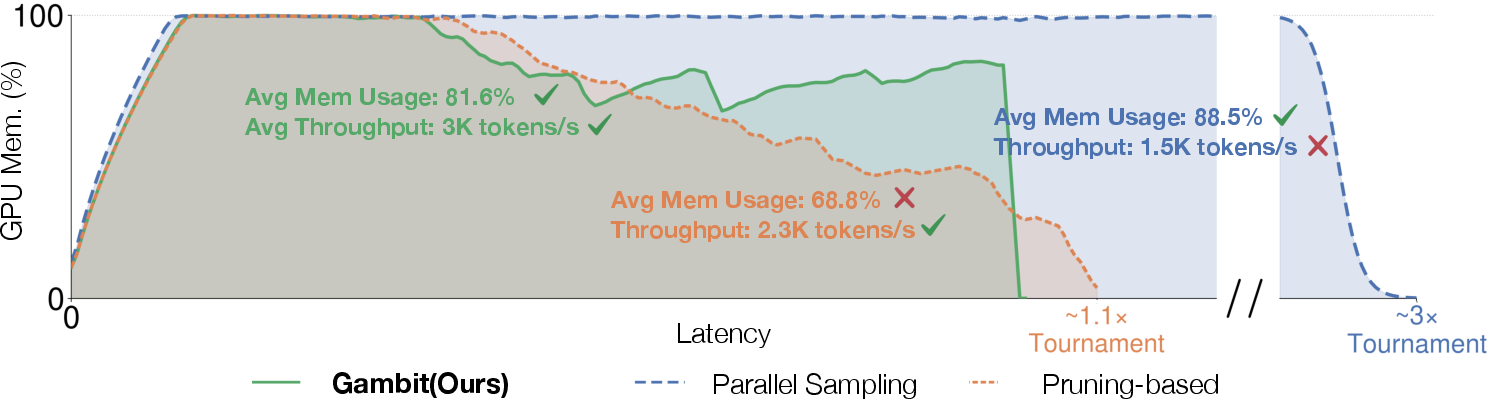
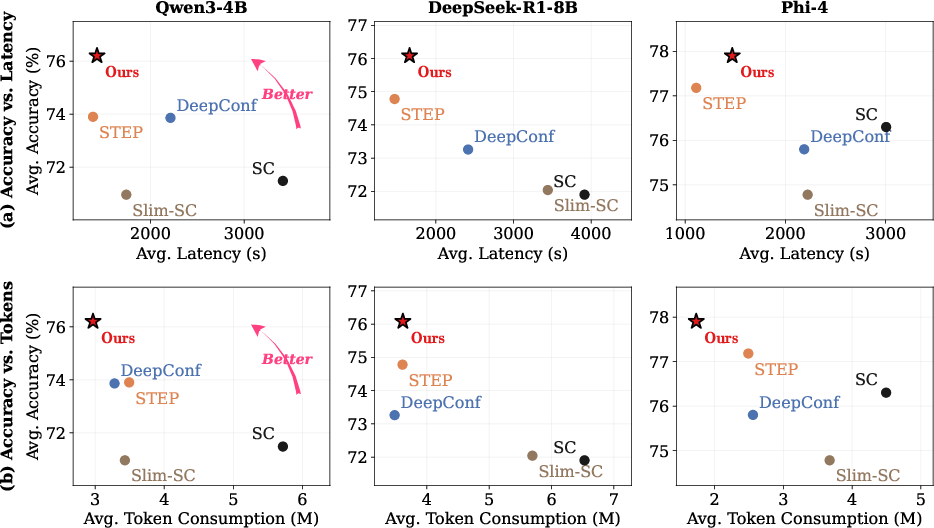
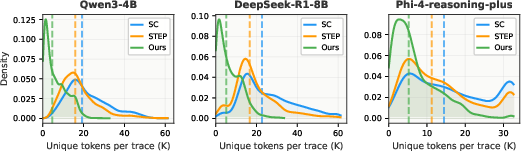
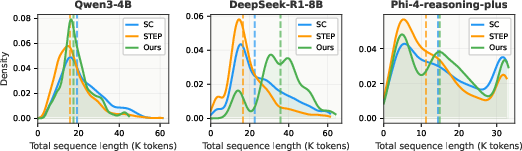
Abstract: Test-time compute scaling is a primary driver of performance in large reasoning models (LRMs), but extreme inefficiency bounds current approaches, shifting the critical question from \emph{how much} compute to spend, to \emph{where} to allocate it. We formalize test-time reasoning as a constrained compute allocation problem over partial trajectories. Under a fixed hardware budget, existing paradigms fail to actively allocate the compute to the most promising partial progress: traditional parallel sampling treats traces independently and induces severe memory bottlenecks, while subtractive pruning starves hardware and fails to actively and sufficiently shift the output distribution. To overcome this dichotomy, we introduce Gambit, an inference algorithm that executes \emph{thought-level beam search}. By periodically pruning unpromising trajectories and immediately branching from high-quality prefixes, Gambit dynamically concentrates compute onto the most promising reasoning traces via a light-weight scorer probing hidden states while maintaining continuous high hardware utilization. Extensive evaluations across multiple models and benchmarks demonstrate that Gambit strictly dominates existing baselines. Under identical hardware constraints, our method yields up to a +6.7\% absolute accuracy gain on HMMT-24 and +3.3\% on AIME-25 over pruning baselines, delivers $>2\times$ higher throughput on trace completion, and reduces total token consumption by up to 68.5\% relative to standard parallel sampling.

Paper Prompts
Sign up for free to create and run prompts on this paper.
Top Community Prompts
Explain it Like I'm 14
1. What is this paper about?
This paper introduces Gambit, a new way to help reasoning LLMs solve difficult problems more accurately and efficiently.
Reasoning models often solve problems by writing a long “chain of thought,” similar to showing their working in math. To improve their chances, researchers usually ask the model to produce many possible solutions and then choose the most common answer.
The problem is that this uses a lot of computer power. Many of the attempted solutions go wrong, even though they may begin with useful or correct ideas. Gambit tries to save the useful parts of good solutions and spend more computer power developing them.
2. What questions does the research ask?
The paper focuses on two main questions:
- Can a model become more accurate by spending extra computing power on the most promising solution attempts?
- Can this be done while using fewer tokens and keeping the computer hardware busy?
The researchers compare Gambit with two common approaches:
- Parallel sampling: Create many completely independent solutions and use a vote to select the answer.
- Pruning: Stop solution attempts that appear to be poor, but do not create replacements.
Gambit combines the useful parts of both methods: it removes weak attempts and immediately creates new attempts from strong partial solutions.
3. How does Gambit work?
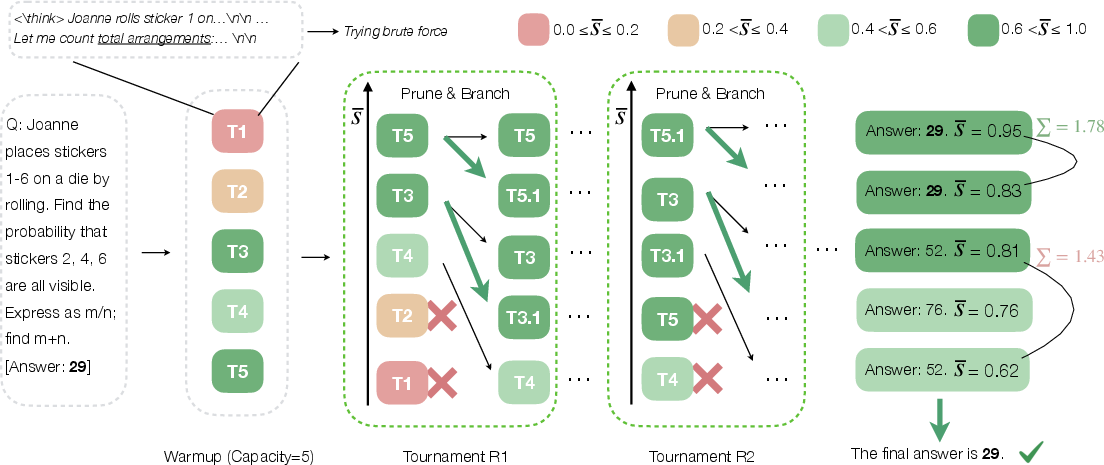
The basic idea: a tournament for solution attempts
Imagine that a class of students is trying to solve a very difficult puzzle.
- At first, every student works on a different solution.
- After some time, a teacher checks their progress.
- The weakest attempts are stopped.
- New students begin from the best ideas found so far, but try different ways to continue.
- The number of students stays the same throughout the process.
Gambit works in a similar way with the model’s reasoning traces.
A reasoning trace is one complete attempt at solving a problem. A prefix is the beginning of a trace—the steps the model has already written. Gambit periodically compares these prefixes and decides which ones look promising.
Scoring partial solutions
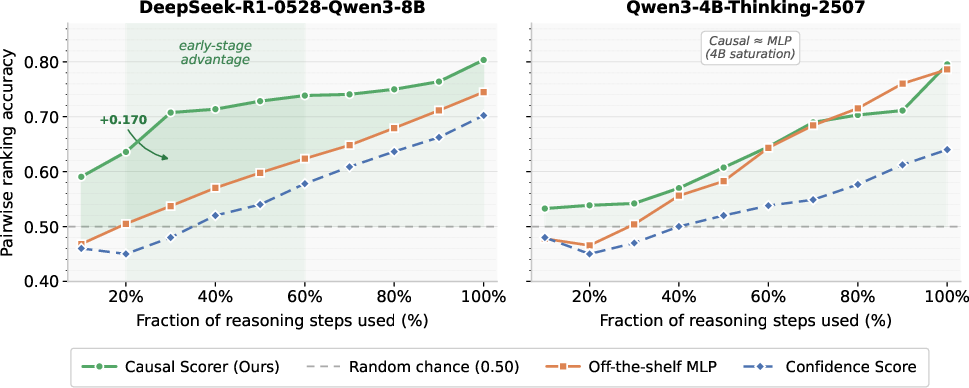
Gambit uses a small scoring system to examine the model’s internal information. This internal information is called a hidden state. It is a collection of numbers inside the model that represents what the model currently “understands” about its reasoning.
The scorer acts like a quick progress checker. It does not prove that an attempt is correct, but it estimates whether the current reasoning is likely to lead to a correct answer.
Gambit also uses a warmup period. It waits until a trace has produced enough reasoning before judging it. This is important because very early steps can look confusing even when they will eventually lead to a good solution.
Pruning and branching
At regular intervals, Gambit holds a “tournament”:
- It removes the lowest-scoring reasoning traces.
- It copies the most promising prefixes.
- From those copied prefixes, it generates new continuations.
This is called branching. It is like taking a good idea and asking the model to explore several different ways of finishing it.
The new branches can share the same saved beginning. This saved information is stored in a structure called a KV cache. The cache is similar to keeping a photocopy of the work already done, so the model does not need to redo the same beginning every time.
Keeping the hardware busy
Gambit uses a fixed number of active traces. When one trace is removed, another takes its place immediately. This prevents the GPU—the powerful computer chip used to run the model—from sitting idle.
The researchers describe this as a zero-sum allocation: the system does not simply reduce the number of attempts. Instead, it transfers resources from weak attempts to stronger ones.
4. What did the researchers find?
The researchers tested Gambit using several reasoning models, including models from Qwen, DeepSeek, and Microsoft Phi. They evaluated the systems on difficult mathematics and science tests, such as:
- AIME mathematics problems
- HMMT mathematics problems
- GPQA-Diamond, which tests advanced scientific reasoning
They compared Gambit with parallel sampling and several pruning methods.
The main findings were:
- Gambit generally achieved higher accuracy than both ordinary sampling and pruning-only methods.
- On some tests, it improved accuracy by as much as 6.7 percentage points compared with pruning.
- It reduced the number of generated tokens by as much as 68.5% compared with standard parallel sampling.
- It produced completed reasoning traces at more than twice the rate of some other methods.
- The extra work needed to manage the search was very small—reported as less than 1% of the system’s time in the paper.
For example, with one model on the HMMT-24 test, Gambit reached 65.0% accuracy, compared with 61.7% for one pruning method and 50.8% for ordinary parallel sampling.
These results matter because they show that using more computing power is not enough by itself. Where the computing power is used can be just as important.
5. Why are these results important?
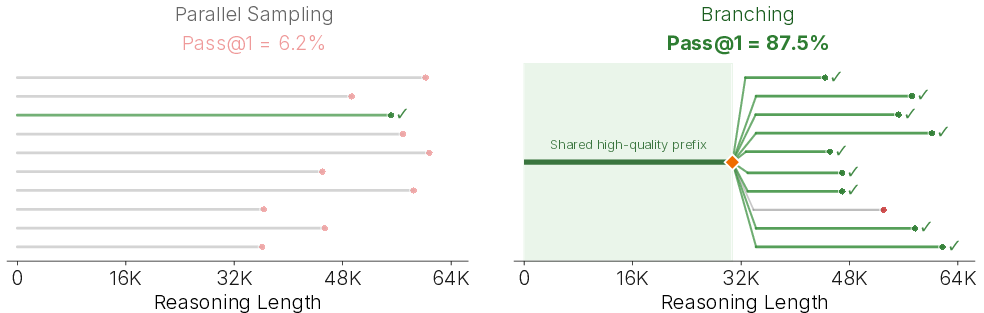
Standard parallel sampling treats every solution attempt as completely separate. If a trace contains ten excellent steps followed by one mistake, the whole trace may be discarded. This wastes the useful work already completed.
Pruning methods save computer resources by stopping bad attempts, but they do not use the freed resources to improve the promising attempts. As more traces are stopped, the hardware may also become less busy.
Gambit attempts to solve both problems:
- It keeps useful partial reasoning.
- It explores multiple possible continuations from strong prefixes.
- It removes weak attempts.
- It keeps the number of active attempts steady.
6. Possible impact and limitations
If the results hold in broader testing, Gambit could make reasoning LLMs:
- Faster
- Less expensive to run
- More accurate on difficult problems
- Better at using powerful hardware efficiently
This could be useful for mathematics, science, programming, and other tasks where models need to think through many steps.
However, Gambit depends on the quality of its scoring system. If the scorer incorrectly labels a good partial solution as bad, Gambit might stop it too early. On the other hand, if it scores an incorrect idea too highly, the system might spend too much effort developing that idea. The researchers try to reduce this risk by waiting before scoring and by keeping several promising branches instead of choosing only one.
Overall, the paper’s main message is simple: rather than making a model produce hundreds of unrelated attempts, it may be better to notice which attempts are developing well and actively build on them.
Knowledge Gaps
The paper leaves the following knowledge gaps, limitations, and open questions unresolved:
- Limited statistical validation: Results are reported primarily as aggregate accuracies without confidence intervals, repeated-run variance, significance tests, or per-problem distributions, making it unclear whether the reported gains are statistically robust.
- Narrow hardware evaluation: System measurements are conducted on a single NVIDIA B300 GPU with vLLM; generalization to other GPUs, multi-GPU deployments, inference engines, batch sizes, and memory capacities remains untested.
- Unclear hardware-budget comparability: The evaluation fixes the number of complete traces at 256, but does not fully establish whether all baselines receive equivalent peak memory, wall-clock, FLOP, energy, and scheduling budgets.
- Incomplete latency accounting: The paper reports speedups and throughput but provides insufficient detail about preprocessing, scorer execution, KV-cache copying or sharing, scheduling delays, synchronization barriers, answer aggregation, and startup overhead.
- Ambiguous token accounting under prefix sharing: It is unclear whether reported token consumption counts generated tokens, unique tokens, decoded tokens, or logical tokens including inherited prefixes, which complicates comparisons with methods that do not reuse KV caches.
- Dependence on scorer quality: Gambit’s effectiveness is likely highly dependent on the hidden-state scorer, yet the paper does not systematically characterize how scorer calibration, ranking error, distribution shift, or model–scorer mismatch affect search quality.
- Insufficient comparison with alternative scoring methods: The experiments focus mainly on the STEP scorer and one custom scorer; comparisons with process reward models, outcome reward models, verifier models, uncertainty estimates, and learned value functions are missing.
- No oracle or ranking-quality analysis: The paper does not report prefix-ranking metrics such as calibration, precision at top-, recall of eventually correct traces, or correlation between intermediate scores and continuation success.
- Unresolved early-score reliability: The warmup threshold is intended to mitigate noisy early signals, but the paper does not show how scorer reliability changes with reasoning depth or whether the chosen threshold is optimal across tasks and models.
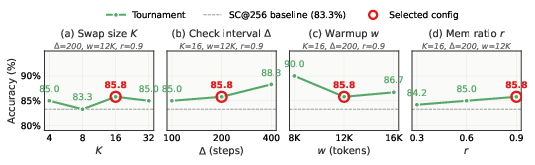
- Fixed hyperparameters may conceal task-specific tuning: The use of a single warmup threshold, swap size, check interval, and capacity across benchmarks does not establish robustness across substantially different reasoning lengths, tokenizers, or task distributions.
- Incomplete hyperparameter evidence: Although the paper refers to ablations, the provided text does not present them; the sensitivity of performance to , , , , temperature, and scoring aggregation therefore remains unresolved.
- Unclear exploration–exploitation behavior: The proposed temperature multiplier and decoupled memory design are described conceptually, but their effects on diversity, mode collapse, duplicate branches, and discovery of rare correct solutions are not isolated.
- Potential loss of diversity from parent concentration: Branching from the highest-scoring prefixes may amplify scorer errors and reduce exploration of lower-ranked but ultimately correct trajectories; the paper does not quantify this failure mode.
- No systematic analysis of duplicate or highly correlated branches: Prefix sharing can cause many continuations to remain correlated, potentially weakening majority voting, but the effective diversity of Gambit’s final trace population is not measured.
- Limited baseline coverage: The evaluation omits several relevant alternatives, including best-of-, verifier-guided decoding, tree search variants, MCTS with batched execution, adaptive self-consistency, diverse beam search, and other active test-time compute allocation methods.
- Potentially non-equivalent aggregation: Gambit uses score-weighted majority voting, while some baselines use different aggregation rules; the contribution of the search policy is therefore not completely separated from the contribution of the final voting mechanism.
- Insufficient ablation of aggregation choices: The paper does not compare score-weighted voting with unweighted voting, final-step scoring, answer-level verification, or calibrated confidence aggregation.
- Questionable breadth of task coverage: Most evaluations concern competition mathematics, while GPQA-Diamond provides only limited evidence for non-mathematical reasoning; performance on coding, formal proof, planning, multi-hop factual reasoning, and long-form scientific tasks is unknown.
- Unclear generalization to harder or longer problems: The benchmarks and fixed 256-trace budget do not establish how Gambit scales with substantially longer reasoning chains, larger search spaces, or problems where useful prefixes emerge late.
- No evaluation of incorrect or poorly structured intermediate reasoning: The method assumes identifiable thought boundaries and meaningful hidden states, but its behavior on models that produce fragmented, verbose, non-delimited, or internally inconsistent reasoning is unexplored.
- Dependence on newline-defined thought boundaries: Defining thoughts using
\n\nmay be model- and prompt-dependent; robustness to alternative step segmentation strategies is not evaluated. - Unresolved correctness of checkpointed prefixes: The paper assumes that a high-scoring prefix represents reusable valid progress, but does not determine how often branching from such a prefix preserves hidden logical errors or constrains future recovery.
- No formal approximation or optimality analysis: Gambit is formulated as a constrained allocation problem, but there is no theoretical guarantee, regret bound, approximation result, or proof that its tournament policy improves the objective under stated assumptions.
- Unclear behavior when no trace is promising: The method always reallocates toward top-ranked prefixes, but fallback behavior and performance on instances where all candidates receive low or similarly misleading scores are not analyzed.
- Ghost-trace semantics may affect fairness and termination: Ghost traces remain logically active while producing no tokens, but the interaction between ghost eviction, tournament timing, completion, and termination is not formally specified or stress-tested.
- Potential race conditions in asynchronous serving: The algorithm is described as synchronized while the underlying serving engine may evict, preempt, or complete traces asynchronously; the correctness and performance impact of such races are not fully characterized.
- Memory-management behavior is under-specified: The paper does not provide detailed measurements of KV-cache fragmentation, cache-block reuse, copying costs, eviction frequency, or memory behavior as sequence lengths become heterogeneous.
- Energy and environmental costs are not measured: Token reductions and latency improvements are reported, but energy consumption, power utilization, and total environmental cost are left unexamined.
- No assessment of robustness to scorer or implementation failures: The effects of noisy hidden states, numerical precision, quantization, cache corruption, scorer latency spikes, and scheduling failures are not evaluated.
- Limited reproducibility of implementation details: The text references code but does not fully specify prompts, decoding temperatures, random seeds, stopping criteria, maximum sequence lengths, scorer-training data, and exact baseline configurations.
- Potential benchmark leakage or contamination is not discussed: The paper does not examine whether the evaluated models or scorers may have encountered the competition problems or related data during training.
- No study of adaptive budget allocation across problems: The budget is fixed per problem, leaving open whether Gambit can decide how much compute to allocate to easy versus difficult instances under a global request or latency budget.
- Unclear multi-tenant serving implications: The evaluation uses a dedicated GPU and does not address fairness, interference, quality-of-service guarantees, or scheduling when multiple users or prompts share the inference system.
- The claimed dominance may not hold outside the tested operating point: Results are concentrated on one trace budget, one GPU, and a small set of models; broader accuracy–latency–memory frontiers are needed to establish whether Gambit consistently dominates baselines across operating regimes.
Practical Applications
Immediate Applications
- More efficient inference for mathematical and scientific reasoning tasks (AI/software; deployable now)
- mathematical problem solving,
- scientific question answering,
- theorem-style reasoning,
- code generation requiring multi-step planning,
- technical report or analysis generation.
- The reported results suggest that this can reduce token consumption by up to 68.5%, improve accuracy over pruning-only methods, and maintain higher trace throughput under a fixed GPU budget.
- Dependencies: A compatible reasoning model, access to intermediate hidden states, reliable thought-boundary detection, KV-cache sharing, and a scorer that correlates with continuation quality.
- Cost and latency reduction in production LLM services (cloud AI infrastructure; deployable now) An inference provider could expose Gambit as an “extended reasoning” decoding mode for requests where higher accuracy is worth additional test-time computation. The system can maintain a fixed number of active traces, prune low-scoring trajectories, and immediately reuse freed capacity for branches from promising prefixes. This can improve GPU utilization and reduce the cost per solved reasoning task compared with static parallel sampling. Dependencies: The reported gains were measured on particular open-weight models, benchmarks, and GPU hardware; production workloads may have different sequence lengths, batch sizes, and scorer calibration requirements.
- Adaptive compute allocation based on service-level objectives (software systems; deployable now)
- low-latency requests can use a small beam and short search horizon;
- high-value requests can receive a larger trace pool;
- systems can impose a hard GPU-memory or token budget;
- request schedulers can dynamically choose between self-consistency, pruning, and Gambit according to current load.
- This enables reasoning systems to allocate compute according to accuracy, latency, or cost targets rather than using a fixed number of independent samples.
- Dependencies: Stable calibration of these parameters across models and workloads; excessive branching or an overly small beam may cause search collapse or loss of diversity.
- Drop-in replacement for pruning-only reasoning methods (AI tooling; deployable now) Organizations already using hidden-state confidence signals, STEP-like probes, or early termination can add active replacement: every terminated trace is replaced by a continuation from a high-quality prefix. This preserves the existing scorer while changing the allocation policy. The paper’s comparison with the same STEP scorer indicates that improvements can come from the search topology rather than from training a more sophisticated evaluator. Dependencies: The existing scorer must provide meaningful relative rankings; a poor scorer may systematically amplify incorrect prefixes.
- GPU memory-aware reasoning workflows (inference infrastructure; deployable now)
- KV-cache-aware beam schedulers,
- reasoning-serving middleware,
- GPU utilization dashboards,
- trace-allocation controllers for long-context inference.
- Dependencies: The serving engine must support cache sharing, trace metadata, eviction, and restoration or logical “ghost trace” bookkeeping.
- Higher-throughput automated benchmark solving and evaluation (academia; deployable now) Research groups can use Gambit to run large-scale evaluations on difficult reasoning benchmarks with fewer generated tokens per problem. This may make repeated ablations, model comparisons, and error analyses more affordable. Score-weighted answer aggregation can also be used as an alternative to unweighted majority voting. Dependencies: Benchmark answers must be verifiable or aggregatable; improvements demonstrated on AIME, HMMT, and GPQA do not automatically establish gains on all reasoning domains.
- Improved code-generation and debugging agents (software engineering; near-term deployment)
- generating several repair strategies from a promising diagnosis,
- branching from a partially completed program analysis,
- exploring alternative test-fix sequences,
- allocating more inference to difficult repository-level tasks.
- Dependencies: Code tasks require task-specific validation signals—such as compilation, unit tests, static analysis, or execution results—because hidden-state scores alone may not reliably identify correct software behavior.
- Energy and infrastructure savings for high-volume reasoning workloads (energy/operations; deployable now) Lower token production and higher productive trace throughput can reduce GPU-hours and associated electricity use for batch workloads such as dataset generation, synthetic reasoning traces, and offline agent planning. Dependencies: Actual energy savings depend on whether the deployment is throughput-limited or latency-limited, as well as GPU power management, cache overhead, and the cost of scorer evaluation.
Long-Term Applications
- General-purpose search controllers for multimodal and agentic systems (robotics, automation, multimodal AI; requires further research)
- preserve a promising robot task plan,
- branch alternative navigation or manipulation strategies,
- terminate unsafe or low-value action sequences,
- allocate more simulation or model calls to promising plans.
- Dependencies: Defining robust “thought boundaries” for actions and observations, handling irreversible real-world actions, and developing verifiable value functions beyond hidden-state probes.
- Search-efficient autonomous software agents (software/enterprise automation; requires development) Long-horizon agents could use thought-level beam search over alternative plans for research, data analysis, procurement, or workflow automation. Shared prefixes would reduce repeated planning effort, while score-guided branching could focus computation on plans that satisfy constraints. Dependencies: Reliable external-state verification, prevention of correlated planning errors, tool/API side effects, and mechanisms for ensuring that multiple branches do not duplicate costly or irreversible actions.
- Process-aware training of reasoning models and verifiers (AI research; requires further research)
- process reward models,
- hidden-state probes,
- value estimators,
- preference or reinforcement-learning objectives,
- curriculum datasets emphasizing recoverable versus unrecoverable reasoning errors.
- This could create a feedback loop in which inference-time search supplies examples of valuable intermediate states for future model training.
- Dependencies: Search-selected traces may inherit scorer bias; labels must distinguish genuinely correct intermediate reasoning from plausible but ultimately incorrect prefixes.
- Domain-specific decision support in healthcare, law, and finance (regulated sectors; long-term)
- differential-diagnosis generation in clinical decision support,
- statutory or case-law analysis,
- financial risk and scenario analysis,
- compliance review with alternative interpretations.
- Dependencies: These applications require domain-validated scorers, authoritative verification, calibrated uncertainty, privacy protection, audit trails, and human approval. Higher benchmark accuracy alone is insufficient for safe deployment.
- Budget-aware policy and public-sector reasoning systems (policy; long-term) Government or institutional AI systems could use fixed-capacity search to analyze policy alternatives, summarize evidence, or test arguments under explicit compute budgets. The allocation policy could be integrated with procurement or deployment rules that specify maximum GPU cost, latency, and required confidence. Dependencies: Transparent scoring is essential because compute allocation can amplify particular reasoning paths. Policy use also requires bias evaluation, reproducibility, trace retention, and mechanisms to prevent a high-scoring but factually wrong argument from dominating.
- Personalized reasoning modes in everyday AI assistants (daily life/consumer software; long-term)
- quick responses for routine questions,
- deeper branching for travel planning, tax preparation, or household budgeting,
- multiple alternatives for purchases or schedules,
- verification-focused search for educational explanations.
- Shared-prefix reasoning could reduce the cost of generating many personalized alternatives.
- Dependencies: User-facing systems need predictable latency, privacy-preserving trace handling, understandable explanations, and safeguards against confident amplification of incorrect advice.
- Distributed or heterogeneous accelerator scheduling (systems and hardware; long-term) The constrained allocation formulation could be extended across multiple GPUs, accelerator types, or edge/cloud resources. High-value prefixes might be migrated to faster devices, while lower-priority branches run on cheaper hardware. This could support elastic reasoning services that trade off throughput, cost, and energy in real time. Dependencies: Prefix migration, cache transfer costs, synchronization overhead, network bandwidth, and heterogeneous scorer/model compatibility may reduce the benefit observed on a single GPU.
- Formal verification and theorem-proving search (mathematics/formal methods; long-term) In theorem provers or proof assistants, partial proof states could serve as prefixes. Gambit-like branching could preserve promising lemmas or proof contexts and allocate additional search to them while pruning states with low estimated solvability. Dependencies: The scorer must be tied to formally checkable proof progress; hidden-state confidence should not replace proof verification. Integration with proof-state representations and efficient cache reuse would also be required.
- Safety-oriented reasoning with explicit exploration constraints (AI safety and reliability; long-term) Gambit’s beam structure could support controlled diversity by limiting how many branches originate from one prefix, applying temperature multipliers, or reserving capacity for exploratory candidates. This may help reduce correlated failure modes in systems that otherwise converge too quickly on a confident but incorrect trajectory. Dependencies: Diversity heuristics do not guarantee correctness or safety. Formal failure-mode analysis, adversarial evaluation, independent verification, and domain-specific safety constraints remain necessary.
Glossary
- Autoregressive LLM: A model that generates a sequence one token at a time, conditioning each token on previously generated tokens. “In the context of autoregressive LLMs”
- Beam search: A decoding or search procedure that retains a limited set of the most promising partial sequences at each stage. “Inspired by beam search”
- Branching: Generating new continuations from an existing partial trajectory or prefix. “Branching spawns new child requests from the highest-scoring prefixes.”
- Checkpointing: Saving an intermediate computational state so that it can be resumed or reused later. “Capturing these states during generation is therefore critical.”
- Chain of thought: A sequence of intermediate reasoning steps generated by a LLM. “by generating long chains of thought during inference”
- Compute allocation: The process of distributing available computational resources among competing tasks or trajectories. “We formalize test-time reasoning as a constrained compute allocation problem”
- Concurrency: The number of tasks or model executions that can proceed simultaneously. “Because pruned traces are permanently discarded and not replaced, concurrency steadily declines during generation.”
- Continuation value: An estimate of how likely a partial sequence is to lead to a successful final answer. “use a scoring function as a proxy for continuation value”
- Cosine-similarity deduplication: Removing items judged redundant according to the cosine similarity between their vector representations. “Slim-SC (which aggregates via cosine-similarity deduplication at a 0.95 threshold)”
- Cumulative score: A score aggregated over multiple intermediate steps of a trajectory. “”
- Decoupled memory management: A design that separates logical search decisions from the physical allocation of memory and execution resources. “We further design a decoupled memory management scheme”
- Decoupled View Architecture: Gambit’s separation of the scheduler’s physical execution state from the beam search’s logical tree state. “Gambit introduces a Decoupled View Architecture”
- Degenerate pathway: A repetitive, unproductive, or low-quality sequence of model decisions. “the redundant exploration of degenerate pathways”
- Diminishing returns: A condition in which additional resources produce progressively smaller improvements. “the current paradigm is reaching diminishing returns due to extreme inefficiency.”
- Distribution collapse: An undesirable concentration of generation probability on too few candidate trajectories. “This induces a pathological feedback loop in which compute is repeatedly concentrated on a small set of high-scoring prefixes, collapsing the search distribution”
- End-to-end latency: The total elapsed time from initiating a request to receiving its final result. “heavily inflating end-to-end latency”
- Exploration and exploitation: The trade-off between investigating diverse possibilities and focusing resources on currently promising options. “To balance exploration and exploitation and prevent greedy collapse”
- Forward pass: One complete computation of a neural network on an input. “execution remains dominated by GPU forward passes”
- GPU memory starvation: A state in which available GPU computational resources are insufficiently supplied with active work. “pruning-based methods alleviate memory pressure but induce hardware starvation”
- Hidden state: An internal vector representation produced by a neural network while processing an input sequence. “hidden-state-based scoring functions can identify promising reasoning prefixes”
- Inference-time search: Searching over possible model-generated continuations during inference rather than relying on a single generation path. “To improve sample efficacy, methods such as Tree-of-Thoughts (ToT) and Monte Carlo Tree Search (MCTS) frame reasoning as a structured search”
- Key-value cache (KV-cache): Stored attention keys and values reused during autoregressive generation to avoid recomputing earlier tokens. “long contexts quickly saturate the KV cache.”
- Large reasoning model (LRM): A LLM optimized to produce extended intermediate reasoning for difficult tasks. “Test-time compute scaling is a primary driver of performance in large reasoning models (LRMs)”
- Majority-vote ceiling: The upper limit on accuracy imposed when an incorrect answer dominates the aggregate vote. “successfully breaking the majority-vote accuracy ceiling.”
- Monte Carlo Tree Search (MCTS): A tree-search algorithm that uses repeated simulations to balance exploration of alternatives with exploitation of promising nodes. “Monte Carlo Tree Search (MCTS) frame reasoning as a structured search”
- Non-monotonic reasoning: Reasoning in which a later step can invalidate conclusions that appeared correct earlier. “Mathematical reasoning is inherently non-monotonic”
- Off-the-shelf model: A pretrained component used without substantial modification or retraining. “either off-the-shelf hidden-state probes adapted from STEP”
- Parallel sampling: Generating multiple independent model outputs simultaneously. “typically through parallel sampling of reasoning traces”
- Partial trajectory: An incomplete sequence of reasoning steps generated toward a final answer. “over partial trajectories”
- Prefix caching: Reusing the cached computation associated with a shared sequence prefix when generating multiple continuations. “The child inherits the parent's KV-cache via prefix caching with minimal overhead.”
- Process Reward Model (PRM): A model that evaluates the quality of individual intermediate reasoning steps rather than only the final answer. “Existing evaluators—from costly Process Reward Models”
- Pruning: Removing low-quality or unpromising candidate trajectories from further consideration. “Pruning immediately terminates the lowest-scoring traces”
- Reallocation: Redirecting computational resources from discarded candidates to more promising ones. “Gambit performs a zero-sum reallocation of compute over a fixed-capacity pool of reasoning traces.”
- Score-weighted majority vote: Selecting the answer whose supporting trajectories have the greatest total evaluation score. “Final answers are aggregated via score-weighted majority vote”
- Self-consistency: An inference method that samples multiple reasoning traces and selects the answer occurring most frequently. “Self-consistency, which aggregates answers from multiple independently sampled traces”
- Sequence scorer: A learned function that evaluates an entire sequence or its accumulated reasoning history. “or custom sequence scorer”
- Synchronous beam allocation: Coordinated distribution of a fixed number of search slots among candidate trajectories at common decision points. “Gambit bridges this gap by reformulating search as a hardware-constrained, synchronous beam allocation”
- Test-time compute scaling: Increasing computation during inference to improve the quality of a model’s answer. “A key driver of these accuracy gains is test-time compute scaling”
- Thought-level beam search: Beam search performed over discrete reasoning steps rather than individual tokens. “we introduce Gambit, an inference algorithm that executes thought-level beam search.”
- Token-level beam search: Beam search that makes selection decisions at every generated token. “Unlike classical token-level beam search”
- Trace throughput: The rate at which complete reasoning trajectories are generated. “yielding over 2 higher trace throughput”
- Tree-of-Thoughts (ToT): A reasoning framework that represents intermediate thoughts as nodes in a structured search tree. “methods such as Tree-of-Thoughts (ToT)”
- Warmup threshold: A minimum generation depth required before a trajectory can be scored or used as a branching parent. “Gambit introduces a strict warmup threshold.”
- Zero-sum allocation policy: A resource policy in which every newly allocated slot is created by removing or repurposing another slot, keeping the total fixed. “we enforce a zero-sum allocation policy that maintains a constant-size pool of active traces”