MatrAIx: Simulating the World with 8.3 Billion Persona Agents
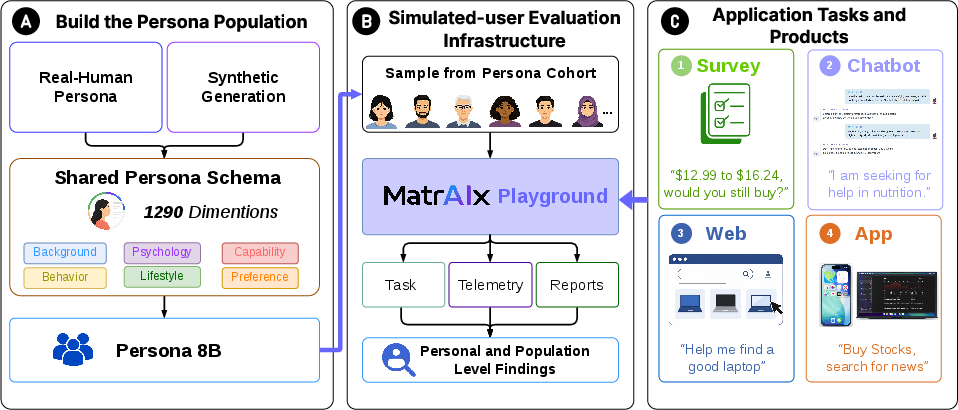
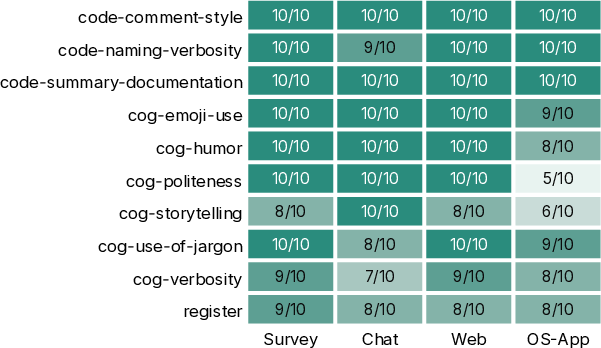
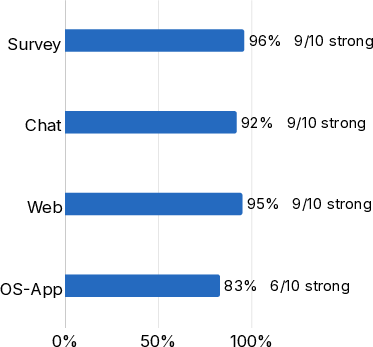
Abstract: Human evaluation of AI systems and digital products is costly, slow, and difficult to scale. Offline evaluations are more scalable but often abstract away human diversity and interactive behavior. We therefore introduce MatrAIx, a population-scale simulated-user evaluation infrastructure for testing AI systems and digital products with heterogeneous users. MatrAIx has three core components: First, Persona 8B contains 8.3 billion persona records represented by 1,290 categorical dimensions. Records are either sampled from a dependency graph that preserves correlated attributes or derived from human-authored profiles. We release a quality-filtered coreset of approximately 1 million personas, comprising 599,847 human-grounded and 400,000 synthetic records. Second, the MatrAIx Playground provides four environments in which diverse users evaluate and interact with digital products: Survey, AI Chatbot, Web, and App. Third, MatrAIx provides 1,010 application tasks spanning more than 25 domains, including Commerce, Software, Finance, and Healthcare. We conducted 18,189 evaluation trials across eight representative tasks. Persona agents were powered by three LLMs: Claude Opus 4.8, GPT 5.5, and Claude Haiku 4.5. The resulting feedback captures how decisions and preferences vary across persona backgrounds, including hesitation after a price increase, willingness to continue after an AI assistant fails, and latency tolerance. We conducted two main validation studies: First, a 400-trial controlled study evaluated persona adherence across ten behavioral attributes and all four environments. The declared behavior was expressed or correctly suppressed in 366 trials (91.5%). Second, human and LLM judges evaluated the extraction quality of human-grounded personas. Overall, MatrAIx provides an end-to-end infrastructure for evaluating AI systems and digital products with diverse simulated human users.
First 10 authors:




Paper Prompts
Sign up for free to create and run prompts on this paper using GPT-5.
Top Community Prompts
Explain it Like I'm 14
What this paper is about
This paper introduces MatrAIx, a way to test AI systems and digital products using billions of realistic “pretend users” called persona agents. Instead of waiting for lots of real people to try something (which is slow and expensive), researchers can run quick, repeatable studies with simulated users who have different ages, jobs, skills, preferences, and habits. This helps teams see how a product might work for many kinds of people, spot problems early, and compare changes over time.
What questions the paper asks
- Can we build a huge, varied set of realistic user profiles (personas) that feel consistent and not contradictory?
- Will AI agents actually act like the personas they’re assigned (for example, a cautious shopper being cautious)?
- Can these simulated-user studies reveal differences across products, AI models, and user groups that normal one-number scores would miss?
How the research works (in everyday terms)
Think of testing a new app like play‑testing a video game with many types of characters. MatrAIx gives you:
- A giant character creator with rules so profiles make sense.
- Several “arenas” where those characters can interact with products.
- A library of ready-to-run testing scenarios.
Here’s the approach, step by step:
1) Persona 8B: building the people
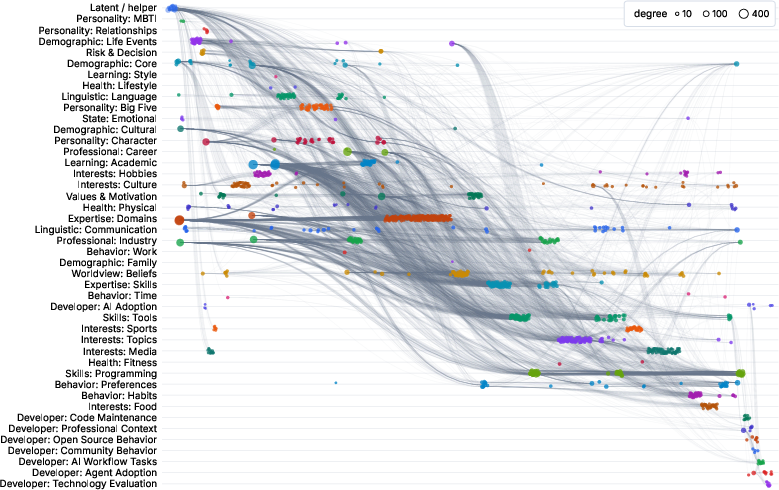
- The team built 8.3 billion persona records described by 1,290 traits (like region, language, tech skills, diet, risk tolerance). That’s like filling out a very detailed character sheet.
- Two ways personas are made:
- Synthetic (made by rules): They use a “dependency graph,” which is like a checklist with logic so traits line up. Example: if someone’s primary language is English and they live in North America, it would be odd for them to have “English proficiency: None.” The system prevents clashes like that while still allowing rare but possible profiles.
- Human-grounded (mapped from real data): They extract traits (without names or personal IDs) from sources like Wikipedia biographies, Amazon review histories, the Stack Overflow Developer Survey, the General Social Survey, PRISM Alignment profiles, and a small volunteer survey. Everything is de‑identified to protect privacy.
- They cleaned the data, removed duplicates, and released a high‑quality “coreset” of about 1 million personas: roughly 600k human-grounded and 400k synthetic.
2) The MatrAIx Playground: where testing happens
- Four environments simulate how users interact with products:
- Survey: personas answer questionnaires (e.g., “Would you still buy this soda after a price increase?”).
- AI Chatbot: personas chat with an AI assistant or support bot; the whole conversation is recorded.
- Web: personas browse and use websites like real shoppers or readers.
- App: personas use desktop or mobile apps inside a safe sandbox (like a virtual computer).
- Everything they do and say is saved, so researchers can see not just the final answer but also how they got there.
3) Applications library: ready-made tests
- There are 1,010 testing tasks across 25+ areas (Commerce, Software, Finance, Healthcare, and more). These describe:
- Which product or system to test.
- Which personas to include (for example, budget-conscious shoppers).
- What the goal is (e.g., compare prices, plan meals, change a privacy setting).
- What counts as success (and how to verify it).
4) Running and checking studies
- Persona agents are powered by LLMs. The paper tried Claude Opus 4.8, GPT 5.5, and Claude Haiku 4.5.
- They ran 18,189 trials across 8 representative tasks.
- Each task includes “verifiers” to check results (for example, “Did the answer include both a choice and a reason?”). When judgment is needed, humans or LLM judges use rubrics to score outcomes.
What they found and why it matters
- Persona behavior mostly matched their assigned traits. In a 400-trial controlled study across all four environments and ten behavioral attributes, persona agents expressed or correctly suppressed assigned behaviors 91.5% of the time. That means the “pretend users” generally acted like the people they were supposed to represent.
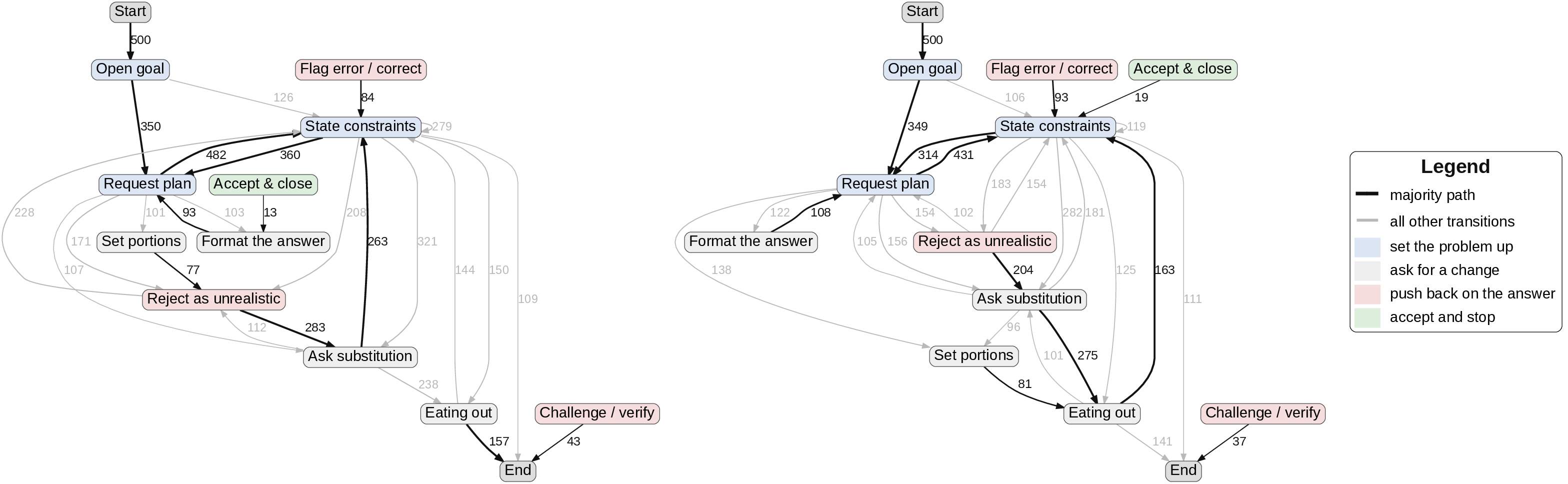
- The system captured meaningful differences between user groups. Examples include:
- Hesitation after a price increase.
- Willingness to keep chatting after an AI assistant makes and corrects a mistake.
- Tolerance for slow responses (latency).
- The human-grounded personas were judged good quality. Human raters gave a mean score of 4.135/5; LLM judges’ scores were usually within one point of that.
- Studies revealed variation that a single overall score would miss. For example, two chatbots with the same average rating might perform very differently for specific groups (like novices vs. experts).
Why this is important:
- Faster, cheaper, repeatable testing: You can run thousands of trials overnight instead of weeks of recruiting humans.
- Fairness and coverage: You can include many groups, including ones that are hard to recruit, and check how each experiences the product.
- Better product decisions: Teams can test “what if” changes, compare versions, and focus improvements where they matter most.
What this could change going forward
- Product development: Companies can use simulated-user studies early to catch issues (like confusing interfaces for newcomers or settings that are hard to find), then confirm key results with targeted human studies.
- Safer, more inclusive AI: By testing with diverse personas, teams can find problems that specifically affect certain groups before launch.
- Research standards: Clear tasks, saved evidence, and reusable verifiers make evaluations more consistent and easier to compare across models and products.
In short, MatrAIx doesn’t replace real users, but it gives a powerful, practical way to explore how different kinds of people might use AI systems and digital products—at scale, quickly, and with enough detail to guide real improvements.
Knowledge Gaps
Knowledge gaps, limitations, and open questions
Below is a consolidated list of concrete gaps, uncertainties, and open questions that remain unresolved and could guide future research.
- Population representativeness and calibration
- The released 1M coreset is calibrated only on four marginals (age, region, gender identity, urbanicity); joint distributions over key attributes (e.g., region × language × education × occupation) are not validated or matched.
- No quantitative audits of marginal/joint fidelity beyond these four axes are reported for either the 1M coreset or the 8.3B synthetic pool.
- Lack of methods for post-stratification or weighting to map simulated outcomes back to target real-world populations.
- Dependency modeling and synthetic generation
- The DAG structure and CPDs are source-informed but hand-constructed; there is no systematic learning of dependencies from data nor ablations comparing alternative graphs (e.g., Bayesian networks, IPF/raking, copulas).
- Long-range and higher-order dependencies (beyond local parents) are not modeled or stress-tested; potential for unrealistic cross-attribute combinations persists.
- No uncertainty quantification for priors, compatibility masks, and dependency weights, nor sensitivity analyses to these design choices.
- Rare but allowed combinations are preserved by the mask—but their plausibility and downstream behavioral realism are not empirically evaluated.
- Human-grounded extraction quality
- Per-field precision/recall, calibration, and error modes of LLM-based extraction (Wikipedia, Amazon Reviews, PRISM) are not reported; evaluation focuses on overall profile scores for a small sample (1,000 LLM-judged; 100 human-judged).
- Source-specific bias analyses (e.g., demographic skews in Wikipedia and Stack Overflow) are not quantified or corrected beyond the four-marginal calibration.
- Handling of missingness: the behavioral effect of large fractions of null fields in human-grounded records is not assessed (e.g., does missingness itself bias agents?).
- Privacy and data governance
- De-identification is described but lacks a formal privacy guarantee (e.g., k-anonymity, differential privacy, re-identification risk assessment).
- No adversarial re-identification study or linkage-risk analysis for extracted attributes, especially those mapped from public biographies or review histories.
- Governance, versioning, and update policies for evolving priors and sensitive attributes are not specified; data lifecycle and takedown processes are unclear.
- Persona adherence and behavioral fidelity
- The 400-trial adherence study covers ten attributes and four environments but remains small relative to the schema (1,290 dims) and task space; power, coverage, and attribute interactions are limited.
- Long-horizon adherence (Web/App tasks with multi-step goals), conflicting attribute conditions, and behavior drift across turns/sessions are not evaluated.
- Cross-model adherence differences are not analyzed in depth (e.g., robustness of adherence across Opus 4.8, GPT 5.5, Haiku 4.5, and open-source models).
- No tests of whether model priors override persona instructions (e.g., stereotype amplification or flattening of within-group variation) in complex interactions.
- Sim-to-real external validity
- There is no sim-to-real validation against human A/B tests, logs, or controlled lab studies for the same tasks (e.g., purchase elasticity, chatbot retention, feature discoverability).
- Agreement studies focus on extraction accuracy rather than on outcome alignment (e.g., willingness to continue after failure, latency tolerance) between simulated and human users.
- No calibration procedure is proposed to align simulated outcomes with observed human baselines when gaps are detected.
- Task coverage and verifier reliability
- Despite 1,010 task specifications, only eight representative tasks (18,189 trials) are executed; Web and App tasks remain underexplored given their complexity.
- LLM-judge bias and reliability are not systematically quantified for task scoring (e.g., inter-judge agreement, rubric calibration, judge-swap stability).
- Verifier leakage risks (e.g., judges inferring persona attributes and biasing scores) and mitigation strategies are not studied.
- For App/Web CUAs, human-likeness of navigation (click patterns, dwell times, error recovery) and its impact on outcomes is not validated.
- Statistical design and inference
- No a priori power analyses or sample-size guidelines are provided for detecting persona-conditioned effects across tasks and subgroups.
- Multiple-testing control is applied in a single case study, but a general framework for hierarchical testing across thousands of attributes and outcomes is absent.
- Lack of causal identification: persona-outcome associations are observational; factorial designs or controlled interventions on persona dimensions are not used to estimate causal effects.
- Cohort sampling and intersectionality
- Sampling recipes for complex, intersectional cohorts (e.g., age × disability × language × income) are not evaluated for coverage and balance.
- No strategy for ensuring adequate representation and statistical power for small or marginalized subgroups across tasks.
- Multilingual and accessibility scope
- While English proficiency is modeled, most environments and tasks appear English-centric; cross-lingual agent behavior and adherence are not validated.
- Accessibility attributes are included in the schema, but no targeted validation is conducted with simulated or real users who have accessibility needs.
- Reproducibility and openness
- Only a 1M coreset is released; the 8.3B population, full DAG, and CPDs are not fully open for replication or independent auditing.
- Determinism claims rely on seeds, but LLM nondeterminism, model updates, and API variability are not characterized; run-to-run reproducibility is unclear.
- Compute cost, throughput benchmarks, and carbon accounting of large-scale simulations are not reported.
- Security and deployment risks
- Remote execution environments (Docker Linux desktop, remote macOS/iOS) lack a documented threat model, sandbox-escape analysis, and data exfiltration mitigations.
- Credential handling is described at a high level; no penetration tests or red-team evaluations of the infrastructure are reported.
- Contamination and training-data leakage
- Potential training-data overlap between persona sources (e.g., Wikipedia, Stack Overflow) and the LLMs powering persona agents and judges is not assessed; risk of circularity remains unquantified.
- Rare personas and outlier behavior
- No targeted evaluation of whether rare but valid persona combinations behave plausibly, nor stress tests for edge-case cohorts.
- Longitudinal evaluation
- No longitudinal or retention studies across multiple sessions; memory, habit formation, and changes in trust over time are not modeled or validated.
- Decision guidance and fairness
- While multidimensional reporting is encouraged, concrete guidance on aggregating subgroup results into product decisions (e.g., risk thresholds, fairness constraints, Pareto trade-offs) is not provided.
- Systematic fairness audits across protected attributes (disparate error/experience) are not conducted.
- Open methodological questions
- How to learn and validate high-dimensional joint persona distributions with partial, biased sources while preserving interpretability and editability?
- How to design verifiers and judges that remain robust across rapidly evolving models and tasks, with bounded error and auditable uncertainty?
- What calibration procedures best align simulated behavioral metrics with real-world KPIs, and how stable are these mappings across domains and time?
Practical Applications
Below are concrete, real-world applications derivable from the paper’s methods, data, and infrastructure. Each item names the sector, what you can do, how to implement it with MatrAIx components, and key assumptions/dependencies that affect feasibility.
Immediate Applications
- Pre-deployment chatbot UX and safety evaluation — Software, Customer Support
- What: Identify subgroup-specific friction, failure modes, and recovery dynamics (e.g., willingness to continue after a hallucination; latency tolerance).
- How: Use MatrAIx Playground Type II (AI Chatbot) with persona cohorts from Persona 8B; reuse chatbot tasks from MatrAIx Applications; record trajectories and verify goals and sentiment.
- Tools/workflows: Cohort sampling → parallel trials → task-owned verifiers → subgroup analysis dashboard.
- Assumptions/dependencies: Persona adherence is high but not perfect (91.5% in controlled trials); LLM-judge bias requires calibration; target chatbot must expose API; simulator outcomes are not guarantees of human behavior.
- Price sensitivity and concept testing — Commerce, Marketing, Product
- What: Forecast purchase intent shifts after price changes or feature bundling and segment by income, region, motivation.
- How: Type I (Survey) with price-sensitivity and purchase-intent tasks from Applications; stratify on background and economic-motivation attributes in the 1,290-dim schema.
- Tools/workflows: Repeated runs across product versions; compare distributions and rationales; power-screen before running costlier human studies.
- Assumptions/dependencies: Core 1M coreset is calibrated to a few marginals (age/region/gender/urbanicity) but not fully representative; sim-to-real requires empirical backchecks.
- App/Web feature discoverability and privacy-controls usability — Software, Security & Privacy
- What: Validate whether diverse users can find and use critical features (e.g., privacy settings, security toggles) and complete tasks.
- How: Type III (Web) and Type IV (App) CUAs; instrument flows; programmatic verifiers check final app state and side effects.
- Tools/workflows: Docker-based Linux desktop, remote macOS/iOS automation; screenshot and state capture; regression testing across releases.
- Assumptions/dependencies: Stable test environments/sandboxes; some websites block automation; automation fidelity may lag advanced UI patterns.
- Localization and accessibility QA at scale — Software, Globalization, Accessibility
- What: Test flows across languages, English proficiency levels, regions, and accessibility needs in one automated suite.
- How: Query Persona 8B for language/region/accessibility attributes; run Web/App tasks with structured verifiers (e.g., error rate, abandoned steps).
- Tools/workflows: Cohort-specific pass/fail gates in CI; triage logs by persona attributes.
- Assumptions/dependencies: Accessibility dimensions must be set and relevant; CUA must robustly interact with assistive-tech settings; localized content must be available.
- Safety, policy, and red-teaming coverage — Trust & Safety, Policy, Compliance
- What: Probe risky and sensitive scenarios across heterogeneous personas (e.g., disclosure tendencies, susceptibility to unsafe advice).
- How: AI Chatbot tasks with risk-tolerance, values, and worldview attributes; LLM- and rubric-based judging.
- Tools/workflows: Pre-release red-teaming sweeps; guardrail A/Bs; evidence-linked case reports.
- Assumptions/dependencies: Judges can be biased; requires human spot-checking; personas should avoid reinforcing stereotypes.
- Tutoring, coaching, and onboarding assistant tuning — Education, HR/Training
- What: Tailor assistant behavior to novice vs expert, different motivations, or risk profiles; quantify satisfaction and learning-support outcomes.
- How: AI Chatbot tasks; measure goal resolution, rubric scores, self-reports (e.g., clarity, perceived effectiveness).
- Tools/workflows: Cohort-specific prompt/policy variants; iterative tuning with fixed cohorts for fair comparisons.
- Assumptions/dependencies: Educational effectiveness needs human/learning-outcome validation; personas simulate interaction style, not learning gains.
- Robo-advice flow checks and disclosures — Finance
- What: Validate that guidance, disclaimers, and risk-matching are understandable and acceptable across risk tolerances and financial literacy levels.
- How: Survey + AI Chatbot tasks with risk-tolerance and financial-knowledge attributes; programmatic checks for required disclosures.
- Tools/workflows: Compliance pre-checks; transcript and rationale archiving.
- Assumptions/dependencies: Regulatory standards vary by jurisdiction; personas do not replace licensed suitability assessments.
- Health-information assistant guardrails and adherence intent — Healthcare, Wellness
- What: Test symptom-checkers/health coaches for appropriateness, safety messaging, and user intent to follow recommendations across dietary and cultural constraints.
- How: AI Chatbot tasks (e.g., meal-planning); capture adherence likelihood, safety disclaimers, culturally appropriate substitutions.
- Tools/workflows: Safety rubrics; manual adjudication for high-stakes cases.
- Assumptions/dependencies: Not a clinical evaluation; requires medical expert review; sim-to-real caution for vulnerable populations.
- Benchmarking LLMs under controlled persona conditioning — AI/ML Research, MLOps
- What: Compare models’ ability to use persona information consistently across Survey, AI, Web, and App settings.
- How: Use shared tasks with fixed targets (e.g., same assistant) and varied persona agents (Opus, GPT, Haiku) to assess downstream differences.
- Tools/workflows: Model selection/tuning; persona-adherence checks; telemetry-based comparisons.
- Assumptions/dependencies: Persona-following varies by model; need reproducible seeds and verifiers for stable comparisons.
- Synthetic preference data for early-stage RLHF/reward-model screening — AI/ML
- What: Generate diverse, persona-conditioned preference traces to pre-screen alignment strategies before human annotation.
- How: Use AI Chatbot/Web/App tasks to collect rationales and outcomes across stratified cohorts.
- Tools/workflows: Preference-data mining; eliminate flawed prompts/policies pre-HIT launch.
- Assumptions/dependencies: Not a substitute for human labels; risk of simulator bias propagating into reward models.
- Continuous regression and release certification gates — Software, DevOps
- What: Lock a fixed cohort and task suite to detect regressions in UX, latency tolerance, completion rates, and safety across releases.
- How: CI step that runs selected Survey/AI/Web/App tasks on remote workers; compare to historical baselines.
- Tools/workflows: Cohort manifests; versioned tasks and verifiers; pass/fail thresholds.
- Assumptions/dependencies: Compute budget for parallel trials; task brittleness if product UIs change substantially.
- Instrument piloting and questionnaire debugging — Academia, Public Policy, Market Research
- What: Pilot surveys to flag ambiguous wording, missing options, and cultural blind spots before fielding.
- How: Type I (Survey) with heterogeneous cohorts; analyze non-response, contradictory answers, and rationale content.
- Tools/workflows: Rapid iterate wording; BH-corrected multiple-comparison scans for item-persona interactions.
- Assumptions/dependencies: Simulated response patterns may smooth within-group variance; must be followed by real piloting.
Long-Term Applications
- Population-level policy forecasting and regulatory sandboxes — Public Policy, Economics
- What: Simulate behavioral responses to policies (e.g., taxes, subsidies, eligibility rules) across calibrated populations; explore subgroup impacts.
- How: Expand calibration beyond four marginals; couple Survey + interactive tasks; integrate external administrative/microdata priors.
- Tools/workflows: Policy scenario libraries; uncertainty quantification; sim-to-real validation loops with field data.
- Assumptions/dependencies: Requires stronger representativeness, longitudinal validation, and governance for responsible use.
- Societal-scale, multi-agent market and social simulations — Economics, Sociology
- What: Model interactions among persona agents with persistent identities, memory, and relationships to study diffusion, trust, and coordination.
- How: Extend Playground with agent societies and network dynamics; tasks spanning repeated games and marketplace interactions.
- Tools/workflows: Agent-based simulators coupled to MatrAIx personas; intervention testing.
- Assumptions/dependencies: Behavioral realism of chains and network effects needs rigorous validation; risk of emergent biases.
- Regulator-accepted pre-certification frameworks — Healthcare, Finance, Safety-Critical AI
- What: Use standardized simulated-user batteries as part of compliance evidence for AI systems and digital products.
- How: Formalize task suites, verifiers, and audit trails; third-party test labs.
- Tools/workflows: Certification pipelines; evidence repositories; continuous monitoring hooks.
- Assumptions/dependencies: Requires standards bodies’ buy-in, reproducibility guarantees, and strict human-in-the-loop oversight.
- Ethical personalization policies and controls — Product, Trust & Safety
- What: Safely adapt tone, explanation depth, and autonomy to user characteristics without stereotyping or disparate impact.
- How: Persona-aware policy learning with fairness constraints; counterfactual testing across persona axes.
- Tools/workflows: Fairness dashboards; sensitive-attribute gating; consent and transparency tooling.
- Assumptions/dependencies: Strong governance, privacy safeguards, and fairness audits; consent for persona-based adaptation.
- Closed-loop product optimization with simulation-in-the-loop — Product, Growth
- What: Automate ideation→simulation→shipping for copy, flows, and policies using fixed cohorts to forecast uplift and risk.
- How: Bayesian optimization or bandits over policy variants using simulated outcomes; human review gates; rollouts.
- Tools/workflows: Optimization services tied to Playground; drift detection.
- Assumptions/dependencies: Avoid overfitting to simulators; requires continuous alignment to real-world telemetry.
- Domain-specialized, high-stakes cohorts — Healthcare, Legal, Finance
- What: Build expert-verified persona cohorts (e.g., clinical comorbidity profiles, legal literacy strata) to stress-test domain agents.
- How: Enrich schema with domain ontologies; expert-curated priors; clinical/legal verifier suites.
- Tools/workflows: Domain data governance; expert adjudication panels.
- Assumptions/dependencies: Significant expert time; stringent privacy and ethical requirements.
- Improved persona fidelity and adherence benchmarks — AI/ML Research
- What: Establish community benchmarks to measure persona-following, behavioral chains, and human–sim agreement across tasks.
- How: Shared leaderboards; mixed human/LLM judging with calibration; ablation studies on schema fields.
- Tools/workflows: Open datasets and seeds; standard error reporting and uncertainty bars.
- Assumptions/dependencies: Requires sustained community curation and funding.
- Synthetic cohort augmentation for experiment design — Academia, Product Analytics
- What: Use calibrated simulators to plan sample sizes, identify high-variance strata, and reduce pilot costs.
- How: Bootstrap experiments in silico; sensitivity analyses for heterogeneity.
- Tools/workflows: Design-of-experiments toolkits integrated with Playground outputs.
- Assumptions/dependencies: Credible intervals rely on calibration to real data; not a substitute for actual samples.
- Commercial QA automation with persona diversity — Software Tooling
- What: Evolve Web/App CUAs into turnkey QA suites that run persona-diverse test plans.
- How: Hardened agents, element-resilient selectors, and state verifiers; marketplace of persona packs.
- Tools/workflows: CI/CD integrations; test-authoring IDEs with persona sampling.
- Assumptions/dependencies: Robustness to UI changes; legal/ToS constraints for live-site testing.
- Training models that internalize persona constraints — Foundation Models
- What: Improve models’ sensitivity to user context and instructions through persona-conditioned pretraining/fine-tuning.
- How: Curated persona–trajectory corpora; adherence-focused objectives.
- Tools/workflows: Data pipelines from Playground logs; evaluation batteries for adherence and safety.
- Assumptions/dependencies: Risk of encoding stereotypes; must include fairness and safety constraints, plus human oversight.
Notes on overarching assumptions and dependencies:
- Representativeness: The released 1M coreset mixes 599,847 human-grounded and 400,000 synthetic records and is calibrated to a limited set of marginals; it is not a fully representative population sample.
- Validity: Persona adherence is strong but imperfect; outcomes should not be treated as ground truth without human and field validation.
- Judging: LLM judges introduce bias and require calibration against human ratings.
- Infrastructure: Access to target systems (APIs, apps, websites), sandboxing, and compute for parallel trials are necessary.
- Ethics and governance: Persona-based analyses risk stereotyping; use privacy, consent, fairness auditing, and human-in-the-loop review, especially in high-stakes domains.
Glossary
- artifact bundle: A standardized package of artifacts from a trial (e.g., submission, trajectory, state). "Each trial produces a canonical artifact bundle "
- Benjamini--Hochberg correction: A multiple-testing procedure that controls the false discovery rate. "after Benjamini--Hochberg correction (best )."
- binary mask: A 0/1 indicator used to exclude incompatible value combinations in a model. "The binary mask applies compatibility rules."
- calibrated population sampling: Sampling designed to match target population characteristics. "Survey simulations require calibrated population sampling,"
- categorical prior: A prior probability distribution over discrete values. "the local conditional probability distribution (CPD) is a categorical prior , the population-wide probability of candidate value ."
- cohort-level analysis: Analysis comparing outcomes across predefined participant groups. "it enables cohort-level analysis by holding the system and task fixed while comparing user groups."
- compatibility constraints: Hard rules that disallow impossible attribute combinations. "a dependency-aware probabilistic model that combines source-informed correlations with explicit compatibility constraints."
- compatibility filtering: A filtering step that removes disallowed combinations while retaining rare but valid ones. "Separating dependency adjustment from compatibility filtering preserves rare but valid profiles while enforcing hard constraints."
- compatibility rule: A specific condition that permits or excludes a value combination. "a compatibility rule excludes a persona whose primary language is English but whose English proficiency is None."
- conditional probability distribution (CPD): A distribution specifying probabilities of a variable given its parents. "the local conditional probability distribution (CPD) is a categorical prior"
- constrained extraction: Information extraction performed under schema or value constraints. "We use LLM-based constrained extraction for the free-text content from Wikipedia, Amazon Reviews, and PRISM Alignment."
- coreset: A curated, representative subset of a larger dataset used for efficient analysis or release. "We then release a coreset of approximately 1 million personas,"
- crosswalk: A deterministic mapping between coding schemes or schemas. "mapped through a deterministic crosswalk that preserves coded responses"
- de-identified: Stripped of direct personal identifiers to protect privacy. "de-identified by removing direct identifiers such as names and contact details"
- deduplication: The process of detecting and removing duplicate records. "we apply contradiction checks, deduplication, and calibration"
- dependency graph: A graph encoding conditional dependencies among attributes. "sampled from a dependency graph that preserves correlated attributes"
- dependency-aware probabilistic model: A model that samples values while respecting specified dependency structure. "We therefore use a dependency-aware probabilistic model that combines source-informed correlations with explicit compatibility constraints."
- directed acyclic graph (DAG): A directed graph with no cycles, often used to encode dependencies. "be a directed acyclic graph (DAG) over the persona dimensions"
- distribution calibration: Adjusting sample composition to better match known population distributions. "Distribution calibration and the 1M coreset."
- forward sampling: Generating variables in dependency order using priors and conditionals. "Synthetic personas are generated by forward sampling in a topological order"
- human-grounded records: Persona entries derived from real-world sources rather than simulated ones. "Human-grounded records draw from six sources:"
- joint distribution: A probability distribution over multiple variables considered together. "We do not infer edges from a joint distribution that no available dataset provides."
- likelihood ratios: Weights that scale probabilities based on evidence relative to a baseline. "parent-specific likelihood ratios"
- LLM judge: A LLM used to evaluate or score outputs. "LLM judges evaluated the extraction quality of human-grounded personas."
- marginals: Individual-variable distributions obtained by summing or integrating over others. "preserve relevant marginals, cross-attribute dependencies, and structural constraints."
- MinHash: A hashing technique for approximate set similarity used in fuzzy deduplication. "MinHash-based fuzzy detection."
- persona adherence: The degree to which an agent’s behavior conforms to its assigned persona. "evaluated persona adherence across ten behavioral attributes and all four environments."
- persona fidelity: Accuracy with which a persona specification is reflected in behavior or data. "persona fidelity, behavioral consistency, population correspondence, and simulator-based system rankings as separate questions"
- population correspondence: Agreement between simulated and real population properties. "persona fidelity, behavioral consistency, population correspondence, and simulator-based system rankings as separate questions"
- population-level reporting: Aggregated reporting across the full (simulated) population or subgroups. "Shared telemetry and task-owned verification preserve the evidence needed for subgroup and population-level reporting."
- root dimension: A variable in a dependency graph with no parents, sampled from its prior. "For a root dimension, the local conditional probability distribution (CPD) is a categorical prior"
- rubric-based LLM judges: LLM evaluators guided by explicit rubrics for consistent scoring. "rubric-based LLM judges for open-ended outputs and interactions"
- sim-to-real transfer: How well results from simulations generalize to real-world settings. "sim-to-real transfer \citep{zhou2026mind}"
- stratified: Divided into strata so that sampling or analysis is balanced across levels. "six diet-relevant attributes are stratified"
- telemetry: Automatically collected runtime signals and logs about system behavior. "Shared telemetry and task-owned verification preserve the evidence"
- topological order: An ordering of DAG nodes where parents precede children. "in a topological order "
- typed findings: Structured, typed evaluation results produced by verifiers. "maps this bundle to typed findings ."
- verifier: A programmatic checker that evaluates artifacts against task-specific criteria. "A task-owned verifier maps this bundle to typed findings ."
Collections
Sign up for free to add this paper to one or more collections.

