Chimera: Designing and Chinchilla-Scaling Hybrid Visual Diffusion Transformers
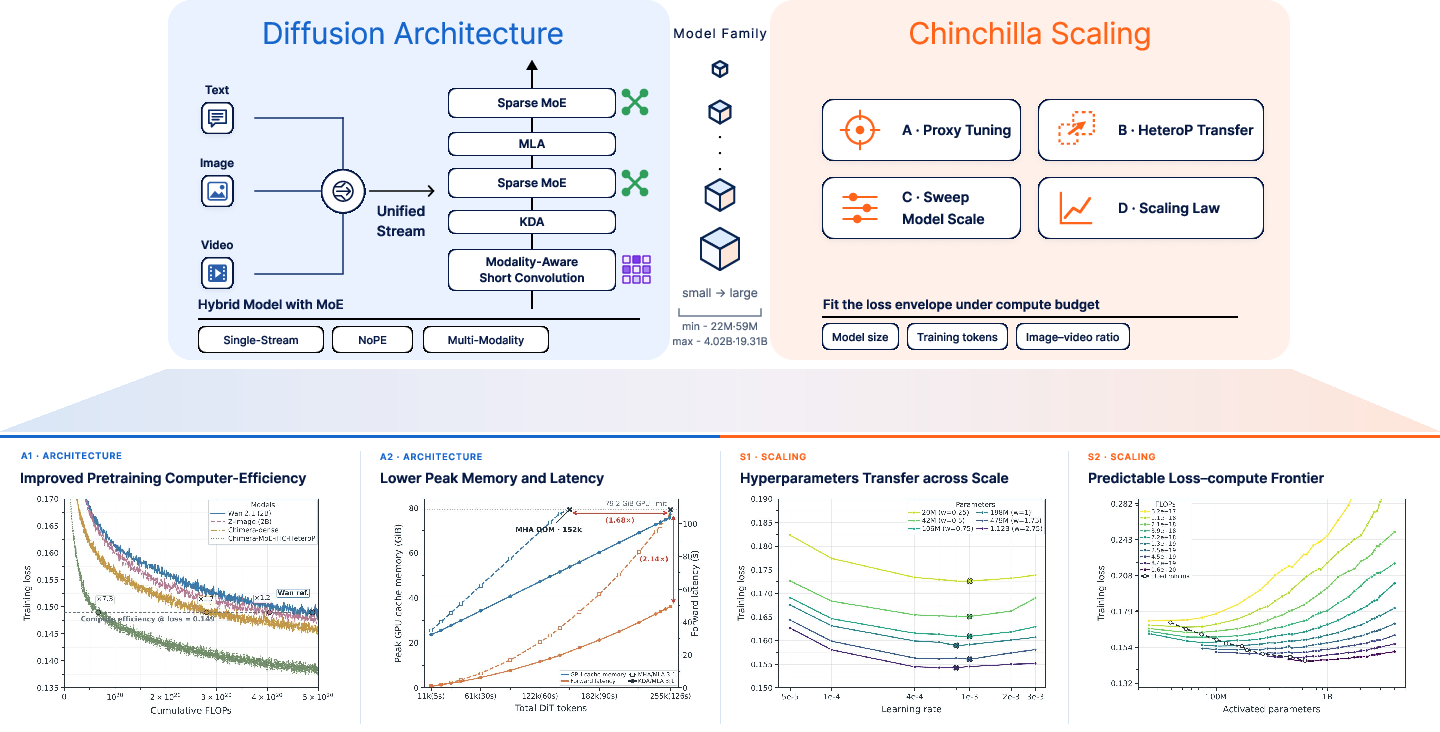
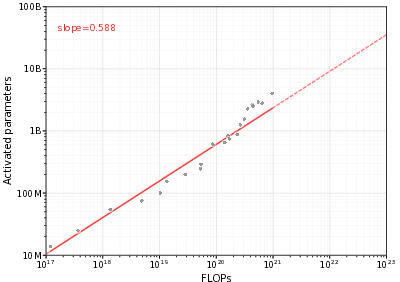
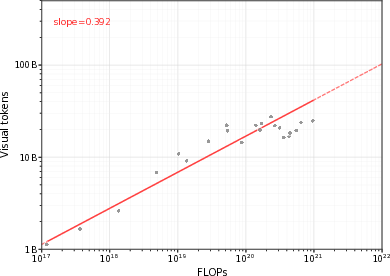
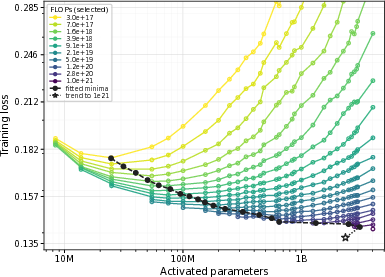
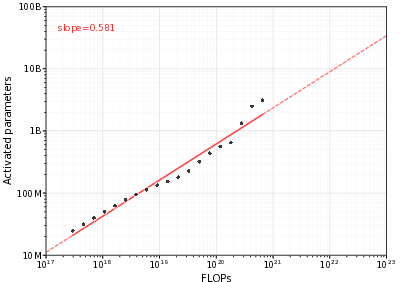
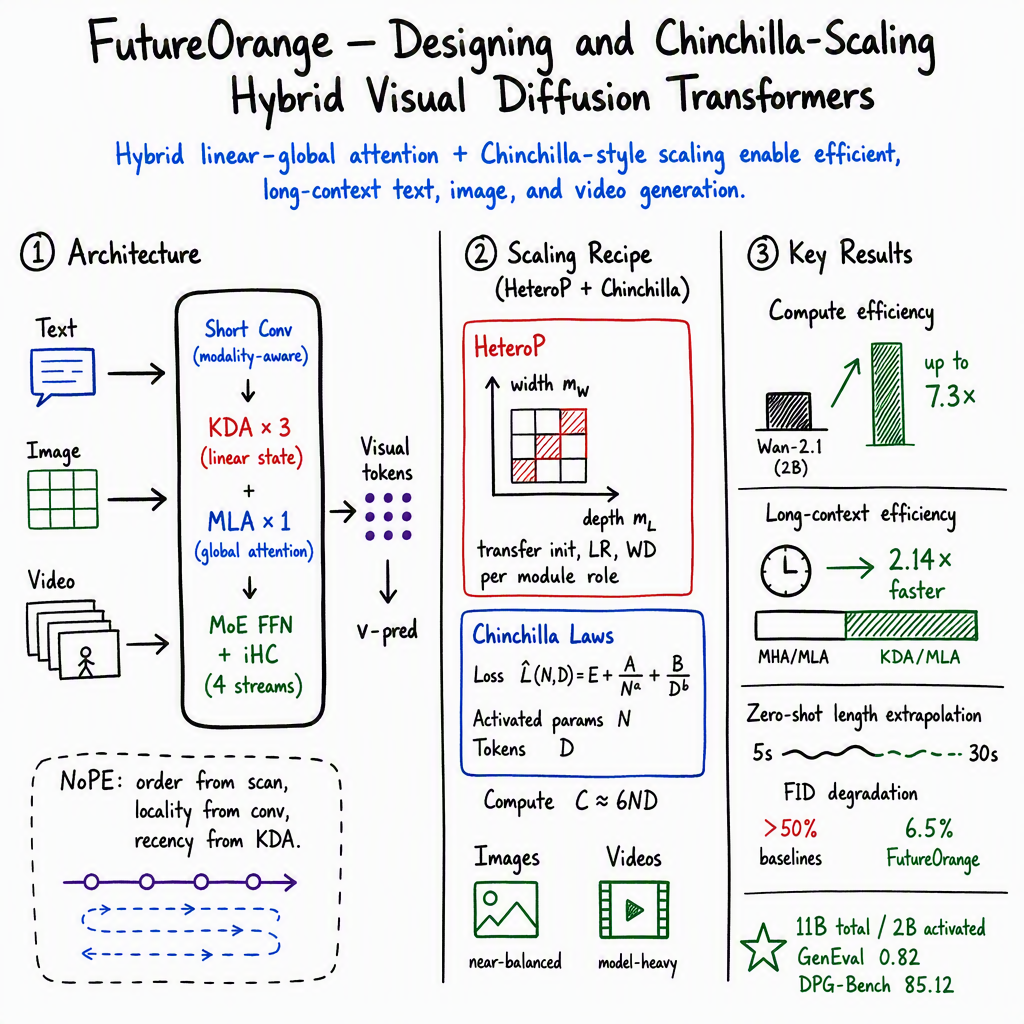
Abstract: Visual generation increasingly requires high-resolution images, long videos, and multimodal context, making the quadratic cost of full attention prohibitive. We introduce Chimera, a hybrid visual diffusion backbone with a principled scaling recipe. Chimera processes text, image, and video tokens in one raster-ordered stream without positional embeddings. It combines Kimi Delta Attention (KDA) for long-context state tracking with O(N) complexity, interleaved Multi-head Latent Attention (MLA) for direct global interaction, and modality-aware short convolutions for local spatiotemporal context. Sparse Mixture-of-Experts (MoE) layers expand capacity while controlling activated compute. To scale this heterogeneous architecture, we introduce HeteroP, a module-wise scheme that transfers hyperparameters across width and depth according to each tensor's functional fan-in and model depth. HeteroP yields a consistently tuned family used to fit Chinchilla-style compute-optimal laws for activated model size, training-token count, and image-video data ratio. Guided by these laws, we train an 11B-parameter Chimera with 2B activated parameters. Experiments show three results. First, measured by pretraining diffusion loss, the dense backbone is 1.7x as compute-efficient as a matched full-attention Wan-2.1 2B baseline, while the complete system reaches 7.3x. Second, without length-specific fine-tuning, Chimera extrapolates zero-shot from 5-second training clips to 30-second videos, with only 6.5% FID degradation in the last five seconds. Third, the fitted laws show that compute-optimal image pretraining divides compute nearly evenly between activated model size and training-token count, whereas video pretraining modestly favors model size at higher budgets. These results establish a foundation for designing and scaling efficient long-context diffusion architectures.


























Paper Prompts
Sign up for free to create and run prompts on this paper using GPT-5.
Top Community Prompts
Explain it Like I'm 14
Explaining “FutureOrange: Designing and Chinchilla-Scaling Hybrid Visual Diffusion Transformers”
1. What is this paper about?
The paper introduces FutureOrange, a new kind of AI model that creates pictures and videos from text. It’s designed to handle very long and detailed content (like ultra-high-resolution images or long videos) without becoming slow or needing huge amounts of memory. It also explains a clear, math-based way to choose the best model size and training data amount so you don’t waste computer power.
2. What questions did the researchers ask?
They focused on three simple questions:
- How can we build an image/video generator that handles very long inputs (many “tokens”) quickly and cheaply?
- How can one model let text, images, and videos “talk” to each other directly, instead of using complicated separate parts?
- How can we predict the best balance between model size and training data (and between image vs. video data) for a fixed compute budget, so training is efficient and not guesswork?
3. How did they do it? (Methods in everyday language)
To explain their ideas, imagine reading a super-long comic strip while taking smart notes, occasionally checking the whole page, and asking specialists for help only when needed:
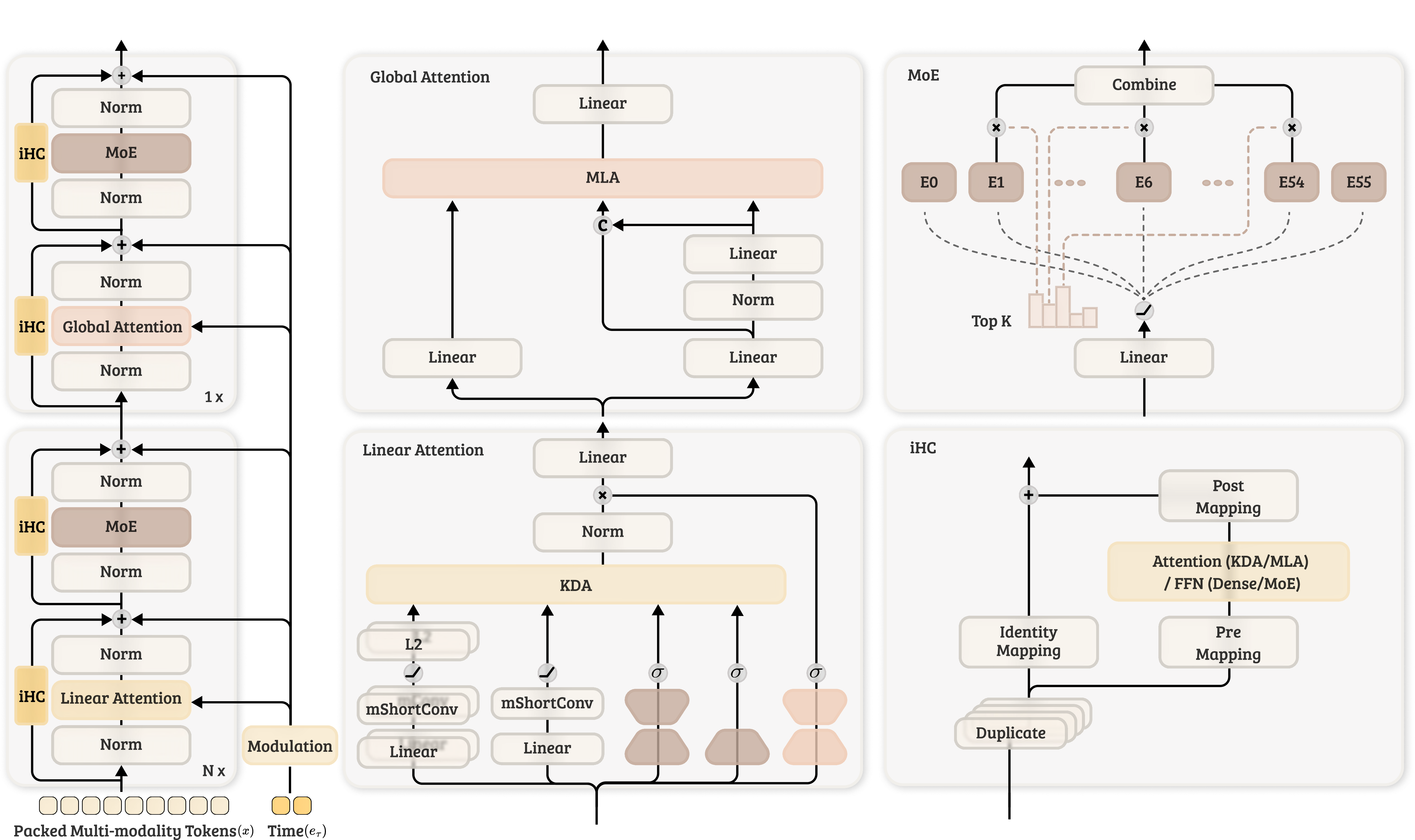
- One stream for everything: The model reads text, image patches, and video frames as one long line of tokens, like gluing all panels of the comic into a single strip. This makes it easy for text to influence visuals and vice versa.
- Kimi Delta Attention (KDA) = fast “note-taking” memory: Think of KDA as a reader who keeps a running summary while moving forward. It processes tokens in order, updating a small memory at each step. This makes it fast: if the sequence doubles in length, the work roughly doubles (linear growth, or O(N)), instead of exploding (quadratic growth).
- MLA (Multi-head Latent Attention) = occasional full “group discussion”: Every few layers, the model does a global check-in where any token can directly talk to any other token. This is slower than KDA, so they do it sparingly and use a compressed trick so it’s still memory-friendly.
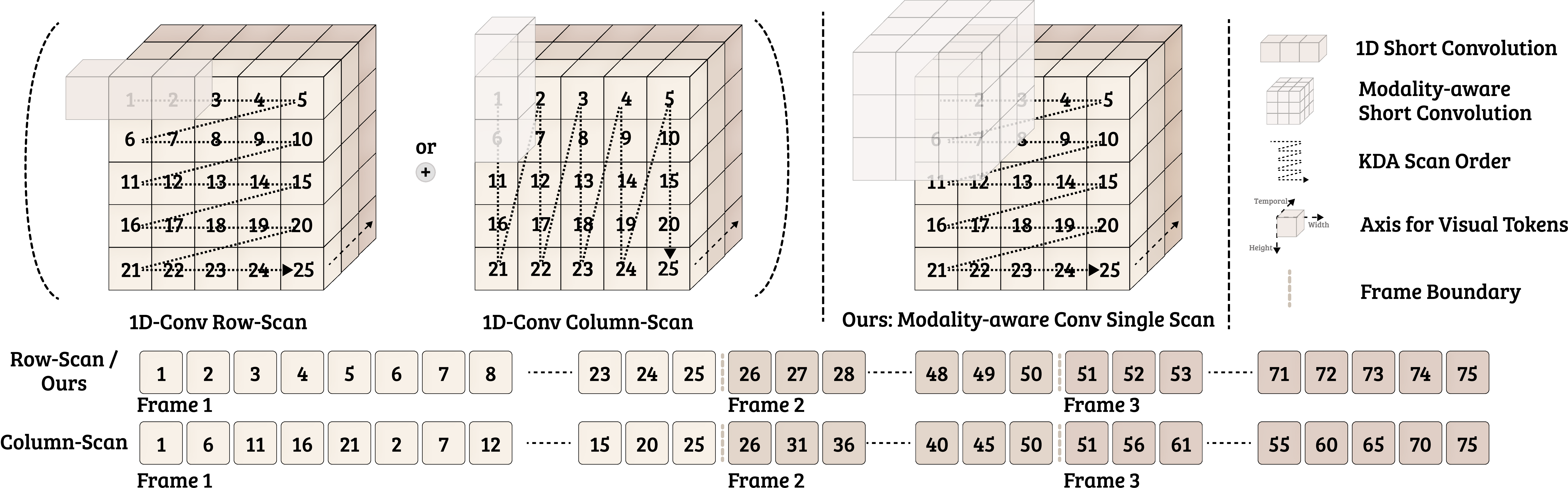
- Modality-aware short convolutions = “look at your neighbors”:
- For text, it looks left along the sentence.
- For images and videos, it looks in a small 3D neighborhood (time, height, width).
- This captures local patterns like edges, motions, and word order without needing heavy attention everywhere.
- No positional embeddings (NoPE) = order from scanning + local context: Many models use special “position tags” (like RoPE) to know where each token is. FutureOrange avoids that. It gets order from the scan itself (it reads in a consistent raster order) and from those short convolutions. This helps it handle longer sequences than it saw during training, because it isn’t tied to fixed positional patterns.
- MoE (Mixture-of-Experts) = call a few specialists, not the whole hospital: The model has many expert mini-networks, but for each token it only activates a small handful. This boosts total capacity without making each step too expensive.
- Stability helpers: Identity hyper-connections and “sandwich” normalization act like guardrails so deep training stays stable.
- Training and scaling recipe (HeteroP + Chinchilla-style laws):
- Diffusion loss as the scorecard: They judge progress using the diffusion training loss (a clean, sampler-independent measure), not generation tricks.
- HeteroP: When you scale a model up or down, every part shouldn’t be adjusted the same way. HeteroP gives each part its own scaling rule (like adjusting each ingredient in a recipe differently) so hyperparameters transfer well across sizes.
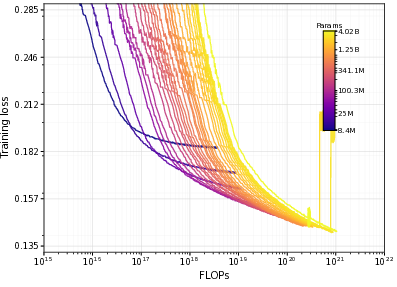
- Compute-optimal scaling laws: They fit rules (like a budget planner) that tell you the best split between “model size” and “number of training tokens,” and how to mix image vs. video data, for a given compute budget.
4. What did they find, and why is it important?
Here are the key results, explained simply:
- Much more compute-efficient:
- Just swapping full attention for their hybrid backbone (dense version) gives about 1.7× better efficiency than a strong full-attention baseline (Wan-2.1 at 2B parameters).
- Using the full FutureOrange system lifts this to about 7.3× fewer FLOPs to reach the same training loss. That’s a big saving in time and money.
- Longer videos without special tricks: The model was trained on 5-second clips but could generate 30-second videos “zero-shot” (no extra fine-tuning). The quality drop over the final 5 seconds was only about 6.5% (measured by FID), while previous methods dropped by more than 50%. This shows the NoPE design and hybrid attention generalize well to longer lengths.
- Fits longer sequences on the same GPU and runs faster:
- Handles about 1.68× longer token sequences on a single 80 GB GPU.
- Runs about 2.14× faster at very long lengths (around 255k tokens).
- Clear, predictable scaling rules:
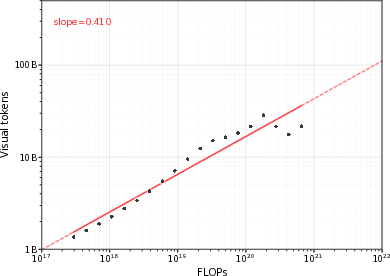
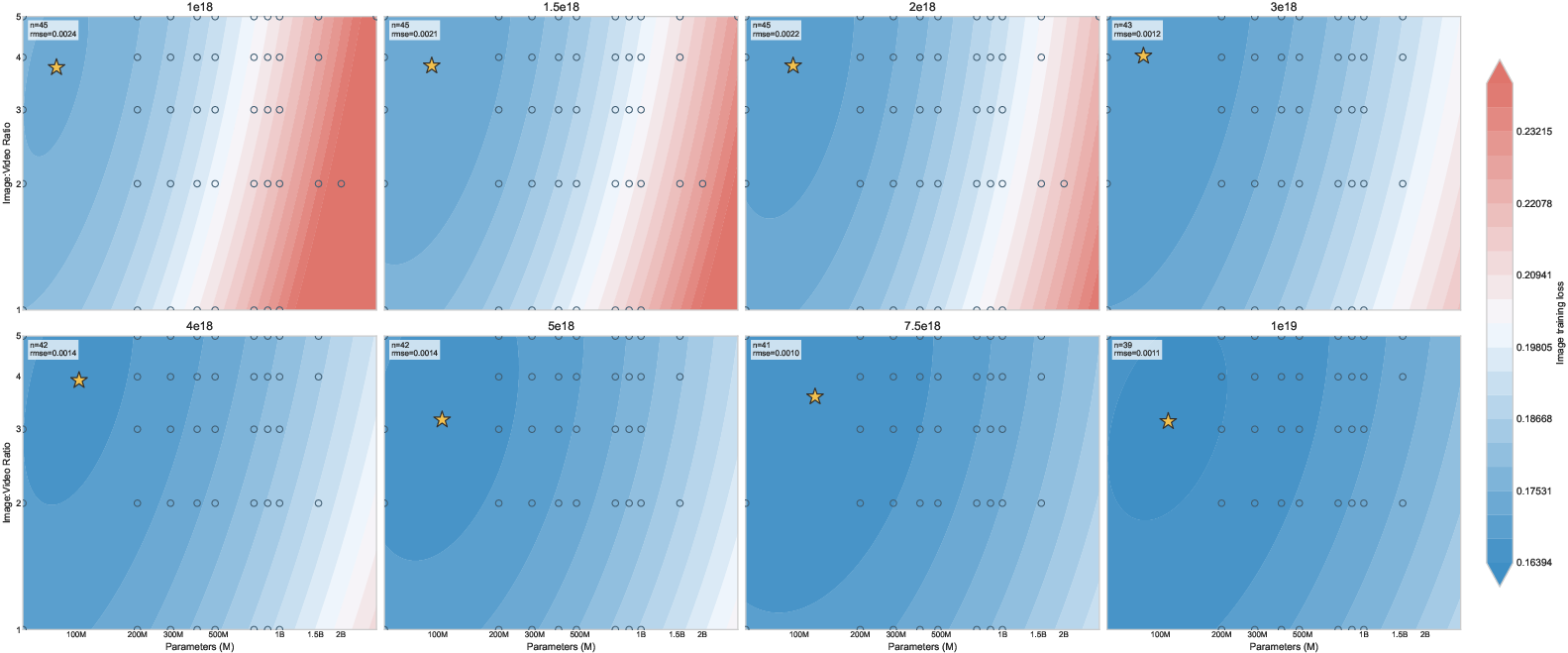
- For image pretraining, the best way to spend compute is roughly 50/50 between model size (activated parameters) and training tokens.
- For video pretraining, as you spend more compute, it helps slightly more to grow the model size than the token count.
- They also estimate how to split compute between image and video data as budgets change, so planning is easier.
- Trained efficiently: Their final 11B-parameter model (2B activated) used about 600 H100-GPU days, dramatically less than some comparable systems (one popular baseline reported about 12,400 H100 days).
Why this matters: You can train powerful video/image generators faster, cheaper, and with less guesswork—and they can handle longer content than they were trained on.
5. What’s the bigger impact?
- More capable creators on normal hardware: Generating ultra-high-res images or long videos gets cheaper and faster. This benefits art, film previsualization, advertising, education, and science communication.
- Better multimodal understanding: Processing text, images, and video together in one stream can improve tasks like video captioning, guided editing, or turning stories into animations.
- Predictable, budget-friendly scaling: The scaling laws are like a training GPS. Labs can plan model size and dataset size to get the most out of their compute budget—less trial and error, more reliable results.
- Stronger long-context modeling: The “no positional embeddings” approach and the hybrid attention make it easier to extend to longer content at test time, opening doors for streaming generation and future “world models.”
- A general recipe for future models: The combination of hybrid attention (fast local memory + occasional global attention), local convolutions, sparse experts, and a principled scaling recipe (HeteroP + Chinchilla-style laws) offers a blueprint other visual or multimodal models can copy.
In short, FutureOrange shows how to build and scale image/video generators that are both fast and smart about long sequences, and it gives practical rules so others can do the same without wasting compute.
Knowledge Gaps
Knowledge gaps, limitations, and open questions
Below is a single, concrete list of unresolved issues that future work could address:
- Validate that diffusion pretraining loss reliably predicts downstream generation quality across image and video benchmarks (e.g., FID, GenEval, DPG, temporal coherence metrics) and that compute-optimal allocations fitted on loss transfer to quality.
- Provide comprehensive ablations isolating the contributions of KDA, MLA frequency/placement, modality-aware short convolutions, NoPE vs RoPE, MoE, identity hyper-connections, and sandwich normalization on loss, quality, speed, and memory.
- Optimize or learn the KDA:MLA interleave schedule: test alternative ratios, depth placements, and content/length-adaptive gating to invoke global attention only when beneficial.
- Quantify artifacts and robustness arising from the fixed temporal-major raster scan; compare to alternative scans (e.g., bidirectional, serpentine) and assess anisotropy in spatial relationships and text–image interactions.
- Characterize numerical stability of KDA’s recurrent updates over very long contexts and wide heads; explore state precision (FP32 vs BF16/FP16), stabilization (clipping, normalization), and their impact on recall and quality.
- Establish memory/time limits of KDA’s O(d_h2) per-head state as width and head count grow; evaluate mitigations (low-rank/state grouping, reversible updates, sparsity) and quantify quality trade-offs.
- Test NoPE vs positional schemes (RoPE, ALiBi, relative bias) on tasks needing absolute positioning and structured layouts (e.g., text placement, grids); determine if NoPE harms spatial precision or long-range spatial references.
- Evaluate zero-shot length extrapolation beyond 30s and at higher frame rates/resolutions; measure identity/motion drift, temporal consistency, prompt adherence, and failure modes over minutes-scale videos.
- Systematically ablate modality-aware short convolution design: kernel sizes/shapes, dilation, content-adaptive/dynamic kernels, and efficiency at 4K+ images and long videos; quantify end-to-end impact beyond microbenchmarks.
- Analyze MoE routing in multimodal settings: expert specialization for text vs visual tokens, load balance, stability under distribution shift, and sensitivity to K/topology/capacity factor; compare token-choice routing with alternatives (e.g., layer-choice, hierarchical MoE).
- Report end-to-end inference latency and memory at matched quality (including sampler steps, CFG, guidance, VAE decode), not just backbone forward cost; include energy/throughput comparisons.
- Clarify compute accounting in scaling laws: include optimizer overheads, MoE communication, encoder/decoder costs; validate generality across hardware (A100/H100/consumer GPUs), tokenizations, patch sizes, and mixed precision.
- Extend scaling variables beyond image–video ratio to encompass resolution, clip length/frame rate, and text length distributions; fit multi-dimensional scaling laws and re-evaluate compute-optimal allocations.
- Assess HeteroP’s robustness across optimizers, batch sizes, gradient clipping, warmups/decays, and to related backbones; document failure cases and provide tuning guidance.
- Publish exact HeteroP per-tensor scaling rules (fan-in mappings, init/residual scalings, LR decomposition) and constants to enable third-party reproducibility without per-scale retuning.
- Investigate joint or partial fine-tuning of the frozen text encoder and VAE; quantify gains vs stability costs and how these choices alter scaling-law optima.
- Explore learned or adaptive scan orders and chunked processing for streaming/online generation; study state persistence across chunks, drift accumulation, and cache management.
- Evaluate MLA without positional rotations on long-range token alignment and cross-frame correspondences; compare with lightweight relative biases that add minimal positional capacity.
- Compare MLA with alternative global-context operators (dilated/sparse attention, memory tokens, retrieval, state-space cross layers) for recall–cost trade-offs in long contexts.
- Conduct robustness, safety, and bias audits: prompt sensitivity, adversarial prompts, content moderation behavior, and demographic/scene bias stemming from data composition and scaling choices.
- Expand downstream evaluations to editing and controllable generation (e.g., masks, depth, pose) and multi-turn conditioning to stress-test the single-stream design under richer controls.
- Measure KDA information retention vs sequence length (e.g., probe recall of inserted tokens/symbols) and test auxiliary objectives or memory augmentations to mitigate forgetting.
- Document distributed MoE training details (expert/data/model parallelism), throughput/efficiency at scale, communication bottlenecks, and strategies that kept activated compute low in practice.
- Analyze reliance on the frozen Wan VAE (compression factors, reconstruction error): test end-to-end training or improved latents and quantify effects on fine detail, temporal stability, and scaling-law conclusions.
Practical Applications
Immediate Applications
Below are concrete, deployable applications that can be built now by leveraging FutureOrange’s architectural choices (KDA+MLA hybrid attention with modality‑aware short convolutions, NoPE design, sparse MoE capacity, fused Triton kernels) and its scaling methodology (HeteroP and Chinchilla-style laws).
- Cost- and memory-efficient long-form video generation for media and advertising
- Sector: Media/entertainment, marketing, creative suites
- What to build:
- A “Length-Extend” video generation feature (e.g., in NLEs like Premiere/After Effects) that can expand 5–10 second concepts into ~30-second coherent clips without re-training
- Cloud APIs offering per-token pricing tiers for longer clips (benefiting from O(N) KDA compute and constant per-head state memory)
- Why it works: 7.3× pretraining compute efficiency vs matched full-attention DiT baseline; 30 s zero-shot extrapolation with only ~6.5% FID degradation over the final 5 seconds; 1.68× longer sequences per 80 GB GPU and 2.14× faster at 255k tokens
- Assumptions/dependencies:
- Quality targets are met by current loss/sampler settings; acceptable degradation for creative previews/ads
- Access to hardware with sufficient HBM (e.g., A100/H100) and support for fused kernels
- Uses the paper’s VAE and text encoder stack (or compatible substitutes)
- Length-agnostic outpainting and panoramic/infinite-canvas image tools
- Sector: Design, photography, product visualization
- What to build:
- “Infinite Canvas” image editor that grows scenes far beyond training resolution/size without re-positioning tricks
- Why it works: No positional embeddings + raster scan + local mShortConv preserves locality and order while avoiding RoPE’s length coupling
- Assumptions/dependencies:
- Tiling/latents and memory planning for very large images
- Sampler and CFG settings tuned for aesthetics
- Multimodal video editing with direct token-level interaction
- Sector: Post-production, education content creation
- What to build:
- Track-level, text-conditioned global edits (e.g., style, lighting) and local, frame-consistent region edits (in/outpainting, object continuity)
- Why it works: Single-stream backbone allows joint processing of text and visual tokens without cross-attention plumbing; MLA restores global interactions; mShortConv captures local spatiotemporal consistency
- Assumptions/dependencies:
- Inference wrappers for regional masks and per-frame consistency checks
- Optional fine-tuning on editing datasets for higher fidelity
- Training-recipe automation and compute planning for ML teams
- Sector: Software/ML infra, cloud providers, enterprise AI labs
- What to build:
- A “Scaling Planner” tool that, given a compute budget, proposes compute-optimal activated parameters, training tokens, and image–video mixture based on FutureOrange’s fitted laws
- HeteroP-based hyperparameter transfer library to port small-scale recipes (LR, init, residual scaling) to large-scale heterogeneous backbones without retuning
- Why it works: Consistent cross-scale tuning via HeteroP; near-balanced N–T allocation for images and modest capacity-lean for videos at higher budgets
- Assumptions/dependencies:
- Access to proxy-scale runs to calibrate constants for a given codebase/dataset
- Similar optimization stack (diffusion v-prediction, AdaLN, sandwich norms, iHC)
- Inference and kernel-engineering gains via fused modality-aware short convolutions
- Sector: ML systems/compilers, inference serving
- What to build:
- Triton/PyTorch extensions shipping fused packed-sequence mShortConv kernels (1D for text, causal 3D for video) as drop-in ops for DiT-like backbones
- Why it works: 2.2–2.3× forward and 1.5–1.8× forward–backward speedups; up to 4× lower activation peak during forward for the local-mixing op
- Assumptions/dependencies:
- Triton-compatible GPUs (A100/H100), correct kernel fusions with AMP/BF16
- Regression tests for numerical parity
- GPU and budget optimization for generative SaaS
- Sector: Cloud/DevOps, cost optimization, sustainability
- What to build:
- IsoFLOP-based scheduling dashboards to pick sequence lengths, batch sizes, and memory tiers (A100 vs H100) to minimize /pixel
- Why it works: Predictable loss–compute frontier; transparent length–cost trade-offs due to O(N) KDA layers and compressed MLA caches
- Assumptions/dependencies:
- Fleet telemetry; accurate tokenization and cache-pressure models
- Academic baselines for token-extensive diffusion
- Sector: Academia, open benchmarking
- What to build:
- Reference backbone for studying long-context denoising, length extrapolation without RoPE, and MoE routing in diffusion
- Why it works: Provides a controlled, heterogeneous model family with hyperparameter transfer and scaling laws
- Assumptions/dependencies:
- Availability of code/checkpoints or faithful re-implementations
- On-prem/edge-friendly creative generation
- Sector: Enterprise creative teams, privacy-sensitive content houses
- What to build:
- On-prem deployments generating higher-resolution images and longer clips on a fixed VRAM budget, enabled by linear attention and sparse MoE activation (2B activated of 11B total)
- Why it works: State memory independent of sequence length for KDA heads; predictable cache footprints
- Assumptions/dependencies:
- Hardware with sufficient compute but limited HBM; tuned KV/state management
Long-Term Applications
These applications are plausible but require further research, scale, or ecosystem development (e.g., longer training sequences, safety/controls, data diversity, productization).
- Feature-length or episodic video generation and virtual production
- Sector: Film/TV, game cinematics, previsualization
- What could emerge:
- Multi-minute scene generation and revision workflows; “script-to-cut” pipelines with zero-shot length generalization beyond training spans
- Dependencies:
- Larger models/training tokens following fitted scaling laws; richer long-horizon datasets; advanced temporal and identity consistency controls; robust safety filters
- Real-time or streaming generative video assistants
- Sector: Live content, interactive media, broadcast overlays
- What could emerge:
- Stateful streaming generators that maintain visual style and narrative coherence across long sessions using KDA’s recurrent state; low-latency, per-frame updates
- Dependencies:
- Further latency reductions (kernel fusion, quantization), streaming-aware schedulers, fine-tuning for autoregressive/online use
- Robotics, autonomy, and embodied AI world models
- Sector: Robotics, autonomous systems, simulation
- What could emerge:
- Long-horizon visual world models for planning/simulation, leveraging causal mShortConv and KDA for temporal consistency and memory efficiency
- Dependencies:
- Integration with control tokens/sensor modalities; evaluation for safety and calibration; possibly moving from latent diffusion to hybrid predictive objectives
- Scientific and industrial digital twins with long visual sequences
- Sector: Climate/earth observation, manufacturing, satellite imaging
- What could emerge:
- Generative simulators producing long spatiotemporal sequences (e.g., weather nowcasting visuals, process monitoring) with token-efficient backbones
- Dependencies:
- Domain-aligned conditioning signals; strict physical constraints; verification against ground truth; governance for decision-critical use
- Healthcare: synthetic longitudinal imaging for data augmentation and pretraining
- Sector: Medical imaging (MRI/CT/ultrasound), ophthalmology
- What could emerge:
- Long-sequence synthetic studies to augment scarce longitudinal datasets while controlling privacy
- Dependencies:
- Clinical validation, bias audits, regulatory approvals; specialized VAEs/tokenizations for medical modalities; strict provenance tracking
- Education: long-form, multimodal lesson generation
- Sector: EdTech, corporate training
- What could emerge:
- Coherent multi-minute video lessons combining diagrams, text highlights, and instructor-style visuals generated from outlines
- Dependencies:
- Content accuracy guarantees, attribution/citation; watermarking and safety layers; authoring tools for iterative control
- Compute governance and sustainability policy tooling
- Sector: Public policy, ESG reporting, AI audit
- What could emerge:
- Policy calculators that estimate energy/carbon impact of image vs video pretraining choices using compute-optimal laws; best-practice guidelines for balanced N–T scaling
- Dependencies:
- Third-party validation across labs; standardized reporting for FLOPs/energy; alignment with regulatory frameworks
- Dataset composition and auto-mixing at scale
- Sector: Data engineering for foundation models
- What could emerge:
- “Mixture planners” that automatically choose image–video ratios per budget to approach compute-optimal curves; active data selection over token-extensive regimes
- Dependencies:
- Accurate metadata, deduplication, quality filters; domain-specific performance objectives beyond diffusion loss
- Migration kits for legacy full-attention DiTs
- Sector: Foundation-model engineering
- What could emerge:
- Tooling to convert DiT checkpoints to hybrid KDA/MLA backbones with NoPE+mShortConv, including distillation adapters and cache managers
- Dependencies:
- Access to training data or strong distillation corpora; license compatibility; careful handling of positional information during migration
- High-resolution, gigapixel, and multi-sensor imagery generation
- Sector: Remote sensing, microscopy, industrial inspection
- What could emerge:
- Token-extensive image generation and editing (very large fields of view) with manageable memory/latency due to linear attention and modality-aware local mixing
- Dependencies:
- Specialized sensor VAEs and calibration; robust stitching/tiling; domain constraints on artifacts
- XR/3D scene and multi-view video generation
- Sector: AR/VR, digital content creation
- What could emerge:
- Long-horizon, multi-view or light-field style generation where unified token streams capture cross-view consistency at scale
- Dependencies:
- Geometry-aware tokenization/priors, multi-camera datasets, view-consistent sampling; extended architectural blocks for 3D inductive bias
Notes on cross-cutting assumptions and risks
- Sampler- and guidance-independence: The paper optimizes diffusion pretraining loss; downstream aesthetic/semantic metrics may still require sampler and CFG tuning, and possibly light post-training.
- Safety and IP: Longer, more coherent outputs heighten risks around deepfakes and IP; enterprise deployments need watermarking, detection, and prompt/content filters.
- Data composition: Compute-optimal laws depend on the image–video mix and tokenization choices; shifts in domain or conditioning can change optimal allocations.
- MoE routing stability: Productionizing sparse MoE requires robust load balancing and failure handling (e.g., expert hot-spotting).
- Hardware/software stack: Speed/memory benefits assume fused Triton kernels, efficient state/KV cache management, mixed precision, and modern GPUs.
Glossary
- AdaLN (Adaptive Layer Normalization): A conditioning mechanism that modulates normalized activations using external signals (e.g., timestep embeddings). "the attention input receives timestep-conditioned AdaLN modulation"
- Activated compute: The amount of computation actually used per token when parts of a model are sparsely activated. "Sparse Mixture-of-Experts (MoE) layers further expand model capacity while keeping activated compute under control."
- Activated parameters: The subset of model parameters used per token in sparse architectures (e.g., MoE). "Guided by these laws, we train an 11B-parameter FutureOrange with 2B activated parameters."
- ALiBi (Attention with Linear Biases): A positional bias scheme that adds distance-dependent penalties to attention scores. "as with ALiBi's distance-dependent penalty"
- Autoregressive modeling: Modeling sequences by predicting each step conditioned on previous steps. "diffusion can be interpreted as approximate autoregressive modeling in the frequency domain"
- BF16 (bfloat16): A 16-bit floating-point format commonly used to accelerate training while maintaining numerical robustness. "using batch size one, BF16 activations, $512$ text tokens, and visual tokens per temporal slice."
- Bidirectional self-attention: Attention that allows each token to attend to all tokens before and after it. "This reduces the key--value cache cost while retaining full bidirectional attention."
- Causal padding: Padding strategy ensuring convolution only uses current and past positions along a temporal axis. "Along the temporal dimension, the 3D convolution uses causal padding, so that each visual token mixes only with tokens from the current and past frames."
- Causal recurrence: A state-update process that proceeds in sequence order using only past information. "together with the ordering inherent in KDA's causal recurrence, make a simple temporal-major raster scan sufficient"
- Chinchilla-style scaling laws: Empirical laws prescribing compute-optimal tradeoffs between model size and training data. "we fit Chinchilla-style laws over activated model parameters and training tokens"
- Compute-optimal allocation: The best split of compute budget between model capacity and data for minimizing loss. "to predict their compute-optimal allocation under a fixed compute budget."
- Denoising objective: A training objective where the model learns to remove noise to reconstruct clean data. "remain effective under a denoising objective"
- Diffusion loss: The training loss used in diffusion or flow models for denoising/velocity prediction. "diffusion loss provides a sampler-independent metric for comparing models across scales."
- Diffusion Transformer (DiT): A transformer backbone adapted to diffusion-based generative modeling. "the dominant Diffusion Transformer still relies on full self-attention"
- FID (Fréchet Inception Distance): A metric that evaluates the quality of generated images by comparing feature distributions. "with only a degradation in FID over the final five seconds."
- FlashAttention: A fused attention kernel that reduces memory usage by tiling attention computation. "FlashAttention does not write the full attention matrix to high-bandwidth memory: it streams blocks of , , and through on-chip SRAM, computes tile by tile, and accumulates the exact output using online softmax."
- Forget gate: A gating mechanism that decays or resets parts of a recurrent state. "The forget gate applies an independent decay to each key channel"
- Fused Triton kernel: A custom GPU kernel (via Triton) that fuses multiple operations to reduce memory traffic and improve speed. "We instead implement a fused Triton kernel that realizes the same text and visual convolutions directly over packed storage, avoiding explicit gather and scatter operations."
- Functional fan-in: The effective number of inputs a parameter tensor aggregates over, used to derive scale-aware hyperparameters. "based on each tensor’s functional fan-in and the model’s depth."
- HeteroP: A module-wise hyperparameter-transfer scheme that scales each tensor using its own ratio derived from functional fan-in and depth. "we introduce HeteroP, a hyperparameter-transfer parameterization that derives a separate scaling ratio for each tensor"
- Identity hyper-connections (iHC): Parallel residual streams that stabilize signal propagation and improve training dynamics. "identity hyper-connections (iHC) wrap each sublayer to stabilize signal propagation."
- IsoFLOP analysis: Studying performance along configurations with equal floating-point operation counts to infer optimal tradeoffs. "We also use IsoFLOP analysis to estimate how the optimal image-video mixture changes with compute."
- Kimi Delta Attention (KDA): A linear-time attention mechanism with a recurrent state and content-adaptive decay for long contexts. "Kimi Delta Attention (KDA) provides long-context state tracking with efficient computation complexity"
- Key–Value (KV) cache: Stored key and value tensors used to reuse attention computations over long sequences. "The 24 MHA layers therefore have sequence-dependent BF16 key--value cache memory of "
- Mixture-of-Experts (MoE): A sparse-activation technique where a router selects a small subset of specialized sub-networks (experts) per token. "Sparse Mixture-of-Experts (MoE) layers further expand model capacity"
- MLA (Multi-head Latent Attention): A full-attention variant that compresses key–value representations to reduce memory while preserving global interaction. "interleaved Multi-head Latent Attention (MLA) enables direct global interaction"
- Modality-aware short convolution (mShortConv): Depthwise short convolutions applied per modality (text/video) to inject local structure before linear attention. "Before each KDA update, a modality-aware short convolution (mShortConv) mixes local context in each modality's native geometry."
- NoPE (No Positional Embedding): Using no explicit positional encodings, relying instead on architectural cues like recurrence and convolution. "FutureOrange uses no explicit positional encoding (NoPE) in either KDA or MLA layers."
- Patchification: Dividing latent feature maps into fixed-size patches to form tokens for transformer processing. "a subsequent patchification layer converts the latents into the clean visual tokens ."
- Raster order: A deterministic scan order (e.g., temporal-major, then row-major) used to linearize multi-dimensional data. "this temporal-major raster order is"
- Rectified flow: A flow-matching formulation for diffusion-like training using velocity (v) targets. "FutureOrange follows the rectified-flow framework with -prediction and -loss"
- RMSNorm (Root Mean Square Layer Normalization): A normalization that rescales activations using their RMS without mean-centering. "Sandwich Normalization places RMSNorm both before () and after () the operator to regulate the variance for training stability."
- RoPE (Rotary Position Embedding): A positional encoding that rotates query/key features by position-dependent angles to encode relative offsets. "For RoPE~\citep{su2024roformer}, the de facto choice in both language and visual generation models, these biases take three forms:"
- Sandwich normalization: Applying normalization both before and after a sublayer to stabilize training. "and adopts MoE layers, identity hyper-connections, and sandwich normalization for capacity and training stability."
- Single-stream multimodal backbone: A shared transformer stack that processes concatenated text and visual tokens in one sequence. "Single-stream Multimodal Backbone. FutureOrange concatenates multimodal tokens from text, images, and video into one sequence and processes them with a single shared backbone."
- SwiGLU: A gated feed-forward activation (SiLU-gated linear unit) used in dense FFN layers. "The first and last blocks use dense SwiGLU FFNs"
- T5-style encoder: A text encoder architecture based on the T5 model for producing token embeddings. "The text prompt is encoded separately by a frozen T5-style encoder"
- Temporal-major raster scan: A scan that iterates over time first, then spatial dimensions, to linearize video tokens. "make a simple temporal-major raster scan sufficient"
- Token-extensive regime: A setting where sequence length dominates memory, latency, and compute costs. "We refer to this as the token-extensive regime, in which sequence length becomes a primary determinant of memory, latency, and training cost."
- Top-K routing: In MoE, selecting the K highest-scoring experts per token from a router. "selects a small top- set "
- VAE (Variational Autoencoder): A generative encoder–decoder model that maps images/videos to latent spaces for diffusion. "Each image or video is encoded by a frozen VAE"
- v-loss: The mean-squared error on predicted velocity targets in rectified/flow-matching diffusion training. "with -prediction and -loss"
- Zero-shot length extrapolation: Generating sequences longer than seen in training without additional fine-tuning. "FutureOrange exhibits zero-shot length extrapolation from 5-second training clips to 30-second videos"
Collections
Sign up for free to add this paper to one or more collections.

