Parallel Decoding Distillation for Fast Image and Video Generation
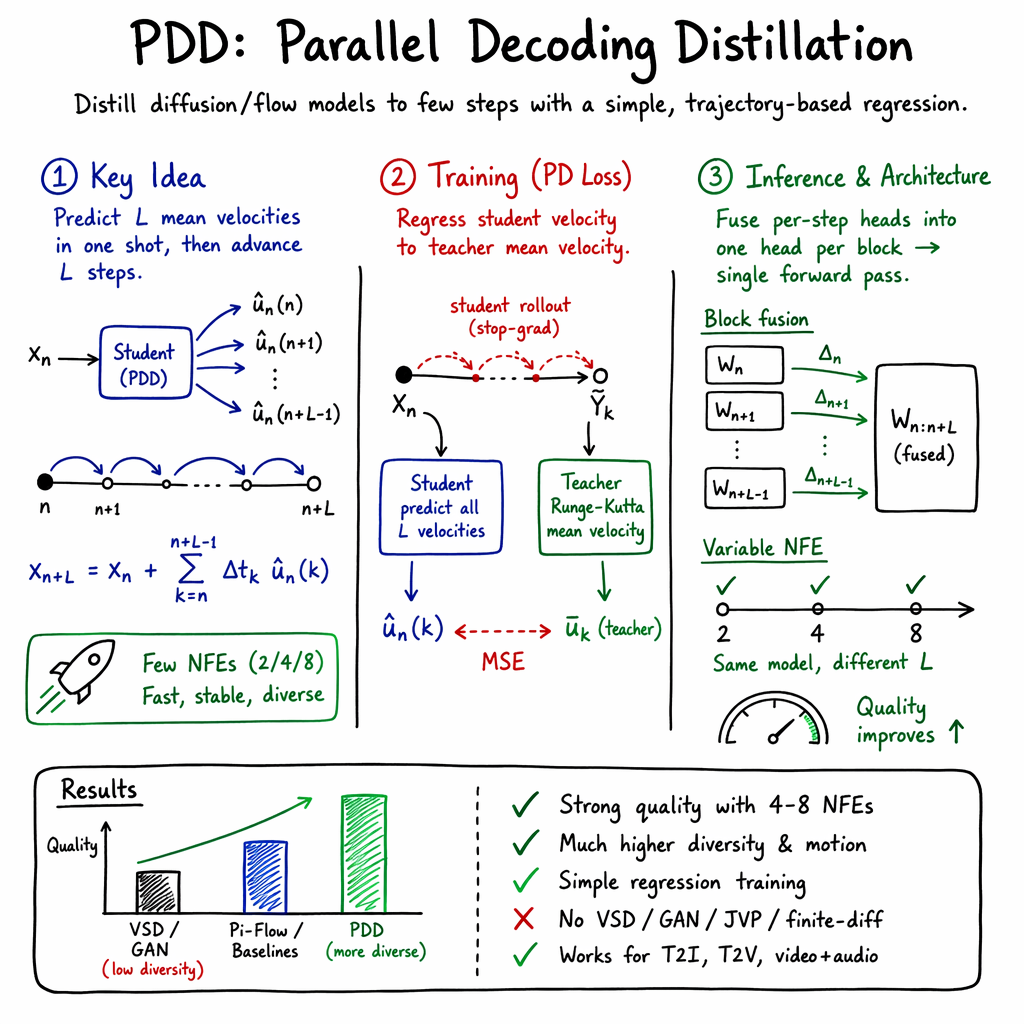
Abstract: Generation in video diffusion or flow models is computationally expensive due to the slow and iterative sampling process. Current state-of-the-art (SOTA) acceleration methods heavily rely on variational score distillation (VSD) and adversarial losses to distill diffusion models into few-step generators. Albeit achieving high-quality video generation, these training losses are notoriously hard to optimize and suffer from mode collapse, leading to loss of video diversity and lack of motion. In this paper, we introduce Parallel Decoding Distillation (PDD), a simplified and scalable trajectory-based distillation method for fast inference of diffusion and flow matching models. Our architecture and training procedure are compatible with any pre-trained model and support sampling with a varying number of function evaluations (NFE). PDD accelerates generation by predicting multiple denoising steps per network evaluation. Conceptually, it learns a representation of the mean velocity without regressing its derivative using JVPs or finite-difference approximations. Our method achieves SOTA performance with 4-8 NFE on LTX-2.3 Text-to-Video/Audio, Wan 14B Text-to-Video, and Qwen-Image Text-to-Image. Moreover, PDD presents a significant improvement in generated video diversity.






Paper Prompts
Sign up for free to create and run prompts on this paper using GPT-5.
Top Community Prompts
Explain it Like I'm 14
Plain-language summary of “Parallel Decoding Distillation for Fast Image and Video Generation”
What is this paper about?
This paper is about making AI image and video generators much faster without losing quality. Today’s best models (called diffusion or flow models) create pictures and videos by cleaning up noise step by step, which takes many slow passes. The authors introduce a new way, called Parallel Decoding Distillation (PDD), that lets the model jump several steps at once while still keeping the results sharp, dynamic, and diverse.
What questions did the authors ask?
- Can we speed up image and video generation to just a few steps (like 4–8) and still get great quality?
- Can we do this without using hard-to-train losses that often make outputs look similar or static (a problem called “mode collapse”)?
- Can the method plug into any existing, pre-trained generator and let us choose how many steps to use at test time (fast vs. higher quality)?
How does their method work? (In everyday terms)
Think of making a video with AI like guiding a messy sketch into a clean, finished scene. Traditional models gently nudge the picture in the right direction hundreds of times—slow but accurate. PDD teaches a student model to make several of those nudges at once, safely.
Here’s the simple idea:
- The original, slow model is the “teacher.” The new, fast model is the “student.”
- The whole generation process (from pure noise to a clean image/video) is split into many tiny time slices.
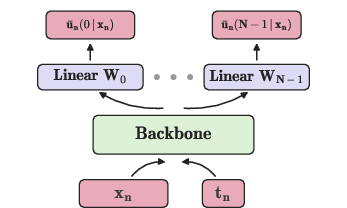
- PDD groups several slices into a “block” and trains the student to predict all the pushes needed across that whole block in one go.
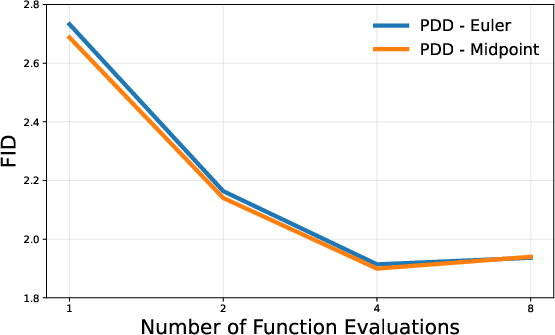
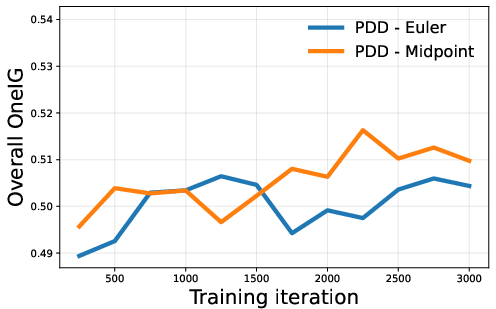
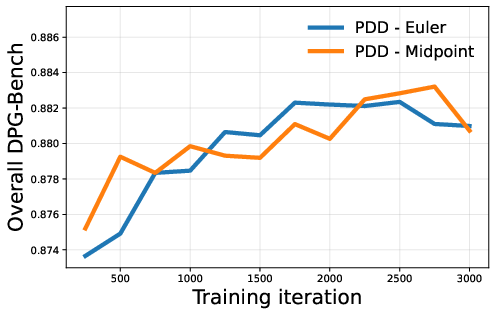
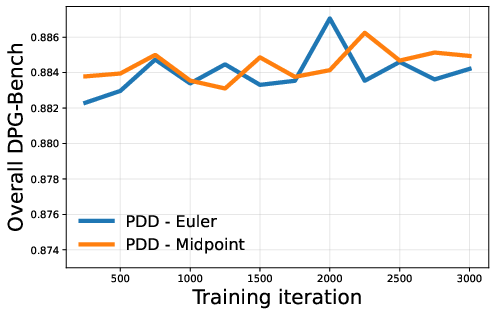
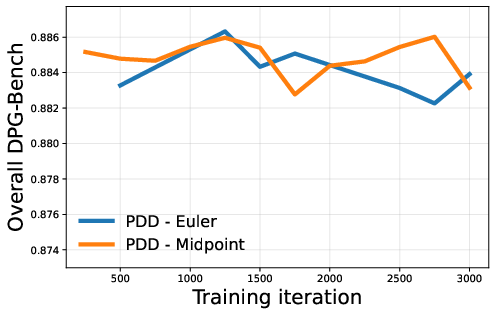
- During training, the student proposes all the pushes for a block, and the teacher checks one of them with a quick, reliable rule of thumb (a basic numerical method called Euler or Midpoint—think of it like a simple calculator step to estimate the “average push” needed).
- The student then adjusts to match the teacher’s checked push. Repeating this teaches the student to give good pushes for the entire block.
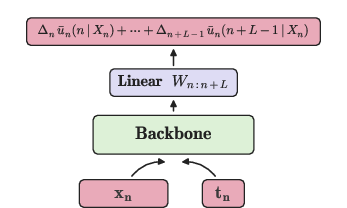
- At generation time, the student combines those predicted pushes into one big move and jumps over the whole block. Do this a few times, and you’re done.
Why this is neat:
- “Number of function evaluations (NFE)” is how many big moves you make. PDD lets you pick 2, 4, or 8 moves, depending on your speed/quality needs.
- It avoids complicated math tricks and tricky losses (like adversarial training), making it simpler, cheaper, and more stable to train.
- It works with many existing models for images and videos, so you don’t need to start from scratch.
- There’s even a “data-free” option: you can train just by interacting with the teacher model, without extra real data.
What did they find?
Across several strong, widely used models and benchmarks, PDD:
- Reaches state-of-the-art quality with only 4–8 steps on text-to-video (Wan 14B and LTX-2.3) and text-to-image (Qwen-Image).
- Keeps outputs more diverse and lively (important for videos with motion) compared to popular fast methods that sometimes produce similar or static results.
- Works reliably with different speed budgets (you can choose 2, 4, or 8 steps at test time), and training stays stable.
- Uses a simple, single loss and avoids extra heavy components, while still matching or beating prior fast methods.
In short: it’s faster, simpler, and gives varied, high-quality results.
Why is this important?
- Practical speedups: Faster generation means lower cost and shorter wait times—good for real-time video tools, interactive editing, and creative apps.
- Better user experience: More diversity means you can get different, interesting outputs instead of the same-looking results.
- Easier deployment: Because it plugs into existing models and avoids complicated training tricks, it’s easier for labs and companies to adopt.
- Greener AI: Fewer steps and simpler training can save a lot of compute and energy.
Takeaway
PDD teaches a model to “plan and take several safe steps at once,” rather than one tiny step at a time. This simple shift brings big wins: much faster image and video generation, top-tier quality, and lively, varied outputs—without the training headaches of older acceleration methods. It’s a practical path toward real-time, high-quality AI media creation.
Knowledge Gaps
Knowledge gaps, limitations, and open questions
Below is a concise, actionable list of what remains missing, uncertain, or unexplored in the paper and could guide future research:
- Theoretical error and stability bounds
- No global error analysis quantifying how RK approximation error and block size L propagate across blocks to the final sample error relative to the teacher.
- No stability conditions (e.g., Lipschitz/contractivity assumptions) guaranteeing bounded drift for large L, different time grids, or long trajectories.
- Choice of solver and supervision fidelity
- Only Euler and Midpoint are considered; the benefit/cost of higher-order RK (e.g., Heun, RK4) remains unquantified for quality vs. teacher-eval compute.
- The effect of supervising multiple intra-block indices k per training sample (vs. a single random k) on convergence speed, variance, and final quality is not studied.
- Time discretization and scheduling
- Time reparameterization is identified as critical, yet there is no principled method to learn or adapt the grid online; adaptive or learned schedulers are unexplored.
- Sensitivity to grid size N and the range of block sizes [L_min, L_max] is not systematically characterized, nor is guidance on selecting them for a target NFE.
- Variable-NFE generalization and adaptivity
- Performance outside the trained NFE range is not reported; the limits of extrapolating to fewer/more NFEs remain unknown.
- No mechanism for adaptive, per-sample NFE/block-size selection (e.g., via error indicators or uncertainty estimates) is explored.
- Train–test mismatch due to fusion
- Training supervises per-interval heads W_k, while inference uses a fused average; potential mismatch (good block-average but poor per-step consistency) is unmeasured and unregularized.
- Applicability scope
- The method assumes deterministic flows; extension to stochastic samplers/SDEs, or hybrid ODE–SDE pipelines, is not addressed.
- Compatibility with diverse model families (e.g., U-Nets vs. DiT/MMDiT, different time-conditioning mechanisms) beyond the tested teachers is not validated.
- Data-free on-policy training
- No analysis of covariate shift when sampling student states without data; coverage of p_t and the impact on mode coverage, motion fidelity, and long-horizon coherence remain unclear.
- Lack of comparative studies between data-free and data-driven training when limited, high-quality data is available.
- Teacher dependence and robustness
- The student inherits teacher biases and artifacts; robustness to weaker or noisy teachers, and methods to decouple or denoise teacher supervision, are not explored.
- No ablation of teacher-quality vs. PDD outcomes, nor strategies like teacher-ensemble supervision or teacher-caching to mitigate cost/variance.
- Computational efficiency and memory footprint
- Wall-clock latency/throughput and memory comparisons (training and inference) vs. baselines on standardized hardware are missing.
- The parameter/memory overhead of N distinct output heads (especially for large N) and fused-layer caching is not profiled or optimized (e.g., pruning/quantization).
- Long-horizon and high-resolution scaling
- Empirical limits for very long videos (>10s), higher frame rates, or high resolutions (e.g., 4K) are not evaluated; scalability constraints are unknown.
- Audio–visual generation
- Although results include text-to-video with audio, there is no description or evaluation of audio modeling, audio–visual synchronization, or cross-modal consistency metrics.
- Diversity and motion metrics
- Video diversity and motion improvements are primarily qualitative; standardized quantitative metrics (e.g., FVD, multi-seed LPIPS over time, VBench motion sub-scores) are not comprehensively reported.
- Guidance and conditioning effects
- The interaction between classifier-free guidance (CFG) at training and inference across NFEs is insufficiently ablated; optimal CFG schedules vs. block size and grid design are unknown.
- Robustness to prompt types (compositionality, OOD prompts, safety-sensitive prompts) and conditioning variations is not characterized.
- Hybrid training with distribution-based regularizers
- Potential synergy between PDD and distribution-matching regularizers (e.g., VSD, GAN-based critics) for improved quality without sacrificing diversity is untested.
- Convergence theory and optimization
- Beyond Proposition 1 (which ignores optimization/approximation errors), there is no convergence analysis under finite capacity, noisy supervision, or non-convex training.
- The variance of the gradient estimator induced by random k selection and on-policy state generation is not analyzed.
- Error control and diagnostics
- No mechanisms to estimate per-block approximation error (e.g., a posteriori error indicators) or to trigger corrective steps/refinements at inference.
- No diagnostics/regularizers to enforce intra-block consistency of per-step predictions vs. fused predictions.
- Scheduler/model mismatch
- Although PDD is said to be interpolant-agnostic, all experiments use linear or shift schedules; applicability to alternative probability paths (e.g., EDM/VP/VE variants) is unverified.
- Safety, bias, and watermarking
- The impact of distillation on safety filters, demographic bias, hallucinations, and watermark persistence is not assessed relative to the teacher.
- Reproducibility and deployment
- Detailed training compute (GPU-hours), energy, and precise hyperparameters affecting scalability (e.g., batch size ceilings on large video models) are not fully disclosed.
- Practical deployment issues (e.g., compatibility with sequence/tensor parallelism, memory-efficient attention) are not discussed.
- Head-to-head benchmarking breadth
- Comprehensive, like-for-like comparisons against Pi-Flow/FreeFlow and distribution-based methods across identical teachers, NFEs, and evaluation suites—especially for video—are limited; broader ablations would strengthen claims.
Practical Applications
Immediate Applications
Below are concrete, deployable use cases enabled by Parallel Decoding Distillation (PDD), organized by sector, with notes on potential tools/workflows and feasibility considerations.
- Fast text-to-video and text-to-image inference for creative production
- Sector: media/entertainment, advertising, social media, gaming
- What: Cut latency and GPU cost by replacing 30–120-step sampling with 4–8 NFE for T2I/T2V while preserving quality and diversity; enable rapid A/B creative exploration via multiple seeds
- Tools/workflows:
- Drop-in inference microservice exposing a “quality/latency” NFE knob
- Plugins for After Effects/Blender/DaVinci Resolve/Unity/Unreal to preview scenes at 2–4 NFE and finalize at 8 NFE
- Batch seed-sweep utilities for diversity-first asset selection
- Assumptions/dependencies: Access to licensed teacher checkpoints (e.g., Qwen-Image, Wan, LTX-2.3); short training run to distill; classifier-free guidance calibration; integration into existing inference stacks (PyTorch/ONNX/TensorRT)
- Interactive editing and iterative design loops
- Sector: creative tools, product design, UX, education
- What: Near-instant previews for inpainting, style tweaks, storyboard beats, or prompt revisions using low NFE; refine selectively with higher NFE as needed
- Tools/workflows: “Preview-to-final” workflow with progressive NFE; UI slider to trade speed for fidelity; seed bank for diversity-preserving edits
- Assumptions/dependencies: UI integration; minor tuning of guidance scales for higher NFE stability
- Cost and energy reduction in cloud inference
- Sector: software/SaaS, infrastructure/cloud, sustainability
- What: Order-of-magnitude fewer function evaluations vs. teacher ODE sampling; lower GPU-hours/sample and improved throughput
- Tools/workflows:
- Autoscaling policies that map SLOs to NFE targets
- Cost/energy dashboards comparing teacher vs. PDD runs
- Carbon-aware scheduling that drops to 2–4 NFE during peak energy prices
- Assumptions/dependencies: Capacity planning with variability in NFE; compute to run initial PDD training; monitoring to avoid quality regressions on hard prompts
- On-device or edge-accelerated generation (preview modes)
- Sector: mobile apps, AR filters, social creation tools
- What: 2–4 NFE preview generations on high-end phones/edge devices; cloud refinement at 8 NFE for final export
- Tools/workflows: Hybrid edge–cloud pipeline; quantization + fused-head deployment; progressive preview pipeline
- Assumptions/dependencies: Hardware constraints; model compression; bandwidth for cloud round-trip
- Higher-diversity content generation for campaign and asset pipelines
- Sector: marketing/advertising, e-commerce, gaming
- What: Reduced mode collapse compared to distribution-based distillation; robust multi-seed variation for campaigns and catalog assets
- Tools/workflows: Automated multi-seed generation and scoring; prompt/seed matrices; diversity diagnostics dashboards
- Assumptions/dependencies: Seed management, content scoring tools (HPSv2/PickScore/CLIP variants), guardrails for brand/style
- Research acceleration and reproducibility
- Sector: academia/industrial research
- What: Faster ablations and benchmarking; variable NFE enables fair, budgeted comparisons; data-free online training allows distilling proprietary teachers without extra data
- Tools/workflows: PDD distiller CLI; reproducible grids for time reparameterization and block-size sweeps; open benchmarking scripts
- Assumptions/dependencies: Access to teacher weights/APIs; documentation of schedules (e.g., shift time mapping); compute for brief distillation runs
- Simulation asset synthesis for downstream model training
- Sector: robotics/simulation, autonomous systems, vision ML
- What: Quick generation of diverse scene/video assets to augment training sets for perception or policy simulators
- Tools/workflows: Scenario templating; seed-sweep asset generation; curriculum pipelines that upshift NFE as difficulty increases
- Assumptions/dependencies: Domain-gap validation; careful use of synthetic data to avoid bias amplification; licensing for synthetic assets
- Multimodal preview generation (video + audio-capable teachers)
- Sector: content production, education/communication
- What: With teachers like LTX-2.3 (video/audio), fast multimodal drafts for storyboards, explainers, or short-form content
- Tools/workflows: Prompt-to-multimodal “first-cut” generator at 4 NFE; audio-visual alignment checks; final pass at 8 NFE
- Assumptions/dependencies: Multimodal teacher availability; audio quality checks; rights management for any audio models
- MLOps: NFE-aware orchestration and guardrails
- Sector: software infrastructure
- What: Policy-based schedulers that adapt NFE to backlog/SLAs; automatic fallback to Midpoint-trained heads for higher fidelity
- Tools/workflows: NFE routing policies; health checks on prompt complexity; dynamic guidance scaling per NFE
- Assumptions/dependencies: Prompt difficulty estimators; monitoring and rollback; per-model calibration
- Education and communications content at scale
- Sector: education, public sector communications, NGOs
- What: Rapid generation of illustrative images/videos for lectures, tutorials, or outreach with controllable diversity
- Tools/workflows: Template libraries; classroom-safe mode; multi-seed galleries
- Assumptions/dependencies: Content safety filters; prompt curation; governance for synthetic media disclosures
Long-Term Applications
These opportunities require additional research, scaling, or ecosystem development, but are clearly indicated by the paper’s findings and architecture.
- Real-time interactive text-to-video and world modeling
- Sector: gaming, robotics, digital twins, virtual production
- What: Sub-second latency T2V previews and interactive scene editing; online agents/world models updated on-the-fly
- Potential products/workflows: “Scrub-to-regenerate” timelines in NLEs; live-coached scene generators; simulator-in-the-loop policy training
- Dependencies/assumptions: Further step-count reduction and optimized backbones; hardware acceleration for fused linear heads; streaming schedulers; temporal consistency controls
- On-device AR glasses and live generative overlays
- Sector: AR/VR, wearable computing
- What: Personalized, context-aware generative visuals in the field; lightweight preview on-device with cloud refinement
- Potential products/workflows: NFE-tiered pipeline (2 NFE live overlay → 8 NFE archival capture); gaze/prompt fusion for interactive overlays
- Dependencies/assumptions: Efficient teachers distilled to small PDD students; robust power/thermal envelopes; privacy-preserving on-device inference
- Adaptive, content-aware NFE scheduling
- Sector: infrastructure, rendering, tools
- What: Allocate more steps to “hard” segments (crowded scenes, fine text) and fewer to “easy” segments within the same clip
- Potential products/workflows: Learned NFE controllers; per-frame/per-region step allocation; confidence-aware refinement passes
- Dependencies/assumptions: Reliable difficulty estimators; fine-grained timing control; stability across variable block sizes
- Unified multimodal co-generation (video, audio, 3D, 4D)
- Sector: creative production, simulation, e-commerce
- What: Joint generation of video, synchronized audio, and coarse geometry/scene flow using a single PDD-distilled backbone
- Potential products/workflows: One-pass generative “shots” with audio cues; product spins and 4D dynamic scenes for catalogs
- Dependencies/assumptions: Strong multimodal teachers; coupling losses for cross-modal consistency; memory-aware fusion of multiple heads
- Hardware–software co-design for fused-block decoding
- Sector: semiconductors, systems
- What: GPU/accelerator kernels and compiler passes optimized for PDD’s fused linear heads and block-step execution
- Potential products/workflows: Kernel fusion in TensorRT/XLA; block-aware memory layouts; chip-level support for parallel decoding heads
- Dependencies/assumptions: Vendor support; standardization of block-wise APIs; model zoo adoption
- Training-from-scratch few-step models leveraging PDD concepts
- Sector: foundational models, research
- What: Self-distillation or flow-map hybrids that directly learn mean-velocity representations without JVPs/finite-diff
- Potential products/workflows: End-to-end training pipelines combining flow matching + PDD-style supervision; curriculum over block sizes
- Dependencies/assumptions: Large-scale datasets; stability under self-teaching; convergence analyses for block-wise objectives
- Hierarchical edge–cloud rendering pipelines
- Sector: mobile/cloud, consumer apps
- What: First-pass low-NFE “instant” results locally; seamless cloud upscaling/refinement for share/export
- Potential products/workflows: “Generate now, enhance later” UX; background refinement jobs; cost-aware user controls
- Dependencies/assumptions: Robust model handoff between tiers; state transfer protocols; QoE metrics aligned with NFE tiers
- Synthetic data governance and efficiency standards
- Sector: policy, ESG, compliance
- What: Guidelines encouraging trajectory-based, compute-efficient distillation to reduce energy per generated asset; disclosure standards for synthetic media
- Potential products/workflows: Efficiency scorecards (steps/sample, Joules/sample); procurement policies favoring few-step generators; watermarking hooks integrated with PDD pipelines
- Dependencies/assumptions: Agreement on metrics; auditing frameworks; co-reporting of quality/diversity and energy
- Safety, watermarking, and detection at scale
- Sector: policy, trust & safety
- What: With lower generation costs, volumes rise—necessitating robust provenance and detection tied to PDD inference traces
- Potential products/workflows: NFE-tagged watermarks; block-wise signatures; forensic tools calibrated to PDD artifacts
- Dependencies/assumptions: Standardized watermarking schemes; compatibility with fused-head execution; low false-positive rates
- Domain-specific simulation for regulated fields
- Sector: healthcare, autonomous driving, industrial inspection
- What: Synthetic video datasets for rare events and edge cases, generated efficiently and with diversity
- Potential products/workflows: Scenario libraries; risk-focused data augmentation; validator suites comparing synthetic vs. real distributions
- Dependencies/assumptions: Rigorous validation and bias assessments; regulatory approval pathways; domain experts in the loop
Cross-cutting assumptions and risks to feasibility
- Model availability and licensing: PDD relies on access to strong, pre-trained teacher models (diffusion/flow ODEs). Commercial licenses and usage rights may limit deployment.
- Calibration matters: Guidance scale and time reparameterization (e.g., shift schedule) influence stability and quality, especially at higher NFEs.
- Hardware/software integration: Realizing speedups requires efficient fused-head implementations and inference optimizations; benefits depend on batch size and kernel fusion quality.
- Data-free training trade-offs: While supported, quality and stability can vary by teacher/model family; online on-policy training needs careful stopping/regularization.
- Safety/compliance: Lower latency and cost can accelerate synthetic media proliferation; watermarking, content moderation, and disclosure should be built-in.
Glossary
- Adversarial losses: Loss functions from generative adversarial training used to improve sample realism by pitting a generator against a discriminator. "Current state-of-the-art (SOTA) acceleration methods heavily rely on variational score distillation (VSD) and adversarial losses to distill diffusion models into few-step generators."
- Block size: The number of consecutive time intervals L grouped and advanced together in the parallel decoding scheme. "The sampling trajectory is discretized into intervals, which are grouped into blocks of size ."
- Classifier-free guidance: A sampling technique that linearly combines conditional and unconditional model outputs to control fidelity vs. diversity. "Additionally, details about classifier-free guidance are in Appendix~\ref{a:experiments}."
- Data-free training: Training that does not require access to the original dataset, relying instead on the pretrained model’s own generations. "Due to the lack of high-quality image and video datasets, we apply data-free training as described in Algorithm~\ref{alg:datafree_parallel_decoding_training}."
- Diffusion models: Generative models that learn to iteratively denoise data from noise by estimating gradients of the data distribution. "The currently dominant approaches for training generative flow models are flow matching... and diffusion models~\citep{sohldickstein2015diffusionmodels, ho2020ddpm, song2021scorebased}."
- Distribution-based methods: Distillation approaches that align student and teacher marginal distributions rather than matching full trajectories. "ii) distribution-based methods~\citep{sauer2023add,wang2023vsd,yin2024dmd,xu2025fdistill}, which relax the constraint of following the teacher trajectories and instead align only the marginal distributions of the student and teacher processes."
- Euler solver: A first-order numerical ODE solver that approximates the velocity as constant over a time step. "The simplest numerical method is the Euler solver, which approximates the velocity as constant over the interval "
- F-divergences: A family of statistical divergences (e.g., KL, JS) used to measure differences between probability distributions. "-distill~\citep{xu2025fdistill} generalizes the VSD loss to -divergences"
- Finite differences: Numerical approximations of derivatives using discrete step differences, often used when analytic derivatives or JVPs are costly. "without regressing its derivative using JVPs or finite-difference approximations."
- Fisher divergences: Divergences based on differences between score functions of distributions, used for distribution alignment. "and SiD and extensions~\citep{zhou2024sid, zhou2024sida,luo2024onestepdiffusiondistillationscore} use variants of Fisher divergences."
- Flow matching: A training framework to learn a velocity field that transports a source distribution to a target distribution over time. "Flow matching provides a framework for learning a model such that the flow defined by \eqref{e:flow_process} maps samples from the source to samples from the target ."
- Flow maps: Operators that map states across time intervals along flow trajectories; can be formulated in Eulerian or Lagrangian views. "which is, for instance, required for flow maps~\citep{geng2025meanflow, sabour2025ayf, boffi2025flowmaps}."
- Interpolant process: A designed process that interpolates between source and target to make training-time sampling of intermediate marginals efficient. "Importantly, during training, the marginal of a flow matching model can be sampled efficiently using the interpolant process."
- Jacobian-vector products (JVPs): Efficient computations of directional derivatives without forming full Jacobians, used to supervise or regularize flow maps. "without regressing its derivative using JVPs or finite-difference approximations."
- Lagrangian formulation: A perspective that follows individual trajectories (particles) through time, used in some flow-map distillation methods. "Additionally, our formulation clarifies the connection to flow map distillation methods, particularly the Lagrangian formulation"
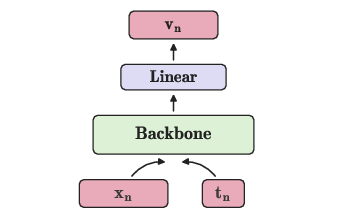
- Layer fusion: Combining multiple per-step linear heads into a single fused linear layer to produce a block’s average update efficiently. "At generation, instead of applying a linear layer per intra-block step~(\ref{e:pd_process}), we can fuse the layers into a single linear layer that outputs the block's average velocity"
- Marginal distributions: The time-indexed distributions p_t of states along the generative process. "align only the marginal distributions of the student and teacher processes."
- Mean velocity: The average velocity over a time interval, whose integral gives the state update for that interval. " denotes the mean velocity of the -th interval "
- Midpoint method: A second-order Runge–Kutta method that evaluates the velocity at the interval’s midpoint for better accuracy. "We use the Midpoint method,"
- Mode collapse: A pathology in generative models where outputs lack diversity and collapse to a few modes. "Albeit achieving high-quality video generation, these training losses are notoriously hard to optimize and suffer from mode collapse, leading to loss of video diversity and lack of motion."
- Number of function evaluations (NFE): The number of model (velocity) evaluations performed per sample during generation. "support sampling with a varying number of function evaluations (NFE)."
- On-policy training: An optimization approach that trains using states produced by the current model’s own rollouts. "During training, we employ an on-policy optimization algorithm that requires the intra-block process given by the parallel decoding model."
- Ordinary differential equation (ODE): An equation involving time derivatives of the state, used here to define and sample flows. "The first successful method to distill the trajectories of the flow ODE~(\ref{e:flow_process}) using a student-teacher scheme to achieve few-step generation is Progressive Distillation"
- Probability path: The time-dependent marginal density p_t of the process along the flow. "The marginal of the process, called the probability path, is a time-dependent density such that for all ."
- Runge–Kutta methods: A family of multi-stage numerical ODE solvers that achieve higher-order accuracy by multiple evaluations within a step. "Runge-Kutta methods are a family of higher-order solvers that use additional evaluations of the velocity in the interval to achieve a higher-order approximation."
- Shift transformation: A time reparameterization used to bias the discretization toward certain regions of the interval. "All models use the shift transformation~\citep{esser2024sd3,shaul2024bns} for the time discretization:"
- Source distribution: The initial distribution p0 from which the flow starts at time t = 0. "A flow process taking values in is defined by a velocity field and a source distribution , which serves as a boundary condition"
- Stop-gradient operator: An operation that prevents gradients from flowing through a tensor during backpropagation. " denotes the stop-gradient operator"
- Target distribution: The desired data distribution p1 that the flow maps to at time t = 1. "Assume a dataset of i.i.d.\@ samples in from a target distribution "
- Time discretization: The partition of the continuous time interval into a finite grid of steps for numerical integration. "the time discretization~(\ref{e:time_disc}), defined by the grid size and the time reparameterization"
- Trajectory-based distillation: Methods that compress a teacher’s multi-step sampling trajectory into a few steps by matching paths or updates. "a simplified and scalable trajectory-based distillation method for fast inference of diffusion and flow matching models."
- Variational Score Distillation (VSD): A distribution-matching distillation objective that aligns gradients (scores) of student and teacher. "Current state-of-the-art (SOTA) acceleration methods heavily rely on variational score distillation (VSD)"
- Velocity field: The time-dependent vector field v_t(x) whose integral defines the flow’s evolution. "A flow process taking values in is defined by a velocity field "
Collections
Sign up for free to add this paper to one or more collections.

