Where Steering Signals Come From: Activation Source Selection in Activation Steering
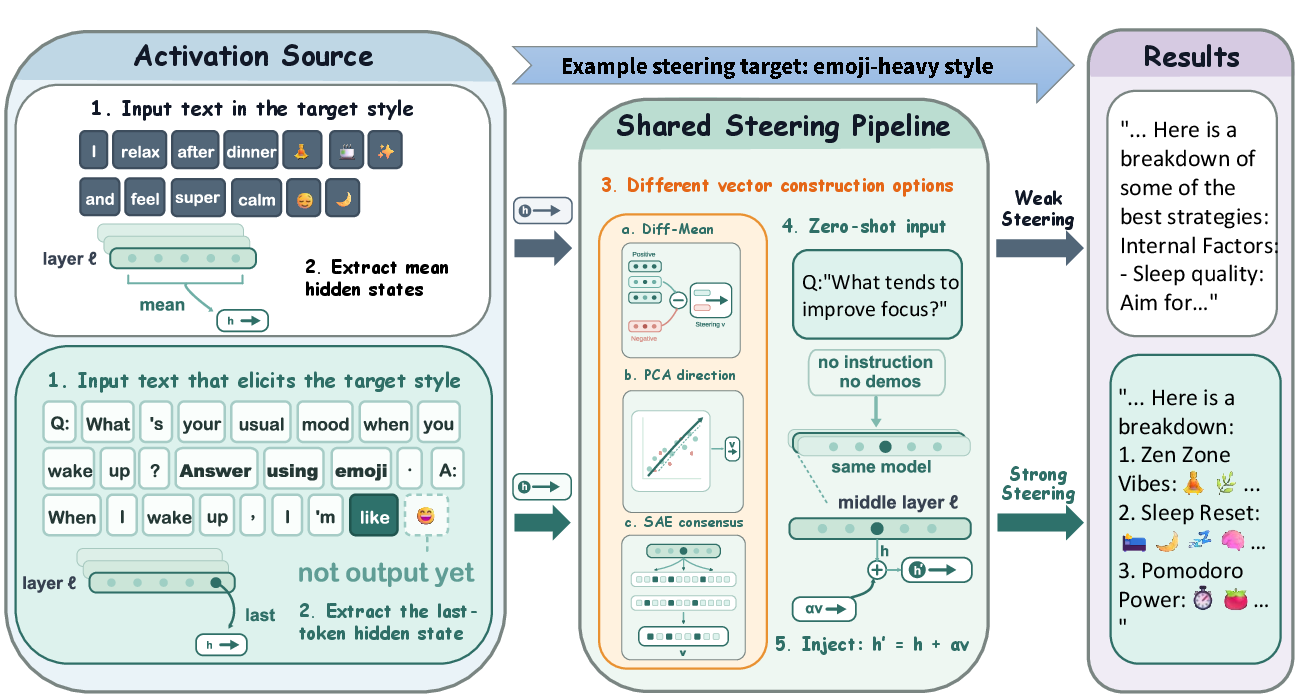
Abstract: Activation steering controls LLMs by adding vectors or features to hidden states at inference time, but the upstream source of these steering signals is often treated as a secondary detail. We study this source choice as activation source selection: the combination of source context and activation readout policy used to collect the hidden states from which a steering signal is built. Holding the downstream intervention fixed, we show across three instruction-tuned models and four steering task families that changing only the source activations substantially changes steering success. We further find that effective steering is not explained simply by whether the desired behavior appears in the source text. Instead, strong signals come from execution-boundary states, where the model is about to produce or continue the target behavior. This pre-/post-realization distinction explains why answer-based sources sometimes work: their useful component aligns with execution-boundary directions rather than target appearance alone. Building on this view, we introduce tail subtraction, which removes shared prompt and continuation semantics from boundary states and yields cleaner, more stable steering signals. Overall, our results suggest that steering depends on representations of what the model is about to do, not merely on what has already appeared.
Paper Prompts
Sign up for free to create and run prompts on this paper.
Top Community Prompts
Explain it Like I'm 14
1. What is this paper about?
This paper studies a way to control LLMs, such as ChatGPT-like systems, called activation steering.
Activation steering works by adding a small mathematical signal to the model while it is writing. This signal can make the model more likely to:
- Use emojis
- Mention a certain topic, such as dogs or coffee
- Sound happy, angry, or flattering
- Refuse a request
- Give nonsense answers
The paper’s main question is: Where should the steering signal come from?
The researchers argue that this question is more important than many earlier studies assumed. They find that the best signals usually come from the model’s thoughts right before it produces the desired behavior—not simply from text where that behavior has already appeared.
2. What questions did the researchers ask?
The paper focuses on several simple questions:
- Does the choice of source information affect steering? In other words, does it matter whether the researchers collect hidden information from the prompt, the answer, or both?
- Is it enough for the desired behavior to appear in the source text? For example, if the researchers want the model to use emojis, is it enough to collect information from an answer that already contains emojis?
- Are the most useful signals found just before the model performs a behavior? The researchers call these moments execution boundaries. This is the point where the model has understood what it should do and is about to begin doing it.
- Can the researchers remove irrelevant information from these signals? A source state may contain information about the question, conversation format, and ordinary sentence continuation. The researchers test a method called tail subtraction to remove some of this extra information.
3. How did the researchers investigate this?
Testing different source texts
The researchers used three instruction-following LLMs:
- Gemma-2-9B-IT
- Qwen2.5-7B-Instruct
- Llama-3.1-8B-Instruct
They tested four kinds of behaviors:
- Entity behavior: mentioning things such as cats, coffee, or music
- Persona and style: sounding happy, angry, flattering, or using many emojis
- Refusal: refusing a request
- Nonsense: giving incorrect or nonsensical answers
For each behavior, they collected hidden states from different kinds of source text:
- Prompt-only: the instruction and question, but no answer
- Prompt plus answer: both the instruction and a sample answer showing the behavior
- Answer-only: just the sample answer
A LLM’s hidden state is a collection of numbers that represents what the model currently understands. It is similar to a computer’s internal notes while solving a problem.
Testing different readout positions
The researchers also changed which hidden states they used:
- Last-token readout: use the state at the final word or token
- Sequence mean: average the states from many tokens
This is like trying to understand a student’s plan by either:
- Listening to what they are thinking at the exact moment before they answer, or
- Averaging everything they thought during the whole answer
Building steering vectors
The researchers turned the collected hidden states into steering vectors. A steering vector is a list of numbers describing a direction in the model’s internal space.
They then added this direction to the model while it generated new answers. The model was tested on questions it had not seen before.
The researchers kept the steering process itself mostly the same and changed only the source of the hidden states. This made it possible to measure how much the source choice mattered.
Studying “before” and “after” behavior
The researchers made a special distinction:
- Execution-boundary state: the model has prepared to perform the target behavior but has not produced it yet
- Post-realization state: the target behavior has already appeared in the text
For example, if the model must answer “small” when given “big”:
- The state just after
Assistant:but beforesmallis an execution-boundary state. - The state after the word
smallhas already appeared is a post-realization state.
Tail subtraction
The researchers noticed that even a useful boundary state may contain unrelated information, such as:
- The user’s question
- The conversation format
- The beginning of the assistant’s answer
- General information about continuing a sentence
Their method, tail subtraction, compares two similar prompts:
- A full prompt that encourages the desired behavior
- A matching prompt without the special behavior instruction
They subtract the second hidden state from the first. The idea is similar to removing the background noise from a photograph so that the important object becomes clearer.
4. What did they find?
The source of the signal matters a lot
Changing only the source activations caused large changes in how well steering worked.
On average, the strongest basic setup was:
Use the prompt and read the final hidden state before the answer begins.
The weakest setup was often:
Use only an answer that already shows the desired behavior.
This is surprising because it might seem natural to collect examples containing the behavior one wants. However, the results show that seeing a behavior in text does not automatically create a good steering signal.
The model’s preparation is more useful than the finished answer
The strongest signals usually came from states where the model was about to produce the desired behavior.
For example, if the goal is to make the model talk about dogs, the most useful state may be the one where the model has read the instruction and question and is about to begin an answer about dogs.
This suggests that steering works best when it captures the model’s internal preparation or plan, rather than simply recording words that have already been written.
Boundary states worked especially well
The researchers created prompts that made the target behavior very likely while leaving the answer unfinished. These boundary sources performed better than answer-only sources across all three models.
A hybrid source—which included both an instruction and example answers, then stopped just before the target behavior—was especially reliable.
In the relation-completion tests, the difference was even clearer. Boundary states reached success rates of roughly 55–65%, while post-realization answer states reached only about 11–13%.
This experiment was useful because, after the answer to a relation task appears, there is usually little need to continue the same behavior. For example, once the model has answered that the opposite of “big” is “small,” the important reasoning has already happened. This supports the idea that the useful signal comes before the answer.
Answer-based sources sometimes work for a special reason
Answer-based sources were not always useless. Sometimes they performed reasonably well, especially when they included both the prompt and the answer.
The researchers suggest that these sources contain a mixture of information:
- Some information describes what has already been said.
- Some information describes how to continue the behavior.
For example, after a model begins writing in an emoji-heavy style, later hidden states may help it continue using that style. Therefore, averaging the whole answer can accidentally include some useful execution information.
The researchers tested this by removing the part of answer-based signals that matched the execution direction. Steering became weaker, showing that answer-based sources worked partly because they contained execution-related information.
Tail subtraction improved performance
Tail subtraction performed better than simpler methods across all three models.
For example, with one averaging method:
- Gemma improved from 60.1% with a standard negative comparison to 86.3% with tail subtraction.
- Llama improved from 34.8% to 54.6%.
- Qwen improved from 58.4% to 72.5%.
The exact scores are experimental measurements, but the overall pattern is important: removing shared, irrelevant continuation information produced cleaner and more effective steering signals.
5. Why are these findings important?
The paper changes how researchers should think about activation steering.
A simple view would be:
Find text that contains the behavior you want, collect its hidden states, and use them to control the model.
The paper argues for a better view:
Find the hidden states where the model is preparing to perform the behavior.
This is similar to the difference between watching someone after they finish an action and watching them just as they are about to start it. The second moment may reveal more about how to make the action happen again.
The findings could help researchers build LLMs that are easier to control without retraining them. For example, future systems might be able to switch styles, follow special rules, or improve safety behavior more reliably by using better source states.
However, the results have limits. The experiments used only three models, mostly around 7–9 billion parameters, and focused on additive steering. Other kinds of steering, larger models, different languages, and longer conversations might behave differently.
Simple conclusion
This paper shows that the timing and location of a steering signal matter greatly. A model’s hidden state just before it produces a behavior often gives a better control signal than the words showing that behavior afterward.
The researchers’ tail subtraction method makes these signals cleaner by removing shared background information. Overall, the study suggests that to control a LLM effectively, we should focus less on what the model has already said and more on what the model is about to do.
Practical Applications
Immediate Applications
The paper’s findings can be applied now in controlled, inference-time workflows for open-weight LLMs, particularly where model weights cannot be retrained and behavior must be changed dynamically.
- Improved activation-steering pipelines for software and AI infrastructure
- Replace answer-only or sequence-mean activation collection with last-token execution-boundary states, taken immediately before the model is expected to produce the target behavior.
- For example, to induce concise, emoji-heavy, refusal-oriented, or entity-specific responses:
- 1. Construct a prompt that specifies the desired behavior.
- 2. Add demonstrations or target-conditioning context.
- 3. Stop immediately before the target continuation.
- 4. Read the final hidden state.
- 5. Build the steering vector from these states and inject it during generation.
- This can be integrated into existing activation-engineering libraries without changing the downstream additive intervention.
- Dependencies: access to model hidden states, a model implementation that supports inference-time hooks, calibration of layer and steering strength, and validation that the behavior does not degrade readability or factuality.
- Tail-subtracted behavior controllers
- Implement the paper’s
tail subtractionprocedure to remove generic question, chat-format, and answer-prefix semantics from a target-conditioned boundary state. - A practical workflow is to create paired prompts:
- a full prompt containing the target instruction or demonstrations; and
- a tail-only prompt containing the same user question and assistant prefix but no target conditioning.
- Subtract the tail-only activation from the full activation before constructing a mean or PCA steering vector.
- This could yield reusable controllers for:
- customer-support tone,
- formal or informal writing,
- refusal behavior,
- emotional style,
- domain terminology,
- controlled mention of entities.
- Dependencies: accurate prompt pairing, consistent tokenization and formatting, sufficient representative examples, and per-model testing. The reported gains are strongest for some models, especially Gemma and Qwen, and should not be assumed to transfer uniformly.
- Implement the paper’s
- Runtime personalization without fine-tuning
- Product teams can provide temporary controls such as “respond more concisely,” “use a friendly tone,” or “avoid mentioning a specified topic” by loading precomputed steering vectors at inference time.
- Because the model parameters remain unchanged, different users, sessions, or applications could use different steering configurations without maintaining separate fine-tuned checkpoints.
- Potential products include:
- configurable writing assistants,
- enterprise chatbots with department-specific response styles,
- adaptive tutoring interfaces,
- developer tools with selectable explanation styles.
- Dependencies: the steering vector must be trained or collected for the specific model and behavior; activation steering may interact unpredictably with prompts, topics, languages, and generation length.
- Inference-time safety and policy controls
- Safety systems can use execution-boundary steering to increase the likelihood of refusal-like responses or policy-compliant response formats before generation begins.
- A safety workflow could combine:
- an external risk classifier,
- a boundary-state steering vector for refusal or safe redirection,
- post-generation policy checks.
- This is potentially useful as a lightweight supplement to prompt-based safety instructions and does not require model retraining.
- Dependencies and risks: the paper evaluates only a synthetic refusal target and does not establish production-grade safety. Steering should not replace policy classifiers, output filters, red-team testing, or human oversight. Strong steering may cause over-refusal, reduce helpfulness, or be bypassed by adversarial prompts.
- Model interpretability and debugging tools
- Researchers and engineers can use source selection as a diagnostic variable when a steering vector appears ineffective.
- Instead of only changing the vector estimator, an analysis tool could compare:
- prompt-only final-token states,
- prompt-plus-answer states,
- answer-only states,
- pre-realization boundary states,
- post-realization trace states,
- tail-subtracted residuals.
- Such comparisons can identify whether a failed controller reflects poor vector construction or an unsuitable activation source.
- Dependencies: hidden-state access and comparable source prompts. Similarity between activation directions should not by itself be interpreted as proof of causal mechanism.
- Activation-steering benchmarking and reproducible evaluation
- Benchmark designers can add source-selection variables to standard steering evaluations rather than reporting only the final intervention method.
- A minimal benchmark should report:
- source context,
- readout position or aggregation rule,
- source and intervention layers,
- steering strength,
- target-expression rate,
- output validity and quality,
- performance on held-out prompts.
- This would make results more reproducible and prevent answer-based activation collection from being treated as a neutral preprocessing choice.
- Dependencies: standardized task definitions, independent quality evaluation, and avoidance of selecting the best layer and strength solely on test data.
- Education and research workflows for representation analysis
- In academic courses or laboratory settings, the paper provides a practical experiment for demonstrating the difference between:
- representing a behavior after it has appeared; and
- representing the computation or preparation immediately before it appears.
- Students can reproduce the comparison using relation-completion tasks, where post-realization answers are clearly separated from pre-answer execution states.
- Dependencies: suitable open-weight models, GPU resources, and careful control of prompt templates and evaluation leakage.
- Controlled daily-use writing assistance
- Advanced users can create local steering profiles for stable stylistic preferences—such as concise, polite, technical, or highly structured responses—without fine-tuning the model.
- Boundary-based source collection may provide more reliable profiles than averaging hidden states from completed example answers.
- Dependencies: local model access and technical tooling. These controllers may change content selection as well as style, so users should review outputs rather than treating the setting as a purely cosmetic filter.
Long-Term Applications
The results also suggest broader applications, but these require validation beyond the three 7B–9B instruction-tuned models, additive interventions, and task families studied in the paper.
- Phase-aware control systems for production LLMs
- Future inference servers could treat generation as a sequence of control phases:
- 1. interpret the instruction,
- 2. prepare an intended response,
- 3. begin continuation,
- 4. sustain the selected behavior.
- Steering could then be applied conditionally at execution boundaries rather than uniformly across every generated token.
- This may support more precise control of style, persona, safety policy, or task execution while reducing unwanted semantic interference.
- Dependencies: research on token- and layer-dependent injection, reliable detection of execution boundaries, low-latency activation processing, and safeguards against control instability.
- Dynamic multi-behavior and multi-vector controllers
- Instead of one global vector, future systems could maintain separate vectors for content, style, safety, verbosity, and task execution, activating them at different generation phases.
- Tail subtraction could help separate target-specific behavior from shared continuation semantics before combining vectors.
- Potential products include policy orchestration layers for enterprise agents and programmable response-control APIs.
- Dependencies: methods for resolving conflicts between vectors, sparse or disentangled representations, automated strength selection, and evaluation of compositionality.
- Steering for agentic systems and robotics
- In tool-using agents, execution-boundary states could be used to influence whether the model is about to:
- call a tool,
- request clarification,
- refuse an action,
- produce a plan,
- execute a particular workflow.
- In robotics, analogous signals might eventually help regulate high-level action policies before commands are emitted.
- Dependencies: validation in tool-calling and multimodal models, strict action authorization, real-time reliability, and external safeguards. The paper does not evaluate physical actions, multimodal inputs, or long-horizon agents, so direct deployment would be premature.
- Healthcare decision-support assistants
- A healthcare assistant might use phase-aware steering to encourage structured communication, uncertainty disclosure, safety-oriented escalation, or referral to a professional before generating recommendations.
- Tail subtraction could potentially isolate these response policies from patient-question wording.
- Dependencies: clinical validation, multilingual and domain-specific testing, privacy protection, regulatory compliance, calibrated uncertainty, and independent safety monitoring. The paper provides no evidence that steering improves medical accuracy or clinical outcomes.
- Education and adaptive tutoring
- Educational systems could dynamically steer an assistant toward Socratic questioning, age-appropriate explanations, concise hints, or encouragement to show intermediate reasoning rather than simply giving answers.
- Boundary-oriented source construction may be useful because tutoring behaviors concern what the model is about to do—ask a question, provide a hint, or explain a concept—rather than merely the words present in completed examples.
- Dependencies: age-group and subject-specific evaluation, protection against pedagogically harmful or incorrect guidance, teacher oversight, and testing across long multi-turn interactions.
- Finance and regulated customer communication
- Financial assistants could use steering vectors to promote standardized disclaimers, conservative language, escalation behavior, or consistent communication styles.
- For example, a controller could encourage the model to state uncertainty and direct high-risk cases to a human advisor before generating a recommendation.
- Dependencies: regulatory approval, auditability, robustness to prompt attacks, evidence that steering does not suppress material information, and deterministic logging of the activation configuration.
- Energy and industrial operations
- In industrial or energy-management agents, activation steering could eventually influence whether a model chooses to recommend monitoring, request additional data, or escalate an operational anomaly.
- Execution-boundary control is potentially relevant when a model is about to issue a tool call or operational instruction.
- Dependencies: integration with control systems, formal verification, fail-safe defaults, simulation-based testing, and strict separation between language generation and actuator authorization.
- Cross-model and cross-lingual steering libraries
- A longer-term research direction is to determine whether execution-boundary directions transfer across model families, scales, languages, and modalities.
- If they do, organizations might build libraries of reusable behavior controllers rather than collecting separate answer-based activation datasets for every model.
- Dependencies: the paper’s evidence is limited to three English, instruction-tuned, open-weight models. Cross-model transfer, multilingual behavior, base models, larger models, and multimodal settings remain untested.
- Automated source-selection and controller-generation tools
- A future tool could automatically search over source contexts and readout policies, selecting the source that maximizes held-out behavioral success while preserving output quality.
- It could compare boundary, hybrid, prompt-only, and tail-subtracted sources and produce a deployment-ready controller with calibrated intervention parameters.
- Dependencies: reliable validation objectives, protection against overfitting, efficient activation collection, judge robustness, and metrics covering factuality, fairness, refusal appropriateness, and unintended behavior.
- Mechanistic interpretability of “what the model is about to do”
- The execution-boundary hypothesis can guide research into latent representations of imminent actions, continuations, and task execution.
- Future work could test whether these signals correspond to identifiable circuits, sparse autoencoder features, neurons, or low-dimensional subspaces.
- This may lead to better transparency tools for diagnosing why a model is preparing a refusal, tool call, relation answer, or stylistic continuation.
- Dependencies: causal interventions beyond additive steering, feature-level and nonlinear analyses, larger-scale replication, and stronger separation of genuine execution representations from prompt-format artifacts.
- Personal digital assistants with context-sensitive behavior profiles
- Long-term consumer systems could switch behavior profiles based on task phase—for example, brainstorming, planning, drafting, checking, or communicating—rather than applying one global personality vector.
- This could support assistants that are creative during ideation, cautious during verification, and concise during execution.
- Dependencies: persistent preference management, privacy controls, robust phase detection, user-understandable explanations, and safeguards against silently changing factual or safety-critical behavior.
Overall, the most immediately actionable contribution is methodological: collect steering signals from pre-realization, last-token execution-boundary states and test matched tail subtraction rather than relying on target-bearing answer averages. The broader applications remain conditional because the paper studies a limited set of models and behaviors, uses additive inference-time interventions, and reports controlled steering success rather than deployment-level safety, reliability, or domain performance.