Gravitational Sedimentation and Rebound of Strongly Coupled Dusty Plasma Crystals: A Molecular Dynamics Study
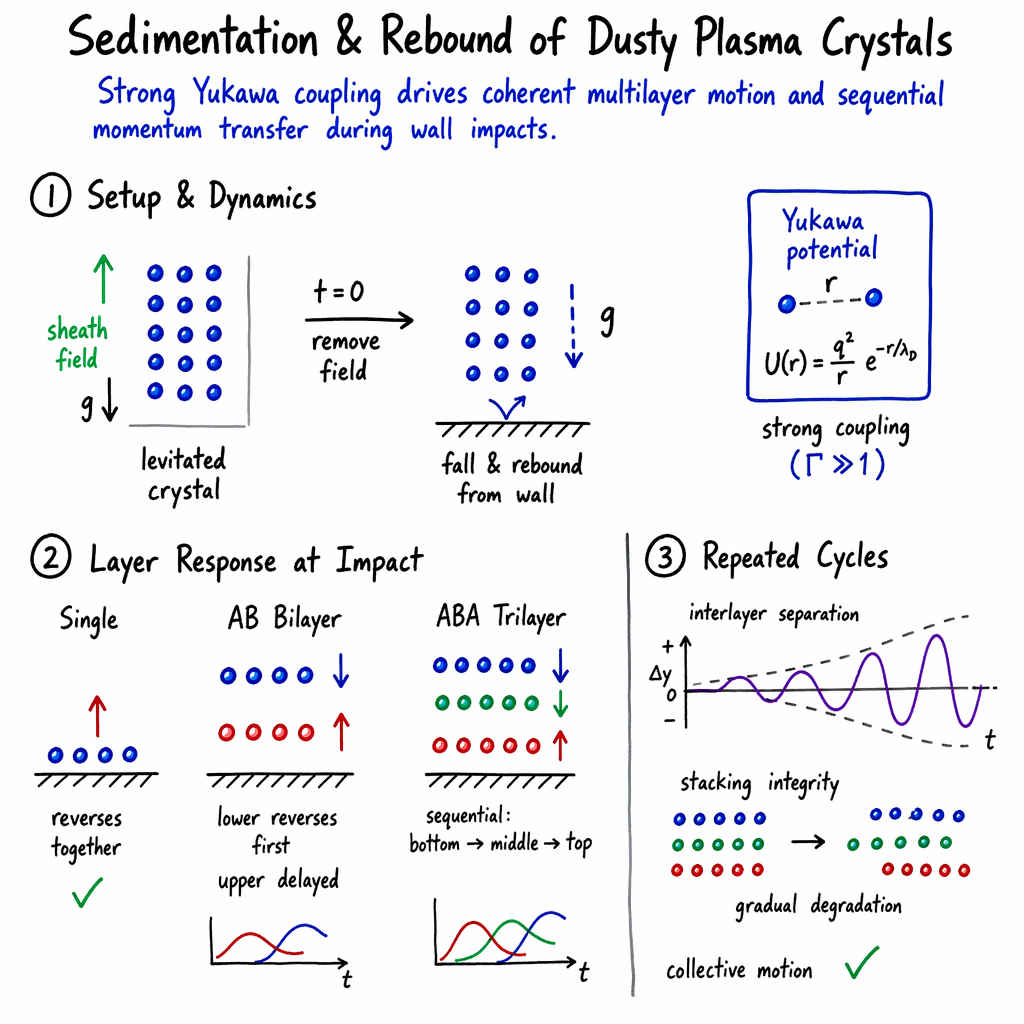
Abstract: The gravitational sedimentation of strongly coupled dusty plasma crystals is investigated using molecular dynamics simulations. Initially, the dust particles are levitated by the balance between the upward external electric field and gravity. Sedimentation is initiated by removing the electric field, allowing the particles to settle collectively under gravity while interacting through the Yukawa (screened Coulomb) potential. Single-layer, AB-stacked bilayer, and ABA-stacked trilayer crystals are investigated to examine the influence of crystal geometry on the sedimentation dynamics. All crystal configurations undergo collective gravitational settling while preserving their in-plane hexagonal ordering during the initial stages of sedimentation. Upon collision with a reflecting boundary, the multilayer crystals undergo transient interlayer compression followed by sequential momentum transfer between neighboring layers, producing coherent collective rebound. In particular, the trilayer exhibits sequential layer-by-layer momentum propagation from the lower to the middle and finally to the upper layer. During successive sedimentation--rebound cycles, repeated interlayer interactions progressively degrade the initial ABA stacking while preserving the collective mechanical response of the crystal. These results demonstrate that strong Yukawa coupling enables multilayer dusty plasma crystals to sustain repeated impacts while maintaining coherent collective motion despite gradual structural evolution. The present study provides a particle-resolved description of gravitational sedimentation in multilayer dusty plasma crystals and offers a theoretical framework for interpreting laboratory experiments following the removal of electrostatic confinement.
Paper Prompts
Sign up for free to create and run prompts on this paper using GPT-5.
Top Community Prompts
Explain it Like I'm 14
Gravitational Sedimentation and Rebound of Strongly Coupled Dusty Plasma Crystals — Explained Simply
Overview: What is this paper about?
This paper studies how tiny, electrically charged dust particles behave when they fall under gravity and bounce off a floor, while still pulling on each other with electric forces. These dust grains can arrange themselves into neat, crystal-like layers. The authors use computer simulations to watch how one layer, two layers, and three layers of these dust “crystals” fall, collide with a surface, and bounce back up—again and again.
Think of it like stacks of very light, sticky marbles gently tied together by stretchy rubber bands, dropped onto a trampoline. The team asks: do they fall together, how do they bounce, and how does the “bounce shock” move through the stack?
Key Objectives: What questions were they asking?
To make their investigation clear and focused, the authors aimed to find out:
- Do crystals made of one, two (AB), or three (ABA) layers fall as a group or break apart when gravity pulls them down?
- What happens when the falling crystal hits a “floor” and bounces—especially for stacks with more than one layer?
- How does the bounce energy move from the bottom layer to the layers above?
- Do repeated falls and bounces keep the crystal neatly stacked, or does its perfect order slowly get scrambled?
Methods: How did they study it?
The team used molecular dynamics (MD) simulations—basically a high-precision physics “video game” where you track every particle.
Here’s the setup in everyday terms:
- The particles are like tiny, negatively charged beads. They strongly attract/repel each other through a “screened” electric force called the Yukawa interaction. “Screened” means the force fades faster with distance, like talking through a wall: nearby friends hear you well; far-away friends do not.
- At first, an upward electric field balances gravity so the dust layers float in place and arrange themselves into neat, hexagonal patterns (like a honeycomb).
- Then the researchers switch off that upward field. Gravity wins, and the whole structure starts to fall.
- The box has periodic sides (like a wrap-around video game screen left-to-right), and a “reflecting” floor and ceiling, meaning the particles bounce without sticking or losing energy—like a perfectly bouncy trampoline.
- They tested three shapes: a single layer, a two-layer stack (AB), and a three-layer stack (ABA). AB and ABA just mean how the layers are offset, like how bricks are staggered in a wall.
- They tracked the center of mass (the average position of all particles in a layer), their speeds, and how well the layers stayed ordered.
Key idea translations:
- Strongly coupled = the particles’ pulls on each other matter a lot more than random jiggling.
- Yukawa potential = an electric force that weakens with distance faster than the usual Coulomb force.
Main Findings: What did they discover, and why is it important?
The results can be pictured with the rubber-band-and-trampoline analogy.
- Single layer: falls and bounces together
- The whole layer behaves like one solid sheet. It keeps its honeycomb pattern while falling.
- Speeds change exactly as gravity predicts. Each bounce looks like the one before it.
- The layer flexes just a little during the bounce, then returns to normal.
- Two layers (AB): delayed rebound in the upper layer
- During free fall, both layers move together and stay ordered.
- On hitting the floor, the bottom layer reverses first (it’s the one that touched the floor), then—after a short delay—the upper layer reverses too.
- This delay is important: it proves that momentum (the “bounce push”) travels upward from one layer to the next through the interlayer electric forces.
- Sometimes the layers briefly swap which one is higher, showing a strong but elastic squeeze between them during the bounce.
- Even with these swaps, the pair stays mechanically “locked” and keeps moving together over many cycles.
- Three layers (ABA): a step-by-step “shock” moving upward
- The bottom layer bounces first, then the middle, then the top—like a wave traveling up a stack of mattresses after you smack the bottom one.
- Over many bounces, the tidy ABA arrangement gets a bit scrambled (the stacking order degrades), but the group still falls and bounces together.
- In short: strong electric coupling keeps the pack moving as a team, even as the fine details of the stacking slowly change.
Why this matters scientifically:
- It reveals how “impulses” (like a bounce shock) move through layered, strongly interacting systems. Here, the coupling is not from physical contact but from long-range electric forces.
- It explains why such crystals can be mechanically resilient: they survive repeated impacts without breaking their collective motion.
Implications: Why should we care?
- Laboratory dusty plasmas: These results help interpret experiments where dust crystals are released (by turning off a confining electric field) and then fall and bounce.
- Industry (microchip making): Charged particles in plasma tools can settle onto surfaces. Understanding how groups of particles fall and transfer momentum can help predict and reduce contamination.
- Space and astrophysics: Dusty environments (like rings, disks, and planetary atmospheres) often involve charged grains that settle and collide. This work offers insight into how structure and forces shape their motion.
Looking ahead, the authors suggest adding more realism next:
- Include air drag, time-varying charges, more realistic electric fields, magnetic fields, bigger crystals, mixed-particle systems, and absorbing walls (not perfectly bouncy). These steps would connect the simple, clean picture here to complex real-world devices and space environments.
In one sentence: Strong electric coupling lets layered dust crystals fall and bounce as a team, passing the bounce “push” upward layer by layer—even while their neat stacking slowly loosens over time.
Knowledge Gaps
Unresolved knowledge gaps, limitations, and open questions
Below is a single, concrete list of what remains missing, uncertain, or unexplored in the study, phrased so it can guide follow‑on research:
- Missing neutral-gas (Epstein) drag and ion drag: quantify how realistic damping alters rebound amplitudes, COM trajectories, and the persistence of sequential momentum propagation; measure quality factor Q versus gas pressure and grain size.
- Constant dust charge and fixed screening: determine how time-dependent charging, height-dependent and , and afterglow-induced positive charging modify interlayer coupling, rebound timing, and stacking stability.
- Absence of ion-wake/nonreciprocal forces: assess how ion streaming and wake-mediated attractions change interlayer compression and momentum transfer, especially in multilayers.
- Idealized, perfectly reflecting, uncharged walls: replace with absorbing/partially absorbing or charged boundaries and realistic sheath potentials; map how wall restitution, roughness, and compliance affect rebound, mixing, and deposition thresholds.
- No energy dissipation pathway during collisions: introduce inelastic wall and interparticle interactions to test whether undamped oscillations persist and to quantify decay timescales of oscillations.
- 2D geometry with limited out-of-plane freedom: extend to fully 3D to capture buckling, out-of-plane modes, and layer undulations that may emerge under compression.
- Small system sizes (≈8 particles per layer) and periodicity in x: perform finite-size scaling and vary lattice orientation to identify size- and boundary-induced artifacts in momentum propagation and disorder growth.
- Narrow parameter exploration: systematically map regimes across , multiple (screening), interlayer spacing, gravitational acceleration , and particle number to locate thresholds for melting, irreversible registry loss, and layer intermixing.
- Single stacking types explored (AB, ABA): test AA, ABC, random registries, and rotational misalignment to determine how initial stacking and interlayer registry control collision response and disorder pathways.
- Monodisperse, identical particles: introduce polydispersity (mass/size/charge dispersion) and binary mixtures to evaluate robustness of coherent sedimentation and the onset of segregation or demixing during rebounds.
- Unquantified momentum-transfer kinetics: measure and model the delay times and propagation speed of the wall-induced impulse through layers; compare with lattice-dynamical predictions for Yukawa-coupled chains/slabs.
- Limited diagnostics beyond COM metrics: compute stress/strain fields, effective elastic moduli, phonon spectra/dispersion, defect densities, and structural order parameters to quantify mechanical response and disordering over cycles.
- No analysis of heating or temperature anisotropy: track kinetic temperature (in-plane vs out-of-plane) and energy partitioning per layer to determine collision-induced heating and its role in disorder growth.
- Sensitivity to Yukawa cutoff and long-range treatment: test larger cutoffs or long-range summation schemes and multiple to verify that observed dynamics are not artifacts of truncation.
- Lack of uncertainty quantification and ensemble statistics: repeat simulations with varied initial conditions and seeds; report variability, confidence intervals, and convergence with timestep/integrator choice.
- Simplified sheath removal scenario: incorporate spatially/temporally varying sheath fields representative of afterglow decay to test whether free-fall and rebound sequences persist under realistic field evolution.
- No direct comparison or calibration to experiments: predict measurable observables (e.g., rebound delay, maximum compression, disorder rate) and validate against afterglow-crystal data (e.g., Chaubey et al.) under matched conditions.
- Single-wall interaction emphasis: explore open/absorbing top boundaries and asymmetric sheaths to emulate experimental chambers; assess how top-boundary conditions shape the oscillation envelope.
- Unexplored transition to irreversible mixing/deposition: identify critical conditions (drag level, impact speed, disorder) under which layers merge, amorphize, or stick to the boundary.
- Magnetic fields omitted: evaluate how modest B-fields (introducing Lorentz forces and magnetized screening) alter sedimentation trajectories, coupling, and rebound dynamics.
- No plasma flow or shear: include background plasma flow to study shear-induced instabilities and their interaction with gravitational settling/rebound cycles.
- Initial defect-free crystals: seed dislocations/grain boundaries to assess how preexisting defects mediate momentum transmission and accelerate stacking degradation.
Practical Applications
Below is an overview of practical applications that follow from the paper’s findings and methods on gravitational sedimentation and rebound in strongly coupled dusty plasma crystals. Each item names the sector, the concrete use case, likely tools/workflows or products, and key assumptions/dependencies that affect feasibility.
Immediate Applications
- Laboratory experiment design and interpretation for dusty plasmas — academia
- Use case: Plan and analyze afterglow/field-off experiments that examine free-fall, rebound, and interlayer momentum transfer in mono-, bi-, and trilayer dust crystals.
- Tools/workflows/products: LAMMPS input decks mirroring the paper’s parameters; analysis scripts to compute center-of-mass (COM) height/velocity, signed interlayer separations, and kinetic/Yukawa energy traces; high-speed imaging protocols keyed to the predicted triangular v(t) and layer-crossing signatures.
- Assumptions/dependencies: Strong coupling regime (high Γ), near-constant charge, uniform screening length, and a well-defined reflecting boundary; accuracy of camera calibration and particle tracking.
- Diagnostic workflow for in situ process monitoring — semiconductor manufacturing, fusion devices
- Use case: Non-intrusive, camera- or laser-scattering-based monitoring to detect onset of dust free-fall and rebound during recipe transitions or afterglow; trigger alarms or safe states when sequential layer crossing implies imminent redeposition risk.
- Tools/workflows/products: Real-time COM and signed-separation estimators; threshold logic on “velocity reversal delays” between layers; integration with tool control software for interlocks.
- Assumptions/dependencies: Optical access and sufficient frame rates; stable illumination; particles large enough for optical detection; minimal line-of-sight occlusion.
- Process-risk assessment of dust rebound during plasma shut-down or mode switches — semiconductor manufacturing
- Use case: Use the paper’s “sequential rebound” mechanism to quantify how wall impacts can re-entrain particles and contaminate wafers/chamber components.
- Tools/workflows/products: Rule-of-thumb calculators for settling time, rebound amplitude, and safe wait times before wafer handling; recipe guidelines to avoid abrupt sheath removal; FMEA updates capturing rebound risk.
- Assumptions/dependencies: Mapping from ideal reflecting walls to real, partly absorbing/sticky surfaces; particle size/charge distributions; local sheath structure variations.
- Surface engineering decisions: reflective vs absorbing boundaries — semiconductor manufacturing
- Use case: Reduce rebound-driven cross-layer momentum transfer by favoring absorbing/coated capture surfaces rather than reflective ones at chamber bottoms or shields.
- Tools/workflows/products: Selection of tacky, porous, or electrostatically biased coatings and replaceable liners; placement of sacrificial “particle sinks.”
- Assumptions/dependencies: Coating longevity under plasma exposure; compatibility with process chemistries/cleaning; outgassing and particle shedding constraints.
- Experimental protocol to probe strong coupling and screening — academia
- Use case: Estimate g, Γ, and effective κ by fitting linear v(t) slopes, kinetic/Yukawa energy oscillations, and transient interlayer compression during rebounds.
- Tools/workflows/products: Parameter-estimation fits to COM/energy time series; uncertainty quantification; cross-checks against independent Langmuir or microwave diagnostics.
- Assumptions/dependencies: Validity of 2D projection assumptions; negligible neutral drag during the measurement window; stationary screening environment.
- Training/education modules on strongly coupled Yukawa systems — education/daily life (STEM outreach)
- Use case: Visualize and teach collective dynamics, strong coupling, and impact-induced momentum propagation using the paper’s MD scenarios.
- Tools/workflows/products: Interactive notebooks (Python + LAMMPS), annotated videos (like the paper’s Supplementary Movies), classroom exercises to reproduce COM and layer-separation plots.
- Assumptions/dependencies: Access to basic compute resources; simplified particle numbers to run fast in teaching settings.
- Benchmark cases for method development — software/academia
- Use case: Reproducible MD testbeds (single-, bi-, trilayer Yukawa systems under gravity) for validating integrators, thermostats, and reduced-order models.
- Tools/workflows/products: Public LAMMPS scripts and initial configurations; regression test suites based on COM trajectories and energy conservation.
- Assumptions/dependencies: Community sharing and curation; portability across compute environments.
Long-Term Applications
- Real-time feedback control of sheath/electrode bias to steer dust to traps — semiconductor manufacturing
- Use case: Actively shape or ramp fields to minimize rebound and guide particles into capture zones during transients (leveraging observed sequential momentum transfer through layers).
- Tools/workflows/products: Fast pulsed power supplies and waveform recipes; vision-based or laser-scattering sensors that feed a controller; model-predictive control using COM/separation metrics.
- Assumptions/dependencies: Millisecond-level actuation and sensing latency; robust charge-state modeling; endurance of power electronics and electrodes.
- Predictive digital twins for particulate transport in plasma tools — software/industry
- Use case: Forecast contamination risk across recipes and hardware states, combining MD-resolved “unit problems” with reduced-order surrogates at reactor scale.
- Tools/workflows/products: Hybrid simulators coupling plasma sheath solvers, charging models, neutral drag, and MD-informed rebound kernels; dashboards for risk heatmaps and mitigation “what-ifs.”
- Assumptions/dependencies: Scalability from tens to 106 particles; accurate charge dynamics and gas-phase drag; validation data from metrology and witness wafers.
- Dust management in fusion devices and high-power plasma systems — energy
- Use case: Design dust traps, divertor tiles, and biasing schemes that damp rebounds and localize dust after disruptions or ELM-like events.
- Tools/workflows/products: Electrostatic/geomorphologic trap designs; surface materials with tailored stickiness or microtexture; shutdown ramp protocols.
- Assumptions/dependencies: Harsh thermal and neutron environments; broad particle size/composition distributions; magnetic field effects not included in the current model.
- Standards and best-practice guidelines for plasma tool transients — policy/industry consortia
- Use case: Define recommended ramp-down rates, minimum post-run wait times, diagnostic checkpoints, and maintenance intervals to limit dust redeposition.
- Tools/workflows/products: SEMI/IEC-style technical guidelines; acceptance tests that include “rebound susceptibility” metrics.
- Assumptions/dependencies: Multi-vendor consensus; evidence from scaled-up experiments including absorbing boundaries and mixed-size dust.
- Astrophysical and space-environment modeling of charged dust settling — space/astrophysics
- Use case: Extend layer-by-layer momentum propagation concepts to regolith lofting/landing, ring-plane rebounds, and exospheric dust transport near surfaces.
- Tools/workflows/products: Models that incorporate photoemission charging, solar wind/UV variability, weak gravity, and magnetic fields; mission planning tools for contamination/dust hazard.
- Assumptions/dependencies: Environment-specific charging and plasma flows; microgravity and non-reflecting natural surfaces; long time scales.
- Shock/impact-mitigating metamaterials inspired by Yukawa-coupled layers — materials/robotics
- Use case: Engineer multilayer lattices whose non-contact coupling produces sequential momentum absorption and delayed transmission, analogous to the paper’s rebound dynamics.
- Tools/workflows/products: Colloidal or magnetoelastic analogs for tabletop tests; design software for tunable interlayer coupling; protective layers in robotic end-effectors or precision stages.
- Assumptions/dependencies: Feasible physical analogs of screened, tunable coupling; manufacturability and robustness.
- Robotic wafer-handling and scheduling optimized for dust settling — robotics/manufacturing
- Use case: Time wafer transfers/EFEM movements to avoid windows of maximal rebound; coordinate chamber throttle/pump states with predicted settling profiles.
- Tools/workflows/products: MES-integrated schedulers that ingest “settle-by” estimates; motion profiles that minimize flow-induced resuspension.
- Assumptions/dependencies: Reliable on-tool sensing or predictive models; minimal exogenous disturbances (pneumatics, flows).
- High-throughput simulation and AI surrogates for parameter sweeps — software/AI
- Use case: Train ML models on MD outputs to map from charge, κ, Γ, particle counts, and boundary types to rebound amplitude, crossing frequency, and time-to-safe-state.
- Tools/workflows/products: Active-learning loops; emulators embedded in tool controllers; uncertainty-aware recommendations.
- Assumptions/dependencies: Diverse and validated training data; robustness to distribution shift; interpretability for safety cases.
Notes on overarching assumptions and dependencies that recur across applications:
- The paper’s model assumes constant dust charge, fixed screening length, high Γ (strong coupling), no neutral gas drag, 2D geometry with periodic lateral boundaries, and perfectly reflecting walls. Many real systems have time-dependent charging, non-uniform sheaths, gas drag, polydisperse particles, and absorbing/adhesive surfaces.
- Translating to industry typically requires: adding neutral drag and plasma flow, realistic sheath profiles, surface adhesion, particle size distributions, electromagnetic effects, and absorption rather than perfect reflection.
- Experimental viability depends on high-speed imaging/illumination, optical access, and robust particle-tracking analytics.
Glossary
- AB-stacked: A two-layer stacking sequence where the upper layer is laterally shifted so particles sit over interstitial sites of the lower layer. "single-layer, AB-stacked bilayer, and ABA-stacked trilayer dusty plasma crystals."
- ABA-stacked: A three-layer stacking sequence with the top and bottom layers aligned (A) and the middle layer shifted (B). "ABA-stacked trilayer dusty plasma crystals."
- Afterglow plasma: The decaying phase of a plasma after external power is switched off. "afterglow-plasma experiments by Chaubey et al. [3, 23, 24] demonstrated that dust crystals undergo collective"
- Center-of-mass (COM): The average position (or velocity) of all particles in a set, representing its collective motion. "The vertical center-of-mass (COM) position of each layer is calculated as"
- Coulomb coupling parameter (Γ): Dimensionless ratio of interparticle electrostatic potential energy to thermal energy; large Γ indicates strong coupling. "The Coulomb coupling parameter,"
- Cutoff distance: A finite range beyond which the interaction potential is set to zero in simulations. "the interaction is truncated at a cutoff distance of c = 5a."
- Debye screening length: The characteristic length over which electric fields are exponentially screened in a plasma. "λD is the Debye screening length."
- Dust plasma frequency: The natural oscillation frequency of the dust component in a plasma. "is the nominal dust plasma frequency."
- Dusty plasma: A plasma that includes charged dust grains in addition to electrons, ions, and neutrals. "Dusty plasmas are multicomponent plasmas consisting of electrons, ions, neutral particles, and charged dust grains."
- Hexagonal ordering: A two-dimensional crystalline arrangement with sixfold symmetry. "preserving their in-plane hexagonal ordering during the initial stages of sedimentation."
- Interlayer compression: A temporary reduction of spacing between crystal layers during impact or loading. "the multilayer crystals undergo transient interlayer compression followed by sequential momentum"
- Interlayer Yukawa interaction: Screened electrostatic coupling between particles in adjacent layers. "through the interlayer Yukawa interaction."
- LAMMPS: An open-source molecular dynamics code for particle simulations. "using the open-source molecular dynamics package LAMMPS [25]."
- Maxwellian distribution: The equilibrium statistical distribution of particle velocities at a given temperature. "The initial particle velocities are then sampled from the corresponding Maxwellian distribution."
- Microcanonical (NVE) ensemble: An MD ensemble with fixed particle number, volume, and total energy. "in the microcanonical (NV E) ensemble"
- Molecular dynamics (MD): A simulation method that integrates particle equations of motion to model many-body systems. "Molecular dynamics (MD) simulations provide a natural framework for investigating these processes"
- Nosé–Hoover thermostat: A deterministic method to control temperature in MD by augmenting the equations of motion. "A Nosé–Hoover thermostat is applied for 1000ω −1 to maintain the target temperature"
- Periodic boundary conditions: Boundary treatment that wraps the simulation domain to emulate an infinite system. "with periodic boundary conditions in the horizontal (x) direction"
- Reflecting boundary: A boundary that elastically reverses particle motion upon collision. "Upon collision with a reflecting boundary,"
- Screening parameter (κ): Dimensionless measure of screening strength, typically κ = a/λD. "The screening parameter is fixed at κ = a/λ D = 0.5,"
- Sedimentation–rebound cycles: Repeated phases of gravitational settling and bouncing from a boundary. "During successive sedimentation–rebound cycles, repeated interlayer interactions progressively degrade the initial ABA stacking"
- Sheath electric field: The strong non-neutral electric field near a plasma boundary or electrode. "following removal of the external sheath electric field."
- Strong Yukawa coupling: Regime where screened electrostatic interactions dominate kinetic effects, yielding strongly correlated motion. "rich rebound dynamics governed by strong Yukawa coupling."
- Velocity-Verlet algorithm: A time-integration scheme used in MD for stable, symplectic updates of positions and velocities. "The equations of motion are integrated using the velocity-Verlet algorithm."
- Yukawa (screened Coulomb) potential: An electrostatic pair potential U(r) ∝ (e−r/λD)/r describing screened interactions in a plasma. "through the screened Coulomb (Yukawa) potential."
Collections
Sign up for free to add this paper to one or more collections.

