Speech Signals Complement LLMs for Predicting Interpersonal Attraction in Speed Dating
Abstract: LLMs can predict interpersonal attraction from conversation transcripts, but it remains unclear what a speech predictor can add beyond transcript-only LLM prediction. Using Japanese speed-dating conversations, we combine predictions from a transcript-only LLM and a supervised speech predictor to estimate participants' reported liking of their partners. We show that speech can complement transcript-only LLM prediction, but that this complementarity is conditional rather than universal. Combining the two predictions significantly improves pairwise ranking accuracy over the transcript-only LLM alone in all evaluated conditions. By contrast, gains in per-participant Pearson $r$ vary across conversation rounds and rating directions, with none significant after correction. Retrospectively, these $r$ gains are concentrated among participants for whom the speech predictor is more accurate. Speech can therefore retain predictive value even when an LLM predicts attraction from transcripts. The relevant question is not simply whether speech helps, but where its complementarity emerges.

Paper Prompts
Sign up for free to create and run prompts on this paper using GPT-5.
Top Community Prompts
Explain it Like I'm 14
Overview
This paper asks a simple question: If an AI can read what two people said on a speed date, does also “listening” to how they said it (their voices) help the AI guess how much they liked each other? The authors show that voice signals can add useful clues on top of what LLMs get from the conversation text—but this extra help doesn’t appear everywhere or for everyone.
The big questions
The study focuses on two clear questions:
- Can a voice-based predictor add anything beyond an LLM that only reads the transcript?
- If yes, when and for whom does voice add the most value?
How the study worked
Here’s the setup in everyday terms:
- What they studied: Real Japanese speed-dating events. After each short conversation, each person rated how much they liked their partner on a 1–9 scale using a 13-question survey (things like “I find them likable,” “We seem similar,” and so on).
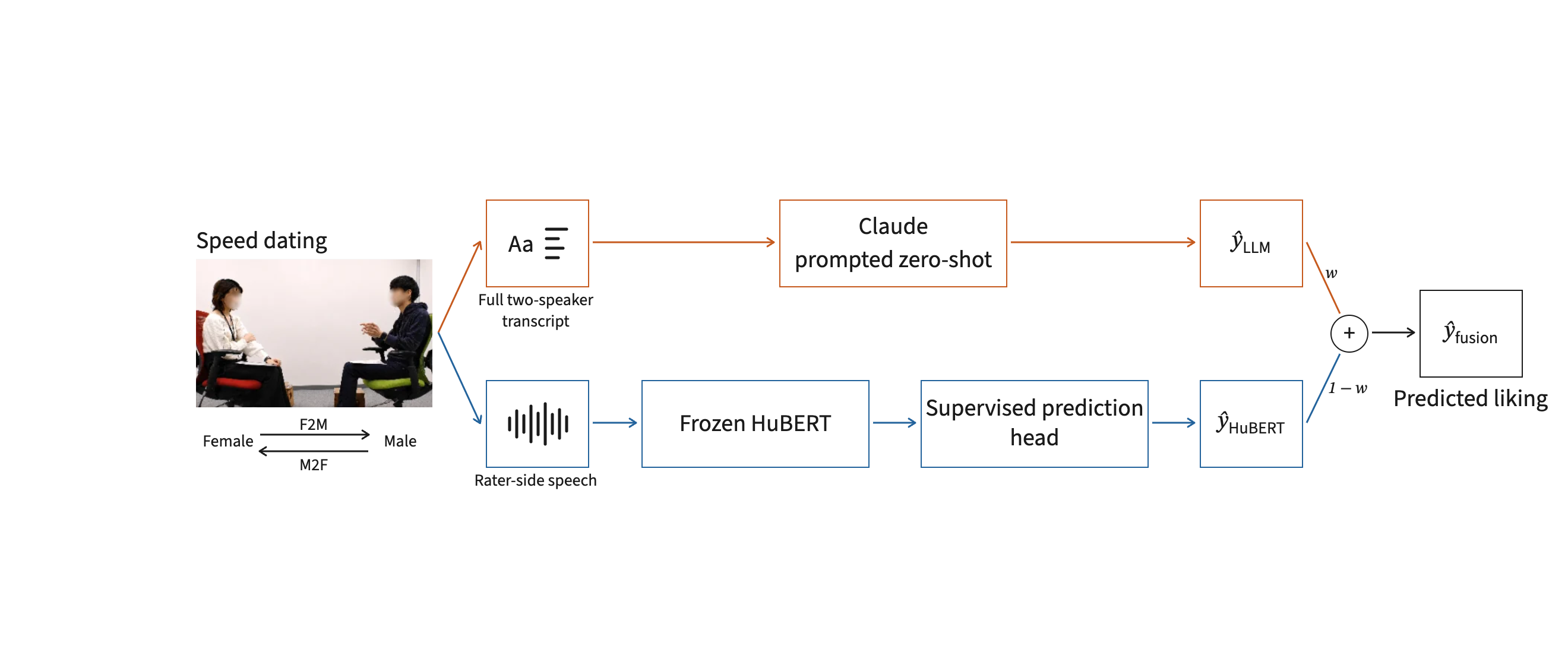
- Two kinds of AI “listeners”: 1) Text-only LLM: An advanced LLM (Claude Sonnet 4.6) read the full transcript (who said what, in order) and predicted the average liking score. 2) Voice-based model: A speech system (built on “HuBERT,” a pretrained audio model) “listened” only to the rater’s own voice during the conversation. It didn’t know the words; it focused on sound patterns like tone and rhythm. Think of it as paying attention to how someone speaks, not just what they say.
- Combining their guesses: The researchers used a simple mix-and-match approach called “late fusion.” Imagine two judges each giving a score; the final guess is a weighted blend of both scores. The blend weight was chosen using a careful validation process, not by peeking at the test answers.
- Fair testing: They tested on one group at a time (leave-one-group-out cross-validation) so the models were always evaluated on people they hadn’t seen during training.
- How success was measured:
- Per-person correlation (Pearson r): Does the AI’s pattern of who you liked more or less match your actual pattern?
- Pairwise accuracy: For every pair of your dates, did the AI correctly order which one you liked more?
- Top-1 accuracy: Did the AI pick your favorite partner?
They also tried multimodal LLMs (that take both text and audio directly), but mainly as a side comparison.
What they found
- Voice adds value—but not everywhere:
- Mixing the voice-based model with the text-only LLM improved pairwise accuracy (ordering who you liked more) in all tested settings. That means the combined system got better at telling which of two partners you liked more.
- Improvements in per-person correlation (the overall pattern match) were smaller and varied by situation; none were statistically significant after strict corrections. So, while ordering got better, the overall “shape” of a person’s likes wasn’t consistently stronger.
- When did voice help more?
- Voice signals helped more in the second round of dates (longer chats, with the same pairs meeting again). Longer or second-encounter conversations seem to let tone, pace, and other sound cues carry more useful information.
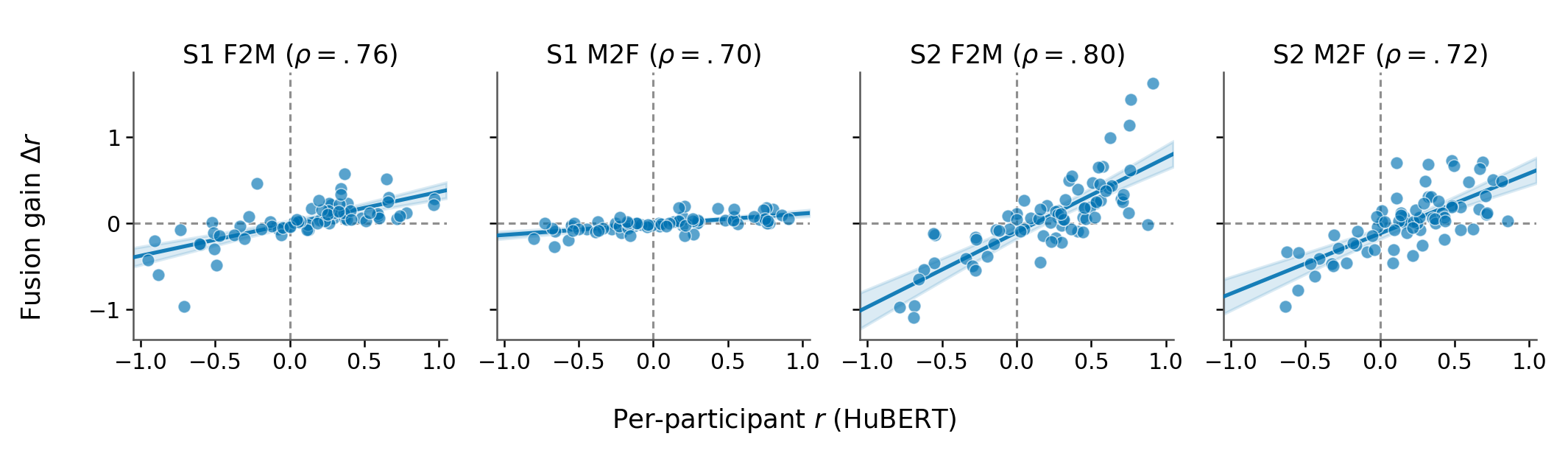
- People for whom the voice model did well also got larger benefits from combining voice with text. In other words, if the voice-based guess was strong for you, the blend helped you more.
- The two models notice different things:
- The text-only LLM and the voice model didn’t strongly overlap in what they captured. Each explained parts of the ratings that the other missed. That’s why blending them can help.
- Direct “all-in-one” AI wasn’t better here:
- Giving both text and audio straight to a multimodal LLM did not beat the strongest text-only LLM in this setup. The simple “two separate predictions + weighted blend” worked better for ordering partners.
- The text-only LLM was strong compared to standard supervised text baselines:
- The LLM that read transcripts outperformed several supervised text models trained specifically on this task.
Why this matters
- Big picture: Even when a powerful LLM reads the transcript, the sound of someone’s voice can still add useful clues about attraction—especially for ranking who someone liked more. This suggests that human feelings often show up not only in words, but also in how we speak.
- Practical angle: If we build tools to understand social interactions (for research, training, or coaching), it may help to combine transcript-based AI with voice-based AI. But we should expect uneven gains: voice won’t help equally for all people or all situations.
What this does not mean—and what’s next
- Not a matchmaking machine: The models’ accuracy is still modest. They’re not good enough to make dating decisions for people.
- Not one-size-fits-all: Voice helped more in some rounds and for some participants. Future systems might first check “Is the voice signal reliable here?” and turn it on or off accordingly.
- Future work:
- Understand why voice helps more in certain cases (longer talks? repeat meetings? certain speaking styles?).
- Try smarter ways to combine text and voice, and test on different cultures and settings.
- Consider privacy and ethics: voice is personal data, and predictions about attraction are sensitive.
In short: The study shows that voice can complement what AI learns from transcripts when predicting who liked whom on speed dates. The key is not just “Does voice help?” but “Where and for whom does it help most?”
Knowledge Gaps
Knowledge gaps, limitations, and open questions
Below is a concise, actionable list of what remains missing, uncertain, or unexplored in the paper.
Data, external validity, and measurement
- Generalizability beyond a single corpus, culture, and language is untested (Japanese, heterosexual dyads, headset-mic recordings, human transcripts); replication on other languages, demographics, recording conditions, and dating paradigms is needed.
- Impact of ASR errors is unknown; all LLM results rely on human transcripts. How robust are findings with realistic ASR transcripts (varying WER) and diarization noise?
- Session-2 effects conflate prior exposure to the same partner with longer interaction time; the design cannot disentangle these factors. Controlled experiments (e.g., counterbalanced durations, new vs. repeat partners) are needed.
- The liking criterion (Rubin’s scale) is immediate, self-reported, and translated; predictive validity for longer-term outcomes (mutual interest, follow-ups) and across translations remains unclear.
- Partner-level consensus vs. rater-idiosyncratic preference is not modeled; while an oracle consensus reference outperforms models, the study does not quantify how much of each model’s variance tracks consensus vs. idiosyncrasy nor leverage consensus priors during training.
Speech modeling scope and mechanisms
- Only rater-side audio is modeled; dyadic acoustic phenomena (e.g., entrainment, turn-taking dynamics, overlap, silence coordination, cross-speaker prosodic adaptation) are unexploited.
- HuBERT is pretrained on English (Libri-Light); potential language/domain mismatch for Japanese speech is unaddressed. Do Japanese-native SSL speech encoders (e.g., WavLM variants or Japanese-pretrained models) yield stronger or different complementarity?
- Acoustic feature attributions are absent; the study does not identify which prosodic or paralinguistic cues drive gains (pitch dynamics, energy, speaking rate, jitter/shimmer, spectral tilt, turn-level timing).
- Temporal structure is largely averaged (utterance-level pooling); fine-grained temporal modeling (frame-level encoders, sequence models capturing within-turn dynamics and cross-turn contingencies) is not explored.
- Robustness of speech-derived complementarity to channel variation (microphone differences, room acoustics), noise, and voice quality differences is untested.
Transcript modeling and prompt design
- Transcript-only LLMs are zero-shot with temperature 0 and item-wise scoring; the effects of few-shot examples, chain-of-thought, extended-thinking modes, Japanese-specialized LLMs, or prompt variants are unknown.
- Input mismatch: LLMs see both speakers’ transcripts, whereas the supervised speech model uses rater-only audio. A matched rater-only transcript condition is not evaluated, leaving the source of complementarity partially confounded.
- The paper does not examine whether LLMs exploit speaker-role information optimally (e.g., rater vs. partner role emphasis, turn structure cues) or whether structured dialogue markers improve prediction.
Fusion design and learning objectives
- Fusion is a global, scalar weighted average; no adaptive or per-participant/per-conversation gating is attempted. Can learned, context-aware fusion (mixture-of-experts, confidence-weighted or meta-learned gates) better capture when speech helps?
- Fusion weight is selected to maximize CCC, while the primary goal emphasizes within-participant ordering; optimizing directly for ranking metrics (pairwise accuracy/Top-1) or multi-objective fusion is unexplored.
- Anticipatory identification of “speech-helpful” cases is retrospective; no pre-hoc predictors or uncertainty estimates are proposed to forecast when to defer to speech vs. transcript.
- The study uses only late fusion; matched early-/intermediate-fusion architectures with shared encoders or cross-modal attention (beyond a single Sentence-T5+HuBERT comparison) are not systematically explored.
Multimodal LLMs (direct-input) comparison
- The direct-input MLLM setup uses mixed-mono audio and specific API constraints; benefits of richer audio conditioning (separate channels per speaker, diarization, higher-fidelity codecs, longer context windows) remain untested.
- Stronger or fine-tuned audio-text LLMs, and alignment strategies (e.g., contrastive pretraining with dyadic signals), are not evaluated; the negative result may reflect configuration limitations rather than a modality ceiling.
Evaluation and statistics
- Per-participant r improvements are not significant after correction; statistical power, variance components (between-rater heterogeneity), and sensitivity analyses for small effects are not fully characterized.
- Weight selection pools are “not strictly participant-disjoint”; although a control yields similar conclusions, a fully nested, leakage-safe CV design with fold-specific weight learning is not reported.
- Calibration vs. ranking trade-offs are not deeply analyzed; CCC is used for training/fusion, but post-hoc calibration (e.g., isotonic, Platt-style) and its effect on both CCC and ranking are unexplored.
- Baselines leveraging partner popularity (consensus priors) or simple mixed-effects models (rater/partner random intercepts) are not integrated as learning components or competitive predictive baselines.
Interpretation, fairness, and deployment
- Mechanistic interpretation is limited; low shared R2 suggests non-redundancy, but whether speech adds genuinely novel social signal vs. stabilizing noisy transcript predictions is unresolved.
- Gender asymmetries (F2M vs. M2F) appear in gains but are not analyzed for underlying causes (cultural norms, acoustic differences, interaction styles).
- Fairness across age groups, speech characteristics (e.g., regional accents), and other demographics is unexamined; no bias audits or subgroup analyses are provided.
- Practical deployment issues are unaddressed: privacy and consent for using voice to infer attraction, potential misuse, transparency to users, and on-device vs. server processing constraints.
Practical Applications
Immediate Applications
These applications can be prototyped or deployed today using the paper’s released code, off-the-shelf LLMs, and frozen speech encoders. They should be framed as decision-support and research tools rather than automated decision-makers because absolute accuracy remains modest and complementarity is conditional.
- Speed-dating event analytics and scheduling assist (sector: social platforms/events)
- What: Rank each participant’s partners after each round to prioritize second conversations or seat reassignments, leveraging the model’s stronger pairwise ordering (PW) gains.
- Tools/workflow: Transcribe sessions; run item-wise zero-shot LLM scoring on full transcripts; extract rater-side HuBERT embeddings; apply weighted score-level late fusion; output per-participant partner rankings and Top-1 candidates.
- Assumptions/dependencies: High-quality per-speaker audio and consent; Japanese-to-target-language domain shift needs quick validation; do not use as sole determinant for participant outcomes.
- Dating-app research and A/B testing (sector: consumer software)
- What: Evaluate whether product changes (prompts, ice-breakers, time limits) improve early-stage interpersonal attraction via per-participant ranking metrics; use speech–LLM fusion as a diagnostic to see when audio signals add value.
- Tools/workflow: Log consented audio/transcripts from in-app calls; compute PW and per-participant r; use fusion weight selection as a tuning knob; run pre/post or cohort A/B comparisons.
- Assumptions/dependencies: Clear user consent; privacy-preserving storage; short calls may reduce speech utility.
- Sales and customer success call coaching (sector: sales/CX)
- What: Triage and review early discovery calls by estimating rapport/liking to prioritize follow-ups; surface segments where vocal delivery likely helped/hurt.
- Tools/workflow: Transcripts to LLM item scores; rater-side (agent-side) speech to HuBERT; fusion to rank calls or moments; attention pooling highlights agent utterances linked to positive predictions.
- Assumptions/dependencies: Frame as coaching, not customer profiling; jurisdictional compliance for voice analytics; domain adaptation from dating to sales required.
- Interviewer training and hiring debrief support (sector: HR)
- What: Provide interviewer coaching on building initial rapport; compare interviewer styles across panels without automating selection decisions.
- Tools/workflow: Apply the same fusion pipeline to interviewer-side speech and full transcripts; report only aggregate, de-identified coaching insights.
- Assumptions/dependencies: Strong ethical guardrails; fairness monitoring; not used for candidate ranking.
- Telehealth and counseling supervision aids (sector: healthcare)
- What: Supervisors get an auxiliary signal of early rapport in first tele-sessions to focus supervision time; trainees receive feedback on prosody/turn-taking.
- Tools/workflow: Use transcripts plus clinician-side speech; generate session-level rankings relative to the clinician’s own caseload; inspect utterance-level attention for reflective practice.
- Assumptions/dependencies: Medical privacy/consent; model is not a clinical diagnostic; domain shift.
- Conversational product UX research (sector: software/UX)
- What: Rapidly benchmark prototypes of conversational agents (chat/voice) for “liking” and perceived connection in first-use sessions.
- Tools/workflow: Run zero-shot itemized LLM scoring; optionally add user-side speech via HuBERT; use PW to compare variants; log where speech adds incremental value.
- Assumptions/dependencies: Synthetic/ Wizard-of-Oz transcripts acceptable; speech benefit varies with session length/quality.
- Multimodal complementarity diagnostic for researchers (sector: academia)
- What: A lightweight, model-agnostic procedure to test whether audio adds value beyond transcript-only LLMs before investing in multimodal architectures.
- Tools/workflow: Reuse the paper’s late-fusion, cross-validated CCC weight selection; compute mutual incremental R² and per-participant Δr to localize complementarity.
- Assumptions/dependencies: Needs paired audio–text; modest sample sizes warrant cross-validation and calibration-sensitive loss (CCC).
- Standards and policy prototyping (sector: policy/ethics)
- What: Use the paper’s conditional gains and modest absolute accuracy as evidence in drafting consent language, inference-disclosure policies, and “no automated consequential use” guidelines for social inference from conversation.
- Tools/workflow: Publish risk summaries; define opt-in tiers for transcript vs audio use; require per-condition validation before deployment.
- Assumptions/dependencies: Multijurisdictional privacy laws; evolving LLM capabilities may alter risk/benefit.
- Personal conversation practice apps (sector: consumer/daily life)
- What: Private feedback on voice pacing/prosody and phrasing that correlate with positive first impressions during mock conversations.
- Tools/workflow: Local or cloud processing of user’s speech plus scripted partner; item-wise scores as reflective prompts; trends across sessions rather than single-shot judgments.
- Assumptions/dependencies: Strong privacy-by-design; clear disclaimers on limits and cultural variability.
Long-Term Applications
These ideas require further research, domain adaptation, stronger accuracy, fairness auditing, and/or infrastructure.
- Real-time facilitation in speed-dating and social audio (sector: social platforms/events)
- What: Adaptive time allocation, dynamic seat shuffling, or nudges during sessions based on evolving rapport signals.
- Future work: Streaming inference; latency-robust embeddings; on-device voice gating; uncertainty-aware fusion that “turns on” audio only when beneficial.
- Dependencies: Low-latency ASR and VAD; consent UX; continuous fairness and leakage testing.
- Cross-domain rapport estimation (sector: healthcare, education, HR, sales)
- What: Generalize from attraction to rapport/engagement in first encounters across domains (intake visits, teacher–student onboarding, interviews).
- Future work: Cross-lingual/cross-cultural datasets, domain adaptation, causal probes to separate partner-level consensus from rater-specific preference.
- Dependencies: Gold standards for rapport; outcome linkage (adherence, retention, satisfaction).
- Agent-assist that adapts prosody and content (sector: contact centers, robotics)
- What: Real-time assistants that modulate voice style and script based on predicted user liking to improve outcomes.
- Future work: Safe policy learning; closed-loop A/Bs; prosody controllability; human-in-the-loop oversight.
- Dependencies: Guardrails against manipulative behaviors; measurable business KPIs; robust audio pipelines.
- Multimodal LLMs that natively reason over rater-side audio (sector: foundation models)
- What: Architectures that directly fuse per-speaker audio streams with transcripts and reason about interpersonal states, outperforming simple T+A prompts.
- Future work: Speaker-conditioned encoders; better alignment for paralinguistic cues; pretraining objectives beyond ASR.
- Dependencies: Scalable, consented multimodal corpora; compute; evaluation benchmarks for conditional complementarity.
- Personalization and meta-fusion (sector: ML platforms)
- What: Learn per-user or per-context fusion weights using signals like session length, SNR, or speech-predictor confidence to decide when audio helps.
- Future work: Reliability estimation, calibration, and active learning; few-shot user adaptation.
- Dependencies: Longitudinal data; privacy-preserving personalization (federated/on-device).
- Fairness, bias, and governance frameworks for social inference (sector: policy/ethics)
- What: Standards to bound use of “liking/attraction” predictors and audits stratified by gender, language, culture, and disability.
- Future work: Impact assessments; red-teaming for social harms; explainability for prosodic contributors.
- Dependencies: Regulatory clarity; third-party auditing ecosystems; dataset documentation.
- Privacy-preserving deployment (sector: security/infra)
- What: On-device or edge inference for speech features; encrypted transcripts; ephemeral storage with verifiable deletion.
- Future work: Federated training, secure enclaves, differential privacy for embeddings.
- Dependencies: Mobile acceleration; acceptable latency–battery trade-offs.
- Research products and benchmarks (sector: academia/standards)
- What: Community benchmarks for “where does audio help?” using per-participant metrics, rank-distance PW, and mutual incremental R².
- Future work: Shared tasks across languages/domains; ablations on session length and prior exposure; causal probes for speech mechanisms (e.g., convergence).
- Dependencies: Curated, consented datasets with speaker-separated audio and validated scales.
- Consent-centered consumer features (sector: daily life)
- What: Opt-in “rapport diary” that tracks how changes in speaking style affect perceived connection across contexts.
- Future work: Robust on-personal-data models; user-controlled sharing; culturally adaptive feedback.
- Dependencies: Transparent UX; strong defaults; local processing.
Notes on key assumptions and dependencies across applications:
- Accuracy scope: The paper reports modest per-participant correlations and condition-dependent gains; use as assistive signal only.
- Data quality: Benefits rely on clean, rater-side audio and reliable transcripts; headset-quality capture is ideal in the study but rare in the wild.
- Generalization: Trained/evaluated on Japanese speed-dating; cross-lingual and cross-domain transfer must be validated.
- Consent and ethics: Explicit, revocable consent for voice analysis; avoid high-stakes automation; disclose inferred attributes.
- Robustness: Gains were stronger in longer, second-round conversations; short or noisy interactions may reduce audio complementarity.
- Model choice: Direct T+A prompts to current MLLMs did not consistently help; simple late fusion was a strong diagnostic baseline—model upgrades may change this calculus.
Glossary
- Additive attention pooling: A mechanism that learns weights to aggregate variable-length sequences by emphasizing informative elements. "frozen representations, additive attention pooling, and modality-specific regression heads."
- Audio-native models: Models that natively process audio inputs alongside or within an LLM to reason over sound directly. "audio-native models such as SALMONN integrate pre-trained speech and audio encoders with an LLM and let it reason over audio inputs directly."
- Bootstrap resampling: A statistical technique that estimates uncertainty by repeatedly resampling data with replacement. "brackets show 95\% CIs based on 2{,}000 participant bootstraps."
- Concordance correlation coefficient (CCC): A measure of agreement that combines correlation with penalties for mean and scale differences. "The supervised predictors are therefore trained on the concordance correlation coefficient (CCC)."
- Cronbach's alpha: A reliability coefficient that estimates internal consistency of a multi-item scale. "and the scale had a Cronbach's of ."
- Feature-level early fusion: Combining raw or intermediate features from multiple modalities into a single representation before prediction. "Multimodal fusion methods are conventionally partitioned into feature-level early fusion and score-level late fusion."
- Holm correction: A stepwise multiple-comparison procedure controlling familywise error rate. "Holm-corrected in each"
- HuBERT: A self-supervised speech encoder (Hidden-Unit BERT) used to extract robust audio representations. "The supervised speech predictor is built on frozen HuBERT-Large representations (hereafter HuBERT)."
- Incremental R2: The additional variance explained by adding one predictor beyond another in a regression model. "Incremental "
- J-LIWC: The Japanese adaptation of Linguistic Inquiry and Word Count, a dictionary-based text analysis tool. "the Japanese Linguistic Inquiry and Word Count (J-LIWC)"
- Leave-One-Group-Out cross-validation: A CV scheme that holds out all samples from one predefined group per fold for evaluation. "We evaluate predictions by 25-fold Leave-One-Group-Out cross-validation"
- Libri-Light: A large unlabeled speech corpus used for self-supervised pretraining. "a self-supervised speech model pretrained on Libri-Light"
- Likert scale: An ordinal rating scale commonly used in questionnaires with fixed-choice responses. "Each item used a 1--9 Likert scale"
- Macro-averaged: Averaging a metric across groups (e.g., participants) giving each group equal weight. "Aggregate PW (left) is macro-averaged across participants"
- Micro-averaged: Averaging computed over all individual items or instances, pooling across groups. "rank-distance bins (Near 1--2, Mid 3--5, Far 6+) are micro-averaged over all within-participant pairs"
- Mixed-mono input configuration: A single-channel audio mix made from multiple recordings for model input. "mixed-mono input configuration created from the two headset recordings."
- Multimodal fusion: Techniques for combining information from multiple modalities (e.g., text and audio) to improve prediction. "Multimodal fusion methods are conventionally partitioned into feature-level early fusion and score-level late fusion."
- Multimodal LLM (MLLM): An LLM that ingests and reasons over multiple modalities such as text and audio. "Two multimodal LLMs that receive transcripts and audio provide auxiliary direct-input comparisons."
- OLS (ordinary least squares): A linear regression method estimating parameters by minimizing squared errors. "solid lines and bands show OLS fits and 95\% CIs"
- openSMILE: A toolkit for extracting engineered audio features for speech and paralinguistic analysis. "The openSMILE predictor produces near-constant outputs for a majority of Session~1 raters."
- Pairwise accuracy (PW): The fraction of within-participant partner pairs whose predicted order matches the true order. "pairwise accuracy (PW), the fraction of same-participant partner pairs whose predicted order matches ground truth."
- Paralinguistic: Pertaining to non-lexical aspects of speech such as prosody and emotion. "paralinguistic tasks such as emotion recognition"
- Rank-biserial effect size: An effect size for paired nonparametric comparisons, related to the Wilcoxon signed-rank test. " is the rank-biserial effect size for the Fusion vs.\ Claude Wilcoxon signed-rank test."
- Rubin's Liking Scale: A 13-item psychometric instrument measuring interpersonal liking. "using a Japanese translation of the 13-item Rubin's Liking Scale"
- Score-level late fusion: Combining the final scalar outputs of separate models into a single prediction. "We combine their scalar predictions through weighted score-level late fusion"
- Self-supervised speech representations: Audio features learned without labels that transfer to downstream tasks. "frozen self-supervised speech representations, including HuBERT, have transferred effectively to paralinguistic tasks such as emotion recognition"
- Spearman rank correlation: A nonparametric correlation measuring monotonic association between ranks. "Panel titles report Spearman rank correlations of +0.76 and +0.70"
- Structured-output mechanism: An API feature enforcing constrained, structured model outputs (e.g., JSON with specific fields). "using each API's structured-output mechanism."
- Top-1 accuracy: The probability that the top-ranked prediction matches the top ground-truth item. "We also report per-participant Top-1 accuracy"
- Utterance-level early fusion: Fusion that concatenates or combines features at the utterance representation level before prediction. "reports score-level late and utterance-level early fusion as reference points."
- Voice activity detection (VAD): An algorithm for detecting speech segments and removing silence/noise. "silence removed via WebRTC voice activity detection."
- Weighted score-level late fusion: Late fusion that uses optimized weights to combine model scores. "We combine their scalar predictions through weighted score-level late fusion, as shown in Figure~\ref{fig:pipeline}."
- Wilcoxon signed-rank test: A nonparametric test comparing paired samples, often with rank-biserial effect size. "Wilcoxon signed-rank tests; rank-biserial --"
- Zero-shot prompting: Using an LLM on a new task without task-specific fine-tuning or examples. "We obtain them using zero-shot prompting"
- ZS-Fuse: A framework combining a zero-shot generalist model with a supervised specialist via fusion. "In ZS-Fuse~\cite{Kataria2026ZSFuse}, whose ``zero-shot large-scale model plus supervised specialist model'' structure parallels ours, the zero-shot branch is itself audio-driven rather than transcript-driven."
Collections
Sign up for free to add this paper to one or more collections.

